15-2 / S.-O. Jeon
• IMID 2009 DIGEST
Abstract
A high efficiency deep blue phosphorescent organic light-emitting diode (PHOLED) was developed using a new wide triplet bandgap host material (PPO1) with a phenylcarbazole and a phosphine oxide unit. The wide triplet bandgap host material was synthesized by a phosphornation reaction of 2-bromo-N-phenylcarbazole with chlorodiphenylphosphine. A deep blue emitting phosphorescent dopant, tris((3,5-difluoro-4-cyanophenyl)pyridine)iridium (FCNIr), was doped into the PPO1 host and a high quantum efficiency of 17.1 % and a current efficiency of 19.5 cd/A with a color coordinate of (0.14,0.15) were achieved in the blue PHOLED. The quantum efficiency of the deep blue PHOLED was better than any other quantum efficiency value reported up to now.
1. Introduction
A high quantum efficiency over 20 % has already been achieved in red and green PHOLEDs1,2.
However, it was difficult to develop high efficiency deep blue PHOLEDs because of poor performances of the wide triplet bandgap host and deep blue phosphorescent dopant materials. In particular, common wide triplet bandgap host materials suffer from poor charge balance because of unipolar charge transport properties.
In the previous work, our group studied the synthesis and device application of deep blue emitting tris((3,5-difluoro-4-cyanophenyl)pyridine) iridium (FCNIr) and reported a high quantum efficiency of 9 % and a color coordinate of (0.15,0.16)3,4. Wide bandgap host
materials are also critical to obtain high quantum
efficiency in deep blue PHOLEDs. The most well-known blue host material is N,N′ -dicarbazolyl-3,5-benzene (mCP) and it was effective as a host material in the deep blue PHOLEDs due to a wide triplet bandgap. However, mCP suffers from poor electron injection due to the lowest unoccupied molecular orbital (LUMO) of 2.4 eV and strong hole transporting properties of mCP material.
In this study, a new bipolar type wide triplet bandgap host material, 3-(diphenylphosphoryl)-9-phenyl-9H-carbazole (PPO1), was synthesized and we investigated the device properties of the deep blue PHOLEDs doped with FCNIr. A high quantum efficiency of 17.1 % with a color coordinate of (0.14,0.15) was demonstrated and this is the best efficiency value of blue OLEDs ever reported in the literature.
2. Experimental
The PPO1 was synthesized by the phosphornation reaction5 of the chlorodiphenylphosphine with
2-bromo-N-phenylcarbazole using nbutyllithium at -78oC followed by the oxidation with hydrogen
peroxide. The structure of device is indium tin oxide (ITO, 150nm)/ N,N'-diphenyl-N,N' -bis-[4-(phenyl-m-tolyl-amino)-phenyl]-biphenyl-4,4'-diamine (60 nm)/N,N'-di(1-naphthyl)-N,N'-diphenylbenzidine (20 nm)/ N,N'-dicarbazolyl-3,5-benzene (mCP, 10 nm)/PPO1:FCNIr (30 nm, 15 %)/2,9-dimethyl-4,7-diphenyl-1,10-phenanthroline (BCP, 5 nm)/tris(8-hydroxyquinoline) aluminium (Alq3, 20 nm)/LiF (1
nm)/Al (200 nm) and the structure of device II fabricated with 4,7-diphenyl-1,10-phenanthroline (Bphen) instead of BCP/Alq3 as shown in Figure 1.
High efficiency deep blue phosphorescent organic light
emitting diodes using a phenylcarbazole type phosphine
oxide as a host material
Soon Ok Jeon, Kyoung Soo Yook, Jun Yeob Lee* Dept. of Polymer Science and Engineering, Dankook University Jukjeon-dong, Suji-gu, Yongin-si, Gyounggi-do, 448-701, Korea
Phone: 82-31-8005-3585, E-mail: [email protected]
Keywords: deep blue phosphorescent organic light emitting diodes, phosphine oxide, high efficiency
15-2 / S.-O. Jeon
IMID 2009 DIGEST • Figure 1. The chemical structures and the devices structures of blue PHOLEDs.
Prior to device fabrication, indium tin oxide (ITO) with a resistance of 10 Ω/□ on glass was patterned as an active area of 4 mm2 (2 mm x 2 mm) square. The substrates were cleaned by sonication in deionized water, boiled in isopropyl alcohol for 20 min, and dried with nitrogen. Finally, the substrates were dry cleaned using UV ozone treatment for 10 min and were transferred to an evaporation chamber. Organic layers were deposited sequentially by thermal evaporation from resistively heated quartz crucibles onto the substrate an a rate of 1.0 Å/s. LiF was deposited at a rate of 0.1 Å/s and Al was evaporated at a rate of 5.0 Å/s. After the evaporation chamber was vented with nitrogen gas, the device was immediately transferred to a glove box upon fabrication. An adhesive was applied from a syringe around the edge of a clean cover glass. To complete the package, a clean cover glass was placed on the top of the device. The epoxy resin was cured under intense UV radiation for 6 min.
Current(I)–voltage(V)–luminance(L) characteristics and electroluminescence (EL) spectra of the devices were measured with Keithley 2400 source
measurement unit and CS 1000A spectrophotometer. 3. Results and discussion
The PPO1 synthesized in this work was designed to get high triplet energy from phenylcarbazole moiety and good electron transport properties from phosphine oxide group. Cabazole unit is high triplet band gap and molecular structural stability. UV–vis absorption and emission spectra of PPO1 were measured in diluted solution. The absorption spectrum of PPO1 exhibited 291, 326 and 339 nm and the emission peak shows at 365 nm. The triplet emission peak at 410 nm that calculated triplet energy level of PPO1 was 3.02 eV. The thermal properties of PPO1 were investigated differential scanning calorimetry (DSC). The results obtained Tg at 74.4oC and Tm at 201oC, respectively. The triplet band gap of the PPO1 was 3.02 eV and it was wider than that of the FCNIr with a triplet bandgap of 2.8 eV. Therefore, the energy transfer from the PPO1 host to FCNIr can be efficient. In addition, the PPO1 host has bipolar charge transport characteristics for balance charge injection because
15-2 / S.-O. Jeon
• IMID 2009 DIGEST
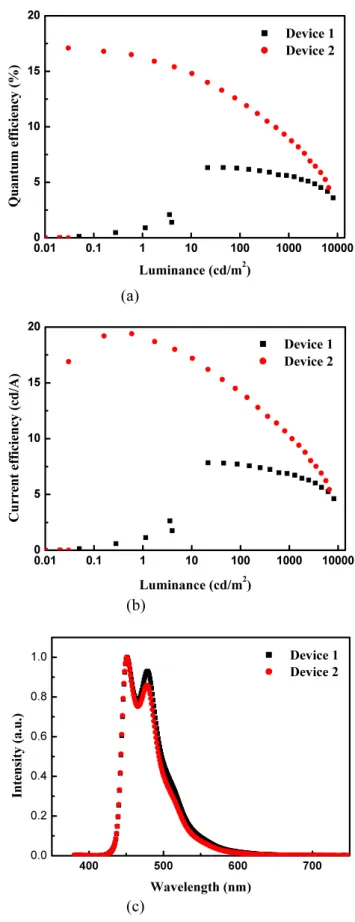
the PPO1:FCNIr emitting layer showed a blue emission peak at 454 nm with a shoulder at 482 nm (Figure 2(c)). Therefore, a deep color coordinate of (0.14, 0.15) was obtained in the deep blue PHOLED with the PPO1:FCNIr emitting layer.PHOLEDs were plotted in figure 2 (A) and (B). A high quantum efficiency of 17.1% and a color coordinate of (0.14, 0.15) could be effectively obtained using a new PPO1 as a host material. The efficiency of device II was doubled by using 4,7-diphenyl-1,10-phenanthroline (BPhen) instead of BCP/Alq3 as an electron transport
material due to improved charge balance in the emitting layer. Device II showed a maximum quantum efficiency of 17.1% and a quantum efficiency of 12.3% at 100 cd/m2. The current efficiency at 100
cd/m2 was 14.4 cd/A and the maximum current
efficiency was 19.5 cd/A in this blue PHOLED with PPO1. The blue PHOLED with hole transporting carbazole unit and electron transporting phosphine oxide unit. HOMO/LUMO energy gap for PPO1 was estimated as ca. 3.56 eV and the HOMO and LUMO energy levels of PPO1 were determined to be 5.94 eV and 2.58 eV, respectively. Device performances of the deep blue PHOLEDs of PPO1 are shown in table 1.
Table 1. Device properties of the deep blue PHOLEDs with PPO1
Device Max QE QE [a] Color[b] Max CE
Device I 6.3 % 6.2 % (0.14,0.17) 7.8 cd/A
Device II 17.1 % 12.3 % (0.14,0.15) 19.5 cd/A
QE : quantum efficiency, CE : current efficiency [a] Quantum efficiency was measured at 100 cd/m2
[b] Color index was measured at 100 cd/m2
The maximum quantum efficienc of 17.1 % was obtained in the device II and a deep blue color coordinate of (0.14, 0.15) was achieved in the deep blue PHOLED with PPO1 as a host materials. The maximum quantum efficiency of 17.1 % in deep blue PHOLEDS reported in the literature.
4. Summary
A high quantum efficiency of 17.1% and a current efficiency of 19.5 cd/A with a color coordinate of (0.14,0.15) were achieved in the deep blue PHOLEDs by using a new PPO1 high triplet energy host material. This is the world record for the quantum efficiency of deep blue OLEDs with color index x and y values less than 0.15. This work is important because the problem of low efficiency of the deep blue PHOLEDs was solved using a new host material and we showed the
possibility for the 100% internal quantum efficiency in the deep blue OLEDs.
0.01 0.1 1 10 100 1000 10000 0 5 10 15 20 Qu an tum ef fic ien cy (% ) Luminance (cd/m2) Device 1 Device 2 (a) 0.01 0.1 1 10 100 1000 10000 0 5 10 15 20 Device 1 Device 2 C ur re nt e ff ic ie nc y (c d/ A ) Luminance (cd/m2) (b) 400 500 600 700 0.0 0.2 0.4 0.6 0.8 1.0 Device 1 Device 2 In te ns ity (a .u .) Wavelength (nm) (c)
15-2 / S.-O. Jeon
IMID 2009 DIGEST • Figure 2. (a) Quantum efficiency-luminance curve,
(b) Current efficiency-luminance curves and (c) EL spectra of the deep blue PHOLEDs used in PPO1.
Acknowledgements
This work partially supported by the GRRC program of Gyeonggi province [GRRC Dankook 2009-B01, Materials development for high efficiency organic solid state lighting], grant No. RTI04-01-02 from the Regional Technology Innovation Program of the Ministry of Knowledge Economy (MKE), MKE/ITEP [10028439-2008-21], and a grant (M2009010025) from the Fundamental R&D Program for Core Technology of Materials funded by the MKE.
5. References
1. C. Adachi, M. A. Baldo, M. E. Thompson, S. R. Forrest,
J. Appl. Phys., 90, 5048 (2001).
2. S.-J. Su, D. Tanaka, Y.-J. Li, H. Sasabe, T. Takeda, J.
Kido, Org. Lett., 10, 941 (2008).
3. S. H. Kim, J. Jang, S. J. Lee, J. Y. Lee, Thin Solid Films, 517, 722 (2008).
4. K. S. Yook, S. O. Jeon, C. W. Joo, J. Y. Lee, Org. Electron., 10, 170 (2009).
5. A. B. Padmaperuma, L. S. Sapochak, and P. E. Burrows, Chem. Mater. 18, 2389 (2006)