
Relations in the aftermath of the NK nuclear test Chapter 3 The impact of the North Korean nuclear test. Two of them dealt with directions on North Korea policy in the wake of the nuclear test, two with the impact of the North Korean nuclear test on the ROK‐U.S. This contributes to the ROK government's efforts to shape policy on unification and North Korea.
The Korean government will not tolerate North Korea's possession of nuclear weapons, and it is the government's firm position that the North's weapons program must be abolished. 2A more detailed description is found in Kun Young Park, "A Strategic-Pragmatic Approach to North Korea: Policy Recommendations for Resolution of the North Korean Nuclear Disputes," manuscript (2005). Speed up the law enforcement process regarding North Korea's alleged illegal activities and reduce the burden of confession by the North.
What is clear, however, is that the recent missile and nuclear tests by North Korea mean that US North Korean policy A Strategic-Pragmatic Approach to North Korea: Policy Recommendations for Resolution of the North Korean Nuclear Disputes.
S. Engagement with North K orea
To judge from its past statements, it is likely that North Korea would take the position that if the United States abandoned its hostile stance, the North Koreans would do the same, and between friends there should be no need for verification. In August 2003, KCNA claimed that “the only thing the DPRK wants is the conclusion of a non-aggression treaty.”19 However, according to other North Korean statements, there is much, much more. The six-party talks continue so that neither side appears to be abandoning diplomacy, but if the United States decides to strike a deal, the motivation will lie in domestic politics, not the expectation that North Korea's nuclear weapons can be eliminated in true.
20Quoted in Kimberly Ann Elliott, “The Role of Economic Leverage in Negotiations with North Korea,” Nautilus Special Report, April 1, 2003, at http://www.nautilus.org/fora/security/0326A_Elliott.html. Sanctions under UN Resolution 1718, adopted after North Korea's nuclear test, add little to already existing sanctions unless individual countries choose to interpret the resolution harshly, which no country other than Japan is likely to do. Likewise, North Korea's immediate neighbors have shown through their actions and statements that they would rather live with a nuclear North Korea than risk causing a collapse of the Kim regime or a new Korean War.
The engagement has demonstrably failed to stop North Korea's nuclear weapons program and significantly change the nature of the Kim regime. How dangerous a nuclear North Korea is, and how important it is to alleviate the suffering of ordinary North Korean people, must be weighed against the value of today's peace and regional status quo. Hassig, "Guessing Right and Guessing Wrong about Engagement," The Journal of East Asian Affairs, Spring-Summer 2001, p.
The Role of Economic Leverage in Negotiations with North Korea." Nautilus Special Report, April 1 at http://www.nautilus.org/fora/security/0326A_. Korea and the Myth of 'Cloning' the German 'Unification Model'." Korea and World Affairs, Vol. The Great Transition Debate.” The Journal of East Asian Affairs, Volume XVII, Number 2 (Autumn/Winter), p.
Guessing right and guessing wrong about engagement.” The Journal of East Asian Affairs, Spring-Summer, p.
Part Ⅱ
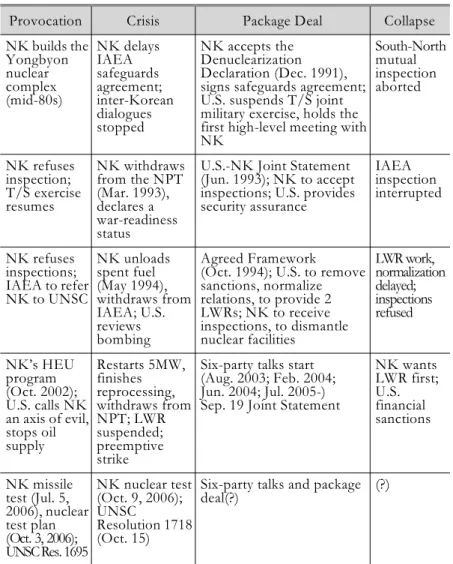
Since then, the six-party talks process has almost completely stalled until North Korea reignited the crisis with missile tests on July 5 and a nuclear test on October 9 this year. North Korea's nuclear test and UN Security Council sanctions facilitated the resumption of the six-party talks, with the US demanding, for example, the immediate CVID (complete, verifiable, irreversible dismantling) of North Korea's nuclear programs; on the other hand, North Korea asked for the provision of LWR and diplomatic normalization before the possible concrete implementation of the agreed terms.
However, we can also note that we could have prevented North Korea's provocations if America's Seoul had made clear its "intolerance" toward North Korea's nuclear armament in its three-point principle for the peaceful resolution of the nuclear issue. Third, the United States and North Korea should engage in bilateral dialogue, both within and outside the six-party talks.
Most North Korea watchers are pessimistic about the prospects for the six-party talks because of the confrontational relationship between the US. First, the current state of the North Korean nuclear problem is marked by two particular events; these are North Korea's nuclear test and UN Security Council sanctions against the North. In the 1990s, when North Korea failed to enforce either the Inter-Korean Declaration on Denuclearization or the US-DPRK Framework Agreement, Washington.
More recently, after the nuclear test, China was instrumental in pushing North Korea back to the negotiating table. Measures to be taken by North Korea and the United States must be taken on a strictly reciprocal basis. The following is a road map for the denuclearization of North Korea and the creation of a peace regime on the Korean Peninsula.9.
President Bush apparently never seriously considered using the military option against North Korea's nuclear program. There are likely some in the Bush administration who would not be displeased if there was regime change in North Korea. Despite the great challenges and frustrations caused by North Korea's nuclear program, the "separation" between the U.S.
Part Ⅲ
Introduction 7
The Bush administration also did not consider the development of nuclear weapons in North Korea as a problem, which will make the United States review the past, present and future of issues related to the development of nuclear weapons in North Korea in the new framework of Northeast Asian international relations. . The ROK, the US and China apparently agree on zero tolerance for North Korea's nuclear weapons program.
China still believes that the core problems of North Korea's nuclear weapons development should be resolved between the US decision to deepen adjustment to North Korea, even though the progress of nuclear weapons development has contributed to widening this gap.6. North Korea's detonation of a nuclear weapon has provided several opportunities to reaffirm old differences between South Korea and the US.
Both countries "stayed on course". South Korea was more worried about Japan's "opportunistic" military expansion and American overreaction than North Korea's nuclear weapons development. A definitive solution to the North Korean nuclear challenge, based on deep Chinese involvement, will be profound. Now Japan finds itself in a situation where the United States, the supposed protector of Japan, is busy with Iraq and unable to effectively counter the North Korean challenge.
South Korea may decide to continue or even expand economic cooperation with a nuclear North Korea. If Japan sees South Korea as tolerant of North Korea's nuclear weapons and moves closer to China, Japan's nightmare would intensify. Japan would expand armaments and prepare for independent strike capability against North Korea's weapons of mass destruction.
China's Role During North Korea's Transition.” A New International Engagement Framework for North Korea?: Contending Perspectives.
Introduction 1 2
The role of the United States in the future of Northeast Asia in the wake of. On the other hand, since the US has the capacity to retaliate with force beyond anyone's wildest nightmares, and which the North is well aware of. So, except in the most extreme circumstances - or unless they are attacked first, no leader in the ROK or the US would seriously consider attacking the North, and one has to believe that the same is true of the leadership in Pyongyang.
So one conclusion I would draw is that on such matters as the US extended nuclear deterrence, if anything the North's nuclear test does the US. That is, it is critical in this situation, regardless of one's current assessment of where the North is at the level of delivery capability, to credibly assure US allies in the region that an attack of any kind on them would be met with a firm and immediate US with Japan, a combination of factors, including most immediately the North Korean nuclear issue but also the uncertainty introduced by China's rise, has led to a strengthening of the alliance relationship with the US over the past decade.
So while North Korea's nuclear test may not have changed the foundations of the military balance, it could help provide the basis for some necessary course corrections by getting people to think about the larger value of the alliance. The North may have been wrong, however, to fail to see the degree to which this pushed China to the brink of deciding to take steps that could actually risk instability in the DPRK. China's unprecedented support for two UN Security Council resolutions condemning North Korea in four months (and it is possible that the first such instance – since July's missile tests – had some influence on North Korea's decision to proceed with a nuclear test) signals an important new dynamic in the game.
That's not to say we shouldn't seek substantial steps from the North early on, and those reported in the press seem sensible. The North's nuclear test should be a reminder that it's not that hard to build a bomb, and while the North Korean issue may be geographically isolated, at least for now, the example we've set in dealing with it and trying to deny it will reverberate elsewhere. In summary, North Korea's nuclear test has so far had no adverse effects on the United States.
The Role of the United States in the Future of Northeast Asia Ahead of North Korea's Nuclear Test".
