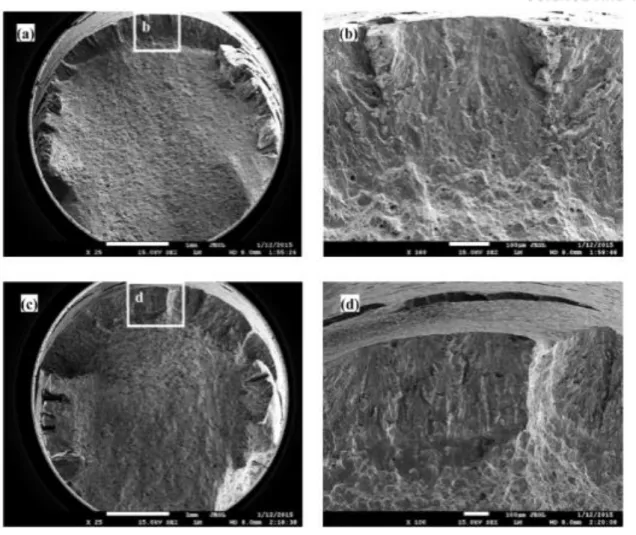
64 Figure 4.7 Potentiodynamic polarization curves for CR316L and SA316L in 5 and 500 ppm chloride concentration solution at 90°C. 68 Figure 4.9 SEM images of pitting in CR316L (left) and SA316L (right) after electrochemical testing in 5 and 500 ppm chloride concentration solutions at 90°C.
Introduction
Motivation of research
SCC affected by various factors such as sensitized grain boundary of metals, high residual stress applied due to welding or bending and corrosive water environment etc. High residual stress during the sinking process is often treated as the key factor causing SCC in this part.
![Figure 1.1 Location and microstructure of SCC observed in pressurizer heater sleeves (316L stainless steel) [1.2]](https://thumb-ap.123doks.com/thumbv2/123dokinfo/10497619.0/17.892.142.761.148.617/figure-location-microstructure-observed-pressurizer-heater-sleeves-stainless.webp)
Objective
Literature study
Stress corrosion cracking
Cold work effect on stress corrosion cracking
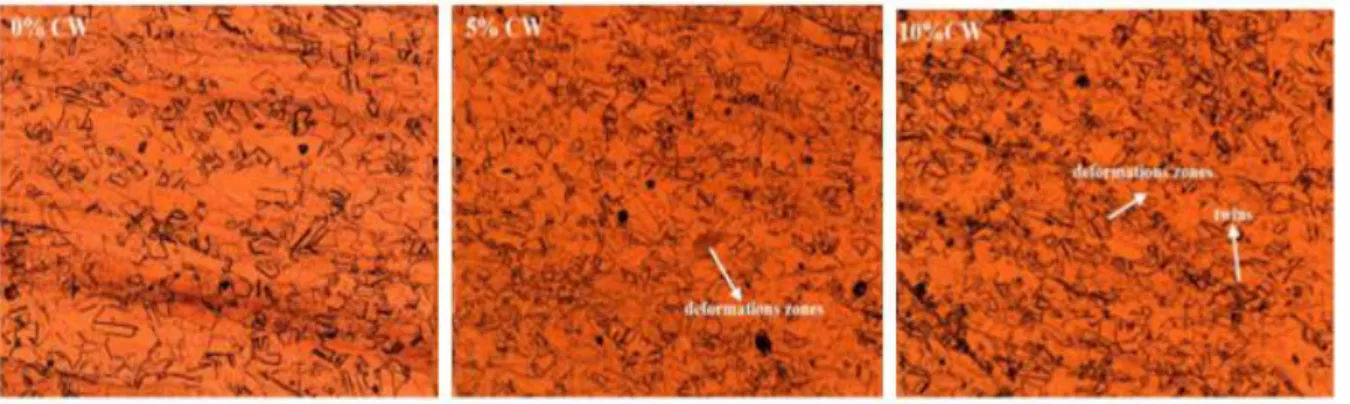
- Microstructure
- Phase and residual stress
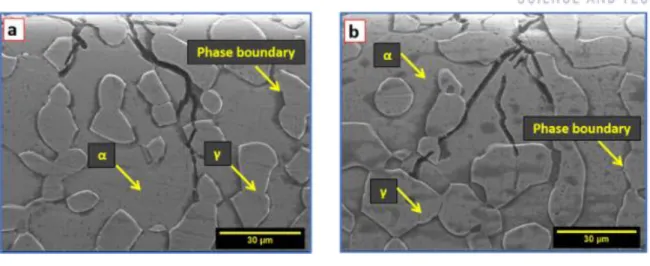
The cold working causes changes in phase, roughness, residual stress and grain sizes, resulting in complex characteristic changes in the surface layer. It can be deduced that most of the cracks pass through the ferrite phase in the chloride environment.
![Figure 2.3 OM image of ( a) solution-treated and (b) cold drawn 316 austenitic stainless steel showing the difference caused by cold working [2.3]](https://thumb-ap.123doks.com/thumbv2/123dokinfo/10497619.0/26.892.116.764.129.387/figure-solution-treated-austenitic-stainless-showing-difference-working.webp)
Chloride effect on stress corrosion cracking
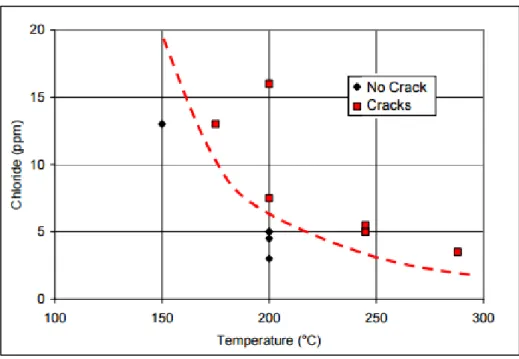
IGSCC occurred at a concentration of 4 ppm, and IGSCC and TGSCC occurred together at a concentration of 11 ppm. Based on these results, the crack shape changes from IGSCC to TGSCC as the chloride concentration increases.
Experimental
Material
As shown in Figure 3.2, the yield strength of corrugated stainless steel 316L was 689 MPa. As shown in Figure 3.3, the fracture surface of these two materials showed a typical cup-and-structure structure, indicating that ductile fracture occurs during the tensile test. The reduction rate of the 21% thickness reduction material has the most similar yield strength to the target heating sleeve material.
As shown in the figure, the yield stress of the specimen with cold rolling was up to 21,705 MPa, which was similar to that of stamped material, which was 689 MPa. The yield stress of solution annealed after 20% cold rolling was 256 MPa, which is most similar to the yield stress of the sample solution annealed after forging, 263 MPa. As shown in the Table 3.2, yield stress of heater sleeve and simulated material was almost similar in 3% of error range.
In the microstructure, which is shown in Figure 3.7 and Figure 3.8, the grains are elongated due to cold rolling, but have similar grain sizes with smooth heating sleeves before and after solution annealing. The yield stress of the cold-rolled specimen at 21 was 705 MPa, which was similar to that of the swaged material, which was. The yield stress of both materials was in a similar range, so the simulated plate material was well fabricated and could represent the tube heater.
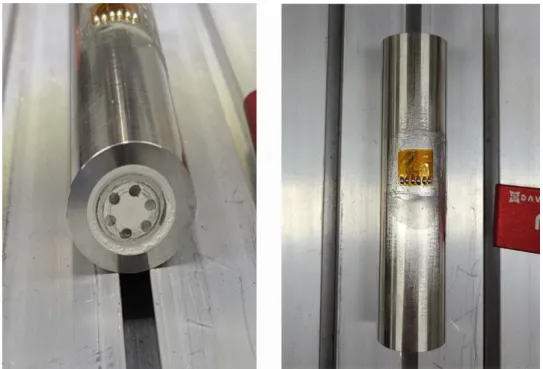
Sample preparation
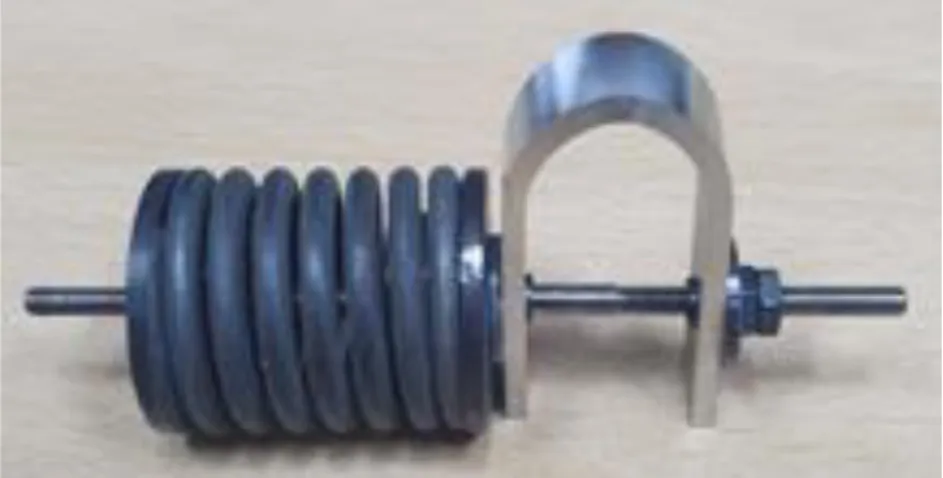
To load the U-bend sample into the autoclave, a structure was produced as shown in Figure 3.11. The structure is built to safely mount 8 U-bend samples in 1 liter autoclave without any additional force applied to the sample.
Stress corrosion cracking experiment
- Experimental facility
- Water chemistry condition
Also, other previous studies also report that Incoloy 800H has superior corrosion resistance in a chloride-containing environment. Therefore, Incoloy 800H was chosen as construction material for autoclave and ports for thermocouple or other things. Test solution that can simulate normal primary water environment near the heat reservoir of the pressurizer was set to follow the EPRI PWR primary water chemistry guideline.
Currently, chloride is regulated at less than 1.5 ppm in primary water environments in accordance with the EPRI primary water guideline (Table 3.6). 3.10] Since there is possibility of chloride in primary circuit of PWR, and its measured value was 5.28 ppm, the chloride concentration in this study was set at 5 ppm. Meanwhile, 5 ppm chloride concentration may be too low to cause significant results in a short time.
Therefore, for accelerated case, 500 ppm chloride concentration with inverted U-bend sample was selected as another case for experiment. Samples were placed in internal structure and first assembled in the autoclave, then chloride containing primary water was poured into the autoclave. After the test for certain period, U-bend samples were taken out of the autoclave and surface of each sample was observed with stereoscope.

Electrochemical potentiodynamic polarization test
As shown in the figures, many small peaks in the passive region were observed in CR316L polarization curves performed at a chloride concentration of 500 ppm. Based on the results, it is expected that large and deep pits will be formed in CR316L at a chloride concentration of 500 ppm. Corrosion potential (Ecorr) and corrosion current density (Icorr) derived from potentiodynamic polarization curves during 0, 5 and 500 ppm chloride concentration are summarized in Tables 4.2.
From the Table 4.2 and Figure 4.7, CR316L in 500 ppm chloride concentration has the highest Icorr (corrosion current density) and lowest Ecorr (corrosion potential) which may mean that CR316L has the lower corrosion resistance in this environment. CR316L in 500 ppm chloride concentration has the highest Icorr (corrosion current density) and lowest Ecorr (corrosion potential) that can mean. According to the Figure 4.7 which is curve of polarization test, CR316L in 500 ppm chloride concentration has the lowest EPit of 0.788V.
And the difference was greater in results of both samples tested in 500 ppm chloride concentration. Since CR316L in 500 ppm chloride concentration has the highest fraction of dark area, it is expected to have the lowest SCC initiation resistance. This indicates that SA316L is more damaged in 500 ppm chloride concentration than in 5 ppm.
Result of the polarization test at a chloride concentration of 5 ppm and 500 ppm shows that the cold rolled material in 500 ppm chloride concentration solution is the most corrosive based on the lowest values of corrosion potential and highest values of corrosion current density. This observation indicates that the combination of chloride concentration and cold working level should be considered when investigating the chloride-induced SCC in stainless steel.
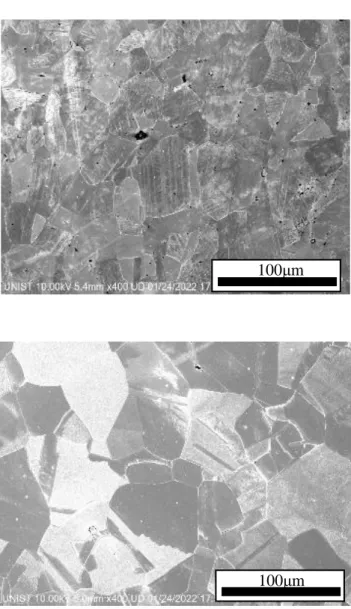
Mircostructure analysis
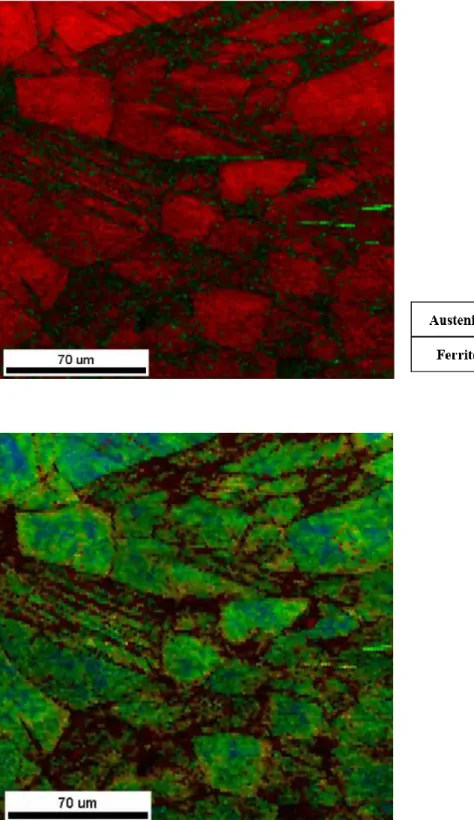
EBSD analysis
Since EPit is the point where the passive layer dissolves and the stable pitting starts to occur, we can know that the destruction of the passive oxide layer of CR316L was accelerated as the concentration of chloride increased and the passive oxide layer of SA316L was not damaged at the same chloride layer. concentration. Therefore, it can be concluded that CR316L is more sensitive to corrosion than SA316L and that its corrosion increases as the chloride concentration increases. Metastable pitting corrosion and stable pitting corrosion were most often observed in bends of cold-rolled material with a chloride concentration of 500 ppm, and SEM images to confirm this after the test also showed many traces of pitting corrosion in cold-rolled material than in solution annealed materials.
This means, as cold roll reduction rate and chloride concentration increase, the SCC susceptibility also increases. In conclusion, through this study it was expected that SCC would occur above a certain chloride concentration level in cold-worked 316L stainless steel in the primary environment of PWR. The experiment showed that the SCC or pit corrosion may not be observed at a chloride concentration level of 5 ppm, which is three or more times higher than the regulatory concentration of chloride of 1.5 ppm in the current primary water environment.
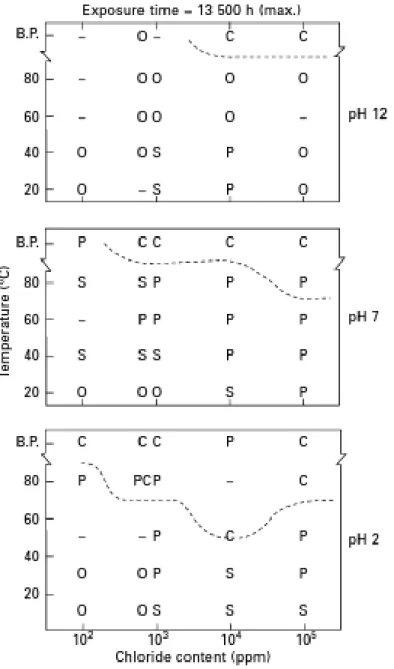
However, chloride-induced SCC has already been observed in the actual operation of nuclear power plants, which means that chloride concentration at cracks may be higher than expected. As investigated in this study, pitting corrosion and large oxide film damage can occur in cold-worked 316L stainless steel when exposed to concentration higher than 500 ppm. Truman J E (1977), 'The influence of chloride content, pH and temperature on the occurrence of stress corrosion cracking with austenitic stainless steels', Corrosion Sci.
Electrochemical electrodynamic polarization test
- Pitting corrosion in potentiodynamic polarization curve
- Result of potentiodynamic polarization test
Stress corrosion crakcing test
The mechanism of stress corrosion cracking initaion by chloride ion and cold rolling
Conclusion
By microstructural investigation more twin structure and deformation zone in cold rolled and corrugated material than solution annealed material. So the dual structure and local deformation zone affect SCC and cold rolled material is vulnerable to SCC than solution annealed material. Since residual stress has been recognized as one of the most important factors causing SCC, it is expected that cold-rolled material that has a relatively high residual stress will overcome SCC more quickly.
And based on the corrosion current density obtained, the corrosion rate at 500 ppm is expected to be about three times faster than 5 ppm. Thus, the more stable pitting can be found in cold-rolled materials, where the passive film dissolves relatively quickly, and it occurs relatively often when the concentration of chloride, which destroys the passive film, is high. And through the SEM image and EDS analysis of the U-bend sample surface, more damaged oxide layers exist in cold-rolled samples than in solution-annealed ones.
Therefore, more research is needed to understand the distinct mechanism of initiation of chloride-induced SCC in different amounts of chloride-containing primary water environments. Meanwhile, both pitting and oxide damage were not severe in both 5 ppm and solution annealed tests. SCC would not be initiated at too low a chloride concentration or during cold work.
Kain, “Microstructural changes in AISI 304L stainless steel due to surface machining: effect on susceptibility to chloride stress corrosion cracking,” J. Arunachalam, “Effect of machined surface integrity on the stress corrosion cracking behavior of super duplex stainless steel,” Eng . For “Chloride-Induced Stress Corrosion Cracking Potential in Dry Storage Containers for Spent Nuclear Fuel,” the U.S.
Pak, “Stress Corrosion Cracking Behavior of Cold Worked AISI316L Stainless Steel in Chloride Environment”, pp. Couvant et al., “Effect of chlorides and sulfates on the EAC of austenitic stainless steel in PWR environment,” Can. Goméz-Briceño, “Effect of yield strength on stress corrosion crack propagation under PWR and BWR environments of hardened stainless steel,”. 4.7] A.Turnbull et al., "Sensitivity of stress corrosion cracking of stainless steel to surface finishing and grinding procedure", Corros.
N, "A Comprehensive Investigation on the Effect of Flooding and MQL Coolant on the Machinability and Stress Corrosion Cracking of Super Duplex Stainless Steel," J. Zhang, "A Research on the Corrosion Susceptibility and Stress Corrosion Cracking of 316L Stainless Steel exposed to supercritical effects. water", Corros. I would like to convey my gratitude to the friends.
![Figure 1.2 Locations of pressurizer heater sleeves and various other components in primary system of PWR [1.4]](https://thumb-ap.123doks.com/thumbv2/123dokinfo/10497619.0/20.892.143.759.159.562/figure-locations-pressurizer-heater-sleeves-various-components-primary.webp)
![Figure 2.2 The difference in the shape of the crack between IGSCC (left) and TGSCC (right) [2.2]](https://thumb-ap.123doks.com/thumbv2/123dokinfo/10497619.0/24.892.127.786.129.369/figure-difference-shape-crack-igscc-left-tgscc-right.webp)