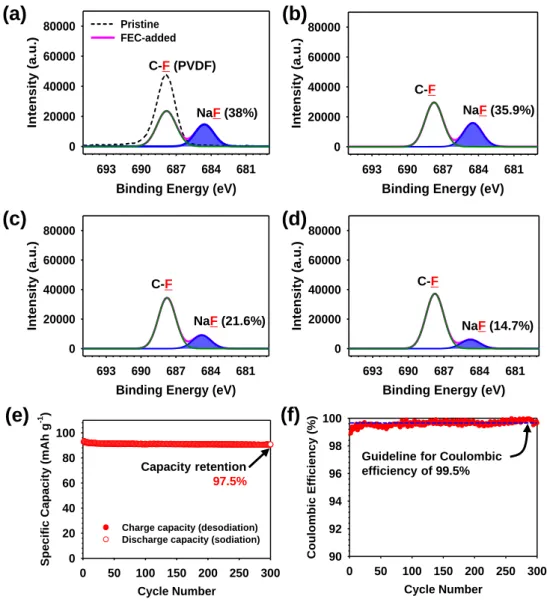
C 1s core level of Na metal plated on a Cu substrate with 1 M NaFSI-FEC and 1 M NaFSI-VC. The initial Na plating was performed at 0.28 mA cm-2 and the surface capacity used of the Na metal electrode was 2.82 mAh cm-2.
Introduction
Na metal batteries
Li metal batteries
In Chapter IV (Fluorine-enriched interfaces enhance the cycling stability of 4 V class Li metal batteries in ether-based electrolytes), we show that the use of concentrated electrolytes containing 1,1,2,2-tetrafluoroethyl-2, 2,3, 3-tetrafluoropropyl ether (TTE) as a co-solvent and FEC as an additive allows homogeneous and reversible reactions in Li metal anodes and results in improved anodic stability in high-capacity Ni-rich cathodes with cut-off charging voltages > 4 V vs. Furthermore, we suggest a mechanistic explanation for how TTE-induced solid electrolyte interphase formation preserves the electrochemical reversibility of Li metal and use cross-sectional imaging to rationalize the ability of FEC to maintain the mechanical integrity of the rich cathode .
Highly stable linear carbonate-containing electrolytes with fluoroethylene carbonate for high-
Introduction
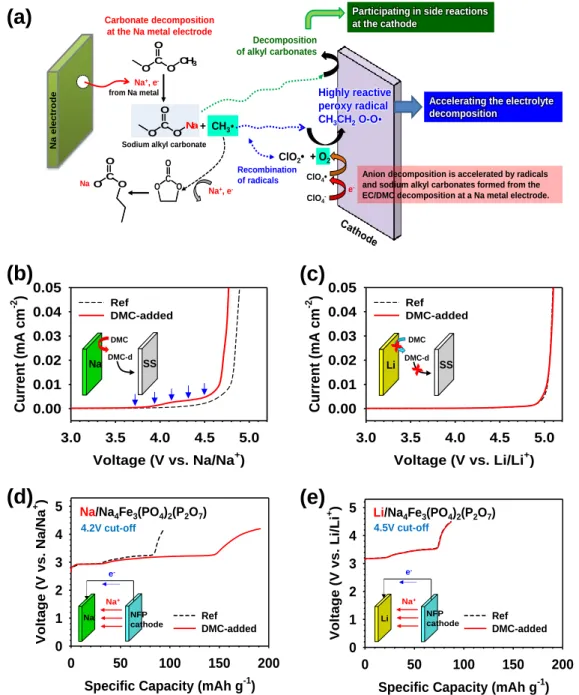
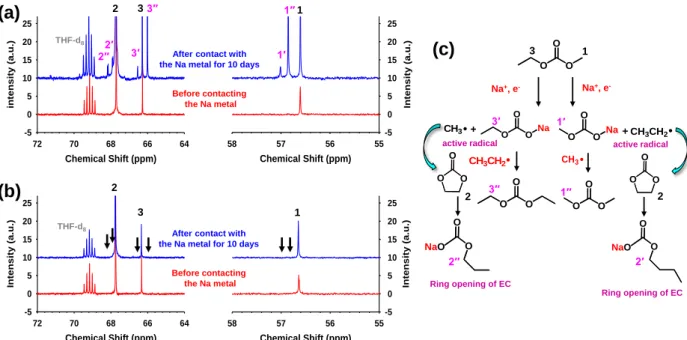
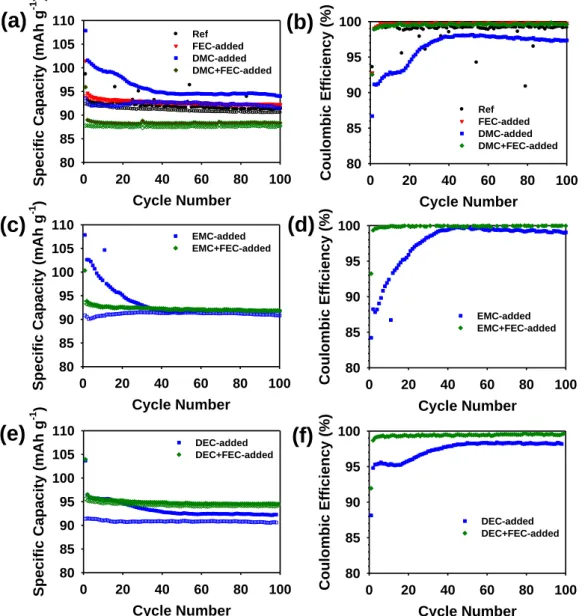
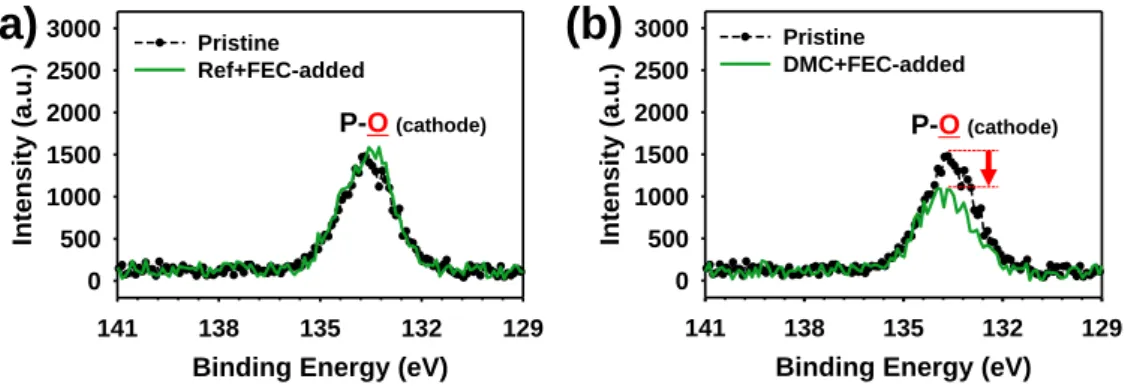
We clearly demonstrate the basic reaction mechanisms of electrolyte decomposition at a metallic Na electrode and Na4Fe3(PO4)2(P2O7) cathode charged to a high voltage of 4.2 V (vs. Na/Na+) using 13C nuclear magnetic resonance (NMR). ) studies. Furthermore, we suggest a possible mechanism by which the FEC additive makes linear carbonate-containing electrolytes stable on the Na metal electrode and improves the cycling performance of cathodes.
Experimental method
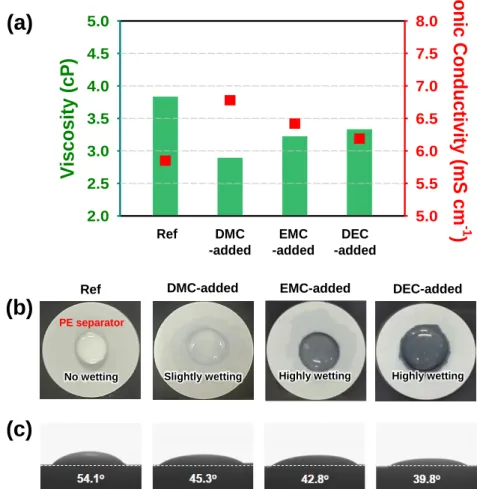
Pre-cycling and cycling assays of cells were performed at C/20 and C/2 stages, respectively. Ionic conductivity and electrolyte viscosity were measured using a standard Oakton CON 11 conductivity meter and a BROOKFIELD viscometer (LVDV-ll + P) at room temperature.
Results and discussion
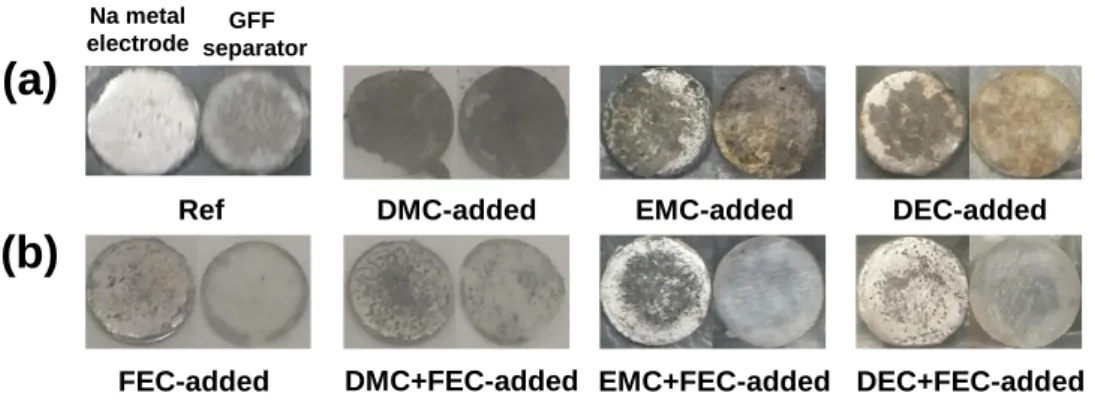
DMC-d represents the by-products formed by the DMC decomposition at the Na metal electrode. There was no significant color change of the Na metal electrodes and GFF separators precycled in the DMC + FEC added electrolyte (Fig. 2.10b).
Conclusion
Fluoroethylene carbonate-based electrolyte with 1 M sodium bis(fluorosulfonyl)imide enables
Introduction
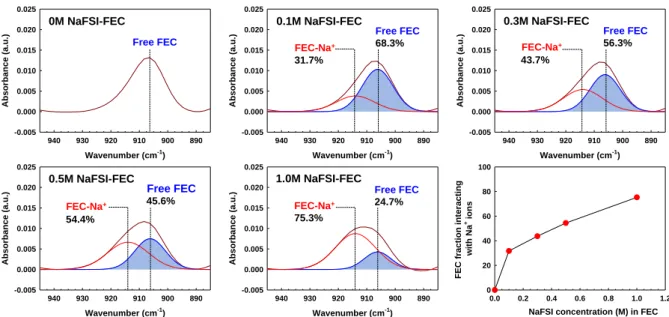
The most postulated degradation mechanisms of an FEC compound that sufficiently modify the interfacial nature of Na deposits in 1 M sodium bis(fluorosulfonyl)imide (NaFSI)-based electrolytes are suggested through ex situ X-ray photoelectron spectroscopy (XPS) studies. Through direct observation using in situ techniques, such as differential electrochemical mass spectrometry (DEMS) and optical microscopy (OM) studies, during the electrochemical reaction, we propose for the first time the underlying mechanisms of the FEC-NaFSI electrolyte that effectively prevents the formation of Na dendrites, which threaten the safety of the Na metal battery and enable fast Na plating and stripping at high current densities.
Experimental method
After electroplating Na metal on the Cu substrate, the cells were carefully disassembled in a glove box and the Na metal deposits were rinsed with a PC solvent to remove excess surface-bound electrolyte. The resulting Na metal deposits on the Cu substrate were dried at room temperature before analysis. Na metal plated on a Cu substrate extracted from cells was placed on an XPS holder in a glove box and the prepared samples were vacuum sealed with an aluminum bag film.
In situ observations of Na electrodeposition on Cu substrate were performed in a beaker-type Na/Cu cell and photographs of Na deposits were obtained by recording at various conditions of Na plating (1, 2, and 30 min, and h) during the initial Na plating process at 0.282 mA cm-2 (corresponding to a capacity of 2.82 mAh cm-2). The Na counter and reference electrodes, Cu substrate (0.54 cm2) and GFF separator were assembled in an argon-filled glove box with less than 1 ppm oxygen and moisture. The electrodeposition of Na metal was performed by a galvanostatic method at 0.463 mA cm-2 to a deposited surface capacity of 1.389 mAh cm-2 using a computer-controlled battery measurement system (BioLogic SP-300).
In situ differential electrochemical mass spectrometry (DEMS) analysis was used to monitor gas evolution in the Na/Cu cells during the initial Na plating at a current density of 0.282 mA cm-2.
Results and discussion
FEC additive in 1 M NaFSI-EC/PC undergoes rapid capacity fading after a few cycles (Fig. 3.3b) because a small amount of FEC does not allow full coverage of the Na metal surface during cycling. Evaluation of the reversibility of Na plating and stripping at high areal capacities confirmed the unique property of 1 M NaFSI-FEC stabilizing Na metal (Fig. 3.6). In situ side and top view observations of Na metal deposition were performed at different stages of the initial Na plating process (Fig. 3.2d and e) to investigate the morphological difference between EC/PC and FEC based electrolytes.
Na plating on a Cu substrate in Na/Cu beaker cells and snapshot of Na metal plated on Cu substrates at specific points. In contrast, non-dendritic, compact and silver Na metal was electrochemically plated on a Cu substrate in the presence of 1 M NaFSI-FEC. A comparison of cross-sectional and surface morphology of Na metal electrochemically coated on a Cu substrate in 1 M NaFSI-EC/PC and 1 M NaFSI-FEC shows the excellent properties of FEC as a solvent, leading to more compact Na metal plating ( Fig. 3.12a-d).
F 1s XPS spectra of Na metal surface electrochemically coated on a Cu substrate with (e) 1M NaFSI-EC/PC or (f) 1M NaFSI-FEC during initial Na deposition at 0.28 mA cm-2 and Na deposition over 2 cycles at 1.41 mA cm-2. Ex situ X-ray photoelectron spectroscopy (XPS) measurements of Na deposits on a Cu substrate were performed to determine the origin of the remarkable reversibility of Na deposition and stripping processes and dendrite-free Na metal deposition in 1 M NaFSI- FEC. We suggest that FEC defluorination occurs by the catalytic effects of Na metal formed during the Na deposition process, and leads to the formation of VC and HF.

Conclusion
Fluorine-enriched interfaces enhance cycling stability of 4 V class Li metal batteries in ether-
Introduction
Fluorine-enriched interfaces improve cycling stability of 4 V class Li-metal batteries in ether-based electrolytes. Herein we show that using concentrated electrolytes containing 1,1,2,2-tetrafluoroethyl-2,2,3,3-tetrafluoropropyl ether (TTE) as cosolvent and fluoroethylene carbonate (FEC) as additive, homogeneous and reversible reactions at Li metal anodes and results in improved anodic stability at high capacity Ni-rich cathodes with charge termination voltages of >4 V vs. In particular, TTE promotes the formation of a stable interlayer that helps protect the reactive Li metal, while FEC manipulates the structure of the cathode-electrolyte interface to reduce the mechanical cracking of Ni-rich secondary particles.
Experimental method
The anodic limits of electrolytes were determined by linear sweep voltammetry (LSV) using an Iviumstat (Ivium Technologies) at a scan rate of 1 mV s−1. 2016 coin-type cell with a Li metal electrode, a copper (Cu) substrate (1.77 cm−2) and a polyethylene separator was assembled in an argon-filled glovebox, which contained less than 1 ppm of both oxygen and moisture, for to evaluate the Coulombic efficiency (CE) of the Li plating and stripping reaction. During the initial cathodic scan, electrochemical plating of Li metal onto the Cu substrate occurred up to a deposited areal capacity of 2.0 mAh cm−2.
2032 coin-type solid cell with a Li metal electrode, an NCM cathode, and a polyethylene separator was mounted in an argon-filled glove box with less than 1 ppm oxygen and moisture. The Li/NCM cells were precirculated in the potential window between 3.0 V and 4.2 V at a rate of 0.1 °C. Contact angle measurements of the electrolytes on the NCM cathode were performed within 2 seconds using an SEO Phoenix 300.
The glass fiber filter (2 cm in width and 6 cm in length) is absorbed with the electrolytes in an amount of 0.5 g and then ignited to assess the flammability of the electrolyte.
Results and discussion
In contrast, a noticeable change in LiF– ion map of Li metal surface contacted with TTE appeared (Fig. 4.7b). F 1s XPS spectra of Li metal in Li/NCM cell with (g) DME+FEC electrolyte and (h) DME+TTE+FEC electrolyte after pre-cycling at a rate of 0.1C. Moreover, planar FEC accepts electron from the Li metal to transform into non-planar FEC.
FEC, which adsorbed favorably on the Li metal thanks to its low adsorption energy, agrees the reductive decomposition of TTE on the Li metal. The SEI layer formed on the Li metal anode in DME+FEC electrolyte is thin relative to that with only DME. The compatibility of the electrolytes towards the Li metal anode and NCM811 cathode was investigated using Li|NCM811 coin cells.
The large overpotential is mostly associated with the activation of the passivated Li metal anode, as well as the kinetics of Li ion deintercalation from the NCM811 cathode. The significant reduction of voltage hysteresis during charge and discharge in a Li|NCM811 full cell at 90th cycle is attributed to the interface stabilization ability of the TTE-oriented SEI on the Li metal anode and the FEC-promoted CEI on the NCM811 cathode (Fig .4.12c). The cycling performance of the Li|NCM811 cell with DME+TTE+FEC was investigated using a very thin Li metal anode with a thickness of 20 μm (corresponding to a surface capacity of 4 mAh cm−2), which further improvement in the energy density of the battery compared to a battery using a 100 μm (corresponding to the surface capacity of 20 mAh cm-2).

Conclusion
H.; Cedar, G.; Kang, K., Electrode materials for rechargeable sodium-ion batteries: possible alternatives to current lithium-ion batteries. T; Kang, K.; Choi, N.-S., Cyclic carbonate-based electrolytes that improve the electrochemical performance of Na4Fe3(PO4)2(P2O7) cathodes for sodium-ion batteries. Y.; Choi, N.-S., Asymmetric fluorinated malonatoborate as an amphoteric additive for high energy density lithium-ion batteries.
Gotoh, K.; Fujiwara, K., Electrochemical Na insertion and solid electrolyte interphase for hard carbon electrodes and application to Na-ion batteries. Lee, Y.; Lee, J.; Kim, H.; Kang, K.; Choi, N.-S., Highly stable linear carbonate-containing electrolytes with fluoroethylene carbonate for high-performance cathodes in sodium-ion batteries. Ushiyama, H.; Yamashita, K.; Son, J.-Y.; Cui, Y.-T.; Oji, H.; Komaba, S., Black phosphorus as a high-capacity negative electrode for sodium-ion batteries: investigation of the electrode/electrolyte interface.
Wang, Z.; Huang, X.; Chen, L., Characterization of spontaneous reactions of LiCoO2 with electrolyte solvent for lithium-ion batteries.