Lecture #1 (2010-Feb-02)
Welcome to EEW508
Introduction to Surface Physics and Chemistry
Time: Tuesday & Thursday 14:30-16:00, Spring 2010 Location: Creative Building Room 101
Instructor: Prof. Jeong Young Park (
박정영) (EEWS Graduate School
Email: jeongypark at kaist.ac.kr Tel: 350-1713
Room: 2309, building N5)
Teaching Assistant: Kim, Sunmi (
김선미)
Welcome to EEW508
Introduction to Surface Physics and Chemistry
http://scale.kaist.ac.kr/lecture
Or Google “EEW508”
EEW508
Introduction to Surface Physics and Chemistry
The class will cover the introduction of Surface Physics and Chemistry The subject of the class will include
• Structure, electronic structure, thermodynamic properties, mechanical properties of surfaces.
• Surface characterization (microscopy and spectroscopy)
• Energy dissipation at surfaces
• Heterogeneous catalysis and renewable energy conversion
Prerequisition: the attendance of general physics and chemistry are
recommended.
EEW508
Introduction to Surface Physics and Chemistry
Text book (primary)
Introduction to Surface Chemistry and Catalysis, Gabor A. Somorjai, (1994, Wiley, New York)
Text book (supplemental)
Introduction to Surface Physics
M. Prutton (1994, Clarendon Press, Oxford)
Modern techniques of surface technique
D. P. Woodruff and T. A. Delchar (1994 Cambridge Univ
Press, Cambridge)
EEW508
Introduction to Surface Physics and Chemistry
Text book (supplemental)
Physics at Surfaces
Andrew Zangwill (1988 Cambridge Univ Press, Cambridge)
Introduction to Solid State Physics Charles Kittel (1986, Wiley, New York)
Physics of Semiconductor Devices
S. M. Sze (1986, Wiley, New York)
Introduction to Surface Physics and Chemistry
Grading
Homework (problem sets) 30%, Presentation 30%,
Attendance 10%
Final term 30%
Introduction to Surface Physics and Chemistry
What is Surface Science?
study of physical and chemical phenomena that occur at the interface of
two phases such as solid-liquid interfaces.
Introduction to Surface Physics and Chemistry
Introduction to Surface Physics and Chemistry
Types of interfaces
Surface Chemistry and Catalysis
G. A. Somorjai (1994)
What is Surface ? - surface versus bulk
surface
bulk
Introduction to Surface Physics and Chemistry
Surface property:
Adsorption, catalysis, oxidation Friction, adhesion, lubrication Bulk property:
Electrical conductance, Thermal conductance, Melting temperature, Heat capacity
Modulus, hardness surface
bulk
Surface property versus bulk property
Introduction to Surface Physics and Chemistry
Types of surfaces
Introduction to Surface Physics and Chemistry
D (dispersion) = Number of surface atoms Total number of atoms
The role of surface is more important as the size of object gets small
Surface Chemistry and Catalysis
G. A. Somorjai (1994)
Introduction to Surface Physics and Chemistry
Dependence of shape of particles on dispersion
cube
Truncated cube
Introduction to Surface Physics and Chemistry
Rh monolayer is used for
catalysis such as NO/CO
Diamon d coating
Magneti c disk – lubricant layer
Introduction to Surface Physics and Chemistry
External Surfaces-Thin film technology
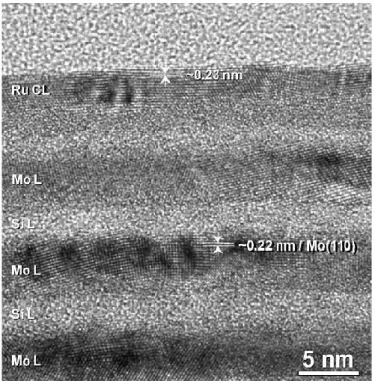
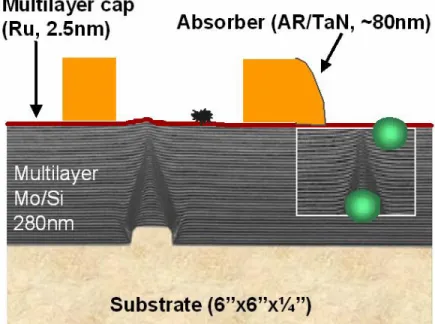
EUV lithography mask
External Surfaces-Thin film technology
Figure 2. High resolution TEM image of Si, Mo multi- layers and Ru capping layer in EUV mask.
Figure 1: Schematic of photomask for EUV lithography.
Introduction to Surface Physics and Chemistry
External Surfaces
-Miniaturization of microelectronic devices
Introduction to Surface Physics and Chemistry
nanoparticle systems – Two or three dimensional systems
(b) (a)
(a) TEM image of two- dimensional (2D) TTAB coated platinum
nanoparticle arrays and (b) TEM image of three- dimensional (3D)
platinum nanoparticle encapsulated in
mesoporous silica (SBA- 15).
Introduction to Surface Physics and Chemistry
External Surfaces -Biointerfaces
Introduction to Surface Physics and Chemistry
Internal surface – trapping of molecules in molecular seive
Introduction to Surface Physics and Chemistry
Sorption pump
Surface study and vacuum
Introduction to Surface Physics and Chemistry
MRT P F N A
= 2
From the kinetic theory of gases, the flux F of molecules striking The surface of unit area at a given pressure P is
) (
) /
(
) 10 (
51 . 3 sec)
/ /
(
2 22K T
mole g
M
Torr cm P
atoms
F =
If P= 3 x 10
–6Torr, M=28 g/mole (say, CO), T=300K, We obtain 10
15molecules/cm
2/s
If each incident molecules stick on the surface (or sticking coefficient is unity), then the surface is covered with one monolayer of molecules.
For this reason, the unit of gas exposure of 10
-6Torr sec is called the Langmuir (L).
If we achieve UHV (1.0 x 10
-10Torr), it may take three hours before a surface is covered completely.
Surface study and vacuum
Introduction to Surface Physics and Chemistry
Mean free path of electron in vacuum Surface study and vacuum
Introduction to Surface Physics and Chemistry
Hybrid system of high pressure and UHV system Surface science techniques
Introduction to Surface Physics and Chemistry
(a) (b)
Surface thermodynamics:
Microcalorimetry, adsorption/desorption
Surface vibration and reaction dynamics:
Electron energy loss spectroscopy, Helium atom scattering, IR spectroscopy, Raman spectroscopy, Sum-frequency generation spectroscopy, Molecular beam surface scattering
Surface electronic structure:
Second harmonic generation, Ultraviolet photoelectron spectroscopy, X-ray emission spectroscopy, Scanning tunneling spectroscopy
Surface structure:
Low-energy electron diffraction, Transmission electron microscopy, Atom diffraction, Atomic force microscopy, Scanning tunneling
microscopy, Surface X-ray diffraction, X-ray absorption fine structure Surface Composition:
Auger electron spectroscopy, X-ray photoelectron spectroscopy, Secondary ion mass spectrometry, Ion scattering spectroscopy
Surface Science Techniques for Molecular-Level Studies
Surface thermodynamics:
Microcalorimetry, adsorption/desorption
Surface vibration and reaction dynamics:
Electron energy loss spectroscopy, Helium atom scattering, IR spectroscopy, Raman spectroscopy, Sum-frequency generation spectroscopy, Molecular beam surface scattering
Surface electronic structure:
Second harmonic generation, Ultraviolet photoelectron spectroscopy, X-ray emission spectroscopy, Scanning tunneling spectroscopy
Surface structure:
Low-energy electron diffraction, Transmission electron microscopy, Atom diffraction, Atomic force microscopy, Scanning tunneling
microscopy, Surface X-ray diffraction, X-ray absorption fine structure Surface Composition:
Auger electron spectroscopy, X-ray photoelectron spectroscopy, Secondary ion mass spectrometry, Ion scattering spectroscopy
Surface Science Techniques for Molecular-Level Studies Surface science techniques
Introduction to Surface Physics and Chemistry
Application of Surface Science
Introduction to Surface Physics and Chemistry
Catalysis
Microelectronic semiconductor Tribology
Electrochemistry
Renewable energy conversion Corrosion
Environmental chemistry
Biointerface
What you are going to learn after taking this class
Introduction to Surface Physics and Chemistry
Will learn concepts of surface physics and chemistry (structure, electronic structure, mechanical properties) Will learn knowledge of vacuum science
Will learn basic operation modes of surface techniques
including spectroscopy, and microscopy