저작자표시-비영리-변경금지 2.0 대한민국 이용자는 아래의 조건을 따르는 경우에 한하여 자유롭게
l 이 저작물을 복제, 배포, 전송, 전시, 공연 및 방송할 수 있습니다. 다음과 같은 조건을 따라야 합니다:
l 귀하는, 이 저작물의 재이용이나 배포의 경우, 이 저작물에 적용된 이용허락조건 을 명확하게 나타내어야 합니다.
l 저작권자로부터 별도의 허가를 받으면 이러한 조건들은 적용되지 않습니다.
저작권법에 따른 이용자의 권리는 위의 내용에 의하여 영향을 받지 않습니다. 이것은 이용허락규약(Legal Code)을 이해하기 쉽게 요약한 것입니다.
Disclaimer
저작자표시. 귀하는 원저작자를 표시하여야 합니다.
비영리. 귀하는 이 저작물을 영리 목적으로 이용할 수 없습니다.
변경금지. 귀하는 이 저작물을 개작, 변형 또는 가공할 수 없습니다.
정치학 석사학위 논문
Election Timing and Retrospective Voting:
Analyses on South Korea’s 2008 and 2012 National Assembly Elections
선거 시기와 회고적 투표:
2008년과 2012년 국회의원 선거를 중심으로
2015년 2월
서울대학교 대학원 정치외교학부 정치학전공
오
현
주
ii
Election Timing and Retrospective Voting:
Analyses on South Korea’s 2008 and 2012 National Assembly Elections
지도교수 강 원 택
이 논문을 정치학석사학위논문으로 제출함 2015년 1월
서울대학교 대학원 정치외교학부 정치학전공
오 현 주
오 현 주 의 석사학위논문을 인준함 2015년 1월
위 원 장
박 원 호 (인) 부 위 원 장
강 원 택 (인) 위 원
김 의 영 (인)
iii
iv
Abstract
Election Timing and Retrospective Voting:
Analyses on South Korea’s 2008 and 2012 National Assembly Elections
Hyunjoo Oh Political Science Major, Department of Political Science and International Relations The Graduate School Seoul National University
Does election timing matter in terms of electoral consequences?
The purpose of this thesis is to show the electorate making dissimilar vote decisions in the elections which take place at different times during presidency. Voters are Janus-faced. At the polling place, they consider the past as well as the future. Previous studies have conceptualized this Janus- faced voting behavior into retrospective voting and prospective voting:
voters look to the past for retrospective evaluations and look forward to the future for prospective inference. But, what makes one side of the face prevail?
i
It has been widely discussed whether, and how, voters use their retrospective and prospective assessments in voting. However, they have remained comparatively silent on when retrospective, or prospective, evaluations show prevailing effects on vote choice. To fill this void, this thesis examines whether, and how, election timing functions as a structural factor that produces retrospective, or prospective, vote decisions. The objectives of this study are three: First, this thesis aims to explain how retrospective voting and prospective voting are linked in electoral reality.
Second, it investigates whether, and how, different election timing caused by the inconsistency of term limits influence retrospective and prospective voting. Third, it shows, election timing leads voter to make decisions in dissimilar ways when combined with party identification. Consequently, it aims to contribute to the expansion of literature, by studying the mechanism of charging and choosing which is framed by election timing.
In order to achieve these goals, this thesis analyzes the effect of election timing on retrospective and prospective voting by comparing the 2008 and 2012 South Korea’s National Assembly elections. As a result, some interesting findings are produced. In particular, it is found that voters save retrospective voting in an early-term election. In 2008 election, they largely depend on party identification instead of punishing or rewarding the
ii
president. Ostensibly, they keep their patience with the newly-formed government to show its real ability, no matter how dissatisfied they are. By contrast, voters’ decisions in a late-term election are driven by both retrospective and prospective assessments. As a presidential election approaches, voters in a late-term election consider both past and future.
Lastly, when exerting on vote choice, the influence of election timing often combines with partisanship. Depending party identification, voters have their distinct ways of making vote decisions in early-term, and late-term, elections.
Keywords: election timing, retrospective voting, prospective voting, South Korea’s National Assembly elections, electoral cycle, party identification.
Student Number: 2012-20196
iii
Table of Contents
CHAPTER ONE: INTRODUCTION ……….. 1
1.1. The Puzzle of Election Timing and Retrospective Voting ……….. 1
1.2. Case Selection: South Korea’s 2008 and 2012 National Assembly Elections ………... 7
CHAPTER TWO: LITERATURE REVIEW …….….……….. 18
2.1. Retrospective Voting and Prospective Voting ………. 19
2.2. Timing of Second-Order Elections ………..… 24
CHAPTER THREE: RESEARCH DESIGN ………. 30
3.1. Research Models ……….. 31
3.2. Data and Measures ………... 44
CHAPTER FOUR: ANALYSES ………...……….. 52
4.1. Retrospective Voting in Different Election Timing ……… 52
4.2. Retrospective Voting, Election Timing, and Party Identification …... 64
CHAPTER FIVE: CONCLUSIONS ………..………...………….. 71
References ………... 77
Appendix: Coding Description of Variables ……….. 89
요약(국문 초록) ………. 93
iv
List of Tables and Figures
Table 1.1. The Electoral Cycle in South Korea (1987-2014)………... 8 Table 3.1. Description on Survey Data ……….…. 45 Table 4.1 Retrospective/Prospective Evaluation and Vote Choice …... 53, 54 Table 4.2 Retrospective Voting in Early-term and Late-term Elections (1)...57 Table 4.3. Retrospective Voting in Early-term and Late-term Elections (2)..58 Table 4.4. Retrospective Voting and Party Identification (Early-term) .… 66 Table 4.5. Retrospective Voting and Party Identification (Late-term)…… 68
Figure 1.1. Presidential Approval Ratings and Macroeconomic Indicators ….4 Figure 4.1. Average Marginal Effects in Early-term and Late-term Elections
………... 64
v
CHAPTER ONE: INTRODUCTION
Time pervades every aspect of human behavior. Decision making in a voting booth is no exception. As uncovered by the existing literature, voters either evaluate the past or expect the future when they decide whom to elect. In this case, the timing of election might induce voters to frame what is more important. However, the effects of election timing on retrospective voting have not been discussed to date. This chapter poses research questions which have been developed from this idea and explains reasons for the selection of cases.
1.1. The Puzzle of Election Timing and Retrospective Voting
After decades of attention, the mechanism of electoral rewards and punishments based on the evaluation of recent changes has entered the realm of common knowledge: With satisfaction of the incumbent’s performance, voters provide electoral support for the government; with dissatisfaction, they withdraw it. The connection between prospects and the fates of governing parties has also been examined thoroughly. However, we
1
do not know how the electorate reaches conclusions in the elections which take place at different times during the administration. Not only do citizens vote for charging the incumbent but they also vote for choosing the next government. Nevertheless, we do not know when the voters make retrospective decisions and when they make prospective decisions.
In the 2008 legislative election, South Korean voters gave landslide victory to the president’s party. The Grand National Party and Pro-Park Geun-hye Alliance swept almost half of the total votes and won safe majorities of the National Assembly1. Previous studies have provided various explanations for the electoral results in the 2008 legislative election:
some have indicated economic prospects mattered in general elections (Choi
& Park, 2012; Lim, 2008; Jeong & Kwon, 2009), while others have suggested the electoral loss of the United Democratic Party (UDP) should be attributed to the pent-up discontent with the last government which was
1 The biggest right-wing conservative party in South Korea, the Grand National Party, was divided by internal conflicts over the nomination process, which resulted in forming the Pro-Park Geun-hye Alliance. When considering the splinter group as an independent party, it is hard to say that the president’s party swept the votes. In reality, the Grand National Party won 153 seats, while the Pro-Park Geun-hye Alliance, Liberty Forward Party, United Democratic Party, and Democratic Labor Party gained 14, 81, 19, 5 seats respectively.
However, the seats which belonged to Pro-Park Geun-hye Alliance could be counted as the governing party’s because it was precisely a faction of the Grand National Party (Hwang 2009, J. M. Song 2012. Also see Hwang, 2008)
2
run by the predecessor of the UDP (Ka, 2008; Ka & No 2010, Sohn, 2008).
They concluded in common that the voters expressed (or might have expressed) friendly attitudes towards the Lee Myung-bak government in the 2008 legislative election. But they have paid little attention to the fundamental cause, i.e., election timing.
Furthermore, the legislative election showing in 2012 which ran counter to the general prediction attracts attention to the puzzle of election timing. Objective conditions of the year fed punitive sentiment which pointed to the electoral defeat of the governing party. But, when looking at the grey area in the Figure 1.1, we can find that the governing party won the election2 even without bringing home the bacon. In 2012, the GDP growth rate was decreasing and so was presidential popularity. The approval rating of the Lee Myung-Bak administration had plunged from 52% in 2008 to 24%
in 20123. Against all odds, however, the 2012 general election resulted in the secure victory of the president’s party. The election results contradicted
2 The president’s party gained the majority of the parliamentary seats (152 out of total 300).
3 Gallup Korea, Political Index. http://www.gallup.co.kr/gallupdb/report.asp
: In the first week of April (4/2~4/6) in 2012, respondents were asked “How do you evaluate the president’s performance these days?” and 23 percent of total 1,708 respondents answered the question; among them, 23% gave positive assessments, 63% gave negative assessments, 6% stood neutral, and 8% were don’t-knows. The survey was conducted by using RDD(Random Digit Dialing) method; it had a 95% confidence level with +/-2.4%p of sampling error with 95%; the respondent’s rate was 17%.
3
the expectations held by many political scientists as it has been widely accepted that the president’s unpopularity or economic stagnation brings defeat to the governing party. Then, why the opposition parties did not enjoy benefits by a wave of retrospective voters? Was there another tide of public opinion which counterbalanced the voter’s desire for vengeance?
Figure 1.1. Presidential Approval Ratings and Macroeconomic Indicators
Note: The fourth quarter of 1989, the second and third quarter of 1991, and the first, third, and fourth quarter of 1992 are omitted. The margin for error is +/- 1.5% at a 95% level of confidence and the average response rate is 16%.
Source: Presidential Approval Ratings (1988-2012) are from Gallup Korea and the unemployment rate (1987-2012), headline inflation rate (1987-2012), and GDP growth rate (1987-2012) are from the Korean Statistical Information Service.
4
In the tradition of democratic theory, elections function as a crucial tool that enables citizens to hold their political representatives accountable so as to produce the desired outcome. According to retrospective voting theories, voters incentivize the elected officials to be responsive to public demands by giving credit or blame (Barro, 1973; Ferejohn, 1986; Key, 1966). They can do it based upon more or less direct impression of political events and living conditions; assessments of political figures and their performance are included in retrospective evaluations as well. Figuratively, retrospective voters are likened to peasants who rely on real-world experience, while prospective voters are compared to bankers who pay more heed to a positive or negative harbinger of things to come (Erikson, MacKuen, & Stimson, 2000; MacKuen, Erikson, & Stimson, 1992). For those who care about the future, the past events are like a guide to prospective inference about the future. As a utility maximizer, a voter chooses whom to elect by expectations about the nation’s economy or the leadership of the near future (Ashworth, 2005; Downs, 1957; Duch &
Stevenson, 2008; Fearon, 1999; Fiorina, 1981; Persson & Tabellini, 2002).
As pointed out in the earlier studies, whether voters are retrospective or prospective is a matter of degree, rather than absolutes (Erikson et al., 2000; MacKuen et al., 1992). Assuming two types of voting are distinct but
5
a matter of degree, the literature has been expanded steadily and added abundant evidence that shows the qualitative difference between retrospective and prospective voting (Fiorina, 1981; Healy & Malhotra, 2013; Kiewiet, 2000; Kiewiet & Rivers, 1984; Lanoue, 1994; A. H. Miller
& Wattenberg, 1985). Nevertheless, relatively little attention was paid to how election timing develops different incentive structures for the voters and, in consequence, frames the judgments of voters at the ballot box.
Therefore, this thesis will attempt to examine the effects of election timing by asking a series of questions relating to election timing: When does the electorate vote retrospectively and prospectively? Particularly, in early- term and late-term elections, how does the voter use different political judgments for deciding whom to elect? If the electoral cycle stimulates voters to become forward-looking or backward-looking, how does it work?
6
1.2. Case Selection: South Korea’s 2008 and 2012 National Assembly Elections
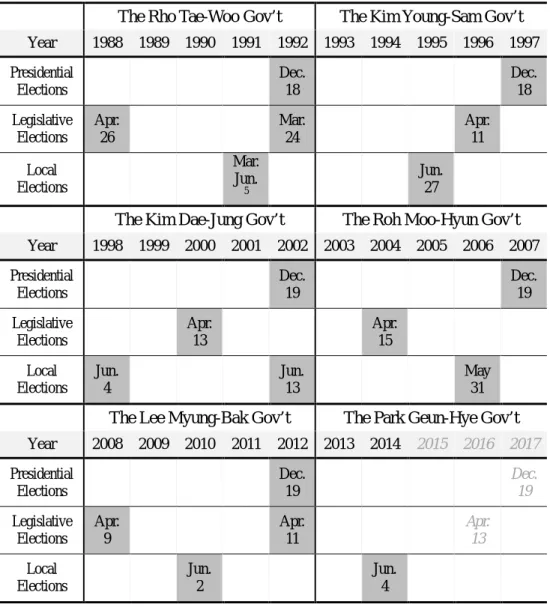
The perfect case for studying the effects of election timing is the South Korean election. Ever since 1987, the democratic elections have been settled in South Korea while carrying out the various levels of elections scheduled at different points in time. South Korea’s presidential elections are held every five years while congressional elections and local elections take place every four years. And, as a result of time-asynchronism which is one of the institutional features of South Korean electoral systems, six presidents have been elected while ten National Assembly elections and eight local elections have been held hitherto.4 Table 1.1 shows the electoral cycle in South Korea from 1987 to 2014.
4 The term limits of the National Assembly members and the President are specified in the Constitution of the Republic of Korea: The Eighth Amendment states that “The term of office of members of the National Assembly shall be four years (Article 40)” and “The term of Office of President shall be five years, and the President shall not be reelected (Article 70).”
7
Table 1.1. The Electoral Cycle in South Korea (1987-2014)
The Rho Tae-Woo Gov’t The Kim Young-Sam Gov’t Year 1988 1989 1990 1991 1992 1993 1994 1995 1996 1997 Presidential
Elections
Dec.
18
Dec.
18 Legislative
Elections
Apr.
26
Mar.
24
Apr.
11 Local
Elections
Mar.
Jun.
5
Jun.
27
The Kim Dae-Jung Gov’t The Roh Moo-Hyun Gov’t Year 1998 1999 2000 2001 2002 2003 2004 2005 2006 2007 Presidential
Elections
Dec.
19
Dec.
19 Legislative
Elections
Apr.
13
Apr.
15 Local
Elections
Jun.
4
Jun.
13
May 31 The Lee Myung-Bak Gov’t The Park Geun-Hye Gov’t Year 2008 2009 2010 2011 2012 2013 2014 2015 2016 2017 Presidential
Elections
Dec.
19
Dec.
19 Legislative
Elections
Apr.
9
Apr.
11
Apr.
13 Local
Elections
Jun.
2
Jun.
4
5 In Korea, there are two levels of local governments; each level of governments equally includes a set of an executive official and a council body. Until 1995, local elections for the lower-level and the upper-level local governments had been held separately; in the 1991 local elections were held in March 26 and June 20. The only exception is the term of elected officials in the 1995 local elections, which was three years instead of four.
8
As presented in the Table 1.1, the National Assembly elections in 1988 and 2008, and the local elections in 1998 were conducted during the president’s first year of office, while the legislative elections in 1992 and 2012, and the local elections in 2002 were the late-term races. Only the general election in 2000 and the local elections in 2010 were the mid-term elections comparable to the exact concept of mid-term congressional elections in the United States. In the light of this variation across time, we might expect it to make the case for studying voting behavior in the elections which have been conducted at different times during the administration. In fact, despite of the insufficient case number, the electoral cycle in South Korea poses interesting questions of political behavior: Do the different levels of elections influence each other? If voters assign the highest priority to presidential elections, do retrospective or prospective assessments affect their vote decisions in the lower level of elections such as legislative elections? And how does this effect vary with the timing of elections?
Existing studies have already provided evidence for the first and the second questions and suggested that various levels of elections are connected to each other by the perception of voters (e.g. Jang, 2012; Kang, 1999, 2006, 2012; B. K. Song, 2008; B. K. Song, 2009). For instance, the
9
voters’ identification of the relationship between each level of elections has been found to be a hallmark of their cognitive competency; it suggests the voters discerning the blurred lines of accountability which are caused by the division of power between each of the three branches of government at different levels (cf. Cain, 2005). Furthermore, it has been witnessed that the electorate considers presidential elections as first-order elections while a legislative elections or local elections as second-order or lower-level elections (Kang, 1999, 2006, 2012; Kang et al., 2014). Such perceptions are reasonable enough, especially when considering the portrayal of Korean politics given by Henderson (1968),6 which characterizes Korean politics as a vortex. In South Korea, the President functions as the center of governing power. It is undeniable that hierarchy is an institutional feature of Korean politics, although it is open to debate. In reality, the weight of the sitting President in legislative or local elections justifies its inclusion.
Yet, we do not know how this perception of political accountability
6 After serving with the US Foreign Services in South Korea for seven years, Gregory Henderson described Korean politics as a vortex. His reason for describing it as a vortex is as follows: “the imposition of a continuous high degree of centralism on a homogeneous society has resulted in a vortex, a powerful upward-sucking force active throughout the culture. This force is such as to detach particles from any integrative groups that the society might tend to build—social classes, political parties, and other intermediary groups—thus eroding group consolidation and forming a general atomized upward mobility. (Henderson, 1968, p. 193)”
10
varies with the timing of elections. In this regard, I will deal with the questions of when and how retrospective and prospective evaluations affect voting decisions in the second-tier elections by analyzing the South Korea’s legislative elections. In general, variation of election timing in presidentialism has been reckoned to be infeasible because the time interval between each tier of elections is fixed in general. Also, the country which holds the elections taking place in the honeymoon periods, midterms, and counter-honeymoon periods is uncommon even though many countries adopt non-concurrent elections. In this regard, the institutional features of South Korea’s electoral systems offer us a good chance to explore the effects of election timing in terms of electoral consequences, as its legislative elections include both on-year and off-year elections; the timing of off-year elections ranges from the president’s first year of office to the final year of office.
Across the globe, there have been three types of electoral cycles in presidential systems: concurrent elections, non-concurrent elections, and the mixed form of elections. Jones (1994, 1995) defines concurrent elections as
“elections where the first or only round of the presidential election and the election of the legislature are held on the same day,” and non-concurrent elections as “elections where the popular selection of the legislature occurs
11
in a separate year from the election of the president.” The electoral cycle in Chile is a good example of concurrent elections, while those in France, Taiwan, and Dominica are categorized as non-concurrent elections (J. H.
Lee 2008, 2010)7. The electoral cycle in the United States8 which has been paid considerable attention by previous works is classified as a mixed form.
The elections in Mexico, Argentina, Russia, El Salvador, and Venezuela are examples of mixed forms as well. South Korea’s elections are also included in a mixed form, but distinct from the other elections in the same category:
the timing of presidential elections and legislative elections are concurrent as well as non-concurrent; theoretically, legislative elections could take place at any time during the presidency, as noted earlier, because of the time intervals which are originated from the different term limits.
Furthermore, by the same token, South Korea’s elections offer some interesting points on the perception of voters. The studies on the government’s popularity curve have presented absorbing accounts of public
7 Due to electoral reforms, the periods should be specified: The electoral cycle in Chile includes the elections which have been held since 2005; the series of elections in France and in Taiwan indicate the elections which have taken place in 2000s; the electoral cycle in Dominica involves the elections which have been held since 1996.
8 In the United States, congressional elections are held in the same year when presidential elections take place and at the half-way term of office of the president. The mid-term elections indicate the latter.
12
approvals for the president or the governing party which vary with time.
They suggest that the government popularity tends to surge in the so-called honeymoon period, decline since then, and sometimes revive to some degree at the end of the administration (Abramowitz, 1985; Abramowitz, Cover, & Norpoth, 1986; Born, 1990; J. E. Campbell, 1986, 1991; Erikson, 1988; Ka & No, 2010; Tufte, 1975). Underlying these explanations is the idea that time shapes public support for the incumbent. However, it is unknown whether the electoral consequences reflect this changing popularity. What we have known so far is the connection between the downturn in presidential approval ratings and the vote choice in the elections which take place at the half-way term of office of the president, namely ‘mid-term loss’ (e.g. Abramowitz et al., 1986; Erikson, 1988;
Rudalevige, 2001). And even our knowledge on the midterm elections are incomplete as the controversy over interpreting the midterm loss has yet been settled. In this respect, investigating South Korea’s elections which have been held at different points in time would not only enrich our knowledge on non-concurrent elections but also expand our understanding of retrospective or prospective voting, especially in the honeymoon period and the counter-honeymoon period.
For the three strategic reasons for the research, the 2008 and 2012
13
National Assembly elections are included in the following analyses. First, the timing of both elections, which is the first and the last year of the presidency, would help avoid the problem of imprecise definition and contribute to comparative literature. The notion of different times in the electoral cycle, except for midterms, has not been clearly defined. The mid- term elections are traditionally defined as ‘the congressional elections at the half-way term of office of the president9’ (J. E. Campbell, 1991; Erikson, 1988; W. L. Miller & Mackie, 1973; Tufte, 1975). Based on this definition, Eum (2008) further defines honeymoon elections as ‘the legislative elections which are held within the first year of office of the president,’ and counter-honeymoon elections as ‘the legislative elections which take place a year before the following presidential election.’ Also, he categorizes the elections other than honeymoon elections and counter-honeymoon elections as midterm elections, but his definition has not been agreed upon by other researchers. For this reason, I have chosen the elections which were held
9 While studying the effects of presidential elections on congressional elections, Tufte (1975) included 1938, 1946, 1950, 1954, 1958, 1962, 1966, 1970 off-year congressional elections as mid-term elections. Also, J. E. Campbell (1991) distinguished midterm elections from on-year congressional elections which were held at the same time with the presidential elections.
14
exactly during the president’s first and final year of office10.
Second, the 2008 and 2012 legislative elections were identically held during the Lee Myung-Bak administration. If voters in both elections used retrospective assessments for making vote decisions, they must have attributed responsibility to the identical political figure, President Lee.
Moreover, analyzing the National Assembly elections would make the link in the chain of accountability between the president and the National Assembly simple and plain11.
Third, the two consecutive general elections which took place under the Lee government provide appropriate backgrounds to investigate retrospective and prospective voting. For instance, the salient election pledge which conduced to the landslide victory of President Lee was boosting the economy. Voters’ satisfaction or dissatisfaction with the
10 The 2008 election was conducted on the 45th day from the inauguration (February 25, 2012); the 2012 election was held during the final year of presidency, which was 253 days before the ensuing presidential election (December 19, 2012).
11 There are other terms in which elections are carried out in the first year and the fifth year of the presidency but those sets of elections are not applicable for testing the retrospective voting and prospective voting: It is highly probable that the intricate political contexts as well as the effect of regionalism in the 1988 and 1992 legislative elections hinder voters from allocating credit and blame to political actors; because of mixed lines of responsibility and diversified participants including local groups and minor parties in local elections, the 1998 and 2002 elections are excluded from the analyses (see B. K. Song, 2008).
15
incumbent government would be measured by their sociotropic or egotropic view on the economy. Also, as stated earlier, the 2012 election attracted scholarly attention for its unexpected electoral results. Because the 2012 election was carried out amid widespread discontents with the incumbent president, the scholars were as one in expressing their surprise at the New Frontier Party winning the votes in the legislative election enough to secure a majority of seats (Hwang, 2012; Jang, 2012; Kang, 2012). Based on previous research, unpopularity of the president should have resulted in the electoral defeat of the governing party. Given that the context of 2012 general election provides favorable conditions for retrospective voting to arise, the 2012 election would be a perfect case to study why a large number of voters gave credit to the governing party instead of punishing them.
For the reasons articulated above, studying the 2008 and 2012 National Assembly elections would be conducive to broaden our understanding of the effects of election timing on retrospective voting.
Therefore, this thesis aims to analyze the South Korean legislative elections in order to achieve three objectives: (1) it intends to show that retrospective voting and/or prospective voting could be driven by election timing; (2) it will delve into what kinds of contents of retrospective or prospective evaluations affect vote decisions and how do they differ by when the
16
elections are carried out; (3) the mechanism of making a vote choice in early-term, and late-term, elections will be discussed in terms of party identification.
The remainder of the study is organized as follows: Chapter 2 reviews the existing literature on retrospective voting and prospective voting, along with the electoral studies which have centered on the timing of election. It will encompass a wide range of the previous studies which are germane to my research. Here, I highlight the lacuna that the earlier works have left and address where my research questions have been raised.
Afterwards, I spell out my research questions in the jargon of current theoretical discussion. Based on a theoretical foundation, Chapter 3 proposes hypotheses and research models. For the following analyses, I also describe variables and measures. In Chapter 4, the results and interpretation of analyses on pre- and post-election survey data from the 2008 and 2012 National Assembly elections will be presented. Furthermore, I will show that voters go through different processes of making decisions in early-term, and late-term, elections and, by extension I will explain what causes this difference with a focus on party identification. Lastly, in Chapter 5, I conclude by summarizing my findings and discussing the theoretical and practical implications of this study.
17
CHAPTER TWO: LITERATURE REVIEW
Does election timing matter in terms of electoral consequences?
Voters are Janus-faced at the polling place with respect to their consideration on the past as well as the future. They should decide whether to impose responsibility on the incumbents or to set aside their desires for vengeance and just move on. Previous studies have conceptualized this Janus-faced voting behavior into retrospective voting and prospective voting:
when making vote decisions, voters look to the past for retrospective evaluation and look forward to the future for prospective inference.
However, although whether to value the past or the future largely hinges on when the decisions are made, the effect of election timing on electoral results has been left as a lacuna.
The earlier works have demonstrated that election timing influences electoral results, whereas they have not offered further explanation of voters’
judgments. In order to understand the effects of election timing, it is necessary to delve into voters’ perception which bridges the structural factor (election timing) and the dependent variable (electoral consequences). In this chapter, I will clarify my research questions by reviewing existing
18
literature. The following review covers the theories on retrospective voting, prospective voting, and election timing, in turn.
2.1. Retrospective Voting and Prospective Voting
In the tradition of democratic theory, elections have been understood as mechanisms of political accountability and public mandates.
Through elections, voters hold the elected officials accountable for their past performance and, at the same time, they select the future leaders. These two types of ideas, which are retrospective and prospective by nature, sustain the functioning of democracies.
On the one hand, voters are rigorous judges, incentivizing their agents to work for them by punishing or rewarding the incumbent’s performance (Barro, 1973; Ferejohn, 1986; Key, 1966). They hold elected officials accountable by reelecting good performers and “throwing the rascals out” (A. H. Miller & Wattenberg, 1985). In the language of rational choice, voters utilize sanctioning tools to reduce moral hazard of their agents. Voting for or against the incumbents based on evaluations of recent changes, namely, ‘available heuristics’ functions as a sanctioning device
19
(Fiorina, 1981). Depending on personal impressions of the bottom-line issues such as peace and prosperity voters judge the incumbents (Karol &
Miguel, 2007; Kinder & Kiewiet, 1981; Lewis-Beck & Stegmaier, 2000;
Markus, 1988).12
On the other hand, voters are rational enough to calculate the future benefits. Downs (1957) has delineated these rational voters inferring the future from available information: They evaluate the election pledges and platforms which candidates offered during the campaign; they also select the best candidate who is likely to win and deliver what they ask. With regard to choosing the candidate who will bring them the greatest return after being elected, the voters are prospective (Fiorina, 1981). Nevertheless, the portrayal of voters in earlier works has been criticized for a certain unreality.
In fact, they have presupposed highly sophisticated voters who are able to make predictions about future events, compare the candidates’ policy plans to their political preferences, and draw inference from the provided information about political actors. But in reality, voters are unwilling to engage in this convoluted way of forecasting procedure. Accordingly, recent
12 Aside from economy and war, voters take account of relief payments (Gasper & Reeves, 2011; Healy & Malhotra, 2009), corruption (Ferraz & Finan, 2011; Ferraz, Finan, &
Moreira, 2012), and even the damage caused by floods, droughts, and tornadoes (Achen &
Bartels, 2004).
20
studies have been depict voters as rational but practical. For instance, in order to see into the future, prospective voters use shortcuts such as the left- right ideology scale (Hinich & Munger, 1994), personal outlooks on national economy (Chappell & Keech, 1985; Erikson et al., 2000), or candidate traits (Bartels, 2002; Funk, 1999; A. H. Miller, Wattenberg, &
Malanchuk, 1986; W. E. Miller & Shanks, 1996).
Primarily, the research on retrospective and prospective voting has developed on whether, or how, they work. But above all, scholars have been concerned about second-order elections because they shed light on a certain aspect of democratic processes. According to previous studies, the second- order elections have been “barometers” of public opinion. When voters are dissatisfied with the president’s performance, they vote against her party in second-order elections, e.g., legislative elections, local elections, and European Parliament elections. Because the electoral results of second-order elections, in general, do not determine the central power, citizens use these elections for transferring their messages (Anderson & Ward, 1996; Norris, 1990). It is why retrospective voting is prevalent in second-order elections.
In such “barometer elections,” electoral outcomes largely depend on the so-called ‘fundamentals’ of common political parlance (Anderson &
21
Ward, 1996; Born, 1986; Feigert & Norris, 1990; Fiorina, Abrams, & Pope, 2003; Manow, 2005; Norris, 1990). For example, based on the traditional
‘bottom line’ considerations such as the state of economy and the administration’s performance, citizens choose whether to vote for the governing party as a reward or retract their supports from them as a punishment (Key, 1966; Tufte, 1975, 1978). They could also infer their future benefits from the presidential performance and signal their demands for the government by considering the ‘fundamentals’. In this regard, they are principals selecting the agents who will run the government on behalf of them. In addition to this, they assess the election pledges and platforms, along with the chance of winning from time to time (Downs, 1957; Fiorina, 1981).
To date, numerous studies have examined the causal dynamics of retrospective and prospective voting. Although they assume voters uphold somewhat contradictory views – that retrospective voting is backward- looking while prospective voting is future-oriented, it is not known how the electorate reaches retrospective or prospective conclusions. In short, voters have different rationality at once: charging the incumbent with responsibility for the last few years versus hopefully choosing the candidate for the next five years. Then, when does the electorate vote respectively and when
22
prospectively?
The central idea of this thesis draws upon the research from a variety of fields which studies the effects of timing. In fact, the timing of particular events matters for various decision-making processes (e.g. Braun- LaTour & LaTour, 2005; Meyers-Levy & Maheswaran, 1992; Roy &
Alcantara, 2012; B. K. Song, 2008; Stein & Streb, 2004). And by extension I believe there should be priority among the entangled judgments of voters before going to the polls and election timing would be a useful key to decipher the codes for public opinion.
Consequently, my argument builds upon and expands the literature on retrospective and prospective voting with a focus on election timing. It is intended to find out the effect of election timing by analyzing second-order elections which took place at different times of the presidency. In particular, variations on retrospective voting and prospective voting across time are expected in two ways: (1) the relative importance of retrospective, and prospective, evaluations would differ by election timing; (2) party identification would shape the dissimilar forms of utility maximization so that the voters’ decisions to vote for or against the incumbent would depend on different calculation.
23
2.2. Timing of Second-Order Elections
Election timing is not terra incognita. Rather, there is a voluminous scholarship on the effects of it, which has expanded primarily in two ways:
(1) the strategic choice of political leaders on election timing in parliamentarism and its consequences (e.g. Kayser, 2005; Smith, 2004), and (2) the voting behavior in European Parliament elections which take place at the different point of time in domestic electoral cycles (e.g. Hix & Marsh, 2007; Kousser, 2004; Marsh, 1998). As this thesis concentrates on the regular ‘surf’ (structural changes of time) itself instead of ‘surfing’
(opportunistic timing), I will sketch out extant studies which have unfolded in the direction of (2).
Election timing has been regarded as an important but delicate variable in the literature of political science. The intricacies of including election timing as a main variable in an analysis result from the diversity of political systems around the world complicating the definition of timing itself. For example, in parliamentary system, election timing is flexible, not fixed. The electoral cycle is put into motion by the determination of the ruling party. For this reason, political leaders choose election dates depending on how citizens assess the government performance.
24
Contrariwise, the timing of election also affects electoral outcomes because calling the election suggests something about the incumbent’s calculation and expectation for the future (Bakvis, 2000; Roy & Alcantara, 2012; Smith, 2004; White, 2005; Wolinetz, 2005). But, are the governing advantages of election timing still applicable when the election dates are fixed? It could be also questioned whether or not voters take election timing into consideration at the polling place.
The election days in presidential systems and European parliament are part of electoral institutions which are fixed and immovable in principle.
When election timing is fixed, the different levels of elections are connected to each other, especially in terms of electoral consequences. According to Jones (1994, 1995), election timing is an important part of electoral system, which is intricately and inextricably linked to the functioning of presidential democracies. Similarly, it is found out that the governing party’s share of seats tends to increase or decline in the elections which are held at different point in time (Erikson, 1988; Shugart, 1995; Shugart & Carey, 1992).
Previous studies also examined the effect of election timing in European Parliament elections and concluded that the electoral results differ by the point of time in domestic electoral cycles when the elections take place (e.g.
Hix & Marsh, 2007; Kousser, 2004; Marsh, 1998). Even though enough has
25
been said about timing and its effects on electoral results, they have paid scant attention to the perception of voters.
Also, the related questions have been raised mostly as to the popularity curve, ignoring the causal dynamics of election timing and retrospective voting. According to the popularity curve theory, approval ratings of the President (or the ruling party) tend to peak in so-called the honeymoon period; shortly after the popularity of government turns into a decline, results in mid-term loss, and sometimes rebound in the late-term with the anticipation (Abramowitz, 1985; Abramowitz et al., 1986; Born, 1990; J. E. Campbell, 1986, 1991; Erikson, 1988; Ka & No, 2010; Tufte, 1975). Popularity curve theories have investigated the fate of governing parties in advanced democracies including the United States, the United Kingdom, and France.
The scholars who have studied the popularity curve address two arguments in common: First, the fluctuation of a government’s (or the president’s) popularity follows a predictable cycle; second, the popularity of governments curves with generous support in an initial honeymoon, an irresistible drop in a midterm, and a hopeful rebound in a final term of office (Hix & Marsh, 2007; Kousser, 2004). However, the popularity curve does
26
not provide causal explanations of vote choice. While the government’s changing popularity might offer rough prediction of the wins or losses of governing parties, it could not explain the voting mechanism behind that.
Much has been explained by previous studies on midterm elections in the United States, which have delved into this mechanism on how support for sitting president affect the vote for his party in off-year elections. In the literature of midterm elections, the vote decline of the incumbent party is depicted as an almost invariable historical regularity (Erikson, 1988). Also, it is explained that midterm loss is a referendum based on economic conditions and presidential popularity (Born, 1986; Tufte, 1975, 1978).
Even though much has been said about it, earlier studies have not arrived at consensus on the cause of midterm loss13 and solving the problem whether midterm loss occurs solely in the second year of governments might provide
13 The explanations for midterm loss of the president’s party are manifold and still in controversy: Hinckley (1967), J. E. Campbell (1985), and Oppenheimer, Stimson, and Waterman (1986) explain it is due to the withdrawal of presidential coattails; A. Campbell (1960) argue it is caused the difference of public interests and participation in on-year and off-year elections; Erikson (1988), Kernell (1977), and (Lau, 1985) views it is so-called
‘presidential penalty’ for which voters are responsive more to negative cues than positive cues; Underhill (1955) and Wrong (1957) assert that it is intended consequences of voters to create a balance between the two major parties based on ruling party suffering in provincial elections in Canada; Fiorina (1988) develops the idea that voters ideologically in the middle split their vote for presidential and congressional elections when American parties differ ideologically from one another.
27
useful clues for the resolution of controversy. In fact, if there is any link which produces the vote decline of governing party, the off-elections in the first year, or the last year of governments should be investigated to identify this hidden link. Consequently, in order to uncover the causal mechanism of how election timing affects vote choice, analyzing the elections at different times during presidency is necessary.
The extant literature on election timing suggests the clear trend of second-order elections mirroring domestic politics which has been found in European Parliament elections (Marsh, 1998; Reif, 1984, 1985; Schmitt, 2005). Typically, second-order elections have particular characteristics in common. First, the same parties compete in the first-order and the second- order elections so that the identical party system works as a background in most cases (Marsh, 1998). Second, the political events and actors in the second-tier elections are less salient in the eyes of the public than those in the national public office such as the president and the ruling party. It leads to, third, lower levels of public attention and participation (Reif & Schmitt, 1980). In short, voters in second-order elections are less attentive because the electoral results do not determine the central administrative power.
The dependency of vote choice in National Assembly elections on
28
the central government has already been discovered by the evidence that voters in the legislative elections are influenced by the evaluation on the sitting president (An, 2013; Cho, 2013; Hwang, 2012; Jang, 2012; Kang, 2012; Park, 2012). Besides, general elections in South Korea share the other features of second-order elections. For instance, the identical parties had participated in the 2007 presidential and the consecutive two legislative elections in 2008 and 201214. Voter turnout in the National Assembly elections was 46.1% in 2008 and 54.2% in 2012, whereas that in the 2007 presidential election reached 63.0%15. The characteristics of general elections in South Korea as second-order elections prove their availability and suitability to study how voters make decisions in the elections of the different election timing.
14 In the 2007, ten presidential candidates ran in the election and they are from the Grand National Party (GNP), United New Democratic Party (UNDP), Democratic Labor Party, Democratic Party, Creative Korea Party, and five other minor parties. On the other hand, in the 2008 and the 2012 general elections, the Grand National Party (the New Frontier Party in 2012), United Democratic Party (the successor of UNDP), Democratic Labor Party, Liberty Forward Party, Creative Korea Party, New Progressive Party, Pro-Park Geun-hye Alliance (PPA), Korea Vision Party and other minor parties participated. Among them, PPA was substantially a transient political faction of GNP. Also, some parties renamed themselves.
15 National Election Commission, South Korea, http://www.nec.go.kr/
29
CHAPTER THREE: RESEARCH DESIGN
This chapter develops a research design and hypotheses. In particular, two sets of hypotheses are proposed in order to find answers to the following questions: (1) In early-term elections, and in late-term elections, does the electorate use different political judgments for deciding whom to elect? (2) How does partisanship make the effects of retrospective and prospective assessments different in each election? In order to clarity them, the research questions and hypotheses are restated in the language of rational choice. Next, I will suggest analysis models which are devised for comparing the two legislative elections in different years in office of the president.16 Data and measures are briefly introduced at the last part of this chapter.
16 It is not within the scope of this study to demonstrate systemic variations across time due to the insufficient number of election cases. In fact, ever since South Korea achieved transition to democracy in 1987, twenty elections have taken place including six presidential elections in 1987, 1997, 2002, 2007, and 2012, seven legislative elections in 1988, 1992, 1996, 2000, 2004, 2008, and 2012, and seven local selections in 1991, 1995, 1998, 2002, 2006, 2010, and 2014.
30
3.1. Research Models
3.1.1. Hypotheses for the Study
When voters have their own expectations on costs and benefits, election timing works as a structural factor which operates to readjust them.
Adopting the economic-individualist models of Buchanan and Tullock (1962), this study constructs research models based on an assumption that individuals attempt to maximize their own utility. That is, while voters, in common, prefer the more to the less through political process, different voters desire different things. Call the 𝐵𝐵𝐼𝐼 for the actual benefits, and E(𝐵𝐵𝐼𝐼) for the expected benefits of keeping an incumbent party in power; E(𝐵𝐵𝐶𝐶) stands for the benefits which are expected from the election pledges of challengers. In general, it has been explained that voters select a candidate or a party by comparing the two expected benefits, E(𝐵𝐵𝐼𝐼) and E(𝐵𝐵𝐶𝐶). If an incumbent party is likely to provide more benefits than challengers, voters choose the incumbent; if challengers are expected to provide a better prospect, they vote against the incumbent and choose them.
(a) Prospective voting:
Reelect the incumbents if and only if E(𝐵𝐵𝐼𝐼) – E(𝐵𝐵𝐶𝐶) ≥ δ
31
But, it only occurs when the incumbent’s performance satisfies voters, i.e., 𝐵𝐵𝐼𝐼 – E(𝐵𝐵𝐼𝐼) above the thresholds, δ. The thresholds (δ) could vary with political contexts, but it is not within the scope of discussion here.
To formally capture the notion of retrospective voting, it is written as follows:
(b) Retrospective voting:
Reward the incumbents by reelecting them if and only if E(𝐵𝐵𝐼𝐼) > E(𝐵𝐵𝐶𝐶) and 𝐵𝐵𝐼𝐼 – E(𝐵𝐵𝐼𝐼) ≥ δ
The notions presented above lie in the center of the traditional retrospective theory. However, previous studies have missed two aspects: (1) Depending on timing of elections, different amounts of information are available to voters; (2) Party identification creates group-bias that magnify, or minify, the importance of retrospective judgment (𝐵𝐵𝐼𝐼 – E(𝐵𝐵𝐼𝐼)).
Suppose elections which are held at different times during presidency. In the election during the president’s early-term of office, voters face the problem of estimating E(𝐵𝐵𝐼𝐼), because they do not know enough about the newly-formed government. Being reluctant to rigorously judge the
32
new government, they seem rather patient to anticipate further improvement.
Empirically, the number of people in an early-term election who thought the election is a referendum on the incumbent president is much smaller than that in a late-term election17. When voters have insufficient information on how the administration actually runs the country, they incorporate other cues such as economic evaluations and party identification. Earlier studies have demonstrated that people are likely to lean on their party identification as voting cues in the low-information elections (Klein & Baum, 2001;
Schaffner & Streb, 2002). Therefore, it is anticipated that party identification would be a determining factor that affects vote decisions in early-term elections. From here, the first hypothesis named “patient voter hypothesis” is proposed.
Hypothesis 1.1 (Early-term Election: Patient Voter Hypothesis): In an early-term election, neither retrospective evaluations nor prospective assessments would be significant determinants of vote choice. Instead, vote decisions will depend predominantly on party identification.
17 In the 2008 survey, respondents whose answers would be “evaluation of the incumbent president” to the question, “what do you think is the meaning of this election?” was 21%. In 2012, the percentage of people who responded that they agreed to the statement “the performance of the incumbent president should be evaluated in this election” was 65%.
33
In contrast, various types of information which become available in late-term elections make voters to consider both past and future. For one thing, having experienced the changes over the last few years, voters are equipped for punishing the governing party. As a presidential election approaches, they are also ready for choosing the next government. When voters perceive late-term elections as preludes to presidential elections, considerations for the forthcoming presidential election could diverts voters’
attention from simple retrospection (𝐵𝐵𝐼𝐼 – E(𝐵𝐵𝐼𝐼)) to different calculation which incorporates the costs of voting (𝐵𝐵𝐼𝐼 – E(𝐵𝐵𝐼𝐼) + C).
(b‘)Retrospective voting in late-term elections:
Reward the incumbents by reelecting them if and only if 𝐵𝐵𝐼𝐼 – E(𝐵𝐵𝐼𝐼) + C ≥ δ
The additional concerns for the forthcoming presidential election increase the cost of retrospective voting and, as a result, the sum of benefits and cost (𝐵𝐵𝐼𝐼 – E(𝐵𝐵𝐼𝐼) + C) could easily exceed the threshold δ. In short, the late-term election provides the electoral environment in which retrospective voting could be redirected toward somewhat prospective direction.
34
To put it another way, voters in late-term elections are Janus-faced.
They value the incumbent’s past achievements as much as the future benefits of electing a new representative. The electoral environments which facilitate retrospective voting and prospective voting make strict judges of voters. But, unlike in midterm elections, voters also recognize their vote choice would exert influence on forming a new government which lies ahead. For these reasons, it is expected that both retrospective voting and prospective voting arise in the late-term elections.
Hypothesis 1.2 (Late-term Election: Janus-faced Voter Hypothesis): In a late-term election, vote choice will be influenced by both retrospective concerns and prospective concerns. But, those considerations will primarily involve evaluations of the president and the presidential candidate in winning.
As noted earlier, voters’ evaluations and judgments are conditioned by their partisanship. When constrained by party identification, voters face the problem of simply comparing E(𝐵𝐵𝐼𝐼) and E(𝐵𝐵𝐶𝐶), which is caused by group-bias18. According to the research on group-bias, individuals tend to
18 It has been proved that party identification creates group-bias (e.g. Brown, 2010; Duck,
35
show favorable attitudes toward their in-groups and to hold unfavorable opinions toward the out-groups (Duck et al., 1995; Greene, 1999; Johnston, 2006; Maggiotto & Piereson, 1977; Malhotra, 2008).19 The former is called
‘in-group favoritism’ which is characterized as affinity for one’s in-group over the out-group; the latter is ‘out-group derogation’ which often results from in-group favoritism. When party identification creates group-bias, it could magnify, or minify, the importance of retrospective judgment (𝐵𝐵𝐼𝐼 – E(𝐵𝐵𝐼𝐼)). A second set of hypotheses intends to go deeper into this study by controlling party identification. It is basically as an extension of the first set of hypotheses. First, it is hypothesized that voters, regardless of their party identification, will identify their teams by ignoring either retrospective or prospective components in early-term elections.
Hypothesis 2.1 (Membership Hypothesis): Vote choice in early-term elections will not be determined by retrospective, or prospective assessments.
Hogg, & Terry, 1995; Malhotra & Kuo, 2008; Rudolph, 2006; Tilley & Hobolt, 2011).
19 In social psychology, an in-group is a social group which a person psychologically belongs to, while an out-group is a group which a person does not identify with. This group categorization is germane to party identification which is one of the main concepts in political science. This study defines ‘in-groups’ as parties that voters support or identify themselves with, and ‘out-groups’ as parties that compete for or hinder from accomplishing the goals of in-group parties.
36
Voters in late-term elections are better informed about the administration than they are in early-term elections, because they could observe and experience the changes made by the administration; they are also provided the campaign pledges, electoral platforms, and economic outlook by challengers. The constituents also situate themselves in the transition period where retrospective evaluations and prospective forecasts would be equally important. At the government’s final term of office, party identification plays a significant role to assist voters in prioritizing various considerations. On account of group-bias, people tend to ascribe positive outcomes to in-group whereas attribute negative outcomes to out-groups (Fletcher & Ward, 1988; Maggiotto & Piereson, 1977; Taylor & Doria, 1981;
Taylor & Jaggi, 1974). Moreover, as suggested by Marsh and Tilley (2010),
“partisanship resolves incongruities between party support and policy evaluation through selective attribution: favoured parties are not blamed for policy failures and less favoured ones are not credited with policy success.”
Accordingly, the voters who identify themselves with the governing party have little incentive to punish their own party, especially when the presidential election approaches. On the contrary, the opposition party supporters coveting the chance of their parties to govern are willing to be a
37
“rational god of vengeance and reward (Key, 1966).” They are also motivated to undertake sober assessment of the economic and political situation. In these respects, two hypotheses could be inferred. As the following hypotheses assume individuals sharing the same goals to maximize their self-defined utility with their own groups, I called them
“utility maximizer hypotheses.” The next two hypotheses focus on ruling party supporters and opposition party supporters, in turn.
Hypothesis 2.2 (Utility Maximizer Hypotheses – Incumbent’s Side):
When choosing whom to elect in late-term elections, the voters who identify themselves with the governing party would assess the competence of the party’s front runner for a forthcoming presidential election. Their vote decisions will also be influenced by economic evaluations, but would be immune to retrospective evaluations.
Hypothesis 2.3 (Utility Maximizer Hypotheses – Challengers’ Side): In early-term elections, vote decisions of the opposition party supporters would largely depend on retrospective evaluations of the president’s performance. By contrast, in the late-term election, they will be influenced by prospective, and by prospective, considerations.
38
On the other hand, compared to party identifiers, Independents face distinct incentive structure of making vote decisions. Without any strong and stable attachments to a particular party, they place top priority on future benefits. As they sit on the fence with regard to party support, neither vengeance nor reward is a matter of concern to them. Rather, their put more stress on economic changes and competency of political leaders. Therefore, the final hypothesis could be developed in the following manner:
Hypothesis 2.4 (Utility Maximizer Hypotheses – Independents): Vote choice of Independents in early-term elections will not be influenced by retrospective evaluations. But, when public sentiment against the governing party pervades, evaluations of the president’s performance might impel Independents to vote against the ruling party. On the other hand, in late-term elections, economic evaluations and political anticipation of the next leader will influence vote decisions of Independents.
39
3.1.2. Methods and Analysis Models
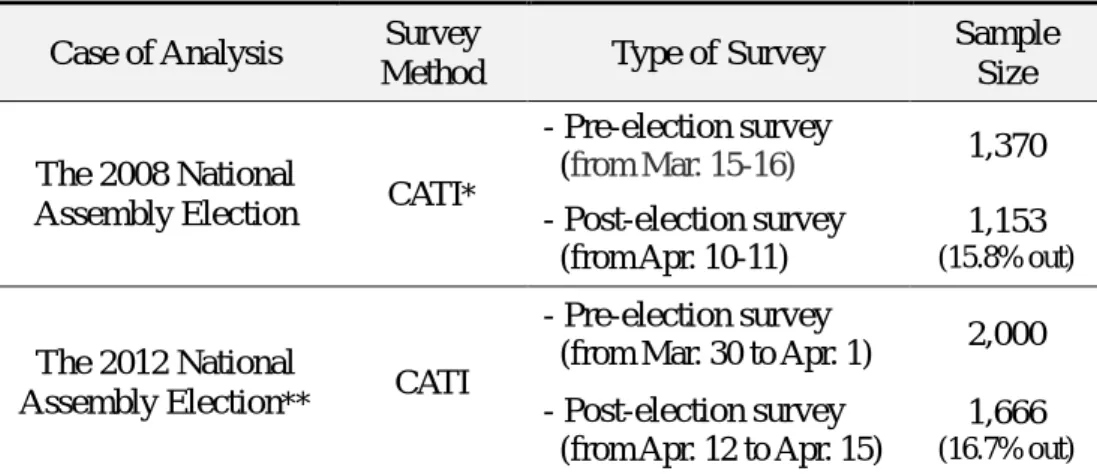
In order to test the two sets of hypotheses presented so far, I employ logistic regression analyses. The cases for this analysis are, as stated in Chapter 1.2, consecutive two general elections during the Lee Myung-bak administration, i.e., the 2008 and 2012 National Assembly elections.
Because of the insufficient number of cases which hinders the observation of systemic variations across time, I will explain the effect of election timing by comparing the two consecutive legislative elections which took place in the first and last year of presidency respectively.
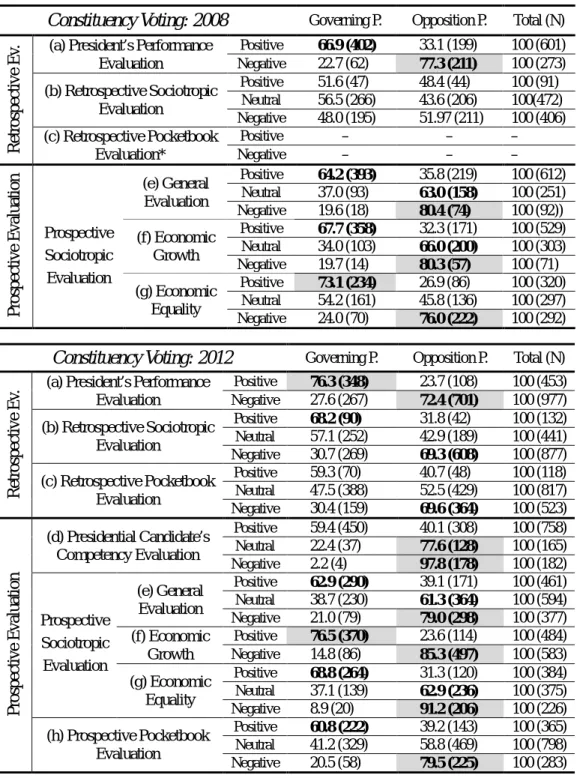
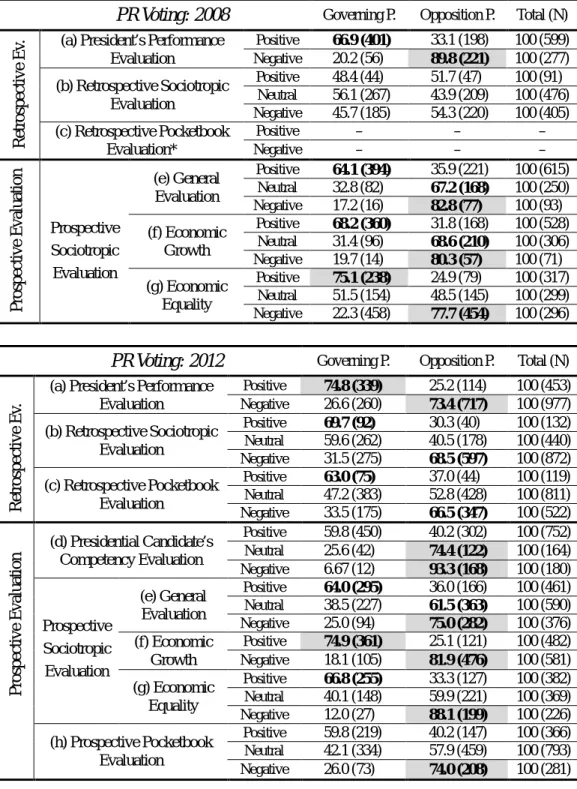
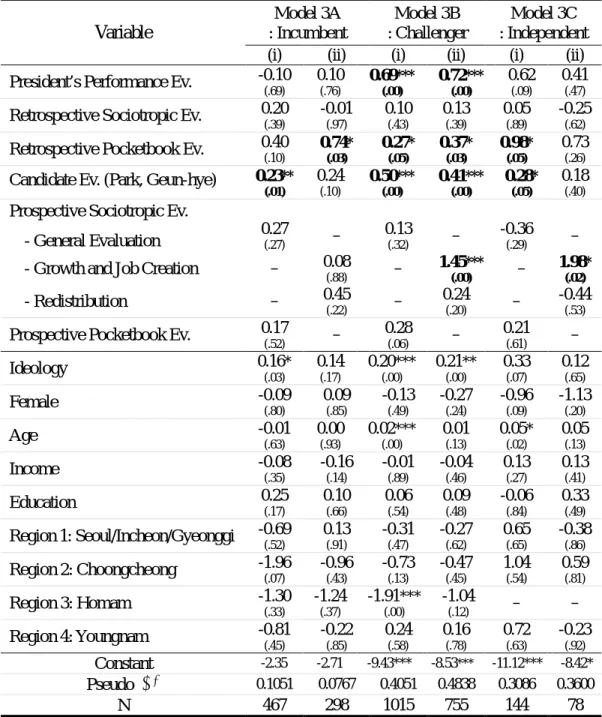
The two base models are devised to estimate the overall effects of retrospective, and prospective, evaluations on vote choice in the elections which are held at different time during presidency. The Model 1A analyzes vote choice in an early-term election while the Model 1B deals with a late- term election. The 2008 and 2012 National Assembly elections will represent an early-term election and a late-term election respectively. For scrutiny, the analyses include both constituency voting and proportional representation voting. Each model contains two submodels, (i) and (ii). The difference between (i) and (ii) lies in the ways of measuring prospective economy. The mathematical form of the first submodel is as follow:
40