Chapter 3 Ensemble and Molecular Partition Functions
The Canonical Ensemble
The average value of a property of the ensemble corresponds to the time-averaged value for the corresponding macroscopic property of the system.
The volume V, temperature T, and the number of particles in each system N are constant. An ensemble in which V, T, and N are
constant is referred to as a canonical ensemble.
i i i
E =
∑
A Ewhere Ai is the occupation numbers corresponding to the number of ensemble members having energy Ei.
Figure 1
A representation of the canonical ensemble, in this case for N=20. The individual replications of the actual
system all have the same composition and volume. They are all mutual thermal
contact, and so all have the same
temperature. Energy may be transferred between them as heat, and so they do not all have the same energy. The total energy E of all 20 replications is a constant
because the ensemble is isolated overall.
!
i!
i
W N
= A
∏
where N is the total number of ensemble members.
( )
Ei
i i
P E g e
Q
β
= −
where gi is the number of states (the density of states) present at a given energy Ei.
The quantity Q is referred to as the canonical partition function and defined as follows:
Ei
i
Q =
∑
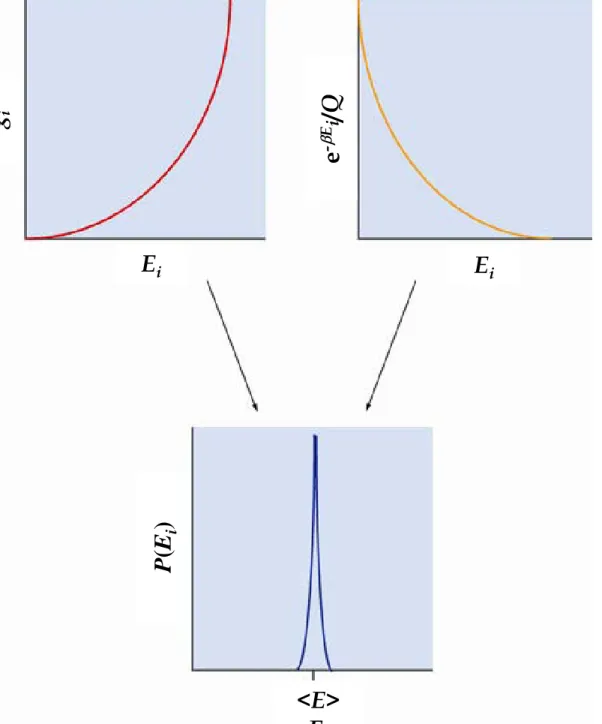
e−βThe value of gi increases with Ei while the Boltzmann term decreases exponentially with Ei. The product of these terms reaches a maximum corresponding to the average ensemble energy.
Ei
e−β Q
Figure 2. For the canonical ensemble, the probability of a member of the ensemble having a given energy is dependent on the product of gi, the number of states
present at a given energy, and the Boltzmann distribution function for the ensemble.
The product of these two factors results in a
probability distribution that is peaked about the average
energy, . E
g i
Ei Ei
P(E i)
<E>
Ei
Assume that a system consists of independent ideal particles.
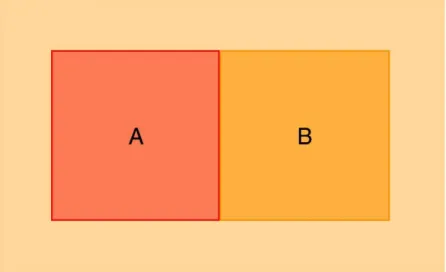
Consider an ensemble made of two distinguishable units, A and B.
Relating Q to q for an Ideal Gas
( An Bn)
En
n n
Q =
∑
e−β =∑
e−β ε +εwhere and refer to the energy levels associated with unit A and B, respectively.
An
ε εBn
Figure 3. A two-unit ensemble. In this ensemble, the two units, A and B are distinguishable.
( ) ( ) ( ) ( )
( ) ( ) ( )
( ) ( ) ( )
0 0 0 1 0 2
1 0 1 1 1 2
2 0 2 1 2 2
An Bn A B A B A B
A B A B A B
A B A B A B
n
Q e e e e
e e e
e e e
β ε ε β ε ε β ε ε β ε ε
β ε ε β ε ε β ε ε
β ε ε β ε ε β ε ε
− + − + − + − +
− + − + − +
− + − + − +
= = + + +
+ + + +
+ + + +
∑
( )(
)
( )( )
0 1 2 0 1 2
2
A A A B B B
A B
e e e e e e
q q q
βε βε βε βε βε βε
− − − − − −
= + + + + + +
=
=
For a system with N distinguishable units, Q = qN
q: molecular partition function
For a system with N indistinguishable units,
A B C
2 1 0
2 0 1
1 2 0
0 2 1
1 0 2
0 1 2
! qN
Q N
∴ =
Consider three distinguishable oscillators (A, B, and C) with three total quanta of energy. The dominant configuration of energy was with the oscillators in three separate energy states, denoted “2,1,0”.
The energy states relative to the oscillators can be arranged in six different ways:
Molecular Energy Levels
For polyatomic molecules, there are four energetic degrees of
freedom to consider in constructing the molecular partition function:
1. Translation 2. Rotation 3. Vibration 4. Electronic
Assume that the energetic degrees of freedom are not coupled.
( )
( )
( )( )( )( )
t r v e
total
t r v e
total
t r v
total t r v e
total t r v
t r v e e
g e g g g g ee
g e g e g
q
q q q
e g e q
β ε ε ε ε βε
βε βε βε βε
ε ε ε ε ε
− + + +
−
− − − −
= + + +
= =
= =
∑ ∑
∑
N total total
Q = q
!
N total total
Q q
= N
for distinguishable particles for indistinguishable particles
Translational Partition Function
For one-dimensional “particle-in-a-box”, quantum mechanics shows
2 2
8 2 t
h n ε = ma
2 2
8 2
,1
1
n h ma t D
n
q e
∞ −β
=
=
∑
Since the energy difference between energy levels is very small as compared to kT,
2 2
0
1 2
n n
qt e βα e βα dn π βα
− ∞ −
=
∑
≅∫
=where
2 2 . 8
h α = ma
Figure 4. Particle-in-a-box model for translational energy levels.
1 2
,1 2
1
2 2
2
2
t D
q m a
h h
m π
β β π
=
Λ =
: thermal de Broglie wavelength thermal wavelength
( )
12,1
1
2 2
2
1 1
2 2 2
t D
a a
q mkT
h
h h h
mkT mkT p
π
π π π
= = Λ
Λ = = =
p = mkT : the average momentum of a gas particle
For a three dimensional box,
3
3 ,3
3 2
3 3
1 1
(2 )
x y z
t t t
y D
x y z
x z
t q q q
a a a
a q
V V
mkT h a a
V π
=
= Λ Λ Λ
= Λ
= Λ
= =
Λ
The increase in qt with volume reflects the fact that as volume is increased, the translational energy level spacings decrease such that more states are available for population at a given T.
Figure 4-1
As the width of a container is
increased, the energy levels become closer together, and as a result more are thermally accessible at a given temperature.
Example:
Ar in 1 L at 298 K. qt=?
Rotational Partition Function
A diatomic molecule consists of two atoms joined by a chemical bond.
The rigid-rotor approximation:
( 1) 0,1, 2,
r hcBJ J J
ε = + =
J: quantum number
2 2
1 2
1 2
8 B h
cI I r
m m
m m
π µ µ
=
=
= +
: the rotational constant : the moment of inertia : the reduced mass
Figure 5. Schematic representation of a diatomic molecule, consisting of two masses (m1 and m2) joined by a chemical bond with the separation of atomic centers equal to the bond length, r.
( 1)
(2 1)
hcBJ J
r J
J J
q g e
g J
β
− +
=
= +
∑
( 1)
(2 1) hcBJ J
r
J
q J e−β +
∴ =
∑
+Assuming that the rotational energy level spacings are small relative to kT,
( 1) 0
( 1) ( 1)
(2 1)
(2 1)
hcBJ J r
hcBJ J hcBJ J
q J e dJ
d e hcB J e
dJ
β
β β β
∞ − +
− + − +
= +
= − +
∫
( 1) ( 1)
0 0
( 1) 0
(2 1) 1
1 1
hcBJ J hcBJ J
hcBJ J r
J e dJ d e dJ
q hcB
kT hcB hcB
dJ hcB e
β β
β
β
β β
∞ − + ∞ − +
∞
− +
∴ + −
− = =
= =
=
∫ ∫
The Symmetry Number
To correct the rotational partition function for overcounting, we can simply divide the expression for the rotational partition function by the number of equivalent rotational configurations.
r
q kT
σhcB
=
For H2, Cl2, σ = 2 For NH3, σ = 3 Example:
What is the symmetry number of CH4?
Figure 6. A 180º rotation of hetero-diatomic and homo- diatomic molecules.
σ = symmetry number
Rotational Level Populations and Spectroscopy
The probability of occupying a given rotational energy level, PJ, is given by
( 1) ( 1)
(2 1)
hcBJ J hcBJ J
J J
r r
g e J e
P q q
β β
− + + − +
= =
e.g. H35Cl, B=10.595 cm−1, 300 K
23
34 10 1
(1.38 10 J/K)(300 K)
(1)(6.626 10 Js)(3.00 10 cm/s)(10.595 cm ) 19.7
r
q kT
σhcB
−
− −
= = ×
× ×
=
With qr = 19.7, we can calculate PJ. Figure 7. Probability of occupying a rotational energy level, PJ, as a function of rotational quantum number J for
H35Cl at 300 K.
Example:
In a rotational spectrum of HBr (B=8.46 cm−1), the maximum intensity is observed for the J = 4 to 5 transition. At what
temperature was the spectrum obtained?
( 1)
( 1)
( 1) 2 ( 1)
2
2 2
0 (2 1)
0 (2 1)
0 2 (2 1)
2 (2 1)
2 (2 1) (2 1)
hcBJ J J
hcBJ J
hcBJ J hcBJ J
da d
N hcB J e
dJ dJ
d J e
dJ
e hcB J e
hcB J
hcB J hcB J
kT
β
β
β β
β
β β
β
− +
− +
− + − +
= = +
= +
= − +
= − +
∴ = + = +
2 2 34 10 1
23
(2 1) (2 4 1) (6.626 10 Js)(3.00 10 cm/s)(8.46 cm )
2 2(1.38 10 J/K)
494 K
J hcB
T k
− −
−
+ × + × ×
∴ = =
×
=
To find the maximum of the function,
Substitution of J=4 into the above equation results in the following temperature at which the spectrum was obtained:
The Rotational Temperature
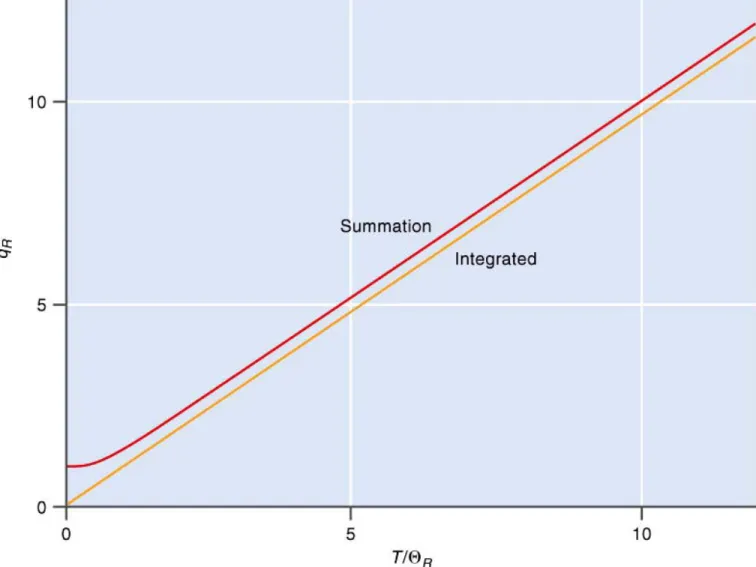
Whether the rotational partition function should be evaluated by direct summation or integration is entirely dependent on the size of the
rotational energy spacings relative to the amount of thermal energy available (kT). Define the rotational temperature as
r
hcB θ = k
r
r
kT T
q = σhcB = σθ
At low temperatures, significant differences between summation and integration is evident.
At high temperatures, the difference becomes smaller.
the use of the integrated form is reasonable.
10,
R
T θ ≥
θr
Figure 8. Comparison of qr for H35Cl (θr = 15.24 cm-1) determined by
summation and by integration. Although the summation result remains greater than the integrated result at all temperatures, the fractional difference
decreases with elevated temperatures such that the integrated form provides a sufficiently accurate measure of qr when T/θr > 10.
Rotational Partition Function of Polyatomics
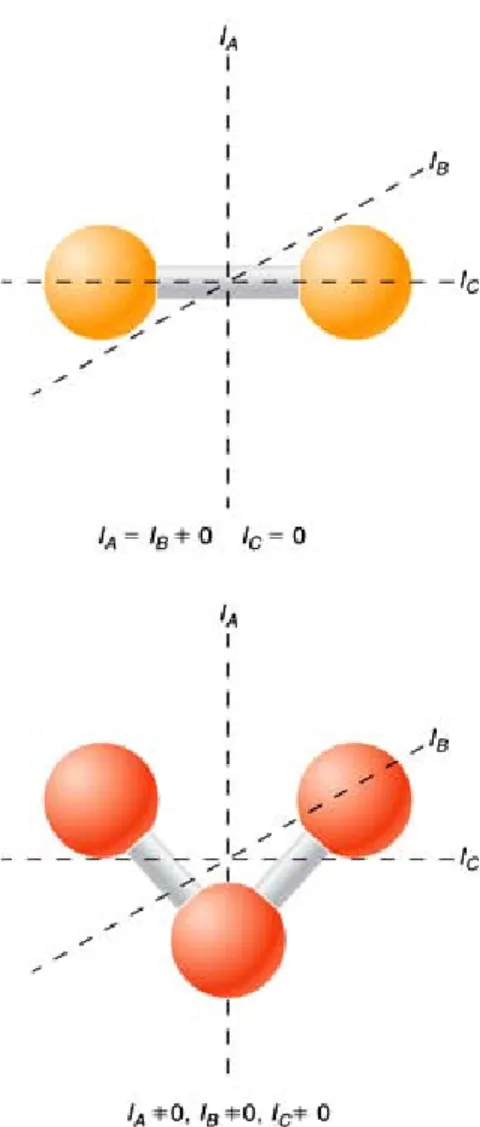
If the polyatomic molecule is not linear, then there are three non-vanishing moments of inertia.
1
1 1
2
2 2
1 1 1
r
A B C
q hcB hcB hcB
π
σ β β β
=
Example:
Evaluate the rotational partition function for the following species at 298 K. Assume that the
high temperature expression is valid.
a. OCS (B=1.48 cm-1) b. ONCl
(BA=2.84 cm-1, BB=0.191 cm-1, BC=0.179 cm-1)
c. CH2O
(BA=9.40 cm-1, BB=1.29 cm-1, BC=1.13 cm-1)
Figure 9. Moments of inertia for diatomic and nonlinear polyatomic molecules.
Vibrational Partition Function
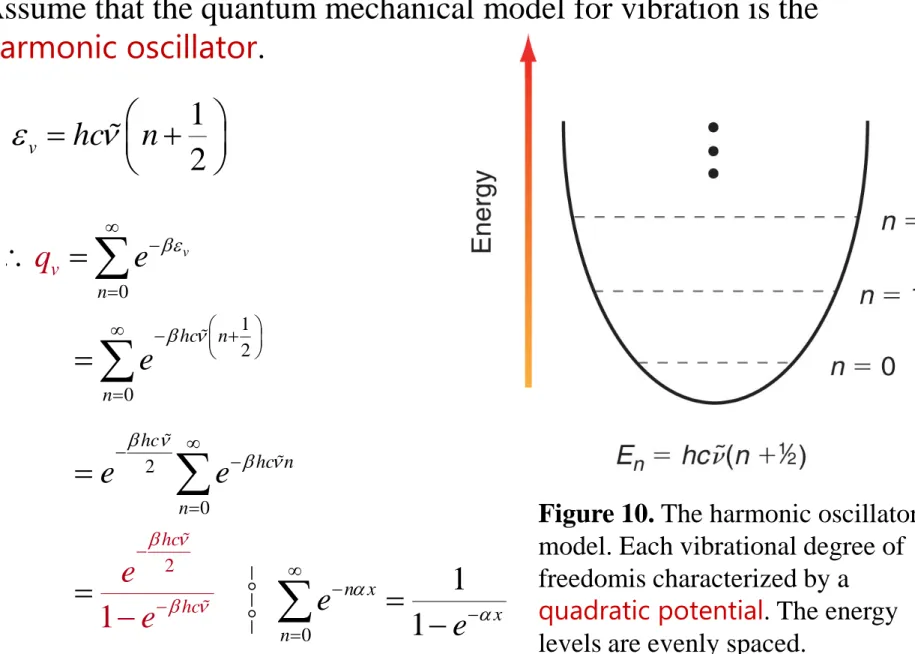
Assume that the quantum mechanical model for vibration is the harmonic oscillator.
1
v hc n 2
ε = ν +
0
1 2 0
2
0 2
1
v
v n
hc n n
hc
hc
hc
hc n n
e e
e q
e e
e
β ν βε
β ν
β ν β
ν
ν
β
∞ −
=
∞ − +
=
− ∞ −
−
−
=
∴ =
−
=
=
=
∑
∑
∑
0
1 1
n x
x n
e e
α
α
∞ −
= −
= −
∑
Figure 10. The harmonic oscillator model. Each vibrational degree of freedomis characterized by a
quadratic potential. The energy levels are evenly spaced.
It is advantageous to redefine the vibrational energy levels such that ε0=0.
Consider the calculation of the probability of occupying a given vibrational energy level, Pn .
1 2 /2
/2 /2 (1 )
1 1
v
hc n
hc hc n
hc n hc
n hc hc
v
hc hc
e e e e
P e e
e e
q
e e
βε β ν β ν β ν
β ν β ν
β ν β ν
β ν β ν
− +
− − −
− −
− −
− −
= = = = −
− −
The relevant energy for determining Pn is not the absolute energy of a given level, but the relative energy of the level. Given this, one
can simply eliminate the zero point energy, resulting in the following expression for the vibrational partition function
1
v 1 hc
q = e−β ν
− (without zero point energy)
A molecule consisting of N atoms has 3N total degrees of freedom corresponding to three Cartesian degrees of freedom for each atom.
Three of 3N corresponds to translational motion of entire molecule.
Two of 3N corresponds to rotational motion for linear molecule.
Three of 3N corresponds to rotational motion for non-linear molecule.
Linear Polyatomics : 3N-5 vibrational modes Nonlinear Polyatomics : 3N-6 vibrational modes
Since the vibrational degrees of freedom are separable, the total vibrational partition function is simply the product of vibrational partition function for each degree of freedom.
3 5 or 3 6 ,
1
( )
N N
v total v i
i
q q
− −
=
=
∏
Beyond Diatomics: Multidimensional q
vExample:
OClO: vibrational frequencies: 450, 945, 1100 cm-1 qv = ? at 298 K.
v
hcv θ = k
the vibrational temperature
/ /
1 1 1
1 1 1 v
v hcv hc kT T
q = e−β = e− ν = e−θ
− − −
2
1 1 for 1
2
x x
e− ≅ − +x ≅ − x x At high temperature, T θv.
/
1 1
1 1 1
v
v v
v T
e
T q θ T
θ θ
= − = =
− − −
(high T limit)
High Temeperature Approximation to q
vIn the case of degeneracy, two or more of these degrees of freedom will have the same vibrational energy spacings, or the same vibrational temperature.
( )
,
1
i
n g
v total v i
i
q q
′
=
=
∑
where gi is the degeneracy of the ith energy level.
Degeneracy and q
vExample:
What is the total vibrational partition function for CO2 at 1000 K?
CO2 : v = 1388, 667.4 (g=2), 2349 cm-1
e
e n
n
q =
∑
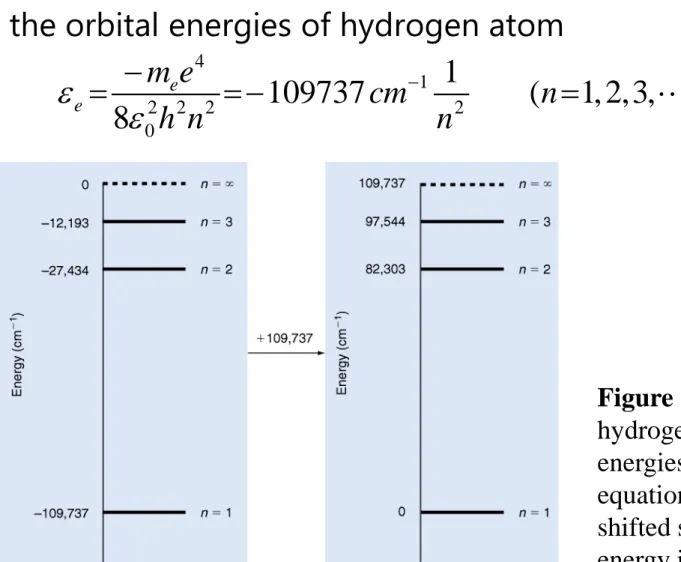
g e−βεthe orbital energies of hydrogen atom
4
1
2 2 2 2
0
109737 1 ( 1, 2,3, )
8
e e
m e cm n
h n n
ε ε
− −
= =− =
Electronic Partition Function
Figure 11. Orbital energies for the hydrogen atom: (a) the orbital
energies solved by the Schrödinger equation, and (b) the energy levels shifted such that the lowest orbital energy is 0.
the electronic temperature,
1 1
0.695
e e
e
hc
k cm K
ε ε
θ = = − −
1 0
ε =
1 2 82, 203cm
ε = − corresponds to θe
118, 421 .
e K
θ = For hydrogen atom, the n=2 state at 298K
2
34 10 1
397.3 23
(6.626 10 )(3 10 )(82303 )
exp 0
(1.38 10 )(298 )
hc Js cm s cm
e e
J K K
β ε − −
− −
−
− × ×
= × = ≈
3
1 2
1 1
1 1
1
(0) (82,303 ) (97,544 )
(82,303 ) (97,544 )
2 8 18
2 8 18
2 8 18
2
hc n hc hc hc
e n
n
hc hc cm hc cm
hc cm hc cm
q g e e e e
e e e
e e
β ε β ε β ε β ε
β β β
β β
− −
− −
∞ − − − −
=
− − −
− −
= = + + +
= + + +
= + + +
≅
∑
2 2 for H gn = n
3 o
1 1
( ) 1
tot t r v e
hc
q q q q q
V g
hcB e β ν
σβ −
=
= Λ − (distinguishable) (indistinguishable) Q= qN
! qN
Q= N