
In fact, while Ornelas (2016) provided a theoretical discussion of the possible effects of NRTPs on beneficiary countries. economic growth performance outcomes, no empirical work has concentrated on the matter. Moreover, the concomitant use of the two blocks of NRTPs contributes to the promotion of economic growth in beneficiary countries. On another point, the use of both GSP programs and other trade preferences improves economic growth in the context of terms of trade improvements.
In addition, and interestingly enough, the use of NRTPs is positively and significantly associated with economic growth in countries receiving large amounts of development aid. This section provides a theoretical discussion of the effects of NRTPs on economic growth (subsection II.A) and of the effects of development aid on economic growth (subsection II.B). This expansion of the most efficient firms would contribute to more economic growth in the beneficiary country.
12It is not the intention here to provide an extensive literature overview of the economic growth effects of development aid. This section presents the model specifications that can help to investigate the effect of the use of NRTPs on economic growth (section III.A). ECONOMIC GROWTH (ESTIMATES:PULSE, WITHIN FIXED SECURITIES AND TWO-STEP SYSTEM GMM) PULSE Within Fixed Securities Two-Step System GMM.
TABLE 2—EFFECTS OF USING NON-RECIPULAR TRADE PREFERENCES ON ECONOMIC GROWTH (ESTIMATOR:TWO-STEP SYSTEM GMM). 5) Time dummies are included in the regressions.
Empirical Results
At the same time, in both columns [1] and [2] there is no significant effect of the utilization rate of other trade preferences on economic growth at the conventional significance levels. The estimates presented in column [3] of Table 1 indicate that both the utilization rate of GSP programs and the utilization rate of other trade preference programs have a positive and significant (at the 1% level) effect on economic growth in beneficiary countries exercise Interestingly, the use of other trade preferences has a slightly stronger positive effect on economic growth than the use of GSP programs.
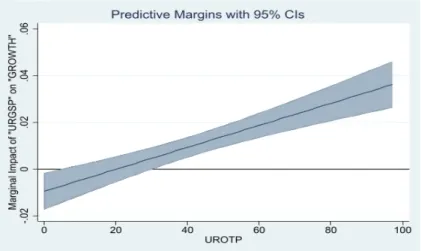
In addition, the size of the effect of the utilization rate of SAP programs on economic growth (which amounts to 0.011) is slightly larger than that (0.009) obtained in column [2] of Table 1 (results based on the POLS estimator ). This outcome certainly obscures the fact that the effect of development aid on economic growth depends on the use of NRTPs. Figures 1 and 2 show, respectively, with a 95 percent confidence interval, the marginal effect of development aid on economic growth for different SAP program take-up rates and the marginal effect of development aid on economic growth for different SAP program take-up rates. other trading preferences.
However, Figure 1 shows that development assistance promotes economic growth in countries whose GSP program utilization rate exceeds 68.7%. These pictures are slightly different if, at 95% confidence intervals, we consider in both cases the marginal effect of the use of GSP programs on economic growth for different amounts of development aid (see Figure 3) and the marginal effect of the use of other trade preference programs on economic growth for different amounts of development aid aid (see Figure 4). In particular, the utilization rate of GSP programs has a positive and significant effect on economic growth for amounts of development assistance greater than USD 16.22 million (otherwise, this effect is statistically zero or negative, including cases of low amounts of development assistance).
Similarly, the take-up rate of other trade preference programs has a positive and significant impact on economic growth only for amounts of development aid exceeding US$6788.2 (otherwise this effect is not significant). In concrete terms, the effects of GSP programs and other trade preferences on economic growth depend on the amounts of development aid that countries receive. These results indicate strong complementarity between GSP programs and other trade preferences in stimulating economic growth in beneficiary countries.
Similarly, at the 5% level, GSP programs and other trade preferences are complementary in promoting economic growth in beneficiary countries when the utilization rate of GSP programs is higher than the utilization rate of other trade preferences. This figure confirms the strong complementarity between GSP programs and other trade preferences in boosting economic growth. Thus, the use of other trade preferences has a positive and significant effect on economic growth only when countries also use GSP programs at a rate higher than 29.4%.
Such countries enjoy a higher degree of the positive effect of the application of other trade preferences on their economic growth rate as the utilization rate of GSP programs increases. To further illustrate these effects, we show in Figures 7 and 8, with 95 percent confidence intervals, respectively, the marginal impact of the application of GSP programs on economic growth for varying levels of terms of trade improvements and the marginal impact of the utilization of other trade preference .
Further Analysis
TABLE 3 - THE EFFECTS OF USING NON-RECIPULAR TRADE PREFERENCES ON ECONOMIC GROWTH FOR DIFFERENT SHARES OF EXPORTS OF GOODS UNDER NRTPS TO THE MARKETS OF PREFERENTIAL GRANTING COUNTRIES (ASSESSOR: TWO-STEP GMM SYSTEM). It is also important to note here that in the entire sample, the values of the shares of countries in total exports to all preference-granting countries are between 0.007% and 99.32% of total exports of goods. Figures 9 and 10 respectively show, at the 95% confidence level, the marginal effect of the use of GSP programs on economic growth for different shares of total exports to all preference-granting countries, relative to total exports of goods, and the marginal effect of the use of other trade preference programs on economic growth for different shares of total exports to all preference-granting countries from total exports of goods.
It appears from these two figures that the marginal impacts increase as the share of total exports to all increases. The marginal impact of GSP programs on economic growth is positive when the share of total exports to QUAD countries out of all goods exports exceeds 33.8%;. On the other hand, the marginal impact of GSP programs on economic growth is positive when the share of total exports to QUAD countries out of all goods exports exceeds 33.8%;.
In a nutshell, the main message that can be derived from Figures 9 and 10 is that both GSP programs and other trade preference programs promote economic growth in countries that export significantly below NRTPs to preferential countries, especially when the share of their exports to QUAD countries relative to total goods exports exceed 33.8%.
Conclusion
GROWTH Growth rate of real GDP per capita (constant 2010 US$), annual percentage World Development Indicators (WDI). It is the ratio (in percentage) of general government final consumption expenditure to GDP. TERMS This is the indicator of the terms of trade, as measured by the net terms of exchange.
The Impact of Foreign Aid on Economic Development: A Systematic Literature Review and Content Analysis of the Top 50 Most Influential Papers," Journal of International Development. The WTO Enabling Clause and Positive Conditionality in the European Community's GSP Program," Journal of International Economic Law. Openness Can Be Good for Growth: The Role of Policy Complementarities,” Journal of Development Economics.
Winners and Losers in a North-South Model of Growth, Innovation and Product Cycles”, Journal of Development Economics. The Trade Impact of the EU's Preferential Margins and Non-Tariff Barriers", Journal of Risk and Financial Management. Generalized System of Preferences in the General Agreement on Tariffs and Trade/World Trade Organisation: History and Current Issues", Journal of World Trade.
The effects of trade liberalization on growth and welfare through basic and applied research”, Journal of Macroeconomics. An investigation of the impact of unilateral European trade preferences on the extensive and intensive margin of trade. Foreign direct investment, institutional quality and economic growth", The Journal of International Trade & Economic Development.
Terms of Trade, Economic Growth, and Trade Patterns: A Small Case of Open Economy," Journal of International Economics. Does Designation of Least Developed Country Status Promote Exports?" Journal of International Trade & Economic Development Improved access to foreign markets increases plant-level productivity...for some plants,” Quarterly Journal of Economics.
Government Spending and Economic Growth in ECOWAS: An Asymmetric Analysis,” The Journal of Economic Asymmetries, 22, e00180.