Why Does Forgiving Boost Creativity?
The Role of Cognitive Persistence
*SU SANG LEE
**KAIST College of Business Daejeon, Korea
EUN JIN JUNG
***National Youth Policy Institute Sejong, Korea
JUNHA KIM
****University of Toronto Toronto, ON, Canada
SUJIN LEE
*****KAIST College of Business Daejeon, Korea
Abstract
This study elucidates the specific cognitive mechanism by which the act of forgiving enhances creativity. We use the dual pathway to creativity model to examine whether the act of forgiving increases creativity via cognitive persistence (generating detailed ideas within a small number of categories), but not via cognitive flexibility (generating multiple categories and switching ideas between categories). Two experiments conducted
* The first three authors contributed equally to this work. This study was supported by a Grant for Research (N01140339) received from the National Research Foundation of Korea. The authors thank members of the Human Innovation Lab at KAIST for their valuable assistance and insightful comments.
** M.S. Candidate, School of Business and Technology Management, College of Business, KAIST, email: [email protected]
*** Associate Research Fellow, National Youth Policy Institute, email: eunjin@nypi.
re.kr
**** Ph.D. Candidate, Rotman School of Management, University of Toronto, email:
*****Corresponding author. Associate Professor, School of Business and Technology Management, College of Business, KAIST, email: [email protected]
within separate Korean and US samples provided convergent evidence that cognitive persistence, not flexibility, mediates the forgiving-creativity link.
Our study suggests that how cognitive resources are deployed serves as a driving mechanism for the creativity-related benefits of forgiving.
Keywords: forgiveness; creativity; cognitive persistence; conflict; dual pathway to creativity model
INTRODUCTION
Forgive me my nonsense as I also forgive the nonsense of those who think they talk sense. – Robert Frost (letter to Louis Untermeyer, 1915)
Conflict is prevalent in all walks of human and organizational life, due to the complexity and interdependence of human interaction (Fincham 2000; Jehn 1995). Regardless of the issue at hand, people can either forgive those with whom they are in conflict, or retaliate (Fehr and Gelfand 2012). The conflict literature has flourished in recent decades (De Dreu 2010; Jehn and Bendersky 2003), with ongoing debates regarding the effects of conflict on creativity—
where creativity is defined as an individual’s ability to produce ideas that are novel and appropriate in a given problem space (Amabile 1983; Runco 2004; Sternberg and Lubart 1999). Though many conflict researchers have focused on conflict’s negative impact on creative thinking, other scholars have shown that conflict benefits individuals by helping them to realize their shortcomings, appreciate opposing perspectives, and search for creative solutions (De Dreu 2006; De Dreu and Weingart 2003; Farh, Lee, and Farh 2010; Jung and Lee 2015; Nemeth 1986). A similarly critical issue might be how victims’ reaction to conflict affects their creativity. One of the ways to handle conflict, for instance, is to forgive the transgressor (Aquino, Grover, Goldman, and Folger 2003; Tsang, McCullough, and Fincham 2006). Thus, with regard to the enhancement of creativity, to forgive or not to forgive? That is our question.
Forgiveness, defined as a motivational change on a victim’s part after an experience of transgression (McCullough, Fincham, and Tsang 2003; McCullough, Worthington, and Rachal 1997), represents a prosocial response to interpersonal conflict. A growing body of research has focused on forgiveness and examined its correlates and consequences (Fehr, Gelfand, and Nag 2010;
Karremans and Van Lange 2008a). Recent empirical evidence has
supported especially that the act of forgiving can enhance creativity (Fehr 2010). To the extent that forgiveness involves an intentional action of resolving the conflict at hand, it is under an individual’s control. Thus, although forgiving a transgressor may be difficult, it may promote creativity as effectively as the demographic, dispositional, and situational predictors on which prior creativity research has focused.
In particular, forgiveness is related to cognitive resources (Fehr 2010; Noreen, Bierman, and MacLeod 2014), and creative thinking is an inherently cognitive process (Nijstad, De Dreu, Rietzschel, and Baas 2010). Still, the specific cognitive mechanism through which the act of forgiving boosts creativity remains unidentified.
Illumination of the intervening mechanism is necessary for theory and implication development within both the forgiveness and creativity literatures. Such research would reveal, for example, the specific processing mode that should be encouraged (or induced through training) to elicit the creative benefits of forgiving.
Furthermore, conclusive support regarding the replicability and generalizability of the forgiveness-creativity link across cultures remains to be established. Therefore, the objectives of our study are: (1) to unpack the specific cognitive mechanism through which the act of forgiving enhances creativity, and (2) to replicate the forgiveness-creativity link experimentally, within Korea- and US- based samples.
We adopt the dual pathway to creativity model (De Dreu, Baas, and Nijstad 2008; Nijstad et al. 2010) to explain why forgiving boosts creativity. The dual pathway model is appropriate for our study, because it purports to disentangle underlying cognitive mechanisms accounting for creativity. It is particularly applicable to forgiving situations, in which creativity occurs with intentional attention (Nijstad et al. 2010), as a victim must have an intention to reconcile and to reestablish a relationship with a transgressor (Fincham, Hall, and Beach 2006; Tsang et al. 2006). In line with the dual pathway model, below we develop and subsequently test our hypotheses that forgiving boosts creativity via cognitive persistence, rather than through cognitive flexibility.
THE DUAL PATHWAY TO CREATIVITY MODEL
The dual pathway to creativity model (De Dreu et al. 2008; Nijstad et al. 2010) proposes that two distinct types of cognitive processing (persistence and flexibility) account for creativity enhancement.
Specifically, cognitive persistence requires constant deliberative effort to fill the “box” of mental space with within-category ideas. Cognitive perseverance toward a task-related goal enriches the quantity of possible solutions, which in turn leads to the generation of more systematic insights (Nijstad et al. 2010). On the other hand, cognitive flexibility, often described as thinking “outside the box,” enables us to switch from our current, baseline perspective to another, and to jump across broad ideational categories. Thus, cognitive flexibility produces ideas and solutions that are out-of-bounds and may even run counter to common sense.
The dual pathway to creativity model is applicable to situations wherein performance requires conscious attention (Nijstad et al.
2010). Though the creativity literature has argued that people generate creative outcomes through random variations and unpredictable associations (Campbell 1960; Simonton 1999), the dual pathway model centers on purposeful attention toward situations in need of creativity. In other words, tasks or activities aimed at creative performance are regulated to a degree by intentional awareness toward the given situational state. In this respect, the dual pathway model is appropriate to explain why the act of forgiving, accompanied by a prosocial transformational intention and deliberative process (McCullough et al. 1997, 2003), can increase the forgiver’s creativity. Fehr (2010) found that forgiveness enhances creativity, relative to a vengeance- focused condition. In his data, only cognitive load (or improvement of depleted cognitive resources)—but not mood or intrinsic motivation—mediated the link between forgiveness and creativity.
Thus, a specific path through which forgiving promotes creativity has remained blurred. The current research aims to elucidate the mechanism for the forgiveness-creativity link by applying the dual pathway model.
FORGIVENESS AND COGNITIVE PERSISTENCE
The act of forgiving is viewed as a deliberative process or intentional decision that follows conflict, transgression, or perpetration (Karremans and Van Lange 2008a). A forgiver must overcome negative thoughts consciously and restrain his or her vengeful desires or behavioral tendencies to condemn the other party in retaliation for the perceived offense and damage, which is not typically erasable (Finkel, Rusbult, Kumashiro, and Hannon 2002). Importantly, forgiving is not simply a matter of coping with the current strained situation by condoning it or attempting to forget it. Rather, the act of forgiving enables the forgiver to actively overcome negative reactions toward a transgressor (Enright, Gassin, and Wu 1992) and to suppress vengeful impulses (Finkel and Campbell 2001). To forgive often takes systematic effort (Enright et al. 1992). Furthermore, the endeavor to embrace the transgressor with benevolence and empathy is more predictable in the presence of executive functioning (a set of cognitive control processes), because such functioning helps to inhibit negative views held toward the other (Pronk, Karremans, Overbeek, Vermulst, and Wigboldus 2010;
van der Wal, Karremans, and Cillessen 2014).
Considering such multidimensional efforts to overcome negative circumstances, we propose that the act of forgiving is likely to increase an effortful or thorough thinking process, or “cognitive persistence” (De Dreu et al. 2008; Nijstad et al. 2010). The dual pathway to creativity model suggests that a problematic situation is conducive to cognitive persistence because people are motivated to resolve a problem and thus put significant effort into thinking deeply and thoroughly about the problematic situation (Nijstad et al., 2010). We propose that an interpersonal conflict situation after which the act of forgiving occurs capitalizes on cognitive persistence.
Forgiving a transgressor after an interpersonal conflict requires one’s purposeful attention; it is an active transformational process by which a forgiver relinquishes any retaliatory motive (Enright et al. 1992). Thus, a victim must have conscious intention to reconcile, and to reestablish a relationship with a transgressor (Fincham et al.
2006; Tsang et al. 2006).
To illustrate, a victim who has forgiven the transgressor is likely to think more deeply about specific ways to prevent future conflicts in the relationship and to maintain a reconciled relationship with
the transgressor. Such a process induces forgivers to immerse themselves and their inhibitory functions within the interpersonal conflictual space and to converge their focus on the past, as well as on the imagined future problematic relationship. This effortful thinking typically impedes the inclusion of irrelevant ideas, with focus on reducing uncertainty around the relationship with the transgressor as thoroughly as possible. In sum, we predict that the act of forgiving, compared with failure or unwillingness to forgive, will increase cognitive persistence, in the form of an effortful, thorough thinking process.
H1: The act of forgiving (vs. not forgiving) after an interpersonal conflict will increase cognitive persistence.
FORGIVENESS AND COGNITIVE FLEXIBILITY
Forgiveness entails a victim’s prosocial intention to mend a damaged interpersonal relationship (McCullough et al. 1997, 2003).
The act liberates the forgiver from the grudge and the intention to seek revenge and harm the perpetrator. The act of forgiving, often described as an unburdening process (Hamilton 2012; Wood 2008; Zheng, Fehr, Tai, Narayanan, and Gelfand 2015), reduces psychological tension and stress levels (Harris and Thoresen 2005; Witvliet, Ludwig, and Vander Laan 2001). In addition to its unburdening effect on cognition, forgiveness has also been found to reduce psychological tensions (Karremans, Van Lange, Ouwerkerk, and Kluwer 2003), to improve relationship satisfaction (Braithwaite, Selby, and Fincham 2011) and cooperation (Karremans and Van Lange 2004), and to foster a sense of connectedness entailing a cognitive shift from “I-ness” to “we-ness” (Karremans and Van Lange 2008b).
Although the act of forgiving generates positive outcomes and safe circumstances for the forgiver, there is not necessarily impetus for a victim who has forgiven a transgressor to think flexibly and switch ideas between multiple categories. Indeed, previous research has shown an inconsistent correlation between forgiving and positive emotion, which predicts flexible and abstract thinking (Baas, De Dreu, and Nijstad 2008). For instance, a meta-analysis found that forgiving is unrelated to positive emotion (Fehr et al. 2010); forgiving
was found to enhance positive emotion only in the context of strong (vs. weak) relational commitment (Karremans et al. 2003). Hence, despite its psychological benefits the act of forgiving may fail to enhance cognitive flexibility.
COGNITIVE PERSISTENCE AS THE MECHANISM
We propose that cognitive persistence explains the positive link between forgiving and creative thinking. Cognitive persistence requires constant deliberative effort to generate many ideas within a small number of categories (De Dreu et al. 2008; Nijstad et al.
2010). Cognitive perseverance toward a task-related goal increases the quantity of possible solutions, which in turn leads to the generation of more systematic insights (Nijstad et al. 2010). The more thoroughly and persistently people think, the more likely it is that they will bring forth rare, out-of-the-ordinary ideas (De Dreu et al. 2008; Lucas and Nordgren 2015; Nijstad et al. 2010). That is, the production of ideas within a limited number of categories results in original solutions through the discarding of more conventional ideas and the blocking of irrelevant ones. The perseverance-focused path is viable because there is only a bounded number of readily available ideas in a certain category (Rietzschel, Nijstad, and Stroebe 2007).
In particular, such within-category fluency is activated in the presence of unfulfilled goals (Baas, De Dreu, and Nijstad 2011;
Carver 2004; De Dreu et al. 2008; Dreisbach and Goschke 2004;
Jung and Lee 2015). Specifically, the presence of unfulfilled goals energizes an individual to sustain attention and focus solely on the problematic situation. This in-depth exploration of solutions in a narrowed problem space prevents distraction and leads to novel insights to resolve the problem (Dreisbach and Goschke 2004;
Koch, Holland, and van Knippenberg 2008; Nijstad et al. 2010).
Accordingly, cognitive persistence in the pursuit of unfulfilled goals enhances creative thinking through deliberate, thorough, systematic search for resolutions to problematic situations.
We predict that the act of forgiving, which arises out of problematic situational cues, leads to higher levels of creativity via enhanced cognitive persistence. A victim who forgives a transgressor will be more creative after an interpersonal conflict that induces
cognitive persistence. Note that the act of forgiving itself does not ensure that the relationship will remain positive in the future. The forgiven transgressor may not necessarily change his or her attitude and behavior; thus, interpersonal conflict could recur. Forgiving is more likely to occur in a context in which the forgiver’s goal (i.e., sustaining a relationship with the transgressor) remains unfulfilled.
Persistent and effortful cognitive processing in the search for a solution to an unfulfilled goal (De Dreu et al. 2008; Nijstad et al.
2010; Pai, Lee, and Jung 2010) is likely to serve as a cognitive path for promoting creative thinking. That is, the act of forgiving, accompanied by effortful thinking about handling the past and imagined future problematic relationship with the transgressor, will serve as a catalyst for subsequent creativity.
H2: Cognitive persistence will mediate the link between the act of forgiving after an interpersonal conflict and subsequent creativity.
ALTERNATIVE EXPLANATIONS
There are at least two alternative explanations for the forgiving- creativity link. First, a victim’s focus on prior interpersonal conflict might explain the link. That is, it may not be individuals’ persistent thinking about the forgiveness-related situation, but simply more or fewer thoughts about the conflict situation that may account for subsequent creativity. Evidence shows that conflict stimulates creative thinking (De Dreu and West 2001; Jung and Lee 2015;
Nemeth 1986). However, multiple studies have also documented the dampening effect of conflict on creativity (Carnevale and Probst 1998; Jehn, Rispens, and Thatcher 2010; Pearsall, Ellis, and Evans 2008). In general, we expect no systematic difference in conflict focus between the forgiving and non-forgiving conditions.
Second, emotions might seem to provide an alternative mechanism for the link between the act of forgiving and creativity. Both positive and negative emotions are antecedents to the dual pathway to creativity (Baas et al. 2008; De Dreu et al. 2008). Thus, the greater or lesser presence of positive/negative emotion may underlie the forgiveness-creativity relationship. However, there is insufficient evidence to suggest that emotion can explain the forgiving-creativity
link. For example, forgiving was found to be unrelated to positive emotion (Baas et al. 2008; Fehr et al. 2010), and emotions did not mediate the impact of forgiving on creativity (Fehr 2010). Thus, our proposed effect of forgiving on creativity may not be attributed to positive or negative emotion.
OVERVIEW OF THE EXPERIMENTS
In two studies we used an experimental between-participants design to demonstrate the causal effect of forgiving on cognitive persistence and creativity. Participants were assigned randomly to one of three conditions: forgiving, non-forgiving, and baseline.
We included the baseline condition to enable assessment of whether forgiving increases creativity or failure to forgive decreases creativity. We predicted that individuals in the forgiving condition would show greater creativity than those in the non-forgiving and baseline conditions, and that the effect would be mediated by cognitive persistence. We recruited Korea- (Experiment 1) and US- based (Experiment 2) participants to confirm our hypothesis across cultures and enhance the generalizability of our findings.
EXPERIMENT 1 Participants
A total of 55 undergraduate students at a Korean university (31 males, 24 females; Mage = 22.16, SD = 1.69) participated in this experiment for approximately USD 5 in compensation. Participants were assigned randomly to one of three conditions: forgiving, non- forgiving, and baseline.
Independent Variable
Forgiveness manipulation. Participants assigned to the forgiving or non-forgiving conditions were asked to recall (or imagine) a past conflict and to describe a situation in which they had (not) forgiven another individual, as follows (Karremans et al. 2003):
Every now and then, most or all people have a conflict with somebody else. The conflict can be relatively mild so that you forget about it easily, or it can be severe so that you are unlikely to forget it. You suffered from a severe conflict with someone and you have (not) forgiven him/her. The other person could be anyone in your social environment (i.e., a friend or acquaintance) and he or she is to blame. In the box below, please describe a situation in which you have (not) forgiven the other.
Participants in the baseline condition were instructed to write about things they did during a typical day.
Mediator Variable
Cognitive persistence. Two independent coders (undergraduate students) blind to our experimental conditions and hypotheses evaluated participants’ descriptions in response to the forgiveness manipulation. To measure cognitive persistence, coders evaluated participants’ descriptions in response to the question: “How deep and detail-oriented was the participants’ writing about the specific situation?” (Jung and Lee 2015; Oral 2006; Sosik, Kahai, and Avolio 1998), based on a 7-point scale from 1 (not at all) to 7 (very much).
We averaged the two coders’ scores to create an index of cognitive persistence (inter-rater reliability = .80, p < .001).
Dependent Variable
Creativity. Participants next completed the “Just Suppose” task, a subset of the Torrance Test of Creative Thinking (Torrance 1974).
This classic laboratory measurement of creativity has been used in multiple previous studies (e.g., Jaben 1983; Runco and Pezdek 1984). To complete the task, participants were given the following instructions: “Just suppose clouds had strings attached to them that hang down to earth. What would happen? List your ideas and guesses.” We then measured originality as an index of creativity.
Two independent coders (undergraduate students who coded only these data) blind to our experimental conditions and hypotheses rated participants’ originality on a 5-point scale (1 = not at all rare, very common; 3 = normal; 5 = very rare, not at all common).
This coding was based on the statistical rarity of each individual
response within the current sample (M = 2.59, SD = 1.05).
Alternative Explanation Variables
Cognitive flexibility. To measure cognitive flexibility, coders evaluated participants’ descriptions in response to the question
“How flexible was the writing in terms of the change and shift in attitude and focus?” (Jung and Lee 2015; Oral 2006; Sosik et al.
1998), based on a 7-point scale ranging from 1 (not at all) to 7 (very much). Again we averaged the two coders’ scores to create an index of cognitive flexibility (inter-rater reliability = .70, p < .001).
Conflict focus. A separate coder (who did not evaluate cognitive persistence/flexibility) counted the number of conflicted-related phrases in each participant’s description. Examples of conflict- related phrases are “during a conflict with my ex-girlfriend,” “had a conflict with my roommate,” and “got a severe conflict with a group member.” To assess the degree to which participants focused specifically on conflict, or conflict focus, we divided the number of conflict-related phrases by the total number of words in each participant’s description and used this ratio as an index of conflict focus.
Emotion. We measured emotion after the forgiveness manipulation and before the creativity measure. Participants in all three conditions reported how they felt at the moment. Specifically, we administered the Positive and Negative Affect Schedule (PANAS), which consists of 20 adjectives describing positive and negative emotions (Watson, Clark, and Tellegen 1988). For each adjective, participants rated its presence on a 5-point scale from 1 (not at all) to 5 (extremely). We combined and averaged scores on all positive adjectives (e.g., excited, interested) into a positive-affect index (α = .75) and all negative adjectives (e.g., irritable, upset) into a negative- affect index (α = .89).
Manipulation Checks
We recruited two undergraduate students (blind to our hypotheses and experimental design and asked to code only these data) to check the effectiveness of our forgiveness manipulation within the Korean
sample. They evaluated each participant’s description and counted the number of phrases related to forgiving (inter-rater reliability
= .94) and non-forgiving (inter-rater reliability = .88). Examples of phrases related to forgiving were “decided to forgive her inwardly”
and “feel comfortable after forgiving.” Examples of phrases related to non-forgiving were “could not forgive him at all” and “do not want to forgive him.” Using the average of the two coders’ counts, we calculated the ratio of forgiving and non-forgiving phrases to each participant’s total words. Then we used the ratio calculated to check the effectiveness of our forgiveness manipulation.
We ran a 3 (forgiving, non-forgiving, baseline) × 2 (forgiving ratio, non-forgiving ratio) mixed analysis of variance (ANOVA), with the latter as a within-participants factor. The two-way interaction was significant, F (2, 52) = 11.77, p < .001, ηp2 = .31. Subsequent multivariate analyses of the forgiving ratio, F (2, 52) = 20.69, p <
.001, ηp2 = .44, and the non-forgiving ratio, F (2, 52) = 5.76, p <
.01, ηp2 = .18, were all significant. Specifically, participants in the forgiving condition (M = .03, SD = .02) showed a higher ratio of forgiving phrases than those in the non-forgiving (M = .00, SD = .01;
p < .01, 95% CI = [.02, .03]) and baseline (M = .00, SD = .00; p < .01, 95% CI = [.02, .04]) conditions. Participants in the non-forgiving and baseline conditions generated similar ratios of forgiving phrases (p >
.60, 95% CI = [−.01, .01]). Moreover, participants in the non-forgiving condition (M = .02, SD = .04) had a higher ratio of non-forgiving phrases than those in the forgiving (M = .003, SD = .01; p < .01, 95%
CI = [.01, .04]) and baseline (M = .00, SD = .00; p < .01, 95% CI = [.01, .04]) conditions. Participants in the forgiving and baseline conditions generated similar ratios of non-forgiving phrases (p > .60, 95% CI
= [−.01, .02]). Thus, our forgiveness manipulation was successful within the Korean sample.
Hypothesis Testing
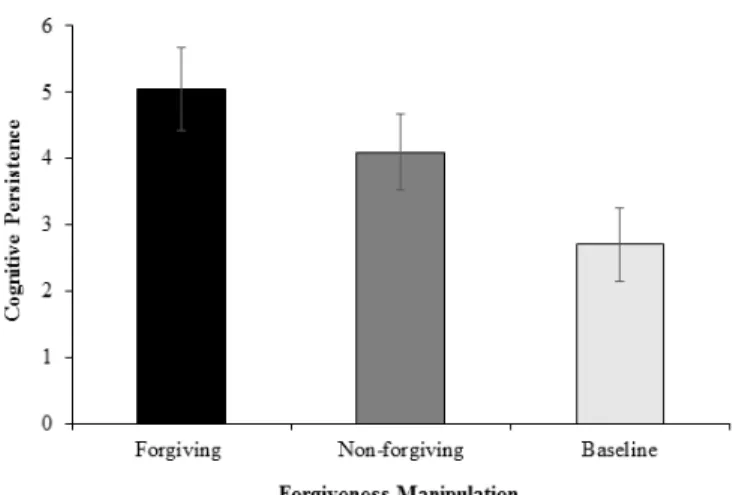
Cognitive persistence. The one-way ANOVA showed that the forgiveness manipulation had a significant effect on cognitive persistence, F (2, 52) = 17.70, p < .001, ηp2 = .41. As Hypothesis 1 predicted, participants in the forgiving condition showed significantly higher levels of cognitive persistence (M = 5.05, SD = .98) than those in the non-forgiving (M = 4.09, SD = 1.45; p < .03, 95% CI = [.11, 1.81]) and baseline (M = 2.70, SD = 1.28; p < .001, 95% CI = [1.55, 3.15])
conditions. Similarly, cognitive persistence among participants in the non-forgiving condition (M = 4.09, SD = 1.45) increased compared with that of participants in the baseline condition (M = 2.70, SD = 1.28; p < .01, 95% CI = [.56, 2.23]; see Figure 1). Thus, Hypothesis 1 Figure 1. Cognitive persistence as a function of forgiveness manipulation:
forgiving, non-forgiving, and baseline conditions (Experiment 1). Error bars represent 95% confidence interval.
Figure 2. Creativity as a function of forgiveness manipulation: forgiving, non-forgiving, and baseline conditions (Experiment 1). Error bars represent 95% confidence interval.
was supported within the Korean sample.
Creativity. The one-way ANOVA showed that the forgiveness manipulation had a significant effect on creativity F (2, 52) = 3.25, p
= .047, ηp2 = .11. Replicating the findings of Fehr (2010), participants in the forgiving condition showed significantly higher creativity levels (M = 3.05, SD = 1.04) than those in the non-forgiving condition (M = 2.22, SD = .93; p < .02, 95% CI = [.14, 1.52]) and marginally higher levels than those in the baseline condition (M = 2.45, SD = 1.05; p <
.07, 95% CI = [−.05, 1.25]). There was no difference in the creativity of participants in the non-forgiving and baseline conditions (p > .40;
see Figure 2). Thus, while the non-forgiving condition did not reduce creativity, the forgiving (vs. non-forgiving) condition increased creativity.
Mediation. The correlation between cognitive persistence and creativity was .31 (p < .03). The bias-corrected confidence interval of bootstrapping (Preacher and Hayes 2008) with 5,000 bootstrap resamples did not include zero (95% CI = [.0013, .2868]), indicating that forgiving had an indirect effect on creativity via cognitive persistence (see Figure 3). That is, forgiving increased creativity by increasing cognitive persistence. Thus, Hypothesis 2 was confirmed within the Korean sample.
Figure 3. Indirect effect of forgiveness on creativity mediated by cognitive persistence (Experiment 1). Numbers in parentheses represent standard errors. *p < .05.
Cognitive Persistence
Forgiveness Creativity
a = .5381*
(.2074) b = .1581
(.0884) c = .4228*
(.1707)
c’ = .3377 (.1739)
Alternative Explanation Results
Cognitive flexibility. A one-way ANOVA showed that the forgiveness manipulation had a significant effect on cognitive flexibility, F (2, 52) = 5.92, p < .01, ηp2 = .19. Participants in the forgiving condition (M = 2.66, SD = 1.28) showed similar levels of cognitive flexibility as those in the non-forgiving condition (M = 2.53, SD = 1.51; p > .70, 95% CI = [−.69, .94]). Cognitive flexibility of participants in the forgiving condition (M = 2.66, SD = 1.28) was lower than that of participants in the baseline condition (M = 3.75, SD = .75; p < .01, 95% CI = [−1.86, −.32]). Likewise, cognitive flexibility of participants in the non-forgiving condition (M = 2.53, SD = 1.51) was lower than that of participants in the baseline condition (M = 3.75, SD = .75; p < .01, 95% CI = [−2.02, −.41]). The correlation between cognitive flexibility and creativity was .10 (p
> .40). The bootstrapping results included zero (95% CI = [−.0444, .0812]), indicating that forgiving had no indirect effect on creativity via cognitive flexibility.
Conflict focus. A one-way ANOVA showed the significant effect of the forgiveness (vs. non-forgiving and baseline) manipulation on the ratio of conflict phrases, F (2, 52) = 8.42, p < .01, ηp2 = .25.
Participants in the non-forgiving condition (M = .09, SD = .10) showed a higher ratio of conflict phrases than those in the forgiving condition (M = .03, SD = .01; p < .01, 95% CI = [.02, .10]), and than those in the baseline condition (M = .01, SD = .03; p < .01, 95% CI
= [.04, .12]). Compared with the baseline condition, participants in the forgiving condition showed no significant difference for the ratio of conflict phrases (p > .20, 95% CI = [−.06, .02]). Thus, our finding that participants in the forgiving condition showed higher cognitive persistence than those in the non-forgiving condition cannot be driven by the forgiving group’s greater focus (or the non-forgiving group’s lesser focus) on conflict. Furthermore, the bootstrapping results included zero (95% CI = [−.0413, .2098]), which indicates that the act of forgiving had no indirect effect on creativity through conflict focus.
Emotion. The one-way ANOVA showed that the forgiveness manipulation had no significant effect on positive emotion, F (2, 52)
= 1.96, p = .151, ηp2 = .07, or negative emotion, F (2, 52) = .59, p =
.560, ηp2 = .02. Moreover, the bootstrapping results included zero for both positive emotion (95% CI = [−.1287, .0285]) and negative emotion (95% CI = [−.2028, .0222]). These results ruled out the emotion-based alternative explanation of the beneficial effect of forgiving on creativity.
Discussion of Experiment 1 Results
Experiment 1 provides evidence that forgiving increases creativity via increased cognitive persistence. While the forgiving group demonstrated increased creativity compared to the non-forgiving group, this was not observed in comparisons with the baseline group. These findings may be attributed to the limitations or context specificity of our experiment. Limitations included a small sample size, selection of Korean undergraduate students as participants, and use of a single creativity measure. Thus, prior to interpreting the results and assessing their generalizability, we sought subsequent replication within a large sample from a diverse population, using a variety of measures. We therefore conducted Experiment 2 with a sample of participants from the United States, using a different measure of creativity.
EXPERIMENT 2
We conducted Experiment 2 to examine whether our prediction could be replicated across a different culture using an alternative measurement of creativity. We used the Remote Associates Test (RAT), which measures general creativity levels and creative problem-solving (Dewhurst, Thorley, Hammond, and Ormerod 2011;
Storm, Angello, and Bjork 2011). The experimental design and procedure were identical to those of Experiment 1.
Participants
Initially, 158 US-based Amazon Mechanical Turk users whose first language was English participated in this experiment. The participants whose data we ultimately used (see below) had diverse occupations and the following demographics: 58 males and 79 females; Mage = 33.34, SD = 11.04; White (74.5%), Hispanic (8.8%),
African-American (8%), Asian (5.8%), and other (2.9%) ethnicities. At the end of our survey, we asked participants the following question:
“Your honest response to our study is very important for obtaining accurate data. Should we use your data?” This simple measure of self-screening served as an effective method to discard careless responders, whose responses might decrease overall data quality and generate less valid results (Meade and Craig 2012). We excluded 21 participants who answered “no” to that question and proceeded to analyze data for the remaining 137 participants.
Independent, Mediator, and Alternative Explanation Variables
We relied on the same forgiveness manipulation and measures for cognitive persistence (inter-rater reliability = .88), cognitive flexibility (inter-rater reliability = .77), conflict focus, and positive (α = .90) and negative emotion (α = .94) used in Experiment 1.
Dependent Variable
Creativity. Participants were asked to complete a 20-item RAT (Bowers, Regehr, Balthazard, and Parker 1990; Mednick and Mednick 1967). For each item, the task was to find the correct word connecting three clue words (e.g., Elephant – Lapse – Vivid → Memory). To complete the RAT successfully, participants needed to suppress their inclination to associate a highly related word with one specific word in isolation. Instead, they needed to generate a new word that was associated remotely with all three parallel clue words (Mednick 1962). Thus, determining the correct answer required the ability to approach the problem from a novel perspective and apply associative thinking. The number of correct answers served as the index of creativity for each participant.
Manipulation Checks
Our method of conducting manipulation checks within the US sample was identical to that for Experiment 1. Interrater reliability was .76 for the forgiving ratio and .71 for the non-forgiving ratio.
Examples of phrases related to forgiving were “eventually forgave her,” “later forgave him and moved on,” and “all was forgiven.”
Examples of phrases associated with non-forgiving were “never
forgave him,” “haven’t forgiven her yet,” and “hurt me to the core and I have not forgiven the friend.”
We ran a 3 (forgiving, non-forgiving, baseline) × 2 (forgiving ratio, non-forgiving ratio) mixed ANOVA, with the latter measure as a within-participants factor. The results showed that the two-way interaction was significant, F (2, 134) = 45.72, p < .001, ηp2 = .41.
Subsequent multivariate analyses conducted for the forgiving ratio, F (2, 134) = 47.59, p < .001, ηp2 = .42, and non-forgiving ratio, F (2, 134) = 31.47, p < .001, ηp2 = .32 were significant. Specifically, participants in the forgiving condition (M = .02, SD = .01) showed a higher ratio of forgiving phrases than those in the non-forgiving (M
= .00, SD = .01; p < .01, 95% CI = [.01, .02]) and baseline (M = .00, SD = .00; p < .01, 95% CI = [.01, .02]) conditions. Participants in the non-forgiving and baseline conditions generated similar ratios of forgiving phrases (p > .10, 95% CI = [−.001, .007]). Moreover, participants in the non-forgiving condition (M = .02, SD = .02) demonstrated a higher ratio of non-forgiving phrases than those in the forgiving (M = .00, SD = .01; p < .01, 95% CI = [.01, .02]) and baseline (M = .00, SD = .00; p < .01, 95% CI = [.01, .02]) conditions.
Participants in the forgiving and baseline conditions generated statistically equivalent ratios of non-forgiving phrases (p > .30, 95%
CI = [−.003, .007]). Thus, our forgiveness manipulation was also effective among the US-based participants.
Hypothesis Testing
Cognitive persistence. A one-way ANOVA showed that the forgiveness manipulation had a significant effect on cognitive persistence, F (2, 134) = 14.54, p < .001, ηp2 = .18. As predicted, and replicating the findings of Experiment 1, participants in the forgiving condition showed significantly higher levels of cognitive persistence (M = 4.05, SD = 1.20) than those in the non-forgiving (M = 3.43, SD
= 1.67; p < .05, 95% CI = [.004, 1.222]) and baseline (M = 2.56, SD = 1.27; p < .001, 95% CI = [.93, 2.04]) conditions. Moreover, increased cognitive persistence occurred among participants in the non- forgiving condition (M = 3.43, SD = 1.67) compared with those in the baseline condition (M = 2.56, SD = 1.27; p < .01, 95% CI = [.30, 1.44]).
Thus, Hypothesis 1 was supported and replicated within the US- based sample.
Creativity. A one-way ANOVA showed that the forgiveness manipulation had a marginally significant effect on creativity, F (2, 134) = 2.74, p = .068, ηp2 = .04. More central to our research and as predicted, participants in the forgiving condition showed higher levels of creativity (M = 9.48, SD = 4.69) than those in the non-forgiving condition (M = 7.03, SD = 5.53; p < .04, 95% CI = [.19, 4.71]) and marginally higher levels than those in the baseline condition (M = 7.47, SD = 5.11; p < .06, 95% CI = [−.05, 4.06]).
There was no significant difference in the creativity of participants in the non-forgiving and baseline conditions (p > .60). These results replicated those of Fehr (2010), as well as our results in Experiment 1, once again demonstrating that forgiving (vs. non-forgiving) boosts creativity.
Mediation. The correlation between cognitive persistence and creativity was .21 (p < .02). The bias-corrected bootstrapping result (Preacher and Hayes 2008) with 5,000 bootstrap resamples showed that the indirect effect of forgiving on creativity via cognitive persistence was significant (95% CI = [.0042, .6108]), again consistent with Experiment 1. Thus, our results confirmed that cognitive persistence is the mechanism underlying the link between forgiving and creativity. Hypothesis 2 was confirmed and replicated within the US-based sample.
Alternative Explanation Results
Cognitive flexibility. A one-way ANOVA showed that the forgiveness manipulation had a significant effect on cognitive flexibility, F (2, 134) = 44.62, p < .001, ηp2 = .40. Contrary to the findings of Experiment 1, participants in the forgiving condition showed significantly higher levels of cognitive flexibility (M = 3.82, SD = 1.10) than those in the non-forgiving (M = 2.74, SD = 1.36, p < .001, 95% CI = [.60, 1.57]) and baseline (M = 1.74, SD = .84, p
< .001; 95% CI = [1.65, 2.52]) conditions. Additionally, increased cognitive flexibility was evident among participants in the non- forgiving condition (M = 2.74, SD = 1.36) compared with those in the baseline condition (M = 1.74, SD = .84; p < .01, 95% CI = [.55, 1.45]). The correlation between cognitive flexibility and creativity was .20 (p < .02). However, the bootstrapping result (95% CI = [−.0386, .8892]) includes zero, indicating that forgiving had no indirect effect
on creativity via cognitive flexibility, replicating Experiment 1.
Conflict focus. Examples of conflict-related phrases in our US participants’ descriptions included “got in a large fight,” “The last conflict that I suffered with,” and “had a fight about an assignment.”
A one-way ANOVA showed the significant effect of the forgiveness (vs. non-forgiving and baseline) manipulation on the ratio of conflict phrases, F (2, 134) = 95.22, p < .01, ηp2 = .59. Participants in the forgiving condition (M = .04, SD = .02) and non-forgiving condition (M
= .04, SD = .02) showed no significant difference for ratio of conflict phrases (p > .10, 95% CI = [−.01, .002]). Participants in the baseline condition (M = .00, SD = .00) showed a lower ratio of conflict phrases than those in the forgiving condition (M = .04, SD = .02; p < .01, 95% CI = [−.05, −.03]) and non-forgiving condition (M = .04, SD = .02; p < .01, 95% CI = [−.05, −.04]). These findings highlight that the difference we found between the forgiving and non-forgiving groups’
cognitive persistence cannot be attributed to their differential focus on conflict. Furthermore, the bootstrapping results included zero (95% CI = [−.2867, .0559]), which replicates the absence of indirect effect via conflict focus in Experiment 1.
Emotion. A one-way ANOVA showed that the forgiveness manipulation had no significant effect on positive emotion, F (2, 134) = 2.38, p = .10, ηp2 = .03, or negative emotion F (2, 134) = 1.83, p = .164, ηp2 = .03, replicating Experiment 1. In addition, the bootstrapping results included zero for both positive (95% CI = [−.1587, .0926]) and negative emotion (95% CI = [−.0330, .4473]), replicating the finding in Experiment 1 that emotion could not serve as an indirect path from forgiving to creativity.
Discussion of Experiment 2 Results
Our findings from Experiment 1 were replicated in Experiment 2 using a larger sample extracted from the general US population, along with an alternative measure of creativity. Whereas Experiment 1 measured divergent creativity (idea generation), Experiment 2 measured convergent creativity (RAT), which differs from the typical brainstorming type of creativity. Regardless of participants’ culture and measurement approaches, the consistent mediation-related results provide converging evidence that the act of forgiving boosts
creativity via cognitive persistence. A conflict situation is more likely to induce a victim (forgiver) to think persistently and thoroughly to resolve the conflict (e.g., Jung and Lee 2015). Under a problematic situation, a path associated with cognitive persistence (De Dreu et al. 2008; Nijstad et al. 2010) explains the creativity-boosting effect of forgiving in the search for resolution.
GENERAL DISCUSSION
This study examined the effect of forgiving on a victim’s creativity, and uncovered the cognitive mechanism underlying this relationship using the dual pathway to creativity model (De Dreu et al. 2008; Nijstad et al. 2010). We developed and tested hypotheses regarding whether the act of forgiving would increase creativity via cognitive persistence, rather than through cognitive flexibility. Two experiments conducted with US and Korean samples supported our hypotheses: Persistent and effortful thinking, but not flexible and unbounded thinking, was found to be responsible for the creativity- boosting effect of forgiving. Our findings make novel contributions to creativity research and the forgiveness literature.
Theoretical Contributions
Our study adds value to the dual pathway to creativity model (De Dreu et al. 2008; Nijstad et al. 2010) by revealing that the act of forgiving a transgressor is associated with the pathway of cognitive persistence. The creativity literature has focused mainly on the cognitive flexibility pathway to creativity. However, cognitive persistence is an equally important and viable pathway to creativity (De Dreu et al. 2008; Nijstad et al. 2010). Previous studies have shown that negative moods (De Dreu et al. 2008) and avoidance motivation (Roskes, De Dreu, and Nijstad 2012) enhance creativity through cognitive persistence. Adding to these psychological antecedents, our study has demonstrated a novel behavioral antecedent of cognitive persistence: the act of forgiving. To the extent that forgiving is an intentional action, it is under an individual’s control. Thus, our work elucidates an intentional behavior that can boost an individual’s creativity via the cognitive persistence pathway. As such, we advance research in this field by offering a
more balanced perspective on dual cognitive pathways (flexibility and persistence) to creativity.
Previous studies have used the dual pathway to creativity model to test creativity mostly for idea-generation tasks (Nijstad et al.
2010). Thus, the predictability of the model has been documented in relation to divergent creativity but not in regard to convergent creativity, as we did by applying the RAT in Experiment 2. Our work, therefore, expands the boundaries of the dual pathway model by demonstrating that it is applicable not only to divergent creativity (Experiment 1) but also to convergent creativity (Experiment 2).
This study extends previous findings for the beneficial effects of forgiving on creativity (Fehr 2010) by unearthing the specific cognitive mechanism for this relationship. In particular, an interpersonal conflict situation depletes a victim’s cognitive resources, whereas the act of forgiving helps the victim recover such resources (Fehr 2010). Our study suggests that how cognitive resources are processed is an important mechanism that drives the creativity-related benefits of forgiving. When cognitive resources are deployed in the persistent thinking associated with forgiving, creativity emerges as a natural product of forgiveness. Thus, it is a matter of how cognitive resources are used that impacts a victim’s creativity.
The current study extends the forgiveness literature by elucidating a new cognitive consequence of forgiving: namely, persistent and effortful thinking (cognitive persistence). Although forgiving is a difficult act for most people (Fincham 2009), a victim experiences multiple benefits after forgiving a transgressor. These include reduced depression (Burnette, Davis, Green, Worthington, and Bradfield 2009), increased relationship satisfaction (Fincham, Paleari, and Regalia 2002; Karremans and Van Lange 2004), altruism (Karremans, Van Lange, and Holland 2005), and psychological and physical well-being (Karremans et al. 2003). In addition to these benefits, our study has demonstrated the novel forgiving-related advantage of making a victim’s cognitive process more effortful and thorough. Such elaborative thinking has been documented to enhance performance in task domains such as information-sharing (Homan, Van Knippenberg, Van Kleef, and De Dreu 2007), group decision-making (Loyd, Wang, Phillips, and Lount 2013), and creativity (De Dreu et al. 2008). Thus, the present study suggests that forgiving significantly enhances victims’ functioning,
not only psychologically and emotionally, but also in regard to creative task performance.
Our findings also facilitate reinterpretation of previous work on forgiveness. Recent research has shown that forgiving (vs. not forgiving) motivates a victim to forget about an offense (Noreen et al.
2014). Our findings hint at a potential mechanism underlying the causal direction of the forgiving-forgetting link. One explanation may be that the act of forgiving facilitates forgetting through cognitive persistence. Once a victim has forgiven a transgressor and then thinks deeply and thoroughly about a past offense, he or she may eradicate suppressed thoughts about the offense more willingly, making it easier for the victim to forget the incident and move on.
By contrast, if the offense is forgotten, nothing would remain to think deeply and thoroughly about. Therefore, cognitive persistence is unlikely to be an outcome of forgetting.
Moreover, our findings showed that the act of forgiving promoted creativity similarly across divergent cultures. People forgive wrongdoers to maintain and restore harmonious relationships.
Belongingness is one of the most fundamental human motivations to form interpersonal bonds (Baumeister and Leary 1995). The quest to belong promotes human survival, because being part of a cooperative group allows for sharing of resources across people, as opposed to dependence on only one’s own resources (DeWall and Bushman 2011). This innate need to belong is ubiquitous, serving as a major psychological driving force across cultures, although individual differences may exist (Baumeister and Leary 1995).
While East Asian cultures differ from North American cultures in the former’s larger emphasis on the value of interdependence and relationships (Lee, Brett, and Park 2012; Markus and Kitayama 1991), North Americans are not always more independent or less interdependent than their East Asian counterparts (Heine, Lehman, Peng, and Greenholtz 2002; Oyserman, Coon, and Kemmelmeier 2002). To the extent that the pursuit of harmonious relationships and belongingness is universal among humans (Baumeister and Leary 1995; DeWall and Bushman 2011), the effect of forgiving on creativity (and mediation thereof by cognitive persistence) was manifested similarly in East Asian and North American cultures.
Limitations and Future Research
Among methodological limitations, our overall sample size was smaller than we originally planned. We initially planned to recruit 158 participants, as indicated by a previous power analysis based on an expected size effect f of 0.25, a statistical power of 0.8, and an α value of 0.5. However, due to practical constraints, our ultimate sample sizes in Experiments 1 and 2 were 55 and 137 respondents, respectively, after excluding careless respondents.
Although our sample sizes were smaller than originally intended, our results revealed adequate statistical power. This ranged from 0.594 (creativity) to 1.000 (cognitive persistence) in Experiment 1, and from 0.534 (creativity) to 1.000 (cognitive flexibility) in Experiment 2. Given that the statistical power of a typical study relating to personality and social psychology ranges from 0.45 to 0.65 (Rossi 2013), our results appear to have sufficient statistical power overall. Nevertheless, potential power issues should be considered in interpretation of our results.
The current study relied only on a recall methodology to manipulate forgiveness. This is a standard measure that has been validated and used widely in the forgiveness literature. However, because participants recalled idiosyncratic incidents relating to past conflict, the severity or context of the conflict recalled may have differed among participants. Future studies should control for or manipulate conflict severity to examine more carefully the causal effect of forgiving on cognitive persistence and creativity.
Related to that, our forgiveness manipulation may fall short of its managerial applicability. We relied on an experimental design because our purpose was to examine the causal impact of forgiving on creativity. In so doing, our findings are limited to demonstrate external validity. Although some participants recalled an interpersonal conflict in the workplace (e.g., forgiving a coworker’s wrongdoing), the majority of participants described a conflict in general settings, not necessarily professional ones. To garner external validity of our findings, future research should measure employees’ forgiving at time 1, cognitive persistence at time 2, and creativity at time 3 in an organizational setting using a longitudinal design.
Another factor that may have influenced our findings involves levels of interpersonal commitment (Karremans et al. 2003). Because
our participants were asked to recall a past conflict with anyone within their social environments (e.g., friends or acquaintances), we were unable to control for the level of interpersonal commitment—
it may have been strong or weak for the incident a given participant recalled. Thus, the data provided by our participants who recalled situations involving high interpersonal commitment may have been more in line with our hypotheses than the responses of participants who recalled low-interpersonal-commitment situations. This is because individuals who are highly committed to their relationships with transgressors should perceive conflicts as more problematic than those who are less committed and, thus, engage in more persistent and thorough thinking to resolve the issue. By contrast, the forgiving-creativity link may be broken for a victim with low interpersonal commitment. Thus, future studies could address the moderating role of levels of interpersonal commitment to determine or extend the boundaries of our findings.
Practical Implications
Current management practice often aims to prevent conflict among employees. However, no matter how well an organization works toward this objective, interpersonal conflict inevitably arises in most work and non-work situations. Thus our findings offer a more viable perspective on conflict management. That is, what is more important is post-, not ante-, conflict management at work, and forgiveness is one beneficial interpersonal process in this context. Forgiving a transgressor is not easy, but it is under an individual’s control and, when achieved, contributes to a victim’s persistent and ultimately creative thinking.
Our research, then, suggests that managers should encourage employees to forgive the wrongdoing of colleagues, to promote more creativity and innovation—critical organizational qualities in ever- more competitive market environments. We propose that managers should take a proactive and benevolent approach to handling workplace conflict by educating and encouraging employees to forgive colleagues who may have been responsible for the conflict.
At the individual level, forgiving enhances not only psychological and physical well-being (Karremans et al. 2003; Orcutt 2006;
Toussaint and Webb 2005) but also fosters persistent and effortful thinking that boosts the forgiver’s creativity, ultimately benefiting
the organization. That means managers should educate employees on the idea that forgiveness is not only a solution for resolving workplace conflict but also has a latent benefit in making the forgiver’s cognitive process more persistent and thorough, eventually leading to higher creative work performance. In this way, a more innovative, creative mind may originate from a forgiving heart.
REFERENCES
Amabile, T. M. (1983), “The Social Psychology of Creativity: A Componential Conceptualization,” Journal of Personality and Social Psychology, 45(2), 357–376.
Aquino, K., S. L. Grover, B. Goldman, and R. Folger (2003), “When Push Doesn’t Come to Shove: Interpersonal Forgiveness in Workplace Relationships,” Journal of Management Inquiry, 12(3), 209–216.
Baas, M., C. K. De Dreu, and B. A. Nijstad (2008), “A Meta-analysis of 25 Years of Mood-Creativity Research: Hedonic Tone, Activation, or Regulatory Focus?,” Psychological Bulletin, 134(6), 779−806.
_______ (2011), “When Prevention Promotes Creativity: The Role of Mood, Regulatory Focus, and Regulatory Closure,” Journal of Personality and Social Psychology, 100(5), 794–809.
Baumeister, R. F. and M. R. Leary (1995), “The Need to Belong:
Desire for Interpersonal Attachments as a Fundamental Human Motivation,” Psychological Bulletin, 117(3), 497–529.
Bowers, K. S., G. Regehr, C. Balthazard, and K. Parker (1990), “Intuition in the Context of Discovery,” Cognitive Psychology, 22(1), 72–110.
Braithwaite, S. R., E. A. Selby, and F. D. Fincham (2011), “Forgiveness and Relationship Satisfaction: Mediating Mechanisms,” Journal of Family Psychology, 25(4), 551−559.
Burnette, J. L., D. E. Davis, J. D. Green, E. L. Worthington, and E. Bradfield (2009), “Insecure Attachment and Depressive Symptoms: The Mediating Role of Rumination, Empathy, and Forgiveness,” Personality and Individual Differences, 46(3), 276−280.
Campbell, D. T. (1960), “Blind Variation and Selective Retentions in Creative Thought as in Other Knowledge Processes,” Psychological Review, 67(6), 380−400.
Carnevale, P. J. and T. M. Probst (1998), “Social Values and Social Conflict in Creative Problem Solving and Categorization,” Journal of Personality and Social Psychology, 74(5), 1300–1309.
Carver, C. S. (2004), “Negative Affects Deriving from the Behavioral Approach System,” Emotion, 4(1), 3–22.
De Dreu, C. K. (2006), “When Too Little or Too Much Hurts: Evidence for a Curvilinear Relationship between Task Conflict and Innovation in Teams,” Journal of Management, 32(1), 83−107.
_______ (2010), “Social Conflict: The Emergence and Consequences of Struggle and Negotiation,” in Handbook of Social Psychology, S. T.
Fiske, D. T. Gilbert, and G. Lindzey eds., New York: Wiley, 983−1023.
De Dreu, C. K. and L. R. Weingart (2003), “Task versus Relationship Conflict, Team Performance, and Team Member Satisfaction: A Meta- analysis,” Journal of Applied Psychology, 88(4), 741−749.
De Dreu, C. K., M. Baas, and B. A. Nijstad (2008), “Hedonic Tone and Activation Level in the Mood-Creativity Link: Toward a Dual Pathway to Creativity Model,” Journal of Personality and Social Psychology, 94(5), 739−756.
De Dreu, C. K. and M. A. West (2001), “Minority Dissent and Team Innovation: The Importance of Participation in Decision Making,”
Journal of Applied Psychology, 86(6), 1191−1201.
DeWall, C. N. and B. J. Bushman (2011), “Social Acceptance and Rejection the Sweet and the Bitter,” Current Directions in Psychological Science, 20(4), 256−260.
Dewhurst, S. A., C. Thorley, E. R. Hammond, and T. C. Ormerod (2011),
“Convergent, but Not Divergent, Thinking Predicts Susceptibility to Associative Memory Illusions,” Personality and Individual Differences, 51(1), 73−76.
Dreisbach, G. and T. Goschke (2004), “How Positive Affect Modulates Cognitive Control: Reduced Perseveration at the Cost of Increased Distractibility,” Journal of Experimental Psychology: Learning, Memory, and Cognition, 30(2), 343–353.
Enright, R. D., E. A. Gassin, and C. R. Wu (1992), “Forgiveness: A Developmental View,” Journal of Moral Education, 21(2), 99−114.
Farh, J. L., C. Lee, and C. I. Farh (2010), “Task Conflict and Team Creativity: A Question of How Much and When,” Journal of Applied Psychology, 95(6), 1173−1180.
Fehr, R. (2010), “On the (Un)intended Consequences of Forgiveness:
Creativity After Conflict,” Doctoral Dissertation. University of Maryland, College Park, Maryland, United States. http://drum.lib.umd.edu/
handle/1903/10878.
Fehr, R. and M. J. Gelfand (2012), “The Forgiving Organization: A Multilevel Model of Forgiveness at Work,” Academy of Management Review, 37(4), 664−688.
Fehr, R., M. J. Gelfand, and M. Nag (2010), “The Road to Forgiveness:
A Meta-analytic Synthesis of Its Situational and Dispositional Correlates,” Psychological Bulletin, 136(5), 894−914
Fincham, F. D. (2000), “The Kiss of the Porcupines: From Attributing Responsibility to Forgiving,” Personal Relationships, 7(1), 1−23.
_______ (2009), “Forgiveness: Integral to a Science of Close Relationships?,”
in Prosocial Motives, Emotions, and Behavior: The Better Angels of Our Nature, M. Mikulincer and P. R. Shaver eds., Washington, DC: APA Books, 347−365.
Fincham, F. D., J. Hall, and S. R. Beach (2006), “Forgiveness in Marriage:
Current Status and Future Directions,” Family Relations, 55(4), 415−427.
Fincham, F. D., F. Paleari, and C. Regalia (2002), “Forgiveness in Marriage:
The Role of Relationship Quality, Attributions, and Empathy,” Personal Relationships, 9(1), 27−37.
Finkel, E. J. and W. K. Campbell (2001), “Self-control and Accommodation in Close Relationships: An Interdependence Analysis,” Journal of Personality and Social Psychology, 81(2), 263−277.
Finkel, E. J., C. E. Rusbult, M. Kumashiro, and P. A. Hannon (2002), “Dealing with Betrayal in Close Relationships: Does Commitment Promote Forgiveness?,” Journal of Personality and Social Psychology, 82(6), 956−974.
Hamilton, A. (2012) Forgiveness: Finding Peace through Letting Go. Nashville, TN: Abingdon Press.
Harris, A. H. and C. E. Thoresen (2005), “Forgiveness, Unforgiveness, Health, and Disease,” in Handbook of Forgiveness, E. L. Worthington ed., New York: Brunner-Routledge, 321−334.
Heine, S. J., D. R. Lehman, K. Peng, and J. Greenholtz (2002), “What’s Wrong with Cross-cultural Comparisons of Subjective Likert Scales?
The Reference-group Effect,” Journal of Personality and Social Psychology, 82(6), 903−918.
Homan, A. C., D. Van Knippenberg, G. A. Van Kleef, and C. K. De Dreu (2007), “Bridging Faultlines by Valuing Diversity: Diversity Beliefs, Information Elaboration, and Performance in Diverse Work Groups,” Journal of Applied Psychology, 92(5), 1189−1199.
Jaben, T. H. (1983), “The Effects of Creativity Training on Learning Disabled Students’ Creative Written Expression,” Journal of Learning Disabilities, 16(5), 264−265.
Jehn, K. A. (1995), “A Multimethod Examination of the Benefits and Detriments of Intragroup Conflict,” Administrative Science Quarterly, 40(2), 256−282.
Jehn, K. A. and C. Bendersky (2003), “Intragroup Conflict in Orga- nizations: A Contingency Perspective on the Conflict-Outcome Relationship,” Research in Organizational Behavior, 25, 187−242.
Jehn, K. A., S. Rispens, and S. M. Thatcher (2010), “The Effects of Conflict Asymmetry on Work Group and Individual Outcomes,” Academy of Management Journal, 53(3), 596−616.
Jung, E. J. and S. Lee (2015), “The Combined Effects of Relationship Conflict and the Relational Self on Creativity,” Organizational Behavior and Human Decision Processes, 130, 44−57.
Karremans, J. C. and P. A. Van Lange (2004), “Back to Caring After Being Hurt: The Role of Forgiveness,” European Journal of Social Psychology, 34(2), 207−227.
_______ (2008a), “Forgiveness in Personal Relationships: Its Malleability and Powerful Consequences,” European Review of Social Psychology, 19(1), 202−241.
_______ (2008b), “The Role of Forgiveness in Shifting from “Me” to “We”,” Self and Identity, 7(1), 75−88.
Karremans, J. C., P. A. Van Lange, and R. W. Holland (2005), “Forgiveness and Its Associations with Prosocial Thinking, Feeling, and Doing beyond the Relationship with the Offender,” Personality and Social Psychology Bulletin, 31(10), 1315−1326.
Karremans, J. C., P. A. Van Lange, J. W. Ouwerkerk, and E. S. Kluwer (2003), “When Forgiving Enhances Psychological Well-being: The Role of Interpersonal Commitment,” Journal of Personality and Social Psychology, 84(5), 1011−1026.
Koch, S., R. W. Holland, and A. van Knippenberg (2008), “Regulating C o g n i t i v e C o n t r o l T h r o u g h A p p r o a c h - A v o i d a n c e M o t o r Actions,” Cognition, 109(1), 133–142.
Lee, S., J. Brett, and J. H. Park (2012), “East Asians’ Social Heterogeneity:
Differences in Norms among Chinese, Japanese, and Korean Negotiators,” Negotiation Journal, 28(4), 429−452.
Loyd, D. L., C. S. Wang, K. W. Phillips, and R. B. Lount Jr (2013), “Social Category Diversity Promotes Premeeting Elaboration: The Role of Relationship Focus,” Organization Science, 24(3), 757−772.
Lucas, B. J. and L. F. Nordgren (2015), “People Underestimate the Value of Persistence for Creative Performance,” Journal of Personality and Social Psychology, 109(2), 232–243.
Markus, H. R. and S. Kitayama (1991), “Culture and the Self: Implications for Cognition, Emotion, and Motivation,” Psychological Review, 98(2), 224−253.
McCullough, M. E., F. D. Fincham, and J. A. Tsang (2003), “Forgiveness, Forbearance, and Time: The Temporal Unfolding of Transgression- related Interpersonal Motivations,” Journal of Personality and Social Psychology, 84(3), 540−557.
McCullough, M. E., E. L. Worthington Jr, and K. C. Rachal (1997),
“Interpersonal Forgiving in Close Relationships,” Journal of Personality and Social Psychology, 73(2), 321−336.
Meade, A. W. and S. B. Craig (2012), “Identifying Careless Responses in Survey Data,” Psychological Methods, 17(3), 437−455.
Mednick, S. A. and M. T. Mednick (1967), Examiner’s Manual: Remote Associates Test. Boston: Houghton Mifflin.
Mednick, S. A. (1962), “The Associative Basis of the Creative Process,”
Psychological Review, 69(3), 220−232.
Nemeth, C. J. (1986), “Differential Contributions of Majority and Minority Influence,” Psychological Review, 93(1), 23−32.
Nijstad, B. A., C. K. De Dreu, E. F. Rietzschel, and M. Baas (2010),
“The Dual Pathway to Creativity Model: Creative Ideation as a Function of Flexibility and Persistence,” European Review of Social