Introduction
Motivation
In recent modeling results, increased CO2 concentration in the future leads to global warming and increased precipitation (Friedlingstein et al., 2003; Bony et al., 2006). Moisture and currents over land promote increased CO2 growth rates in the atmosphere due to suppression of soil carbon uptake (Heimann and Reichstein et al., 2014; . Wang et al., 2014).
Scientific Objectives
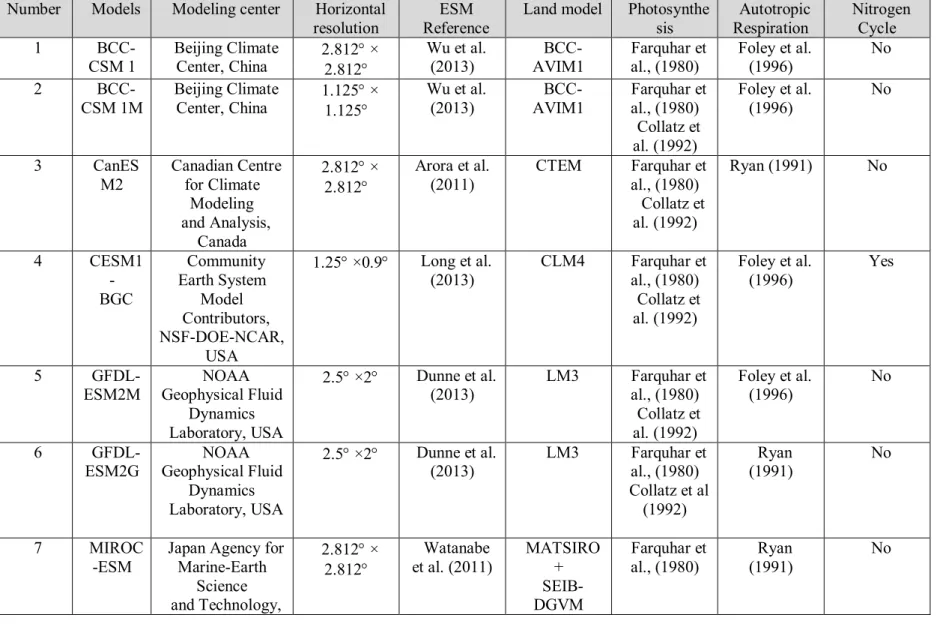
Historical simulations (also Experiment 5.2 or ESM Historical Simulation 1850–2005; Taylor et al., 2012) were subjected to the gridded fossil fuel CO2 emission data of Andres et al. The GPP simulation is directly linked to the photosynthesis formulas in the models.
Historical Backgrounds and Model Descriptions
Previous studies of modeling for land-atmosphere carbon-cycle
This bias of atmospheric CO2 concentration in historical simulation continues continuously in the future projection of atmospheric CO2 concentration each model (Hoffman et al., 2013;. In the model study, simulated CUE in ESMs depends on the space represented for climate characteristics not time (Shao et al., 2013).
Processes of Terrestrial Biosphere in the models
Typically, Ra parameterized in models are a function of temperature over carbon stocks or the maximum potential of plants to take up carbon (Collatz et al., 1991). Most plants globally are limited in growth by the amount of nitrogen or phosphorus (Fisher et al., 2012).
Model Descriptions
- Overall Description of GFDL-ESM2M
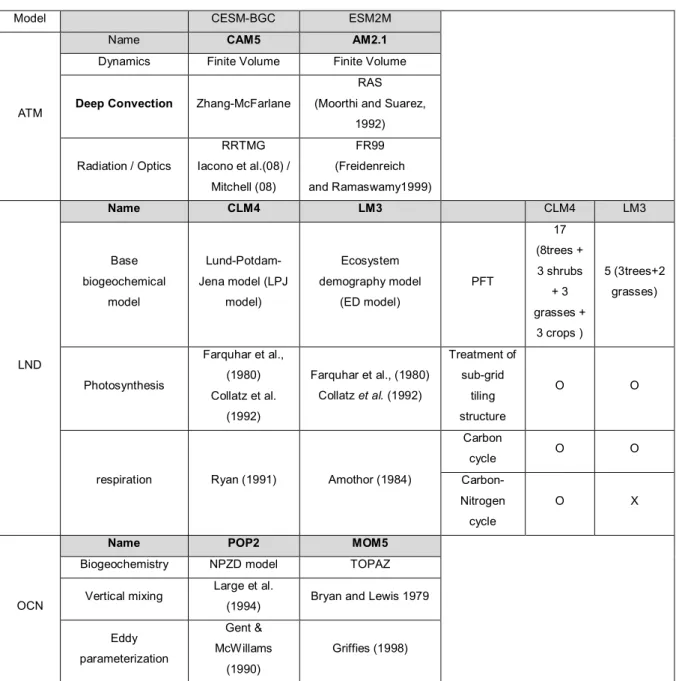
- Characteristics of CLM4
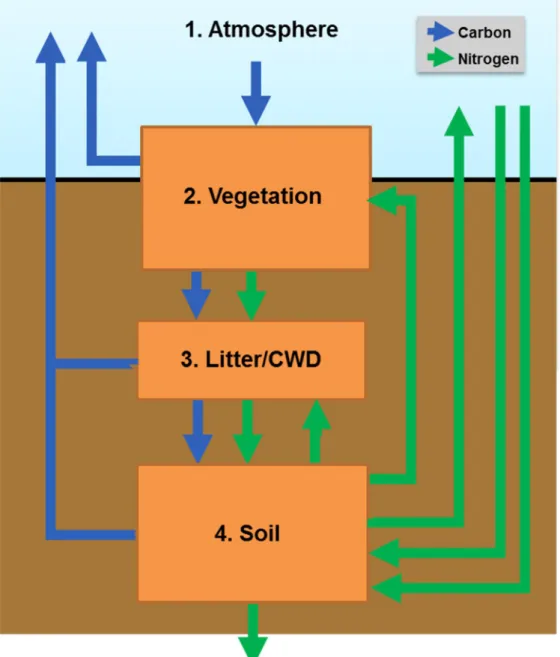
The major difference between CLM4 and LM3 is the coupling of nitrogen (N) processes within the carbon (C) cycle in the parameterization of biogeochemistry in CLM4 (Thornton et al., 2007; Thornton et al., 2009). Photosynthesis in the terrestrial biosphere is the same as LM3, which is based on Farquhar et al., (1980) in C3 plants and Collatz et al.
Parameterizations of Terrestrial Biogeochemistry
- Photosynthesis parameterization
- Respiration parameterization
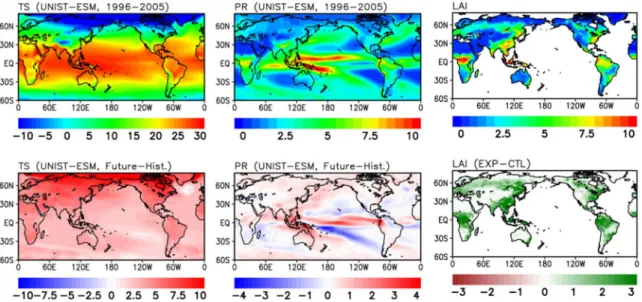
In the UNIST-ESM simulation, the global surface temperature will increase significantly in the future. The change in the pattern and amount of precipitation in the future is also shown in Figure 5.1.
Validation Data
Intercomparison of the Dynamic Vegetation Parameterization and
Analysis Methods
For the comparison with MODIS, this study also used GPP estimates from FLUXNET-MTE (Multi-Tree Ensemble; Jung et al. 2011), which is an upscaled data for global coverage of 178 surface flux tower observations by a machine learning technique to use. Although this gridded global dataset is useful for validating ESMs, key limitation is also discussed in the literature (Jung et al. 2011). A striking difference between the two is in the Amazon where MODIS tends to significantly underestimate productivity.
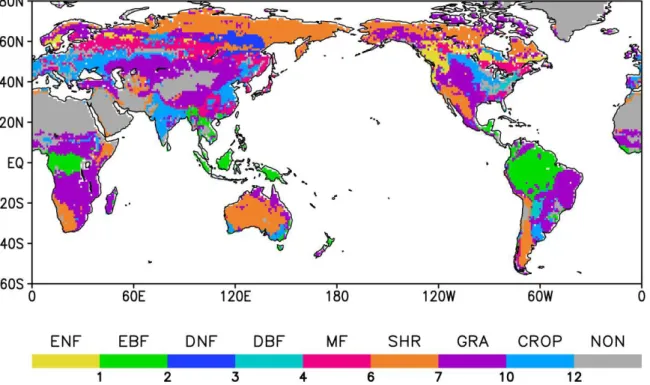
In the remaining regions, MODIS tends to underestimate slightly in the tropics and overestimate at high latitudes in general, compared to FLUXNET. The model data are obtained from the Earth System Network Federation (ESGF), an international network of distributed climate data servers (Williams et al., 2011). It is noted that the deficiency in the simulation of CUE according to the individual model is not only caused by the deficiencies in the parameterization of carbon fluxes from the vegetation, but also by the differences in the classifications of PFTs specified differently in each model.
Systematic Biases in Multi-Model Ensemble
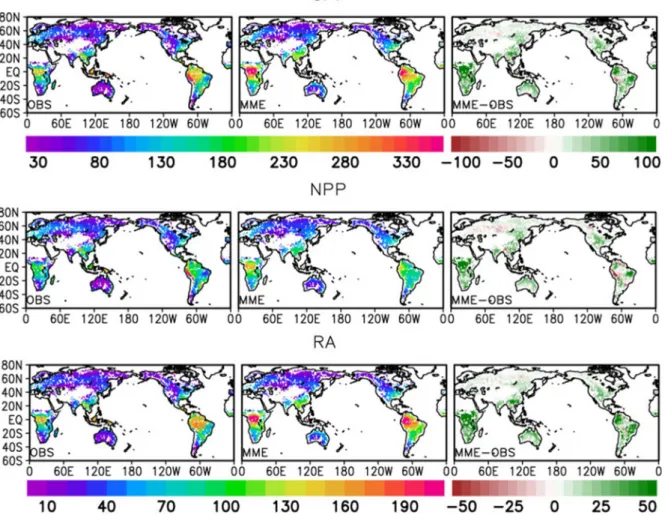
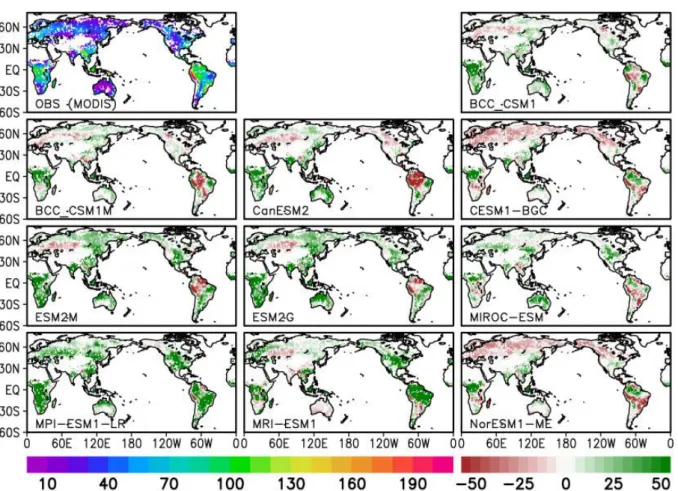
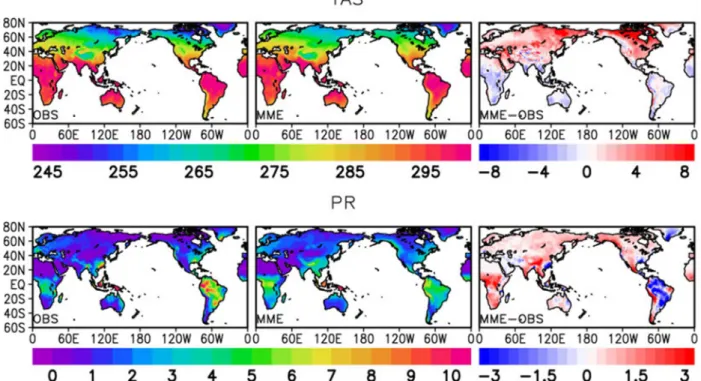
The formulations of GPP and Ra are closely related to temperature and precipitation (Rahman et al., 2005; Yang et al., 2006), and the model perturbations in these carbon fluxes may be driven by both systematic biases in climate conditions, e.g. such as temperature and precipitation and the uncertainty in the actual formulation of dynamic vegetation models. The models also show much higher spatial variability than that observed in both GPP and NPP. The Taylor diagram analysis suggests that the systematic biases in the ESMs may be successively amplified by the deficiencies in the simulation of climate and terrestrial carbon cycle.
Additionally, much greater scatter in GPP and NPP by ESMs than in temperature and precipitation suggests that there should be much greater uncertainty in the parameterization of terrestrial carbon cycling in current dynamic vegetation models. Taylor diagram of CMIP5 ESMs for annual mean distribution of (a) surface air temperature, (b) precipitation, (c) gross primary production (GPP) and (d) net primary production (NPP) with respect to the corresponding observations for 6 more years. The observed values are from CRU for temperature and precipitation is MODIS for GPP and NPP.
Model Dependences
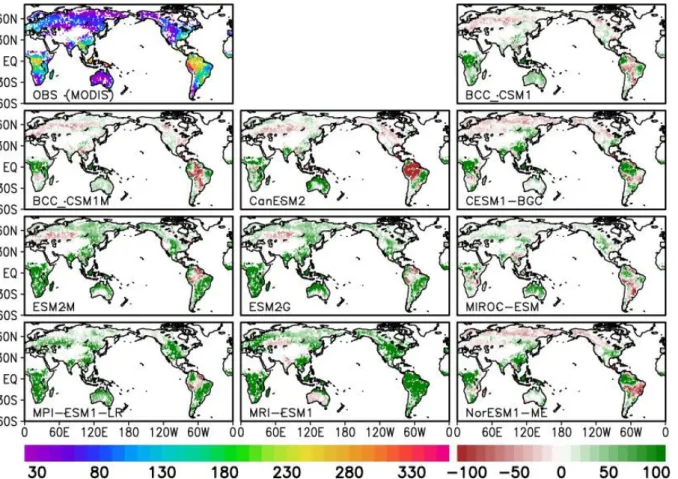
The two GFDL models with the same dynamic vegetation model implemented in LM3 (i.e. ESM2M and ESM2G) and the other two models with CLM4 (CESM1-BGC and NorESM1-ME) show completely opposite signs of NPP bias in the boreal regions north to 40 N , which highlights significant model differences in the carbon flux parameterization through vegetation.
Carbon Use Efficiency
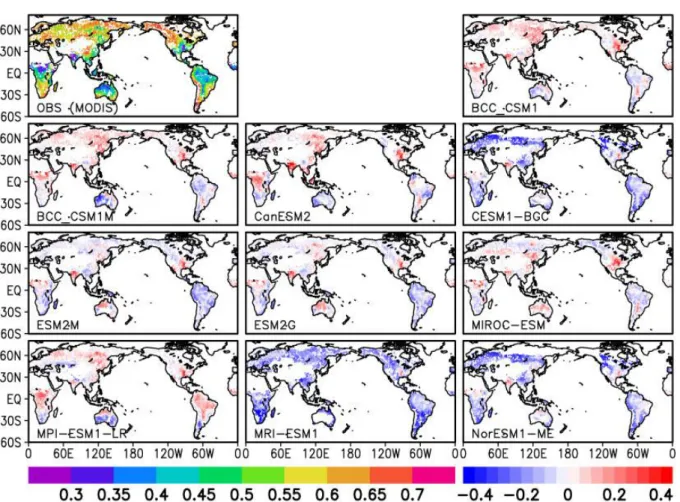
Furthermore, the observed CUE shows the sensitivity of CUE associated with precipitation in the tropics where there is more sensitivity of plant growth and precipitation compared to high latitudes. In contrast, CLM4.0-based models such as CESM1-BGC and NorESM1-ME and MRI-ESM1 show weaker sensitivity of CUE for both temperature and precipitation than other models. This large divergence of CUE model sensitivity with temperature and precipitation induces atmospheric CO2 concentration in the future climate from fully coupled ESMs.
Inclusion of the nitrogen cycle in models typically limits the amount of land surface carbon uptake by vegetation (Zaehle et al., 2010; Friedlingstein et al., 2014) and higher simulated growth respiration than other models (Shao et al., 2013). ). This means that current models do not adequately account for the observed ecological resistance to temperature, and the balance between respiration and production in the models is more simplistic than observed. In fact, the parameterization of most dynamic vegetation models is based on a conceptual formulation at the leaf level, such as in the calculation of processes of biochemical photosynthesis and the dependence of CO2 exchange on stomatal conductance, which explicitly use temperature and soil moisture in their formulations.
Summary and Discussion
The zonal distribution of CUE in MME is reasonably simulated compared to MODIS, with high CUE in high latitudes and low CUE in tropical and low latitudes. It indicates that CUE in warm temperature and abundant rainfall can be lowered as there is plenty of production and plant growth. The inverse relationship between temperature and CUE is reasonably simulated in the MME over arid regions.
From previous studies, the observed CUE has reasonable results with the CUE nonlinearity under temperature variation. In contrast, the stronger sensitivity of CUE to temperature increase in the MME is reflected in the systematic biases of the numerical biogeochemical processes. Therefore, the relationship between temperature and CUE in the models is too strongly linear compared to observation.
Characteristics of Target Models
Development of a new Earth system model with the possibility of the terrestrial carbon cycle with nitrogen cycle. In this section we highlight the features associated with the terrestrial biogeochemical cycle in two land surface models. Ocean biogeochemistry is also able to consider both models with a different scheme (e.g. CESM: NPZD model, ESM2M: TOPAZ model).
In contrast to CLM4, it is able to control plant and soil activity with two nutrients such as carbon and nitrogen.
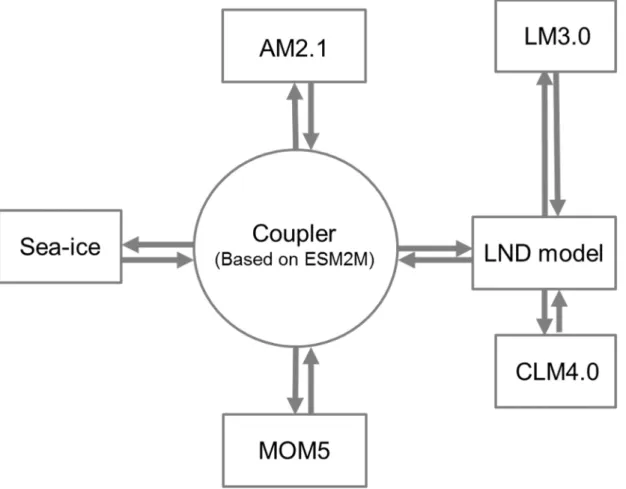
Model Performance of UNIST-ESM
The estimate of the seasonal cycle of atmospheric CO2 concentration in UNIST-ESM is shown in fig. This spatially heterogeneous distribution of precipitation from ENSO drives the observed spatial distribution of GPP. The spatial distribution feature of the precipitation anomaly from ENSO is reasonably represented in the ESM.
CESM and UNIST-ESM are similar amplitude of GPP anomaly in ENSO response in the globe. In the terrestrial carbon cycle, UNIST-ESM still has systematic bias for simulating global GPP. Investigation of vegetation – climate feedback and effects of vegetation changes on the hydrological cycle i.
Improvement of Terrestrial Carbon Cycle in developed ESM
- Methods of Q10 parameterization
- Experiments Designs
- Impacts of variation of Q10 parameterization
Summary and Discussions
Focusing on the East Asia region, rainfall tends to increase in the future. The change of LAI in the future is reflected by changes in climate conditions in the future. Due to the decreased 2m RF over China, the formation of low-level clouds is suppressed in the future (-1.28.
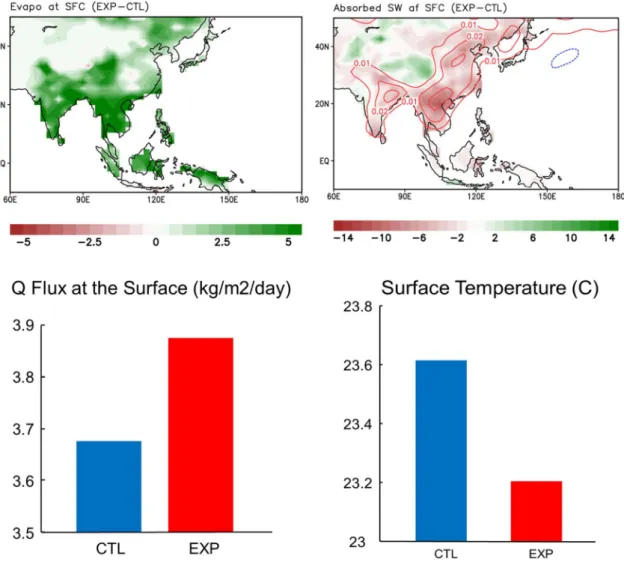
Therefore, the Chinese region will experience more solar radiation in the future due to decreasing low-level cloud cover. In the increased vegetated areas, the positive anomaly of low-level clouds is simulated by more water vapor in the low-level layers. The LAI in the future climate will also increase due to increasing climate conditions associated with vegetation growth.
In the future, the amplitude of precipitation over EA will increase slightly due to local surface moisture replenishment by increasing vegetation. Therefore, the increased incoming solar radiation over the Chinese regions is caused by suppressed low-level cloudiness in the future climate.
Investigation of vegetation – climate feedback and Impacts of
Prediction of Future climate using UNIST-ESM
The role of vegetation on the variation of East Asia summer monsoon101
In the future climate projection using UNIST-ESM, the global surface temperature and precipitation are significantly increased by an additional heat source such as CO2 concentration. In the EA region, the vegetation induces the increasing temperature due to positive feedbacks during the summer monsoon season. In the large-scale circulation change, the land-sea contrast between China and the near sea tends to decrease.
To improve the land-atmospheric carbon cycle, greater understanding and parameterization of the carbon cycle at the Earth's surface and subsurface are needed. In the large-scale circulation, the temperature drop due to many vegetation causes a decrease in the land-sea contrast, which plays an important role in controlling EASM. Slater: Technical description of the prototype version (v0) of Tracers of Phytoplankton with Allometric Zooplankton (TOPAZ) ocean biogeochemical model as used in the Princeton IFMIP model.
Summary and Conclusion Remarks
Summary and Conclusion
Jung, M., Henkel, K., Herold, M. and Churkina, G.: Exploiting synergies of global land cover products for carbon cycle modeling, Remote. Thornton, P.E., Lamarque, J.-F., Rosenbloom, N.A., and Mahowald, N.M.: Impact of carbon-nitrogen cycle coupling on soil model response to CO2 fertilization and climate variability. Wan, S. and Luo Y.: Substrate regulation of soil respiration in a tall grass pond: Results of a cutting and shading experiment, Global Biogeochem.
Xu, M. and Qi, Y.: Spatial and seasonal variations of Q10 determined by soil respiration measures at a Sierra Nevadan forest, Global Biogeochem. Zhou, T., Shi, P., Hui, D., and Luo, Y.: Global pattern of temperature sensitivity of soil heterotrophic respiration (Q10) and its implications for carbon-climate feedback, J. Zhang, Y., Xu , M., Chen, H., and Adams, J.: Global pattern of NPP to GPP ratio inferred from MODIS data: effects of ecosystem type, geographic location and climate, Glob.