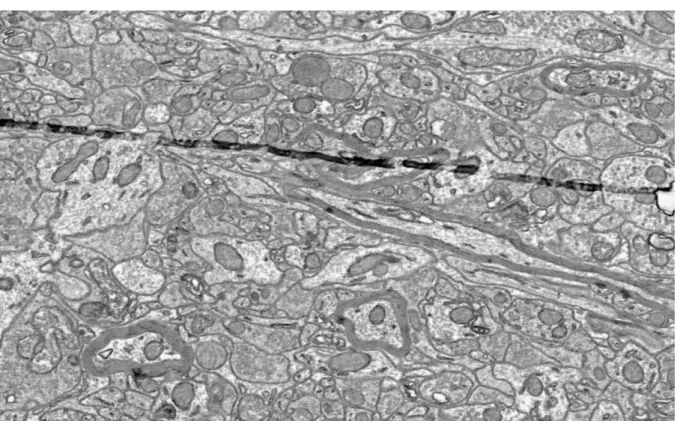
In this thesis, a new novel method is presented to match two images with the latest deep learning scheme called ssEMnet. However, tuning each ssEM plane is not straightforward due to its tightly wound circuit structures. In addition, dynamic deformations are applied to images in the process of acquiring ssEM datasets from samples.
In recent deep learning research, especially related to convolutional neural networks (CNNs), it has shown that it can handle various problems in computer vision area. The first part is a spatial transformer module that supports differentiable transformation of images in deep neural network. The CAE is trained by unsupervised mode and its features give wide receptive field information to align the source and target images.
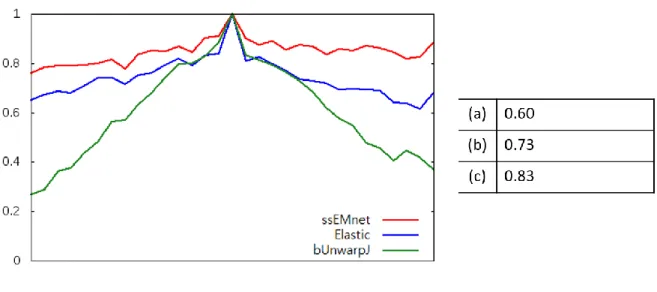
This method is compared with two other major ssEM image registration methods and increases accuracy and robustness, although it has less number of user parameters. EM slice does not match its neighbors, so an image registration procedure is required. 1 The graph of the weighted dice coefficient of each slice and the average values by slices for each method.
Introduction
- Problem definition
- Background
- Motivation
- Contribution
- Goal
7] The physical approaches to finding connections between the neural structure are based on cutting up brain tissue and scanning these sections using electron microscopy (EM). However, the obtained dataset undergoes a slice-wise transformation including scale, rotation, translation and non-linear deformation due to the heat and pressure applied to the tissue. Although image registration problems have been studied for decades with both real and medical images, ssEM image registration has several challenging issues with traditional registration problems when dealing with real-world images.
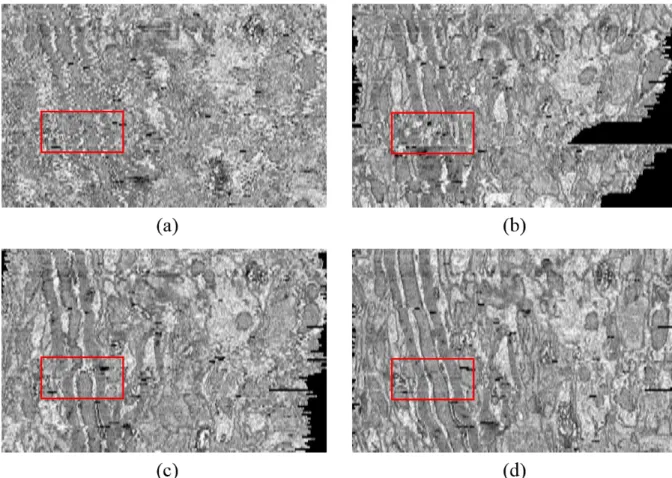
Elastic stack alignment finds the corresponding points of the two images by brute force search of matching block. Due to these limitations of existing tools, data-driven image registration algorithm with less number of parameters is required for large-scale ssEM datasets. The concept overview of image registration on connectome dataset. After imaging, each EM slice is not matched to its neighbors, so an image registration procedure is required.
Convolutional Neural Networks (CNN) address many of the problems in the field of computer vision with superior performance. If there is a trained network of the target data, there will be no need for the user parameter for that data set and it can be applied to complicate the data like ssEM. With this and the feature network, M and T in (1) can be constructed based on deep learning.
In this framework, new networks, transformations and objective functions can be used to construct new image registration models. Since it is differentiable, backpropagation-based optimizers used in existing deep learning can be used. Therefore, we want to verify that proposed image registration can work even if there is no powerful pre-trained network for arbitrary data.
It enables matching even in severely damaged data that cannot be matched by the conventional method, and it can be applied in neural network architecture to improve image registration performance. The aim of this study is to propose a new method, called ssEMnet, which is a general image registration framework with pre-trained deep neural networks. To apply it directly to unsupervised ssEM dataset, I proposed a CAE that can be directly used as an unsupervised feature encoder, and proposed a lossy droplet technique for robust image registration in mismatched artifacts.
Related Work
Convolutional Neural Networks
7. is trained, an interpolated frame is obtained from two frames to calculate the optical flow. Slopes from each pixel in the interpolated frame to the given two frames are calculated as a chain rule. Since the pixel that gives the largest absolute gradient value has the greatest influence on the interpolation, we can find the matching of two frames.
The VGG-19 network learned from ImageNet [13], a large-scale dataset, serves as a good descriptor for extracting various features of an image [14]. The authors made two assumptions in this paper: 1) if the features of two images coming through VGG-19 are similar, they must be morphologically similar, and 2) the image style is the correlation of filter responses in a CNN layer . Based on their assumptions, they defined content loss (3) and style loss (4) as follows, and performed style transfer by minimizing the total loss function (5).
𝐹𝐼𝑙(𝑖, 𝑗) is the 𝑙th lag function in the input image 𝐼, where the pixel positions are given as 𝑖 and 𝑗. In this study, the style loss is removed and only the content loss is used to adjust a few images. 10] acquires multidimensional features through a folded stacked autoencoder (SAE) to reduce the large 3-D image patch.
They proposed multi-dimensional features by max-pooling and stacked autoencoder for MRI volume and fit it by means of multichannel version of Demons algorithm [ 20 ] and feature-based HAMMER algorithm [ 21 ]. However, their convolutional stacked autoencoder has no convolution operators but spatially reduced maximum pooling of patchwise features trained with sparse SAE. This allows for a wider receptive field than a simple patch-wise SAE feature, but max-pooling is a manual reduction.
Image Registration
Spatial Transformer Networks
The partial derivative of (9), (10) can be used to learn the localization network, which can make up for the lack of rotation invariant and scale properties of the convolution operator.
Method
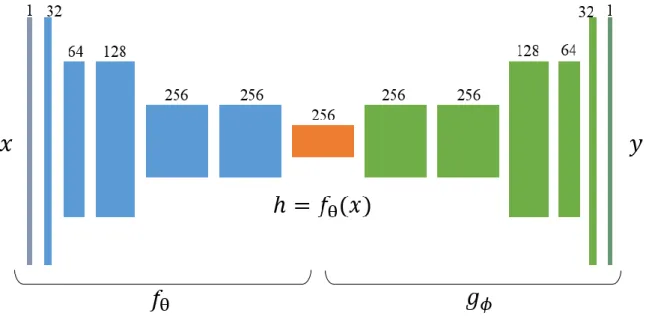
Training a Convolutional Autoencoder
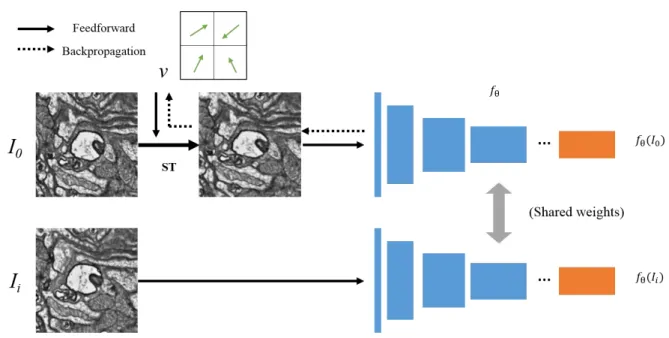
After learning the CAE, the encoder of the CAE is taken out and attached to an ST. This term is intended to mean a loss that reduces the difference between the encoded features of the distorted image and the target image with an L2 norm. For more robust registration, (14) is extended to create different sections of the neighbor as target images.
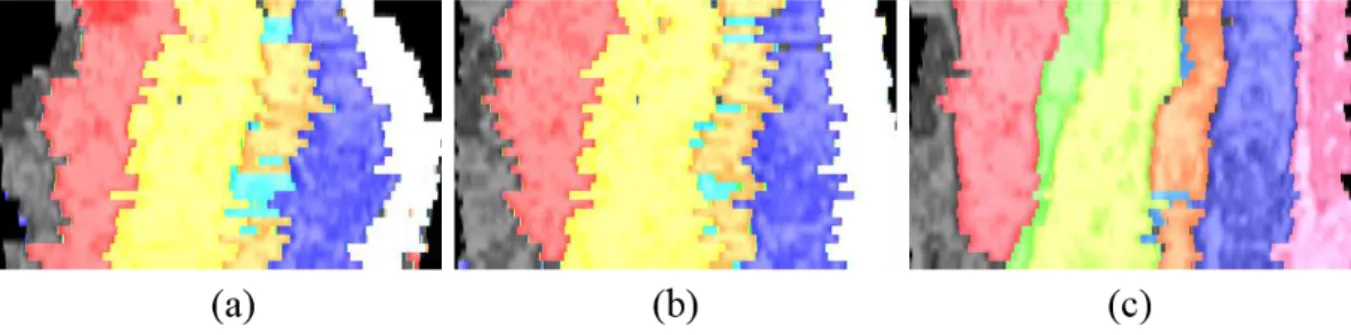
The characteristics of the CAE features, the receptive field, and the computational burden of backpropagation vary greatly depending on the structure of the CAE. The membranes of the subvolume are more smoothly connected via sections after rearrangement than before. The labeled image was distorted as well as the raw EM image. For qualitative comparison, the weighted die coefficients of the label images after registration and those before the random deformation were obtained.
The weighted Dice coefficients were obtained by assigning weights according to the size of the cell cross-section for each slice of the largest cell labels in the sampled area, and averaged over all slices. 1 shows a graph for the weighted dice coefficient of each checker and the average of the weighted dice coefficient of all checkers. The vertical portion by the proposed image registration method is smoother and more continuous than the other methods.
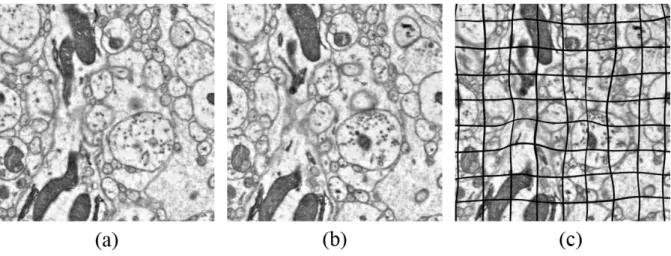
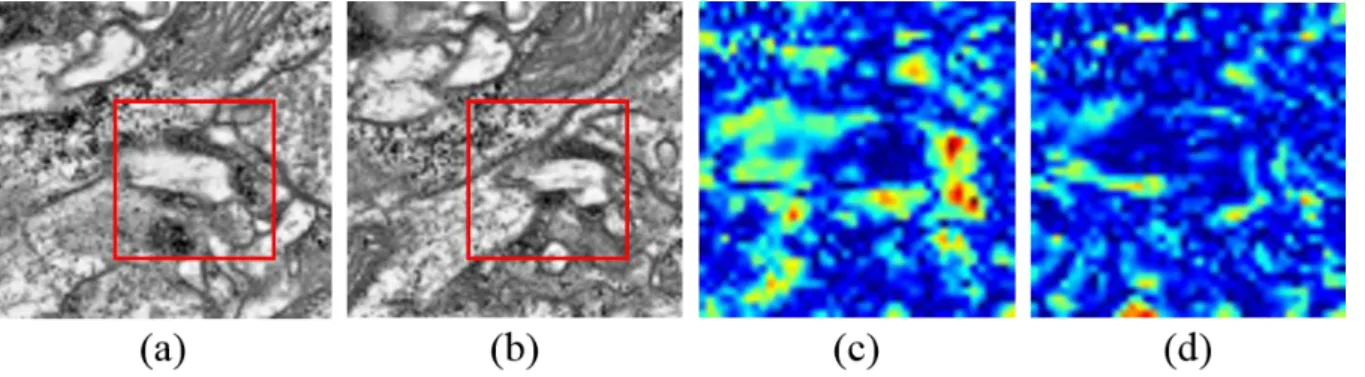
Vertical view of the alignment result of the randomly warped CREMI dataset. a) bUnwarpJ, (b) elastic stack stretching, and (c) our method. Plot of each slice's weighted dice coefficient and average values across slices for each method. Deformable image registration methods based on pixel intensity have a dilemma for matching these folded EM images.
The proposed method has a remarkably small number of parameters for matching due to the characteristic of learning-based approach. This is because it is difficult to train the complex deformation of the EM image without supervision. Therefore, it may be future work to train the feed-forward network with the regularization on vector maps and a suitable loss function rather than the backpropagation-based direct optimization of the vector map.
Deformable Image Registration using a Spatial Transformer Network
Results
Implementation & Experiment Details
Each dataset is transmission EM (TEM) images of Drosophila brain, human-labeled TEM images of another Drosophila brain provided by the CREMI challenge (https://cremi.org/). Mouse brain scan EM (SEM) images are damaged by fold artifacts that create a strong deformation and loss of image parts. The original dataset of an adult female Drosophila brain section has 4 million aerial images and occupies a capacity close to 50TB.
The grid points of each source image are matched to adjacent target images based on the pixel intensities of the images. When it finds the mapping, it uses the relaxation method with virtual springs, like elastic stack alignment does. This tool supports parallel execution with the Massage Mediation Interface (MPI), which can efficiently process a large amount of images in a parallel manner.
Although AlignTK is a very powerful tool to align such a large-scale dataset of EM images, it still requires persistent efforts from users and a large amount of CPU resources, such as a huge computer cluster.
Recovery of Artificially Deformed Dataset
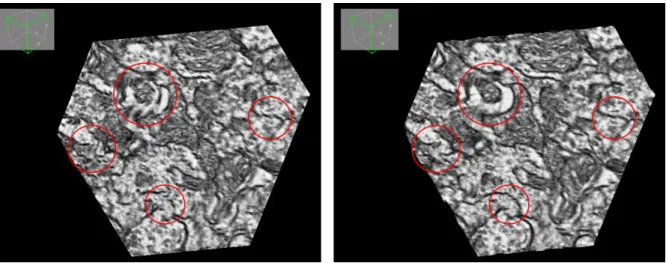
Visual comparison of ssEM image registration results from mice. a) before alignment, (b) bUnwarpJ, (c) elastic stack alignment, and (d) our method. CNN is powerful in many areas of computer vision, but the fundamental component of CNN, the convolution operator, is neither scale invariant nor rotation invariant. In this work, a deformable image registration method using a deep learning feature using ST and the widely used backpropagation of deep learning has been proposed.
In this work, z-axis alignment is performed by the sliding window method and the sparse term for the vector map, but applying the same relaxation scheme as the spring mesh will align the stack of EM images faster. 25] propose how to learn deformable image registration through unsupervised end-to-end training, but do not deal with regularization and appropriate metrics.
Robust Alignment of Data with Fold Artifacts
Conclusion and Future Work