Cryogenic Engineering
2015 Fall Semester Min Soo, Kim
※ reversible mixing/unmixing – semipermeable membrane (free passage for one gas)
A + B Tm Pm
permeable to A permeable to B
WA WB
pure A pure B
Tm PA Tm PB
reversible isothermal work
1 – before separation 2 – after separation
P2 2
T
P1
1
S
−𝑊𝑖
𝑚 = 𝑇𝑚 𝑠1 − 𝑠2 − ℎ1 − ℎ2
− 𝑊𝑖
𝑚𝑚 = −𝑊𝑖𝑖 𝑚𝑖
𝑚𝑖
𝑚𝑚 − 𝑊𝑖𝑖 𝑚𝑖
𝑚𝑖 𝑚𝑚
= 𝑇𝑚 𝑠1𝑖 − 𝑠2𝑖 − ℎ1𝑖 − ℎ2𝑖 𝑚𝑖
𝑚𝑚 + 𝑇𝑚 𝑠1𝑖 − 𝑠2𝑖 − ℎ1𝑖 − ℎ2𝑖 𝑚𝑖 𝑚𝑚
Ideal work of separation for an ideal gas mixture For an ideal gas,
𝑃𝑚
𝑃 = 𝑚𝑚𝑅𝑚𝑇𝑚⁄𝑉𝑚
𝑚 𝑅 𝑇 ⁄𝑉 = 𝑚𝑚𝑅𝑚 𝑚 𝑅 𝑝𝑉 = 𝑚𝑅𝑇
ℎ = 𝐶𝑝𝑇
𝑠 = 𝐶𝑝ln𝑇 − 𝑅ln𝑝
∴ − 𝑊𝑖
𝑚𝑚 = 𝑇𝑚𝑅𝑖 ln 𝑃𝑚 𝑃1𝑖
𝑚𝑖 𝑚𝑚 + 𝑇𝑚𝑅𝑖 ln 𝑃𝑚
𝑃1𝑖
𝑚𝑖 𝑚𝑚
𝑚𝑅 = 𝑛𝑅� = 𝑚𝑅� 𝑀⁄
Since
𝑃𝑚
𝑃1𝑖 = 𝑛𝑚
𝑛𝑖 = 1
𝑦𝑖 𝑦𝑖: mole fraction of gas A
Work requirement per unit mole of mixture
− 𝑊𝑖
𝑛𝑚 = 𝑅�𝑇𝑚 𝑦𝑖ln 1
𝑦𝑖 + 𝑦𝑖ln 1 𝑦𝑖
= 𝑅�𝑇𝑚 � 𝑦𝑗ln 1 𝑦𝑗
𝑗
Ideal work of separation of gas mixtures
• For a single substance in a single phase, we need only 2 independent thermodynamic properties are required to Specify thermodynamic state
Gibbs phase rule
Gibbs phase rule
Phase diagram
- Temperature-composition diagram
Typical temperature-composition diagrams for binary mixtures
(a) Typical curve for pressures less than the critical pressure for
(b)Typical curve for pressures less than the critical pressure for one component, but above the critical
Azeotrope
not boil change
Azeotrope is a particular mixture (two or more miscible liquids) which does not change the composition during the distillation.
(c) Azeotropic mixture
Water-alchol distillation
• An-dong soju(안동소주) : 23~45% alcohol
Water-alchol distillation
• Vodka : 40% alcohol
Distillation apparatus
Distillation apparatus
The basics of distilling alcohol
How Alcohol distillation works
Multistage Distillation Principle
Stage The beginning The end
1 11%
(base alcohol, for example wine) 32%
2 32% 55%
3 55% 70%
4 70% 78%
Two different shapes of temperature-composition diagrams
As shown below, in case of the narrow diagram, a substance cannot be purified quickly, so more steps are required to get purer substance in liquid composition
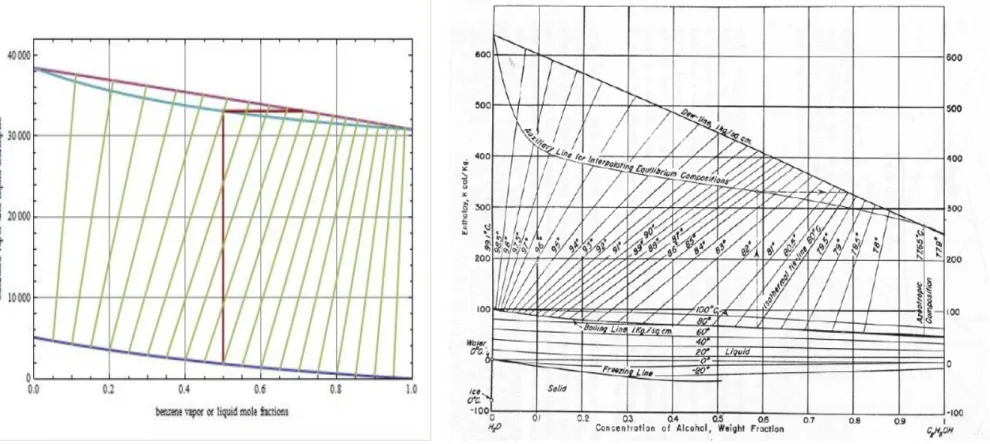
Another set of thermodynamic curves important in the study of mixtures
Fig. Enthalpy-composition diagrams
Table. Enthalpy of nitrogen-oxygen mixtures. h= enthalpy of the saturated liquid at the bubble point; H= enthalpy of the saturated vapor at the dew point
Distillation column in a cryogenic Air separation plant
• Rectification is synonymous with countercurrent distillation. This special distillation separation process enables the individual components of a mixture to be separated with a high purity
combined with a good yield, even when their boiling points are
relatively close to each other.
Temperature
Mole fraction
0 1
• Consider two mixtures AB and CD at 1 atm whose temperature-composition diagrams are as shown.
- Gas A + Gas B - Gas C + Gas D
• The respective boiling points of each gas are as shown.
• The boiling point difference of the mixture AB is less than that of the mixture CD.
A, C = 0
B, D = 1 A, C = 1
B, D = 0
• Let us consider a mixture with composition at state 1 as shown.
• If this mixture is rectified on AB diagram at 2, we have
• Again, if this mixture is rectified on CD diagram, we have
liq 2 AB
y = f
liq 2 CD
y = f
Mole fraction A, C = 0
B, D = 1 A, C = 1
B, D = 0
Temperature
0 1
• The separation is more effective when the difference in the boiling points is more.
• For such mixtures, almost pure product is obtained in one or two condensations.
Mole fraction A, C = 0
B, D = 1 A, C = 1
B, D = 0
Temperature
0 1
• As done earlier, rectification of this mixture at point 3.
- Vapor is enriched in low boiling point component (N2)
- Liquid is enriched in high boiling point component (O2)
• This process forms the fundamental step for the rectification column.
Mole fraction
Temp. K
0 1
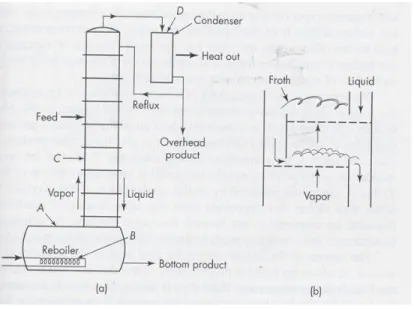
Rectification Column
• As mentioned earlier, gas separation is a process of repeated rectification.
• The equipment which carries out these processes is called as a Rectification column.
• The figure shows the schematic of a Rectification column.
Rectification Column
• It is vertical column which is closed by
spherical domes, both at the top and at the bottom.
• Theses are spherical in shape in order to minimize surface area(less heat in-leak) and accommodate high pressures(1~5 atm)
• The column is well insulated because, it is usually operated at cryogenic temperatures.
• The top dome houses a Condenser and the bottom done houses a Boiler.
• The two phase mixture is first expanded
isenthalpically. It can be liquid or liquid + vapor or vapor.
• This expanded product is introduced into the column as Feed.
Condenser
Feed
Boiler
Rectification Column - The rectification of the mixture occurs across each
Plate and Downcomer assembly as shown in the figure.
- These Plates have holes for the vapor mixture to pass through and ultimately reach the condenser.
- Similarly, the Downcomer takes the mixture in liquid phase towards the boiler.
Rectification Column
• During this motion, vapor and liquid flow in opposite directions and exchange heat in a counter-flow manner.
• Hence, there is a temperature gradient across the length of the column.
Increasing Temperature, K
Rectification Column
• The low boiling component(LBC) is condensed in the Condenser and the high boiling component(HBC) is
evaporated in the Boiler.
• The low and high boiling components are collected at the top and bottom respectively.
LBC
HBC
• For the ease of understanding,
consider a mixture of N2 and O2 at 1 atm.
• Let the Feed in saturated vapor condition enter the column at 1, as shown in figure.
• Let us assume a steady state and an ideal operation of column.
• When the mixture condenses or evaporates, its composition remains constant.
1
• Hence for any plate, the vapor rising and the liquid on the plate have
same molar composition, although the liquid is at lower temperature.
• Hence, the liquid on the plate above the feed inlet(point 2) has same
composition as the vapor.
• Therefore, extending a constant composition line about point1, we have point 2.
1 2
2
• Also, the vapor leaving point 3 is in thermal equilibrium with liquid at 2.
(same plate)
• Extending an isotherm about the point2, we have the point 3.
1 3 2
• Similarly, liquid at point 4 has same composition as point3.
• Extending a constant composition line about 3, we have point 4
1 3 2
4
• On the other hand, we have the points 1, 2’ and 3’ as shown in the figure.
• The point 1 and 2’ are in thermal equilibrium(same plate).
• Also, liquid at point 2’ has same
composition as point 3’ and liquid is at lower temperature.
1 3 2
4
2’
3’
• Therefore, the liquid moving down is enriched in high boiling point
component(O2).
• On the other hand, the vapor
moving up is enriched in low boiling point component(N2).
1 3 2
4
2’
3’
• In order to keep the process running, some heat is supplied to the boiler, to continuously evaporate the high boiling component.
• Similarly, some heat is withdrawn from the condenser to condense the low boiling component.
1 3 2
4
2’
3’
Q
outQ
in Condensation and Evaporation in bubble.
• The heat exchange between the liquid and vapor fractions is
explained as follows.
• The vapor is at high temperature as compared to that of liquid.
• When vapor bubbles through the liquid layer, the high temperature vapor transfers heat to the liquid.
Condensation and Evaporation in bubble.
• Heat transfer from vapor bubble results in condensation of as little bit of high boiling point
component(here, O2) from bubble.
• Also this heat exchange causes an evaporation of a little bit of low boiling point component(here, N2) from the bulk liquid.
Condensation and Evaporation in bubble.
• Thus as the vapor bubble
moves up, it becomes richer in low boiling point component, that is N2.
• And as liquid moves down, it gets richer and richer in high boiling point component, that is O2.
Real Rectification Column.
• In an ideal rectification column, the vapor and the liquid are in thermal equilibrium.
• But in actual rectification columns, the vapor does not leave the plate as the same temperature of the liquid.
• To ensure the required heat exchange, more number of plates are required than the theoretical prediction.
• Hence, there is a need to study efficiency of an actual system with respect to and ideal system.
• Let the mixture of N2 and O2 at 1 atm be subjected to
rectification.
• Consider a jth plate of the
rectification column as shown in the figure.
• Across this plate, the vapor mixture rises up and the liquid mixture flows down.
j
• Let be the mole fraction of LBC in vapor phase rising to the jth plate.
• The composition of liquid at this plate is given by
• In thermal equilibrium, the mole fraction of LBC in vapor phase leaving the jth plate is j
1
yj−
xj
1
yj−
x
j0,j
y
• But due to the non-ideality, the mole fraction of LBC in vapor phase leaving the jth plate is .
• Hence, the maximum possible and the actual change in mole fractions are
•
• j
1
yj−
xj yj
yj
0,j j 1
y − y
−1
j j
y − y
−• Murphree efficiency of a plate is defined as the ratio of actual change in mole fraction to the maximum possible change that can occur.
• Mathematically, j
1
yj−
xj yj
Murphree efficiency
1
0, 1
j j
M
j j
y y
y y
η
−−
= −
−
Murphree efficiency
• Heat and mass transfer analysis between the vapor and the bulk fluid is important to understand the underlying physics.
• In order to achieve high Murphree efficiency, the following conditions are required.
- Small bubbles
- Long time of contact
- Large values of the overall mass and heat transfer coefficients.
• When the feed stream is introduced into a rectification column, it is
important to determine the
condition of the feed stream if the stream enters the column as a two- phase fluid. Flash calculation is used to solve this type of problem.
Fig. rectification column
Applying a mass balance for component j, we obtain
𝑦𝑗= 𝑥𝐹𝐹
1+𝐹𝐿 𝐾𝐹1 −1
𝑥𝐹𝑗𝐹 = 𝑦𝑗𝑉 + 𝑥𝑗𝐿 = 𝑦𝑗 𝐹 − 𝐿 + 𝑥𝑗𝐿
The mole fraction of the jth component in the liquid phase 𝑥𝑗 = 𝑦𝑗⁄𝐾𝑗, so We may solve the mole fraction 𝑦𝑗
If we apply an energy balance to the system, we obtain
ℎ𝐹𝐹 = ℎ𝐿 + 𝐻𝑉 = ℎ𝐿 + 𝐻(𝐹 − 𝐿)
𝐿
𝐹 = 𝐻 − ℎ𝐹 𝐻 − ℎ
� 𝑦𝑗
𝑗
= 1 = � 𝑥𝐹𝑗 1 + 𝐿
𝐹 1
𝐾𝑗 − 1
𝑗
The sum of the mole fractions for the vapor phase is equal to unity.
Two basic methods used to determine the number of theoretical plates
• Ponchon (1921) and Savarit (1922)
Rectification column Perforated plate
Ponchon (1921) and Savarit (1922) method
- Rigorous and capable of handling all distillations, but requires detailed enthalpy data for its application
- Simultaneous material and energy balance calculations - Detailed calculations of equilibrium conditions
- More accurate, but difficult to use
- Largely superseded by rigorous computer simulation calculations - Requires detailed enthalpy data in its application
McCabe and Thiele (1925) method
- Less rigorous, enthalpy data not required.
- Adequate for many applications, more commonly use because of its simplicity - Uses graphical solution for binary mixture on equilibrium diagram (x-y plot).
- Provides the number of theoretical (ideal) trays required for a given separation.
- Pressure is assumed constant throughout the entire column.
- Less general, but it requires only equilibrium concentration data in its application
Upper enriching section
Conservation of Mass Principle 𝑉𝑛 = 𝐿𝑛+1 + 𝐷 Ln+1
D N-th plate
Vn Vn-1
yn-1 Xn
Ln
yn
(4.38)
Q. D
Upper enriching section (suppose a two-component mixture for simplicity)
Ln+1
D N-th plate
Vn Vn-1
yn-1 Xn
Ln
yn
Conservation of Mass Principle yn𝑉𝑛 = xn+1𝐿n+1 + 𝑥𝐷D (4.39) Q. D
Upper enriching section (suppose a two-component mixture for simplicity)
Ln+1
D N-th plate
Vn Vn-1
yn-1 Xn
Ln
yn
• First Law of Thermodynamics
Assuming
1. no heat inleaks from ambient 2. no work transfer
3. steady-state operation
Q. D
𝐸̇ = 𝑄̇ − 𝑊̇ + � 𝑚̇𝑖(ℎ𝑖 + 1
2𝑣𝑖2 + 𝑔𝑧𝑖) − � 𝑚̇𝑒(ℎ𝑒 + 1
2𝑣𝑒2 + 𝑔𝑧𝑒)
Assuming
1. no heat inleaks from ambient 2. no work transfer
3. steady-state operation
4. negligible changes in kinetic and potential energies
③
= 𝑄̇𝑖𝑛 − 𝑄̇𝑜𝑜𝑜 + 𝑚̇𝑖(ℎ𝑖 + 1
2𝑣𝑖2 + 𝑔𝑧𝑖) − 𝑚̇𝑒(ℎ𝑒 + 1
2𝑣𝑒2 + 𝑔𝑧𝑒)
②
① ④ ④ ④ ④
= 𝑄̇𝑜𝑜𝑜 + 𝑚̇ ℎ𝑖 𝑖 − 𝑚̇ ℎ𝑒 𝑒
Upper enriching section (suppose a two-component mixture for simplicity)
Upper enriching section (suppose a two-component mixture for simplicity)
= 𝑄̇𝑜𝑜𝑜 + 𝑚̇ ℎ𝑖 𝑖 − 𝑚̇ ℎ𝑒 𝑒
= −𝑄̇𝐷 + 𝑉𝑛𝐻𝑛 − 𝐿𝑛+1ℎ𝑛+1 − ℎ𝐷𝐷
𝑽𝒏𝑯𝒏 = 𝒉𝒏+𝟏𝑳𝒏+𝟏 + 𝒉𝒉𝒉 + 𝑸̇𝒉 (4.40)
Assuming
1. no heat inleaks from ambient 2. no work transfer
3. steady-state operation
Upper enriching section (suppose a two-component mixture for simplicity)
𝑉𝑛𝐻𝑛 = ℎ𝑛+1𝐿𝑛+1 + ℎ𝐷𝐷 + 𝑄̇𝐷 (4.40)
𝑉𝑛𝐻𝑛 /𝐷 = ℎ𝑛+1𝐿𝑛+1/𝐷 + ℎ𝐷 + 𝑄̇𝐷/𝐷
𝑉𝑛𝐻𝑛
𝐷 = ℎ𝑛+1(𝑉𝑛 − 𝐷)
𝐷 + ℎ𝐷 + 𝑄̇𝐷 𝐷 𝑉𝑛
𝐷 𝐻𝑛 − ℎ𝑛+1 = 𝑄̇𝐷
𝐷 + ℎ𝐷 − ℎ𝑛+1 (4.41)
Upper enriching section (suppose a two-component mixture for simplicity) 𝑉𝑛
𝐷 𝐻𝑛 − ℎ𝑛+1 = 𝑄̇𝐷
𝐷 + ℎ𝐷 − ℎ𝑛+1 (4.41)
𝐷
𝑉𝑛 = 𝐻𝑛 − ℎ𝑛+1
(𝑄̇𝐷/𝐷) +ℎ𝐷 −ℎ𝑛+1 (4.42)
Using eqn. (4.38) 𝑉𝑛 = 𝐿𝑛+1 + 𝐷 𝐿𝑛+1/𝑉𝑛 = 1 + (𝐷/𝑉𝑛) ynVn = xn+1Ln+1 + 𝑥𝐷D
Using eqn. (4.39) yn = Ln+1
Vn xn+1 + 𝐷 Vn 𝑥𝐷
(4.43)
(4.44)
Operating line (upper enriching section)
The bubble line and the dew line
Exactly horizontal lines If,
Then,
ℎ𝑛+1 𝑎𝑛𝑎 𝐻 𝑎𝑎𝑒 𝑐𝑜𝑛𝑠𝑜𝑎𝑛𝑠 for a particular column
1. The molar heat of vaporization for the two pure components were identical
2. The enthalpy of mixing were negligible
Operating line (upper enriching section)
𝐷
𝑉𝑛 = 𝐻𝑛 − ℎ𝑛+1
(𝑄̇𝐷/𝐷) +ℎ𝐷 −ℎ𝑛+1 = 𝑐𝑜𝑛𝑠𝑜𝑎𝑛𝑜 (4.42) 𝐿𝑛+1/𝑉𝑛 = 1 + (𝐷/𝑉𝑛) = constant (4.43)
Operating line (upper enriching section)
𝐷
𝑉𝑛 = 𝐻𝑛 − ℎ𝑛+1
(𝑄̇𝐷/𝐷) +ℎ𝐷 −ℎ𝑛+1 = 𝑐𝑜𝑛𝑠𝑜𝑎𝑛𝑜 (4.42) 𝐿𝑛+1/𝑉𝑛 = 1 + (𝐷/𝑉𝑛) = constant (4.43)
yn = Ln+1
Vn xn+1 + 𝐷
Vn 𝑥𝐷 (4.44)
slope intercept
The operating line
Operating line (upper enriching section)
yn = Ln+1
Vn xn+1 + 𝐷
Vn 𝑥𝐷 (4.44)
slope intercept
The operating line
= Ln+1
Vn 𝑥𝐷 + 𝐷
Vn 𝑥𝐷 = Ln+1 + 𝐷 𝑥𝐷
Vn = 𝑥𝐷
The y-intercept value (at x=0, y=xDD/Vn) may be used to construct the operating line for the enriching section of the column
Rectification columns
<Bubble-cap trays>
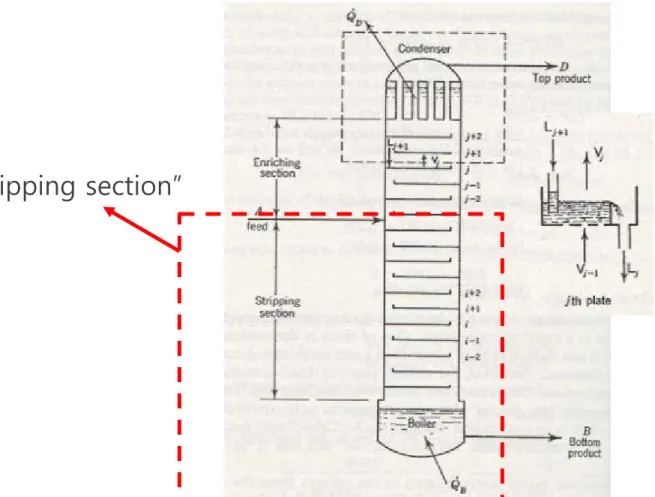
Lower (stripping section)
<page. 180, Figure 4.13 >
“Stripping section”
Similar analysis applied to the stripping section
Conservation of mass principle,
𝐿
𝑚+1= 𝑉
𝑚+ 𝐵
𝑳𝒎+𝟏
𝑽𝒎
𝑩
<Control volume for the stripping section>
Similar analysis applied to the stripping section
Applying lower boiling-point components yields,
𝑥
𝑚+1𝐿
𝑚+1= 𝑦
𝑚𝑉
𝑚+ 𝑥
𝐵𝐵
(𝑥𝐵 = 𝑚𝑜𝑚𝑒 𝑓𝑎𝑎𝑐𝑜𝑖𝑜𝑛 𝑜𝑓 𝑜ℎ𝑒 𝑚𝑜𝑙𝑒𝑎 − 𝑏𝑜𝑖𝑚𝑖𝑛𝑔 − 𝑝𝑜𝑖𝑛𝑜 𝑐𝑜𝑚𝑝𝑜𝑛𝑒𝑛𝑜 𝑖𝑛 𝑜ℎ𝑒 𝑏𝑜𝑜𝑜𝑜𝑚 𝑝𝑎𝑜𝑎𝑜𝑐𝑜)
Similar analysis applied to the stripping section
Applying First law of thermodynamics,
ℎ
𝑚+1𝐿
𝑚+1+ 𝑄̇
𝐵= 𝐻
𝑚𝑉
𝑚+ ℎ
𝐵𝐵
(ℎ𝐵 = 𝑜ℎ𝑒 𝑒𝑛𝑜ℎ𝑎𝑚𝑝𝑦 𝑜𝑓 𝑜ℎ𝑒 𝑏𝑜𝑜𝑜𝑜𝑚 𝑝𝑎𝑜𝑎𝑜𝑐𝑜 𝑠𝑜𝑎𝑒𝑎𝑚)
Operating line for the lower or stripping section of the column,
𝑦𝑚 = 𝐿𝑚+1
𝑉𝑚 𝑥𝑚+1 − ( 𝐵 𝑉𝑚)𝑥𝐵 𝐵
𝑉𝑚 = 𝐻𝑚 − ℎ𝑚+1 𝑄̇𝐵
𝐵 − ℎ𝐵 + ℎ𝑚+1 𝐿𝑚+1
𝑉𝑚 = 1 + ( 𝐵 𝑉𝑚)
Similar analysis applied to the stripping section
Finding intersection of the operating lines for the upper and lower sections,
𝑽𝒏
𝑽𝒎
𝑭 n - th
m - th 𝑳𝒏+𝟏
𝑳𝒎+𝟏
…..
𝐹 = 𝑉𝑛 − 𝑉𝑚 + 𝐿𝑚+1 − 𝐿𝑛+1
(𝐹 = 𝑚𝑜𝑚𝑒 𝑓𝑚𝑜𝑙 𝑎𝑎𝑜𝑒 𝑜𝑓 𝑓𝑒𝑒𝑎 𝑖𝑛𝑜𝑜 𝑜ℎ𝑒 𝑐𝑜𝑚𝑜𝑚𝑛)
Define parameter q = the ratio of the difference in liquid flow between the upper and lower column sections to the feed flow
𝑞 = (𝐿
𝑚+1− 𝐿
𝑛+1)/𝐹
Combine equations,
𝐹 = 𝑉
𝑛− 𝑉
𝑚+ 𝐿
𝑚+1− 𝐿
𝑛+1, 𝑞 = (𝐿
𝑚+1− 𝐿
𝑛+1)/𝐹
𝑉
𝑛− 𝑉
𝑚= 1 − 𝑞 𝐹
The difference in vapor flows,
Using upper vapor flow and lower vapor flow equations, we can obtain the intersection of the two operating lines
𝑦
𝑛=
𝐿𝑛+1𝑉𝑛
𝑥
𝑛+1+ (
𝑉𝐷𝑛
)𝑥
𝐷(upper section)
𝑦
𝑚=
𝐿𝑚+1𝑉𝑚
𝑥
𝑚+1+ (
𝑉𝐷𝑚
)𝑥
𝐵(lower section)
𝑉𝑛 − 𝑉𝑚 = 𝐿𝑛+1 − 𝐿𝑚+1 𝑥
𝑦 + (𝑥𝐷𝐷 + 𝑥𝐵𝐵)
𝑦 = 1 − 𝑞 𝐹
For the column as a whole,
𝑥
𝐹𝐹 = 𝑥
𝐷𝐷 + 𝑥
𝐵𝐵
−𝑞𝐹 𝑥
𝑦 + 𝑥
𝐹𝐹
𝑦 = 1 − 𝑞 𝐹
Therefore,
The locus of the intersection of the two operating lines is,
𝑦 = 𝑥
𝐹1 − 𝑞 −
𝑞
1 − 𝑞 𝑥
Determine q value,
ℎ
𝐹𝐹 = 𝑉
𝑛𝐻
𝑛− 𝑉
𝑚𝐻
𝑚+ 𝐿
𝑚+1ℎ
𝑚+1− 𝐿
𝑛+1ℎ
𝑛+1Vapor and liquid enthalpies are assumed to be independent of composition,
𝐻
𝑛= 𝐻
𝑚= 𝐻 𝑎𝑛𝑎 ℎ
𝑚+1= ℎ
𝑛+1= ℎ
ℎ
𝐹𝐹 = 𝑉
𝑛− 𝑉
𝑚𝐻 + 𝐿
𝑚+1− 𝐿
𝑛+1ℎ
And, we also can obtain, ℎ
𝐹= 1 − 𝑞 𝐻 + 𝑞ℎ
And,
𝑞 = 𝐻 − ℎ
𝐹𝐻 − ℎ
The value of q may be determined from the feed stream enthalpy ℎ𝐹 and the saturated vapor enthalpy H and saturated liquid enthalpy h
ⅰ) Sub-cooled liquid feed : q > 1
ⅱ) Saturated liquid feed : q = 1
ⅲ) Two-phase mixture feed : 0 < q < 1
ⅳ) Saturated vapor feed : q = 0
ⅴ) Superheated vapor feed : q < 0
The value of the parameter q is as follows, depending upon the condition of the feed stream,
Example 4.7 – Determine the number of theoretical plates required!
① Top product : 98% nitrogen
② Bottom product : 5% nitrogen, 95% oxygen
③ Feed stream : 79% nitrogen, 21% oxygen
④ Feed stream liquid Molar fraction : 0.831 mol liquid/mol mixture
⑤ The bottom, top product streams leave as sat.liquid
⑥ Bottom product flow rate : 25 mol/s
⑦ Heat removed at the top : 1071 kW
⑧ Mean pressure : 101.3 kPa (1atm)
Example 4.7 – Determine the number of theoretical plates required!
ⅰ) Find flow rates of the feed and top product – Conservation of mass!
𝐹 = 𝐵 + 𝐷 = 25 + 𝐷 𝑥𝐹𝐹 = 𝑥𝐵𝐵 + 𝑥𝐷𝐷 Substituting in the numerical values,
0.79𝐹 = 0.05 25 + 0.98𝐷 = 1.25 + 0.98(𝐹 − 25) Solving for the feed stream flow rate,
𝐹 = (24.5 − 1.25)
(0.98 − 0.79) = 122.37 𝑚𝑜𝑚/𝑠
𝐷 = 𝐹 − 𝐵 = 122.37 − 25 = 97.37 𝑚𝑜𝑚/𝑠
Example 4.7 – Determine the number of theoretical plates required!
ⅱ) Applying the First law of thermodynamics to the entire column, 𝑄̇𝐵 = 𝑄̇𝐷 + ℎ𝐷𝐷 + ℎ𝐵𝐵 − ℎ𝐹𝐹
ℎ𝐹 = 0.831 1050 + 1 − 0.831 6916 = 2041𝐽 𝑚𝑜𝑚⁄ Using the values in the First law equation,
𝑄̇𝐵 = 1,071,000 + 1050 97.37 + 1050 25 − 2041 122.37 𝑄̇𝐵 = 949,731 𝑊 = 949.731 𝑘𝑊
ℎ = 1050𝐽 𝑚𝑜𝑚⁄ 𝑠𝑎𝑜𝑜𝑎𝑎𝑜𝑒𝑎 𝑚𝑖𝑞𝑜𝑖𝑎 = ℎ𝐷 = ℎ𝐵 𝐻 = 6916𝐽 𝑚𝑜𝑚⁄ (𝑠𝑎𝑜𝑜𝑎𝑎𝑜𝑒𝑎 𝑣𝑎𝑝𝑜𝑎)
The enthalpy of the feed stream(two-phase mixture) is,
Example 4.7 – Determine the number of theoretical plates required!
ⅲ) Determine the operating line equations 𝐷
𝑉𝑛 = 6916 − 1050
(1,071,000 97.37) + 1050⁄ − 1050 = 0.5336
𝐿𝑛+1
𝑉𝑛 = 1 − 0.5336 = 0.4664 Operating line for the upper section,
𝑦𝑛 = 0.4664𝑥𝑛+1 + 0.5336 0.98 = 0.4664𝑥𝑛+1 + 0.5229 The reflux ratio,
Example 4.7 – Determine the number of theoretical plates required!
𝐵
𝑉𝑚 = 6916 − 1050
(949,731 25)⁄ − 1050 + 1050 = 0.1544
𝐿𝑚+1
𝑉𝑚 = 1 + 0.1544 = 1.1544 Operating line for the lower section,
𝑦𝑚 = 1.1544𝑥𝑚+1 − 0.05 0.1544 = 1.1544𝑥𝑚+1 − 0.00772 The reflux ratio,
Example 4.7 – Determine the number of theoretical plates required!
𝑞 = 6916 − 2041
6916 − 1050 = 0.831
𝑦 = 0.79
1 − 0.831 − 0.831
1 − 0.831𝑥 = 4.6746 − 4.9172𝑥 We obtain feed line,
The equation for the feed line,
Example 4.7 – Determine the number of theoretical plates required!
𝑞 = 6916 − 2041
6916 − 1050 = 0.831
𝑦 = 0.79
1 − 0.831 − 0.831
1 − 0.831𝑥 = 4.6746 − 4.9172𝑥 We obtain feed line,
The equation for the feed line,
Rectification column
System used in the development of the
theoretical-plate equations.
The flow rate of vapor 𝑚𝑒𝑎𝑣𝑖𝑛𝑔 the 𝑛th plate is denoted by 𝑉𝑛 and the flow rate of the liquid 𝑚𝑒𝑎𝑣𝑖𝑛𝑔 the 𝑛th plate is denoted by 𝐿𝑛
Minimum number of theoretical plates
→ when the slope of the operating lines approach unity
Upper operating line 𝑦𝑛 = 𝐿𝑛+1
𝑉𝑛 𝑥𝑛+1 + 𝐷 𝑉𝑛 𝑥𝐷 Lower operating line
𝑦𝑚 = 𝐿𝑚+1
𝑉𝑚 𝑥𝑚+1 − 𝐵 𝑉𝑚 𝑥𝐵
Minimum refrigeration 𝑄𝐷 ↓
Requirement of an infinite number of theoretical plates
Packed column
-Cylinders filled with a packing material such as metallic rings and wire gauze
-The packing material provides a large surface area
-This type of column is not so frequently used in cryogenic systems ex) diffuser
Plate column
-Several plates to allow the vapor to bubble through the liquid on the plate
-Small holes -Fine mesh -Bubble cap
(a) Perforated plate
Perforated plates
(b) bubble-cap plate
Bubble-cap trays
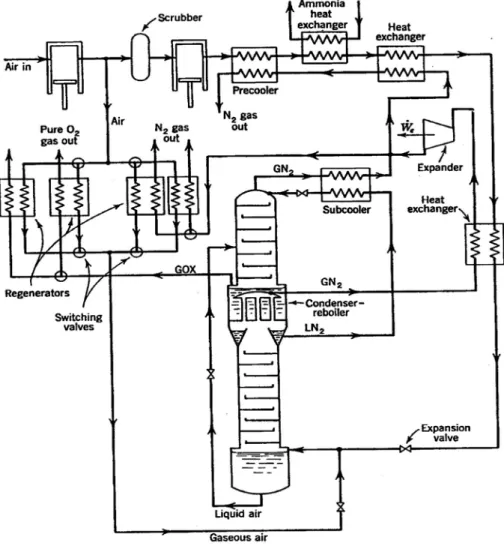
Fig. Linde double-column gas-separation system. If the product were desired in the liquid phase, the heat exchanger would be a two-channel heat exchanger, and
The Linde single-column system has two serious disadvantages.
1. Only pure oxygen can be produced
2.Large quantities of oxygen are wasted in the impure nitrogen exhaust gas
Fig. Linde-Frankl gas-separation system
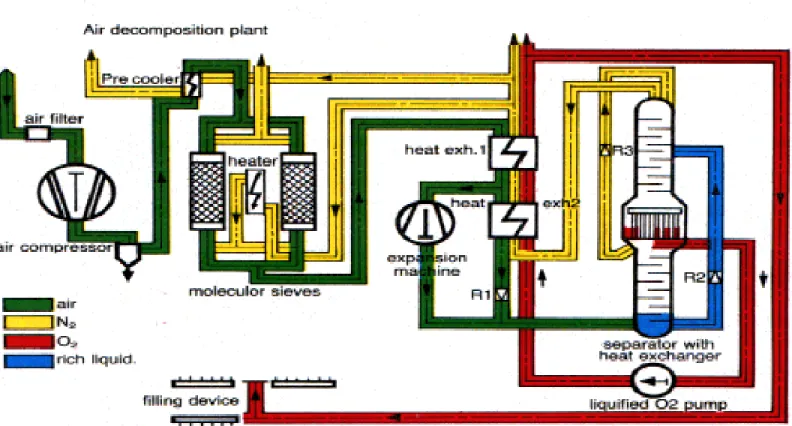
Fig. Air separation plant
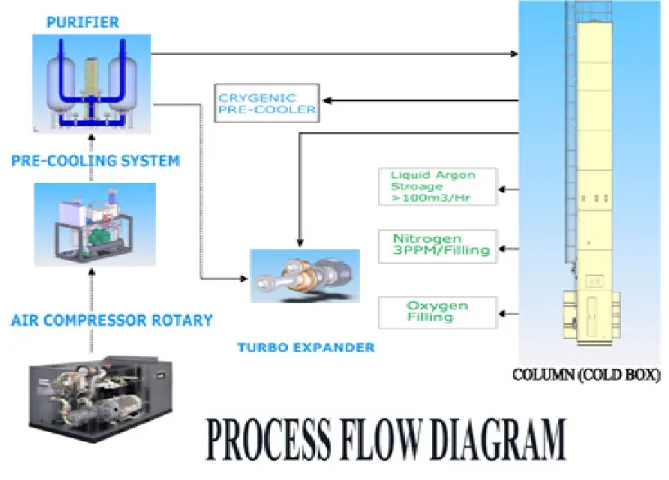
Fig. Air separation process flow diagram
Fig. Composition of dry atmospheric air Argon
• NBP: 87.302K at 1atm
Introduction to Argon
The argon-separation system usually consists of two basic parts
• A recovery subsystem
• The purification subsystem
- The catalytic-combustion system - The adsorption system
A Recovery Subsystem
Fig. Argon recovery subsystem
The purification system (adsorption system)
The purification system (catalytic-combustion system)
Fig. Argon-purification subsystem using catalytic combustion with hydrogen
Fig. Composition of dry atmospheric air Neon
• NBP: 27.3K at 1atm
Introduction to Neon
The neon-separation system usually consists of two basic parts
- A recovery subsystem
- The purification subsystem
The purification system
Several methods for obtaining hydrogen gas
- Cryogenic treatment of coke-oven gas or other hydrogen-rich by-product stream - Reforming natural gas
- Partial oxidation of crude oil - Electrolysis of water
- Ammonia dissociation
- Passing steam over heated iron
- Thermal decomposition of hydrocarbons
heat
Coke-oven gas
Coke-oven gas is a fuel gas having a medium calorific value that is produced during the manufacture of metallurgical coke by heating bituminous coal to temperatures of 900°C to 1000°C in a chamber from which air is excluded. The main constituents are, by volume, about 50% hydrogen, 30% methane and 3% higher hydrocarbons, 7%
carbon monoxide, 3% carbon dioxide and 7% nitrogen. The gas has a heating value of about 20,000 kJ/m3.
Chemical composition of some common gaseous fuels
Composition (Percent by Volume) Fuel
Carbon Dioxide (CO2)
Carbon Monoxide
(CO)
Methane
(CH4) Butane
(C4H10) Ethane
(C2H6) Propane
(C3-H8) Hydrogen (H2)
Hydrogen Sulfide
(H2S)
Oxygen
(O2) Nitrogen (N2)
Carbon Mon
oxide 100
Coal Gas 3.8 28.4 0.2 17.0 50.6
Coke Oven
Gas 2.0 5.5 32 51.9 0.3 4.8
Digester Gas 30 64 0.7 0.8 2.0
Hydrogen 100
Landfill Gas 47 0.1 47 0.1 0.01 0.8 3.7
Natural Gas 0 - 0.8 0 - 0.45 82 - 93 0 - 15.8 0-1.8 0 - 0.18 0 - 0.35 0.5 - 8.4
Propane Gas 0.5 - 0.8 2.0 - 2.2 73 - 97
Linde-Bronn system
The Societe l’Air Liquide system
Hydrogen-deuterium separation system
Uses of helium
< The uses of helium in industry >
U.S Bureau of Mines for the separation of helium-rich natural gas
< Schematic diagram of a United States Bureau of Mines helium separation plant >
Clapeyron equation 𝑎𝑝
𝑎𝑇�𝑠𝑖𝑠 = 𝑠𝑔 − 𝑠𝑓
𝑣𝑔 − 𝑣𝑓 = ℎ𝑓𝑔 𝑇(𝑣𝑔 − 𝑣𝑓)
𝑣𝑔 = 𝑠𝑎𝑜𝑜𝑎𝑎𝑜𝑒𝑎 − 𝑣𝑎𝑝𝑜𝑎 𝑠𝑝𝑒𝑐𝑖𝑓𝑖𝑐 𝑣𝑜𝑚𝑜𝑚𝑒 𝑣𝑓 = 𝑠𝑎𝑜𝑜𝑎𝑎𝑜𝑒𝑎 − 𝑚𝑖𝑞𝑜𝑖𝑎 𝑠𝑝𝑒𝑐𝑖𝑓𝑖𝑐 𝑣𝑜𝑚𝑜𝑚𝑒 𝑠𝑔= 𝑠𝑎𝑜𝑜𝑎𝑎𝑜𝑒𝑎 − 𝑣𝑎𝑝𝑜𝑎 𝑒𝑛𝑜𝑎𝑜𝑝𝑦
𝑠𝑓 = 𝑠𝑎𝑜𝑜𝑎𝑎𝑜𝑒𝑎 − 𝑚𝑖𝑞𝑜𝑖𝑎 𝑒𝑛𝑜𝑎𝑜𝑝𝑦 ℎ𝑓𝑔 = ℎ𝑒𝑎𝑜 𝑜𝑓 𝑣𝑎𝑝𝑜𝑎𝑖𝑧𝑎𝑜𝑖𝑜𝑛
ℎ𝑓𝑔 = 𝐴 − 𝐵𝑇
𝐴,𝐵 = 𝑐𝑜𝑛𝑠𝑜𝑎𝑛𝑜𝑠 𝑜ℎ𝑎𝑜 𝑎𝑒𝑝𝑒𝑛𝑎 𝑜𝑝𝑜𝑛 𝑜ℎ𝑒 𝑠𝑜𝑏𝑠𝑜𝑎𝑛𝑐𝑒 𝑣𝑔 = 𝑅𝑇
𝑝 (𝑎𝑜 𝑚𝑜𝑙 𝑝𝑎𝑒𝑠𝑠𝑜𝑎𝑒𝑠;𝑖𝑎𝑒𝑎𝑚 𝑔𝑎𝑠)
The expression for the vapor-pressure curve 𝑎𝑝
𝑎𝑇�𝑠𝑖𝑠 = 𝑃(𝐴 − 𝐵𝑇) 𝑅𝑇2
𝐥𝐥 𝒑
𝒑
𝟎= 𝑪
𝟏− 𝑪
𝟐𝐓 − 𝑪
𝟑𝐥𝐥𝐓
: The expression for the vapor-pressure curve Adsorption
Absorption is when one substance enters completely into another. Think of people walking into and sitting down in a car trolley.
Adsorption is when one substance just hangs onto the outside of another. Think of people holding onto a car trolley with one hand and leaning off the side. They’re along for the ride but not inside.
Absorption
Absorption and adsorption at Gas-liquid and liquid-solid interfaces respectively
Purifier using a refrigeration purifier and an adsorption purifier in series