These results indicate that the electrolyte with HFEPN can simultaneously improve the thermal stability and electrochemical properties of the LiNi0.4Mn1.6O4 cathode. In full cells consisting of a cathode LiNi0.4Mn1.6O4 and a graphite anode with a practical level of loading,. A fully dissolved (charged) LiNi0.4Mn1.6O4 cathode with pristine SEI or HFEPN-derived SEI was heated to 350 °C in the presence of pristine electrolyte.
Schematic representation of the thermal degradation pathways of the electrolytes with or without HFEPN at the LiNi0.4Mn1.6O4 cathode. Potentiostatic profiles of Li/LiNi0.4Mn1.6O4 half-cells held at a charging voltage of 5.0V for 10 hours. Discharge capacity of Li/LiNi0.4Mn1.6O4 half-cells in the electrolyte with or without 5%.
Rate performance of Li/LiNi0.4Mn1.6O4 half-cells with or without (a) 5% HFEPN and (b) different concentrations of HFEPN at different discharge rates C. Exothermic peak temperature and amount of heat generated by thermal decomposition of delithiated LiNi0.4Mn1 cathodes, 6O4 in electrolyte with or without 0.5% HFEPN.
Introduction
Demand for lithium ion batteries
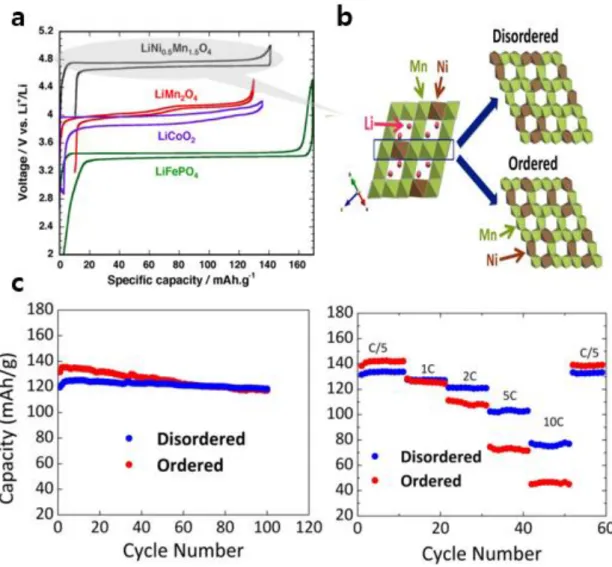
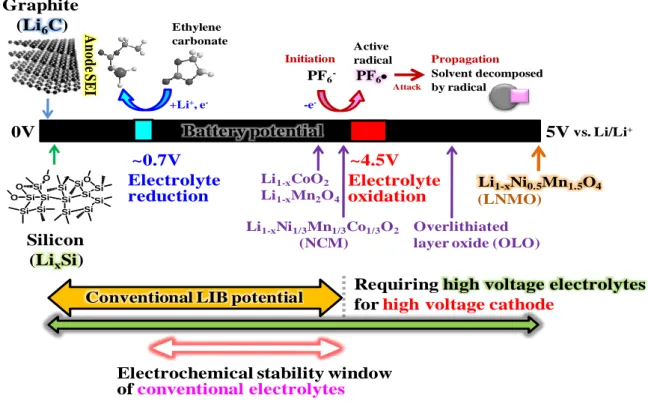
Schematic representation of a lithium-ion battery containing a LiNi0.5Mn1.5O4 cathode, graphite anode and liquid electrolyte. Although lithium ion batteries have been successfully commercialized, conventional cathode materials such as LiCoO2 and LiFePO4 have unsatisfactory performance in terms of output power, power density, safety and energy density, up to 3.7 V and 3.3 V.8 Clearly high energy density of the cathode materials is needed to commercialize transportation applications (Fig. 3a).9 Among the various 5V class spinel LiNi0.5Mn1.5O4, LiNiPO4, and LiCoPO4 cathode materials, LiNi0.5Mn1.5O4 has recently become a promising candidate for high-voltage cathode batteries. materials due to the high operating potential of 4.7 V vs. Li/Li+ and the reasonably high theoretical capacity of 147 mAh g-1.10-15. Moreover, LiNi0.5Mn1.5O4 has advantages including less environmental impact, low cost and inherently high Li+ diffusivity within the three-dimensional channels of the spinel structure, leading to good speed capability and cycling stability.
The LiNi0.5Mn1.5O4 have two types of ordered P4332 phase and disordered Fd-3m phase types of crystal structures depending on the order of Ni/Mn in the octahedral sites. (Fig. 3b) 16 For the ordered P4332 space group that synthesized by re-annealing at a relatively lower temperature of 700 oC, Ni and Mn are incorporated into the octahedral 4b and 12d sites, with Li-ion occupying the 8c and O ions occupied at 8c and 24e positions, respectively. In the Fd-3m phase with sintering heated to 900 oC, Ni and Mn are randomly located at the 16d site, with Li and O ions occupying the 8a and 32e sites, respectively.17-24.
In terms of cycling performance and rate performance, disordered is better than ordered due to the increased diffusion coefficient of Li+.

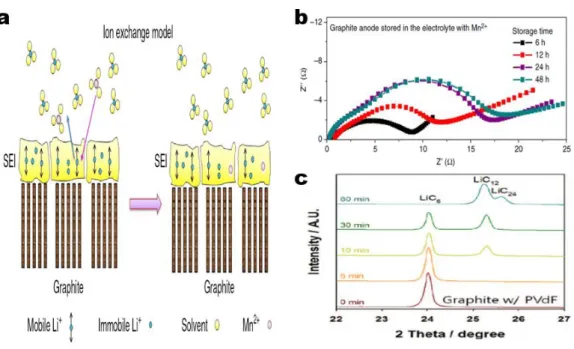
Graphite anode after different cycling times at 0.5 C and 55 oC, c) Change of XRD peaks attributed to the LiC6 phase of the fully lithiated graphite anode due to ion exchange self-discharge.
Lithium Ion Battery Safety
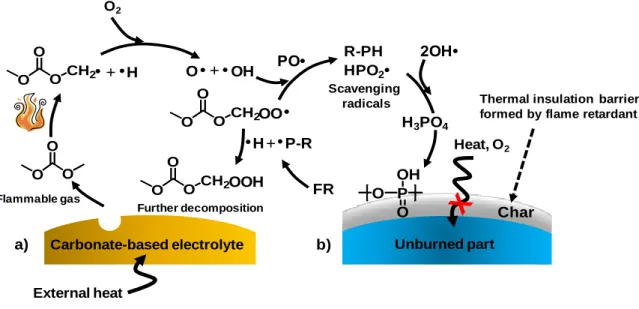
After reaction of P∙ radicals with organic solvents (PO∙ + OH∙ → HPO2∙ + 2OH∙ →H3PO4∙) the phosphoric acid becomes polyphosphoric acid at elevated temperature and forms a physical thermal insulator barrier (called carbon) between unburned and burned off the condensation reactions. 9)5 The resulting char protects the non-burnt parts from heat and oxygen transfer and prevents the combustion chain reaction of organic solvent decomposition.42, 43 Many researchers have made efforts to develop flame retardant or non-flammable to act as radical scavengers such as .eg as phosphazene, phosphate, phosphite, phosphonate.43-56 (Fig. 10) But because phosphate, phosphonate have a narrow potential window, they may tend to be reductive decomposition on graphite anode or oxidative decomposition on high voltage cathode. Recently, Zhaoping Liu reported the ethoxyfluorocyclophosphazene as flame retardant, as an electrolyte additive to stabilize the cathode and anode surface.57 However, the flame retardant does not meet the expectations regarding high voltage cathode.
To be an ideal flame retardant, various aspects of electrochemical properties and improvement of thermal stability between electrode and electrolyte are required. Here, a fluorinated hyperbranched cyclotriphosphazene, hexakis(2,2,2-trifluoroethoxy)cyclotriphosphazene (HFEPN), was used as a functional additive to simultaneously improve the electrochemical properties and thermal stability of the LiNi0.4Mn1.6O4 cathode in lithium-ion batteries. The cyclotriphosphazene motif as the structural core is not only covalently bonded to the fluoro-alkoxy substituents to ensure redox stability, but also improves thermal stability and self-quenching function because it has high densities of P and F in a single molecule.
Schematic representation of nonflammability of electrolytes: (a) Thermal decomposition of a conventional electrolyte based on carbonate solvents.
Experimental
Electrode and Electrolyte
Characterization
Result and discussion
- Purity of the HFEPN
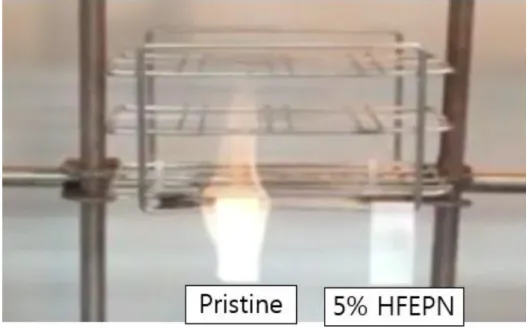
- Self-extinguishing Time of the electrolyte with or without flame-retardant
- Thermal stabilization on LiNi 0.4 Mn 1.6 O 4 cathode
- Electrochemical performances of HFEPN on the Li/graphite half cells
The main peak at 226 C was attributed to the exothermic reaction between LiNi0.4Mn1.6O4 and the electrolyte solution. This significant improvement in thermal stability between the LiNi0.4Mn1.6O4 cathode and the pristine electrolyte can be explained by the self-quenching feature of HFEPN. A fully delithiated LiNi0.4Mn1.6O4 cathode with pristine SEI or HFEPN-derived SEI was heated to 350 °C in the presence of pristine electrolyte.
The stability of the LiNi0.4Mn1.6O4 cathode with HFEPN against electrochemical oxidation was measured using linear sweep voltammetry (LSV). While the electrolyte with pristine electrolyte showed a much larger leakage current, indicating significant oxidative decomposition, the leakage current in the presence of the electrolyte with 5% HFEPN was significantly reduced, compared to the pristine electrolyte, due to the formation of a more stable surface of HFEPN- derived SEI on the LiNi0.4Mn1.6O4 cathode. To evaluate the electrochemical behavior of the Li/LiNi0.4Mn1.6O4 half-cells with or without 5%.
The initial coulombic efficiency (ICE) of the electrolyte with 5% HFEPN was slightly higher than that of the pristine electrolyte. Furthermore, the discharge capacity was higher than that of the pristine electrolyte because the HFEPN-derived SEI on the LiNi0.4Mn1.6O4 cathode inhibited the oxidative decomposition of the electrolyte consuming Li+ and electron. The discharge capacity of Li/LiNi0.4Mn1.6O4 was slightly improved for the electrolyte with 5% HFEPN at 30 oC, while substantial improvement was observed for the electrolyte with 5% HFEPN at 60 oC.
This result implied that the amount of HFEPN was one of the factors affecting the electrochemical performance of the Li/LiNi0.4Mn1.6O4 half-cells. The LiNi0.4Mn1.6O4 containing the electrolyte with 5% HFEPN provided a discharge capacity of 114 mAh g-1 at 5C, compared to that with pristine electrolyte, which corresponds to 97 mAh g-1. Voltage profiles of Li/graphite half-cells in the electrolyte with or without 5% HFEPN at pre-cycling.
Discharge capacity of Li/graphite half-cells in the electrolyte with or without 5% HFEPN during 40 cycles. To further confirm the SEI components of the HFEPN-derived SEI on the LiNi0.4Mn1.6O4 cathode, C 1s XPS was measured. It was evidence for HFEPN in the electrolyte to form additional films on the LiNi0.4Mn1.6O4 cathode surface due to having CF3 in the 2,2,2-trifluoroethoxy (-OCH2CF3) groups of HFEPN.
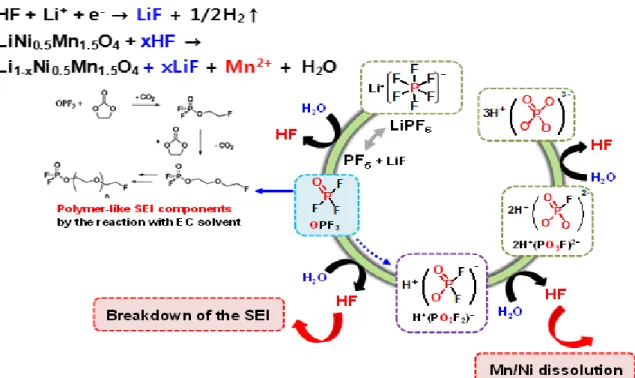
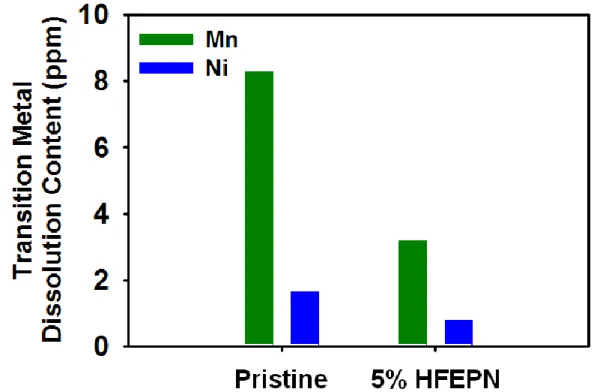
A relatively large fraction of Li2CO3 at 290 eV was observed on the LiNi0.4Mn1.6O4 cathode surface in the electrolyte with 5% HFEPN. Therefore, HF removal in the electrolyte can lead to a drastically reduced Ni and Mn solution of the delithiated LiNi0.4Mn1.6O4 cathode with the HFEPN-derived SEI.
F 2 -HFHF
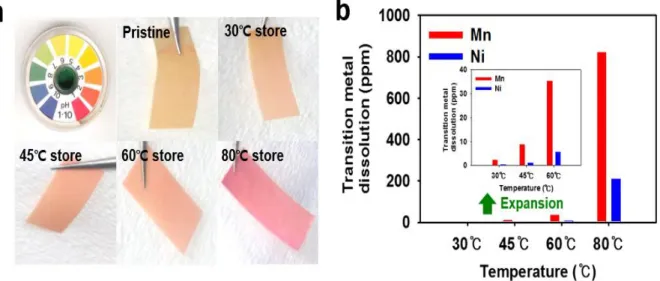
19F NMR spectra of the electrolyte (a) without HFEPN and (b) 5% HFEPN (the HF spot is shown in the corresponding inset). Dissolved transition metal content of fully delithiated LiNi0.4Mn1.6O4 cathodes with and without an HFEPN-derived SEI after storage in pure electrolyte at 60 °C for 22 h. 3.7 Electrochemical performance of HFEPN in graphite/LiNi0.4Mn1.6O4 whole cells. The initial full-cell voltage profiles presented two voltage plateaus at around 4.0V and 4.75V, which were attributed to the electrochemical oxidation of Mn3+ to Mn4+ and Ni2+ to Ni4+, respectively.
The full cell in the presence of the pristine electrolyte showed rapid capacity decay over the 100 cycles, delivering only a relatively low discharge capacity of 36 mAh g-1, while the full cell with HFEPN electrolyte showed a significantly improved discharge capacity of 67 mAh g-1 1. 1 after 100 cycles. The entire cell in the presence of the HFEPN showed a Coulomb efficiency improvement of 99.4% compared to the pristine electrolyte of 99.0. Lower Coulombic efficiency in the whole cell was attributed to the following two reactions.
First was the repair of the destroyed SEI layer on the cathode and anode, resulting in a net consumption of Li from the LiNi0.4Mn1.6O4 cathode. Secondly, the other was the dissolution of metal ions from the LiNi0.4Mn1.6O4 cathode, which can cause the capacitance to decrease because the ions migrate to the anode during cycling and their deposition led to the extraction of Li+ from the lithiated graphite anode. Electrochemical performance of graphite/LiNi0.4Mn1.6O4 full cells with or without 5%. a) Stress profiles during precycling, (b) Maintenance of discharge capacity, (c) Coulombic efficiency.
Discharge Capacity (mAh g-1)
Conclusions
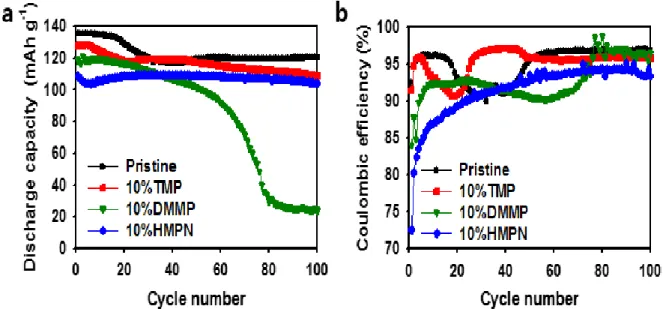
In this study, fluorinated hyperbranched cyclotriphosphazene, hexakis(2,2,2-trifluoroethoxy)cyclotripphosphazene (HFEPN), containing multiple phosphorus and fluorine atoms in a molecule as a promising flame retardant, was used for high-voltage lithium ion batteries. HFEPN significantly improved the electrochemical performance and thermal stability on LiNi0.4Mn1.6O4 cathode and graphite anode, while the conventional flame retardants such as TMP and DMMP often showed disappointed results of electrochemical performance for meeting safety. Ex-situ XPS and NMR analysis results suggested that the HFEPN additive formed stable and robust SEI on LiNi0.4Mn1.6O4.
DSC and electrochemical results consistently indicated that the exothermic reactions between the delithiated LiNi0.4Mn1.6O4 cathode and the electrolyte could be drastically reduced by HFEPN, with the improved cycling performances at 60 oC due to the improvement of the thermal stability. Notably, the HFEPN addition was further evaluated in full cells with the practical level high mass loading revealing the unequivocal improvements of cycling performance. The combined synthetic chemical and analytical approaches will contribute to the rational design of next-generation self-extinguishing compounds for the high electrochemical performance large-scale lithium-ion batteries with improved safety.