Submitted20 June 2019 Accepted 10 October 2019 Published18 November 2019 Corresponding authors Alexei V. Tchesunov, [email protected]
Wonchoel Lee, [email protected] Academic editor
James Reimer
Additional Information and Declarations can be found on page 25
DOI10.7717/peerj.8023 Copyright
2019 Jeong et al.
Distributed under
Creative Commons CC-BY 4.0
Bibliographic revision of Mesacanthion Filipjev, 1927 (Nematoda:
Thoracostomopsidae) with description of a new species from Jeju Island, South Korea
Raehyuk Jeong1, Alexei V. Tchesunov2and Wonchoel Lee1
1Department of Life Science, Hanyang University, Seoul, South Korea
2Department of Invertebrate Zoology, Faculty of Biology, Moscow State University, Moscow, Russia
ABSTRACT
A new species of the genusMesacanthionFilipjev, 1927 was discovered during a survey of natural beaches of Jeju Island in South Korea. The new speciesMesacanthion jejuensis sp. nov.shares general morphology of the genus such as the outer labial and cephalic setae being situated at the middle of cephalic capsule, well-developed mandibles with two columns united by a curved bar, and three equally sized and shaped teeth shorter than the mandibles. The new species belongs to a group of Mesacanthionspecies in which spicules are shorter than two anal body diameters. The new species is most closely related toM. pannosum, first discovered in Puget Sound, Washington, in terms of having enlarged cervical setae flap at the end of cephalic capsule, spicules which are shorter than 2 anal body diameter, both supplementary organ and gubernaculum.
It can be distinguished from M. pannosumby its stronger inner labial setae, longer outer labial setae, and difference in the index value of b and c’. Along with the description ofMesacanthion jejuensissp. nov.,the genusMesacanthionFilipjev, 1927 is bibliographically reviewed and revised. Including the new species, a total of 48 species are described within the genus; 39 which are valid; eight which are considered to be species inquirenda due to misplacement of genus and poor description; one which is considered nomen nudum. An updated diagnosis of the genus is provided along with a compiled tabular key comparing different diagnostic morphological characters of all valid species, as well as a pictorial key consisting of 21 species with spicules shorter than two anal body diameters.
SubjectsBiodiversity, Marine Biology, Taxonomy, Zoology Keywords Free-living marine nematodes, Meiofauna, Taxonomy
INTRODUCTION
Over 50 species of free-living marine nematodes have been reported in South Korea, including those reported on domestic journals (Rho & Min, 2011; Barnes, Kim & Lee, 2012;Hong & Lee, 2014;Kim, Tchesunov & Lee, 2015;Hong, Tchesunov & Lee, 2016;Jeong, Tchesunov & Lee, 2019). The majority of the species found in South Korea belong to
ComesomatidaeFilipjev, 1918, DesmoscolecidaeShipley, 1896, EnchelidiidaeFilipjev, 1918 CyatholaimidaeFilipjev, 1918and IronidaeDe Man, 1876. This is the first record of the genusMesacanthion, let alone the family ThoracostomopsidaeFilipjev, 1927to be recorded in South Korea.
Family Thoracostomopsidae was first erected byFilipjev (1927)and it is composed of three subfamilies: Thoracostomopsinae (Filipjev, 1927) (2 genera), Trileptiinae (Gerlach
& Riemann, 1974) (one genus), and Enoplolaiminae De Coninck, 1965 (19 genera).
The three subfamilies can be differentiated by the presence or absence of mandibles (Enoplolaiminae or Trileptiinae respectively), with Thoracostomopsinae uniquely bearing a long and eversible spear (Smol & Coomans, 2006). Now total of 238 species belonging to 22 genera make up the family to date (Bezerra et al., 2019). The genusMesacanthion (Filipjev, 1927) was first erected as a subgenus ofEnoplolaimus(De Man, 1893) with type species Mesacanthion lucifer (Filipjev, 1927;Gerlach & Riemann, 1974) discovered from Barents Sea.Filipjev (1927)specified the characters of the genusMesacanthionto be three short equal (seldom slightly different) onchia, cephalic setae placed in the middle or anterior to the cephalic capsule with tapered tail with a short dactyli/claviform terminal part. Many of the species currently belonging to the genus Mesacanthion were those transferred from the genusEnoplolaimuswhenMesacanthionhad been newly erected as a subgenus byFilipjev (1927). Most species (98%) belonging to this genus are recorded from marine environments with exception to one species (Mesacanthion alexandrinusNicholas, 1993), which was recorded in freshwater environment. Of the valid species, 40% (16) were described from Europe; 20% (eight) from America (four from North and South); 17.5%
(seven) from Asia (mainly from western Asia), 15% (six) from Africa, and 7.5% (three) from Australia. The genus Mesacanthionis the second most diverse genus in the family next toEnoplolaimus(De Man, 1893), with 40 valid species recorded to date.
The aim of this study was to review the genus by compiling information such as species distribution, tabular and pictorial key of the genus while determining the validity of existing species. In addition to the revision,Mesacanthion jejuensissp. nov.is described from Jeju Island, South Korea. An updated diagnosis of the genus is provided with a compiled tabular key consisting of all valid species as well as a pictorial key consisting of 21 species with spicules shorter than two anal body diameters.
MATERIALS AND METHODS
Sampling and morphological study
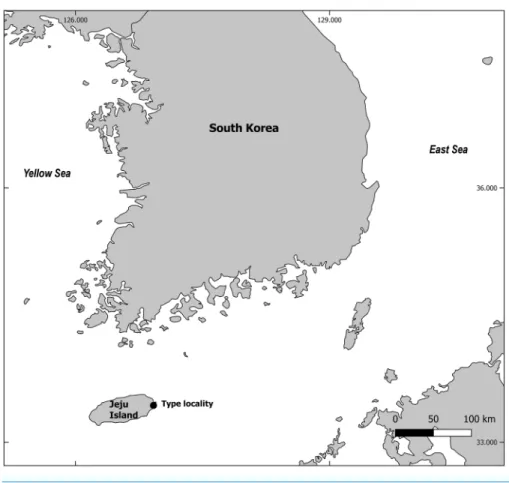
A series of sampling took place in June 2018, during a survey of natural beaches of Jeju Island, South Korea (Fig. 1). Two sub-samples of the sediments from the intertidal zone were obtained using a 10 cm2acryl sampling tube. Sediments were fixed in 5% neutralized formalin solution and brought back to the laboratory. Meiofauna were extracted using the Ludox method (Burgess, 2001), and post-fixed with 70% ethanol dyed with Rose bengal.
Nematodes were counted and individual specimens of interest were picked to a Petri dish filled with 10% glycerin. The dish was placed in a drying oven set at 40◦C for a day or two to be completely dehydrated as conferred in the glycerin-ethanol method (Seinhorst,
Figure 1 Map of sampling locality.This map is made with QGIS software v.2.18.14, a free and open source geographic information system (https://qgis.org).
Full-size DOI: 10.7717/peerj.8023/fig-1
1959). A single or as many as five specimens (depending on their size) were mounted in a single drop of anhydrous glycerin on a glass slide using the wax-ring method (Hooper, 1986). Mounted specimens were identified under Olympus BX51, Leica DM5000B and DM2500 microscopes. All morphometric measurements were done manually using IC measure v.2.0.0.161 software. For scanning electron microscopy, specimens were placed in a drop of glycerin and gradually mixed with drops of distilled water to be washed from any remnant of glycerin. Hydrated specimen were treated to ethanol series for dehydration (20%, 40%, 50%, 70%, 80%, 90%, 95%, 100%, for 10 min each) and then placed in hexamethyldisilazane (HMDS). Specimens bathed in HMDS were placed in a drying oven to be dried. Once dried, specimens were mounted on a stub to be splutter coated, and observed with COXEM EM-30 microscope.
Revision of the genus
The Bremerhaven Checklist of Aquatic Nematodes by Gerlach & Riemann (1974)was used as primary referral when collecting original descriptions/references and additional information on their distribution. Any updates and changes made to the genus subsequent to 1974 were checked using NeMys, World Database of Nematodes. Once all references had
compiled, (2) distribution of species were determined, (3) validity of each species were determined via comparison and examination, (4) diagnosis of the genus was updated. To construct a pictorial key, original depictions were collected from respective papers and their heads, tails and spicules (if available) were resized and oriented using Adobe Photoshop CS6 for optimum comparison between species. The original drawings were retraced using Wacom Intuous Pro Pen Tablet and Adobe Photoshop CS6.
Nomenclatural acts
The electronic version of this article in Portable Document Format (PDF) will represent a published work according to the International Commission on Zoological Nomenclature (ICZN), and hence the new names contained in the electronic version are effectively published under that Code from the electronic edition alone. This published work and the nomenclatural acts it contains have been registered in ZooBank, the online registration system for the ICZN. The ZooBank LSIDs (Life Science Identifiers) can be resolved and the associated information viewed through any standard web browser by appending the LSID to the prefixhttp://zoobank.org/. The LSID for this publication is: urn:lsid:zoobank.org:pub:
989DF431-166A-4534-9A37-9AC408194DE7. The online version of this work is archived and available from the following digital repositories: PeerJ, PubMed Central and CLOCKSS.
SYSTEMATICS
Order Enoplida Filipjev, 1929
Family ThoracostomopsidaeFilipjev, 1927 Subfamily EnoplolaiminaeDe Coninck, 1965 GenusMesacanthionFilipjev, 1927
Generic diagnosis: (Updated from Wieser, 1953; Platt & Warwick, 1983; Smol, Muthumbi & Sharma, 2014) Enoplolaiminae. Outer labial and cephalic setae situated at middle or anterior end of cephalic capsule. Mandible well-developed, provided with claws, arch-shaped, consisting of two rod-like columns anteriorly united by a curved bar. Teeth shorter than mandibles. Spicule mostly short, unipartite and symmetrical, sometimes long, bipartite (divided by a seam:M. ditlevseni) and asymmetrical (anisomorphic and anisometric:M. diplechma). If long, usually gubernaculum present with caudal apophysis.
Marine and freshwater.
Type species:Mesacanthion lucifer (Filipjev, 1927)Gerlach & Riemann, 1974.
Notes on generic diagnosis:Mesacanthion,EnoplolaimusDe Man, 1893,Paramesacan- thion Wieser, 1953, andOxyonchusFilipjev, 1927bear mandibles which are arch-shaped, consisting of two rod-like columns while mandibles of Enoploidesare solid, two lateral bars fused to form a single rod.Oxyonchuscan be distinguished from other genera which bear similar mandibles by its two uniquely large ventrosublateral teeth which extend to anterior end of the mandibles with small dorsal tooth.Mesacanthion,Paramesacanthion,
Enoplolaimus, all have teeth shorter than the mandibles, but the latter can be distinguished by the placement of their outer labial and cephalic setae at posterior end of cephalic capsule.
Mesacanthionspecies have their outer labial and cephalic setae at the middle or anterior end of the cephalic capsule, similar toParamesacanthionspecies except outer labial and cephalic setae are only in front of anterior end of cephalic capsule.Mesacanthion and Paramesacanthionshare the most characters, making them the closest related genera within the family. The two genera can be differentiated from each other however by the following three characteristics: 1. Outer labial and cephalic setae are located at the anterior end of cephalic capsule forParamesacanthionwhile outer labial and cephalic setae are located at the middle or anterior end of cephalic capsule forMesacanthion.Paramesacanthion species have extra ring(s) of subcephalic setae located at the middle of cephalic capsule where outer labial and cephalic setae would be located for Mesacanthionspecies. This means when compared toMesacanthionspecies,Paramesacanthionspecies may appear to have extra ring(s) of setae at the anterior end of cephalic capsule, in between inner labial setae and cephalic setae/outer labial setae. This seemingly additional ring of setae are the true cephalic setae, while ring of setae at the middle of cephalic capsule are actually the sub-cephalic setae forParamesacanthionspecies; 2. Sexual dimorphism is apparent in the pilosity of the head forParamesacanthionspecies, while it is not apparent inMesacanthion species; 3. AllParamesacanthionspecies have spicules consisting of two portions, distal and proximal, articulating from one another, while only someMesacanthionspecies (M. audax, M. ditlevseni,M. infantile andM. jejuensissp. nov.) have bipartite spicules divided by a transversal seam, but without the obvious articulation or constriction.
List of valid species
1. Mesacanthion africanthiformeWarwick, 1970(Warwick, 1970: 142–145, fig. 2A–E;
three males and three females, Exe estuary, England).
2. Mesacanthion africanumGerlach, 1957(Gerlach, 1957b: 4, fig. 3A–C; description based on one male, Atlantic at Congo mouth, plankton net from above muddy ground).
3. Mesacanthion agubernatusVitiello, 1971(Vitiello, 1971: 860, fig. 1A–E; description based on one male, Mediterranean, terrigenous coastal muds, 60 m deep).
4. Mesacanthion alexandrinusNicholas, 1993(Nicholas, 1993: 163, 165, fig. 1A–E, 2A–
D; four males and three females, sand at water edge of fresh-water Lake Alexandrina, South Australia).
5. Mesacanthion arabiumWarwick, 1973(Warwick, 1973: 114–116, fig. 14A–G; three males and three females, Arabian Sea, fine sand, 49 m deep).
6. Mesacanthion arcuatileWieser, 1959 (Wieser, 1959: 16–17, Pl. 11 fig. 11A–B;
description based on one female, Alki Beach, Washington, US, 6.5 ft, lapsusarcuatilis).
7. Mesacanthion armatumTimm, 1961(Timm, 1961: 32, fig. 5A–C; more than one male and one female, Bay of Bengal, onSiphonocladus, lapsus armatus).
8. Mesacanthion audax(Ditlevsen, 1918) Filipjev, 1927[Ditlevsen, 1918: 208–209, pl.
14 fig. 4, 7, pl. 15 fig. 5 (=Enoplolaimus audax); description based on one male,
Mesacanthion.Gerlach, 1958b: 73; (asMesacanthion audax), Kiel Bay, Sand and silt, 6 m deep.Riemann, 1966: 186; three males, North Sea, sand].
9. Mesacanthion banale(Filipjev, 1927) Gerlach & Riemann, 1974[Filipjev, 1927: 147, Pl. 7 fig. 40A, B; (=Enoplolaimus(Mesacanthion)banalis), description based on three females, Barents Sea, muddy sand, 25 m deep.Gerlach & Riemann, 1974: 531; transfer Enoplolaimus banaleto genusMesacanthion].
10. Mesacanthion breviseta(Filipjev, 1927) Gerlach & Riemann, 1974[Filipjev, 1927:
150–151, pl. 7 fig. 43A–C; (=Enoplolaimus(Mesacanthion)breviseta) description based on one male and a juvenile male, Barents Sea, sand with shells and stones, 83 m deep.
Gerlach & Riemann, 1974: 531; transferEnoplolaimus(Mesacanthion)brevisetato genus Mesacanthion].
11. Mesacanthion caveiInglis, 1964[Inglis, 1964: 313–314, fig. 76–78; description based on two males (one in poor condition) and one damaged juvenile, South Africa, coarse sand and broken shells, 26–27 m deep].
12. Mesacanthion ceeumInglis, 1964(Inglis, 1964: 313, fig. 74–75; description based on one male and one juvenile, South Africa, coarse sand and broken shells, 26 m deep, lapsusceeus).
13. Mesacanthion conicum(Filipjev, 1918) Filipjev, 1927[Filipjev, 1918: 105–107, Table 3, fig. 16A–B; (=Enoplolaimus conicus), description based on one female, Black Sea.
Filipjev, 1927: 143; transferEnoplolaimus conicusto subgenusMesacanthion].
14. Mesacanthion cricetoidesWieser, 1959(Wieser, 1959: 17–18, fig. 13A–B; description based on one female, Richmond Beach, Washington, 2.5 ft deep).
15. Mesacanthion diplechma(Southern, 1914) Filipjev, 1927[Southern, 1914: 55–56, fig.
25A–J; (=Enoplus diplechma), two males and two females, Clew Bay, sandy bottom, 25–
31 m deep.Filipjev, 1927: 143; transferEnoplus diplechmato subgenusMesacanthion.
Gerlach, 1958: 72; asMesacanthion diplechna, Kiel Bay, silt, 8 m deep.Riemann, 1966:
186 North Sea, sand.Boucher, 1977: 741–743, Figs. 4A–4E; asMesacanthion diplechma Southern, 1914, one male, three females and six juveniles, Pierre Noire (Western Channel), infralittoral sands].
16. Mesacanthion ditlevseni(Filipjev, 1927) Gerlach & Riemann, 1974[Filipjev, 1927:
148, pl. 5 fig. 41A–D; (=Enoplolaimus(Mesacanthion)ditlevseni), three males and one female, Barents Sea, silt with stones, 36–280 m deep.Ditlevsen, 1928: 210–213, fig.
8–13; (=Enoplolaimus angustignathus), one male and one female, Greenland, mud, clay, 100–200 m deep, De Coninck and Stekhoven, 1933: 38.Allgén, 1954: 22; (as Enoplolaimus(Mesacanthion)angustignathus), five males and nineteen females, Jan Mayen, Greenland, black sand, 23 m deep.Gerlach & Riemann, 1974: 532; transfer Enoplolaimus ditlevsenito genusMesacanthion].
17. Mesacanthion fricumInglis, 1966(Inglis, 1966: 87, fig. 10–12; description based on one male, South Africa, sand, lapsusfrica).
18. Mesacanthion heterospiculumSergeeva, 1974 (Sergeeva, 1974: 123, fig. 4A–4B;
description based on 14 males, Black Sea, various depths and sediments).
19. Mesacanthion hirsutumGerlach, 1953(Gerlach, 1953: 536–537, fig. 9A–E; description based on one male and one female, Mediterranean.Gerlach, 1967: 26, fig. 10A–E; two males, two juveniles and one male, Sarso Island, Red Sea, Saudi Arabia).
20. Mesacanthion infantile(Ditlevsen, 1930) De Coninck & Schuurmans Stekhoven, 1933[Ditlevsen, 1930: 205–208, fig. 8–10; (=Enoplolaimus infantilis), one male and one female, Stewart Island, Halfmoon Bay, sand, 5–7 fms.Allgén, 1951: 322–323, fig.
33A–B; (=Enoplolaimus mortenseni), description based on one female, Australia see Mawson, 1956: 65–66 (re-examination of type specimen=Mesacanthion infantilis), op Wieser, 1953: 75.Allgén, 1951: 323–324, fig. 34A–B; (=Enoplolaimus philippinensis), description based on one juvenile, Australia, opMawson, 1956: 65–66 (re-examination of type specimen=Mesacanthion infantilis). De Coninck & Schuurmans Stekhoven, 1933: 38; (asMesacanthion infantile).Wieser, 1953: 76, fig. 39A–Btwo females, Chile.
Mawson, 1956: 65–66, fig. 29A–C; two juveniles, Antarctica].
21. Mesacanthion karense(Filipjev, 1927) Gerlach & Riemann1974[Filipjev, 1927: 152, pl. 7 fig. 45A–C; (=Enoplolaimus(Mesacanthion)karensis), one juvenile male and three females, Kara Sea, sand, 15 m deep.Gerlach & Riemann, 1974: 533; transfer Enoplolaimus(Mesacanthion)karensisto genusMesacanthion].
22. Mesacanthion kerguelenseMawson, 1958(Mawson, 1958: 338–339, fig. 22A–D; five males, two females and three juveniles, Kerguelen Island, Heard Island, Macquarie Island).
23. Mesacanthion longispiculumGerlach, 1954(Gerlach, 1954: 228–229, fig. 1A–B; one male and one female, Mediterranean.Gerlach, 1957a: 421; Brazil.Gerlach, 1958a:
352–353, fig. 4A–C; (as cf.longispiculum), one male, Mananjary, Madagascar, muddy sand).
24. Mesacanthion longissimesetosumWieser, 1953(Wieser, 1953: 78–79, fig. 42A–E; two males, one female and thirteen juveniles, Chile, littoral exposed and sheltered sand, sublittoral secondary substratum and soft bottom, lapsuslongissimesetosus).
25. Mesacanthion lucifer(Filipjev, 1927) Gerlach & Riemann, 1974[Filipjev, 1927: 149–
150, pl. 7 fig. 42A–C; (=Enoplolaimus(Mesacanthion)lucifer), one male and two females, Barents Sea, Kara Sea, sand and sandy silt, 18–83 m deep. (Gerlach & Riemann, 1974):
533; transferEnoplolaimus(Mesacanthion)lucifer to genusMesacanthion.]
26. Mesacanthion majus(Filipjev, 1927) Gerlach & Riemann, 1974[Filipjev, 1927: 151–
152, pl. 7 fig. 44A–C; (=Enoplolaimus(Mesacanthion)major), three females, Kara Sea, Barents Sea, sand and gravel, 15–36 m deep.Wieser, 1953: 78, fig. 41A–D; (as Mesacanthion major(Filipjev, 1925b), four males, two females and 15 juveniles, Arctic Sea, Chile, sublittoral, secondary substratum and coarse bottom, lapsusmajor.Gerlach
& Riemann, 1974: 533; (asMesacanthion majusFilipjev, 1927).]
27. Mesacanthion marisalbiGaltsova, 1976(Galtsova, 1976: 261–263, fig. 7; two males, one female and one juvenile, White Sea, littoral zone in slightly silted sand).
28. Mesacanthion monhysteraGerlach, 1967(Gerlach, 1967: 27–28, fig. 11A–F; one male and one juvenile female, Red Sea, sandy beach and littoral subsoil water).
29. Mesacanthion obscurumGagarin & Klerman, 2006(Gagarin & Klerman, 2006: 533–
535, fig. 1A–E; twelve males and eight females, Mediterranean Sea off the Israeli coast near Hadera, sandy sediment, 30–35 m deep).
30. Mesacanthion paliWieser1959(Wieser, 1959: 16, fig. 10A–B; description based on one male, Puget Sound, subterranean water, medium fine to coarse sand).
31. Mesacanthion pannosumWieser, 1959(Wieser, 1959: 17, fig. 12A–D; one female and one female, Puget Sound, medium fine to coarse sand, 2.5 ft deep).
32. Mesacanthion propinquumGagarin & Klerman, 2006 (Gagarin & Klerman, 2006:
536–538, fig. 2A–E; twelve males and eleven females, Mediterranean Sea off the Israeli coast near Hadera, sandy sediment, 30–35 m deep).
33. Mesacanthion proximumGerlach, 1957(Gerlach, 1957a: 427–429, fig. 5G–5M; one male and one juvenile, Santos, Brazil, fine sand).
34. Mesacanthion rigensGerlach, 1957(Gerlach, 1957a: 427, fig. 5C–5F; one male and one female, Bertioga, Brazil.Gerlach, 1956: 204; Brazil, nomen nudum).
35. Mesacanthion southerniWarwick, 1973(Warwick, 1973: 111–114, fig. 12A–C, 13A–C;
six males, three females and two juveniles, Arabian Sea, fine sand and fine muddy sand, 48–49 m deep).
36. Mesacanthion studiosumInglis, 1964(Inglis, 1964: 315–316, fig. 79–90; two males, two females and two juveniles, South Africa, coarse white sand, 27 m deep, lapsus studiosa).
37. Mesacanthion tenuicaudatum(Ssaweljev, 1912) De Coninck & Schuurmans Stekhoven, 1933 [Ssaweljev, 1912: 111–112; (=Enoplolaimus tenuicaudatus), both sex but number of specimen not specified, White Sea, lapsustenuicaudatus.De Coninck
& Schuurmans Stekhoven, 1933: 39; transfer and correct name fromEnoplolaimus tenuicaudatustoMesacanthion tenuicaudatum].
38. Mesacanthion virile(Ditlevsen, 1930) De Coninck & Schuurmans Stekhoven, 1933 [Ditlevsen, 1930: 208–211, fig. 11–14; (=Enoplolaimus virilis), description based on one male, Stewart Island; Halfmoon Bay, New Zealand, Sand, 9.1–12.8 m(converted from fathom). De Coninck & Schuurmans Stekhoven, 1933: 39; transfer and correct name Enoplolaimus virilistoMesacanthion virile.Allgén, 1959: 48–50; 8 females and twelve juveniles, Falkland Islands, South Georgia, Graham Land].
Species Inquirenda
1. Mesacanthion brachycolleAllgen, 1959 [Allgén, 1959: 50, fig. 32A, B; two females and two juveniles, Falkland Islands, sandy bottom with algae, 40 m deep, Graham Island, mud, 125 m deep.Allgén, 1960: 479, fig. 3; (asEnoplolaimus(Mesacanthion)brachycollis), lapsusbrachycollis, one female and one juvenile, Falkland Islands].Species Inquirenda.
This species is placed as species inquirenda due to the following reasons: (1) substandard quality of the original text and figures making it impossible to understand, to which genus this species should be referred as; (2) ambiguity of the material, where females and juveniles are indicated as the only materials yet a male tail is given on fig. 32B.
2. Mesacanthion donsitarvae (Allgen, 1935) Wieser, 1953 (species inquirenda) [Allgén, 1935: 47; (=Enoplolaimus donsitarvae) Norway, lapsus (donsi)-tarvae.Wieser, 1953: 76;
transferEnoplolaimus donsitarvaeto genusMesacanthionand opinionates the fact that Allgén provided no figures and description was based on erroneous data of Ditlevsen on wrong number of cephalic setae].
3. Mesacanthion gracilisetosum(Allgen, 1930) Wieser, 1953 (species inquirenda) [Allgén, 1930: 189–191, Figs. 1–3; (=Enoplolaimus gracilisetosus), one male, two females and one juvenile, Macquarie Island.Wieser, 1953: 76; transferEnoplolaimus gracilisetosusto genusMesacanthion, lapsusgracilisetosus].
4. Mesacanthion hawaiiense (Allgen, 1951) Wieser, 1953 (species inquirenda) [Allgén, 1951: 274–275, fig. 5A–5B; (=Enoplolaimus hawaiiensis), description based on one female, Honolulu, Hawaii.Wieser, 1953: 75; transferEnoplolaimus hawaiiensisto genus Mesacanthionand opinionates description is insufficient, lapsushawaiiensis].
5. Mesacanthion pacificum(Allgen, 1947) Wieser, 1953 (species inquirenda) [Allgén, 1947: 212, fig. 76A–B; (=Enoplolaimus pacificus), description based on one female and one juvenile, Bay of Panama, Perlas Island.Allgén, 1951: 275, 277, Figs. 6A–6D; one male, one female and three juveniles, Coast of Honolulu.Wieser, 1953: 66, 76; transfer Enoplolaimus pacificusto genusMesacanthionand opinionates it resemblesOxyonchus more.Allgén, 1959: 48; (asMesacanthion pacificus), two juveniles, Falkland Islands, sand and small stones with algae, 40 m deep, lapsuspacificus].
6. Mesacanthion paradentatum(Allgen, 1932) Wieser, 1953 (species inquirenda) [Allgén, 1932: 111–112, fig. 8A–B; (=Enoplolaimus paradentatus), description based on one juvenile, Campbell Island.Wieser, 1953: 76; transferEnoplolaimus paradentatus to genusMesacanthion, lapsusparadentatus].
7. Mesacanthion primitivum(Allgen, 1929) Wieser, 1953 (species inquirenda) [Allgén, 1929: 441, fig. 6A–B; (=Enoplolaimus primitivus), Skagerrak.Wieser, 1953: 76; transfer Enoplolaimus primitivusto genusMesacanthion, lapsusprimitivus].
8. Mesacanthion ungulatum(Wieser, 1953)Wieser, 1953: 78, fig. 40A–B; description based on two juveniles, Seno Reloncavi proper, Chile, exposed littoral algae, lapsus ungulatus).Species inquirenda. Further discussed in the discussion.
Nomen nudum
1. Mesacanthion microsetosusAllgen, 1932 (nomen nudum –Bezerra et al., 2019) [Allgén, 1932: 110–111, fig. 7A–B; (=Enoplolaimus microsetosus) description based on one juvenile, Campbell Island 40 m deep. Allgén, 1959: 48; (transfer Enoplolaimus microsetosusto genusMesacanthion) nine females and five juveniles, South Georgia, Antarctica, clay with sparse stones, 125 m deep, lapsusmicrosetosus, nomen nudum].
Only female or juvenile used for description and according toWieser, 1953, Allgén stating four labial and four cephalic setae makes his description doubtful,Wieser, 1953:
82; moved toParamesacanthion.
Mesacanthion jejuensis sp. nov.
Figs. 2and3,Table 1
urn:lsid:zoobank.org:act:EE4EB2FC-59DA-48D3-9C10-C9E5646AF0D9
Type locality: Intertidal zone at coast of Jeju Island, South Korea (33◦2600500N 126◦5501500E), in sandy beach
Type material:All specimen deposited in National Institute of Biological Resources (South Korea). Holotype 1♂ (NIBRIV00008488276) on one slide, Allotype 1♀ (NIBRIV00008488277) on one slide, Paratypes 2♂♂, 1♀ on two different slides (NIBRIV00008488278–NIBRIV00008488279), 1♂and 1♀dried, mounted on two separate stubs and coated with gold for SEM (NIBRIV00008488280–NIBRIV00008488281) from coast of Jeju Island, South Korea (33◦2600500N 126◦5501500E) collected on 17 June 2018.
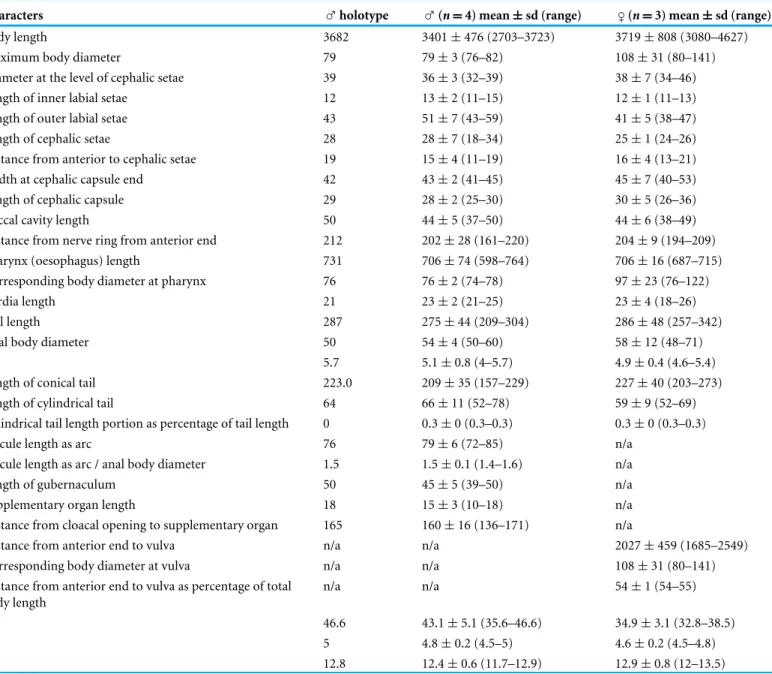
Measurements:SeeTable 1for detailed measurements and morphometric ratios.
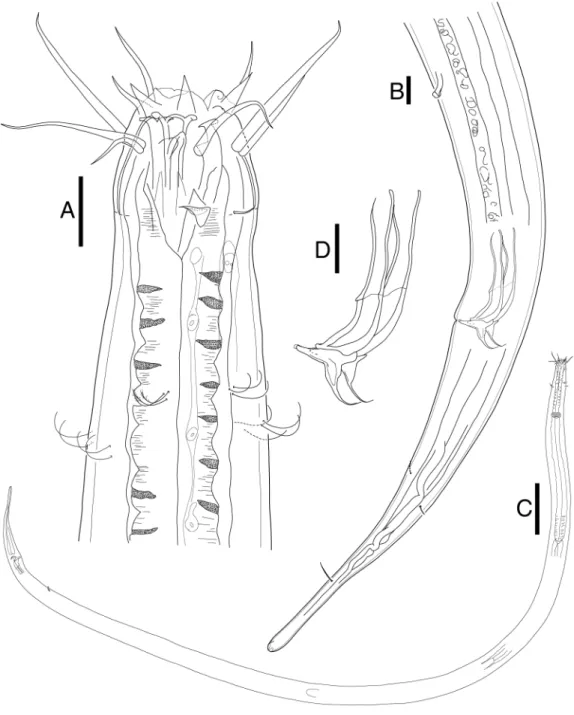
Description: Male (Fig. 2). Cuticle smooth above cephalic capsule, finely striated posterior to cephalic capsule until tail tip. Three lips well developed; edges of lips narrowed and distally pointy curving outwards, each lips carrying two inner labial setae. Six inner labial setae, stout and conical 12µm long. Six longer outer labial setae and four shorter cephalic setae sharing one crown, situated at midlevel of cephalic capsule. Cephalic capsule vaguely set off at mid-level, anterior part narrow, and posterior part gradually thicker. Buccal cavity funnel shaped, wide at anterior end, gradually narrowing to the base. Coffee-bean shaped epidermal glands distributed along dorsal plane from anterior end of body until posterior end. Buccal cavity armed with three mandibles and three teeth. Mandible consisting of two rods distancing from one another anteriorly joined by anterior rod. Lateral edges of each rod with teeth or denticle pointing to the lumen (Fig. 3E).∼5–6 short cervical setae in singles at level of posterior end of cephalic capsule.
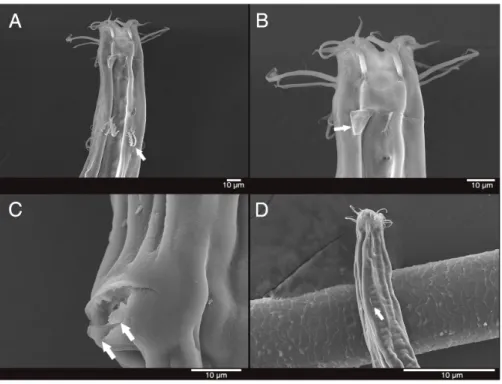
Modified cervical setae, a flap, inverse triangular, just posterior to a single lateral outer labial setae at posterior end of cephalic capsule, observable in all four males on both lateral body sides (Fig. 4B). Amphid ambiguously present below the cervical flap, pouch-shaped.
Two pores observed diagonally below cervical flap and amphid (Fig. 4B). Cervical somatic setae in 8 groups of 2–3 around pharyngeal region a, roughly two cephalic capsule lengths below level of cephalic capsule end (Figs. 4Aand4B). Some cervical setae partly possessing irregular lateral and terminal processes, resemblingpenicillusor plumule (Figs. 4Aand4B).
Somatic setae scarcely distributed along the body in singles until tail region. Pharynx fairly long and annulated with plasmatic lens-like interlayers and sinuous external contours, cardia triangular and going into the middle of intestine. Metanemes not visible. Testes paired opposed, both ends situated to the right of the intestine. Thick supplement, 18µm long, 165µm above from cloacal opening. Spicules paired, bipartite, symmetrical, curved slightly and thick. Each spicule with distinct transverse, oblique seam, dividing it distal and proximal portions (Figs. 5Aand5B). Distal portion shorter than proximal portion. Distal portion slightly curved towards cloacal opening, anterior end with one denticle just above and/away from its round pointy end. Proximal portion rather straight, posterior end with a knob/neck-like constriction. Gubernaculum embracing spicules, shaped like irregular
Figure 2 Mesacanthion jejuensis.sp. nov. male.(A) Head, lateral view. (B) Tail, with spicule and gu- bernaculum. (C) Total view. (D) Bipartite spicules with triangular gubernaculum. Scale bars: 20µm (A, B, and D) and 200µm (C). Figure credit: Raehyuk Jeong.
Full-size DOI: 10.7717/peerj.8023/fig-2
triangle, lateral end which lies lateral to the spicule, almost perpendicular to axis of the anus, even extending beyond distal end of spicule, and the other end arching off at an angle towards the tail. Tail elongated and papilliform. five somatic setae in tail region. Caudal gland protruded anterior to the anus, their nucleus-containing bodies located along the
Figure 3 Mesacanthion jejuensis.sp. nov. female.(A) Head, lateral view. (B) Reproductive system with vulva protruding. (C) Total view. (D) tail region with caudal glands. (E) Ventrosublateral mandible. Scale bars: 20µm (A and D),100µm (B and C) and 10µm (E). Figure credit: Raehyuk Jeong.
Full-size DOI: 10.7717/peerj.8023/fig-3
Table 1 Measurement of diagnostic morphological characters ofMesacanthion jejuensissp. nov. Measurements are inµm where applicable, and morphometric values rounded.
Characters ♂holotype ♂(n=4) mean±sd (range) ♀(n=3) mean±sd (range)
Body length 3682 3401±476 (2703–3723) 3719±808 (3080–4627)
Maximum body diameter 79 79±3 (76–82) 108±31 (80–141)
Diameter at the level of cephalic setae 39 36±3 (32–39) 38±7 (34–46)
Length of inner labial setae 12 13±2 (11–15) 12±1 (11–13)
Length of outer labial setae 43 51±7 (43–59) 41±5 (38–47)
Length of cephalic setae 28 28±7 (18–34) 25±1 (24–26)
Distance from anterior to cephalic setae 19 15±4 (11–19) 16±4 (13–21)
Width at cephalic capsule end 42 43±2 (41–45) 45±7 (40–53)
Length of cephalic capsule 29 28±2 (25–30) 30±5 (26–36)
Buccal cavity length 50 44±5 (37–50) 44±6 (38–49)
Distance from nerve ring from anterior end 212 202±28 (161–220) 204±9 (194–209)
Pharynx (oesophagus) length 731 706±74 (598–764) 706±16 (687–715)
Corresponding body diameter at pharynx 76 76±2 (74–78) 97±23 (76–122)
Cardia length 21 23±2 (21–25) 23±4 (18–26)
Tail length 287 275±44 (209–304) 286±48 (257–342)
Anal body diameter 50 54±4 (50–60) 58±12 (48–71)
c’ 5.7 5.1±0.8 (4–5.7) 4.9±0.4 (4.6–5.4)
Length of conical tail 223.0 209±35 (157–229) 227±40 (203–273)
Length of cylindrical tail 64 66±11 (52–78) 59±9 (52–69)
Cylindrical tail length portion as percentage of tail length 0 0.3±0 (0.3–0.3) 0.3±0 (0.3–0.3)
Spicule length as arc 76 79±6 (72–85) n/a
Spicule length as arc / anal body diameter 1.5 1.5±0.1 (1.4–1.6) n/a
Length of gubernaculum 50 45±5 (39–50) n/a
Supplementary organ length 18 15±3 (10–18) n/a
Distance from cloacal opening to supplementary organ 165 160±16 (136–171) n/a
Distance from anterior end to vulva n/a n/a 2027±459 (1685–2549)
Corresponding body diameter at vulva n/a n/a 108±31 (80–141)
Distance from anterior end to vulva as percentage of total body length
n/a n/a 54±1 (54–55)
a 46.6 43.1±5.1 (35.6–46.6) 34.9±3.1 (32.8–38.5)
b 5 4.8±0.2 (4.5–5) 4.6±0.2 (4.5–4.8)
c 12.8 12.4±0.6 (11.7–12.9) 12.9±0.8 (12–13.5)
posterior midgut. Spinneret well developed. 1 short caudal (terminal) setae (with porous) just above distal end of tail.
Female(Fig. 3). Female generally longer and larger in size. Three lips higher in female, edges of lips noticeably stronger in female, distal end aggressively curved, each lips carrying two inner labial setae. No subtle sexual dimorphism found in setae in the head region, other than shorter length outer labial and cephalic setae compared to male. Short knobs on each anterior end of mandible. Female lacking cervical setae flap on cephalic capsule end. Amphid not observed. Groups of cervical setae found in esophageal region in males
Figure 4 Scanning electron micrograph ofMesacanthion jejuensissp. nov.(A) Male, head region, lat- eral view, groups of cervical setae in doubles/trios with irregular lateral and terminal processes. (B) Male, head region showing contour of cephalic capsule end and triangular cervical setae flap just posterior to lat- eral outer labial seta. (C) Male, cloacal opening with distal end of gubernaculum peeking out. (D) Female, head region, lateral view, single cervical seta.
Full-size DOI: 10.7717/peerj.8023/fig-4
length with protruding lips. Reproductive system didelphic amphidelphic, both ends flexed inwards. Both ovaries positioned left of the intestine, antidromously reflexed. Tail conico-cylindrical, three somatic setae in tail region with no apparent caudal setae.
Diagnosis:Mesacanthion. Body length 2700–4630µm. Cuticle finely striated along the body, smooth only in cephalic capsule region, head set off with cephalic capsule.
Metanemes not visible. Six inner labial setae 8–15µm. Six longer outer labial setae 36–59 µm, four shorter cephalic setae 18–34µm long sharing one crown. Buccal cavity armed with mandible and three teeth. Mandible consisting of two rods distancing from one another anteriorly joined by anterior rod. Lateral edges of each rod with teeth or denticle pointing to the lumen. Buccal cavity 37–61 µm long. 8–9 groups of cervical setae in groups of two to three at stoma region. Cervical setae in single groups in females. Males with testis paired and opposed. Spicule paired, symmetrical, slightly curved, divided into two portions by a seam. Distal portion shorter than proximal. Proximal portion with knob/neck-like end. Gubernaculum paired, shaped like an irregular triangle with caudal apophysis, distal end extending beyond spicules and ventrally towards cloacal opening.
Precloacal supplementary organ present. Three to four somatic setae distributed along the tale. Tail conico-cylindrical, c’ 4–5.7, cylindrical portion of the tail constituting about 30%
of the entire tail length.
Figure 5 Mesacanthion jejuensissp. nov. (A and B, paratype). (A) Lateral view of male cloacal region, showing a seam separating spicules in distal and proximal portions. (B) Lateral view of male cloacal re- gion, showing distal end of spicule and triangular gubernaculum. Scale bars: 30µm (A and B).
Full-size DOI: 10.7717/peerj.8023/fig-5
Differential diagnosis:Total of 23 species ofMesacanthionwith spicules shorter than 2 abd were examined. Species such asM. arcuatile,M. conicumandM. cricetoideswere omitted from examination due to the fact that only female was ever described. Also, species with asymmetrical spicules (anisomorphic and anisometric) were omitted even if the shorter spicule is shorter than 2 abd, sinceGagarin & Klerman (2006)already provided a key for those group of species. M. tenuicaudatumwhich most likely does have spicules shorter than 2 abd, is also omitted from examination and pictorial key as there are no depiction of the specimen available. Description also lacks information regarding gubernaculum, measurements of anal body diameter and length of all setae, making it not feasible for comparison. Lastly,M. virile is included for analysis, despite its lack of information on abd. Although it cannot be confirmed that it possesses spicules which are shorter than 2 abd, given the length of spicule and other relative body measurements, it is likely that this species belongs to this group.
The new species is most similar toM. pannosumas they both share striking resemblance in overall morphology. They both have spicules shorter than 2 abd with presence of both supplementary organ and gubernaculum. Index value of both species (a and c) are within range to each other as well. Most interesting character shared by the two species is the presence of modified/transformed cervical setae seen as a flap. This flap-like appendage is seen as inverse triangle just below a single outer labial seta (lateral seta), at the end of cephalic capsule. It was first observed byWieser (1959) in males ofM. pannosumand it has been a character unique to the species until it now. LikeM. Pannosum, the flap is
previously seen inM. pannosum. The only difference concerning the flap between the two species is thatM. pannosumhad two flaps next to each other, but only a single flap is seen in the new species (Fig. 4B).
The new species differs fromP. pannosumby having stronger (stout) inner labial setae;
longer outer labial setae (43–59 µm vs. 24–25µm, respectively); difference in the index value of b and c’ (4.5–5 vs. 6.3 and 4.0–5.7 vs. 3, respectively); type of spicules (unipartite vs. bipartite with seam, respective).
The validity of diagnostic value in presence or absence of a seam (bipart spicule), can be questionable considering it is an ambiguous character and could be mistaken from a diffraction caused by a large gubernaculum. Due to this reason, the seam was not given a significant importance in the diagnosis of species within the genus, but the character and species which bear it are still discussed for reference.
Total of four species within the genusMesacanthionhave paired bipartite spicules:M.
audax,M. ditlevseni,M. infantile, andM. jejuensissp. nov. They all have spicules which are shorter than 2 abd, butM. audaxis most easily distinguished from the other three species by its lack of supplementary organ. While the three species have supplementary organ, the new species resemblesM. ditlevsenithe most. They both have stout inner labial setae with presence of both supplementary organ and triangular gubernaculum. Their index value (a, b, and c’) are also within range from one another. The new species can be distinguished by its proportionally longer cephalic setae (in which is double the length of cephalic setae observed in M. ditlevseni); presence of cervical flap in new species; dense distribution of cervical setae in groups of doubles/trios below at stoma region in male; differing details to its spicules and gubernaculum. The spicule of the new species is different fromM. ditlevseni in that distal portion of the spicule is shorter than proximal portion where vice versa is true forM. ditlevseni. This is peculiar characteristic unique to the new species, as all bipartite spicules found inMesacanthionspecies have longer distal portion over proximal portion.
We believe that diagnostic value of modified cervical setae flap is greater than bipartite spicule (spicule with seam) in terms of ambiguity. Therefore, the species most similar to the new species is considered to beM. pannosum.
Etymology:The species namejejuensisis given as the species was discovered from coast Jeju Island, South Korea.
Pictorial key to species with spicules shorter than 2 anal body diameter within the genusMesacanthionand morphometric values for valid species ofMesacanthion Figs. 6–8,Table 2
Key to species with spicules shorter than 2 anal body diameters within the genusMesacanthion
1. Supplementary organ present in males . . . 5 -Supplementary organ absent in males . . . 2
2. Stout post-cloacal setae present . . .M. africanthiforme -Stout post-cloacal setae absent . . . 3
3. Tail conico-cylindrical . . .M. karense -Tail conical . . . 4
4. Tail long (c =14–19) with typical stoma . . .M. audax
-Tail stout (c= 43–51) with well-developed posterior rods of the stoma . . . M. armatum
5. Gubernaculum present in males . . . 11 -Gubernaculum absent in males . . . 6 6. Body length over 3000µm . . . 7
-Body length below 2000µm . . . 8
7. Several cervical setae at cephalic capsule with spicules arrow shape with sharp distal end . . .M. agubernatus
-No cervical setae at cephalic capsule with simple spicules slightly curved with blunt distal end . . .M. studiosum
8. Mandible decorated by longitudinal marks . . .M. rigens -Mandible with no decoration . . . 9
9. Somatic setae absent . . .M. proximum -Somatic setae present . . . 10
10. Dorsal tooth missing . . .M. monhystera -Dorsal tooth present . . .M. hirsutum
11. Enlarged cervical setae (flaps) present below lateral outer labial seta at posterior end of cephalic capsule . . . 12
-Enlarged cervical setae (flaps) absent . . . 13
12. Inner labial setae stout. Index c’ 4.0–5.7 . . .M. jejuensissp. nov.
-Inner labial setae thin. Index c’ 3 . . .M. pannosum 13. Subventral precloacal setae absent . . . 14
-Subventral precloacal setae present . . . 18 14. Gubernaculum triangular . . . 15
-Gubernaculum simple with dorsal appendage . . .M. marisalbi
15. Gubernaculum with two parts; membranous part and rod-like part which supports it caudally with barbed tip . . .M. virile
-Gubernaculum with just one part . . . 16 16. Spicule bipartite . . .M. ditlevseni
-Spicule unipartite . . . 17
17. Subcephalic setae absent, supplementary organ 2.2 abd away from anus . . . M. breviseta
-Four subcephalic setae very thin near end of cephalic capsule, supplementary organ 3 abd away from anus . . .M. lucifer
18. Proximal end of spicule with massive process . . .M. fricum -Proximal end of spicule without massive process . . . 19
19. Distal end of spicule with backwardly pointing spines . . .M. audax -Distal end of spicule with no backwardly pointing spines . . . 20 20. Spicule distally dilated . . .M. majus
-Spicule with no dilation . . . 21
21. Supplementary organ located close (∼1 spicule length) to proximal end of the spicule . . .M. kerguelense
-Supplementary organ located further (>1.1 spicule length) away from the anus . . . 22
22. Inner labial setae stout 12µm long, Index a∼30, Index b∼5, Index c’ 4.2–4.5 . . .M. longissimesetosum
µ
DISCUSSION
The genus Mesacanthion currently consist of 39 valid species. Of these valid species, Mesacanthion ungulatum(Wieser, 1953) is most ambiguous in terms of validity. The species was erected from a description based on only two juvenile specimens, with reasoning that the species in question bears extremely long labial setae and high lips. While there is no problem with the validity according to the International Code of Zoological Nomenclature, since a new species can be described at any life stage, it is ambiguous nonetheless in its current state as its distinguishing characters for the species is no longer unique to the species.
Labial setae inM. ungulatumis noted to be extremely long, measuring to be 15µm might have been lengthy for the genus at the time of original description, but currently compared to other species within the genus, it is quite average in length.Mesacanthion arabium (Warwick, 1973) bears labial setae measuring from 23–25µm, albeit its overall longer body length. Even when comparing proportionally to body length,Mesacanthion fricum (Inglis, 1966) (body length 1650µm/length of inner labial setae 13µm) andMesacanthion hirsutum(Gerlach, 1953) (1155–1982µm/8–14µm) have longer proportioned inner labial setae thanM. ungulatum(2250–2430µm/15µm). The only characteristic discerning this species from the rest is then by its high lips, but even that is questionable, considering later described species such as Mesacanthion alexandrinus(Nicholas, 1993), while it does not mention in the description, depict just as high lips as shown inM. ungulatum. It would be appropriate to consider this a synonymization case, and find a species described after M. ungulatumwhich is most similar to follow the Principle of Priority. Unfortunately, remaining characteristics ofM. ungulatumis very generic to the genus and the fact that there is no male to compare its spicules, gubernaculum and supplementary organ which can be unique to each species, no further action can be taken other than to place it as species inquirendum. There is however 18S ribosomal RNA gene, partial sequence ofM.
ungulatumavailable on GenBank. It seems that the sample specimen was obtained from Chile, the type locality, so there is high probability that more information can be gathered regarding adult stage of this species. Hopefully someone can review the species with a sound adult specimen to clear this species of its current status.
Diagnosis of the genusMesacanthionprovided bySmol, Muthumbi & Sharma (2014), was updated in this study based on our review and findings. The original diagnosis specifically states that spicules are generally short, but if long, gubernaculum with caudal apophysis is to be present. This is true in most cases, but with exceptions in species such asM. brevista, which has one of the longest spicules in the genus (165µm) with no gubernaculum at all, andM. arabium,which has a pair of short spicules (24µm) bearing a triangular gubernaculum which resembles a caudal apophysis. In addition, accounts for different types of spicules were added (symmetric/asymmetric, bipartite, etc.), so that later encounters of new species with bipartite spicules is not simple mindedly mistaken as Paramesacanthionas opposed toMesacanthion, as was the case with us.
The morphology of the spicule is especially diverse in the genusMesacanthion. Spicules which come in a pair can be either short or long/symmetrical or asymmetrical/straight, L-shaped or arcuate in shape. Spicules, if long can be anisomorphic and/or anisometric
Figure 6 Pictorial key to species with spicules shorter than 2 anal body diameters within the genus Mesacanthion. A–D, species without supplementary organ with gubernaculum; E–J, species with supple- mentary organ without gubernaculum. Species with bipartite spicules marked with asterisk. Figure source:
(A)Warwick (1970). (B)Timm (1961). (C)Ditlevsen (1930). (D)Filipjev (1927). (E)Vitiello (1971). (F) Gerlach (1967). (G)Gerlach (1967). (H)Gerlach (1957a). (I)Gerlach (1957a). (J)Inglis (1964).
Full-size DOI: 10.7717/peerj.8023/fig-6
and can be bipartite or in whole. The part of it being bipartite can be perplexing when it comes to species identification, as it can lead to wrongful placement of the species to the related genus Paramesacanthion. Diagnosis of Paramesacanthionprovided by Smol, Muthumbi & Sharma (2014)specifically mentions its distinguishing characteristic is
‘‘spicules consisting of two portions, distal and proximal, articulating with each other’’,
Figure 7 Pictorial key to species with spicules shorter than two anal body diameters within the genus Mesacanthion. A–K, species with supplementary organ and gubernaculum. Species with bipartite spicules marked with asterisk. Figure source: (A)Ditlevsen (1918). (B)Filipjev (1927). (C)Filipjev (1927). (D)In- glis (1966). (E)Mawson (1958). (F)Wieser (1953). (G)Filipjev (1927). (H)Wieser (1953). (I)Platonova &
Galtsova (1976). (J)Wieser (1959). (K)Ditlevsen (1930).
Full-size DOI: 10.7717/peerj.8023/fig-7
knowing some spicules inMesacanthioncan be bipartite, it is imperative to put emphasis into the word ‘‘articulating’’ in diagnosis of Paramesacanthion species’ two portioned spicules. Most spicules of the genusParamesacanthionclearly depict the two portions and its articulation from one another (i.e., Knee joint). While some species likeP. marei, does not clearly show the articulation much like bipartite spicules found inMesacanthion, they too can be distinguished as aParamesacanthionspecies by its: 1. Outer labial and cephalic
Figure 8 Pictorial key to species with spicules shorter than two anal body diameters within the genus Mesacanthion. A–B, species with supplementary organ and gubernaculum along with triangular cervical setae flaps. Species with bipartite spicules marked with asterisk. Figure source: (A)Wieser (1959). Figure credit: (B) Raehyuk Jeong.
Full-size DOI: 10.7717/peerj.8023/fig-8
setae in front of anterior end of cephalic capsule and 2. Subcephalic setae at middle of cephalic capsule. Paramesacanthionspecies bear an extra ring of subcephalic setaes which can be confused with the true cephalic setae ofMesacanthionspecies.Wieser (1953) specifically mentioned this when erecting the genus, not to confuse ‘‘the subcephalic setae of the male with the true cephalic setae since the former occupy that level of the head on which inMesacanthionthe insertion of the cephalic setae takes place’’ (p.80). As such, the new species has a paired spicule which are symmetric from one another. They are bipartite with distal portion slightly shorter than proximal part. Distal and proximal is divided by a seam which seems to thicken or ‘‘arm’’ around the distal portion of the spicule. Proximal end arcuate and distal end set with pointing spine or a ‘‘barb’’.
Metanemes are one character which was surprisingly not observed within the new species.
While no species belonging toMesacanthionhave yet been described to date with description or depiction of metanemes, orthometaneme of dorsolateral kind was expected to be present within the new species prior to inspection. Diagnosis of the family Thoracostomopsidae (Filipjev, 1927) (according toSmol, Muthumbi & Sharma, 2014) specifically states ‘‘only dorsolateral orthometanemes with a robus scapulus but no caudal filament’’. Species belonging to Mesacanthion’s most closely related genus, Paramesacanthion abyssorum Bussau 1995, was also recorded with presence of dorsolateral orthometanemes. Not only that, ‘‘coffee bean shaped epidermal glands’’ which were sighted alongside dorsolateral orthometanemes in P. abyssorumare very much present within the new species as well (Figs. 2Aand3A). Given that orthometanemes are subtler in their appearance compared
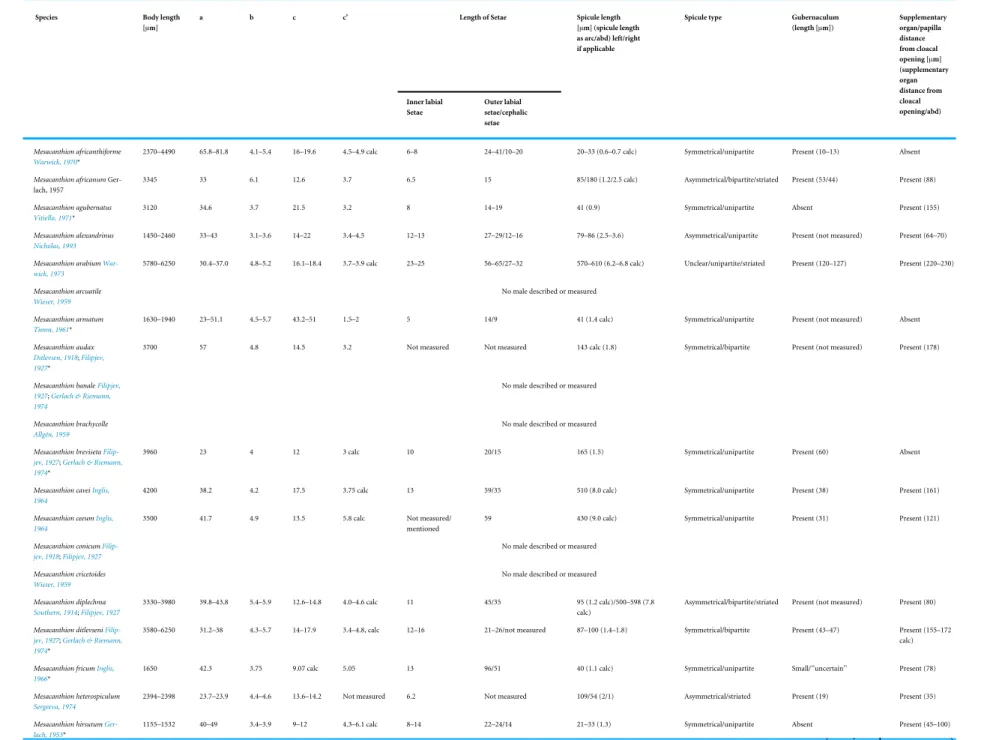
Table 2 Comparison of diagnostic morphological characters of allMesacanthionspecies. Species with spicules shorter than 2 anal body diameters marked with aster- isk. Males only, morphometric values rounded.
Species Body length
[µm]
a b c c’ Length of Setae Spicule length
[µm] (spicule length as arc/abd) left/right if applicable
Spicule type Gubernaculum
(length [µm])
Supplementary organ/papilla distance from cloacal opening [µm]
(supplementary organ distance from cloacal opening/abd) Inner labial
Setae
Outer labial setae/cephalic setae
Mesacanthion africanthiforme Warwick, 1970*
2370–4490 65.8–81.8 4.1–5.4 16–19.6 4.5–4.9 calc 6–8 24–41/10–20 20–33 (0.6–0.7 calc) Symmetrical/unipartite Present (10–13) Absent
Mesacanthion africanumGer- lach, 1957
3345 33 6.1 12.6 3.7 6.5 15 85/180 (1.2/2.5 calc) Asymmetrical/bipartite/striated Present (53/44) Present (88)
Mesacanthion agubernatus Vitiello, 1971*
3120 34.6 3.7 21.5 3.2 8 14–19 41 (0.9) Symmetrical/unipartite Absent Present (155)
Mesacanthion alexandrinus Nicholas, 1993
1450–2460 33–43 3.1–3.6 14–22 3.4–4.5 12–13 27–29/12–16 79–86 (2.5–3.6) Asymmetrical/unipartite Present (not measured) Present (64–70)
Mesacanthion arabiumWar- wick, 1973
5780–6250 30.4–37.0 4.8–5.2 16.1–18.4 3.7–3.9 calc 23–25 56–65/27–32 570–610 (6.2–6.8 calc) Unclear/unipartite/striated Present (120–127) Present (220–230)
Mesacanthion arcuatile Wieser, 1959
No male described or measured
Mesacanthion armatum Timm, 1961*
1630–1940 23–51.1 4.5–5.7 43.2–51 1.5–2 5 14/9 41 (1.4 calc) Symmetrical/unipartite Present (not measured) Absent
Mesacanthion audax Ditlevsen, 1918;Filipjev, 1927*
3700 57 4.8 14.5 3.2 Not measured Not measured 143 calc (1.8) Symmetrical/bipartite Present (not measured) Present (178)
Mesacanthion banaleFilipjev, 1927;Gerlach & Riemann, 1974
No male described or measured
Mesacanthion brachycolle Allgén, 1959
No male described or measured
Mesacanthion brevisetaFilip- jev, 1927;Gerlach & Riemann, 1974*
3960 23 4 12 3 calc 10 20/15 165 (1.5) Symmetrical/unipartite Present (60) Absent
Mesacanthion caveiInglis, 1964
4200 38.2 4.2 17.5 3.75 calc 13 59/35 510 (8.0 calc) Symmetrical/unipartite Present (38) Present (161)
Mesacanthion ceeumInglis, 1964
3500 41.7 4.9 13.5 5.8 calc Not measured/
mentioned
59 430 (9.0 calc) Symmetrical/unipartite Present (31) Present (121)
Mesacanthion conicumFilip- jev, 1918;Filipjev, 1927
No male described or measured
Mesacanthion cricetoides Wieser, 1959
No male described or measured
Mesacanthion diplechma Southern, 1914;Filipjev, 1927
3330–3980 39.8–43.8 5.4–5.9 12.6–14.8 4.0–4.6 calc 11 45/35 95 (1.2 calc)/500–598 (7.8
calc)
Asymmetrical/bipartite/striated Present (not measured) Present (80)
Mesacanthion ditlevseniFilip- jev, 1927;Gerlach & Riemann, 1974*
3580–6250 31.2–38 4.3–5.7 14–17.9 3.4–4.8, calc 12–16 21–26/not measured 87–100 (1.4–1.8) Symmetrical/bipartite Present (43–47) Present (155–172
calc)
Mesacanthion fricumInglis, 1966*
1650 42.3 3.75 9.07 calc 5.05 13 96/51 40 (1.1 calc) Symmetrical/unipartite Small/’’uncertain’’ Present (78)
Mesacanthion heterospiculum Sergeeva, 1974
2394–2398 23.7–23.9 4.4–4.6 13.6–14.2 Not measured 6.2 Not measured 109/54 (2/1) Asymmetrical/striated Present (19) Present (35)
Jeongetal.(2019),PeerJ,DOI10.7717/peerj.8023