430
Dialects
A language is a dialect that has an army and a navy.
MAX WEINREICH (1894–1969)
All speakers of English can talk to each other and pretty much understand each other. Yet, no two of us speak exactly alike. Some differences are the result of age, sex, social situation, and where and when the language was learned. These differences are reflected in word choices, the pronunciation of words, and gram- matical rules. The language of an individual speaker with its unique characteris- tics is referred to as the speaker’s idiolect. English may then be said to consist of anywhere from 450 million to 850 million idiolects, or the number of speakers of English (which seems to be growing every day and is difficult to estimate).
Like individuals, different groups of people who speak the same language speak it differently. Bostonians, New Yorkers, Texans, blacks in Chicago, whites in Denver, and Hispanics in Albuquerque all exhibit variation in the way they speak English. When there are systematic differences in the way groups speak a language, we say that each group speaks a dialect of that language. Dialects are mutually intelligible forms of a language that differ in systematic ways. Every
Language is a city to the building of which every human being brought a stone.
RALPH WALDO EMERSON, Letters and Social Aims, 1876
Language in Society
9
speaker, whether rich or poor, regardless of region or racial origin, speaks at least one dialect, just as each individual speaks an idiolect. A dialect is not an inferior or degraded form of a language, and logically could not be so because a language is a collection of dialects.
It is not always easy to decide whether the differences between two speech communities reflect two dialects or two languages. Sometimes this rule-of- thumb definition is used: When dialects become mutually unintelligible—when the speakers of one dialect group can no longer understand the speakers of another dialect group—these dialects become different languages.
However, this rule of thumb does not always jibe with how languages are officially recognized, which is determined by political and social considerations.
For example, Danes speaking Danish and Norwegians speaking Norwegian and Swedes speaking Swedish can converse with each other. Nevertheless, Danish and Norwegian and Swedish are considered separate languages because they are spoken in separate countries and because there are regular differences in their grammars. Similarly, Hindi and Urdu are mutually intelligible “languages” spo- ken in Pakistan and India, although the differences between them are not much greater than those between the English spoken in America and the English spo- ken in Australia.
The recent history of Serbo-Croatian, the language of the former nation of Yugoslavia, illustrates the factors that can determine if a particular way of speaking is considered to be a dialect or a language. From a linguistic point of view, Serbo-Croatian is a single Slavic language: Even though Croats use Roman script (like English) while Serbs use Cyrillic script (like Russian), in speech the varieties are mutually intelligible, differing slightly in vocabulary just as the Brit- ish and American English dialects do. But from a sociopolitical point of view, following the breakup of Yugoslavia in the 1990s, the Serbo-Croatian language
“broke up” as well. After years of conflict, the two now-independent nations declare that they speak not just different dialects but different languages.
On the other hand, linguistically distinct languages in China, such as Man- darin and Cantonese, although mutually unintelligible when spoken, are nev- ertheless referred to as dialects of Chinese in the media and elsewhere because they have a common writing system that can be read by all speakers (because it’s ideographic—see chapter 11), and because they are spoken in a single country.
It is also not easy to draw a distinction between dialects and languages on strictly linguistic grounds. Dialects and languages reflect the underlying gram- mars and lexicons of their speakers. It would be completely arbitrary to say, for example, that grammars that differ from one another by, say, twenty rules repre- sent different languages whereas grammars that differ by less than twenty rules are dialects. Why not ten rules or thirty rules? In reality, what one finds is that there is no sudden major break between dialects. Rather, dialects merge into each other, forming a dialect continuum. Imagine, for example, a traveler jour- neying from Vienna to Amsterdam by bicycle. She would notice small changes in the German spoken as she bicycled from village to village, and the people in adjacent villages would have no trouble communicating with one another. Yet by the time our traveler reached Dutch-speaking Amsterdam, she would realize
that the accumulated differences made the German of Vienna and the Dutch of Amsterdam nearly mutually unintelligible.
Because neither mutual intelligibility, nor degree of grammatical difference, nor the existence of political or social boundaries is decisive, it is not possible to precisely define the difference between a language and a dialect. We shall, however, use the rule-of-thumb definition and refer to dialects of one language as mutually intelligible linguistic systems, with systematic differences among them.
As we will discuss in the next chapter, languages change continually but these changes occur gradually. They may originate in one geographic region or in one social group and spread slowly to others, and often over the life spans of several generations of speakers. Dialect diversity develops when the changes that occur in one region or group do not spread. When speakers are in regular contact with one another, linguistic properties spread and are acquired by children. How- ever, when some communication barrier separates groups of speakers—be it a physical barrier such as an ocean or a mountain range, or social barriers of a political, racial, class, educational, or religious kind—linguistic changes do not spread so readily, and the differences between groups are reinforced and grow in number.
Dialect leveling is movement toward greater uniformity and less variation among dialects. Though one might expect dialect leveling to occur as a result of the ease of travel and mass media, this is not generally the case. Dialect varia- tion in the United Kingdom is maintained although only a few major dialects are spoken on national radio and television. There may actually be an increase in dialects in urban areas, where different groups attempt to maintain their dis- tinctness and group identity.
Regional Dialects
Phonetics . . . the science of speech. That’s my profession. . . . (I) can spot an Irishman or a Yorkshireman by his brogue. I can place any man within six miles. I can place him within two miles in London. Sometimes within two streets.
GEORGE BERNARD SHAW, Pygmalion, 1912
The educated Southerner has no use for an r except at the beginning of a word.
MARK TWAIN, Life on the Mississippi, 1883
When various linguistic differences accumulate in a particular geographic region (e.g., the city of Boston or the southern area of the United States), the language spoken has its own character. Each version of the language is referred to as a regional dialect. The hypothetical journey from Vienna to Amsterdam discussed previously crossed regional dialects. In the United States, most dialectal differ- ences are based on geographic region.
The origins of many regional dialects of American English can be traced to the people who settled in North America in the seventeenth and eighteenth cen- turies. Because they came from different parts of England, these early settlers already spoke different dialects of English, and these differences were carried to the original thirteen American colonies. By the time of the American Revolu- tion, there were three major dialect areas in the British colonies: the Northern dialect spoken in New England and around the Hudson River; the Midland dialect spoken in Pennsylvania; and the Southern dialect. These dialects differed from one another and from the English spoken in England in systematic ways.
Some of the changes that occurred in British English spread to the colonies; oth- ers did not.
How dialects develop is illustrated by the pronunciation of words with an r in different parts of United States. As early as the eighteenth century, the British in southern England were dropping their r’s before consonants and at the ends of words. Words such as farm, farther, and father were pronounced as [fa m], [faðə], and [faðə], respectively. By the end of the eighteenth century, r-drop was a general rule among the early settlers in New England and the southern Atlan- tic seaboard. Close commercial ties were maintained between the New Eng- land colonies and London, and Southerners sent their children to England to be educated, which reinforced the r-drop rule. The r-less dialect still spoken today in Boston, New York, and Savannah maintains this characteristic. Later set- tlers, however, came from northern England, where the r had been retained; as the frontier moved westward, so did the r. Pioneers from all three dialect areas spread westward. The mingling of their dialects leveled many of their dialect differences, which is why the English used in large sections of the Midwest and the West is similar.
Regional phonological or phonetic distinctions are often referred to as dif- ferent accents. A person is said to have a Boston or Brooklyn or Midwestern accent, a Southern drawl, an Irish brogue, and so on. Thus, accent refers to the characteristics of speech that convey information about the speaker’s dialect, which may reveal in what country or in what part of the country the speaker grew up, or to which sociolinguistic group the speaker belongs. People in the United States often refer to someone as having a British accent or an Australian accent; in Britain they refer to an American accent.
The term accent is also used to refer to the speech of non-native speak- ers, who have learned a language as a second language. For example, a native French speaker’s English is described as having a French accent. In this sense, accent refers to phonological differences caused by one’s native language. Unlike regional dialect accents, such foreign accents do not reflect differences in the speech of the community where the language was learned.
Regional dialects may differ not only in their pronunciation but also in their lexical choices and grammatical rules. A comedian once remarked that “the Mason-Dixon line is the dividing line between you-all and youse-guys.” In the following sections we discuss the different linguistic levels at which dialects may vary.
Phonological Differences
I have noticed in traveling about the country a good many differences in the pronunciation of common words. . . . Now what I want to know is whether there is any right or wrong about this matter. . . . If one way is right, why don’t we all pronounce that way and compel the other fellow to do the same? If there isn’t any right or wrong, why do some persons make so much fuss about it?
LETTER QUOTED IN “THE STANDARD AMERICAN,” in J. V. Williamson and V. M.
Burke, eds., A Various Language, 1971
A comparison of the r-drop and other dialects illustrates the many phonological differences among dialects of American English. These variations created dif- ficulties for us in writing chapter 4 (phonetics), where we wished to illustrate the different sounds of English by using key words in which the sounds occur. As mentioned, some people pronounce caught kɔt with the vowel ɔ and cot kat with a , whereas others pronounce them both kat . Some pronounce Mary, merry, and marry the same; others pronounce the three words differently as meri mɛri , and m ri ; and still others pronounce two of them the same. In the southern area of the country, creek is pronounced with a tense [i] as [krik], and in the north Midlands, it is pronounced with a lax ɪ as krɪk . Many speak- ers of American English pronounce pin and pen identically, whereas others pro- nounce the first pɪn and the second p n .
The pronunciation of British English (or many dialects of it) differs in system- atic ways from pronunciations in many dialects of American English. In a sur- vey of hundreds of American and British speakers conducted via the Internet, 48 percent of the Americans pronounced the mid consonants in luxury as voiceless
lʌkʃəri , whereas 96 percent of the British pronounced them as voiced lʌgʒəri . Sixty-four percent of the Americans pronounced the first vowel in data as [e]
and 35 percent as æ, as opposed to 92 percent of the British pronouncing it with an [e] and only 2 percent with [æ]. The most consistent difference occurred in the placement of primary stress, with most Americans putting stress on the first syllable and most British on the second or third in polysyllabic words like cigarette, applicable, formidable, and laboratory.
The United Kingdom also has many regional dialects. The British vowels described in the phonetics chapter are used by speakers of the dialect called RP for “received pronunciation” because it is “received” (accepted) in the court of the monarch. In this dialect, h is pronounced at the beginning of both head and herb, whereas in most American English dialects h is not pronounced in herb.
In some British English dialects the h is regularly dropped from most words in which it is pronounced in American, such as house, pronounced aʊs , and hero, pronounced iro . As is true of the origin of certain American dialects, many of the regional dialects of British English, such as the West Country dialect, the East Anglia dialect, and the Yorkshire dialect, are not deviations from the
“standard” dialect spoken in London, but are direct descendants of earlier vari- eties that existed alongside London English as far back as the eleventh century.
English is the most widely spoken language in the world (as a first or second language). It is the national language of several countries, including the United States, large parts of Canada, the British Isles, Australia, and New Zealand. For many years it was the official language in countries that were once colonies of Britain, including India, Nigeria, Ghana, Kenya, and the other “anglophone”
countries of Africa. There are many other phonological differences in the vari- ous dialects of English used around the globe.
Lexical Differences
“Liberty Meadows” copyright © 1998. By permission of Frank Cho and Creators Syndicate, Inc.
Regional dialects may differ in the words people use for the same object, as well as in phonology. Hans Kurath, an eminent dialectologist, in his paper “What Do You Call It?” asked:
Do you call it a pail or a bucket? Do you draw water from a faucet or from a spigot? Do you pull down the blinds, the shades, or the curtains when it gets dark? Do you wheel the baby, or do you ride it or roll it?
In a baby carriage, a buggy, a coach, or a cab?
People take a lift to the first floor (our second floor) in England, but an eleva- tor in the United States; they fill up with petrol (not gas) in London; in Britain a public school is “private” (you have to pay), and if a student showed up there wearing pants (“underpants”) instead of trousers (“pants”), he would be sent home to get dressed.
If you ask for a tonic in Boston, you will get a drink called soda or soda-pop in Los Angeles; and a freeway in Los Angeles is a thruway in New York, a park- way in New Jersey, a motorway in England, and an expressway or turnpike in other dialect areas.
Dialect Atlases
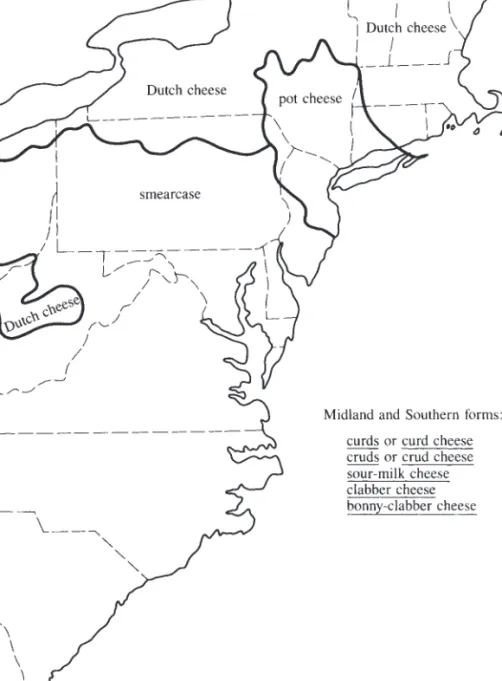
Linguist Hans Kurath published dialect maps and dialect atlases of a region on which dialect differences are geographically plotted (see Figure 9.1). The dialec- tologists who created the map noted the places where speakers use one word or another word for the same item. For example, the area where the term Dutch cheese is used is not contiguous; there is a small pocket mostly in West Virginia where speakers use that term for what other speakers call smearcase (from the Dutch word smeerkaas, a compound made from the verb smeren “to spread”
and kaas “cheese”).
In similar maps, areas were differentiated based on the variation in pronun- ciation of the same word, such as krik and krɪk for creek. The concentrations defined by different word usages and varying pronunciations, among other lin- guistic differences, form dialect areas.
A line drawn on the map to separate the areas is called an isogloss. When you cross an isogloss, you are passing from one dialect area to another. Sometimes several isoglosses coincide, often at a political boundary or at a natural barrier such as a river or mountain range. Linguists call these groupings a bundle of isoglosses. Such a bundle can define a regional dialect.
DARE is the acronym for the Dictionary of American Regional English, whose chief editor was the distinguished American dialectologist Frederick G.
Cassidy (1907–2000). This work represents decades of research and scholar- ship by Cassidy and other American dialectologists and is a major resource for those interested in American English dialects. Its first four volumes, covering A through Sk, are published; volume 5, covering Sk through Z, is due to be pub- lished in 2011. Its purpose is described on its Web site as follows:
The Dictionary of American Regional English (DARE) is a reference tool unlike any other. Its aim is not to prescribe how Americans should speak, or even to describe the language we use generally, the
“standard” language. Instead, it seeks to document the varieties of English that are not found everywhere in the United States—those words, pronunciations, and phrases that vary from one region to another, that we learn at home rather than at school, or that are part of our oral rather than our written culture. Although American English is remarkably homogeneous considering the tremendous size of the country, there are still many thousands of differences that characterize the various dialect regions of the United States. It is these differences that DARE records.
While Professor Cassidy did not live to see the completion of DARE, he took his life’s work with him to the grave, where on his tombstone is inscribed “On to Z!”
Syntactic Differences
Dialects can also be distinguished by systematic syntactic differences. In most American dialects, sentences may be conjoined as follows:
FIGURE 9.1 | A dialect map showing the isoglosses separating the use of different words that refer to the same cheese.
Kurath, Hans. A Word Geography of the Eastern United States. Ann Arbor, MI: University of Michigan Press, copyright © 1949. Reprinted with permission of University of Michigan Press.
1. John will eat and Mary will eat. → John and Mary will eat.
In the Ozark dialect of southern Missouri, the following conjoining is also possible:
2. John will eat and Mary will eat. → John will eat and Mary.
In (1) the VP will eat in the first conjunct is deleted, while in (2) the VP in the second conjunct is deleted. Most dialects of English allow deletion of only the first conjunct and in those dialects John will eat and Mary is ungrammatical.
The Ozark dialect differs in allowing the second VP to delete.
Speakers of some American dialects say Have them come early! where oth- ers would say Have them to come early! Many speakers of the latter dialect also exhibit “double modals,” and expressions like He might could do it or You might should go home are grammatical. While Aux recursion (see chapter 2) is permitted in all English dialects, most dialects constrain verb phrases to contain no more than one modal verb.
Some of the dialects that permit double modals (e.g., Appalachian En glish) also exhibit double objects (e.g., I caught me a fish); and a-prefixing with progressives, He came a-runnin’. Several distinguishing syntactic characteris- tics contribute to a bundle of syntactic isoglosses that separate these regional dialects.
In some American English dialects, the pronoun I occurs when me would be used in other dialects. This difference is a syntactically conditioned morphologi- cal difference.
Dialect 1 Dialect 2
between you and I between you and me
Won’t he let you and I swim? Won’t he let you and me swim?
*Won’t he let I swim?
The use of I in these structures is only permitted in a conjoined NP, as the starred (ungrammatical) sentence shows. Won’t he let me swim?, however, is grammatical in both dialects. Dialect 1 is growing, and these forms are becom- ing Standard English, spoken by TV announcers, political leaders, and univer- sity professors, although language purists still frown on this usage.
In British English the pronoun it in the sentence I could have done it can be deleted. British speakers say I could have done, which is not in accordance with the syntactic rules of American English. American English, however, permits the deletion of done it, and Americans say I could have, which does not accord with the British syntactic rules.
Despite such differences, we are still able to understand speakers of other English dialects. Although regional dialects differ in pronunciation, vocabulary, and syntactic rules, the differences are minor when compared with the total- ity of the grammar. Dialects typically share most rules and vocabulary, which explains why the dialects of a language are mutually intelligible.
Social Dialects
The limits of my language mean the limits of my world.
LUDWIG WITTGENSTEIN, Tractatus Logico-Philosophicus, 1922
“For Better or for Worse” copyright © 2005 Lynn Johnston Productions. Dist. by Universal Press Syndicate. Reprinted with permission. All rights reserved.
In many respects, social boundaries and class differences are as confining as the physical barriers that often define regional dialects. It is therefore not surprising that different dialects of a language evolve within social groups.
The social boundaries that give rise to dialect variation are numerous. They may be based on socioeconomic status, religious, ethnic or racial differences, country of origin, and even gender. Middle-class American and British speakers are often distinguishable from working-class speakers; in Baghdad the Chris- tian, Muslim, and Jewish groups all speak different varieties of Arabic; in India people often use different dialects of a standard regional language such as Hindi, Gujarati, or Bengali depending on the social caste they belong to; in America, many speakers of African descent speak a different dialect than those of Euro- pean, Asian, or Hispanic descent; and, as we shall see, women and men each have their own distinguishing speech characteristics.
Dialect differences that seem to come about because of social factors are called social dialects, as opposed to regional dialects, which are spawned by geographical factors. However, there are regional aspects to social dialects and, clearly, social aspects to regional dialects, so the distinction is not entirely cut and dried.
The “Standard”
We don’t talk fancy grammar and eat anchovy toast. But to live under the kitchen doesn’t say we aren’t educated.
MARY NORTON, The Borrowers, 1952
Even though every language is a composite of dialects, many people talk and think about a language as if it were a well-defined fixed system with various dialects diverging from this norm. This is false, although it is a falsehood that is
widespread. One writer of books on language accused the editors of Webster’s Third New International Dictionary, published in 1961, of confusing “to the point of obliteration the older distinction between standard, substandard, collo- quial, vulgar, and slang,” attributing to them the view that “good and bad, right and wrong, correct and incorrect no longer exist.” In the next section we argue that such criticisms are ill founded.
Language Purists
A woman who utters such depressing and disgusting sounds has no right to be anywhere—no right to live. Remember that you are a human being with a soul and the divine gift of articulate speech: that your native language is the language of Shakespeare and Milton and the Bible; and don’t sit there crooning like a bilious pigeon.
GEORGE BERNARD SHAW, Pygmalion, 1912
Prescriptive grammarians, or language purists, usually consider the dialect used by political leaders and national newscasters as the correct form of the language.
(See chapter 6 for a discussion of prescriptive grammars.) This is the dialect taught in “English” or “grammar” classes in school, and it is closer to the writ- ten form of the language than many other dialects, which also lends it an air of superiority.
Otto Jespersen, the great Danish linguist, ridiculed the view that a particular dialect is better than any other when he wrote: “We set up as the best language that which is found in the best writers, and count as the best writers those that best write the language. We are therefore no further advanced than before.”
The dominant, or prestige, dialect is often called the standard dialect. Stan- dard American English (SAE) is a dialect of English that many Americans nearly speak; divergences from this “norm” are labeled “Philadelphia dialect,” “Chi- cago dialect,” “African American English,” and so on.
SAE is an idealization. Nobody speaks this dialect; and if somebody did, we would not know it, because SAE is not defined precisely (like most dialects, none of which are easy to clarify). Teachers and linguists held a conference in the 1990s that attempted to come up with a precise definition of SAE. This meeting did not succeed in satisfying everyone’s view of SAE. SAE was once represented by the language used by national news broadcasters, but today many of them speak a regional dialect or a style of English that is not universally accepted as
“standard.” For example, the British Broadcasting Corporation (BBC) once used mostly speakers of RP English, but today speakers of Irish, Welsh, Scottish, and other regional dialects of English are commonly heard on BBC programs. The BBC describes its English as “the speech of educated professionals.”
A standard dialect (or prestige dialect) of a particular language may have social functions. Its use in a group may bind people together or provide a com- mon written form for multidialectal speakers. If it is the dialect of the wealthy, influential, and powerful members of society, this may have important implica- tions for the entire society. All speakers who aspire to become successful may be required to speak that dialect even if it isn’t their own.
In 1954 the British scholar Alan Ross published Linguistic Class-Indicators in Present-Day English, in which he compared the speech habits of the English
upper class, whom he labeled “U,” with the speech habits of “non-U” speak- ers. Ross concluded that although the upper class had words and pronuncia- tions peculiar to it, the main characteristic of U speech is the avoidance of non-U speech; and the main characteristic of non-U speech is, ironically, the effort to sound U. “They’ve a lovely home,” for example, is pure non-U, because it is an attempt to be refined. Non-U speakers say “wealthy” and “ever so”; U speakers say “rich” and “very.” Non-U speakers “recall”; U-speakers simply “remember.”
Non-U speech habits often include hypercorrections, deviations from the norm thought to be “proper English,” such as pronouncing often with a [t], or saying between you and I, while U speakers, who are generally more secure about their dialect, say ɔf n and between you and me. Ironically, in some cases non-U speech is so pervasive it eventually becomes part of the prestige dialect, as we are seeing today with often and between you and I/me.
No dialect, however, is more expressive, less corrupt, more logical, more complex, or more regular than any other dialect or language. They are sim- ply different. More precisely, dialects represent different set of rules or lexical items represented in the minds of its speakers. Any judgments, therefore, as to the superiority or inferiority of a particular dialect or language are social judg- ments, which have no linguistic or scientific basis.
To illustrate the arbitrariness of “standard usage,” consider the English r-drop rule discussed earlier. Britain’s prestigious RP accent omits the r in words such as “car,” “far,” and “barn.” Thus an r-less pronunciation is thought to be better than the less prestigious rural dialects that maintain the r. However, r-drop in the northeast United States is generally considered substandard, and the more pres- tigious dialects preserve the r, though this was not true in the past when r-drop was considered more prestigious. This shows that there is nothing inherently bet- ter or worse about one pronunciation over another, but simply that one variant is perceived of as better or worse depending on a variety of social factors.
Banned Languages
Language purists wish to prevent language or dialect differentiation because of their false belief that some languages are better than others, or that change leads to corruption. Languages and dialects have also been banned as a means of polit- ical control. Russian was the only legal language permitted by the Russian tsars, who banned the use of Ukrainian, Lithuanian, Georgian, Armenian, Azeri, and all the other languages spoken by national groups under the rule of Russia.
Cajun English and French were once banned in southern Louisiana by prac- tice if not by law. Even as recently as August 8, 2006, Mary Tutwiler writes in a blog entitled “The French Connection,” “Many local French speakers were so traumatized by the experience of being punished for speaking their mother tongue in school that they suppress their linguistic knowledge in public.”
For many years, American Indian languages were banned in federal and state schools on reservations. Speaking Faroese was formerly forbidden in the Faroe Islands. A proscription against speaking Korean was imposed by the Japanese during their occupation of Korea between 1910 and 1945. Throughout history many languages and dialects have been banned to various degrees.
In France, a notion of the “standard” (the dialect spoken in Paris) as the only correct form of the language is promoted by the French Academy, an official
panel of “scholars” who determine what usage constitutes the “official French language.” Some years ago, the Academy enacted a law forbidding the use of
“Franglais,” which are words of English origin like le parking, le weekend, and le hotdog. The French, of course, continue to use them, and because such words are notorious, they are widely used in advertising, where being noticed is more important than being correct. Only in government documents can these pro- scriptions be enforced.
In the past (and to some extent in the present), a French citizen from the provinces who wished to succeed in French society nearly always had to learn the prestigious Parisian French dialect. Then, several decades ago, members of regional autonomy movements demanded the right to use their own languages in their schools and for official business. In the section of France known as l’Occitanie, the popular singers sing in Langue d’oc, a Romance language of the region, both as a protest against the official language policy and as part of the cultural revival movement.
In many places in the world (including the United States), the use of sign languages of the deaf was once banned. Children in schools for the deaf were often punished if they used any gestures at all. The aim of these schools was to teach deaf children to read lips and to communicate through sound. This view prevented early exposure to language. It was mistakenly thought that children, if exposed to sign, would not learn to read lips or produce sounds. Individuals who become deaf after learning a spoken language are often able to use their knowledge to learn to read lips and continue to speak. This is, however, very difficult if one has never heard speech sounds. Furthermore, even the best lip readers can comprehend only about one-third of the sounds of spoken language.
Imagine trying to decide whether lid or led was said by reading the speaker’s lips. Mute the sound on a TV set and see what percentage of a news broadcast you can understand, even if recorded and played back in slow motion, and even if you know the subject matter.
In recent years in the United States, a movement has arisen to establish En glish as an official language by amending the Constitution. An “Official En glish” ini- tiative was passed by the electorate in California in 1986; in Colorado, Florida, and Arizona in 1988; and in Alabama in 1990. Such measures have also been adopted by seventeen state legislatures. This kind of linguistic chauvinism is opposed by civil rights minority-group advocates, who point out that such a measure could be used to prevent large numbers of non-English-speaking citi- zens from participating in civil activities such as voting, and from receiving the benefits of a public education, for which they pay through taxes. Fortunately, as of this writing, the movement appears to have lost momentum.
African American English
The language, only the language. . . . It is the thing that black people love so much—the saying of words, holding them on the tongue, experimenting with them, playing with them. It’s a love, a passion. Its function is like a preacher’s: to make you stand up out of your seat, make you lose yourself and hear yourself. The worst of all possible things that could happen would be to lose that language.
TONI MORRISON, interviewed in The New Republic, March 21, 1981
Most regional dialects of the United States are largely free from stigma. Some regional dialects, like the r-less NewYorkese, are the victims of so-called humor, and speakers of one dialect may ridicule the “drawl” of southerners or the “nasal twang” of Texans (even though not all speakers of southern dialects drawl, nor do all Texans twang).
There is, however, a social dialect of North American English that has been a victim of prejudicial ignorance. This dialect, African American English (AAE),1 is spoken by a large population of Americans of African descent. The distin- guishing features of this English dialect persist for social, educational, and eco- nomic reasons. The historical discrimination against African Americans has created the social boundaries that permit this dialect to thrive. In addition, par- ticularly in recent years, many blacks have embraced their dialect as a means of positive group identification. AAE is generally used in casual and informal situ- ations, and is much more common among working class people. African Ameri- cans from middle class backgrounds and with higher levels of education are now more likely to be speakers of SAE. U.S. President Barack Obama and First Lady Michelle Obama are cases in point.
Since the onset of the civil rights movement in the 1960s, AAE has been the focus of national attention. Some critics attempt to equate its use with inferior genetic intelligence and cultural deprivation, justifying these incorrect notions by stating that AAE is a “deficient, illogical, and incomplete” language. Such epithets cannot be applied to any language, and they are as unscientific in reference to AAE as to Russian, Chinese, or Standard American English. The cultural-deprivation myth is as false as the idea that some dialects or languages are inferior. A person may be “deprived” of one cultural background, but be rich in another.
Some people, white and black, think they can identify the race of a person by speech alone, believing that different races inherently speak differently. This belief is patently false. A black child raised in Britain will speak the British dialect of the household. A white child raised in an environment where AAE is spoken will speak AAE. Children construct grammars based on the language they hear.
AAE is discussed here more extensively than other American dialects because it provides an informative illustration of the morphological and syntactic regu- larities of a dialect of a major language, and the systematic differences from the so-called standard dialects of that language. A vast body of research shows that there are the same kinds of linguistic differences between AAE and SAE as occur between many of the world’s major dialects.
Phonological Differences between African American English and SAE
Because AAE is not a single, monolithic dialect, but rather refers to a collection of tightly related dialects, not everything discussed in this section applies to all speakers of AAE.
r-Deletion
Like several dialects of both British and American English, AAE includes a rule of r-deletion that deletes /r/ everywhere except before a vowel. Pairs of words like guard and god, nor and gnaw, sore and saw, poor and Poe, fort and fought,
1AAE is actually a group of closely related dialects also variously called African American Vernacular English (AAVE), Black English (BE), Inner City English (ICE), and Ebonics.
and court and caught are pronounced identically in AAE because of this phono- logical rule. There is also an l-deletion rule for some speakers of AAE, creating identically pronounced pairs like toll and toe, all and awe, help and hep.
A consonant cluster reduction rule in AAE simplifies consonant clusters, par- ticularly at the ends of words and when one of the two consonants is an alveolar
t d s z . The application of this rule may delete the past-tense morpheme so that meant and mend are both pronounced as men, and past and passed (pass + ed) may both be pronounced like pass. When speakers of this dialect say I pass the test yesterday, they are not showing an ignorance of past and present-tense forms of the verb, but are pronouncing the past tense according to this rule in their grammar.
The deletion rule is optional; it does not always apply, and studies have shown that it is more likely to apply when the final [t] or [d] does not represent the past- tense morpheme, as in nouns like paste pest as opposed to verbs like chased tʃest , where the final past tense [t] will not always be deleted. This has also been observed with final [s] or [z], which will be retained more often by speakers of AAE in words like seats /sit + s/, where the /s/ represents plural, than in words like Keats /kits/, where it is more likely to be deleted to yield the surface form [kit].
Consonant cluster reduction is not unique to AAE. It exists optionally for many speakers of other dialects including SAE. For example, in SAE the medial [d] in didn’t is often deleted, producing [d nt]. Furthermore, nasals are com- monly deleted before final voiceless stops, to result in [h t] versus [h nt].
Neutralization of [ɪ] and [ɛ] before Nasal Consonants
AAE shares with many regional dialects a lack of distinction between /ɪ/ and /ɛ/ before nasal consonants, producing identical pronunciations of pin and pen, bin and Ben, tin and ten, and so on. The vowel sound in these words is roughly between the [ɪ] of pit and the [ɛ] of pet.
Diphthong Reduction
AAE has a rule that reduces the diphthong ɔɪ (particularly before /l/) to the simple vowel ɔ without the glide, so that boil and boy are pronounced bɔ.
/ɔɪ/ → /ɔ/
This rule is common throughout the regional dialects of the South irrespective of race and social class.
Loss of Interdental Fricatives
A regular feature is the change of a θ to f and ð to /v/ so that Ruth is pro- nounced ruf and brother is pronounced brʌvər . This θ f correspondence also holds in some dialects of British English, where θ is not even a phoneme in the language. Think is regularly f nk in Cockney English.
Initial /ð/ in such words as this, that, these, and those are pronounced as [d]. This is again not unique to AAE, but a common characteristic of certain regional, nonethnic dialects of English, many found in the state of New Jersey as well as in New York City and Boston.
Another regular feature found in many varieties of AAE (and non-AAE) is the substitution of a glottal stop for an alveolar stop at the end of non-word- final syllables; thus the name Rodman is pronounced ra m n , but the word rod
is pronounced [rad]. In fact, we observed in chapter 4 on phonetics that the glot- tal stop is a common allophone of /t/ in many dialects of English.
All of these differences are rule-governed and similar to the kinds of phono- logical variations that are found in languages all over the world, including Stan- dard English.
Syntactic Differences between AAE and SAE And of his port as meeke as is a mayde
He nevere yet no vileynye ne sayde
GEOFFREY CHAUCER, Prologue to The Canterbury Tales, 14th century
Syntactic differences also exist between dialects. They have often been used to illustrate the illogic of AAE, and yet these differences are evidence that AAE is as syntactically complex and as logical as SAE.
Multiple Negatives
Constructions with multiple negatives akin to AAE He don’t know nothing are commonly found in languages of the world, including French, Italian, and the English of Chaucer, as illustrated in the epigraph from The Canterbury Tales. The multiple negatives of AAE are governed by rules of syntax and are not illogical.
Deletion of the Verb “Be”
In most cases, if in Standard English the verb can be contracted, in African American English sentences it is deleted; where it can’t be contracted in SAE, it can’t be deleted in AAE, as shown in the following sentences:
SAE AAE
He is nice/He’s nice. He nice.
They are mine/They’re mine. They mine.
I am going to do it/I’m gonna do it. I gonna do it.
He is/he’s as nice as he says he is. He as nice as he say he is.
*He’s as nice as he says he’s *He as nice as he say he How beautiful you are. How beautiful you are.
*How beautiful you’re *How beautiful you
Here I am. Here I am.
*Here I’m *Here I
These examples show that syntactic reduction rules operate in both dialects although they show small systematic differences.
Habitual “Be”
In SAE, the sentence John is happy can be interpreted to mean John is happy now or John is generally happy. One can make the distinction clear in SAE only by lexical means, that is, the addition of words. One would have to say John is generally happy or John is a happy person to disambiguate the meaning from John is presently happy.
In AAE, this distinction is made syntactically; an uninflected form of be is used if the speaker is referring to habitual state.
John be happy. “John is always happy.”
John happy. “John is happy now.”
*John be happy at the moment.
He be late. “He is habitually late.”
He late. “He is late this time.”
*He be late this time.
Do you be tired? “Are you generally tired?”
You tired? “Are you tired now?”
*Do you be tired today?
The ungrammatical sentences are caused by a conflict of the habitual mean- ing with the momentary meaning conveyed by at the moment, this time, and today. The syntactic distinction between habitual and nonhabitual aspect also occurs in SAE, but with verbs other than be. In SAE eventive verbs such as eat and dance, when marked with the present-tense -s morpheme, have only a habitual meaning and cannot refer to an ongoing situation, in contrast to stative verbs such as think or love, as exemplified by the following sentences:
John dances every Saturday night.
*John dances now.
John loves Mary now and forever.
“There” Replacement
Some AAE dialects replace SAE there with it’s in positive sentences, and don’t or ain’t in negative sentences.
It’s a fly messing with me. “There’s a fly messing with me.”
Ain’t no one going to help you.
Don’t no one going to help you. “There’s no one going to help you.”
Combined with multiple negatives, consonant cluster simplification, and complement deletion, speakers produce highly condemned, but clear, logically sound sentences like Ain’t no hard worker never get no good payin’ job: “There isn’t a hard worker who never gets a good paying job.”
Latino (Hispanic) English
A major group of American English dialects is spoken by native Spanish speak- ers or their descendants. For more than a century large numbers of immigrants from Spanish-speaking countries of South and Central America and the Carib- bean islands have been enriching the United States with their language and cul- ture. Among these groups are native speakers of Spanish who have learned or are learning English as a second language. There are also those born in Spanish- speaking homes whose native language is English, some of whom are monolin- gual, and others who speak Spanish as a second language.
One cannot speak of a homogeneous Latino dialect. In addition to the differ- ences between bilingual and monolingual speakers, the dialects spoken by Puerto Rican, Cuban, Guatemalan, and El Salvadoran immigrants or their children are somewhat different from one another and also from those spoken by many Mex- ican Americans in the Southwest and California, called Chicano English (ChE).
Although ChE is not homogeneous, we can still recognize it as a distinct dialect of American English with systematic differences from other dialects of English.
Chicano English (ChE)
Chicano English is acquired as a first language by many children, making it the native language of hundreds of thousands, if not millions, of Americans. It is not English with a Spanish accent but, like African American English, a mutu- ally intelligible dialect that differs systematically from SAE. Many of the differ- ences, however, depend on the social context of the speaker. (This is also true of AAE and most “minority” dialects.) Linguistic differences of this sort that vary with the social situation of the speaker are termed sociolinguistic variables. For example, the use of nonstandard forms like double negation is often associated with pride of ethnicity, which is part of the social context. Many Chicano speak- ers (and speakers of AAE) are bidialectal; they can use either ChE (or AAE) or SAE, depending on the social situation.
Phonological Variables of ChE
Phonological differences between ChE and SAE reveal the influence of Spanish on ChE. For example, as discussed in chapters 4 and 5, English has eleven vowel phonemes (not counting the diphthongs): i ɪ e ɛ æ u ʊ o ɔ a ʌ. Spanish, how- ever, has only five: i e u o a . Chicano speakers whose native language is Span- ish may substitute the Spanish vowel system for the English. When this is done, several homonyms result that have distinct pronunciations in SAE. Thus ship and sheep are both pronounced like sheep; rid is pronounced like read, and so on.
Chicano speakers whose native language is English may choose to speak the ChE dialect despite having knowledge of the full set of American English vowels.
Other differences involve consonants. The affricate tʃ and the fricative ʃ are interchanged, so that shook is pronounced as if spelled with a ch and check as if spelled with an sh. Also, some consonants are devoiced; for example, /z/ is pronounced [s] in words like easy isi and guys gaɪs . Another difference is the substitution of /t/ for θ and /d/ for ð word initially, so thin is pronounced like tin or teen and they is pronounced day.
ChE has word-final consonant cluster reduction. War and ward are both pro- nounced like war; star and start like star. This process may also delete past-tense suffixes (poked is pronounced like poke) and third-person singular agreement suffixes (He loves her becomes he love her). Word-final alveolar-cluster reduc- tion (e.g., pronouncing fast as if it were spelled fass) has become widespread among all dialects of English, including SAE. Although this process is often sin- gled out for speakers of ChE and AAE, it is actually no longer dialect specific.
Prosodic aspects of speech in ChE such as vowel length and intonation pat- terns may also differ from SAE and give ChE a distinctive flavor. The Span- ish sequential constraint, which does not permit a word to begin with an /s/
cluster, is sometimes carried over to ChE in speakers who acquire English after early childhood. Thus scare may be pronounced as if it were spelled escare, and school as if it were spelled eschool.
Syntactic Variables in ChE
There are also regular syntactic differences between ChE and SAE. In Spanish, a negative sentence uses a negative morpheme before the verb even if another
negative appears; thus negative concord (the multiple negatives mentioned ear- lier) is a regular rule of ChE syntax:
SAE ChE
I don’t have any money. I don have no money.
I don’t want anything. I no want nothin.
Lexical differences also occur, such as the use of borrow in ChE for lend in SAE (Borrow me a pencil), or barely in ChE for just in SAE (The new Prius had barely come out when I bought one), as well as many other often subtle differences.
Genderlects
© 2006 Berkeley Breathed
Dialects are defined in terms of groups of speakers, and speakers are most read- ily grouped by geography. Thus, regional dialects are the most apparent and generally are what people mean when they use the word dialect. Social groups are more amorphous, and social dialects correspondingly less well delineated and, until recently, less well studied. Surprisingly, the most obvious division of
humankind into groups—women and men—has not engendered (if you’ll par- don the expression) much dialectal attention until relatively recently.
In 1973, the linguist Robin Lakoff wrote the first article specifically con- cerned with women and language to be published in a major linguistics journal.2 Lakoff identified a number of features that occurred more frequently in women’s speech than in men’s. For example, women “hedge” their speech more often than men do, with expressions like I suppose, I would imagine, This is prob- ably wrong, sort of, but . . . , and so on. Women also use tag questions more frequently to qualify their statements (He’s not a very good actor, is he?), as well as words of politeness (e.g., please, thank you) and intensifying adjectives such as really and so (It’s a really good film, It’s so nice of you). Lakoff claimed that the use of these devices was due to uncertainty and a lack of confidence on the part of women.
Since Lakoff’s study, an increasing number of scholars have been conducting research on language, gender, and sexism, investigating the differences between male and female speech and their underlying causes. Many sociolinguists study- ing gender differences in speech now believe that women use hedges and other, similar devices not because they lack confidence but in order to express friendli- ness and solidarity, a sharing of attitudes and values, with their listeners.
There is a widespread belief that when men and women converse, women talk more and also that they tend to interrupt more than men in conversation. This is a frequent theme in sitcoms and the subject of jokes and sayings in various cul- tures, such as the English proverb “Women’s tongues are like lambs’ tails—they are never still,” or the Chinese proverb “The tongue is the word of a woman and she never lets it become rusty.” However, serious studies of mixed-sex conver- sations show that in a number of different contexts men dominate the talking, particularly in non-private conversation such as television interviews, business meetings, and conference discussion where talking can increase one’s status.
This dominance of males in mixed speech situations seems to develop at an early age. It occurs in classroom situations in which boys dominate talk time with the teachers. One study found that boys were eight times more likely to call out answers than girls. There is also evidence that teachers encourage this domi- nant behavior, reprimanding girls more often than boys when they call out.
It has also been observed that women are more conservative in their speech style. For example, they are less likely to use vernacular forms such as the reduc- tion of -ing to -in’ or him to ’im as in I was walkin’ down the street when I saw
’im. Some dialects of British English drop word initial “h” in casual speech as in
’arf an hour (half an hour), ’enry (Henry), ’appy (happy). This h-less pronuncia- tion happens more frequently in the speech of men than women. The tendency for women to speak more “properly” than men has been confirmed in many studies and appears to develop at an early age. Children as young as six show this pattern, with girls avoiding the vernacular forms used more commonly by boys from the same background.
Lakoff observed this effect in her early study and proposed that women spoke more “proper” English than men because of an insecurity caused by sexism in
2Lakoff, R. 1973. Language and woman’s place. Language in Society 2:45–80.
society. This explanation is generally supported by other linguists who have elaborated on this general idea. Among the more specific reasons that have been suggested are that women use more standard language to gain access to senior- level jobs that are often less available to them, that society tends to expect “bet- ter” behavior in general from women than men, that people who find themselves in subordinate roles (as women do in many societies) must be more polite, and that men prefer to use more vernacular forms because it helps to identify them as tough and strong. The linguist Janet Holmes has also suggested that most socio- linguistic experiments are conducted by middle-class, well-educated academics and it is possible that the women who are interviewed “accommodate” to the interviewer, changing their speech to be more like the interviewer’s or simply in response to the more formal nature of the interview situation. Men, on the other hand, may be less responsive to these perceived pressures.
The linguist Deborah Tannen calls the different variants of English used by men and women “genderlects” (a blend of gender and dialect). Variations in the language of men and women occur in many, if not all, languages. In Japa- nese, women may choose to speak a distinct female dialect, although they know the standard dialect used by both men and women. The Japanese language has many honorific words—words intended to convey politeness, respect, humility, and lesser social status in addition to their regular meaning. As noted earlier, women tend to use polite forms more often than men. Japanese has formal and informal verbal inflections (see exercise 17, chapter 5), and again, women use the formal forms more frequently. There are also different words in Japanese used in males and female speech, for example,
Women’s Word Men’s Word
stomach onaka hara
delicious oishii umai
I/me watashi boku
and phrases such as:
eat a meal gohan-o taberu meshi-o kuu be hungry onaka-ga suita hara-ga hetta
stomach become empty stomach decrease
One effect of the different genderlects of Japanese shows up in the training of guide and helper dogs. The animals learn their commands in English because the sex of the owner is not known in advance, and it is easier for an impaired person to use English commands than it is for trainers to train the dog in both language styles.
The differences discussed thus far have more to do with language use—lexical choices and conversational style—than with grammatical rules. There are, how- ever, cases in which the language spoken by men and women differ in their gram- mars. In the Muskogean language Koasati, spoken in Louisiana, words that end in an /s/ when spoken by men, end in /l/ or /n/ when used by women; for example, the word meaning “lift it” is lakawhol for women and lakawhos for men. Similarly, in Bengali women often use an [l] at the beginning of words where men use an [n].
In Yana, women’s words are sometimes shorter than men’s because of a suffix that men use. For example, the women’s form for “deer” is ba, the men’s ba-na, for
“person” we find yaa versus yaa-na, and so on. Early explorers reported that the men and women of the Carib Indians used different dialects. The historical reason for this is that long ago a group of Carib-speaking men invaded an area inhabited by Arawak-speaking people and killed all the men. The women who remained then continued to use Arawak while their new husbands spoke Carib.
In Chiquitano, a Bolivian language, the grammar of male language includes a noun-class gender distinction, with names for males and supernatural beings mor- phologically marked in one way, and nouns referring to females marked in another.
In Thai, utterances may end with “politeness particles,” k rap for men and k a for women (tones omitted). Thai also has different pronouns and fixed expressions like please and thank you that give each genderlect a distinctive character.
One obvious phonetic characteristic of female speech is its relatively higher pitch, caused mainly by shorter vocal tracts. Nevertheless, studies have shown that the difference in pitch between male and female voices is generally greater than could be accounted for by physiology alone, suggesting that some social factors may be at work, possibly beginning during language acquisition.
Margaret Thatcher, the former prime minister of England, is a well-known example of a woman altering her vocal pitch, in this case for political reasons.
Thatcher’s regular speaking voice was quite high and a little shrill. She was coun- seled by her advisors to lower her voice and to speak more slowly and monoto- nously in order to sound more like an authoritative man. This artificial speaking style became a strong characteristic of her public addresses.
Sociolinguistic Analysis
Speakers from different socioeconomic classes often display systematic speech differences, even when region and ethnicity are not factors. These social-class dialects differ from other dialects in that their sociolinguistic variables are often statistical in nature. With regional and social dialects, a differing factor is either present or absent (for the most part), so regional groups who say faucet say it pretty much all the time, as do the regional groups who say spigot. Speakers of AAE dialects will say she pretty meaning “she is pretty” with great regularity, other factors being equal. But social-class dialects differentiate themselves in a more quantitative way; for example, one class of speakers may apply a certain rule 80 percent of the time to distinguish it from another that applies the same rule 40 percent of the time.
The linguist William Labov carried out a sociolinguistic analysis in New York City that focused on the rule of r-dropping that we discussed earlier, and its use by upper-, middle-, and lower-class speakers.3 In this classic study, a model for subsequent sociolinguistic analyses, Labov first identified three department stores that catered primarily to the three classes: Saks Fifth Avenue, Macy’s, and S. Klein—upper, middle, and lower, respectively. To elicit data, he would go to the three stores and ask questions that he knew would evoke the words fourth and
3Labov, W. 1966. The social stratification of English in New York City. Washington, DC:
Center for Applied Linguistics.
floor. People who applied the r-dropping rule would pronounce these words fɔθ and flɔ, whereas ones who did not apply the rule would say fɔrθ and flɔr .
The methodology behind much of Labov’s research is important to note.
Labov interacted with all manner of people in their own environment where they were comfortable, although he took care when analyzing the data to take into account ethnic and gender differences. In gathering data he was careful to elicit naturally spoken language through his casual, unassuming manner. Finally, he would evoke the same answer twice by pretending not to hear or understand, and in that way was able to collect both informal, casual utterances, and utter- ances spoken (the second time) with more care.
In Saks, a high-end department store, 62 percent of respondents pronounced the r at least some of the time; in Macy’s, a less expensive store, it was 52 per- cent, and in Klein’s, a lower-end retailer, a mere 21 percent. The r-dropping rule, then, is socially “stratified,” to use Labov’s terminology, with the lower socio-class dialects applying the rule most often. What makes Labov’s work so distinctive is his methodology and his discovery that the differences among dia- lects can be usefully defined on a quantitative basis of rule applications rather than the strict presence or absence of a rule. He also showed that social context and the sociolinguistic variables that it governs play an important role in lan- guage change (discussed in chapter 10).
Languages in Contact
“Bizarro” copyright © 1994 by Dan Piraro. Reprinted with permission of King Features Syndicate. All rights reserved.
Even a dog we do know is better company than a man whose language we know not.
ST. AUGUSTINE, City of God, 5th century
Human beings are great travelers and traders and colonizers. The mythical tales of nearly all cultures tell of the trials and tribulations of travel and explora- tion, such as those of Odysseus (Ulysses) in Homer’s Odyssey. Surely one of the tribulations of ranging outward from your home is that sooner or later you will encounter people who do not speak your language, nor you theirs. In some parts of the world, for example in bilingual communities, you may not have to travel very far at all to find the language disconnect, and in other parts you may have to cross an ocean. Because this situation is so common in human history and society, several solutions for bridging this communication gap have arisen.
Lingua Francas
Language is a steed that carries one into a far country.
ARAB PROVERB
Many areas of the world are populated by people who speak diverse languages.
In such areas, where groups desire social or commercial communication, one language is often used by common agreement. Such a language is called a lingua franca.
In medieval times, a trade language based largely on the languages that became modern Italian and Provençal came into use in the Mediterranean ports.
That language was called Lingua Franca, “Frankish language.” The term lingua franca was generalized to other languages similarly used. Thus, any language can be a lingua franca.
English has been called “the lingua franca of the whole world” and is stan- dardly used at international business meetings and academic conferences.
French, at one time, was “the lingua franca of diplomacy.” Russian serves as the lingua franca in the countries of the former Soviet Union, where many different local languages are spoken. Latin was a lingua franca of the Roman Empire and of western Christendom for a millennium, just as Greek served eastern Chris- tendom as its lingua franca. Yiddish has long served as a lingua franca among Jewish people, permitting Jews of different nationalities to communicate with one another.
More frequently, lingua francas serve as trade languages. East Africa is popu- lated by hundreds of villages, each speaking its own language, but most Africans of this area learn at least some Swahili as a second language, and this lingua franca is used and understood in nearly every marketplace. A similar situation exists in Nigeria, where Hausa is the lingua franca.
Hindi and Urdu are the lingua francas of India and Pakistan. The linguistic situation of this area of the world is so complex that there are often regional lin- gua francas—usually a local language surrounding a commercial center. Thus the Dravidian language Kannada is a lingua franca for the area surrounding the south- western Indian city of Mysore. A similar situation existed in Imperial China.
In modern China, 94 percent of the people speak Han languages, which can be divided into eight major language groups that for the most part are mutu- ally unintelligible. Within each language group there are hundreds of dialects.
In addition to the Han languages, there are more than fifty “national minor- ity” languages, including the five principal ones: Mongolian, Uighur, Tibetan, Zhuang, and Korean.
The situation is complex, and therefore the government inaugurated an exten- sive language reform policy to establish as a lingua franca the Beijing dialect of Mandarin, with elements of grammar from northern Chinese dialects, and enriched with the vocabulary of modern colloquial Chinese. They called this dialect “Putonghua,” meaning “common speech.” The native languages and dia- lects are not considered inferior. Rather, the approach is to spread the “common speech” so that all may communicate with one another in this lingua franca.
Certain lingua francas arise naturally; others are instituted by government policy and intervention. In many parts of the world, however, people still cannot speak with their neighbors only a few miles away.
Contact Languages: Pidgins and Creoles
I include “pidgin-English” . . . even though I am referred to in that splendid language as
“Fella bilong Mrs. Queen.”
PRINCE PHILIP, husband of Queen Elizabeth II
A lingua franca is typically a language with a broad base of native speakers, likely to be used and learned by persons with different native languages (usually in the same language family). Often in history, however, speakers of mutually unintelligible languages have been brought into contact under specific socio- economic and political conditions and have developed a language to communi- cate with one another that is not native to anyone. Such a language is called a pidgin.
Many pidgins developed during the seventeenth, eighteenth, and nineteenth centuries, in trade colonies along the coasts of China, Africa, and the New World. These pidgins arose through contact between speakers of colonial Euro- pean languages such as English, French, Portuguese, and Dutch, and the indig- enous, non-European languages. Some pidgins arose among extended groups of slaves and slave owners in the United States and the Caribbean in the nineteenth century. Other cases include Hawaiian Pidgin English, which was established on the pineapple plantations of Hawaii among immigrant workers from Japan, China, Portugal, and the Philippines; Chinook Jargon, which evolved among the Indian tribes of the Pacific Northwest as a lingua franca among the tribes them- selves as well as between the tribes and European traders; and various pidgins that arose during the Korean and Vietnam Wars for use between foreign soldiers and local civilians.
In all these cases the contact is too specialized and the cultures too widely separated for the native language of any one group to function effectively as a lingua franca. Instead, the two or more groups use their native languages as a basis for developing a rudimentary lingua franca with reduced grammatical