Motivation Research:
Toward New Concepts and Definitions
*Tae-Young Kim
**Chung-Ang University
Abstract
This paper focuses on the theoretical foundation of second language (L2) learning motivation from a Vygotskian Activity Theory (AT) perspective. In general, previous L2 motivation research adopted either psychometric or sociological approaches, which have not fully considered the mediational process between individual learners and their meaningful environments. Since L2 motivation reflects learners’
histories and sociocultural contexts, it is crucial to approach this from an AT perspective. After critiquing current L2 motivation research using Valsiner and van der Veer’s (2000) argument of downward/upward reductionism, I introduce the notion of L2 motivation as social mediation and discuss the applicability of AT to motivation research. L2 learning motivation is defined as an L2 learner’s realization of the personal significance of an L2–related activity. It is argued that a learner’s L2 learning motive can be transformed into motivation when the learner’s initial motive to learn an L2 integrates with specific goal(s) and physical or imaginary participation.
Key words: second language motivation, activity theory, sociocultural theory, motive, demotivation, goal, participation
* This paper is an expanded version of the author’s doctoral dissertation (Kim, 2007).
** Corresponding author ([email protected])
Ⅰ. Introduction
In retrospect, research on second language (L2) motivation has produced a wide array of empirical findings. Gardner (1985), for instance, categorizes two distinctive orientations in L2 learning motivation: integrativeness and instrumentality. The learner’s social and psychological integration within the target language culture, or acculturation (Schumann, 1977), can influence L2 learners’ motivation to learn and use the L2. Ryan and Deci’s (2000) Self–Determination Theory underscores another aspect of motivation: whether it is intrinsic or extrinsic.
Intrinsically motivated learners are more likely to endure the laborious learning process and thus attain high academic achievement (Noels, 2001). Other studies focus on the teacher’s influence in L2 learners’ motivation (Christophel, 1990;
Christophel & Gorham, 1995), demotivation (Falout, Elwood, &
Hood, 2009; Kikuchi, 2009; Nikolov, 2001), gender issues in L2 motivation (Cumming & Gill, 1992; Kissau, 2006a, 2006b), willingness to communicate (Kang, 2005; MacIntyre, Clément, &
Donovan, 2002; MacIntyre, Clément, Dörnyei, & Noels, 1998;
Yashima, Zenuk-Nishede, & Shimizu, 2004), investment (Norton, 1993, 1995, 2000; Potowski, 2004; Skilton-Sylvester, 2002), and L2 Motivational Self System (Dörnyei, 2005, 2009). Given the depth and diversity of L2 motivation research, it will continue to flourish as a major area in individual difference studies (Dörnyei, 2005) as well as in second language acquisition (SLA) research, and its theoretical (sub)concepts will be further refined by L2 researchers.
However, despite the optimistic prospects of L2 learning motivation studies, researchers have favored studies of commonalities among L2 learners over the uniqueness found in each L2 learner. As Skehan (1989, p. 1) comments, previous SLA research in general focused on “establishing how learners are similar, and what processes of learning are universal.” Indeed, in order to establish a macro L2 theory, researchers considered the results which reached above a given set of significance level (e.g., p<.05 or p<.01) as useful data and other relatively
non-significant ones as outliers that needed to be controlled or discarded. In general, L2 motivation studies have favored macro theory generation over a particularized case study orientation (cf.
van Lier, 2005).
In this theoretical paper, my intent is not to argue that previous research on L2 learning motivation has not produced meaningful findings. Rather, while appreciating the value of previous studies and their implications for L2 education, I intend to suggest another way of investigating L2 learning motivation from Vygotskian Activity Theory (AT) perspective (Engeström, 1987, 1999a; Leont’ev, 1978). It is legitimate to report on diverse phenomena related to L2 learning motivation from a psychometric or sociological point of view. However, it seems equally important to delve into the hidden logic and development of each L2 learner’s motivation from an AT perspective.
To date, a couple of position papers existed and argued for the necessity to investigate L2 learning motivation from an AT perspective (e.g., Kim, 2005; Ushioda, 2003). However, the previous works did not refine complex psychological concepts such as motive, motivation, goals, and objects, and so forth.
Therefore, this paper aims to make a conceptual clarification among these constructs. In order to achieve this purpose, the current paper comprises two parts. In Section 2, based on the work of Valsiner and van der Veer (2000), I critique previous L2 motivation research falling into two types of reductionism:
downward and upward. In Section 3, first I elaborate on the relevance of Vygotsky’s (1978, 1979a, 1979b) Sociocultural Theory (SCT), Leont’ev’s (1978, 1981) and Engeström’s (1987, 1999a) Activity Theory (AT), and Wenger’s (1998) notion of communities of practice to L2 motivation research. Then I present my understanding of L2 motivation from an AT perspective, with close reference to Engeström (1987, 1999a), Leont’ev (1978), and Markova (1990). I conclude the paper by re–emphasizing the importance of incorporating an AT perspective into current L2 motivation research.*
* Due to the page limit, practical applications of AT to L2 motivation
Ⅱ. Two Types of Reductionism in L2 Motivation Research
Through schooling, we gradually acquire skills in categorizing and generalizing. We can merge subcategories (or subconcepts) x, y, and z into an umbrella category (or concept), X. We can also aggregate umbrella terms such as X, Y, and Z into another broader concept, X‘. Along the same lines, languages have traditionally been analyzed hierarchically as text, utterance, clause, phrase, word, morpheme, syllable, and phoneme.
Many applied linguists have already raised serious concerns about the tendency toward reification and argued for epistemological reorientations in the field of applied linguistics (e.g., Larsen-Freeman, 1997, 2000; Osborn, 2000; Reagan, 2000, 2002). From an SCT perspective, Valsiner and van der Veer (2000) expressed similar concerns warning against two types of reductionism:
Sociocultural thinkers often counter the tendencies of explaining psychological phenomena by their underlying biophysical substrate (reductionism “downward”) [or] by reducing the complexity of personal psyches to social–explanatory constructs (texts, discourse, narratives, culture; i.e., reductionism
“upward”). Both versions of reductionism are similar in their construction features. (p. 6)
Valsiner and van der Veer’s (2000) point seems applicable to L2 motivation research. Traditional psychometric approaches (Gardner, 1985, 1988, 2001, 2005, 2006; Gardner & Lambert, 1959, 1972; Gardner & Smyth, 1975; Masgoret & Gardner, 2003;
Tremblay & Gardner, 1995) may be considered as examples of downward reductionism, although these researchers did not research cannot be fully covered in this paper. For those who are interested in such recent advances, please refer to Kim (2009, in press).
presuppose a biologically inherited, human–specific substrate such as the Language Acquisition Device (LAD) posited by Chomsky (1965). For example, Gardner (1985) conceptualized the integrative motive as comprised of integrativeness, attitudes towards the learning situation, and motivation. He, further, conceptualized motivation as comprised of three components: effort, desire, and attitude toward learning. He thus divided L2 motivation, his theme of investigation, into more manageable subcomponents, and the directionality in this reduction is downward.
It seems clear that important interactions between L2 learners and the influence of the culture and norms of L2 communities were not highlighted enough in Gardner’s (1985) psychometric model. As Dörnyei, Csizér, and Németh (2006) acknowledge, the dynamics of culture–embedded and situation–
sensitive motivation, which may be operative when a learner faces a new context (e.g., Dörnyei & Csizér, 2002; Dörnyei &
Skehan, 2003), were not fully addressed either. By relying on a quantitative, psychometric approach, Gardner and his associates have focused on specific groups’ L2 learning motivation, not on each L2 learner’s individual motivation. For this reason, Dörnyei (2005, p. 74) categorizes Gardner et al.’s studies as a
“macroperspective.”
It is noteworthy that in the 1990s, L2 researchers tried to diversify L2 motivation models in this downwardly reductionistic, psychometric paradigm. However, although researchers’ renewed efforts since the 1990s to conceive an adequate L2 motivation framework have been entirely worthwhile, without refining the components for educational relevance and ecological validity, it seems impossible for us to escape the influx of new definitions and constructs in L2 motivation theory. MacIntyre (2002), for example, problematized differences in motivational constructs in studies by Dörnyei (1994), Oxford and Shearin (1994), and Crookes and Schmidt (1991). For example, self–confidence was identified as a motivational factor only by Dörnyei, personality traits only by Oxford and Shearin, and persistence only by Crookes and Schmidt. Regarding these inconsistencies, MacIntyre (2002) cautiously stated, “studying the variables [identified as
motivational subcomponents] would keep the [L2 motivation]
field busy for a very long time” (p. 55).
Contrary to downward reductionism in L2 motivation critiqued above, from the 1990s, we can find another noticeable trend: the influence of macro sociological perspectives. Norton’s (1993, 1995, 2000) works are exemplary, and applied linguists have developed Norton’s idea in their respective areas of interest (e.g., Angelil-Carter, 1997; Potowski, 2004; Skilton-Sylvester, 2002).
It seems that Norton’s works can be regarded as the other pole of reductionism: upward reductionism.
Norton (2000) refuted both Gardner et al.’s psychometric L2 motivation research and various attempts to modify Gardner’s model in the 1990s. She stated that those academic debates “do not capture the complex relationship between power, identity and language learning” (p. 10). Adopting Bourdieu’s (1977, 1991) socio–economic metaphor of investment and capital, Norton (1995, p. 17) emphasized that L2 learners do not simply learn languages but invest in them to “acquire a wider range of symbolic and material resources” and to “increase the value of their cultural capital.” Investigating five female immigrant English as a second language (ESL) learners in Toronto, Canada, Norton (1993, 1995, 2000) focused on the invisible social barriers between non-immigrant, native English speakers and recent immigrant, non-native English speakers, and how unequal linguistic capital marginalized the immigrant ESL learners. She argued that “it is through language that a person gains access to – or is denied access to – powerful social networks that give learners the opportunity to speak” (1995, p. 13). English learning is a huge personal investment that, her participants believe, is the key to social success and entry into mainstream society of their English-medium host country.
Her concept of investment is nested in broader concerns of power imbalance and hegemonic struggles. She explained her five participants’ L2 learning experiences, and their lives in general in the target–language society, through macro social discourses such as gender, identity, and social class. Even though Norton frequently refers to her participants’ life histories in both
their respective home countries and their L2 community, she used these to highlight and problematize the political, economic, and societal inequalities existing in her participants’ daily lives.
Her standpoint is evident in the following:
Their [her participants’] investment in English and their opportunities to practice English must be understood with reference to the construction of social identity across historical time and social space. This, in turn, must be understood with reference to social processes of gender, ethnicity, and class.
(Norton, 1993, p. 166)
Undoubtedly, humans are social beings and live in the macro social structures (or “habitus” in Bourdieu’s [1977] term).
However, the structures, in many cases, seem to function as ultimate, infalsifiable criteria. That is, even though the invisible but existing structures are constantly re-shaped by the influence of environment and human recognition of it, once we start to attribute human experiences to its macro structures, further discussion does not seem possible. L2 learners’ motivation or investment in the target language community and the subsequent repositioning of L2 learners’ social identity, defined as “how people understand their relationship to the world, how that relationship is constructed across time and space, and how people understand their possibilities for the future” (Norton, 1997, p. 410), are now attributed to macro social structures and other related concepts such as gender, ethnicity, and class.* In this regard, Norton’s research, despite its insights into educational policy and critical studies, seemed to produce an opposing pole of macroperspective: upward reductionism.
In sum, the two dominant theoretical camps in L2 motivation seem to be based on reductionistic conceptualizations.
The psychometric orientation aggregates the entirety of learner motivation into operationalized subconcepts, whereas the
* Price (1996) made a similar criticism of Norton’s (1995) work. He pointed out that Norton’s concept of investment may not fully capture the complex realities of L2 learners, and may, in fact, play the same determining role as the psychometric orientation.
sociological approach attributes L2 learning motivation to conceptually higher levels of discourse. The two theoretical camps have significantly advanced L2 motivation research, and, indeed, I base this paper on their legacy. However, from an Activity Theory (AT) perspective, which considers cultural mediation* and its potential to trigger irrevocable change from the past, neither of them seems to have paid sufficient attention to L2 learner history, agency, and perceived social surroundings which make each learner’s L2 learning motivation unique to that of other learners.
Ⅲ. Activity Theory and Its Application to L2 Motivation Theory
In this section, I discuss the applicability of Activity Theory (AT) to L2 motivation research. First, I survey the development of AT and explain features of AT that differ from other frameworks utilized in previous L2 motivation studies. Second, using the work of Engeström (1999a, 1999b), Leont’ev (1978), Markova (1990), and Miettinen (2005), I define the concepts of motives, objects, and goals and highlight the difference between motive and motivation. Third, I provide my definition of L2 learning motivation from the perspective of AT. Finally, I explain the relevance of AT to L2 motivation research and introduce recent literature in L2 motivation adopting an AT perspective.
A. A Brief Overview of Activity Theory
Davydov (1999) defines activity as “a specific form of the societal existence of humans consisting of purposeful changing of natural and social reality,” and emphasized that, “any activity carried out by a subject includes goals, means, the process of molding the object, and the result. In fulfilling the activity, the subjects also change and develop themselves” (p. 39). Therefore,
* Cole (1990, p. 92) defines cultural mediation as “the ability to act indirectly on the world via material/ideal artifacts.”
activity needs to have the element of purpose, goal, and the expectation of personal development.
The greatest difference between AT and other theories is its focus of investigation. That is, while other theories were based on paradigms that do not give equal attention to individuals and their facilitating environments or affordances (van Lier, 2000, 2004).* AT takes a dialectical perspective in order to understand the human world as an open system, which can be modified depending on contextual changes and on learners’ (or agents’) recognition of them. As Daniels (2001, p. 84) emphasized, from an AT perspective, “the individual and the cultural should be conceived of as mutually formative elements of a single, interacting system.” Even though I am aware that, to a certain degree, mainstream psychometric L2 learning motivation models take social aspects into account, they do not fully reflect individual uniqueness and try to achieve general models through sophisticated statistical analysis.
Vygotsky (1978, 1979a, 1979b) can be considered to have initiated AT, but, due to his premature death, his colleagues refined AT. Leont’ev, one of the theory’s key originators, differentiated three strata of analysis: (a) activity and motive, (b) action and goal, and (c) operation and conditions (Leont’ev, 1978, 1979; see also Wertsch, 1985c). According to Block (2003, p. 102),
“motives are about why something is done; action is about what is done; and operation is about how something is done.” Even though the activity is the same, the actions and operations take on diverse forms.
After the collapse of the former Soviet Union, in the early 1990s, the work of a group of Finnish AT scholars (Engeström, 1987, 1991, 1999a; Engeström & Miettinen, 1999; Engeström, Miettinen, & Punamáki, 1999; Miettinen, 2005) has gradually drawn attention. Engeström and Miettinen (1999) clarified what was not explicit in the previous work of Vygotsky (1978, 1979a, 1979b) and Leont’ev (1978, 1979, 1981). For instance, they stated that “a single network, though interconnected with a number of
* Van Lier (2000, p. 252) defines affordances as “a particular property of the environment that is relevant … to an active, perceiving organism in that environment.”
other networks, typically still in no way represents any general or lawful development in society” (p. 8) and “individuals act in collective practices, communities, and institutions. Such collective practices are not reducible to sums of individual action” (p. 11).
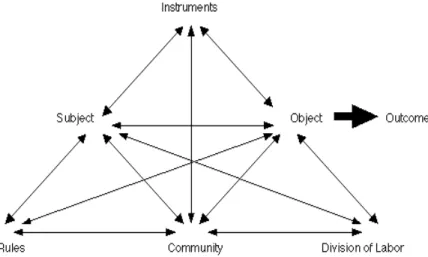
Figure 1. A complex model of an activity system (Engeström, 1999a, p. 31).
With this new insight, Engeström (1999a) proposed a complex model of an activity system (see Figure 1). This model includes the essential elements of human activity: subject, instruments (or mediating artifacts, mediational tools), object, rules, community, and division of labor.
Cole (1996) regards Engeström’s (1999a) AT model as a relational view because a factor classified as an element of one activity system can simultaneously belong to a different element in another activity system. In an L2 classroom, for instance, a fluent L2–speaking teacher can use the L2 as the medium of instruction, in which case the L2 functions the role of mediational tool (or instrument). At the same time, from the L2 learners’
viewpoint, the L2 itself may be viewed as the object to be mastered within a limited time (e.g., by the end of school year, or by graduation). Therefore, factors, which belong to each element of an activity system, are not fixed but open the possibility of being repositioned depending on the focus of
investigation in the same activity system.
B. Motivation from an AT Perspective
Although Leont’ev (1978) emphasized motives in relation to objects in activity, the relationship between motive and motivation does not seem to have been sufficiently refined in AT and is debated among SCT scholars (e.g., Hyysalo, 2005;
Miettinen, 2005). In this subsection, I explain (a) the concepts of motives, objects, and goals, (b) the relationship between motive and motivation, and (c) the difference between demotivation and amotivation.
1. Motives, Objects, and Goals
Leont’ev (1981) emphasizes that human activity gears toward an object, and the object humans pursue is qualitatively different from animals’ object. Comparing higher human objects which always involve the use and making of tools and labors in a joint, collective activity, he summarizes the characteristics of animals’ low plane object by stating that:
Any activity realizing animals’ directly biological, instinctive relations with the nature around them, is characterised by its always being directed to objects of biological need and stimulated by those objects. There is no activity in animals that does not respond to some sort of direct biological need, that is not evoked by an effect with biological meaning of them, i.e., the sense of an object that satisfies a given need of theirs, and that would not be directly aimed in its final link at that object.
(Leont’ev, 1981, pp. 209-210)
According to Markova (1990), when a need is coupled with an object in an activity system, the need is transformed into a motive, a “guiding or integrating force” (Wertsch, 1985b, p. 212).
Thus, a motive is “an internal characteristic of the structure of an activity,” and “it changes and is transformed as that activity
is developed” (Markova, 1990, p. 23). In Leont’ev’s (1978) conceptualization, an object is the central focus of an activity system, and it is inseparable from a subject’s motive (Kaptelinin, 2005; Miettinen, 2005).
Citing the above Leont’ev’s (1981) comments, Miettinen (2005, p. 55) stated that, “for animals, the objects of need are natural objects… For humans, they are cultural and historical objects.” If an object includes momentum toward a material or psychological target, the object itself captures the mental efforts of a subject in the activity system. Thus viewed, objects seem similar to goals, which are often defined in psychology as “the outcome that one is consciously trying to attain” (Pintrich &
Schunk, 2002, p. 404). Both objects and goals connote human desire to attain a physical or mental ideal. However, Engeström (1999b) emphasized that objects and goals should not be confused:
Goals are attached to specific actions. Actions have clear points of beginning and termination and relatively short half–lives.
Activity systems evolve through long historical cycles in which clear beginning and ends are difficult to determine. Goals do not explain the emergence of actions; goals and plans are formulated and revised concurrently as one acts, and they are commonly explicated clearly only retrospectively… An activity system constantly generates actions through which the object of the activity is enacted and reconstructed in specific forms and contents – but… the object is never fully reached or conquered. (p. 381)
When Leont’ev (1978) described his three strata of activity, he mentioned that the activity stratum is related to a subject’s motive, the action stratum to a goal, and the operation stratum to the conditions of the action. Therefore, from Leont’ev’s perspective, a motive is conceptually broader than a goal, and it can be transformed into a set of concrete goals having clear start and end points, as Engeström (1999b) clarified above.
Need + Object Motive + Goal + Participation Motivation Figure 2. The relationships between need, motive, and motivation.
2. Motive and Motivation
Within educational contexts, Markova (1990) differentiated a need, a motive, and a motivation. She defined a need as “the general orientation of a pupil’s activeness,” and stated, “it establishes the preconditions for learning activity in school” (p.
27). However, a need does not have the power to induce behavioral changes that reflect a subject’s decision unless it is connected to an object within an activity system. “The objectification of a need” transforms it into a motive, and once created, the motive “has selective power” (Miettinen, p. 56). In Markova’s conceptualization, when a motive aligns with a goal, it is transformed into a motivation. Motivation is understood as
“the realization of motives” (Markova, p. 28). In this realization, I think that participation in or belonging to communities (Wenger, 1998) is crucial. Since an L2 learner’s participation may not be actual, physical engagement in L2 communities through peripherality (Lave & Wenger, 1991), the concept participation needs to incorporate Wenger’s concept of “belonging through imagination.” As Wenger (p. 178) emphasized, imagination is not
“personal fantasies” but mental enactment of yet–to–be–
realized, expanded reality. In sum, “motivation is social and is determined by the child’s [or adult’s] unique experience, and that motivation can change and develop throughout a person’s life” (Markova, p. 31). Figure 2 shows how need, motive, and motivation relate.
Figure 3 presents the focal areas of motive and motivation based on Engeström’s (1987, 1999a) activity triangle model.
Motive relates only to the upper, basic triangle (subject, object, and instruments), whereas motivation relates to the expanded triangle(s) among all the elements including rules, community, and division of labor. Because the transformation from a motive
to a motivation requires actual or imaginary participation in an L2 community, division of labor and rules in an activity are inseparable from participation.
Motivation Motive
Figure 3. The focal area of motive and motivation
If we conceptualize motive and motivation according to Engeström’s AT model (shown in Figure 3), we can understand that conflicts between elements in the upper basic triangle (subject, object, and instruments) and those in the lower expanded triangle(s) (rules, community, and division of labor) may hinder transformation of a motive to a motivation. For example, if tension exists between an L2 learner and her L2 community, such as an L2 class, her motive to learn the L2 may not be transformed into a motivation.
3. The Relationship of Motivation, Amotivation, and Demotivation
Amotivation is the lack of motivation, while demotivation is a
Need + Object Motive + Goal + Participation Motivation Figure 4. The relationships between motive, motivation, and demotivation.
gradual decrease in motivation (Dörnyei, 2001b, 2005). From the AT perspective, both motivation and amotivation reflect the degree of integration between motive, goal, and sense of participation. Motivation shows cohesive integration of these factors, whereas amotivation shows total disintegration.
As previously emphasized, a motive is transformed into a motivation with the integration of concrete goal(s) and sense of participation. When a motivation disintegrates into a motive, goal(s), and participation, amotivation results. Demotivation, compared to amotivation, captures the process of gradual disintegration of the same three elements. For example, if L2 learners cannot set specific goals befitting their L2 learning contexts, or if they cannot foresee their participation in physical or imaginary L2 communities, their L2 learning motivation goes through a reverse transformational process into L2 learning motive. This longitudinal process is L2 learning demotivation (see Figure 4).
Demotivation (from motivation to motive)
Amotivation, from an AT perspective, is related to the lack of an object in the L2 learning activity system. As Miettinen (2005) emphasized, object plays a pivotal role in AT, and if L2 learners initially set an object in L2 learning activity system but cannot retain (or even eliminate) the object, the activity system collapses and amotivation results (Kim, in press). For example, in many ESL contexts, the dominant discourse of English-as-a-global-language (cf. Crystal, 2003) is based on L2 learners’ beliefs that English will be efficacious to so-called non-native English speakers’ initial job placement and promotion in the workplace. Thus, these beliefs in the efficacy of English
can function as a psychological artifact (Alanen, 2005; Kim &
Yang, 2010), which mediate between a subject (i.e., an L2 learner) and an object (i.e., becoming proficient in the L2).
However, in some cases, these beliefs may not be maintained, because they do not successfully obtain a job even after they attained satisfactory L2 proficiency for employment. In such cases, first, the beliefs, a mediational tool, cease to function in the activity system, and the object is dissociated from the system. If an object does not exist, the activity system per se cannot exist (Miettinen, 2005). Therefore, amotivation captures the collapse of L2 learning activity system.
C. Definition of L2 Learning Motivation from an AT Perspective
Undoubtedly, previous L2 motivation studies have contributed to the expansion of the concept. Indeed, these studies have produced a plethora of operational definitions and approaches (see Dörnyei, 2001a, pp. 10-11; Williams & Burden, 1997, pp. 111-142). These definitions, however, share one general assumption: Motivation is an individual learner’s mental phenomenon. For example, Reeve (1996) defined motivation as an “internal [italics added] process that gives behavior its energy and direction,” a definition typically found in educational psychology and psychology in general.
The definition of L2 motivation does not seem to differ from the above. Brown (2007) described L2 motivation as an inner drive, impulse, emotion, or desire that moves one to a particular action. Similarly, Gardner (1985) defined it as “the combination of effort plus desire to achieve the goal of learning the language plus favorable attitudes toward learning the language” (p. 10).
The individualism in definitions of L2 motivation is also found in dictionaries of applied linguistics; for example, “a psychological trait which leads people to achieve some goal”
(Johnson & Johnson, 1998, pp. 219-220) and “the factors that determine a person’s desire to do something” (Richards, Platt, &
Weber, 1985, p. 185).
From the perspective of AT, which aims to attain a holistic understanding of mediated action involved in irreducible tension between subjects and their social, historical, and cultural environments (Wertsch, 1994), the above definitions seem insufficient. That is because we need to go through two (or more) steps to define L2 motivation, in Gardner’s (1985) case, starting from what motivation is, and then defining effort, desire, and attitudes. In creating an alternative definition of L2 learning motivation, we should not fall into downward reductionism (Lantolf & Thorne, 2006; Valsiner & van der Veer, 2000).
Another consideration in an AT definition of L2 motivation is the avoidance of dichotomous terms, such as intrinsic/extrinsic and internal/external. Although Gardner et al. (e.g., Gardner &
Lambert, 1972; Gardner, 2006) and Ryan and Deci (2000) have consistently argued that their motivation models should not be understood as simple dichotomies, many L2 researchers and teachers have understood in this way (see Brown, 2007, p. 175 for “motivational dichotomies” table). Indeed, the complex genesis and actualization of L2 learning motivation precludes such dichotomies. The new definition needs to be sufficiently sensitive to interdependence between internal and external factors (van Lier, 1996).
Even though it is rare in academia to find a definition of L2 learning motivation from an AT perspective, two previous studies shed light on this paper. Ushioda (2003, p. 90) conceptualized L2 motivation not as an individual mental state but as “a socially mediated phenomenon.” This conceptualization is thought–provoking in the sense that it is based on a different epistemology: L2 motivation comes not from within the individual but from the mediation between the society and the individual’s recognition of it. In addition, mainly concerning L2 classroom learning, Negueruela (2003, p. 102) states that “L2 motivation is not ... a cause of learning the L2 but is an orienting meaning that may become significant for the learner as a result of participating in properly organized instructional activity.”
Regarding Negueruela’s (2003) definition, three crucial issues
need to be considered: (a) the orienting meaning that may become significant, (b) its significance as a result of participating, and (c) properly organized instructional activity. To address the first issue, the concepts of meaning and sense (Kozulin, 1995;
Van der Veer & Valsiner, 1991) are useful:
Meaning preserves the core of the object’s already established characteristics. These characteristics, however, may have marginal importance in a particular situation in which the given object becomes involved in individual thinking. In sense the object is becoming defined by its contextual meanings, but it does not yet exist as an entity of its own apart from its context. (Kozulin, 1995, p. 125)
Even if a context seems meaningful to others, it may have no personal, context-embedded meaning to an L2 learner unless he or she realizes and is willing to accept its significance. An objective meaning needs to be transformed into a subjective sense to obtain full personal meaning. Note that meaning–
making provides preconditions in sense–making. Given Figure 2 above, meaning–making seems related to a motive, whereas sense–making to a motivation. L2 learners may have a motive to learn the L2 as long as they can attribute social significance to L2 learning. For example, students in English as a foreign language (EFL) contexts may have a motive to learn English because they can understand that English (as a world language) might be of potential use for their future jobs. When these learners’ L2 learning motive is integrated with specific learning goals and sense of participation, it becomes a sense–making process and is transformed into a motivation. In this regard, Negueruela’s (2003) explanation – the orienting meaning that may become significant – can be rephrased as “the L2 learner may realize the significance of an L2–related activity.”
To address the second issue, the meaning of participating needs more theoretical elaboration. As argued above, motivation is the integration of motive, goal, and participation. Participation is related not only to physical involvement in the learning
situation but also to imaginary involvement. Without either actual or imaginary participation in L2 communities, L2 learners do not become motivated. Even before an L2 learner starts to learn the L2, he or she can imagine participating in the L2 community actively using the L2. During the L2 learning period, the learner rehearses participation. Even when an L2 learner does not have any fluent L2 speaker easily accessible to talk to in his or her daily life, the learner can imagine such a situation (cf. Norton, 2001). Wenger’s (1998) considers imagination as a mode of belonging and states that “imagination ... is not just the production of personal fantasies. Far from an individual withdrawal from reality, it is a mode of belonging that always involves the social world to expand the scope of reality and identity” (p. 178).
Looking at the third issue, Negueruela (2003) focused on instructional settings in L2 learning. Equally important, however, is lifelong L2 learning. Such learning can occur even in non-instructional settings, such as workplaces or everyday verbal interactions. In this regard, for most L2 learners (especially those in the L2 host country), L2 activities are realized at different times and in different locations. Thus, there is no need to think of L2 activity systems as a single or closed; they encompass both instructional and everyday contexts.
Given the above theoretical considerations, we need to redefine L2 learning motivation and can regard it as an L2 learner’s realization of the personal significance of an L2–related activity, resulting from his or her sense of participation in L2 activity systems. L2 learners may express and realize their motivation in their social speech and/or private speech. For example, in verbal protocols (Swain, 2006), actively talking about L2 learning may lead L2 learners to realize its personal meaning and thus become motivated. They may realize that they have spent their learning time and effort in the object of the activity or in the goal(s) of the action. The term personal significance also needs to be redefined. The more significance an L2 learner places on L2 learning, the more intensely motivated the learner will initially be, although, to continue growing, motivation must
be augmented by learning goals and relevant participation in a variety of L2 communities (e.g., L2 classroom, L2 peer group, etc.).
D. Relevance of Activity Theory to L2 Motivation Research The use of AT in L2 motivation research may enable us to remedy confusion in operational definitions (see MacIntyre, 2002 in Section 2) and to build a robust theoretical framework for reconceptualizing L2 motivation as a socially mediated phenomenon. Indeed, we can establish concrete constructs in L2 motivation theory by focusing on the interplay between individual learners and their unique social, cultural, and historical contexts. Additionally, AT enables us to understand the comprehensive, dynamic nature of L2 motivation. For instance, using Engeström’s (1987, 1999a) AT model, we can understand L2 learners as subjects having their own agency. We can see L2 learners’ beliefs as mediational tools since, through them, L2 learners do or do not achieve their object for L2 learning (Kim, 2008; Kim & Yang, 2010). At the same time, teachers can be important in Engeström’s division of labor; L2 learners’
motivation will be influenced by their teachers’ verbal performance and instructional behavior in the classroom. In fact, teachers can be one of the most influential collaborators in L2 learners’ motivation (Crookes, 1997). This does not imply, however, a rigid, unidirectional relationship between L2 teachers and L2 learners. Teachers also possess L2 teaching motivation, which may increase or decrease as a result of learners’ L2 attainment and classroom (mis)behavior (Ehrman & Dörnyei, 1998). Thus viewed, motivation in the L2 classroom is always bi –directional and mediated by many resources and tools.
Other elements of Engeström’s (1987, 1999a) AT model also affect L2 learners’ motivation. For example, teaching techniques influence L2 learners’ performance in the classroom, and in this sense, they function as rules or principles in AT (Feryok, 2009).
As Lantolf and Genung (2002) documented, in many cases, when an L2 teacher’s teaching techniques do not correspond to what
an L2 learner thinks ideal for his or her learning, the learner’s motivation may begin to decrease and the learner, accordingly, needs to adjust his or her learning goal(s) or becomes amotivated in case of the lack of L2 learning object.
Community, another element in Engeström’s (1987, 1999a) AT model, also influences a learner’s L2 learning motivation. For example, two distinct ESL learner groups (e.g., short-term, international ESL students vs. long-term, immigrant ESL learners) might form different communities, such as the workplace community in the immigrants’ case or the L2 classroom community in the international students’ case. Their willingness to integrate into the perceived community might also differ.
Through interacting within the communities, members of both groups will be affected. The community can either facilitate learning an L2 or inhibit it.
However, the community per se does not function facilitating or inhibiting roles. Rather, the learners’ perception of it seems crucial. As Norton (2001) clearly demonstrated, the ESL learners’ actual community is not the main driving force that makes them learn and use the L2. It is their perception of community which makes them actively participate in L2 classes.
For this reason, Norton introduces the concept of imagined community. The importance of imagined community is also identified in Kim and Yang’s (2010) recent research, where two ESL learners in North America are investigated. Drawing on Lave and Wenger’s (1991) community of practices, they argued that ESL learners are motivated to learn English when they retain learner beliefs that L2 learning is facilitated when they actively participate in a variety of communities.
E. Recent Advances in L2 Motivation Research from an AT Perspective
As stated above, Vygotskian AT perspective was the potential to shed the new light on L2 motivation research, and a group of SCT-oriented researchers delved into L2 learning motivation in the first decade of the 21st century. Although
Sivan (1986) made the first academic effort to look at motivation from Vygotskian social constructivistic view, the ground work in the field of L2 motivation was first set by Ushioda (2003). She emphasized that L2 motivation is not simply an individual psychological phenomenon but involves “interactions among persons, tasks, and the larger environmental contexts” (p. 92).
Similar voices were raised by Kim (2005), which made first theoretical connection between the AT framework and L2 motivation.
Despite the novelties in Ushioda’s (2003) and Kim’s (2005) theoretical position papers, an empirical study which involves data collection and analysis of the data was conducted by Kim (2006). By analyzing five Korean ESL learners in Toronto, Kim focused on the integration process of motive, learning goal and participation in L2 communities. Semi-structured interviews as well as other triangulating data indicated that the integration resulted in sensitization point, which is defined as “the moment when an L2 learner recognizes the gap between his or her current L2 proficiency and the desirable L2 proficiency to be attained.” Kim’s research demonstrated that L2 learners’
sensitization resulted in the maintenance of L2 learning motivation, and the sensitization reflects the mediational process between the learner and the context.
Ⅳ. Summary and Implications
Despite the theoretical advances of L2 learning motivation in the last fifty years, in general, L2 motivation researchers did not distinguish motive and motivation in their research; in some cases, these two terms were used interchangeably, or in other cases, the terms were distinguished only on an operational level and in a downwardly reductionistic manner. However, as clarified in this paper, from the AT perspective, these previous studies on L2 motivation may mostly be related to L2 learners’
motives not their motivations in that researchers rarely conducted an in-depth analysis of the mode of belonging (Wenger, 1998) to
the L2 communities, nor distinguished object and goal as Engeström (1999b) did.
From a sociological feminist orientation, Norton (1993, 1995, 2000, 2001) investigates L2 learners’ participatory behavior in detail, but she does not seem to focus on the interface between need, motive, and motivation. Therefore, Norton’s research deals with L2 motivation dissociated from learners’ initial need, object, and motive, and in many cases, the phenomena related to L2 learning motivation are attributed to macro social, politicized constructs such as investment, capital, gender, ethnicity, and power.
The AT approach may bridge the missing links between motive and motivation in L2 motivation research by focusing on the dynamic interactions between individual L2 learners and their sociocultural contexts without losing the richness of each L2 learner’s unique L2 experience, which cannot be equated with that of other L2 learners. Therefore, AT analyses on L2 motivation require triangulated qualitative data collection techniques. In order not to fall into reductionism, future L2 motivation research needs to use longitudinal case study designs.
Since SCT and AT are inherently genetic theories (Wertsch, 1985a), cross-sectional designs may not fully address the dynamically evolving interface between motive and motivation.
Since this paper is an attempt to reconceptualize L2 motivation from an AT perspective, further discussion is required and more conceptual refinements need to be addressed.
Moreover, we need more empirical research based on an AT approach, which can confirm or disprove the definition and (sub)concepts of L2 motivation proposed in this paper.
Received in 30th September, 2010 Reviewed in19th November, 2010 Revised version received in 17th December, 2010
References
Alanen, R. (2005). A sociocultural approach to young language learners’ beliefs about language learning. In P. Kalaja & M.
F. Barcelos (Eds.), Beliefs about SLA: New research approaches (pp. 55-86). Dordrecht, The Netherlands: Kluwer.
Angelil-Carter, S. (1997). Second language acquisition in spoken and written English: Acquiring the skeptron. TESOL Quarterly, 31(2), 263-287.
Block, D. (2003). The social turn in second language acquisition.
Edinburgh, UK: Edinburgh University Press.
Bourdieu, P. (1977). Outline of a theory of practice (R. Nice, Trans.).
Cambridge, UK: Cambridge University Press.
Bourdieu, P. (1991). Language and symbolic power (M. Adamson, Trans.). Cambridge, MA: Harvard University Press.
Brown, H. D. (2007). Principles of language learning and teaching (5th ed.). White Plains, NY: Pearson Education.
Chomsky, N. (1965). Aspects of the theory of syntax. Cambridge, MA:
MIT Press.
Christophel, D. M. (1990). The relationships among teacher immediacy behaviors, student motivation and learning. Communication Education, 39, 323-339.
Christophel, D. M., & Gorham, J. (1995). A test-retest analysis of student motivation, teacher immediacy and perceived sources of motivation and demotivation in college classes.
Communication Education, 44, 292-306.
Cole, M. (1990). Cognitive development and formal schooling: The evidence from cross-cultural research. In L. C. Moll (Ed.), Vygotsky and education: Instructional implications and applications of sociohistorical psychology (pp. 89-110).
Cambridge, UK: Cambridge University Press.
Cole, M. (1996). Cultural psychology. Cambridge, MA: Harvard University Press.
Crookes, G. (1997). What influences what and how second and foreign language teachers teach? The Modern Language Journal, 81, 67-79.
Crookes, G., & Schmidt, R. W. (1991). Motivation: Reporting the
research agenda. Language Learning, 41, 469-512.
Crystal, D. (2003). English as a global language (2nd ed.). New York:
Cambridge University Press.
Cumming, A., & Gill, J. (1992). Motivation or accessibility? Factors permitting Indo-Canadian women to pursue ESL literacy instruction. In B. Burnaby & A. Cumming (Eds.), Socio-political aspects of ESL (pp. 241-252). Toronto, Ontario, Canada: The Ontario Institute for Studies in Education Press.
Daniels, H. (2001). Vygotsky and pedagogy. London: Routledge.
Davydov, V. V. (1999). The content and unsolved problems of activity theory. In Y. Engeström, R. Miettinen & R.-M. Punamáki (Eds.), Perspectives on activity theory (pp. 39-52). New York:
Cambridge University Press.
Dörnyei, Z. (1994). Motivation and motivating in the foreign language classroom. The Modern Language Journal, 78, 273-284.
Dörnyei, Z. (2001a). Motivational strategies in the language classroom.
Cambridge, UK: Cambridge University Press.
Dörnyei, Z. (2001b). Teaching and researching motivation. Harlow, UK: Longman.
Dörnyei, Z. (2005). The psychology of the language learner: Individual differences in second language acquisition. Mahwah, NJ:
Lawrence Erlbaum.
Dörnyei, Z. (2009). The L2 motivational self system. In Z. Dörnyei &
E. Ushioda (Eds.), Motivation, language identity and the L2 self (pp. 9-42). Bristol, UK: Multilingual Matters.
Dörnyei, Z., & Csizér, K. (2002). Some dynamics of language attitudes and motivation: Results of a national longitudinal survey. Applied Linguistics, 23(4), 421-462.
Dörnyei, Z., Csizér, K., & Németh, N. (2006). Motivation, language attitudes and globalisation. Clevedon, UK: Multilingual Matters.
Dörnyei, Z., & Skehan, P. (2003). Individual differences in second language learning. In M. H. Long & C. J. Doughty (Eds.), The handbook of second language acquisition (pp. 589-630).
Malden, MA: Blackwell.
Ehrman, M. E., & Dörnyei, Z. (1998). Interpersonal dynamics in second language education: The visible and invisible classroom.
Thousand Oaks, CA: Sage.
Engeström, Y. (1987). Learning by expanding: An activity-theoretical approach to developmental research. Helsinki, Finland:
Orienta-Konsultit.
Engeström, Y. (1991). Non scolae sed vitae discimus: Toward overcoming the encapsulation of school learning. Learning and Instruction, 1, 243-259.
Engeström, Y. (1999a). Activity theory and individual and social transformation. In Y. Engeström, R. Miettinen & R.-M.
Punamáki (Eds.), Perspectives on activity theory (pp. 19-38).
New York: Cambridge University Press.
Engeström, Y. (1999b). Innovative learning in work teams. In Y.
Engeström, R. Miettinen & R.-M. Punamáki (Eds.), Perspectives on activity theory (pp. 377-404). New York:
Cambridge University Press.
Engeström, Y., & Miettinen, R. (1999). Introduction. In Y. Engeström, R. Miettinen & R.-M. Punamáki (Eds.), Perspectives on activity theory (pp. 1-16). New York: Cambridge University Press.
Engeström, Y., Miettinen, R., & Punamáki, R.-M. (1999). Perspectives on activity theory. New York: Cambridge University Press.
Falout, J., Elwood, J., & Hood, M. (2009). Demotivation: Affective states and learning outcomes. System, 37, 403-417.
Feryok, A. (2009). Activity theory, imitation and their role in teacher development. Language Teaching Research, 13(3), 279-299.
Gardner, R. C. (1985). Social psychology and second language learning: The role of attitudes and motivation. London:
Edward Arnold.
Gardner, R. C. (1988). The socio-educational model of second language learning: Assumptions, findings, and issues. Language Learning, 38(1), 100-125.
Gardner, R. C. (2001). Integrative motivation and second language acquisition. In Z. Dörnyei & R. Schmidt (Eds.), Motivation and second language acquisition (pp. 1-19). Honolulu, HI:
University of Hawaii Press.
Gardner, R. C. (2005). Integrative motivation and second language acquisition. Retrieved December 15, 2010, from
http://publish.uwo.ca/~gardner/docs/caaltalk5final.pdf
Gardner, R. C. (2006). The socio-educational model of Second Language Acquisition: A research paradigm. EUROSLA Yearbook, 6, 237-260.
Gardner, R. C., & Lambert, W. E. (1959). Motivational variables in second language acquisition. Canadian Journal of Psychology, 13, 266-272.
Gardner, R. C., & Lambert, W. E. (1972). Attitudes and motivation in second language learning. Rowley, MA: Newbury House.
Gardner, R. C., & Smyth, P. C. (1975). Motivation and second language acquisition. Canadian Modern Language Review, 31, 218-230.
Hyysalo, S. (2005). Objects and motives in a product design process.
Mind, Culture, and Activity, 12(1), 19-36.
Johnson, K., & Johnson, H. (Eds.). (1998). Encyclopedic dictionary of applied linguistics: A handbook for language teaching. Malden, MA: Blackwell.
Kang, S.-J. (2005). Dynamic emergence of situational willingness to communicate and its effects on second language communication. System, 33(2), 277-308.
Kaptelinin, V. (2005). The object of activity: Making sense of the sense-maker. Mind, Culture, and Activity, 12(1), 4-18.
Kikuchi, K. (2009). Listening to our learners’ voices: What demotivates Japanese high school students? Language Teaching Research, 13(4), 453-471.
Kim, T.-Y. (2005). Reconceptualizing L2 motivation theory: Vygotskian Activity theory approach. English Teaching, 60(4), 299-322.
Kim, T.-Y. (2006). L2 learning motivation from a sociocultural theory perspective: Theory, concepts, and empirical evidence. English Teaching, 61(4), 51-76.
Kim, T.-Y. (2007). Second language learning motivation from an activity theory perspective: Longitudinal case studies of Korean ESL students and recent immigrants in Toronto. Unpublished doctoral dissertation, University of Toronto, Toronto, Ontario, Canada.
Kim, T.-Y. (2008). Korean immigrants’ English learning motivation and learner beliefs in Toronto: A qualitative case study based
on NVivo. The Sociolinguistic Journal of Korea 16(2), 141-168.
Kim, T.-Y. (2009). The 50 year history of second language learning motivation research: Historical changes and its prospects.
English Language Teaching, 21(1), 273-302.
Kim, T.-Y. (in press). Sociocultural dynamics of ESL learning (de)motivation: An activity theory analysis of two adult Korean immigrants. To appear in the Canadian Modern Language Review.
Kim. T.-Y., & Yang, J.-S. (2010). Learner beliefs in study-abroad experience: A qualitative case study of two Korean ESL learners. English Teaching, 65(2), 75-99.
Kissau, S. (2006a). Gender differences in motivation to learn French.
Canadian Modern Language Review, 62(2), 401-422.
Kissau, S. (2006b). Gender differences in second language motivation.
Canadian Journal of Applied Linguistics, 9(1), 73-96.
Kozulin, A. (1995). The learning process: Vygotsky’s theory in the mirror of its interpretations. School Psychological International, 16, 117-129.
Lantolf, J. P., & Genung, P. B. (2002). “I’d rather switch than fight:”
An activity theoretic study of power, success, and failure in a foreign language. In C. Kramsch (Ed.), Language acquisition and language socialization: Ecological perspectives (pp.
175-196). London: Continuum.
Lantolf, J. P., & Thorne, S. (2006). Sociocultural theory and the genesis of second language development. Oxford, UK: Oxford University Press.
Larsen-Freeman, D. (1997). Chaos/Complexity science and second language acquisition. Applied Linguistics, 18(2), 141-165.
Larsen-Freeman, D. (2000). Second language acquisition and applied linguistics. Annual Review of Applied Linguistics, 20, 165-181.
Lave, J., & Wenger, E. (1991). Situated learning: Legitimate peripheral participation. New York: Cambridge University Press.
Leont’ev, A. N. (1978). Activity, consciousness, and personality.
Englewood Cliffs, CA: Prentice-Hall.
Leont’ev, A. N. (1979). The problem of activity in psychology. In J. V.
Wertsch (Ed.), The concept of activity in Soviet psychology (pp. 37-71). Armonk, NY: M. E. Sharpe.
Leont’ev, A. N. (1981). Problems of the development of the mind.
Moscow: Progress.
MacIntyre, P. D. (2002). Motivation, anxiety and emotions in second language acquisition. In P. Robinson (Ed.), Individual differences and instructed language learning (pp. 45-68).
Philadelphia: John Benjamins.
MacIntyre, P. D., Clément, R., & Donovan, L. A. (2002). Willingness to communicate in the L2 among French immersion students.
Paper presented at the 2002 Second Language Research Forum, Toronto, Ontario, Canada.
MacIntyre, P. D., Clément, R., Dörnyei, Z., & Noels, K. (1998).
Conceptualizing willingness to communicate in a L2: A situated model of competence and affiliation. The Modern Language Journal, 82, 545-562.
Markova, A. K. (1990). Ways of investigating motivation for learning in school children. Soviet Psychology, 28(6), 21-42.
Masgoret, A.-M., & Gardner, R. C. (2003). Attitudes, motivation, and second language learning: A meta-analysis of studies conducted by Gardner and associates. Language Learning, 53(1), 123-163.
Miettinen, R. (2005). Object of activity and individual motivation.
Mind, Culture, and Activity, 12(1), 52-69.
Negueruela, E. (2003). A sociocultural approach to teaching and researching second languages: Systemic-theoretical instruction and second language development. Unpublished doctoral dissertation. The Pennsylvania State University, State College, PA.
Nikolov, M. (2001). A study of unsuccessful language learners. In Z.
Dörnyei & R. Schmidt (Eds.), Motivation and second language acquisition (pp. 149-170). Honolulu, HI: University of Hawaii Press.
Noels, K. (2001). Learning Spanish as a second language: Learners’
orientations and perceptions of their teachers’ communication style. Language Learning, 51(1), 107-144.
Norton, B. (1997). Language, identity, and the ownership of English.
TESOL Quarterly, 31(3), 409-429.
Norton, B. (2000). Identity and language learning: Gender, ethnicity and educational change. Harlow, UK: Longman.
Norton, B. (2001). Non-participation, imagined communities and the language classroom. In M. P. Breen (Ed.), Learner contributions to language learning: New directions in research (pp. 157-171). Harlow, UK: Longman.
Norton Peirce, B. (1993). Language learning, social identity, and immigrant women. Unpublished doctoral dissertation, University of Toronto, Toronto, Ontario, Canada.
Norton Peirce, B. (1995). Social identity, investment, and language learning. TESOL Quarterly, 29, 9-31.
Osborn, T. A. (Ed.). (2000). Critical reflection and the foreign language classroom. Westport, CT: Bergin & Garvey.
Oxford, R. L., & Shearin, J. (1994). Language learning motivation:
Expanding the theoretical framework. The Modern Language Journal, 78(1), 12-28.
Pintrich, P. R., & Schunk, D. H. (2002). Motivation in education:
Theory, research, and applications (2nd ed.). Upper Saddle River, NJ: Merrill Prentice Hall.
Potowski, K. (2004). Student Spanish use and investment in a dual immersion classroom: Implications for second language acquisition and heritage language maintenance. The Modern Language Journal, 88(1), 75-101.
Price, S. (1996). Comments of Bonny Norton Peirce’s “Social identity, investment, and language learning.” TESOL Quarterly, 30(2), 331-337.
Reagan, T. (2000). Non-western educational traditions: Alternative approaches to educational thought and practice. Mahwah, NJ:
Lawrence Erlbaum.
Reagan, T. (2002). “Knowing” and “Learning” a foreign language:
Epistemological reflections on classroom practice. In T. A.
Osborn (Ed.), The future of foreign language education in the United States (pp. 45-62). Westport, CT: Bergin & Garvey.
Reeve, J. (1996). Motivating others: Nurturing inner motivational resources. Needham Heights, MA: Allyn & Bacon.
Richards, J. C., Platt, J., & Weber, H. (1985). Longman dictionary of
applied linguistics. Harlow, UK: Longman.
Ryan, R. M., & Deci, E. L. (2000). Intrinsic and extrinsic motivations: Classic definitions and new directions.
Contemporary Educational Psychology, 25, 54-67.
Schumann, J. H. (1977). The pidginization process: A model for second language acquisition. Rowley, MA: Newbury House.
Skehan, P. (1989). Individual differences in second-language learning.
London: Edward Arnold.
Skilton-Sylvester, E. (2002). Should I stay or should I go?
Investigating Cambodian women’s participation and investment in adult ESL programs. Adult Education Quarterly, 53(1), 9-26.
Sivan, E. (1986). Motivation in social constructivist theory. Educational Psychologist, 21(3), 209-233.
Swain, M. (2006). Verbal protocols: What does it mean for research to use speaking as a data collection tool? In M.
Chalhoub-Deville, C. A. Chapelle & P. Duff (Eds.), Interface and generalizability in applied linguistics: Multiple perspectives (pp. 97-113). Amsterdam: John Benjamins.
Tremblay, P. F., & Gardner, R. C. (1995). Expanding the motivation construct in language learning. The Modern Language Journal, 79, 505-520.
Ushioda, E. (2003). Motivation as a socially mediated process. In D.
Little, J. Ridley & E. Ushioda (Eds.), Learner autonomy in the foreign language classroom: Learner, teacher, curriculum and assessment (pp. 90-103). Dublin, Ireland: Authentik.
Valsiner, J., & van der Veer, R. (2000). The social mind: Construction of the idea. Cambridge, UK: Cambridge University Press.
van der Veer, R., & Valsiner, J. (1991). Understanding Vygotsky: A quest for synthesis. Oxford, UK: Blackwell.
van Lier, L. (1996). Interaction in the language curriculum:
Awareness, autonomy and authenticity. London: Longman.
van Lier, L. (2000). From input to affordance: Social interactive learning from an ecological perspective. In J. P. Lantolf (Ed.), Sociocultural theory and second language learning (pp.
245-259). Oxford, UK: Oxford University Press.
van Lier, L. (2004). The ecology and semiotics of language learning: A
sociocultural perspective. Norwell, MA: Kluwer.
van Lier, L. (2005). Case study. In E. Hinkel (Ed.), Handbook of research in second language teaching and learning (pp.
195-208). Mahwah, NJ: Lawrence Erlbaum.
Vygotsky, L. S. (1978). Mind in society: The development of higher psychological processes. Cambridge, MA: Harvard University Press.
Vygotsky, L. S. (1979a). The development of higher forms of attention in childhood. In J. V. Wertsch (Ed.), The concept of activity in Soviet psychology (pp. 189-240). Armonk, NY: M. E.
Sharpe.
Vygotsky, L. S. (1979b). The genesis of higher mental functions. In J.
V. Wertsch (Ed.), The concept of activity in Soviet psychology (pp. 144-188). Armonk, NY: M. E. Sharpe.
Wenger, E. (1998). Communities of practice: Learning, meaning, and identity. New York: Cambridge University Press.
Wertsch, J. V. (1985a). Introduction. In J. V. Wertsch (Ed.), Culture, communication, and cognition: Vygotskian perspectives (pp.
1-18). New York: Cambridge University Press.
Wertsch, J. V. (1985b). Vygotsky and the social formation of mind.
Cambridge, MA: Harvard University Press.
Wertsch, J. V. (Ed.). (1985c). Culture, communication, and cognition:
Vygotskian perspectives. New York: Cambridge University Press.
Wertsch, J. V. (1994). The primacy of mediated action in sociocultural studies. Mind, Culture, and Activity, 1(4), 202-208.
Williams, M., & Burden, R. L. (1997). Psychology for language teachers: A social constructivist approach. Cambridge, UK:
Cambridge University Press.
Yashima, T., Zenuk-Nishede, L., & Shimizu, K. (2004). The influence of attitudes and affect on willingness to communicate and second language communication. Language Learning, 54(1), 119-152.