&Y1PTU"TTFTTNFOUPG-FHJTMBUJPOJOB
$PNQBSBUJWF $POUFYU $&& BOE #BMLBO
Tímea Drinóczi*73)
Contents
1. Putting into context: quality in legislation
2. Ex post evaluation in some CEE and Balkan states 3. Hungary, the backsliding country ?Gworse practice 4. Lessons learned
5. Conclusion
* Associate Professor at Department of Constitutional Law, Faculty of Law, University of Pécs
Introduction
In this paper I offer a rough understanding of ex post evaluation of legislation1) in the context of the concept of the quality legislation2) and present an overview describing how they or and soon will be implemented in the CEE and Balkan region and indicate both best and worse practices. ‘Quality legislation’ (or quality law-making), comprises both the quality of the legislative procedure and the law produced as an output of the procedure. In this view, the quality of legislation encompasses both the formal and substantive elements of political decision-making processes (legislation) in a constitutional democracy. It is therefore, not considered satisfactory utilizing only a formalistic approach but requires a democratic and constitutional content of laws as well. In achieving this, among others, a comprehensive ex post evaluation of legislation which is both de iure and de facto embedded in the decision-making process appears to be essential in this region.
1) For the purpose of this paper, expression of ‘ex post assessment’ and ‘ex post evaluation’ is used as interchangeable expressions even though there are many different ways of interpreting and using them.
For a broad definition [‘[e]valuation answers the question of whether a treatment (i.e., a regulation or regulatory policy) works in terms of reducing a problem’] and ways of using evaluation (regulatory administration, behavioural compliance and outcome performance) see e.g. Cary Coglianese, ‘Measuring Regulatory Performance Evaluating the Impact of Regulation and Regulatory Policy’ (OECD Expert Paper No 1, OECD Publishing 2012, available at
https://www.oecd.org/gov/regulatory-policy/1_coglianese%20web.pdf p. 14-15. On the other hand, evaluation may also be used for the analysis and assessment of the effects of legislation. See also Stephan Naundorf and Claudio M. Radaelli, ‘Regulatory Evaluation ?Gex ante and ex post. Best practice, guidance and methods’, In Ulrich Karpen, Helen Xanthaki, eds, Legislation and Legisprudence in Europe. A comprehensive guide for scholars and legislative practitioners. (Forthcoming 2016) (Reference is made with the consent of the authors.), Luzius Mader, ‘The evaluation of draft law’, in Ulrich Karpen, ed, Evaluation of Legislation.
Proceedings of the Fourth Congress of the European Association of Legislaton (EAL) in Warsaw (Poland), June 15th-16th, 2000 (Nomos, Baden-Baden, 2002) p. 106. Regulatory impact assessment in this sense means the systematic process of identification and quantification of economic, social and environmental impacts likely to flow from adoption of a proposed regulation or a non-regulatory policy option under consideration.
GOV/SIGMA(2007)6, available at,
http://www.oecd.org/officialdocuments/publicdisplaydocumentpdf/?doclanguage=en&cote=gov/sigma p. 99.
2) Tímea Drinóczi, ‘Concept of Quality in Legislation?Revisited: Matter of Perspective and a General Overview’ 3 Statute Law Review (2015), Tímea Drinóczi, ‘Quality legislation and law-making. Legislation and legislative processes in Hungary’, In Global Legal Issues 2012 [1] Korea Legislation Research Institute, 2012.
The paper seeks to answer the following research questions: i) how ex post assessment is considered, regulated and conducted in some CEE and Balkan states as compared to OECD recommendations and papers,3) concepts evolved in legisprudence scholarship and best practices,4) ii) whether the introduction of ex post evaluation of legislation is strictly linked or linked at all to the success of the implementation of ex ante impact assessment; iii) what lessons observers and states, which have not introduced ex post assessment yet, can learn from the experiences of states that have already done so.
The research is facilitated by OECD and available national reports, some English language literature on CEE and Balkan states that are however very few in number,5) and papers of scholars conducting researches of legisprudence. Nevertheless, research results presented in this paper should not be considered comprehensive,6) but a first step towards understanding specifically, what is going on, what lessons are to be learned and what pitfalls to be avoided, in the field of ex post evaluation within the target regions.
The paper concludes that ex post assessment is considered an important element of the policy process in most of the countries in the CEE and Balkan regions, but
3) 2012 Recommendation of the Council on Regulatory Policy and Governance (OECD, 2012), Lorenzo Allio, ‘Ex post evaluation of regulation: An overview of the notion and of international practices’, in Regulatory Policy in Perspective. A Reader’s Companion to the OECD Regulatory Policy Outlook 2015.
4) Discussing different methods are outside of the topic of this paper. For this, see e.g. Naundorf and Radaelli, loc. cit. n. 1.
5) It is still a common reference. For a reference to insufficient attention to CEE countries in comparative perspective see Katarína Staro쟗ova, Oversight mechanism for regulatory impact assessment: comparative study of the five CEE countries. April 2015, available at
https://www.psa.ac.uk/sites/default/files/conference/papers/2015/Staro쟗ova_PSA_RIA_oversight.pdf, p. 1, and Evelina Agota Vitkute, ‘EU initiative of better regulation and its status in Lithuania’ 8 European Integration Studies (2014), available at http://eis.ktu.lt/index.php/EIS/article/view/6745/3814 p. 29 and Jaroslav Dvorak, The Lithuanian Government’s policy of regulatory impact assessment, 2 Management and Business Administration Central Europe (2015). p. 133.
6) See footnote on issues outside of the topic of this paper in footnote 4 above. Lack of language knowledge and available scholarly works and analyses English, focusing on the presentation of national practices of these regions, and then difficulty to find legislations in effect of a particular state in English form also an obstacle for making a more comprehensive research.
while CEE states, with a clear exception of Hungary that is in regression, also in the field of legislative quality, are rather struggling with its proper implementation, the challenge for Balkan states is the adequate introduction. In the more advanced states, specifically within the regions, there is a visible attempt to embed ex post evaluation of legislation in the legislative cycle, which is why they try to link it to the ex ante impact assessment. This is more successful in cases where ex ante assessment process have already reached a certain level of quality. Based on experiences, states can benefit in which an ex post assessment needs a massive political commitment, skill and knowledge, participation and enabling legal environment; ii) the initial focus on reduction of administrative burdens should be broaden and potentials of ex post assessment need to be realised; iii) there are more techniques which, such as sunset clauses, may help to see the actual impacts of existing legislations; iv) declining practices should also be observed and avoided.
In reaching these conclusions, the paper is structured as follows. A background of studying the ex post assessment is offered in the guise of the concept of the quality of legislation (point 1). An overview of the regulation and actual implementation of ex post evaluation in some CEE and Balkan states follows. This summary includes a brief outline of ex ante assessment, as in support of observing legislative activities as a cyclic process, ex post assessment is usually recommended to be linked with its ex ante counterpart (point 2). The situation in Hungary is dealt with separately in point 3 as this is the only state that is in regression and lagging considerably behind. Lessons learned is summarized in point 4, which concluding remarks follows.
1. Putting into context: quality in legislation
Quality in legislation means that both the legislative process and the content of the adopted legislative measures promote quality. Legislative process may be of
quality if the entire legislative process (policy cycle) are properly regulated and implemented and complied with by state organs and agencies. This also includes and presupposes adequate legislative planning and coordination including both existence and functioning of quality control bodies. If the state, however, is not committed to legislative quality,7) it will not adopt any rules or incentives to bring quality in legislation, or if it does, it will not comply with the rules and will not enforce those rules.8) The content of a law is of quality if it is ‘capable to reach the (constitutional, legitimate, legal, and necessary) legislative aim. It follows, in which the quality in content of laws principally is dependent on the quality of the legislative process (whether or not it is transparent and requires properly conducted policy setting, genuine RIA, and consultation as well as proper management and compliance by all, including state bodies) because these elements can guarantee the efficiency, implementability, and constitutionality of laws.’9) Legislation is a rational activity of a state,10) which should be based on evidence,11) through which it intends to achieve certain policy goals and as a result of which it intends to see compliance.
7) See point 4 below.
8) See the case in Hungary since 2010 not only in the field of legislative quality [see Tímea Drinóczi and Miklós Kocsis, Public consultation ?Gtheory and Hungarian practice. In Lizius Mader, Sergey Kabyshev (ed): Regulatory reforms. Implementation and compliance. Proceedings of the Tenth Congress of the International Association of Legislation (IAL) in Veliky Novgorod, June 28th-29th, 2012. Nomos 2014, Drinóczi (2015), loc. cit. n. 2, Drinóczi (2012), loc. cit. n. 2, Deák Dániel: Unorthodoxy in legislation:
the Hungarian experience, available at
http://unipub.lib.uni-corvinus.hu/1601/1/SE_2014n2_Deak.pdf] but in terms of constitutionality [most recently see Tímea Drinóczi, Constitutional politics in contemporary Hungary. 1 ICL (2016), Imre Vörös, The constitutional landscape after the fourth and fifth amendments of Hungarian Fundamental Law, 1 Acta Iuridica Hungarica (2014), János Kornai, Hungary’s U-Turn, 3 Society and Economy in Central and Eastern Europe (2015)]. It must be noted, that Hungary ranked comparatively quite well in OECD 2015 working papers and researches, because the data employed could obviously not include the 2016 regression in the field of regulatiory assessment. See point 3 below.
9) Drinóczi (2015), loc.cit. n 2
10) Therefore, legislative body needs to have information about the effects of the legislation both prospectively (ex ante) and retrospectively (ex post). Tests and experimental legislation may also be mentioned as a special type of evaluation. See Mader, loc. cit. n. 1, at p. 149.
11) Patricia Popelier ?GArmen Mazmanyan ?GWerner Vandenbruwane, eds, The role of constitutional courts in multilevel governance (Intersentia, Cambridge, Antwerpen, Portland 2013), Ittai Bar-Siman-Tov,
‘Semiprocedural judicial review’ Legisprudence Vol. 6, No. 3.
As adopted legal measures may produce unintended effects (either detrimental or beneficial), may not reach the intended goal, may become obsolete over years, legislative authority needs to review from time to time, if, indeed, legislation in effect still upholds quality, and is considered useful and effective. This activity, towards achieving quality in legislation, should be properly regulated, understood by politicians, civil servants, stakeholders and the public, and adequately implemented. To accomplish this, existing and applied legal measures on ex post evaluation, methods and techniques for periodical monitoring of legal system,12) consultation, reporting mechanism and transparency as well as established methodologies and trained civil servants are needed. Organizational structures and culture needs to be developed within and/or outside the administration (or parliamentary bodies), including the determination of units responsible for conducting ex post evaluation and monitoring/screening (maintenance) activity and quality control over the assessment (regulatory oversight bodies). Avoiding a situation in which only the formal compliance with these requirements, i.e. pure existence of rules without proper implementation, or in which only formal implementation is considered, it is of importance to review the experiences of the practical exercise of these activities.
Despite several academic papers on notions, methods, types etc. of ex post evaluation and OECD reports and recommendations (OECD 2012) and research reports13) about its methods and the need to conduct ex post assessments and embed it into the legislative cycle, Coglianese’s statement from 2013, according to which
‘retrospective review is today where prospective analysis was in the 1970’s: ad hoc and largely unmanaged’,14) has not been rebutted by the majority of OECD states.
There are several best practices originating from the UK, Canada, Switzerland,
12) Discussing these in the detailed is outside of the scope of this paper. See Wim Voermans, Chris Moll, Nico Florijn, Peter van Lockem, ‘Codification and consolidation in Europe as means to untie red tape, 2 Statute Law Review, (2008).
13) 2014 Evidence-based instruments report. RIA application, quality of RIA process, sustainability check.
Bertelsmann Stiftung 2014 (Report 2014) 14) Allio, loc. cit. n. 3 at p. 218.
Sweden, European Commission and Germany, presented by Prognos Expert Report in 2013.15) Still, the OECD report established in 2015: ex post evaluation has remained relatively side-lined as compared to ex-ante RIA’s and, though there are an increase of evaluating spending programmes and financial interventions, systematic ex post evaluations are less common.16) Against this background, it may be interesting to see how ex post assessment is actually developing in other CEE17) and Balkan states.
2. Ex post evaluation in some CEE and Balkan states
As a first step towards implementing a particular of better regulation program, pilot projects were organized in 2005-2006 in connection with reduction of administrative burdens in the Czech Republic, Slovakia and Slovenia. This common start justifies the joint review of their performance. Poland and Hungary is discussed individually as they seem to be the representatives of both the best and worse practice in the target region, respectively. This distinct nature of the Hungarian practice justifies a comparatively longer discussion in point 3. Baltic and Balkan states are also dealt with separately. After briefly presenting the state of the art of the ex post, and necessarily ex ante, assessment of the region, a comparative analysis is offered with the intent of identifying lessons which can be learned and possible dangers which are to be avoided.
15) Expert Report on the implementation of ex-post evaluations. Good practices and experiences in other countries. Prognos, 2013. (Prognos 2013)
16) See for instance the practice of the European Commission.
17) Countries presented in this paper and OECD states from the region overlaps in the case of Estonia, Latvia, Poland, Czech Republic, Slovakia, Hungary, and Slovenia.
2.1. Czech Republic, Slovakia and Slovenia ?Gstates conducting pilot studies on administrative burden reduction as a start
Evaluation of existing legislation in the Czech Republic takes place on an ad hoc basis and is used rather rarely.18) After the complex reform of RIA after 2010,19) which led to the adoption of common minimum standards and the establishment of a systematically implemented ex ante assessment20) that applies to most regulations,21) the next step is the introduction of ex post and corruption impact assessment as well as the further strengthening of the RIA through education and training.22) Ex ante assessment may provide a good basis for successful implementation of ex post assessment in the future as the most important criteria for the quality of RIA process23) are currently in place. It is linked to the legislative planning and it is a continuous process which is parallel with the decision-making.
Results of the RIA are accessible, transparency is ensured, and since 2011 there is an independent body (RIA Board) to conduct quality review of assessments. The RIA Board is authorized to reject (veto power) and return submitted reports.24) In 2013, the Board considered 97 new RIA reports and issued 142 opinions, 45 of those on resubmitted reports.25) Unlike other states in the region, the reports of
18) OECD Regulatory Policy Outlook, Country Report, Czech Republic, 2015
19) The development in more detailed can be found in Katarína Staro쟗ova, Jan Pavel and Katarina Krapež,
‘Piloting regulatory impact assessment: a comparative analysis of the Czech Republic’, Slovakia and Slovenia, 4 Impact Assessment and Project Appraisal (2007) p 272.
20) Before the reform, RIA was only a one-off activity. Staro쟗ova, loc. cit. 5. at p. 7, In 2010, 48%
of enacted laws did not have RIA; though more than half of them was not proposed by the government.
Karel Jára, ‘Does RIA really evaluate regulatory impact? The case of the Czech Republic’, IES Working Papers 29/2012, available at http://ies.fsv.cuni.cz/sci/publication/show/id/4782.
21) Report 2014
22) Michal Mejst쟨ik and Jana Chvalkovská, ‘Czech approach to regulatory impact assessment’, available at http://ec.europa.eu/smart-regulation/refit/admin_burden/docs/120321_presentation_riab_prof_mejstrk_22_3_2012_
en_en.ppt.
23) According to the Report 2014.
24) Staro쟗ova, loc. cit. n. 5, at p. 7, 6, and 9.
the RIA Board are also accessible. Since 2011, the RIA is coordinated by the Government’s Legislative Council instead of the Minister of Interior26), which had exercised this competence since the introduction of RIA in 2005.27)
On the contrary, in both Slovakia and Slovenia, the ex post assessment is focused primarily on administrative burdens and they lack a more comprehensive, in-depth ex post evaluation which extends beyond administrative burdens.28) Due to the initial focus of better regulation programme, which was administrative burden’s reduction during the pilot projects, neither ex ante assessment is advanced, particularly in Slovenia. Additionally, in Slovakia, political leadership did not fully embrace the idea of better regulation pilot projects, as they allowed no civil servant participate within the pilot project.29) Against this background, ex ante assessment practices need to be studied in order to see whether a more comprehensive ex post assessment can be linked to them and whether this retrospective analysis can be embedded within the legislative cycle.
In Slovakia, the first legal requirement for RIA was introduced by the rules of procedures of the government in 2001 as a part of explanatory memorandum.
However, there was no central unit established yet four ministries were involved, and the focus is mostly made on budgetary impacts.30) The general quality of ex ante RIA has slowly improved due to the new methodology (2010) that updated the earlier version which had been adopted in 2008. Today, the unified methodology is considered ideal towards assessing economic, social and environmental impacts, and a more advanced quality control (Permanent Working Committee of the
25) Petra Guasti, Zdenka Mansfeldová, Martin Myant, Frank Bönker, 2015 Czech Republic Report (Bertelsmann Stiftung, 2015), available at http://www.sgi-network.org/docs/2015/country/SGI2015_Czech_Rep.pdf p. 22 26) Report 2014
27) More about the introduction see Staro쟗ova, Pavel and Krapež, loc. cit. n. 19, at p. 272.
28) OECD Regulatory Policy Outlook, Country Report, Slovakia, 2015 (OECD 2015 Slovakia), OECD Regulatory Policy Outlook, Country Report, Slovenia, 2015 (OECD 2015 Slovenia)
29) Staro쟗ova, Pavel and Krapež, loc. cit. n. 19, at p. 277.
30) Staro쟗ova, Pavel and Krapež, loc. cit. n. 19, at p. 272, 274, Report 2014, Staro쟗ova, loc. cit. n.
5, at p. 5, OECD 2015 Slovakia.
Legislative Council of the Slovak Republic). Consultation with the public and businesses is also regulated and practiced, even if today, it is exercised rather selectively.31)
In Slovenia, the ex ante RIA, which is supposed to be conducted in the case of all primary law, is seen to be a mere administrative obligation32) and suffers from a number of weaknesses. RIA quality is very uneven, and there are no official statistics regarding ex ante assessments. As fast-track legislation is exempt from RIA, ex ante impact assessments were not performed for at least a third of all new measures passed in 2013-2014.33) The conducted RIAs are only rarely made public but when they are available, reports indicate the ex ante assessment is not realistic, often is superficial and unelaborated.34) Public participation has its legislative framework since 2010, but in practice, legal standards are not met.35) RIA oversight is divided among several agencies and they mostly check formal correctness, without addressing substantive quality.36) Reports with insufficient quality still cannot be sent back.37) In 2015, training for drafters, external stakeholders and decision-makers took place.38)
It appears to be clear, within these two states, even ex ante assessment process need to be developed either prior to an ex post assessment is established or coordinated during its introduction.
31) Staro쟗ova, Pavel and Krapež, loc. cit. n. 19, at p. 274, OECD 2015 Slovakia, Marianne Kneuer, Darina Malová, Frank Bönker, 2015 Slovakia Report (Bertelsmann Stiftung, 2015), available at http://www.sgi-network.org/docs/2015/country/SGI2015_Slovakia.pdf p 20
32) Dobrosav Milovanovi잖, Nemanja Nenadi잖Gand Vladimir Todiri잖, Survey on the improvement of the legislative process in the Republic of Serbia (Belgrade 2012) p. 184.
33) Miro Hacek, Susanne Pickel, Frank Bönker, 2015 Slovenia Report (Bertelsmann Stiftung, 2015), available at http://www.sgi-network.org/docs/2015/country/SGI2015_Slovenia.pdf p. 19.
34) Milovanovi잖, Nenadi잖Gand Todiri잖, loc. cit. n. 32 at p. 184.
35) See e.g. Slovenia: Violations of the Minimum Standards of Public Consultation, available at http://www.balkancsd.net/slovenia-violations-of-the-minimum-standard-of-public-consultation/.
36) Hacek, Pickel, Bönker, op. cit. n. 33, at p. 19
37) Staro쟗ova, Pavel and Krapež, loc. cit. n. 19, at p. 275, OECD 2015 Slovenia.
38) OECD 2015 Slovenia
2.2. Baltic states ?Gaverage development model in the region
In Estonia, since the complex reform after 2010,39) there is a legal obligation to assess seven different impacts of all legal acts both ex ante and ex post.40) Ex post evaluation is linked to ex ante assessment as a decision has to be made in advance if there would be an ex post assessment. It is also prescribed that the absence of ex post assessment has to be explained.41) There is no ex postassessment planned42) or conducted, yet.43) Moreover, ‘according to public information provided by of Ministry of Justice, [ex ante] RIAs have, in fact, been carried out in very few cases .’44) Thus, it ex post evaluation seems to be embedded in the legislative process, even if it is not yet properly implemented. Currently, they appear to be fine-tuning the oversight quality control system (RIA unit in the Ministry of Justice). They decided to do so as quality control is now linked to checking the formal quality of drafts, and their opinions are not mandatory, and even if the unit is authorized to reject a report, it often happens only when this decision is politically supported.45)
In Lithuania, even though the government adopted the better regulation program in 2008, governments have been committed to conduct both ex ante and ex post assessment since only since 2013.46) In the beginning, Lithuania concentrated on measuring the impact of EU acquis in her legal system.47) The political commitment
39) Before the reform, RIA was urged by the Parliament. Marija Risteska, ‘Regulatory Impact Assessment in Macedonia and Estonia: Lessons (to be) learned’ Uprava IX(3) p. 152.
40) Report 2014, Risteska, ibid.
41) Helena Braun, ‘First years of systematic regulatory impact assessment in Estonia ?Glessons learnt’ (2014) available at http://www.just.ee/sites/www.just.ee/files/jum_ettekanne_18.09.2014_oma.pptx.
42) Ibid.
43) OECD Regulatory Policy Outlook, Country Report, Estonia 2015 (OECD 2015 Estonia), 44) Anu Toots, Allan Sikk, Detlef Jahn, 2015 Estonia Report, (Bertelsmann Stiftung, 2015) available at
http://www.sgi-network.org/docs/2015/country/SGI2015_Estonia.pdf p. 27 45) Braun, loc. cit. n. 41, Staro쟗ova, loc. cit. n. 5, at p. 10.
46) Vitkute, loc. cit. n. 5, at p. 32, Report 2014,
47) Ram쟺nas Vilpišauskas, ‘The introduction of the regulatory impact assessment in Lithuania: from contributing to EU accession to improving the performance of public administration’ available at
experienced after 2010 is presented also at legislative level in 2013 (Law on reduction of administrative burden) and 2014 (Law on legislative framework). However, to date, there has been no ex post evaluation conducted,48) and, more improved regulatory tools are used to achieve the administrative burden reduction goals as most of the attention is concentrated to this specific activity. Notably, even the Better Regulation Supervisory Commission supervises only the implementation of reduction projects. Additionally, among the three better regulation measures enshrining from the Act of 2014, an ex post evaluation cannot be found, but ex ante assessment, public consultation on drafts and an obligation to plan and publish legislative initiatives definitely exists.49) In practice, ex post assessment in Lithuania cannot really be linked to ex ante, as it is not systematically used, but conducted in a quick and primitive manner, which is even discouraged by the selection culture of the Office of the Government (responsible for coordination and quality control of ex ante assessment) for ex ante assessment. Only 13-16% of proposed legislation (in 2013 and 2014) was selected by the Office for assessment. Moreover, consultation is fragmented and far from efficient.50) Prior to the Guideline (2012) on consultation and access to the result of the RIA is adopted,51) citizens cannot access the results of conducted RIAs.52) The problems Lithuania faces include the following: lack of political support, weak administrative culture, lack of knowledge,53) and no sufficient theoretical and scientific basis.54)
Toots and her co-authors’ opinion on the Estonian situation, according to which it is difficult to use ex ante assessment as a basis for future ex post assessment, because even though formal regulations are introduced, full implementation and
http://ria-studies.net/wp-content/uploads/File/Conference_papers/2003/13_vilpisauskas.doc.
48) Report 2014
49) Vitkute, loc. cit. n. 5, at p. 33, 32.
50) Dvorak, loc. cit. n. 5, at p. 135, 136, 143-144.
51) Available in Lithuanian at https://finmin.lrv.lt/uploads/finmin/documents/files/sanaudu_gaires.pdf 52) Report 2014, Dvorak, loc. cit. n. 5, at 135.
53) Dvorak, loc. cit. n. 5, at 137.
54) Vitkute, loc. cit. n. 5, at p. 33.
enforcement is clearly lagging behind55) may likely be applied to Lithuania. The Latvian regulation and practice on ex post assessment is difficult to assess due to the lack of information.56) In reference to the ex ante assessment, Latvia has made significant progress in terms of consultation process, but it is still lagging behind in certain fields, including consultation (still), the quality of annotations and quality control.57)
2.3. Poland ?Gbest practice in the region
In Poland, ex post evaluation is required by legal norm and detailed by the RIA guideline (2014).58) The impact assessment is standardized and forms an essential part of the policy cycle,59) since its reform in 2012-2013.60) The first step in the
55) Toots, Sikk, Jahn, op. cit. n. 44, at p. 27 56) See also fn. 6.
57) The Latvian explanatory memorandums (annotations) to drafts, which due to their very nature are accessible for all, since 2013, contain the result of the assessment of compliance costs for citizens and businesses, an assessment of public health effects, and explain and describe the participation of stakeholders.
Consultation is required to be taken place early in the drafting phase with the use of green papers.
In practice, the quality of annotations has been varied widely depending on the approach taken by the drafters, which could be a detailed, evidence-based analysis or a simple pro forma, summary of intent. Since 2013 the State Chancellery monitors quality of annotations and the use of the green papers and has already delayed several policies, because of inadequacies in the annotations or consultation process.
The State Chancellery however cannot be considered an independent oversight body; its main function in this regard is to oversight the decision-making process. The executive branch had 173 different consultative bodies and held over 200 public consultations in 2011, an increase of 30% over 2010.
Despite this quantitative evidence of consultation, the quality of consultations is often questionable.
Consultations are perceived as formal, and in fact offer little opportunity to make an impact on the direction and quality of government policies. Vita Anda Terauda, Daunis Auers, Detlef Jahn, 2015 Latvia Report, (Bertelsmann Stiftung, 2015), available at
http://www.sgi-network.org/docs/2015/country/SGI2015_Latvia.pdf pp. 38-40.
58) OECD Regulatory Policy Outlook, Country Report, Poland 2015 (OECD 2015 Poland), Wacław Brzek,
‘Regulatory Impact Assessment (RIA) in Poland and in some EU countries’ 109 Procedia - Social and Behavioral Sciences (2014), available at
http://regulatoryreform.com/wp-content/uploads/2015/02/Poland-Regulation-Impact-Assessment-RIA-at-Poland-and- at-Some-EU-Countries-2013.pdf p. 48, 49.
59) This was recognised by OECD as well. See Malgorzata Kaluzynska, ’Best practices in legislative and regulatory processes in a constitutional perspective: actors, processes and transparency. The case of Poland’
(European Parliament, Brussels, 2015) p. 9.
60) Kaluzynska, loc. cit. n. 59, at p. 6. For more information about the first steps and development of
drafting process is the Regulatory Test (RT) which is obligatory to all submissions to the government’s working programme, which contains an early impact assessment on regulatory burdens, costs and benefits (monetary, non-monetary, unmeasurable) within the next 10 years. In the RT, planned measures of implementation and evaluation must also be indicated. On the basis of the RT, the Government Programming Board indicates key projects with an obligatory in-depth analysis.61) Legislative proposals are subjected to an ex ante assessment. Most of the RIA elements are repeated from the RT but require more detailed description on public finance sector, regulatory burdens, competition, entrepreneurship, family, citizens, households, and other impacts (environment, regions, demographics, state assets, IT, health, and even other). In the case of complex projects that cover many issues, ex ante assessment is conducted only on the most important changes. Reports on the consultation are attached as a separate document. Ex post assessment is obligatory upon the request of the Council of Ministers or another authorized body or under the conditions defined in RT and ex ante RIA. Distinctly, the link between ex ante and ex post assessment can be clearly noted. During the ex post assessment, the actual situation has to be compared with the one which was experienced prior to the enactment and envisaged by the draft.62) In 2014, 20 drafts were identified for ex post evaluation63) and 7 were actually the subject of this process.64) RIA quality control is exercised by the Chancellery of the Prime Minister (Regulatory Impact Assessment Department), of which, after having been the task of the ministry of economics,65) is indeed now considered as another progress.66) However, there are
the system see Brzek, loc. cit. n. 58, at p. 46-47.
61) In 2014 it requested additional analysis in 23% of the submitted assumptions, and determined 16 (2013) and 11 (2014) in-depth analysis. The set objective for 2015 was 30. Kaluzynska, loc. cit. n.
59, at p. 15.
62) Grzegorz Lang, ‘Standardized forms of impact assessment in the Polish legislative process’ available at http://www.osservatorioair.it/wp-content/uploads/2014/10/Workshop-4-Poland-Lang.pdf.
63) Kaluzynska, loc. cit. n. 59, at p. 16.
64) Grzegorz 젊muda, Piotr Prokopowicz, Weronika Felcis, Marianna Król , ‘The use of impact assessment in the process of public policy creation in Poland’, in Evidence-based impact assessment: a model for Poland.
Joint publication under the direction of Jarosław Górniak (Kozminsi University) p. 54, 69.
some weaknesses of the system. Among others, the following may be mentioned:
it is not obligatory to conduct ex post assessment on secondary legislation;67) there is an evident contradiction between the shape of the required documents (RT, RIA, ex post RIA); the preparation and utilization of RT, RIA and ex post RIA is very diversified, mostly due to the organizational structure of the entire impact assessment process in ministries and the lack of process approach; rules on public consultation, though consultation itself is in a progress, is not precisely clear on selecting partners and there is not enough time for stakeholders to submit their opinions.68) These above-mentioned weaknesses are better to be considered as flaws of an already functioning system which requires improvement and fine-tuning. In respect to achieving more progress, they are addressing the followings: reducing the number of regulations subjected to impact assessment in favour of conducting more in-depth, better quality assessments; using methods that extend far beyond cost-benefit analyses; improving the skills of analytical staff; initiating a process of educating analysts and developing impact assessment methodologies in universities; performing organizational changes resulting in more units with more distinct tasks in impact assessment; and ensuring bills voted on in parliament in their final state are subjected to impact assessment.69) In Poland, ‘regulatory impact assessment is less often seen
65) 젊muda, Prokopowicz, Felcis, Król, loc. cit. n. 64, at p. 59 and Jarosław Górniak, Stanisław Mazur,
‘Challenges for the regulatory impact assessment system in Poland’, in Evidence-based impact assessment:
a model for Poland. Joint publication under the direction of Jarosław Górniak (Kozminsi University) p.
99.
66) First, regulatory oversight bodies, according to Staronova, rely on the expertise and professionalism of those conducting RIA, which suggests that a certain level of this has already been achieved in Poland.
Second, the OECD establishes that if the regulatory oversight body is in an economic ministry or independent from the government, the focus is more on the business and SMEs, but when it is closer to the centre of the government it implies that the country possesses a whole-of-government strategy encompassing the whole policy cycle. (Staronova, loc. cit. n. 5, at p. 3, OECD 2015 pp. 68-69.) This seems to be happening in Poland.
67) Piotr Prokopowicz, Grzegorz 젊muda, Marianna Król, ‘Legislation and institutional frameworks for the process of impact assessment in Poland, in Evidence-based impact assessment: a model for Poland. Joint publication under the direction of Jarosław Górniak (Kozminsi University) p. 43.
68) 젊muda, Prokopowicz, Felcis, Król loc. cit. n. 64, at p. 59, 67-68, 60.
69) Jarosław Górniak, ‘Conclusion’, in Evidence-based impact assessment: a model for Poland. Joint publication
as a formal requirement, and more frequently as an important tool for improving regulation, through introducing systematic analyses of the anticipated consequences to the process of preparing regulations.’70) This is the result of the continuous political commitment, the capacity provided in terms of increase of staff, training, and regular monitoring of activities.71)
2.4. Some Balkan states ?Gstill in discovery of ex ante assessment
In Croatia, the EU accession process has accelerated the development of RIA,72) but it has not developed to the extent in which the introduction of ex post evaluation has been considered. As a result, there is still no effective mechanism established to monitor or evaluate the efficiency of the implementation of legal norms,73) notwithstanding, the RIA Act adopted in 2011. The scope of this Act covers only the proposed legislation in which cases ex ante RIA is obligatory; no mention is made with respect to any ex post evaluation. The RIA Act re-established74) the Government Office for Coordination of the Regulatory Impact Assessment System and shortly afterwards, it evolved into a department of the government’s Legislation Office. RIA implementation coordinators were appointed in all ministries, though information describing them reportedly cannot be found at any known website. Pursuant to the Freedom of Information Act, which contains the same obligation as the RIA Act, all government bodies have been obliged to prepare annual regulatory plans,
under the direction of Jarosław Górniak (Kozminsi University) p. 188-189.
70) Górniak, loc. cit. n. 69, at p. 188. Before the reform in 2012-2013, the problem with RIA was that it had met only the formal requirements. Brzek, loc. cit. n. 58, at p. 48.
71) Kaluzynska, loc. cit. n. 59, at p. 6.
72) Zdravko Petak, William Bartlett, Frank Bönker, 2015 Croatia Report, (Bertelsmann Stiftung, 2015), available at http://www.sgi-network.org/docs/2015/country/SGI2 015_Croatia.pdf p 21.
73) Zdravko Petak, ‘Evidence-based policy-making and the implementation of regulatory impact assessment in Croatia, 2 Management and Business Administration. Central Europe (2015) p. 155.
74) It had been abolished in July 2009 as a reaction to populist critique. Petak, Bartlett, Bönker, op.
cit. n. 72, at p 21.
specifying which of their planned regulations should undergo an impact assessmen t,75) consultation plans, and reports on the implementation of consultation.76) There are some weaknesses of the RIA process in Croatia which may make the actual introduction of ex post assessment even more difficult. The reform could not change the poor administrative capacities, the insufficient coordination between policy goals, and the lack of true policy coordination of central state administrative bodies which had been experienced prior to the reform. The numbers of drafts that are accompanied by ex ante assessments have not been increased between 2013 and 201 5.77) Also, the participation of stakeholders is often symbolic in the process because ministries are also eager to control the selection of external collaborators and most ministries confine themselves simply to informing the public instead of inviting them to consult electronically within the 15 days long consultation period. Additionally, citizens are not generally interested in participating, therefore, scholars78) suggest citizens need to be motivated in order to become involved. The planned consultation for 2013 was 128, but only 40% was implemented. Requirement for transparency of processes are not complied with: less than a third of all ministries enabling the public to leave comments on proposed plans, the information on consultation differs both in content and terminology.79)
In Serbia, there is absolutely no institutionalized framework for ex post assessment.
Neither the ex ante assessment is sufficiently regulated,80) even though the council for regulatory reform and quality control began its work in 2003. The regulatory
75) Ibid.
76) Danijela Romi잖Gand Želka Vajda Halak, ‘Regulatory Impact Assessment in the republic of Croatia
?GSituation and perspective’, Challenges of the Knowledge Society Public Administration History p. 884, 889.
77) Petak, loc. cit. n. 73, at p. 155, 158.
78) Romi잖Gand Vajda Halak, loc. cit. n. 76, at p. 890
79) Petak, Bartlett, Bönker, op. cit. n. 72, at pp. 21-22, Romi잖Gand Vajda Halak, loc. cit. n. 76, at p. 889, 890.
80) Milovanovi잖, Nenadi잖Gand Todiri잖, loc. cit. n. 32 at p. 177, Ljubinka Joksimovi잖, The Serbian Regulatory Reform and Governance’, ANALELE 쟭TIIN쟱IFICE ALE UNIVERSIT작쟱II „ALEXANDRU IOAN CUZA” DIN IA쟭I Num잒r special 쟭tiin쟲e Economice 2010, available at
http://anale.feaa.uaic.ro/anale/resurse/mec2joksimovic.pdf p. 244,.
reform strategy of 2008-2011 was economic-driven, focused on reduction of administrative burdens, applied a one-time elimination of redundant and unnecessary regulations approach (regulatory guillotine) and envisaged the strengthening of the impact assessment.81) Pursuant to the rules of procedures of the government in effect, the RIA is still administrative burden reduction oriented, focuses on cost and benefit analysis. Proper regulatory basis is lacking for the form and content of the RIA and for oversight mechanisms, there are no designated RIA officers, and RIA reports are not attached to bills when they are submitted to parliament since this is not legally required.82) Public consultation, which is regulated also by the rules of procedures of the government, is mandatory only in the most important cases.83) As a consequence, RIA reports are incomplete and unclear, usually state that no additional fund is required for the implementation of the law, explanatory memoranda are below standard, and do not specify costs at all.84) RIA Office, which is a body of the government, is the coordinating and oversight body for the implementation of the impact assessment. It offers opinions on the need for ex ante assessment and provides a mere formal check on submitted RIA assessment. It reviews only the completeness of its content, but cannot block the process.85) The reasons for this underdeveloped system are likely due to most participants within the legislative process do not fully understand the RIA process. The lack of training, the low quality of current operational processes and the negligence of public bodies to send there their civil servants do not help. There is no tracking of political intention towards increasing the expertise and skills of the staff of ministries but to strengthen the capacities of the RIA Office, which is something that seemingly
81) Joksimovi잖, loc. cit. n. 80, at p. 246, 247.
82) Milovanovi잖, Nenadi잖Gand Todiri잖, loc. cit. n. 32, at p. 177, 182.
83) When the law would significantly change the legal regime in certain area and when it is of practical interest for the public. Joksimovi잖, loc. cit. n. 80, at p. 253.
84) Milovanovi잖, Nenadi잖Gand Todiri잖, loc. cit. n. 32, at p. 177, 180
85) Art 2, Regulation on the Office for Regulatory Reform and and Regulatory impact assessment, Official Journal of the Republic of Serbia no 89/2010 of 29 November 2010., Milovanovi잖, Nenadi잖Gand Todiri잖, loc. cit. n. 32, at p. 177.
appears to contradict the mainstream opinion with respect to quality control bodie s.86) Additionally, the Regulatory Reform Strategy is not yet a binding document;
its better regulation requirements simply are not yet complied with.87)
In Kosovo, the ‘Better regulation strategy 2014-2020 Regulatory Impact Assessment’ was adopted by a decision of the government in 2014,88) following wide public consultation.89) Rules of the procedures of the government were effectively adjusted.90) The Better regulation strategy is accession-driven, economy and burden reduction oriented; its main objective is creating and implementing a smart regulatory system, and an improved effort to communicate to its citizens, businesses and civil society. The action plan of the strategy envisages, among others, the introduction of an ex post assessment on existing legislation to enhance competitiveness. Due to its goal, the scope of the ex post assessment offers an analysis of regulatory impact on key regulations, and, by applying SCM, identifying potential burden reduction and submitting proposal for reducing these burdens. Annual monitoring activity of regulatory authorities are also prescribed, based on which drafts proposals need to be submitted for removing identified constraints on competitiveness. The action plan also sets objectives regarding the methodology of and trainings on RIA and foresees that all drafts are published and accompanied by RIA (cost and benefit assessment) from 2015. As planned, the Guidelines on ex post evaluation of legislation in the Republic of Kosovo, which had been drafted with the assistance of OSCE-Mission in Kosovo, was adopted by the decision of the Government in 2015.91) The guidelines attempt to position the ex post assessment
86) See fn 66 in this regard and Staronova, loc. cit. n. 5, at p. 3.
87) Milovanovi잖, Nenadi잖Gand Todiri잖, loc. cit. n. 32, at p. 179, 180,
88) Decision of the government no. 03/189 of 13 May 2014. The Better regulation strategy 2014-2020 Regulatory Impact Assessment is available at
http://www.kryeministri-ks.net/repository/docs/Better_Regulation_Strategy_2014_2020_-_ENG_.PDF.
89) Better regulation strategy 2014-2020 Regulatory Impact Assessment p. 5.
90) Rules of the procedures of the government no. 09/2011, available at
http://www.kryeministri-ks.net/repository/docs/Rregullore_e_punes_se_Qeverise_09.2011_(anglisht).pdf.
91) Decision of the Government no 03/38 of 15 July 2015, available at http://www.kryeministri-ks.net/repository/docs/2_Guidelines_on_Ex-post_evaluation.pdf.
into the policy cycle as it requires ministries must ensure the outcome of the ex post assessment are indeed reflected in the future legislative drafts.
In Montenegro, RIA is seen as a tool for reducing administrative burdens, it focuses on the economic impact of draft laws and by-laws, primarily due to the lack of capacities to conduct a more comprehensive RIA. RIA is one of the three pillars of regulatory reform in Montenegro, as announced by the ‘Action plan for regulatory reform and promotion of business environment’ of 2009. The other two pillars are regulatory guillotine and ease of doing businesses reform. The priority of regulatory reform program in Montenegro is growing more and more competitive. The Council for regulatory reform and promotion of business environment was established in 2009, a draft handbook on RIA implementation was written and pilot projects were conducted in the area of business licencing in 2011. Since 2010, the effective training of civil servants has routinely taken place. In Montenegro, the impact assessment process is constructed as follows: RIA units located in ministries determined ex ante impact assessment for certain laws. After it is conducted, the draft with both explanatory memorandum and impact assessment is next sent forward to public debate and intergovernmental consultation involving ministries and the Council for regulatory reform. If the result of this latter process is positive, the draft can proceed to the government meeting. What is required for further advancement, in the opinion of research papers, is the political support which should also be offered to other impacts. Moreover, administrative capacities require improvement, including constructing a single, comprehensive website, and information and awareness raising marketing campaigns should be conducted highlighting RIA to both public and civil servants.92)
Macedonia, in its new methodology for policy analysis and coordination of 2006, also concentrated on the reduction of administrative burdens by applying regulatory
92) Towards „Better” regulation. Regulatory Impact Assessment (RIA) in Montenegro, available at http://media.institut-alternativa.org/2012/07/institute-alternative-regulatory-impact-assessment-ria-in-montenegro-en.
pdf p. 3-6.
guillotine and introducing a government website in which draft laws and laws are published. Ex ante RIA is presented as a part of economic reform rather than that of a public administration reform agenda. Since 2008, ex ante assessment has been obligatory for primary law drafts proposed by the government when it is so decided by the ministries. There is a general compliance with these rules, but it is a rather formal one, meaning only a pro forma filling of RIA reports; there are no in-depth impact assessments. Coordination is made by a special unit of the government, but there is no independent oversight body. Consultation is regulated only by the law on the organization and work of the state administration; it rarely takes places as it is not obligatory. Sadly, the general public is not interested in participation, which causes concerns for scholars. The problem appears to be the overemphasis of the fiscal impact, the lack of exploring the full potential of RIA,93) the lack of proper legal basis, and a lack of independent oversight bodies. There is no mention of ex post assessment in legal acts and manuals.
Currently, with the exception of Kosovo, there is no sign in the studied Balkan countries that ex post assessment has seriously been considered as a comprehensive analytical tool towards effectively achieving better legislation and enhanced quality.
It is only Croatia in which this has been attempted, introducing a more or less comprehensive ex ante assessment process, while others seem to use impact assessment as a mere tool for increasing competitiveness and reducing administrative burdens. This is a feasible, however, too narrow a scope of application and may lead to disregarding the potential of a more comprehensive approach. This may make the introduction and application of ex post impact assessment even more complicated and incidental within these states.
As it can be seen, ex post assessment is not practised or even institutionalized in all countries of the target regions, but an effort to successfully and efficiently assess the impacts of legislation can be seen in the majority of the cases. Against
93) Risteska, loc. cit. n. 39, at p. 145, 146, 149, 152.
this background, it worth noting how Hungary has become a tail-ender after having proper legal regulation on both ex ante and ex post assessment and at least, a type of pro forma implementation thereof. So as to picture the Hungarian backsliding, yet even more eye-catching, a more comprehensive review is offered.
3. Hungary, the backsliding country ?G worse practice
First efforts in Hungary, in terms of better regulation,94) could be experienced during and right after transition. At the time, after having monitored the legal system, guillotine legislations were introduced to omit rules not compatible within a democratic form of government. In the mid-nineties, obsolete regulations and those imposing too much cost were identified and repealed through a deregulation exercise of which, the state aimed at reducing state intervention in economy. These waves of repealing of laws and deregulation activities however failed to address the issues of efficiency and efficacy of law. There was also a lack of assessment of their consequences following enactment primarily due to the fact that repeal and deregulation exercises served only political motivations, which were, however, not even well conceptualized. The lack of an effective organizational structure and coordination also contributed to the ad hoc nature of this kind of better regulation efforts until 2002. Monitoring the legal system and repeal of obsolete laws and changing those not compatible within the EU acquis was at the agenda prior to the accession. In addition to guillotine legislations, the technique of automatic repeal has been applied since 1997 in each case when the end of the effect of laws can be foreseen, i.e., when the sole goal of a piece of legislation is considered an amendment or repeal. With this preventive strategy of avoiding the proliferation of the legal system, it is not burdened with unnecessary ‘skeleton’ laws.
Acts of legislations (1987 and 2010) provided more or less an adequate frame
94) Tímea Drinóczi, József Petrétei, Jogalkotástan [Legisprudence] (Dialóg Campus Kiadó, Budapest ? Pécs2004) pp. 420-425.
for both ex ante and ex post impact assessments, which were further elaborated by secondary legislations. Methodology and guidelines in support of an ex ante impact assessment, based on best practices available at the time, was adopted in 2004, and a central unit for impact assessment was established in the Ministry of Justice.
However, neither the quality of ex ante impact assessment nor consultation practice improved much up until the ‘change of regime’ in 2010. In 2009 and 2010, there was a kind of baseline measurement of administrative burdens in certain areas.
Results were not accessible,95) and there was no known follow-up research, structural or institutionalized development towards establishing a continuous, separated and planned measurement. It may have been considered only a trendy exercise fitting into the mainstream of better regulation efforts of the EU and other states but, indeed, it did serve if nothing else, to demonstrate superficial political commitment in this regard.
Legal basis of ex ante and ex post assessment and consultation was changed by the new government and parliament in 2010. Pursuant to the Act on legislation (2010), both ex ante (for indicating the expected outcomes of drafts and the consequences if the law was not implemented) and ex post assessment is required to be conducted. It also covers the issue of the regular monitoring of legal system:
when preparing new law, monitoring activity has to be performed regarding the possible obsolete, unnecessary, non-fitting legislation in the particular field the new law intends to address. Following the identification of such legal norms, a repealing provision has to be drafted at the end of the draft law. Ex-post assessment reviews the results and outcomes, both expected and observed, of an existing law. Both ex ante and ex post impact assessments are the responsibility of the ministry or ministries associated with the specific laws. ECOSTAT Government Feasibility Centre was also established96) by the new legal regime for the assistance of the
95) Drinóczi (2012), loc. cit. n. 2.
96) Attila Ágh, Jürgen Dieringer, Frank Bönker, 2015 Hungary Report (Bertelsmann Stiftung, 2015), available at http://www.sgi-network.org/docs/2015/country/SGI2015_Hungary.pdf p. 20
preparation and implementation of impact studies. Reports and studies were however, rarely available. Recently, all the tasks performed by this Centre were overtaken by the Research Department of the Office for Public Administration and Justice.
Beyond general task description, there is no current information available, with respect to this department, its mission objectives and/or research papers at the website.97) Thus, the genuine and even the pro forma performance of this task, appears to be currently defunct in Hungary.
Up until April 2016, the decree of the minister of administration and justice on impact assessment [24/2011. (VIII. 4) KIM decree] and a ‘General overview on the new impact assessment system and impact assessment sheet’ were available but there were no specific laws or guidance with respect to the types of impact assessment governed by the new regulations of 2010 and 2011. The KIM decree provided for a summary sheet (6 pages long sample document) which had to be filled out in reference to the primary expected impacts of the planned regulation regarding competitiveness, administrative burden, social inclusion, fiscal effects, and effects on health and the environment, among others. Positive and negative effects were to be explored and examined, quantitatively if possible. Unified methodology had to be applied. The impact assessment’s sheet was to be accompanied by documentation for all calculations included, along with methodology and other relevant informatio n.98) The ex post assessment appeared to be embedded into the policy cycle, largely due to the sheet required to indicate if an ex post assessment is recommended and if it is, the suggested methodology had to be described and the responsible unit had to be identified. If the ex post assessment was not foreseen, the justification had to be made. The process itself resembles the Polish version, however, the difference is within the political commitment, the lack of genuine ex ante assessments and its
97) http://kih.gov.hu/kutatas-es-elemzes1
98) Drinóczi (2012), loc. cit. n 2, Éva Alberti et al, The Quality of Hungarian Legislation 2013-2014 (Budapest, 2015) available at
http://ec.europa.eu/hungary/about-us/growth-and-jobs/legislation_eu_2014_report_150216_2100.pdf p. 7.
poor quality, if they were indeed, conducted at all. Additionally, in Hungary, no ex post assessments have yet been conducted, or at least there is no available information thereof. However, even if ex ante assessment is conducted, no in-depth analysis can be found, results are rarely or only partially made available to political actors,99) and almost never shared with the public.100) Public consultation is still lacking and if it is organized, the process is not yet considered transparent, ministers can be selective in choosing with whom they want to engage. Stakeholders’
involvement through electronic consultation also exists on the books, but not yet in practice.101) It also does not help that the number of bills submitted by individual MPs, or group of them, are still increasing, which characterizes an obvious lack of public consultation.102) As an alternative to legally regulated public consultation (an Act of 2010) with societal actors, the second Orbán government introduced and the third also one applies a system of ‘national consultation’. It involves questionnaires sent to all households103) on different, highly populistic issues the answers for which have previously been pre-formulated in political communication s;104) the approach thus is structured top-down and state directed which is not able to substitute a genuine consultation. There are obvious detrimental consequences of the poor preparation of laws. Just to mention a few: there is a high percentage of laws, almost double in average in the period of 2010-2013, compared to the period of 2006-2010, which had to be modified within one year after it publication;
deterioration of legal certainty; erosion of the rule of law; increasing possibility of corruption and inequality caused by legislative activity.105)
99) Ágh, Dieringer, Bönker, op. cit. n 96, at p. 21 100) Alberti et al, loc. cit. n. 98, at p. 40
101) The situation has not changed since 2012. Compare Drinóczi (2012), loc. cit. n. 2 and Alberti et al, loc. cit. n. 98, at p. 18.
102) Alberti et al, loc. cit. n. 98, at p. 40
103) Ágh, Dieringer, Bönker, op. cit. n 96, at p. 21
104) See the billboard campaign and questionnaire on refugees at http://www.slideshare.net/Johanwesterholm/national-consultation.
105) Alberti et al, loc. cit. n. 98, at p. 37, 40, 42.
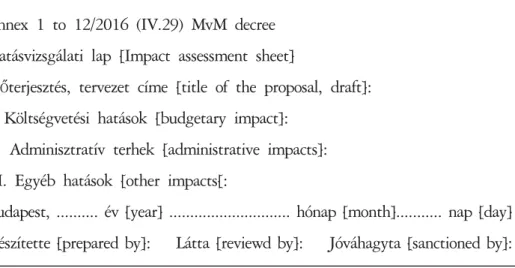
New rules adopted in 2010 and 2011 thus showed improvements but in truth, actual practice was still considerably lagging behind in terms of conducting ex ante and ex post impact assessments, access to the reports, and consultation processes which is a mere formality.106) This situation, however, contrary to the progress other states have planned started or achieved, has not yet improved and suggests a regression may soon be further experienced. In 29 April 2016, the Minister of the Chancellery, who is now responsible for the coordination of governmental activity instead of the minister of justice,107) issued a new decree [12/2016 (IV.29) MvM decree] on ex ante and ex post impact assessment. The new decree is a shorter version of the previous one: it contains neither the enumeration of impacts on which ex ante assessment has to be conducted (the new summary sheet only names fiscal, administrative and other impacts), nor a detailed description on how to fill the impact assessment summary sheet in (when it can be omitted, what happens if more sheets need to be filled in). As for establishing a link between ex ante and ex post assessment in order to embed this latter to the policy cycle, the decree is ambiguous:
it requires rules on ex ante assessment (regarding positive, negative effects, monetary, unified methodology) have to be applied also in the case of ex post assessment, but the summary sheet (Table 1) is tragically simplified, making no reference to ex post assessment and offers essentially, little or no information whatsoever to those interested, either serving as political actors, governments agencies or stakeholders and the general public.
106) Drinóczi (2012) , loc. cit. n. 2., Drinóczi and Kocsis, loc. cit. n. 8, Alberti et al, loc. cit. n. 98, at p. 40
107) It was the minister of justice (and public administration) that has traditionally been responsible for coordinating governmental activities. That is why the previous decree on ex ante and ex post impact assessment was issued by this minister.
Table 1 Ex ante impact assessment sheet in Hungary in 2016
Annex 1 to 12/2016 (IV.29) MvM decree Hatásvizsgálati lap [Impact assessment sheet]
El
쟠
terjesztés, tervezet címe [title of the proposal, draft]:I. Költségvetési hatások [budgetary impact]:
II. Adminisztratív terhek [administrative impacts]:
III. Egyéb hatások [other impacts[:
Budapest, ... év [year] ... hónap [month]... nap [day]
Készítette [prepared by]: Látta [reviewd by]: Jóváhagyta [sanctioned by]:
The new system of impact assessment is to be applied ex nunc, but the previous system determined by the KIM decree can be applied through the end of 2016.
There are still no rules on quality control, transparency, consultation during the assessment process, and publication of reports. This new approach erases all the preceding political efforts and results of the previous accomplishments of the public administration and opens up a more autocratic/illiberal/unorthodox legislative model which is certainly, not in line with any European trend, but which can serve short term political goals and immediate implementation of new ideas. What matters is the effectivity of laws, meaning, they are expected to achieve the intended result with a possible immediate (or retrospective108)) effect, and what completely disregarded are the efficacy, proportionality and constitutionality, i.e., the quality of law in a constitutional democracy.
108) See the retroactive taxation story in Hungary of 2010, Drinóczi, loc. cit. n. 8.
4. Lessons learned
There is a clear development both in quality and actual exercise of ex ante assessment and an unambiguous effort to introduce retrospective analysis and improve existing ex ante and ex post assessment practices in the target regions. Even though reasons of introduction of impact assessment system, legal basis governing the mechanism, organizational mechanisms, quality of implementation, capacity and even political commitment and efforts are divers, a linear development can be experienced, except in Hungary, which indeed, made a U-turn also in its efforts to achieve better/smart/quality legislation.
Thus, there is a clear trend in the CEE and Balkan regions109) with reference to the introduction of impact assessment. It has been and still is mainly triggered by the influence of the international organization, EU accession and focusing on competitiveness through administrative burden reduction programmes and includes three phases.110)
In the CEE region, at the very beginning, as Staro
쟗
ova emphasizes, a formal adoption of the assessment systems indeed took place primarily prior to the 2004 accession. This, however, does not only apply to those Staro쟗
ova named (Czech Republic, Estonia, Hungary, Slovakia, and Slovenia) but also extends to Poland, Lithuania, and presumably, Latvia. In the Balkan region, the same was experienced later on, around and after 2010 (Macedonia, Croatia, Serbia, and Montenegro).Additionally, Kosovo closed in upon us, later, in 2014.
In most of the CEE states, based on former experiences, a ‘reform-period’ followed the first years in the operational functionality of the assessment system between 2010 and 2013, which also envisaged to the introduction of ex post assessment in Czech Republic, Poland, Estonia, and Lithuania. In these states, ex post assessment has
109) Based on Staro쟗ova who however based this finding on five states (Czech Republic, Estonia, Hungary, Slovakia, Slovenia). Staro쟗ova, loc. cit. n. 5.
110) Staro쟗ova differentiated two phase: formal application and reform steps.