1
The Premium of English Proficiency in the South Korean Labor Market*
Choi Hyung-Jai** and Kim Jin-Yeong***
In this paper, we estimate the wage premium of English skills in the Korean labor market using Korean Labor and Income Panel Study (KLIPS) data. In a simple OLS model, we find that people with some English skills in terms of self evaluation or job requirement earn 30%
more than those who do not have English skills. But in a small sample of relatively young people, higher English test scores do not raise earnings. When we add SAT scores in the wage equation, there is no wage premium of English skills, and in the IV estimation, we find no
“English premium”. These results consistently imply that while there is a large wage premium of English skills in the Korean labor market, it reflects unobservable ability for the most part.
Meanwhile some of the regression results favor human capital theory over screening theory as an explanation of the nature of the wage premium of English skills.
Keywords: English proficiency, English premium, wage equation, human capital theory, screening theory
I. IntroductIon
Along with the progress of globalization, English proficiency has been demanded of nearly all students and not a few participants in the labor market in South Korea, which is not an English-speaking country. In other words, English proficiency has come to be considered a requirement for everyone instead of a choice. In recent years, the South Korean government’s
* translated from the article published in Korean Journal of Labour Economics vol. 32, no. 2 (2009), with permission from the Korean Labor Economic Association.
** department of Economics, Korea university Sejong campus
*** department of Economics, Konkuk university
educational policy likewise has greatly stressed the improvement of English proficiency so that investment for the enhancement of English proficiency in public education is expected to be concentrated as never before. of course, investment in private education made through means including cram schools, private tutoring, and overseas training, too, has reached a considerable level. operating behind the consideration of English proficiency as an indispensable competence and the execution of much investment in it will also be the economic incentive of high revenues from English proficiency.
When the economic efficiency of investment in English proficiency is to be evaluated, however, it is necessary first to review profitability fully.
the present study examines how English proficiency is evaluated in the South Korean labor market. Between English proficiency and the labor market performance, interactions where a bilateral causal relationship coexists presumably occur. First, English proficiency may be highly evaluated in the labor market and lead to high wages. The possibility of wage increases according to English proficiency leads once again to investment for the acquisition of English proficiency. of course, the high proportion of private education in English in the overall private education in South Korea will be a result of such interactions. Although the present study cannot show all facets of interactions between such high anticipated profits and ensuring investment, it will examine the evaluation of English proficiency in the South Korean labor market in comparative detail and from diverse angles.
At present, when English proficiency is evaluated as a very important element in the South Korean labor market as well, a review of the relationship between English proficiency and labor market performance is a very necessary task. A review of English proficiency in terms of labor market performance will be an important starting point for a review of the efficiency of social investment in human resources or as a basic material for establishing effective policy for English language education in public education.
Based on data obtained by adding a survey on English to the 10th-year Korean Labor and Income Panel Study (KLIPS), the present study examines the relationship between English proficiency and the labor market. More specifically, the purpose of the present study lies in deriving and analyzing the significance of the wage premium of English proficiency. In analysis, the following two aspects will be emphasized. First, for an accurate measurement
of the English proficiency premium, care will be taken to control unobserved ability factors. As is well known, in general regression analysis, the effect of English proficiency may be overestimated due to omitted ability variables.
to control this, two methods will be used: adding indices that represent invisible abilities to the regression equation; and using IV. Second, the present study will seek to answer the question of whether the effect of English proficiency on wages is to be seen as productivity improvement stemming from increased human capital or as a result of screening in the employment process. of course, though it is difficult to conclude that either the screening theory or the human capital theory is the truth in the labor market, a rational interpretation will be attempted as much as possible.
The present study is organized as follows. chapter II will overview existing literature that empirically examines the effect of English proficiency on immigrants’ wages or income mainly in English-speaking countries. chapter III will survey prior discussions on topics including the formation of English proficiency, measurement of English proficiency, and analysis of the wage premium of English proficiency, which can be seen as the labor market’s evaluation of English proficiency. chapter IV will derive the wage premium enjoyed by English proficiency in the labor market. As for English proficiency variables, those including the following will be made use of: self-evaluations on English conversation, reading comprehension, and writing skills; the degree to which English is needed at work; and scores on English language tests such as the test of English as a Foreign Language (toEFL) and the test of English for International communication (toEIc). the most difficult aspect of deriving the wage premium of English proficiency is the concern that English proficiency may have a high correlation with other unobserved abilities and therefore be overestimated. In consideration of this, to estimate the effect of English proficiency more accurately, regression analysis using proxy variables regarding abilities or estimations according to the IV method will be attempted. In addition, the present study will review whether the English premium stems from selection mechanisms or is given as a profit from human capital. chapter V is the conclusion.
II. A rEVIEW oF ExIStIng LItErAturE on EngLISh
And LABor MArKEt PErForMAncE
though economic analyses of language cannot be said to be numerous, they have been conducted. Since the 2000s, no fewer than three volumes containing economic analysis of language from theoretical and empirical perspectives have been published as well. These books, however, have been:
an analysis of language in terms of the game theory (rubinstein 2000);
an examination of immigrants’ English proficiency and labor market performance in the labor market in English-speaking countries (chiswick and Miller 2007); and an anthology of papers on diverse topics including communication, culture and assimilation, and bilingualism (ramberton 2002). It has therefore been difficult to find other literature that addresses analysis directly relevant to the present study.
As for research that reviews the relationship between individuals’ English proficiency and labor market performance in non-English-speaking countries with a problematics similar to that of the present study, Kanto’s paper (2002), which analyzes English proficiency, wages, and occupation selection in the Japanese labor market, is the sole case. It is thus difficult to find existing studies presumably because the evaluation of English proficiency by the labor market hitherto has not been a greatly interesting topic in non-English- speaking countries.
however, in that they examine the effect of English proficiency on wages after including variables measuring English proficiency along with other control variables in the explanatory variables of regression analysis, studies on the labor market performance of English proficiency in non-English- speaking countries and those on the English proficiency of immigrants in English-speaking countries and labor market performance can be seen as similar methodologically. consequently, it will be meaningful to overview briefly existing studies on the effect of immigrants’ English proficiency on wages in English-speaking countries as well.
Based on the variables of individuals’ subjective evaluations of their own English proficiency1 and with Asian and hispanic immigrants as the main
1 For example, on the current Population Survey (cPS) of the united States, respondents are to report their respective English proficiency in terms of the following five categories: “not at all”; “not well”; “well”; “very well”; and “speak English only.”
subjects, early studies examined the effect of English proficiency on wages.
For example, McManus et al. (1983) and McManus (1985) demonstrated that English proficiency had a considerable effect on wages and that this effect increased as the educational background and the career did. According to a report by McManus (1985), individuals with a perfect command of English receive wages that are 26% higher, on an average, in comparison with those without such a command. Based on American census data, carliner (1995;
1996) examined immigrants’ English proficiency acquisition and the effect of their English proficiency on wages. This research shows that advancement in English proficiency by one level (“not at all” → “not well” → “well” → “very well”) has a wage increase effect corresponding to that of one year of formal school education.
however, such studies have the problem of endogeneity between English proficiency and unobserved abilities. If a correlation exists between English proficiency and unobserved abilities, ordinary least squares (oLS) estimation can lead to a bias. A series of studies have been conducted to correct this problem also. For example, chiswick and Miller (1995) estimated the wage increase effect of English proficiency by making use of 1980 cPS data from the united States and through the IV method, and the estimates thus obtained were greater than oLS estimates. Such results led to doubts about the validity of the tool that they used. Bleakley and chin (2002) likewise used the IV method to estimate the wage increase effect of English proficiency from 1990 cPS data and, similar to chiswick and Miller (1995), obtained a wage increase effect greater than that of oLS estimation. they argued that though oLS estimation could lead to an upward bias due to endogeneity, a downward bias due to measurement errors was far greater.
In a similar context, both dustmann and Soest (2001) and dustmann and Fabbri (2003) pointed out the possibility for measurement errors inherent in the English proficiency variable, especially problems due to misclassification errors and unobserved heterogeneity, to lead to a bias in oLS estimation and demonstrated the fact that when such problems were taken into consideration, the importance of language in the labor market was greater for the united Kingdom than for other countries.
disparate studies thus obtained disparate estimates. According to gonzalez (2005), the wage increase effect of English proficiency obtained
from diverse empirical studies was distributed broadly, ranging from 10% to 100% or more. gonzalez (2005) adopted the method of non-parametrically finding the upper and lower boundary values of the wage increase effect of English proficiency and estimated that hispanic immigrants’ lack of English proficiency led to wage losses of 3.8-38.6%.
As is apparent from the existing literature above, measurement errors and endogeneity can be cited as the greatest methodological problems. Likewise, in estimating the wage increase effect of English proficiency in the South Korean labor market, ample attention must be paid to the problems of the accuracy of measurements and endogeneity.
III. thE concEPtuAL FrAMEWorK And An EMPIrIcAL ModEL
1. The English Premium
It is difficult to say that economics can provide a theoretical framework regarding what factors determine people’s proficiency in foreign languages instead of their respective their mother tongues, used in everyday life.
nevertheless, through the framework of cost-benefit, which serves as a basic incentive for much behavior in economics, it will be possible to consider the determining factors of proficiency in foreign languages including English from the perspective of the costs and benefits of language acquisition.
Basically, proficiency in foreign languages will be formed in accordance with innate abilities and investment in language acquisition. out of these, there will be much room for economic explanations of how innate abilities are formed. however, investment for the formation of English proficiency can be considered from diverse angles. Investment with the clearest economic explanation is the direct costs incurred by the study of English. Whether implemented through formal school education, through forms of private education such as cram schools and private tutoring, or through the form of overseas training, the acquisition of English proficiency incurs costs.
though there is no guarantee that these costs and English proficiency will necessarily be in proportion to each other, at least those who are investing to
acquire English proficiency will expect their English proficiency to increase in accordance with these costs.
on the other hand, costs for English proficiency acquisition can be determined to a considerable degree by individuals’ home environments. The economic strength of households will be an important factor determining the scale of investment for English acquisition. In addition to such home environments, diverse elements that are difficult to observe such as surroundings or local environments where English is used much and the competence of English teachers in formal school education can serve as factors that allow individuals to acquire better English proficiency even at the same costs.
In addition to such direct costs that thus incur cash expenditure, there also are opportunity costs, which must be considered to be important. English proficiency acquisition requires studying over a considerable period. When seen from the perspective of the formation of human capital, the time and efforts invested to acquire English can be secured by sacrificing those invested to create other forms of human capital. of course, there will be considerable individual differences in opportunity costs. For example, opportunity costs can be said to be particularly great when those without comparative advantages in language acquisition for reasons including innate abilities invest considerable time and efforts to improve their English proficiency.
Ideally, the best thing would be evaluating the profits from investment in English proficiency. Questions such as the degree of English proficiency acquired through private education and training and its rate of return, whether profits from English proficiency can amply compensate economically for investment, and whether the rate of return on English proficiency will exceed that on other forms of investment, which are alternatives to investment for the improvement of English proficiency, hold an important meaning in terms of the distribution of investment in human capital. unfortunately, however, the period in which investment for English proficiency acquisition was made on a large scale in South Korea is too short for examining the relationship between investment and the rate of return so that it is impossible, as of now, to estimate the rate of return with respect to investment. the present study therefore will focus on an examination of profits according to English proficiency rather than of profits with respect to costs.
As indices of English proficiency, we propose the followings. First is the subjective English proficiency index obtained through survey. consequently, to extract the subjective English proficiency index, the present study added to the KLIPS individual survey questions evaluating the respondent’s competence in the three categories; English conversation, reading, and writing. of course, obtained from the respondent’s evaluation of his or her own English proficiency, the English proficiency index has the fundamental limitation of being a subjective evaluation notwithstanding the advantage that many observations can be obtained.
As a somewhat more objective index, there is the answer to the question of whether the respondent’s duties demands English proficiency. In that firms will not assign to duties that demand English proficiency people with inadequate English proficiency, those who perform duties that demand English can be classified as a group with high English proficiency. though this, too, is limited in being a subjective evaluation, it can be used as an index representing English proficiency.
In a similar context, the answer to the question of whether English was required in the employment process can also be seen as an index of English proficiency. If English proficiency was demanded at the time of employment and the individual in question passed the employment process, he or she can be seen as being equipped with English proficiency to a certain degree.
of course, this question can be interpreted very differently from that of whether duties demand English. As will be discussed later as well, the English proficiency here basically has a screening function. consequently, high wages can stem from good occupations from which higher wages are obtained rather than from the premium obtained by using English while performing duties. of course, even the English premium used only during the screening process unmistakably is the English premium, but the relationship between this premium and productivity cannot be seen as clear.
As has been mentioned above, because all English proficiency measurement values considered in the present study have their respective advantages and disadvantages, all possible indices will be used evenly in the empirical analysis below.
next, let us consider the problem of control over other factors that can affect wages. As has been mentioned in the review of existing literature above,
the English premium generally derived from oLS is likely to overestimate the true English premium. When people with English proficiency are equipped also with unobserved abilities that can increase their wages, the English premium is overestimated. to avoid or mitigate such overestimation, abilities other than English proficiency must be controlled.
While easily observable variables such as the educational background and age will be basically controlled, it is difficult to discover other ability- related indices. As for the over 500 people who took the cSAt during 1994- 2003, the present study will control ability factors by making use of percentile rank scores on the cSAt per subject. the disadvantage of these test score data are that, as with data on English language test scores, the number of observations is small. Because such a fundamental disadvantage cannot be overcome, IV estimation, which can control ability factors, will be employed at the same time. Though they do not correlate with ability factors, these IV must correlate with English proficiency. As these variables, the educational background of the respondent’s father and the area in which the respondent grew up at the age of 14 will be used as IV. The nature of these variables and their appropriateness as IV, among other things, will be discussed further in the chapter that addresses the results of empirical analysis.
3.
An Interpretation of the English Premium: Human Capital vs.
Screening Functions
the relationship between English proficiency and wages can be seen as an application of the classical debate on the human capital theory vs. the screening theory.2 According to the human capital theory, English proficiency
2 debates on human capital and screening functions have centered on education. In labor economics, a large number of empirical studies show results implying that the reception of additional school education considerably increases future income by increasing human capital. More specifically, one year of additional education is estimated to increase the annual income by 5-11%. however, according to the screening theory, the reception of additional education of several years, especially on the college level, functions only as a screening mechanism for identifying more competent people. According to this theory, those who are highly productive must send signals about their productivity to prospective employers. In addition, they can
is an important form of human capital and can be interpreted to operate as a factor that increases individuals’ productivity, thus raising wages. on the contrary, according to the screening theory, English proficiency serves as a good index that can show individuals’ productivity more clearly to employers. In particular, along with the universalization of college education in South Korea in recent years, the two aspects of English proficiency—i.
e., the screening theory and the human capital theory—hold considerable significance. In a situation where the higher education advancement rate has increased to nearly 85%, the signaling effect of college diplomas has weakened. In a situation where the signaling effect of college diplomas has weakened, the incentive to use other signaling indices increases. here, English proficiency can be used as a very persuasive index.
In other words, English proficiency leads to high wages not only because English proficiency increases productivity but also occupations that guarantee high wages demand English proficiency. of course, it is difficult to see either the human capital theory or the screening theory as the truth, and English proficiency can contribute to increased productivity through a broader ability for communication in addition to a useful tool in the screening process.
consequently, it may be an impossible task to determine clearly why English proficiency is highly rated in the South Korean labor market. nevertheless, the question of which mechanisms operate more importantly holds an important meaning in relation to South Korea’s overall productivity.
If English serves only as a screening function regardless of the need for it according to workers’ duties, it can cause serious problems in terms of the efficient distribution of human capital in society at large. For example, if investment in English cannot be employed usefully in the actual performance of duties at work, it could be inefficient overinvestment. At the individual level, investment in English is a compensation acquired by sacrificing investment in other fields. In other words, someone who has secured a good occupation through English proficiency may have exhibited higher
do so through the fact that they have each jumped over the hurdle of the university entrance examinations and obtained college degrees. What this theory implies is that education serves only as a signal of already existing competence instead of increasing productivity and aiding the subjects to obtain high wages.
productivity if he or she had spent more time and efforts to accumulate human capital related to his or her future duties instead of investing in English.
on the other hand, in the labor market, where screening through English plays an important role, everyone will make investment to send signals about his or her English proficiency. If only a very small number of people actually obtain good occupations through the screening process, however, the result will be not only a misfortune for individuals who have failed to obtain good occupations even after making considerable investment in studying English but also a great decrease in the efficiency of investment in human resources for the society as a whole.
consequently, it is necessary in the Korean context, to conduct an in- depth review of whether, English proficiency contributes to productivity improvement or largely has a screening function. Though its analysis alone will be inadequate for explaining high wages according to English proficiency as the result either of the human capital effect or of the screening effect, the present study will apply both the human capital theory and the screening theory and make an interpretation as careful as possible in interpreting the English premium derived from the empirical discussions below.
VI. EMPIrIcAL AnALySIS: EngLISh ProFIcIEncy And WAgES
1. Data
Based on the discussions given above, the present section will empirically examine the relationship between English proficiency and wages. Empirical analysis data are from the 10th-year KLIPS. The 2007 KLIPS added questions related to English proficiency. these questions included those addressing:
self-evaluations of competence in reading comprehension, writing, and conversation; the necessity of English in duties; the necessity of English upon employment; and the necessity of English upon promotion. the English premium is estimated by combining answers to such English-related survey questions and wage data.
The samples were basically restricted to workers receiving wages. Because the results of toBIt analysis, which included even people not participating in the labor market, were nearly identical qualitatively, the results of regression analysis shown below are those of estimation basically of worker samples who received wages.
Making use of the advantage that these were panel data, the present study sought to examine even the latest changes to the English premium by making estimation for each year from 2001 to 2007 instead of being restricted to a Table 1. descriptive statistic values of the major variables
Variable no. of
observa-
tions Average Standarddeviation Minimum Maximum
Wage 4,334 189.721 188.050 7 5,300
Educational level 4,334 12.731 3.272 0 20
Age 4,334 39.971 11.510 17 82
Male 4,334 0.610 0.488 0 1
English conversation proficiency 4,334 0.400 0.490 0 1 English reading comprehension
proficiency 4,334 0.445 0.497 0 1
English writing proficiency 4,334 0.347 0.476 0 1
The toEIc taken 4,334 0.065 0.246 0 1
The toEIc score 281 688.509 159.137 250 990
Percentile rank score on the cSAt 327 79.415 13.868 25.14 99.57 need for English reading compre-
hension at work 4,334 0.143 0.350 0 1
English language test score upon
employment 4,334 0.099 0.298 0 1
college education or above 4,334 0.137 0.344 0 1
residence in a large city at age 14 4,334 0.401 0.490 0 1
Large corporation 4,334 0.177 0.381 0 1
note: All data are for 2007. completed with workers with wages as the standard. The unit of the monthly wage is 10,000 won.
single year. <table 1> below shows the descriptive statistic values of the major variables used in regression analysis.
2. The Necessity of English for Duties and Wages
Before analyzing the relationship between English proficiency and wages, let us first examine whether wages are higher for duties that require English.
this is because, for English proficiency to be linked to higher wages, there must exist duties that require English proficiency and such duties must guarantee high wages. It is also because how much higher wages are for duties that actually require English than for those that do not can be seen as the English premium.
First, let us examine the number of duties that demand English proficiency and whether people in charge of such duties receive high wages. the 2007 KLIPS includes questions on the importance of English upon employment and during the performance of duties.
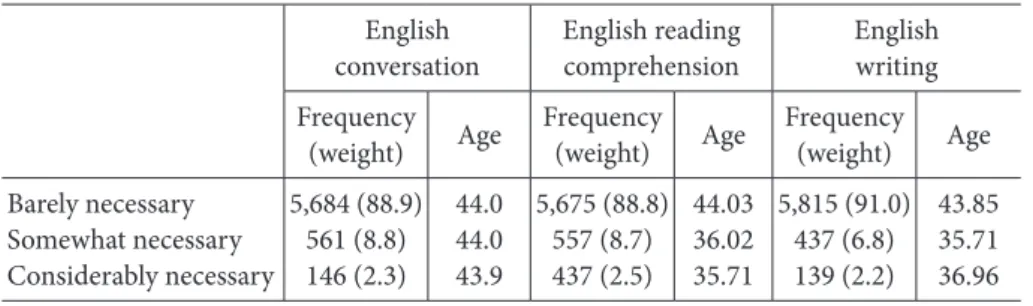
First, as <table 2> shows, to the question of how much English proficiency was needed for the respondent’s duties, 89% answered that English conversation was barely necessary, and all answers that English was considerably necessary took up less than 5% of the total. however, the demand for English at work differed considerably by age. For example, while the average age was approximately 44 for respondents who stated that English proficiency was barely needed, it was 36, eight years lower, for those who answered that English proficiency was needed to a certain degree. on an average, the demand for English proficiency increased for those born in 1970 and later.
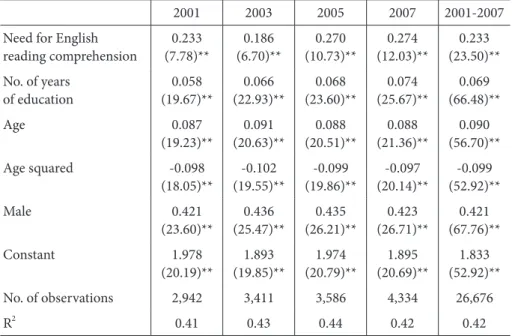
Such a demand for English for the performance of duties was wholly reflected by wages. <table 3> presents the results of estimations made after adding to the basic Mincer wage equation a dummy variable with the value of 1 for those who said that English reading comprehension proficiency was needed for their duties as an explanatory variable. A regression equation for odd years since 2001 was estimated, and estimations were made after combining the data for 2001-2007. According to the results of estimation, the wages of those for whom English reading comprehension proficiency was required somewhat or considerably were higher than those of other people by
no less than approximately 27.4% for 2007. These figures were slightly higher than those for 2001. In other words, respondents who stated that English proficiency was demanded at work received far higher wages even when variables such as the educational level and age were controlled.
Such a relationship between the importance of English proficiency and wages appears also in the differences between the group of which English was demanded upon employment and the group that was not. As <table
Table 2. degree of English proficiency necessary for work English
conversation English reading
comprehension English writing Frequency
(weight) Age Frequency
(weight) Age Frequency (weight) Age Barely necessary
Somewhat necessary considerably necessary
5,684 (88.9) 561 (8.8) 146 (2.3)
44.0 44.0 43.9
5,675 (88.8) 557 (8.7) 437 (2.5)
44.03 36.02 35.71
5,815 (91.0) 437 (6.8) 139 (2.2)
43.85 35.71 36.96
Table 3. English proficiency necessary for work and wages
2001 2003 2005 2007 2001-2007
need for English
reading comprehension 0.233
(7.78)** 0.186
(6.70)** 0.270
(10.73)** 0.274
(12.03)** 0.233 (23.50)**
no. of years
of education 0.058
(19.67)** 0.066
(22.93)** 0.068
(23.60)** 0.074
(25.67)** 0.069 (66.48)**
Age 0.087
(19.23)** 0.091
(20.63)** 0.088
(20.51)** 0.088
(21.36)** 0.090 (56.70)**
Age squared -0.098
(18.05)** -0.102
(19.55)** -0.099
(19.86)** -0.097
(20.14)** -0.099 (52.92)**
Male 0.421
(23.60)** 0.436
(25.47)** 0.435
(26.21)** 0.423
(26.71)** 0.421 (67.76)**
constant 1.978
(20.19)** 1.893
(19.85)** 1.974
(20.79)** 1.895
(20.69)** 1.833 (52.92)**
no. of observations 2,942 3,411 3,586 4,334 26,676
r2 0.41 0.43 0.44 0.42 0.42
note: In the parentheses are t- values. * are significant at 5%, and ** are significant at 1%.
4> shows, although the number of respondents who stated that English had been an important factor to employment was very small, the wages of this group were far higher than those of respondents who answered that English had not been important at the time of employment. of course, there can be differences between English being important and English being required at work. however, if the group for whom English had been important upon employment was indeed the group that actually needed English at work, then the fact that the wages of this group was higher by 30-40% than those of the group for whom English had not been important at the time of employment can be seen as a proof that duties requiring English proficiency guarantee relatively higher wages.
the relationship between the English proficiency demanded upon employment and wages can be observed also in the absence or presence of the evaluation of English proficiency at the time of employment. Less than 10% of the respondents answered that English proficiency in any form had been taken into consideration at the time of their employment. As <table 5> shows, however, wages were higher by approximately 40-50% for people who had been demanded to present scores on English language tests upon employment than for those who had not been thus demanded. In addition, such a gap has generally tended to expand with the passage of time. Between 2001 and 2007, wage differences according to the absence or presence of English proficiency evaluation increased from 40% to 65%.
now, let us examine how much wage increase English proficiency led to when other variables were controlled. As is apparent in <table 6>, the group with occupations where English proficiency evaluation was conducted upon
Table 4. English proficiency necessary upon employment and wages
Important unimportant Frequency
weight (A/A + c)
Wage ratio (B/d) Frequency
(A) Average wage
(B) Frequency
(c) Average wage (d) 20012002
20032004 2005
152157 183174 217
176.47 189.38 227.75 220.44 240.44
14501604 17671842 2030
133.71 143.17 153.24 159.27 166.43
9.5%8.9%
9.4%8.6%
9.7%
1.321.32 1.491.38 1.44
employment received far higher wages than did the other group even when the number of years of education or age was controlled. In addition, when the years 2001 and 2007 are compared, the wage gap between these two groups tended to widen considerably.3 consequently, it is possible to interpret that efforts to select duties that demand English proficiency can bring about considerable potential profits.4
When examined comprehensively, duties demanding English proficiency
3 As an anonymous commentator has pointed out, because an English-related survey was included only in the 2007 study, the demand for English upon employment or at work may have changed into labor turnover, job change, or job transfer over seven years. In addition, English proficiency in 2001 and in 2007 can differ. When such possibilities are considered, it will be difficult to argue, based on the results of this regression analysis alone, that the English premium has expanded with the passage of time. nevertheless, a phenomenon where the English premium per year is estimated to be different is clearly noteworthy. Whether such a phenomenon will be observed in 2007 and later and what the reasons for the phenomenal increase of the English premium are must be elucidated in the future.
4 Although not presented separately, the average wage of respondents who stated that their English proficiency had been evaluated upon promotion, as with employment, likewise was higher than that of those who had not been subjected to such evaluations.
Though the proportion of people who had been evaluated for their English proficiency was somewhat smaller than that of those who had been similarly evaluated at the time of employment, the wage gap according to the evaluation of one’s English proficiency upon promotion was nearly identical to that according to the evaluation of one’s English proficiency upon employment.
Table 5. Presence/absence of English proficiency evaluation upon employment and wages English proficiency
evaluation present English proficiency
evaluation absent Frequency weight (A/A + c)
Wage ratio (B/d) Frequency
(A) Average
wage (B) Frequency
(c) Average wage (d) 20012002
20032004 20052007
126132 151137 170427
186.37 206.59 244.10 229.25 261.11 294.11
14761629 17991879 20773907
133.62 142.49 153.19 159.84 166.41 178.31
7.9%7.5%
7.7%6.8%
10.3%7.6%
1.391.45 1.591.43 1.571.65
are not numerous and take up less than 10% of the total respondents.
nevertheless, wages for those duties are far higher than those for other duties.
duties demanding English lead to high wages, approximately 30-40% when the educational background or age is not controlled and approximately 30%
even when such variables are controlled, respectively. This can be called the premium of English proficiency.
The data above confirm that people who need English for their duties or are evaluated for English proficiency upon employment or promotion receive higher wages than others. When all other conditions are identical, differences in wages can be seen as the English premium. of course, as will be examined later, there is the possibility that high wages may not stem purely from English proficiency. Before examining such possibilities in earnest, let us first look at the relationships between other English proficiency indices and wages.
Table 6. Presence/absence of English proficiency evaluation upon employment and wages
2001 2003 2005 2007 2001-2007
English proficiency
evaluation 0.182
(5.25)** 0.198
(6.44)** 0.325
(11.34)** 0.345
(13.18)** 0.240 (21.02)**
no. of years
of education 0.063
(18.31)** 0.068
(21.68)** 0.073
(24.00)** 0.075
(26.75)** 0.072 (63.21)**
Age 0.087
(14.00)** 0.086
(15.94)** 0.085
(17.04)** 0.086
(20.97)** 0.088 (46.46)**
Age squared -0.096
(12.34)** -0.096
(14.53)** -0.095
(16.18)** -0.095
(19.76)** -0.096 (41.95)**
Male 0.417
(19.54)** 0.429
(22.49)** 0.407
(22.57)** 0.419
(26.50)** 0.403 (57.67)**
constant 1.938
(15.45)** 1.977
(17.57)** 2.009
(18.62)** 1.922
(21.04)** 1.845 (45.63)**
no. of observations 1,981 2,474 2,957 4,332 20,300
r2 0.41 0.43 0.45 0.42 0.41
note: In the parentheses are t- values. * are significant at 5%, and ** are significant at 1%.
3. Individuals’ English Proficiency and Wages
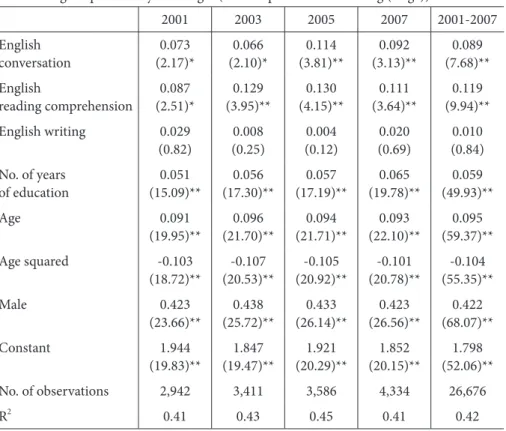
First, let us examine the effect of respondents’ subjective English proficiency on their wages. <table 7> shows the results of the regression equation obtained by adding the English conversation, English reading comprehension, and English writing dummy variables to the basic Mincer wage equation for odd years during 2001-2007. Estimations were made per year, and regression analysis was conducted also on samples to which the data for 2001-2007 had been integrated. According to the results of regression analysis, the wages of the group with proficiency in English conversation and reading comprehension were consistently high. however, English writing proficiency
Table 7. English proficiency and wages (oLS: dependent variable log (wage))
2001 2003 2005 2007 2001-2007
English
conversation 0.073
(2.17)* 0.066
(2.10)* 0.114
(3.81)** 0.092
(3.13)** 0.089 (7.68)**
English
reading comprehension 0.087
(2.51)* 0.129
(3.95)** 0.130
(4.15)** 0.111
(3.64)** 0.119 (9.94)**
English writing 0.029
(0.82) 0.008
(0.25) 0.004
(0.12) 0.020
(0.69) 0.010 (0.84) no. of years
of education 0.051
(15.09)** 0.056
(17.30)** 0.057
(17.19)** 0.065
(19.78)** 0.059 (49.93)**
Age 0.091
(19.95)** 0.096
(21.70)** 0.094
(21.71)** 0.093
(22.10)** 0.095 (59.37)**
Age squared -0.103
(18.72)** -0.107
(20.53)** -0.105
(20.92)** -0.101
(20.78)** -0.104 (55.35)**
Male 0.423
(23.66)** 0.438
(25.72)** 0.433
(26.14)** 0.423
(26.56)** 0.422 (68.07)**
constant 1.944
(19.83)** 1.847
(19.47)** 1.921
(20.29)** 1.852
(20.15)** 1.798 (52.06)**
no. of observations 2,942 3,411 3,586 4,334 26,676
r2 0.41 0.43 0.45 0.41 0.42
note: In the parentheses are t- values. * are significant at 5%, and ** are significant at 1%.
did not affect wages. When examined in terms of the sizes of the coefficients, the coefficients for English reading comprehension proficiency consistently were the highest for all years. While it may be difficult to infer the reasons from the results of regression analysis alone, this may be because English reading comprehension can be the most often demanded task.
on the other hand, English writing does not exhibit statistically significant values in <table 7>. Such results may be due to the problem of multicollinearity stemming from the strong correlation among English conversation, English reading comprehension, and English writing proficiency. In fact, when English proficiency is classified into the dummy variables of English conversation, English reading comprehension, English writing, and the toEIc taken and the relationship between English proficiency and wages is examined, those who possessed high subjective English proficiency or had taken the toEIc received higher wages, by approximately 17-19%, than others, as in <table 8>, even when the educational background or age was controlled. Such results imply a causal Table 8. Subjective English proficiency evaluation and wages (oLS, 2007)
English
conversation English reading
comprehension English
writing The toEIc taken English proficiency 0.183
(9.71)** 0.192
(9.98)** 0.164
(8.54)** 0.169 (5.26)**
no. of years
of education 0.069
(21.68)** 0.067
(20.70)** 0.071
(22.31)** 0.081 (28.64)**
Age 0.091
(21.80)** 0.092
(21.92)** 0.090
(21.55)** 0.088 (20.87)**
Age squared/100 -0.100
(20.51)** -0.100
(20.60)** -0.099
(20.32)** -0.096 (19.62)**
Male dummy 0.422
(26.47)** 0.424
(26.61)** 0.422
(26.42)** 0.420 (26.10)**
constant 1.854
(20.14)** 1.846
(20.08)** 1.869
(20.26)** 1.839 (19.82)**
no. of observations 4,334 4,334 4,334 4,334
r2 0.41 0.41 0.41 0.40
note: In the parentheses are t- values. * are significant at 5%, and ** are significant at 1%.
relationship of English proficiency → duties requiring English → high wages.
on the other hand, the absolute value of the coefficients was in the order of English reading comprehension, English conversation, and English writing, which corresponds to the results in <table 7> as well. In reflection of such results, when selecting one from among English conversation, English reading comprehension, and English writing as a variable representing English proficiency below, the English reading comprehension variable will be used.
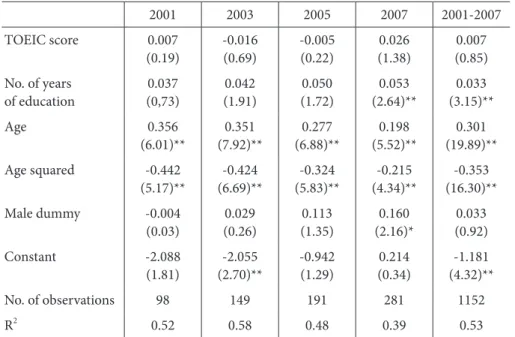
next, toEIc scores, which can be seen as indices of English proficiency expressed numerically, were added to the basic wage equation. The results of estimation show that toEIc scores did not affect wages. This was a consistent phenomenon during 2001-2007, and the same held true for the results of oLS estimation performed after adding the data for 2001-2007 in consideration of the limitation that the samples were small. Such results may stem from the fact that the samples were small and only included comparatively young people. consequently, the analysis of these results must be conducted with careful and compared with the results derived from large samples following the future accumulation of more English language test score data. Because the problem of small samples is serious, analysis with toEIc scores as a proxy variable of English proficiency will not be conducted below.
nevertheless, let us accept the results for the time being and make the analysis that toEIc scores do not have a large effect on wages. Even if toEIc scores in themselves have a low correlation with wages, they can coexist with the results showing that the English premium actually exists, as has been examined above. Indeed, there are cases where firms demand toEIc scores on certain levels. there is also a strong possibility that the standard here, or toEIc scores on “certain levels,” will not have a large effect on wages. In addition, in the case of standardized and schematic tests, it may be possible for test takers to receive high scores even without improving English proficiency necessary for actual work through a form of learning that accustoms them to the tests.
the relationship between wages and English proficiency as grasped through subjective self-evaluations and toEIc scores has been thus examined. however, as has been mentioned above, the English premium can be overestimated when other ability factors that have a correlation with
English proficiency are not appropriately controlled. to control ability factors, let us now include in the regression equation percentile rank scores on the cSAt, which can represent ability and diligence.
though cSAt scores can be very good control variables, there is the decisive limitation that the number of observations is small. consequently, in interpreting the results below, it must be remembered that the analysis concerns a small number of observations and relatively low ages. In particular, in the case of 2001 and 2003, for samples consisting only of those with observable cSAt scores, English proficiency did not affect wages even in a regression equation that did not include percentile rank scores on the cSAt, thus showing that the problem of small samples must be heeded.5
<table 9> shows the results of regression analysis of the data for 2005 and 2007, when the English premium value changed considerably according to the presence or absence of cSAt scores, and for 2001-2007 combined.6 In the case of 2005 and 2007, the English premium, which amounted to approximately 18% with the exclusion of cSAt scores, decreased in the coefficient value and significance alike with the inclusion of cSAt scores.
A phenomenon where the coefficients of English proficiency variables thus changed from significant positive (+) values to statistically insignificant values according to the inclusion or exclusion of cSAt scores shows the persuasiveness of the inference that the English premium will be overestimated when ability variables are not controlled appropriately.
It will be possible to interpret the results above with the disparate frameworks of the human capital theory and the screening theory. When interpreted within the framework of the human capital theory, English proficiency coincides considerably with the ability to improve cSAt scores. consequently, when the two variables are included, the results will be different from those of regression analysis that includes only English
5 the number of observations only amounted to 118 in 2001 and 189 in 2003, respectively, thus showing a possibility that the English premium will not appear properly in small samples.
6 As for English proficiency variables, the English reading comprehension variable was established as the representative one. there are no qualitative differences, however, even when the English conversation or English composition variable is included instead.
proficiency variables
When examined within the framework of the screening theory, if employers can infer information on prospective employees’ potential abilities through the latter’s schools (alma maters) or departments and use that information in the employment process, the incentive to use the information of English proficiency additionally will decrease.
regardless of which theory is applied, if a correlation exists between English proficiency and general academic abilities, it will be possible to obtain the same regression analysis results. however, as <Figure 1> shows, while there is a correlation between percentile rank scores on the cSAt and toEIc scores, it cannot be seen as considerable. the correlation coefficient of the two variables obtained from 130 observations possessing both scores is 0.276.
The correlation coefficient between the English conversation, English reading comprehension, and English writing dummy variables and cSAt scores is even lower.
Table 9. toEIc scores and wages
2001 2003 2005 2007 2001-2007
toEIc score 0.007
(0.19) -0.016
(0.69) -0.005
(0.22) 0.026
(1.38) 0.007 (0.85) no. of years
of education 0.037
(0,73) 0.042
(1.91) 0.050
(1.72) 0.053
(2.64)** 0.033 (3.15)**
Age 0.356
(6.01)** 0.351
(7.92)** 0.277
(6.88)** 0.198
(5.52)** 0.301 (19.89)**
Age squared -0.442
(5.17)** -0.424
(6.69)** -0.324
(5.83)** -0.215
(4.34)** -0.353 (16.30)**
Male dummy -0.004
(0.03) 0.029
(0.26) 0.113
(1.35) 0.160
(2.16)* 0.033 (0.92)
constant -2.088
(1.81) -2.055
(2.70)** -0.942
(1.29) 0.214
(0.34) -1.181 (4.32)**
no. of observations 98 149 191 281 1152
r2 0.52 0.58 0.48 0.39 0.53
note: In the parentheses are t- values. * are significant at 5%, and ** are significant at 1%.
As for toEIc scores, raw scores divided by 100 were used for regression analysis.
Figure 1. Percentile rank scores on the cSAt (horizontal axis) and scores on the toEIc (vertical axis).
Table 10. English proficiency and wages (percentile rank score on the cSAt controlled)
2005 2007 2001-2007
English writing 0.179
(1.92) 0.073
(0.79) 0.187
(2.37)** 0.102
(1.32) 0.109
(2.85)** 0.069 (1.81)
cSAt score 0.009
(4.95)** 0.008
(5.28)** 0.005
(5.97)**
no. of years
of education 0.014
(0.51) 0.000
(0.02) 0.031
(1.44) 0.018
(0.88) 0.003
(0.28) -0.007 (0.64)
Age 0.239
(6.26)** 0.229
(6.30)** 0.224
(6.73)** 0.207
(6.42)** 0.290
(21.07)** 0.283 (20.73)**
Age squared -0.294
(5.72)** -0.280
(5.70)** -0.261
(6.02)** -0.239
(5.70)** -0.348
(17.82)** -0.339 (17.48)**
Male dummy 0.168
(2.95)** 0.148
(2.72)** 0.187
(4.07)** 0.186
(4.21)** 0.065
(2.56)* 0.056 (2.23)*
constant 0.234
(0.32) -0.027
(0.04) 0.100
(0.16) 0.074
(0.12) -0.525
(2.00)* -0.601 (2.32)*
r2 0.30 0.37 0.31 0.37 0.45 0.47
no. of observations 238 327 1,417
note: In the parentheses are t- values. * are significant at 5%, and ** are significant at 1%.
When the results of regression analysis above and the rather low correlation coefficient between cSAt scores and English proficiency are interpreted comprehensively, it is possible to state that, in the labor market, there are a certain tendency for people with high cSAt scores also to have high English proficiency and a high tendency for those with high cSAt scores and low English proficiency to receive higher wages than do those with low cSAt scores but high English proficiency.
When such results are examined within the framework of the human capital theory, it is possible to make the interpretation that, in the labor market, general skills as represented by percentile rank scores on the cSAt are more important than specific skills as represented by English proficiency.
It is possible also to say that although the possession of English proficiency is more advantageous than its absence for receiving high wages, English proficiency alone does not guarantee high wages.
When examined within the framework of the screening theory, it is possible to make the interpretation that, in the labor market, one’s university (alma mater) or major has a stronger screening function than does English proficiency or English language test scores. relatively disadvantaged job seekers invest more in the improvement of their English proficiency to overcome such weaknesses. consequently, it is also possible to make the interpretation that the correlation between cSAt scores and toEIc scores has become weaker than in cases where English proficiency does not serve as an auxiliary screening function. Though the present study cannot address it in greater depth due to the problem of small samples mentioned above, this is an important research topic that must be considered in the future.
now, let us consider estimation through IV as another method that can mitigate the problem of the overestimation of the English premium due to unobserved abilities. As has been stressed numerous times, when there is a high correlation between English proficiency and other unobservable elements, the English proficiency premium can be overestimated.
consequently, let us estimate the pure premium of English proficiency through other wage increase factors that correlate with English proficiency and can affect wages but are unobserved, especially IV, which do not correlate with unobserved abilities.
Variables that can be considered as IV are those of the area of residence
at age 14 and the parents’ educational backgrounds. unless the hypothesis that there are differences in individuals’ proficiency according to the area is accepted as true, it will be difficult to think that areas of individuals’ residence at age 14 are directly related to unobservable individual abilities that can bring about wage increases.
Likewise, in the case of the parents’ educational backgrounds, their effect may be connected to high wages through the number of years of the children’s education. however, it will be difficult to see such backgrounds in themselves as elements determining the children’s abilities. In particular, in the case of South Korea, the educational backgrounds of older populations were often determined by the condition of financial restrictions besides individuals’ own abilities. consequently, this variable, too, is expected to satisfy the condition as an IV.7
In fact, there is a high correlation between English proficiency variables and IV. <table 11> shows the proportion of people with high subjective English proficiency evaluations per area of residence at age 14. It is apparent from <table 11> that people whose area of residence at age 14 was Seoul are far likelier to evaluate their own English conversation, English reading comprehension, and English writing proficiency highly than those from other areas. differences in English proficiency according to the area appear not only between Seoul and other areas but also between Special and Metropolitan cities and provinces. In general, English proficiency was higher for people who had lived in the seven Special and Metropolitan cities including Seoul than for those who had lived in provinces including gyeonggi and gangwon Provinces or areas other than large cities in South chungcheong Province and further south.
7 of course, parents with more abilities tend to live in large cities, and if such abilities are transmitted to their children through heredity, a wage gap may develop according to the areas of individuals’ residence. Even if the areas of individuals’ residence are unrelated to abilities, the possibility that they will serve as a cause of high wages through elements such as personal connections cannot be excluded. In addition, the parents’ educational backgrounds may be related not only to their children’s English proficiency but also to the children’s “abilities,” formed through the effect of elements including heredity and the child rearing environment. Such suspicions about IV will be validated by testing hypotheses.
on the other hand, <table 11> also confirms the fact that, in relation to the usefulness of IV, the average monthly wage per area of residence at age 14 is not particularly high for Special and Metropolitan cities.
<table 12> shows the results of the estimation of wages, with the two variables as the IV. the dependent variable is the log value of the average monthly wage for 2007, which had the greatest English premium. First, when the appropriateness of the IV is reviewed, the significance of the IV in explaining diverse English proficiency variables is considerable. the F statistic value amounts to 55-60 for the null hypothesis that the coefficients of the father’s educational background and the area of residence at age 14 for each English proficiency variable are 0. In addition, as <table 12> shows, all Sargan tests in relation to exogeneity are passed.
the results of estimation according to the IV method are considerably Table 11. differences in English proficiency per area lived in at age 14 and wages in 2007
no. of observa-
tions
English conversa-
tion
English reading compre- hension
English writing
Average monthly wage in 2007 Seoul
Busan daegu Incheon gwangju daejeon ulsan
gyeonggi Province gangwon Province n. chungcheong Province S. chungcheong Province n. Jeolla Province S. Jeolla Province n. gyeongsang Province S. gyeongsang Province Jeju Province
1,884 813536 237422 303188 1,312
477468 821 900 1183 986 1125 32
49.9%
39.4%
39.0%
46.4%
48.6%
40.6%
41.5%
36.2%
26.6%
25.4%
15.0%
30.0%
20.5%
19.8%
26.3%
34.3%
54.6%
48.1%
50.4%
43.9%
51.4%
48.5%
54.3%
40.1%
28.1%
32.3%
15.7%
32.1%
21.2%
26.4%
29.3%
34.4%
44.0%
37.5%
38.8%
35.9%
45.7%
40.3%
40.4%
31.3%
22.4%
19.0%
11.7%
26.6%
14.0%
19.1%
24.3%
31.3%
204.2 (733) 179.2 (352) 190.7 (202) 207.5 (93) 174.3 (178) 204.9 (115) 181.1 (67) 162.2 (410) 181.1 (195) 250.6 (191) 204.6 (283) 183.7 (332) 171.8 (372) 181.2 (374) 196.2 (387) 209.8 (14) note: The unit of the average monthly wage is 10,000 won. In the parentheses is the in- come of those who were observed to receive wages.