저작자표시-비영리-변경금지 2.0 대한민국 이용자는 아래의 조건을 따르는 경우에 한하여 자유롭게
l 이 저작물을 복제, 배포, 전송, 전시, 공연 및 방송할 수 있습니다. 다음과 같은 조건을 따라야 합니다:
l 귀하는, 이 저작물의 재이용이나 배포의 경우, 이 저작물에 적용된 이용허락조건 을 명확하게 나타내어야 합니다.
l 저작권자로부터 별도의 허가를 받으면 이러한 조건들은 적용되지 않습니다.
저작권법에 따른 이용자의 권리는 위의 내용에 의하여 영향을 받지 않습니다. 이것은 이용허락규약(Legal Code)을 이해하기 쉽게 요약한 것입니다.
Disclaimer
저작자표시. 귀하는 원저작자를 표시하여야 합니다.
비영리. 귀하는 이 저작물을 영리 목적으로 이용할 수 없습니다.
변경금지. 귀하는 이 저작물을 개작, 변형 또는 가공할 수 없습니다.
國際學碩士學位論文
Trade Facilitation and its Implication for Development 무역원활화 정책과 개발에 대한 시사점
2015 年 2 月
서울大學校 國際大學院 國際學科 國際通商專攻
安 秀 智
Trade Facilitation and
its Implication for Development 무역원활화 정책과 개발에 대한 시사점
A thesis presented by
Su Jee An
to
Graduate Program in International Commerce In partial fulfillment of the requirements
For the degree of Master
In the subject of International Studies
Graduate School of International Studies Seoul National University
Seoul, Korea
February 2015
Trade Facilitation and its Implication for Development 무역원활화 정책과 개발에 대한 시사점
指導敎授 安 德 根
이 論文을 國際學碩士 學位論文으로 提出함
2015 年 2 月
서울大學校 國際大學院 國際學科 國際通商專攻
安 秀 智
安 秀 智 의 碩士學位論文을 認准함 2015 年 2 月
委
員
長 朴 泰 鎬 (인)
© Copyrights by Su Jee An 2015
All Rights Reserved
ABSTRACT
Trade Facilitation and its Implication for Development
Su Jee An International Commerce Graduate School of International Studies Seoul National University
The issue of trade facilitation has gained more serious attention since it was first introduced to the WTO at the Singapore Ministerial Conference in 1996. As well as the WTO, there also exists a multitude of international organizations working on the issue. This is because trade facilitation is presumed to generate positive developmental gains, particularly in developing and least-developed countries where there remain various challenges related to border transactions.
However, despite the positive presumption on the linkage between trade facilitation and developmental gains, developing and least-developed countries are concerned about the cost of implanting trade facilitation measures. With this
implication on development by analyzing the case study of Cambodia as qualitative evidence. The implication on development is both for the developed and the developing, while claiming the significance of the multilateral initiative for trade facilitation to be implemented.
Key Words: Trade Facilitation, Development, Cambodia, WTO Student Number: 2013-22038
TABLE OF CONTENTS
Abstract ... i
Table of Contents ... iii
List of Table and Figures ... iv
List of Abbreviations ... v
I. Introduction ... 1
II. Trade Facilitation Overview ... 3
2.1. Institutional Framework of Trade Facilitation ... 3
2.2. Significance of the Issue ... 4
III. Trade Facilitation in Doha Development Agenda under the WTO ... 6
3.1. Trade Facilitation under the WTO ... 6
3.2. WTO as the Leading Organization for Trade Facilitation ... 9
IV. Effectiveness of Trade Facilitation for Development ... 19
4.1. Qualitative Evidence: Case Study of Cambodia ... 19
4.2. Recent Changes in Cambodia since 2000 ... 20
4.3. Effectiveness of Trade Facilitation ... 24
4.4. The Overall Evaluation ... 27
4.5. Implications ... 29
V. Conclusion ... 33
VI. References ... 36
LIST OF TABLES
LIST OF FIGURES
Figure 1 RTAs Containing Trade Facilitation Components (1970-2013) Figure 2 Automated Customs Procedure in Cambodia
Figure 3 Number of Documents Required for Customs Clearance (2005-2014) Figure 4 Cost to Export/Import (2006-2014)
Figure 5 Time in Process of Customs Clearance (2006-2014) Figure 6 Customs Revenue (2005-2012)
Figure 7 Net Inflow of Foreign Direct Investment as % of GDP (2003-2013) Table 1 Definition of Trade Facilitation by International Organizations Table 2 GATT Articles related to Trade Facilitation
Table 3 Domestic Reform of Trade Facilitation in Cambodia
LIST OF ABBREVIATIONS
ASEAN Association of Southeast Asian Nations ASYCUDA Automated System for Customs Data CPPM Customs-Private Partnership Mechanism
DDA Doha Development Agenda
FDI Foreign Direct Investment
FTA Free Trade Agreement
GATT General Agreement on Tariffs and Trade GDCE General Department of Customs and Exercise
GDP Gross Domestic Product
IMF International Monetary Fund
LDC Least Developed Country
OECD Organization for Economic Co-operation and Development
RTA Regional Trade Agreement
SAD Single Administrative Document
SDT Special and Differential Treatment
TFCP Trade Facilitation and Competitiveness Project TRAC Trade-Related Assistance
UNCTAD United Nations Conference on Trade and Development UNECE United Nations Economic Commission for Europe
UNESCAP United Nations Economic and Social Commission for Asia and the Pacific
WB World Bank
WCO World Customs Organization
WTO World Trade Organization
I. Introduction
Integration in international trading regime puts a great emphasis on simplification of trade procedures. Accordingly, the emphasis has formulated an increasing demand for trade facilitation measures. It is in general presumed that there exist developmental gains to be driven by a successful implementation of trade facilitation measures. This presumption has been shared among various international institutions in pursuit of multilateral cooperation for trade facilitation. The efforts by international institutions in this matter are clearly evident from a diverse array of initiatives and projects having been undertaken.
However, despite the endeavor, trade facilitation at multilateral level has not been achieved yet. Although the WTO drafted the Agreement on Trade Facilitation at Bali Ministerial Conference in December 2013, the Agreement is not effective due to the failure to reach a consensus among the WTO members. This failure implies that members are not convinced of the linkage between trade facilitation and prospective benefits, while relying on a positive presumption that trade facilitation may encourage economic development.
Rather than the presumption, however, it is required to undertake an actual evaluation of the linkage between trade facilitation and development.
Without such evaluation, the presumption is involved with ambiguity and uncertainty which makes it difficult to implement the multilateral initiative for trade facilitation. This is a substantial matter of evaluation so as to ease the suspicion whether the implementation of trade facilitation measures leads to economic development. Considering that most of developing and least-developed countries are unconvinced of how trade facilitation leads to development, the analysis deserves a serious attention.
To analyze the link between trade facilitation and development, this paper is composed of the following three parts; 1) the overview of trade facilitation, 2) trade facilitation in the Doha Development Agenda (DDA) under the WTO, and 3) case study of Cambodia as qualitative evidence.
Through the analysis, this paper aims at demonstrating whether trade facilitation measures contribute to generating developmental gains in international trade.
II. Trade Facilitation Overview
2.1. Institutional Framework of Trade Facilitation
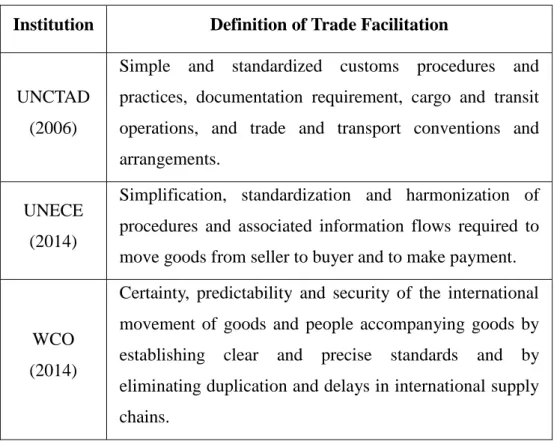
Due to a multitude of international organizations working on trade facilitation, the definition of trade facilitation has not been uniformly consolidated. The table below (Table1) outlines how major international organizations define trade facilitation.
Institution Definition of Trade Facilitation
UNCTAD (2006)
Simple and standardized customs procedures and practices, documentation requirement, cargo and transit operations, and trade and transport conventions and arrangements.
UNECE (2014)
Simplification, standardization and harmonization of procedures and associated information flows required to move goods from seller to buyer and to make payment.
WCO (2014)
Certainty, predictability and security of the international movement of goods and people accompanying goods by establishing clear and precise standards and by eliminating duplication and delays in international supply chains.
Table 1 Definition of Trade Facilitation by International Organizations
Not only the definition but also the measurement of trade facilitation is not internationally standardized. Each international organization adopts a different set of indexes or indicators to measure trade facilitation procedures, reflecting the development focus of each institution.
However, regardless of the diversification addressed by multiple international organizations, the core element of trade facilitation is uniformly agreed. Each institution aims to establish a transparent, consistent, and predictable trading environment for border transactions by reducing transaction costs and enhancing the level of integration and competitiveness.
To achieve this ends, cooperation and partnership have been sought between international organizations.
2.2. Significance of the Issue
The multitude of international organizations working on trade facilitation underlies the significance of the issue. The international endeavor itself is reflective of the positive prospects attached to trade facilitation. International organizations working on trade facilitation explicitly demonstrate the significance of the issue with regards to development, as already discovered by the existing literatures.
The World Bank asserts that trade facilitation is “imperative for development” (World Bank, 2005). This notion does not merely address how actively the WB supports and provides assistance for trade facilitation.
Rather, it suggests developmental implication of trade facilitation which leads to more opportunities for development. Such opportunities are not one-off remedy for the expansion of international trade, but a sustainable ground for future development. The IMF also addresses the “positive development impact of trade facilitation” (IMF, 2013). It is assumed that trade facilitation will help improve the export competitiveness, consumer welfare and administrative benefits for government, which will contribute to positive impact on development.
Based on the anticipated benefits of trade facilitation, UNECE (2014) claims the significance of the issue despite the costs of implementation.
OECD (2009) emphasizes that trade facilitation is “particularly important for developing countries”. This is because benefits of international trade and fluid border are currently out of reach for many developing and least- developed countries. The emphasis is therefore appropriately attached, anticipating that improved trade facilitation measures are to provide those countries with more convenient and accessible international trading environment. The rationale for trade facilitation is as follows, according to the report provided by the UNESCAP (2009).
Trade facilitation helps reduce cost and time of cross-border transaction, enabling exporters to provide goods at a lower price and in a timely manner. Moreover, a facilitated trading environment provides more attractive circumstance for inflows of foreign investment, capital, technology, and business networks. This allows domestic business to better integrate into international market. In other words, trade facilitation is a critical element to drive economic growth which is closely correlated with poverty reduction and development.
The significance of trade facilitation is therefore indisputable, since it promises both trade and developmental gains. Achieving more open and fairer markets for the promotion of development is the whole purpose of trade facilitation, which is the ultimate mission of the multilateral trading system under the WTO’s institutional framework (UNDP, 2005).
III. Trade Facilitation in DDA under the WTO
3.1 Trade Facilitation under the WTO
3.1.1. Trade Facilitation as a Topic of Discussion
The idea of trade facilitation at the WTO was first introduced at the Singapore Ministerial Conference in 1996. According to paragraph 21 of the Singapore Ministerial Declaration, trade facilitation is involved with “the simplification of trade procedures in order to assess the scope for WTO rules in this area.” The issues raised at Singapore Ministerial Conference are called ‘Singapore issues’ including competition, trade and investment, transparency in government procurement, and trade facilitation. Except for the issue of trade facilitation, however, the other Singapore issues could not be incorporated under the DDA due to the objections by developing countries. Developing countries raised their concern that those three issues are not in line with broad development priorities, while reflecting their implicit consent to developmental implication of trade facilitation.
Consequently, the issue of trade facilitation became a topic of discussion at the WTO and incorporated into the Doha Ministerial Declaration in 2001 as part of the DDA. Based on the Singapore Declaration, paragraph 27 of the Doha Declaration recognizes trade facilitation as
follows; “further expediting the movement, release and clearance of goods, including goods in transit, and the need for enhanced technical assistance and capacity building in this area”. This recognition resembles the definitions of trade facilitation suggested by other international organizations, as listed in Table1.
The launch of DDA was based on the presumption that trade can be a positive force for development (Charlton and Stiglitz, 2005), which makes the Doha Round commonly referred to as ‘development round’. In other words, DDA is an affirmation of the WTO’s commitment to development.
With this collective recognition for development, the WTO members have placed development issues and interests of developing countries at the heart of negotiation (WTO, 2014). The incorporation of trade facilitation under the DDA underpins the implication that trade facilitation can help promote development.
3.1.2. Formal Negotiations on Trade Facilitation
After several years since the launch of DDA, the actual negotiations on trade facilitation commenced with the explicit consensus decided by the General Council on August 1, 2004. The text of the General Council’s
In accordance with the Modalities for Negotiations on Trade Facilitation in Annex D of July package, trade facilitation is to clarify and improve the relevant GATT Articles (Table 2).
GATT Article Contents
Article V Freedom of transit
Article VIII Fees and Formalities connected with Importation and Exportation
Article X Publication and Administration of Trade Regulations Table 2 GATT Articles related to Trade Facilitation
As well as the compliance with those GATT Articles, negotiations on trade facilitation take into account the developmental needs of developing and least developed countries on the basis of Article 2 in Annex D under the GATT1.
3.2. WTO as the Leading Organization for Trade Facilitation
There exists a multitude of international organizations working for trade facilitation, as previously discussed. Nevertheless, the emphasis on the
1 Special and Differential Treatment (SDT) in Article 2, Annex D under the GATT
The results of the negotiations shall take fully into account the principle of special and differential treatment for developing and least-developed countries. Members recognize that this principle should extend beyond the granting of traditional transition periods for implementing commitments. In particular, the extent and the timing of entering into commitments shall be related to the implementation capacities of developing and least- developed members. It is further agreed that those members would not be obliged to
role of WTO has been continuously put forward, letting the WTO carry out the leading responsibility for trade facilitation at multilateral level. This is because the issue of trade facilitation has gained more serious and political attention internationally only after it became a topic of discussion in the Doha Ministerial Declaration (Apostolov and Cosgove-Sacks, 2003, p.29).
Since then, there have been international efforts to enact formal rules of trade facilitation as part of the WTO machinery, which became the text of Agreement on Trade Facilitation. The purpose of making the rules formally incorporated is in order to let them legally binding, as soft rules such as informal guidelines or best practices are neither predictable nor enforceable enough (Apostolov and Cosgove-Sacks, 2003, pp.8-10).
Furthermore, there is empirical evidence demonstrating limitations of regional or bilateral initiatives to promote trade facilitation (Lisinge, 2008, p.7). It suggests that the WTO undertake a leading role to promote trade facilitation in more comprehensive manner at multilateral level.
The WTO, as the leading organization for international trading regime, is expected to fulfill the following roles. First of all, more coherent rules on trade facilitation are required, presuming that WTO is working as a
‘platform’ for international trade facilitation measures pursuing enhanced
time for the WTO to be an executive platform for the actual implementation of the rules.
Secondly, the WTO has been regarded as the most adequate international authority for trade facilitation, considering its political impetus (Apostolov and Cosgove-Sacks , 2003, p.22) as well as the its capacity to keep pace with the rapid changes in international trading environment. The Doha Round has its own significance, as it creates “political leverage” to allow complementary actions between international actors (Apostolov and Cosgove-Sacks, 2003, p.146). For a successful implementation of trade facilitation, it is essential to maintain a wide range of political supports along with sustained commitments (OECD, 2005, p.7). Reflected in opinions by international community, the WTO is capable of providing this political impetus for trade facilitation at multilateral level.
3.2.1. Trade Facilitation Provisions within Regional Trade Agreements
Trade facilitation at regional level has been invigorated since the issue of trade facilitation was first introduced to the WTO members at Singapore Ministerial Conference in 1996. In other words, Singapore Ministerial Conference was the catalyst for the significant shift in trade facilitation at the WTO.
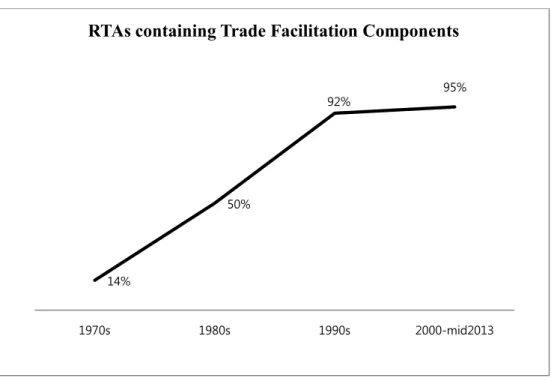
Figure 1 RTAs Containing Trade Facilitation Components (Neufeld, 2014a)
The obvious shift is evident from the percentage of regional trade agreements (RTAs) containing trade facilitation provisions. Along with the rapid expansion of Free Trade Agreements (FTAs) in the recent decades, provisions for trade facilitation have been increasingly incorporated within RTAs. Figure 1 illustrates the percentage of total RTAs containing trade facilitation provisions. As clearly indicated by the sharp increase from 1980s to 1990s, a large number of RTAs contain provisions for trade facilitation after the issue of trade facilitation was formally introduced to the WTO in 1996.
14%
50%
92% 95%
1970s 1980s 1990s 2000-mid2013
RTAs containing Trade Facilitation Components
says that RTAs rarely incorporate provisions on technical assistance and support for trade facilitation, as only 21% of RTAs have such elements related. Considering deep-rooted problems of infrastructural constraints in developing countries, this limitation is a serious bottleneck to promote trade facilitation. With this limitation perceived, a multilateral initiative for trade facilitation has been sought to address the assistance-related issues for developing and least-developed countries. The desire for such initiative became materialized in the Agreement on Trade Facilitation.
3.2.2. Bali Package in Stalemate
3.2.2.1. Agreement on Trade Facilitation
WTO members reached the conclusion of Trade Facilitation Agreement at Bali Ministerial Conference in December, 2013. The conclusion of negotiation has its own significance, taking it into account that this was the first multilateral agreement among the WTO members since the WTO emerged in 1995. Furthermore, it illustrates endeavors of the WTO members to promote trade facilitation through collective efforts. The Agreement on Trade Facilitation is composed of two sections. Section I reflects the mandate given under the GATT 1944 Article V, VIII, and X, which outlines provisions for expediting the movement, release and clearance of goods. Section II is SDT Provisions for developing and the least-developed country members, helping those counties’ capacity building
by providing trade-related assistance for the implementation of trade facilitation measures.
According to Neufeld (2014b), SDT provisions in the Agreement on Trade Facilitation have its own novelty, as it breaks a conventional practice of SDT. The traditional SDT under the WTO was to provide special treatment for countries with flexibilities “on the basis of a country’s association” to either developing or least-developed group (Neufeld, 2014b).
Departing from this approach, SDT mandate in the Agreement on Trade Facilitation is customizable for each individual country. This new approach confronts ‘one-size-fits-all’ kind of criticism which has been raised against the WTO’s rules and regulations. The Agreement allows developing and least-developed countries to tailor their implementation of measures, as there are three categories of provisions2. In accordance with the categorization, countries are overloaded with commitment beyond capacity.
2 Categories of Provisions under the Section II of The Agreement on Trade Facilitation
2.1. There are three categories of provisions:
a. Category A contains provisions that a developing country Member or a least developed country Member designates for implementation upon entry into force of this Agreement, or in the case of a least developed country Member within one year after entry into force, as provided in paragraph 3.
b. Category B contains provisions that a developing country Member or a least developed country Member designates for implementation on a date after a transitional period of time following the entry into force of this Agreement, as provided in paragraph 4.
However, the WTO members missed the deadline for the adoption of the protocol on the Trade Facilitation Agreement. The protocol is the essential instrument to trigger the process for the Agreement entry into force, while the initial deadline for the protocol was designated on July 31, 2014.
As reported by the former WTO Director-General Roberto Azevêdo (2014), the WTO members could not resolve the issue of protocol adoption despite intensive consultations encouraging cooperative mood for the implementation of the Agreement. This momentum of setback depicts that the WTO members are more concerned about the cost of implementation, rather than being assured of the prospective gains from trade facilitation.
3.2.2.2. Concern by Developing Countries
Even ‘within’ the group of developing countries, each country is positioned differently in terms of infrastructure for trade. This is because trading environment is highly contextual, as having been influenced by natural endowments, public institutions, social issues and so forth. Despite the differences, however, developing countries have experienced similar obstacle to trade facilitation; long waiting times at borders, inappropriate fees, cumbersome formalities, and inadequate or unclear rules and regulations, which all become serious obstacles to trade, and as a consequence adversely affect investment, employment and trade-led development (UNCTAD, 2014).
Developing countries expect that trade facilitation is to address those persistent challenges of border-transactions, which will result in better controls and larger customs revenues for governments. It has been proven that simple, modern and transparent procedures enhance border control and fraud prevention, and lead to higher customs revenue intake. This improvement is crucial for developing countries relying on customs duties as an important source of administrative budget (European Commission, 2014). Even though a specific interest may differ between countries according to policy objectives, priorities and developmental needs, commonly shared anticipation is that trade facilitation measures are to ease the barriers of trade.
Regardless of their awareness that trade facilitation is to create a better trading environment, there remains hesitation in implementing trade facilitation measures. The foremost concern is the cost of implementation which is regarded as a large burden on administrative capacity of developing countries (Charlton and Stiglitz, 2005). The cost herein includes not only financial constraints on public resources, both in terms of infrastructure and human resources, but also weak government institutions to carry out relevant reforms (Duval 2006). SDT provisions in the
Considering that the cost-related concern is prevalent, it is questioned how trade facilitation is to meet developmental needs of developing and least developed countries. This question is to discover whether the positive prospects of trade facilitation are to offset the initial cost of implementation. Finger (2000) suggests that the compliance with the trade facilitation rules under the WTO mechanism is not attractive investment option for many of the least developed countries. It is because trade facilitation does not guarantee direct development gains, compared to other expenditures on basic development goals such as health and education.
In other words, those countries are not convinced of the effectiveness of trade facilitation with regards to developmental gains, while their compliance with the WTO appears to restrict other developmental priorities in domestic policy options.
The remaining part of this paper evaluates the linkage between trade facilitation and development. It is hardly deniable that implementing trade facilitation measures will accommodate more trade-favorable environment, which will allow a greater volume of cross-border trade. However, despite this clear anticipation, the actual linkage between trade facilitation and development is relatively unaddressed and ambiguous. This is because the linkage is merely presumed that the expansion of trade by volume will satisfy the developmental needs. This presumption may be valid to a certain
is, if trade is encouraged at the expense of developmental priorities, increase in trade volume cannot lead to economic development. This will be contrary to the primary intention of trade facilitation initiatives. Therefore, it is necessary to discover whether trade facilitation actually satisfies the developmental needs of developing and least-developed countries. Without a careful examination and due consideration for this matter, trade facilitation would only lead to the expansion of trade by volume which may either undermine developmental needs at best, or even aggravate other development priorities.
IV. Effectiveness of Trade Facilitation for Development
4.1. Qualitative Evidence: Case Study of Cambodia
As discussed in the previous part, the SDT provision in the Agreement on Trade Facilitation is based on a country-specific approach.
This approach implies a difficulty to enforce a standardized model of trade facilitation. Considering that the linkage between trade facilitation and development should be understood within a context, the effectiveness of trade facilitation can be analyzed by an individual case study approach.
Among many developing and least-developed countries, a case study of Cambodia is proposed as qualitative evidence in this paper.
Cambodia is considered an appropriate country for the case analysis, taking into account its domestic circumstance as well as regional and international initiatives which it has been involved in. As Cambodia is considered one of the countries where challenges of international trade remained extensively, a case study of Cambodia suggests a broad implication for developing and least-developed countries in terms of developmental gains. It is noteworthy that Cambodia has improved its trading environment by implementing trade facilitation measures at domestic, regional and international level. Effort at each level has been complementary to one another.
4.2. Recent Changes in Cambodia since 2000
Getting into the 21st Century, Cambodia has undertaken various efforts to advance its trading environment. Given Cambodia’s rapid growth in international market, trade facilitation measures are considered
“imperative” in order for the emerging economy to be sustained (Khieng, 2009). Cambodia's domestic reform of trade facilitation has been in compliance with regional initiatives within ASEAN as well as with the international framework under the umbrella of the WTO.
General Department of Customs and Excise (GDCE) is the most representative authority for trade facilitation measures in Cambodia. Under the guidance of GDCE, Cambodia could undertake a series of trade facilitation reforms as below (Table 3).
Year(s) Domestic Reform
2000 Customs Reform Program (2000) 2003 Customs Reform Program (2003) 2003 Investment Climate Survey
2003-2008 Work Program for Customs Reform 2004 12-Point Action Plan
2009-2013 Strategy Work Program on Reform and Modernization
Customs Reform Program in 2000 and 2003, respectively, is a comprehensive set of initiatives aimed at development and implementation of a modern customs law and related regulations (GDCE, 2014). The program was designed for the purpose of complying with trade facilitation measures at international level. Following these reforms, GDCE undertook Investment Survey in 2003 which helped them identify concerns associated with border management. After the cause of concern having been identified in the survey, GDCE continued its efforts to improve trade facilitation measures. Through executing the 12-Point Action Plan, GDCE reviewed several trade facilitation measures including the ideas of national single window system, cross-agency risk management program, and customs automation.
As well as the domestic reforms, Cambodia has been involved in regional trade facilitation initiatives within ASEAN since 1999. As Cambodia is geographically between two rapidly growing economies, Thailand and Vietnam, Cambodia’s regional integration has been regarded as more than necessary. ASEAN members including Cambodia have made an effort to remove non-tariff barriers within the region, attaching further significance to trade facilitation. In this regard, ASEAN members are sharing experiences of national single window so as to implement and establish regional single window. These regional experiences and initiatives
At international level, the accession to the WTO in 2004 was the impetus in Cambodia’s trade facilitation history (Seng, 2014, p.118). As a member of WTO, Cambodia has been further motivated to implement relevant reforms of trade facilitation in compliance with international standard. Those reforms have been supported and financed by international development partners such as WB, IMF, UNDP and UNCTAD. While there have been a number of trade facilitation initiatives and projects, Trade Facilitation and Competitiveness Project (TFCP) is particularly considered the major one leading to significant changes in Cambodia’s trade facilitation measures (Nhem, 2010, p.2).
TFCP by WB was designed to implement reform and modernization of trade facilitation measures with the direct objective of reducing time and costs of customs procedures. TFCP financed the implementation of Automated System for Customs Data (ASYCUDA) in Cambodia, which is computerization system of customs operations (Figure 2).
As a result of implementing ASYCUDA, GDCE could develop Single Administrative Document (SAD) system allowing customs automation in the clearance process of exports and imports. The system supports the rationale for trade facilitation under the relevant GATT Articles, as it helps promote freedom of transit, consistency in fees and formalities for importation and exportation, and publication and administration of trade regulations. (UNCTAD, 2008). Following the completion of TFCP, Cambodia is currently a recipient of another trade facilitation assistance, Trade-Related Assistance (TRAC) Program by the WB. Through this program, Cambia seeks further improvement in customs and border reform by focusing on its regional partnership with other ASEAN members as well as establishing national single window in Cambodia by 2015.
4.3. Effectiveness of Trade Facilitation
Considering that TFCP was the breakthrough initiative to modernize customs procedure in Cambodia, changes in customs procedure after the launch of this project are noteworthy. The recent changes and trend since the launch of TFCP depict how effectively the project has contributed to improvement in Cambodia’s trade facilitation measures.
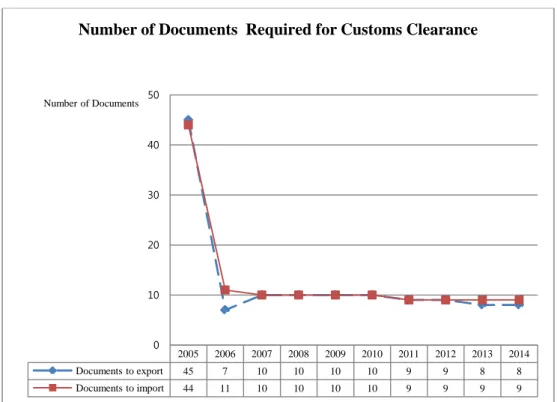
Figure 3 Number of Documents Required for Customs Clearance (IMF Database, 2014)
2005 2006 2007 2008 2009 2010 2011 2012 2013 2014
Documents to export 45 7 10 10 10 10 9 9 8 8
Documents to import 44 11 10 10 10 10 9 9 9 9
0 10 20 30 40 Number of Documents 50
Number of Documents Required for Customs Clearance
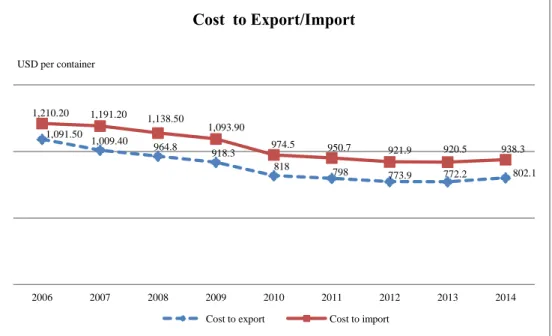
Figure 4 Cost to Export/Import (IMF Database, 2014)
1,091.50 1,009.40
964.8
918.3
818 798 773.9 772.2 802.1
1,210.20 1,191.20 1,138.50
1,093.90
974.5 950.7 921.9 920.5 938.3
2006 2007 2008 2009 2010 2011 2012 2013 2014
Cost to Export/Import
Cost to export Cost to import USD per container
2006 2007 2008 2009 2010 2011 2012 2013 2014
Time to export 43 37 37 22 22 22 22 22 22
Time to import 54 45 45 29 29 26 26 26 24
0 5 10 15 20 25 30 35 40 45 50 55 60 Days
Time in Process of Customs Clearance
The Figures (Figure 3, 4 & 5) indicate a declining changes in the number of documents, cost and time to be required for customs procedure.
The Figures collectively represent that modernization and automation of customs procedure in Cambodia simplified trade facilitation processes.
Particularly, there was a significant drop in the number of documents required as clearly indicated by the sharply declining line in Figure 3.
While it is unquestionable that trading environment became modernized, automated and after the launch of TFCP, it is yet answered whether such progress actually helped Cambodia in terms of development.
With improvement in trade facilitation measures in Cambodia, Cambodia became more accessible and better destination of international trade for its trading partners. However, it does not necessarily coincide with making a positive contribution to economic development in Cambodia. It is required to analyze how Cambodia has been benefited from the implementation of trade facilitation measure. Since Cambodia has experienced a rapid economic growth over the previous decades, it would be insignificant to simply refer to the increase in trade volume as evidence of benefits.
Changes in customs revenues and inflows of Foreign Direct Investment (FDI) are illustrated as indicators of the evaluation of trade facilitation
4.4. The Overall Evaluation
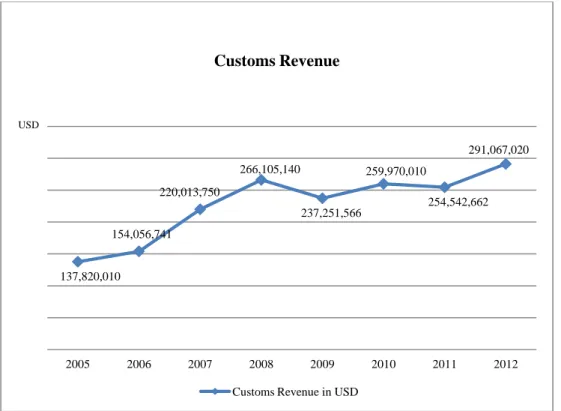
Figure 6 Customs Revenue (WB Database, 2014)
As illustrated in Figure 6, the collection of customs revenue has been enhanced. The revenue collection of 2008 almost doubles that of 2005, illustrating a significant increase in revenue collection. Despite a slight drop from 2008 to 2009, the revenue collection has been steadily showing an upward trend, maintaining over US 2 million dollars. This represents the expected benefit of adopting the automated customs procedure. Not only was the customs procedure simplified, but also customs revenue enhanced.
137,820,010
154,056,741 220,013,750
266,105,140
237,251,566
259,970,010
254,542,662 291,067,020
2005 2006 2007 2008 2009 2010 2011 2012
USD
Customs Revenue
Customs Revenue in USD
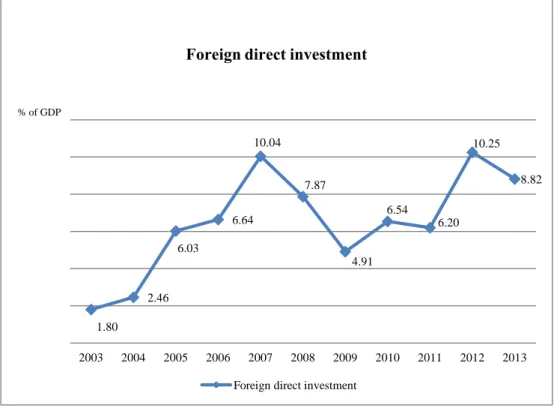
Figure 7 Net Inflow of Foreign Direct Investment as % of GDP (WB Database, 2014)
The net inflow of FDI as the percentage of GDP (Figure 7) explains another dimension of benefits derived from trade facilitation. Except for the drops in 2008 and 2009, FDI inflows generally indicate upward movements.
It is considered that the sluggish figures in those years are due to the aftermath of Global Financial Crisis in 2008, which marked the end of a growth cycle in global FDI with worldwide flows down by more than 20 percent (UNCTAD, 2005).
1.80
2.46 6.03
6.64 10.04
7.87
4.91 6.54
6.20 10.25
8.82
2003 2004 2005 2006 2007 2008 2009 2010 2011 2012 2013
% of GDP
Foreign direct investment
Foreign direct investment
benefits of trade facilitation are multiple-fronts and outweighing the costs of reform (Haaparanta & Kerkela, 2006). The benefits of trade facilitation are to be shared among governments, firms and consumers. This is because enhanced efficiency benefits both firms and consumers, attracting further FDI inflows and enhancing government revenue collection. These can in turn have an important impact on a country’s economic development. As indicated in Figure 6 and 7, customs revenue and FDI inflows improved since the launch of TFCP. It is therefore supposed that these improvements are to promote development of Cambodia, addressing the close linkage between implementation of trade facilitation and economic development.
4.5. Implications
4.5.1. To Other Developing Countries
The case study of Cambodia suggests prospective developmental gains from the improvement of trade facilitation measures. Despite the difficulty generalizing the effectiveness of trade facilitation, other developing and least-developed countries may learn from the determining factor which led to the successful implementation of trade facilitation measures in Cambodia. Customs-Private Partnership Mechanism (CPPM) is considered a critical element contributing to the successful reform in
purpose of coordinating cooperation and mutual understandings between customs administration and private sector as well as addressing customs related issues (GDCE, 2014). Through this mechanism, private sector was encouraged to comply with trade facilitation reforms, creating a fairer and more transparent business and investment climate. Mein (2014) claims that there is a growing importance for customs-private partnership, as having all stakeholders involved in trade and logistics processes is to drive substantial advantages. Based on CPPM, GDCE could well manage the trade facilitation reforms, as more practical and technical customs matters were addressed by Private Sector Development Committee (Nhem, 2010). This consultative relationship between government and private sector maximized the positive prospect of developmental gains from trade facilitation reforms and international assistance.
Recommendation of private-customs partnership is well reflected in the Revised Kyoto Convention of 19993.The role of private sector is expected ‘to direct necessary resources to customs reform and modernization efforts’ and hence to maintain business standard in line with international trade facilitation measure (Mikuriya, 2012). Thus, developing countries should note that trade facilitation is related to not only technical
but also institutional matter which demands management of cooperative relationship between government, private sector and other regional and international organizations related. In order to carry out this role, government should be well equipped with a sustained political will. Without a proper domestic institution based on sound political impetus, neither regional initiatives nor international assistance may lead to developmental gains from the implementation of trade facilitation measures. To build institutional cornerstone, developing countries may be required to undertake difficult political reforms, considering that border inefficiencies are composed of a complex web of challenges in developing countries (Runde
& Magpile, 2014).
4.5.2. To Developed Countries
Figure by OECD shows that international assistance for trade facilitation has increased ten-fold, in real terms, from 2002 to 2010 (Jackson, 2013). The figure is self-explanatory that donor countries, mostly developed countries, recognize the significance of international trade facilitation.
Furthermore, this trend is anticipated to continue (World Bank, 2013). As the former WTO Director-General Pascal Lamy mentioned in a speech to the Chittagong Chamber of Commerce in Bangladesh on 1 February 2013, trade facilitation at multilateral level could boost the world economy by US 1 trillion dollars (Lamy, 2013). That is why developed countries cannot and
should not neglect the positive prospects of international trade facilitation.
The benefits of improved trade facilitation procedures in developing countries are not limited within those assistance-recipient countries only, but shared in international trading environment as a whole. Developed are to be benefited from reducing transaction costs with those developing and least- developed countries as well as increasing export volumes by US 475 billion dollars (ICC, 2013). Therefore, developed countries are advised to take the lead in providing assistance to developing countries who are concerned about financial and technical costs of trade facilitation. This effort by developed countries is expected to generate returns for both the developed and the developing, and for the international trade as a whole. In other words, developed countries are to contribute to global public good and to keep DDA legacy alive, by making a commitment to international trade facilitation as donors
V. Conclusion
The case study of Cambodia illustrates how improvement in trade facilitation measures can contribute to economic development. With international assistance by the WB, Cambodia could successfully reform its domestic customs by implementing the automated customs. The reform not only helps Cambodia comply with international standard of trade facilitation procedures, but also provides opportunities for further economic development as indicated by the improvement in customs revenue and FDI inflows.
While acknowledging a difficulty of generalization, Cambodia’s case suggests developmental implication for other developing and least- developed countries confronting infrastructural challenges of border transactions. The positive linkage between trade facilitation and development may ease developing and least-developed countries’ suspicion related to the effectiveness of trade facilitation in terms of development. If such development-related concern is alleviated, those countries will be more encouraged to comply with international standard of trade facilitation despite the initial cost of implementation. Acknowledging the close linkage between trade facilitation and economic development is a prerequisite of undertaking reforms for trade facilitation.
For a successful reform of trade facilitation, developing and least- developed countries should be aware of how sustained political will and domestic institution play a critical role. CPPM is considered a determining factor leading to success of customs reform in Cambodia, as it is imperative for domestic institution to manage relevant reforms. In other words, the positive dimension of trade facilitation can be driven, if two pillars of efforts are well coordinated simultaneously. One pillar is the assistance from international and regional institutions, while the other depends on a good governance by domestic authority. It depicts that trade facilitation is not only related to technical dimension, but also closely to institutional aspect.
While Cambodia’s domestic institution well coordinated and executed relevant reforms, those reforms would not have been feasible without assistance from international developmental partners. This implies the prospective role of the developed countries. Developed countries are advised to continue to make their efforts as donor countries providing financial and technical assistance. The rationale for such commitment is based on a positive impact of trade facilitation which is to be shared among various stakeholders in international trade regime. Commitment by developed countries will ease the financial concern of developing and the
least-developed countries are equally recognized as enhanced convenience and accessibility for trading partners.
The WTO, along with other international development partners, is responsible for spreading the importance and positive impact of improved trade facilitation processes and procedures. WTO’s political leverage is to mediate different positions held by the developed, the developing and the least-developed. Based on this effort, it is expected that the Agreement on Trade Facilitation becomes effective, moving towards consistency and coherence in measures for trade facilitation.
VI. References
Apostolove, C., & Cosrove-Sacks, C. (2003). Trade facilitation: the
Challenges for growth and development. New York and Geneva: United Nations Publication.
ASEAN. (2013). Study visit by Cambodian officials to Malaysia on national single window. ASEAN. Retrieved from
http://asw.asean.org/events/item/study-visit-by-cambodian-officials-to- malaysi-on-national-single-window-nsw?category_id=72
Azevêdo, R. (2014). Members unable to bridge the gap on trade facilitation.
WTO. Retrieved from
http://www.wto.org/english/news_e/news14_e/tnc_infstat_31jul14_e.ht m
Cautain, J.F., & Zauchau, U. (2014, March). Cambodia is on the move. The Phnom Penh Post. Retrieved from
http://www.worldbank.org/en/news/opinion/2014/03/21/cambodia-is- on-the-move
Charlton, A., & Stiglitz, J.E. (2005). Fair trade for all: How trade can promote development. Oxford: Oxford University Press.
Duval, Y. (2006). Cost and benefits of implementing trade facilitation measures under negotiations at the WTO: an Exploratory survey. Asia- Pacific Research and Training Network on Trade Working Paper Series, 3. Retrieved from
http://www.unescap.org/sites/default/files/AWP%20No.%203.pdf Elgin, R. (2008). The Doha round negotiations on trade facilitation. The
Global Enabling Trade Report 2008 (1.2). Retrieved from
http://www.weforum.org/pdf/GETR08/Chap%201.2_The%20Doha%20 Round%20Negotiations%20on%20Trade%20Facilitation.pdf
Finger, J. M. (2000). The WTO's special burden on less developed countries.
Cato Journal. 19(3), 425-437.
GATT. (1986). General Agreement on Tariffs and Trade.
GDCE. (2014). Customs-Private sector partnership. General Department of Customs and Exercise. Retrieved from
http://www.customs.gov.kh/index.php/trade-facilitation/customs- private-sector-partnership-mechanism-cppm
Grainger, A. (2005). Customs and trade facilitation: from concepts to implementation. World Customs Journal, 2(1), 17-30.
Haaparanta, P., & Kerkela. L. (2006, November). Trade and aid policies:
Their impact on economic development in Mozambique. OECD policy dialogue with non-members on aid for trade: From policy to practice.
Symposium conducted at the meeting of the Organisation for Economic Co-operation and Development, Doha, Qatar.
ICC. (2013). Trade facilitation fact sheet. International Chamber of Commerce. Retrieved from
http://www.iccwbo.org/Data/Documents/Global-Influence/World- Trade-Agenda/Reports-and-documents/Factsheet-on-a-Trade- Facilitation-Agreement/
IMF. Joint statement by multilateral institutions on trade facilitation
assistance. (2013, October 13). International Monetary Fund. Retrieved from http://www.imf.org/external/np/sec/pr/2013/pr13403.htm
IMF Data and Statistics. (2014). International Monetary Fund. Retrieved from http://www.imf.org/external/data.htm
Jackson, S. (2013, October 7). WTO trade facilitation agreement: a Development opportunity [World Bank blog]. Retrieved from http://blogs.worldbank.org/trade/wto-trade-facilitation-agreement- development-opportunity
Keen, M. (2003). Changing customs: challenges and strategies for the reform of customs administration (Ed.). Washington, DC: International Monetary Fund.
Khieng, S. (2009). Key mechanisms for stakeholder consultation in trade facilitation in Cambodia. Country Paper-Cambodia. Retrieved from http://artnet.unescap.org/mtg/tf_sme_cam.pdf
Lamy, P. (2013). A trade facilitation deal could give a $1 trillion boost to world economy. World Trade Organization. Retrieved from
http://www.wto.org/english/news_e/sppl_e/sppl265_e.htm
Lisinge, R.T. (2008). Leveraging WTO negotiations on trade facilitation to operationalize the Almaty Programme of Action. African Trade Policy Centre, 71. Retrieved from http://www.uneca.org/publications/no-71- leveraging-wto-negotiations-trade-facilitation-operationalise-almaty- programme
Mein, J.E. (2014). Customs-private sector partnership: not just wishful thinking. World Customs Journal, 8(1), 129-136.
Mikuriya, K. (2012). Expansion of customs-business partnership in the 21st century. The Global Enabling Trade Report 2012 (1.7). Retrieved from http://www3.weforum.org/docs/GETR/2012/GETR_Chapter1.7.pdf Neufeld, N. (2014a). Trade facilitation provisions in regional trade
agreements: Traits and trends. Staff Working Paper, ERSD-2014-01.
Retrieved from
http://www.wto.org/english/res_e/reser_e/ersd201401_e.htm Neufeld, N. (2014b). The long and winding road: How WTO members
finally reached a trade facilitation agreement. Staff Working Paper, ERSD-2014-06. Retrieved from
http://www.wto.org/english/res_e/reser_e/ersd201406_e.pdf
Nhem, K. (2014). Developing a coordinated border management approach through automation: the Cambodia experience [pdf document].
Retrieved from
https://www.eiseverywhere.com/file_uploads/49c5516c9a4b0f78b2a25 683bce23e73_D2RT2-kunnhem.pdf
OECD. (2005). The costs and benefits of trade facilitation. Policy Brief, October. Retrieved from www.oecd.org/trade/facilitation/35459690.pdf
OECD. (2009). Overcoming border bottlenecks. Paris: OECD Publishing.
Pellan, M. I., & Wong, M.H. (2011). Trade facilitation in ASEAN and ASEAN+1 FTAs: an Analysis of provisions and progress. In Findlay, C.
(ed.), ASEAN+1 FTAs and global value chains in East Asia, 52-111.
Jakarta: ERIA.
Portugal-Perez, A., & Wilson, J.S. (2010). Export performance and trade facilitation reform: Hard and soft infrastructure [WPS5261]. Policy Research Working Paper, 5261. Retrieved from
https://openknowledge.worldbank.org/bitstream/handle/10986/3748/W PS5261.pdf?sequence=1
Runde, D.F., & Magpile, J. (2014). Implementing the forthcoming WTO trade facilitation agreement. CSIS. Retrieved from
http://csis.org/publication/implementing-forthcoming-wto-trade- facilitation-agreement-2
Seng, A. (2014). The facilitation of trade in Cambodia: challenges and possible solutions. World Customs Journal, 8(1), 113-127.
Siphana, S. (2011). An analysis of trade facilitation and import/export processes in Cambodia. United Nations Development Account Project, 6. Retrieved from http://unnext.unescap.org/tools/bpa_cam.pdf
UNCTAD. (2005). Trade facilitation handbook part I national facilitation bodies: Lessons from experience [UNCTAD/SDTE/TLB/2005/1].
United Nations Conference on Trade and Development. Retrieved from http://unctad.org/en/Docs/sdtetlb20051_en.pdf
UNCTAD. (2008). Automated system for customs data: ASYCUDA.
UNCTAD Trust Fund for Trade Facilitation Negotiations, Technical Note,21. United Nations Conference on Trade and Development.
Retrieved from http://unctad.org/en/docs/TN21_Asycuda.pdf.
UNCTAD. (2014). The new frontier of competitiveness in developing countries. United Nations Conference on Trade and Development.
Retrieved from
http://unctad.org/en/PublicationsLibrary/dtltlb2013d2_en.pdf UNDP. (2005). Trade for Development. London: Earthscan.
UNECE. Trade facilitation - principles and benefits. (2012). United Nations Economic Commissions for Europe. Retrieved from
http://tfig.unece.org/details.html
UNESCAP. (2009). Impact of trade facilitation on export competitiveness:
a Regional perspective. New York: United Nations Publication.
UNESCAP. (2014). Asia-Pacific trade and investment report: recent trends and developments. Bangkok: United Nations Publication.
WCO (1999). Revised Kyoto Convention.
WCO. (2003). Customs capacity building strategy. World Customs Organization. Retrieved from
http://www.wcoomd.org/en/topics/capacity-
building/overview/~/media/3C486A00F972488DB85F687EA0F551FB.
ashx
World Bank. Trade Facilitation in the World Bank. (2005). World Bank.
Retrieved from
http://siteresources.worldbank.org/INTRANETTRADE/Resources/Topi cs/Trade_Facilitation_Brochure_July_2005.pdf
World Bank Open Data. (2014). Retrieved from http://data.worldbank.org/
World Trade Organization. (2013). Agreement on Trade Facilitation (WT/L/931).
World Trade Organization. The Doha Round. (2014). World Trade Organization. Retrieved from
http://www.wto.org/english/tratop_e/dda_e/dda_e.htm
국 문 초 록
무역 원활화 정책과 개발에 대한 시사점
무역원활화 정책은 1996년 WTO 싱가폴 각료회의에서 처음 소개되었으며, 2004년 WTO 도하개발어젠다의 공식 의제로 선정되었다. 그 이래로 WTO 및 유관 국제기구 내의 주요 국제 통상 현안으로 대두되었다. 국경간 교역량이 증가하면서 원활한 무역 흐름이 강조됨에 따라, 무역원활화 정책이 함의하는 중요성이 더욱 커지고 있다. 그러나 열악한 무역 인프라를 갖고 있는 개발도상국과 최빈국의 경우, 무역원활화 제도 도입의 필요성을 인식하고 있음에도 불구하고 제도 도입에 따르는 비용 부담에 한계를 직면하고 있다. 비용 부담과 더불어 무역원활화 정책이 시사하는 경제 개발의 측면이 간과되고 있다.
본 논문은 캄보디아의 통관 자동화 제도도입을 통한 무역원활화 제도 개선 사례를 살펴봄으로써, 무역원활화 제도가 지니는 개발에 대한 시사점을 알아보고자 하였다. 캄보디아 사례는 무역환경 개선이 필요한 개도국과 최빈국뿐만 아니라, 타 선진국에도 시사점을 제공하고 있으며 다자간 무역원활화 제도의 필요성을 뒷받침 한다.
키워드: 무역 원활화, 개발, 캄보디아, 세계무역기구 학번: 2013-22038