저작자표시-비영리-변경금지 2.0 대한민국 이용자는 아래의 조건을 따르는 경우에 한하여 자유롭게
l 이 저작물을 복제, 배포, 전송, 전시, 공연 및 방송할 수 있습니다. 다음과 같은 조건을 따라야 합니다:
l 귀하는, 이 저작물의 재이용이나 배포의 경우, 이 저작물에 적용된 이용허락조건 을 명확하게 나타내어야 합니다.
l 저작권자로부터 별도의 허가를 받으면 이러한 조건들은 적용되지 않습니다.
저작권법에 따른 이용자의 권리는 위의 내용에 의하여 영향을 받지 않습니다. 이것은 이용허락규약(Legal Code)을 이해하기 쉽게 요약한 것입니다.
Disclaimer
저작자표시. 귀하는 원저작자를 표시하여야 합니다.
비영리. 귀하는 이 저작물을 영리 목적으로 이용할 수 없습니다.
변경금지. 귀하는 이 저작물을 개작, 변형 또는 가공할 수 없습니다.
A Dissertation for the Degree of Doctor of Philosophy in Pharmacy
Synthesis and Biological Evaluation of an Orally Bioavailable Gonadotropin-releasing Hormone (GnRH) Receptor Antagonist
February 2018
Graduate School of Pharmacy Seoul National University Pharmaceutical Chemistry Major
Seon Mi Kim
Synthesis and Biological Evaluation of an Orally Bioavailable
Gonadotropin-releasing Hormone (GnRH) Receptor Antagonist... i
Part 1... 1
Discovery of an Orally Bioavailable Gonadotropin-releasing Hormone (GnRH) Receptor Antagonist ... 1
ABSTRACT ... 2
1. INTRODUCTION ... 3
1.1 GnRH and GnRH receptor... 3
1.2 Development of GnRH receptor antagonist... 4
2. AIMS OF OUR STUDIES ... 7
3. RESULTS AND DISCUSSION... 9
3.1 Chemistry... 9
3.2 Structure Activity Relationship. ... 14
3.3 Interspecies Differences and Activation of Signaling Pathways. ... 36
3.4 Pharmacokinetic Studies. ... 37
3.5 Animal Studies. ... 38
4. CONCLUSION... 41
5. EXPERIMENTAL... 43
5.1 Chemistry... 43
5.2 Biological Study. ... 121
6. REFERENCES ... 130
7. ABSTRACT IN KOREAN ... 139
[Part 2] ... 141
ABSTRACT ... 142
1. INTRODUCTION ... 143
1.1 Endometriosis and its current treatments ... 143
1.2 GnRH antagonist as an endometriosis treatment ... 144
2. AIMS OF OUR STUDIES ... 147
3. RESULTS AND DISCUSSION... 148
3.1 Chemistry... 148
3.2 Structure-Activity Relationship... 151
3.3. Interspecies selectivity ... 158
3.4 In vivo activity in castrated monkeys... 159
4. CONCLUSION...
오류! 책갈피가 정의되어 있지 않습니다.
5. EXPERIMENTAL... 1635.1. Chemistry... 163
5.2. In vitro Assays ... 194
5.3. In vivo Assays ... 196
6. REFERENCES ... 198
7. ABSTRACT IN KOREAN ... 203
8. ACKNOWLEDGEMENT...
오류! 책갈피가 정의되어 있지 않습니다.
Part 1
Discovery of an Orally Bioavailable
Gonadotropin-releasing Hormone
(GnRH) Receptor Antagonist
ABSTRACT
We developed a compound library for orally available gonadotropin-releasing hormone (GnRH) receptor antagonists that were based on a uracil scaffold. Based on in vitro activity and CYP inhibition profile, we selected 18a (SKI2496) for further in vivo studies.
Compound 18aexhibited more selective antagonistic activity toward the human GnRH receptors over the GnRHRs in monkeys and rats, and this compound also showed inhibitory effects on GnRH-mediated signaling pathways. Pharmacokinetic and pharmacodynamic evaluations of 18a revealed improved bioavailability and superior gonadotropic suppression activity compared with Elagolix, the most clinically advanced compound.
Considering that 18a exhibited highly potent and selective antagonistic activity toward the hGnRHRs along with favorable pharmacokinetic profiles, we believe that 18a may represent a promising candidate for an orally available hormonal therapy.
Keyword : Gonadotropin-releasing hormone, GnRHreceptor antagonist, GnRH, Sex hormone
Student Number :2013-30502
1. INTRODUCTION
1.1 GnRH and GnRH receptor
Human gonadotropin-releasing hormone (GnRH) is a key regulator of sexual development and reproductive function.1 This linear decapeptide hormone is produced in the hypothalamus and stimulates the synthesis and secretion of gonadotropins, including luteinizing hormone (LH) and follicle-stimulating hormone (FSH), by interacting with GnRH receptors (GnRHR) in the pituitary gland. Human GnRHR is a member of the G-protein coupled receptor (GPCR) family and is known to be involved in various signaling processes, including activation of mitogen-activated protein kinase (MAPK) family activity and mobilization of intracellular Ca2+.2The signaling processes triggered by GnRHR activation eventually lead to the production of steroid hormones that maintain the reproductive cycle.
Figure.Hypothalamic Pituitary Gonadal (HPG) axis
1.2 Development of GnRH receptor antagonist
As GnRH plays a critical role in the human reproductive system, GnRH and its analogs have been widely used for the treatment of various steroid hormone-dependent diseases, including endometriosis, uterine fibroids, and prostate cancer.3Notably, chronic administration of GnRH analogs can downregulate GnRHRs and results in the complete ablation of steroid hormones; thus, these analogs has been accepted as an effective and safe method to treat hormone-dependent tumors.4,5
However, growing concern exists over this particular strategy because of the initial flare effect6and the risk of bone loss from long-term use of hormonal agonists.7,8 To overcome these challenges, several peptide- based GnRH antagonists have been introduced to the market. For example, Degarelix has been approved for the treatment of hormone- sensitive prostate cancer9 and Cetrorelix is used for infertility.10 Nevertheless, one problem with currently available agents is that, owing to their peptidic nature, they must be administered by injection, which is associated with various potential side effects. Non-peptidic agents are considered to be preferable because of their superior oral availability and greater specificity.
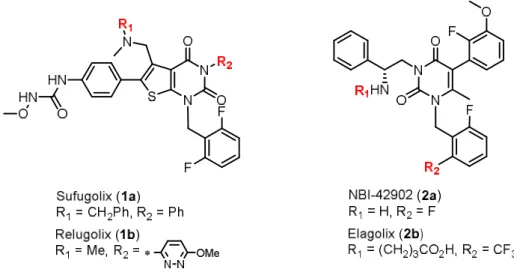
To date, many non-peptidic compounds have been reported in the literature as GnRH antagonists;11 however, only a few compounds described in Figure 1 have been advanced to clinical development.
Sufugolix (compound 1a)12 exhibited gonadotropin suppression in healthy young men13 and post-menopausal women by single or repeated dosing,14 although this compound was eventually discontinued in phase II trials. Relugolix (compound 1b)15 has exhibited greater potency and much weaker CYP3A4 inhibition than compound 1a, and it is currently in phase III clinical trials for uterine fibroids.16Compounds with a uracil
scaffold, such as NBI-42902 (2a)17 and Elagolix (2b)18, have shown promising results in phase I trials. Notably, compound 2b exhibited greater potency and weaker CYP3A4 inhibition compared to compound 2a, and compound2b has advanced to phase III trials for the treatment of endometriosis19a,band uterine fibroids.20a,b
Figure 1. Representative non-peptidic GnRH antagonists in clinical development.
2. AIMS OF OUR STUDIES
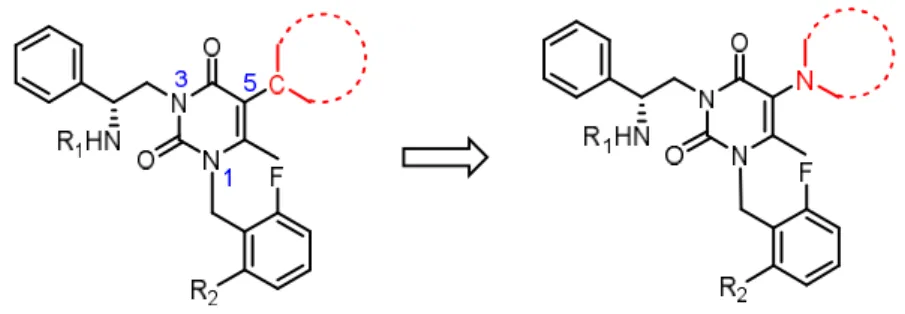
Although compound 2b is the most advanced non-peptidic compound studied to date, this compound appears to exhibit relatively low oral bioavailability (F = 5.8% in rats and 11% in monkeys).18 According to previously reported structure-activity analyses,21-24 the uracil group provides a versatile structural scaffold for diverse modifications. The 6-methyl group and electron-deficient aromatic ring at the 1-position are required for a proper orientation needed to achieve an optimal binding interaction. The 3-aminoethyl group is essential for activity and metabolic stability, whereas the 5-phenyl group appears to mostly affect binding affinity. We speculated not only that the 5-position of the uracil moiety is readily available for further modification but also that the structure-activity relationship of non-aromatic substituents at this specific position has not yet been elucidated. Therefore, we sought to design a new series of compounds that contained various non- aromatic heterocycles at the 5-position of the uracil group to yield compounds with improved oral absorption and pharmacodynamic profiles, as shown in Figure 2.
Figure 2. Strategy for modifications at the 5-position of the uracil scaffold.
In this present study, we synthesized a library of uracil derivatives that contained cyclic amines, including substituted piperidines and piperazines, at the 5-position. We performed in vitro binding and cell-based assays for human GnRHR and CYP inhibition tests to select potent GnRH antagonists that did not significantly inhibit CYP enzymes. Based on the results of these in vitroassays, we selected a final candidate, compound 18a (SKI2496), and then further evaluated its biological effects on downstream cellular signaling pathways. We also examined interspecies differences in binding affinity and activation of GnRHR-specific signaling processes using human-, monkey-, and rat- derived GnRH receptors and cells. Finally, we evaluated the in vivo antagonistic effects of compound 18a in castrated monkeys, along with its pharmacokinetic profiles in rats, dogs and monkeys.
3. RESULTS AND DISCUSSION
3.1 Chemistry
Syntheses of 5-heterocyclic uracil derivatives began with compound 3, which was prepared in a large quantity according to previously described procedures.17 Substitutions of the 5-bromine with various heterocyclic amine reagents were performed by microwave irradiation at 120°C, followed by deprotection of the N-Boc group in the presence of trifluoroacetic acid to yield the corresponding amines 4 (Scheme 1).
Scheme 1. Synthesis of uracils with 5-heterocyclesa
aReagents and conditions: (a) (i) H-R1, MeCN, microwave, 120°C (ii) TFA, CH2Cl2, r.t. 10~98%
To synthesize 5-piperazinyl uracil derivatives, either N-benzyl or N-Cbz piperazine was used for selective deprotection reactions. These
N-protected piperazines were hydrogenated under Pd/C to yield common intermediates 8 or 9, and these intermediates were subsequently alkylated with various substituted aryl halides or aldehydes followed by TFA treatment to yield the final compounds 10, 11, 12, 13 and 14(Scheme 2).
Scheme 2. Synthesis of 5-(4-substitutedpiperazinyl)uracilsa
a Reagents and conditions: (a) N-Cbz-piperazine or N-Bn-piperazine, MeCN, microwave, 120°C, 65~83%; (b) Pd/C, H2, MeOH, 78~95%;
(c) (i) [Method A] R2-CH2Br or R2-SO2Cl, DIPEA, CH2Cl2, r.t., [Method B] R2-CH2Cl, K2CO3, MeCN, 20–60°C, [Method C] R2- CH2Br, K2CO3, KI, DMF, 80°C, [Method D] R2-CHO, dichloroethane,
NaBH(OAc)3, r.t., (ii) TFA, CH2Cl2, r.t. 7~83%
Among the 5-(4-substitutedpiperazinyl)uracils, acid-containing derivatives, i.e., compound 16, were alkylated using 3- (bromomethyl)benzoic acid methyl ester, and then were hydrolyzed under basic conditions to yield compound 15, as shown in Scheme 3.
Compound 15was further reacted with amine-containing aliphatic esters to produce the corresponding amide 16. Hydrolysis, followed by N-Boc deprotection of 16, afforded the desired product 17.
Scheme 3. Synthesis of uracils with acid-containing 4- benzylpiperazines at the 5-positiona
9 N a O
O
N N
BocHN
F
F3C
NH
15 N O
O
N N
BocHN
F
F3C N
O OH
16 N O
O
N N
BocHN
F
F3C N
O N H nCO2Et
17 N O
O
N N
H2N
F
F3C N
O N H nCO2H b
c
aReagents and conditions: (a) (i) 3-(bromomethyl)benzoic acid methyl ester, TEA, CH2Cl2, r.t., (ii) 1N-NaOH, MeOH, 60°C, 89%; (b) HCl· NH2(CH2)nCO2Et, HBTU, DIPEA, DMF, r.t. 95~99%.; (c) (i) 1N-
NaOH, EtOH, r.t, (ii) TFA, CH2Cl2, r.t. 21~35%
To conjugate a side chain that contained an aliphatic acid at the 3-aminoethyl group, we followed procedures previously reported by Struthers and co-workers (Scheme 4).18 Alkylation of compound 12 or 14 with ethyl 4-bromobutyrate or phosphonate, followed by hydrolysis with aqueous NaOH yielded the corresponding acids 18 and 19.
Meanwhile, reaction of compound 14 with 1,3-propanesultone at 90°C generated the corresponding sulfonic acid 20.
Scheme 4. Synthesis of compounds that incorporate acids at the side chain of 3-phenethylaminesa
a Reagents and conditions: (a) (i) Br(CH2)3CO2Et or Br(CH2)3P(=O)(OEt)2, DIPEA, MeCN, 95°C (ii) 1N NaOH, EtOH:H2O (7:5), 60°C, 13~46% or TMSBr, DCE, 45°C, 30%; (b) 1,3- propanesultone, MeCN, 90°C, 93%
To introduce an acid substituent at the 3-phenethyl group, compound 21 was prepared according to a previously described procedure.25 Compound 21was then subjected to microwave irradiation in the presence of 1-benzylpiperazine. Subsequent hydrogenation followed by an alkylation reaction with 3-nitrobenzyl bromide yielded compound 23. Alkylation of 23 with a mesylate fragment 24 generated compound 25, which was treated with boron trifluoride to afford 26.
For additional alkylation of the phenolic OH, a Boc group was first reintroduced at the 3-aminoethyl position, and then O-alkylation of 27 was performed with a proper t-butoxycarbonylalkyl bromide. TFA treatment finally afforded the desired product, compound 28 (Scheme 5).
Scheme 5. Synthesis of derivatives containing an acid substituent at the phenyl ring of the 3-phenethyl groupa
a Reagents and conditions: (a) (i) 1-benzylpiperazine, MeCN, microwave, 120°C, 79% (ii) Pd/C, H2, MeOH:CH2Cl2 (1:1), r.t, 78%.; (b) 3-NO2- benzylbromide, DIPEA, dichloroethane, 50°C, 77%; (c) MsCl, TEA, CH2Cl2, quantitative; (d) K2CO3, DMF, 70°C, 62% ; (e) BF3, DCE, -78°C→40°C, 80%; (f) (Boc)2O, TEA, CH2Cl2, 40°C, 67%; (g) (i) Br(CH2)nCO2tBu, K2CO3, DMF, 70°C, (ii) TFA, CH2Cl2, r.t. 38~39%
3.2 Structure Activity Relationship.
To assess the binding affinity of the synthesized compounds, we performed competitive binding assays using radiolabeled peptide, [125I]D-Trp6-LHRH, for the human recombinant GnRHRs.26 Additionally, we evaluated the functional antagonistic activity of the compound by measuring inhibition of reporter gene activity in HEK293
cells transfected with constructs encoding GnRHR and nuclear factor of activated T-cells (NFAT) promoter AP-1-luc, a luciferase assay system, as summarized in Tables 1–5.
To investigate the structure activity relationship, we first measured the binding affinity of uracil derivatives that contained various aromatic and non-aromatic substituents at the 5-position of the uracil core. As shown in Table 1, most of the 5-piperazinyl analogues demonstrated weak or no affinity towards the human GnRH receptors, except for 5-(4-benzyl)piperazinyl (IC50 = 12 nM) and 5-[4-(3- pyridinyl)]piperazinyl (IC50 = 13.9 nM) analogues (4e, 10b). Any changes in the linker properties, such as length, flexibility, or additional functional groups, of these analogues resulted in a significant reduction in activity. When the 5-piperazine group of 4e was replaced with a piperidine (4r), the resulting compound showed greatly reduced binding affinity, exhibiting 3-fold weaker activity than its piperazinyl counterpart, which indicated that the extra nitrogen atom may participate in hydrogen bonding interactions. The other 5-heterocyclic uracils, including substituted pyrrolidines, a fused azacyclic ring, and morpholine-containing analogues, exhibited little or no activity.
Table 1. SAR of the 5-heterocyclic uracil compounds
Compound R1 hGnRH-R binding
IC50(nM)
2a 0.59
4a >1000
4b >1000
4c >1000
4d >1000
4e 12
10a >100
10b 13.9
10c >100
4f >100
10d >100
10e >100
10f >100
10g >100
10h >100
4g >100
4h >100
4i >100
4j >100
4k >100
4l 129
4m >100
4n 80.3
4o 75.6
4p >100
4q >100
4r 34.2
4s >100
4t >100
4u >100
As compound 4e exhibited the greatest potency among this series, we decided to focus on 5-(4-benzyl)piperazinyl uracils. While keeping the rest of the functional groups unchanged, we introduced diverse substituents into the benzene ring and analyzed the structure- activity relationship, as shown in Table 2. Among compounds that contained the ortho-substituted benzenes, it appeared that only a small sized electron-withdrawing group, such as 2-F (11c) or 2-CN (11d), enhanced the potency, exhibiting IC50values in the low nanomolar range.
Electron-withdrawing groups at the meta-position, such as 3-NO2(11i), 3-F (11k), 3-CN (11l), 3-Cl (11n), 3-CF3 (11o), and 3-OCF3 (11p), generally provided potent activities regardless of the size. Notably,
compound 11o(IC50 = 0.91 nM) demonstrated excellent potency, which was comparable to that of compound 2a. Interestingly, a combination of an electron-withdrawing group at both positions yielded mixed results;
the 2,3-diF substituted compound (11y) showed reduced activity (IC50 = 10 nM), whereas the 2-F, 3-CF3 substituted compound (11z) demonstrated comparable activity (IC50 = 1.1 nM), suggesting that potential dipole-dipole interactions may have affected binding interactions in this region, in addition to electronic factors.
Table 2. SAR of 5-(4-benzylpiperazinyl)uracil derivatives
Compound X hGnRHR binding
IC50(nM)
2a 0.59
4e H 12.0
11a 2-NO2 13.3
11b 2-Me 73.8
11c 2-F 4.1
11d 2-CN 6.8
11e 2-OMe >1000
11f 2-Cl 19.1
11g 2-CF3 65.6
11h 2-OCF3 >100
11i 3-NO2 2.9
11j 3-Me >100
11k 3-F 3.8
11l 3-CN 5.0
11m 3-OMe 14.8
11n 3-Cl 3.1
11o 3-CF3 0.91
11p 3-OCF3 1.5
11q 4-NO2 36.9
11r 4-Me 65.5
11s 4-F 48.6
11t 4-CN 10.0
11u 4-OMe >100
11v 4-Cl 14.0
11w 4-CF3 65.7
11x 4-OH 35.3
11y 2,3-diF 10.0
11z 2-F,3-CF3 1.1
As the 5-(4-benzyl)piperazinyl group with an electron- withdrawing substituent demonstrated comparable activity to that of compound 2a, we wanted to explore whether we would observe a similar structure-activity relationship by modifying compound 2b. As shown in Figure 1, there are two major differences between 2aand 2b;
first, compound 2b has a 1-(2-fluoro-6-trifluoromethyl)benzyl group instead of a 1-(2,6-difluoro)benzyl group; and second, compound 2b has an extended acid group at the 3-aminoethyl side chain. It has been
reported that replacing the 1-(2,6-difluoro)benzyl group in compound 2a with a 1-(2-fluoro-6-trifluoromethyl)benzyl group enhanced antagonistic activity by affecting the kinetics of ligand-receptor interactions.27Therefore, we switched the 1-(2,6-difluoro)benzyl with 1- (2-fluoro-6-trifluoromethyl)benzyl and also added various substituents at the 5-(4-benzyl)piperazinyl group, as shown in Table 3. First, we measured IC50 values for human GnRHRs and, as expected, the 1-(2- fluoro-6-trifluoromethylbenzyl) analogues were generally more potent than the corresponding 1-(2,6-difluorobenzyl) analogues, ranging from 1.5-fold (11p versus 12e) to 25-fold (11y versus 12r). Additionally, we determined the inhibitory effects of each compound on NFAT activation.
NFAT is a calcium-dependent nuclear transcription factor and its reporter gene assays provide a reliable method to monitor the activation of GPCR signaling pathways, including GnRHR. Surprisingly, all of the analogues showed relatively weak inhibition compared with compound 2b (IC50 = 5.4 nM) in NFAT-responsive luciferase assays. Those
compounds that contained an acetyl or ester substituent (12m and 12i) showed the greatest inhibitory effects in this series (IC50 = 16.5 and 23.3 nM, respectively), and compound 12h (R = 3-CF3) also showed comparable activity (IC50= 27.9 nM). Compound 12n, which contains a sulfinyl group, was slightly less potent (IC50= 51.2 nM) than compound 12m, which contains an acetyl group, whereas a compound with a
sulfonate group (12o) significantly lost its activity (IC50 = 214 nM).
Compounds with a 3-amide substituent (12j, 12k, and 12l) showed much weaker activity, and 3-carboxylic acid analogue (12p) was inactive. Among those compounds having multiple substituents, compounds 12t and 12v exhibited slightly better activity than the other compounds. Notably, compounds 12r and 12o showed weak NFAT inhibition (IC50 = 266 and 214 nM, respectively) in contrast to their potent binding affinity for GnRHR (IC50 = 0.39 and 0.38 nM, respectively). Interestingly, incorporating a 3-(oxazol-2-yl) group into the meta-position of the benzyl ring (12w) provided good potency,
which might occur because the oxazolyl group is an isostere of an ester group, so it exhibited activity similar to that of12i (R= 3-CO2Me, IC50
= 23.3 nM). Considering the overall SAR shown in Table 3, we believe that having a lipophilic electronic-withdrawing group at the meta- position or a combination of the 2-fluoro and a 3-hydrophilic electronic- withdrawing group of the benzyl ring may be beneficial for both binding affinity and NFAT inhibition.
Table 3. SAR of 1-(2-fluoro-6-trifluoromethyl)benzyl derivatives
Compound X
hGnRHR binding IC50 (nM)
NFAT Inhibition IC50(nM)
2a 0.59 87
2b 0.94 5.4
11i 2.9 401
12a 2-F 1 340
12b 2-CN 0.32 351
12c 2-CO2Me 24.3 >10,000
12d 3-NO2 0.45 155
12e 3-OCF3 1 250
12f 3-F 1.7 321
12g 3-CN 0.41 213
12h 3-CF3 0.52 27.9
12i 3-CO2Me 0.39 23.3
12j 3-CONH2 1.95 86.5
12k 3-CONHMe ND 170
12l 3-CONHEt ND >300
12m 3-COMe 0.16 16.5
12n 3-SOMe ND 51.2
12o 3-SO2Me 0.38 214
12p 3-CO2H >100 ND
12q 4-CN 1.16 326
12r 2-F, 3-F 0.39 266
12s 2-F, 3-NO2 ND 115
12t 2-F, 3-CN ND 61
12u 2-CN, 3-F ND 108
12v 2-F, 3-CONH2 ND 42
12w 3-(oxazol-2-yl) ND 53
ND = not determined
Next, while keeping the 1-(2-fluoro-6-trifluoromethyl)benzyl group at the uracil core, we focused on the 5-(4-heterocyclic piperazinyl) group, and we further investigated the SAR of these compounds, as described in Table 4. As previously noted in Table 1, compound 10b, which contains a pyridyl group at the 4-position of 5- piperazine, showed the second greatest activity (IC50 = 13.9 nM).
Therefore, we decided to evaluate the SAR of the 4-pyridyl derivatives, as well as other 4-heterocyclic derivatives. As expected, the 5-(4- pyridyl) derivative 13a showed potent binding affinity for hGnRHR (IC50 = 2 nM), although its NFAT inhibitory activity appeared to be weak (IC50 = 290 nM). We believe that this apparent discrepancy in hGnRHR binding affinity and NFAT inhibition is possibly due to the
slow dissociation kinetics, which was reported with compounds 2a and 2b previously.18 Other 4-pyridyl derivatives exhibited comparable IC50
values for hGnRHR ranging from 1.07 to 14.2 nM; however, these compounds also exhibited similarly weak NFAT inhibition, irrespective of the position and electronic properties of the substituent. Moving the position of the pyridyl nitrogen or the additional introduction of hetero atoms did not appear to improve either binding affinity or NFAT inhibition.
Given that the 4-pyridyl group does not appear to significantly improve activity, we next investigated the SAR of the fused bicyclic systems and various five-membered heterocyclic functional groups at the same position. While most compounds with a fused ring system at the 2,3-position of the benzyl group (13r–13v) exhibited weak to no activity, compound 13s was the only exception, as it exhibiting potent binding affinity (IC50= 0.6 nM) but showed weak NFAT inhibition (IC50
= 885 nM). When various five-membered heterocycles were introduced, the 2-furyl and 2-thiophenyl analogues (14f, 14h) showed promising potency, which prompted us to incorporate additional substituents.
Interestingly, placing an electron-withdrawing group at the 5-position of the furyl ring dramatically enhanced activity. The 2-(5-
trifluoromethyl)furyl analogue (14k) showed the greatest activity for both binding affinity (IC50 = 0.95 nM) and NFAT inhibition (IC50 = 12.6 nM), which is comparable to 2b. By contrast, replacing the furyl ring with a thiophene (14r) or a 1,3,4-oxadiazole (14s) decreased activity.
Table 4. SAR of 5-(4-heteroarylmethylene)piperazinyl uracil derivatives
N O
O N H2N
F
F3C N
N R
.
Compound R
hGnRHR binding IC50(nM)
NFAT inhibition IC50(nM)
2a 0.59 87
2b 0.94 5.4
13a 2 290
13b 5.11 543
13c 14.2 1690
13d 7.18 1180
13e 1.07 193
13f 2.0 1510
13g 2.57 526
13h 3.77 554
13i ND >300
13j ND >300
13k ND 217
13l ND 226
13m 20 2050
13n ND >300
13o ND >300
13p >100 ND
13q 28.1 1090
13r 18.2 10230
13s 0.6 885
13t ND >300
13u ND >300
13v >100 ND
13w 48 4900
14a 17.7 1660
14b 35.6 2130
14c 8.94 930
14d 14.1 >1000
14e 7.01 >1000
14f 2.76 >1000
14g 6.59 >1000
14h 1.27 >1000
14i ND >300
14j ND >300
14k 0.95 12.6
14l 0.39 178
14m 0.31 64
14n 0.17 103
14o ND >300
14p ND >300
14q >100 >1000
14r ND 62
14s ND >300
ND = not determined
Based on SAR analyses of all tested compounds, we selected three representative compounds among the 1-(2-fluoro-6- trifluoromethyl)benzyl uracil derivatives shown in Table 3 and 4.
Compounds 13d (R = 4-(3-nitro)benzyl), 12h (R = 4-(3- trifluoromethyl)benzyl), and 14k(R = 4-((5-trifluoromethyl)furan-2-yl)) were first screened for human CYP isozyme inhibition. Unfortunately, all three compounds demonstrated strong CYP3A4 inhibition (89–96%) at a concentration of 10 mM (Table 5). As discussed in the introduction and the SAR regarding compounds in Table 1 and 2, compound 2a suffered from CYP3A4 inhibition, whereas compound 2bwas much less problematic. The previously reported SAR studies indicated that when
the primary amine group at the N-3 side chain of uracil in 2a was alkylated with a butyric acid, this structural modification, which is also present in compound 2b, significantly reduced CYP3A4 inhibition.18 In addition to the 3-position of the uracil core, the Neurocrine Bioscience research group has reported that the phenyl ring at the 5-position is another viable site for a further modification to reduce CYP3A4 inhibition.28,29
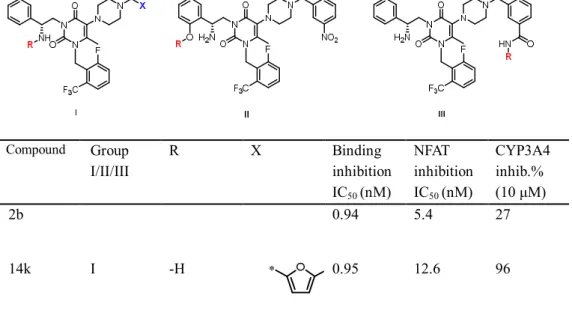
Inspired by these approaches, we decided to modify our representative compounds by adding polar groups into three different regions, as shown in Figure 3. Because it has been previously reported that the length of the alkyl group at the N-3 side chain affects the activity, whereas the butyric acid group appears to provide an optimal distance,18 we replaced the terminal carboxylic acid group with phosphoric acid and sulfonic acid, while maintaining a propyl linker, shown as group I in Table 5. Furthermore, we incorporated another carboxylic acid group into the phenyl ring of the N-3 side chain (group II) and 5-(4-benzyl)piperazinyl group via an amide bond (groupIII).
Figure 3. Strategy to overcome CYP3A4 inhibition of piperazinyl compounds
As shown in groupIofTable 1, introducing three different acid groups into compound 14k significantly reduced CYP3A4 inhibition;
this introduction also adversely affected the functional antagonistic activity of all compounds except for compound 18a, which contained a butyric acid group. This finding again confirmed that the butyric acid group is the most preferable functional group at this position. Similarly, when we added a butyric acid group to compounds 12d and 12h, we observed attenuated CYP3A4 inhibition in the modified compounds (18band 18c, respectively).
For the compounds belonging to groups II and III, we maintained the terminal carboxylic acid, but varied the alkyl chain length.
A shorter chain was more beneficial for CYP3A4 inhibition in group II,
whereas there was little difference by chain length in group III. Notably, among these three groups, modifications in group I appeared to most efficiently reduce CYP3A4 inhibition. The addition of a carboxylic acid chain in groups II and III also reduced CYP3A4 inhibition, as demonstrated in compounds 28a, 28b, and 17c; however, not as effectively as compounds in group I. Overall, we concluded that compound 18a in group Iexhibited the most potent GnRH antagonistic activity with low CYP3A4 inhibition. Therefore, we decided to focus on this compound for further studies.
Table 5. SAR of compounds that contained an extended acid side chain
Compound Group I/II/III
R X Binding
inhibition IC50(nM)
NFAT inhibition IC50(nM)
CYP3A4 inhib.%
(10 μM)
2b 0.94 5.4 27
14k I -H 0.95 12.6 96
18a I -(CH2)3CO2H 0.44 13.0 21
19a I -(CH2)3PO(OEt)(OH) 1.8 184 45
19b I -(CH2)3P(=O)(OH)2 1.2 411 16
20 I -(CH2)3SO3H 1.1 122 45
12d I -H 0.45 102 89
18b I -(CH2)3CO2H 1.42 60 17
12h I -H 0.33 27.9 96
18c I -(CH2)3CO2H 0.68 49.5 22
26 II -H 0.17 89.3 97
28a II -CH2CO2H 0.23 27.7 30
28b II -CH2CH2CH2CO2H 0.14 26.9 57
12j III -H 1.95 86.5 93
17a III -CH2CO2H >10 >300 74
17b III -CH2CH2CO2H 1.2 146 72
17c III -CH2CH2CH2CO2H 1.1 376 66
3.3 Interspecies Differences and Activation of Signaling Pathways.
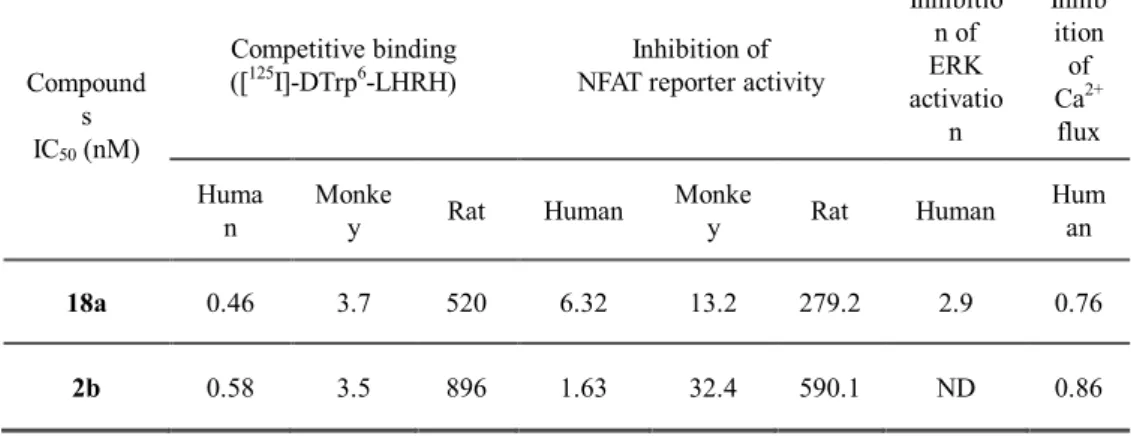
Most of the currently available non-peptidyl GnRH antagonists are highly specific to human GnRHR,15,30,31 so we determined the species specificity of compound 18a in parallel with that of compound 2b (Elagolix), as described in Table 6. Competitive binding assay data revealed that compound 18a appeared to be the most specific to human GnRHR, followed by monkey and rat GnRHR; the species specificity of compound 2b also showed a similar trend, presumably because of their structural similarity. We also observed similar interspecies specificity in the NFAT promoter inhibition assay. The NFAT inhibitory activity of compound 18a for human GnRHR was 2-fold greater than that of the monkey homolog and 44-fold more potent than of the rat homolog.
Compared with compound 2b, compound 18awas 4-fold less potent for human receptors, while it was approximately 2-fold more potent for both the monkey and rat receptors.
To further examine the effects of compound 18a on GnRH- induced downstream cellular responses, we assessed calcium mobilization and ERK1/2 activation upon the treatment of cells with 18a. Compound 18a effectively blocked Ca2+ flux with an IC50 value of
0.76 nM, which is comparable to that of compound 2b (IC50 = 0.86 nM).
Regarding ERK1/2 phosphorylation, compound 18a exhibited an inhibitory activity with an IC50 value of 2.9 nM, confirming that compound 18a inhibited GnRHR activity along with intracellular GnRH-mediated signaling pathways.
Table 6. Summary of in vitro binding and cell based assay results for compound 18a and 2b
Compound s IC50(nM)
Competitive binding ([125I]-DTrp6-LHRH)
Inhibition of NFAT reporter activity
Inhibitio n of ERK activatio
n
Inhib ition
of Ca2+
flux Huma
n
Monke
y Rat Human Monke
y Rat Human Hum
an
18a 0.46 3.7 520 6.32 13.2 279.2 2.9 0.76
2b 0.58 3.5 896 1.63 32.4 590.1 ND 0.86
ND = not determined
3.4 Pharmacokinetic Studies.
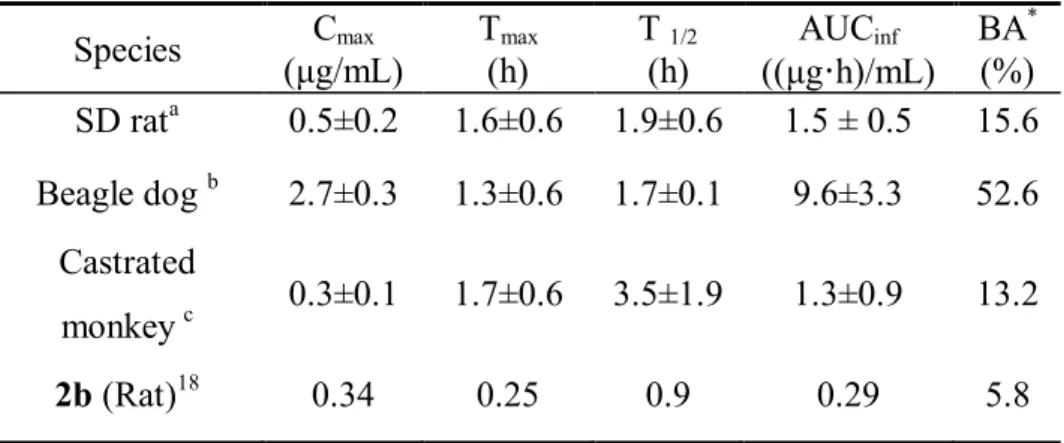
The pharmacokinetic properties of compound 18a were evaluated in rats, dogs, and castrated monkeys. The estimated bioavailability for each animal was 15.6%, 52.6% and 13.2% in rat, dog and castrated monkeys, respectively, when animals were orally administered 10 mg/kg compound 18a (Table 7). Compared with the
previously reported parameters for compound 2b in rats, compound 18a exhibited greater oral bioavailability and showed 5-fold higher AUC.
Based on these results, we believe that compound 18a exhibited improved oral exposure compared with compound 2b.
Table 7. Pharmacokinetic parameters of compound 18a in SD rats, dogs and castrated monkeys after oral administration (10 mg/kg).
Species Cmax
(μg/mL)
Tmax
(h)
T 1/2
(h)
AUCinf
((μg·h)/mL)
BA* (%) SD rata 0.5±0.2 1.6±0.6 1.9±0.6 1.5 ± 0.5 15.6 Beagle dogb 2.7±0.3 1.3±0.6 1.7±0.1 9.6±3.3 52.6
Castrated
monkeyc 0.3±0.1 1.7±0.6 3.5±1.9 1.3±0.9 13.2
2b(Rat)18 0.34 0.25 0.9 0.29 5.8
amale, n=5, 7 weeks old
bmale, n=3, 17–18 months old and 10–15 kg
cmale, n=3, 5.5–6.5 yrs. old and 4–4.8 kg
* BA was calculated using the PK parameters from the group administered intravenously with 5 mg/kg (SD rats), 0.3 mg/kg (beagle dog) or 0.5 mg/kg (castrated monkey).
3.5 Animal Studies.
Compound 18a had a low binding affinity for rat GnRHRs, as described earlier in Table 6, so we speculated that rats did not represent a proper animal model for our in vivopharmacodynamic studies. Instead,
we chose castrated monkeys to confirm in vivo functional antagonism by measuring gonadotropin suppression after the acute administration of compound 18a.26 Following a single dosing of either compound 18a or compound 2b (30 mg/kg, po) in castrated male cynomolgus monkeys with elevated levels of gonadotropins, blood samples were collected at scheduled time points for analyses of circulating LH and FSH concentrations using a radioimmunoassay (RIA).
Figure 4. Suppression of serum LH concentrations in castrated male cynomolgus monkeys after oral administration of either compound 18a or compound 2bat 30 mg/kg. The time courses are shown with circulating LH levels expressed as a percentage of pretreatment LH levels. On the day of the study, monkeys were administered saline (vehicle), compound 18a or compound 2b by nasogastric gavage at doses of 30 mg/kg. Values shown represent the means ± SEM of LH levels, which are expressed as a percentage of pretreatment LH levels for each of three individual animals.
While compound 2bresulted in maximal LH suppression of 70%
at 4–8 h after its administration, after which LH began to return to baseline, compound 18a reached a maximal LH suppression of 84% at 12 h, which was maintained for up to 24 h. This finding indicated that compound 18a provided both stronger potency and much longer duration than compound 2b (Figure 4). We believe that the prolonged efficacy on LH suppression by compound 18a was related to higher exposure of the drug. Overall, compound 18a resulted in higher AUC and Cmax values than those values of compound 2b at 30 mg/kg in castrated monkeys (compound 18a: AUC of 37 µg·hr/mL and Cmax of 5.5 µg/mL; compound 2b: AUC of 3.9 µg·hr/mL and Cmax of 2.3 µg/mL).
4. CONCLUSION
In this study, we sought to improve the potency and oral exposure of a GnRH antagonist with a uracil scaffold, and we performed SAR studies on the 5-position of the uracil moiety. To this aim, we designed and synthesized a series of 5-(4-benzyl piperazinyl) and the 5-(4-heterocyclic piperazinyl) uracil derivatives. Our SAR analyses revealed that the presence of a lipophilic electron withdrawing group at the meta-position of the 4-benzyl substituent improved the binding affinity and antagonistic activity for GnRHR. Further studies of heteroaromatic rings yielded another promising candidate, compound 14k, with a 4-((5-trifluoromethyl)furan-2yl))piperazine group at the 5- position. However, these heterocyclic derivatives proved to be potent inhibitors of the enzyme CYP3A4. To resolve this issue, we incorporated an extended acid to three different regions of the uracil scaffold. Compounds modified with a butyric acid not only showed a dramatic reduction of CYP3A4 inhibition but also retained receptor activity comparable to that of the corresponding parent compounds.
Based on our in vitro findings, we selected compound 18a for
further investigation. Species specificity and signaling pathway activation assays indicated that compound 18a demonstrated selective antagonistic activity towards human GnRH receptors over GnRHRs from monkeys and rats, and compound 18a showed inhibitory effects on both Ca2+ flux and ERK activation in GnRH-mediated signaling pathways. Pharmacokinetic evaluations of compound 18a in rats and monkeys revealed improved oral exposure compared with those evaluations of compound 2b. Finally, compound 18a exhibited superior gonadotropic suppression in castrated monkeys compared with compound 2b; the stronger and prolonged efficacy of compound 18a was attributed to its higher oral exposure. Given these favorable in vitro and in vivo characteristics, compound 18a has advanced to preclinical toxicological studies for further development. We believe that compound 18a may not only represent a promising candidate for the treatment of sex hormone-dependent disorders but may also yield useful insights into the development of orally available GnRH analogues in the future.
5. EXPERIMENTAL
5.1 Chemistry 5.1.1 General.
Melting points were determined on a Buchi melting point B-545 apparatus and were uncorrected. 1H NMR and 13C NMR spectra were measured with a Varian Unity 300 (300MHz) or a Varian Unity Inova (500MHz) or a Jeol Oxford 600 (13C NMR) spectrometer. Chemical shifts were given in ppm units using tetramethylsilane as the reference standard, and coupling constants (J) are given in hertz (Hz). Mass spectra were recorded on a Thermo LCQ DECA XP instrument. HPLC analyses were performed on an Agilent HP1100 system.
Chromatographic separations were carried out on silica gel (Kieselgel 60, 230-400 mesh, Merck) or basic silica gel (Chromatorex NH- DM1020, 100- 200 mesh, Fuji Silysia Chemical Ltd.) using the indicated eluents. Yields were not optimized. The purity (≥ 95%) of each sample was measured by analytical HPLC, and the detailed conditions and results of HPLC analyses were included in Supporting Information. All
animal experiment protocols were approved by Frontier Bioscience Institutional Animal Care and Use Committee (IACUC).
5.1.2 General Procedure for Amination and Deprotection (for compounds 4a - 4u).
A mixture of compound 3(1 mmol) and amine (15 mmol) in acetonitrile (6 mL) was placed in a microwave vessel and heated at 120 °C under microwave irradiation for 1-5 h with stirring. After cooled to ambient temperature, the resulting solution was concentrated in vacuo. The residue was purified by column chromatography on silica gel using Hexane/EtOAc (2:1) as eluent to yield the aminated product. The aminated product was then dissolved in dichloromethane (20 mL), treated with trifluoroacetic acid (2 mL), and stirred at room temperature for 3 h. The resulting solution was neutralized with saturated sodium bicarbonate solution and extracted with dichloromethane. The organic phase was concentrated in vacuo. The residue was purified by column chromatography on silica gel using CH2Cl2/MeOH (20:1) as eluent.
5.1.2.1 (R)-3-(2-Amino-2-phenylethyl)-1-(2,6-difluorobenzyl)-6- methyl-5-(piperazin-1-yl)pyrimidine-2,4(1H,3H)-dione (4a). Yield 44%, colorless oil. 1H NMR (300 MHz, CDCl3) δ 7.45 - 7.18 (m, 6H),
6.90 (t, J= 8.3 Hz, 2H), 5.30 - 5.15 (m, 2H), 4.36 (dd, J= 9.3, 5.1 Hz, 1H), 4.19 (dd, J = 13.0, 9.3 Hz, 1H), 4.05 (dd, J = 13.0, 5.1 Hz, 1H), 3.50 - 3.30 (m, 2H), 3.05 - 2.72 (m, 4H), 2.57 - 2.43 (m, 2H), 2.43 (s, 3H). MS (ESI) m/z456 (MH+).
5.1.2.2 (R)-3-(2-Amino-2-phenylethyl)-1-(2,6-difluorobenzyl)-6- methyl-5-(4-phenylpiperazin-1-yl)-pyramidine-2,4(1H,3H)-dione (4b). Yield 20%, off-white foam. 1H NMR (300 MHz, CDCl3) δ 7.44 - 7.37 (m, 2H), 7.36 - 7.20 (m, 6H), 6.97 - 6.81 (m, 5H), 5.28 and 5.21 (d, J= 16.2 Hz, 2H), 4.38 (dd, J= 9.4, 5.0 Hz, 1H), 4.22 (dd, J= 13.0, 9.4 Hz, 1H), 4.06 (dd, 13.2, 5.1 Hz, 1H), 3.82 - 3.49 (m, 4H), 2.85 (m, 2H), 2.66 (m, 2H), 2.52 and 2.46 (s, 3H). MS (ESI) m/z532 (MH+).
5.1.2.3 (R)-3-(2-Amino-2-phenylethyl)-1-(2,6-difluorobenzyl)-6- methyl-5-(4-(pyridin-2-yl)piperazin-1-yl)pyrimidine-2,4(1H,3H)- dione (4c).Yield 40%, colorless oil. 1H NMR (300 MHz CDCl3) δ 8.18 (ddd, J= 4.9, 2.0, 0.9 Hz, 1H), 7.56 - 7.15 (m, 7H), 6.91 (t, J= 8.3 Hz, 2H), 6.65 (d, J= 8.7 Hz, 1H), 6.59 (ddd, J= 7.1, 4.9, 0.8 Hz, 1H), 5.30 - 5.18 (m, 2H), 4.36 (dd, J = 9.3, 5.1 Hz, 1H), 4.19 (dd, J = 13.0, 9.4 Hz, 1H), 4.25 - 4.13 (m, 2H), 4.05 (dd, J= 13.0, 5.1 Hz, 1H), 3.59 (m, 2H), 2.97 (m, 2H), 2.63 (m, 2H), 2.47 (s, 3H). MS (ESI) m/z 533 (MH+).
5.1.2.4 (R)-3-(2-Amino-2-phenylethyl)-5-(4-(cyclohexylmethyl) piperazin-1-yl)-1-(2,6-difluorobenzyl)-6-methylpyrimidine-
2,4(1H,3H)-dione (4d). Yield 10%, colorless oil. 1H NMR (300 MHz, CDCl3) δ 7.42 - 7.38 (m, 2H), 7.33 - 7.19 (m, 4H), 6.89 (m, 2H), 5.26 and 5.19 (d, J= 16.2 Hz, 2H), 4.36 (dd, J= 9.5, 4.9 Hz, 1H), 4.20 (dd, J = 12.9, 9.5 Hz, 1H), 4.05 (dd, J = 12.9, 5.0 Hz, 1H), 3.55 (m, 2H), 2.75 (m, 2H), 2.47 (m, 2H), 2.41 (s, 3H), 2.19 - 2.03 (m, 4H), 1.84 - 1.61 (m, 4H), 1.47 (m, 1H), 1.30 - 1.11 (m, 4H), 0.86 (m, 2H). MS (ESI) m/z552 (MH+).
5.1.2.5 (R)-3-(2-Amino-2-phenylethyl)-5-(4-benzylpiperazin-1-yl)-1- (2,6-difluorobenzyl)-6-methyl-pyrimidine-2,4(1H,3H)-dione (4e).
Yield 42%, white foam. 1H NMR (300 MHz, CDCl3) δ 7.42 - 7.34 (m, 4H), 7.33 - 7.19(m, 7H), 6.89 (m, 2H), 5.27 and 5.19 (d, J = 15.9 Hz, 2H), 4.37 (dd, J = 9.6, 5.1 Hz, 1H), 4.21 (dd, J = 12.9, 9.3 Hz, 1H), 4.05 (dd, J= 12.9, 5.1 Hz, 1H), 3.70 - 3.44 (m, 4H), 2.78 (m, 2H), 2.48 (m, 2H), 2.41 (s, 3H), 2.20 (m, 2H). MS (ESI) m/z546 (MH+).
5.1.2.6 (R)-3-(2-Amino-2-phenylethyl)-5-(4-benzoylpiperazin-1-yl)- 1-(2,6-difluorobenzyl)-6-methyl-pyrimidine-2,4(1H,3H)-dione (4f).
Yield 24%, white foam. 1H NMR (300 MHz, CDCl3) δ 7.42 - 7.34 (m, 7H), 7.33 - 7.19(m, 4H), 6.90 (m, 2H), 5.27 and 5.19 (d, J = 15.9 Hz,
2H), 4.62 (m, 1H), 4.35 (dd, J= 9.3, 5.1 Hz, 1H), 4.19 (dd, J = 13.0, 9.3 Hz, 1H), 4.05 (dd, J= 13.0, 5.2 Hz, 1H), 3.69 (m, 1H), 3.59 - 3.45 (m, 2H), 3.06 (m, 2H), 2.53 (m, 2H), 2.45 (s, 3H). MS (ESI) m/z 560 (MH+).
5.1.2.7 (R)-Benzyl 4-(3-(2-amino-2-phenylethyl)-1-(2,6- difluorobenzyl)-6-methyl-2,4-dioxo-1,2,3,4-tetrahydropyrimidin-5- yl)piperazine-1-carboxylate (4g). Yield 44%, colorless oil. NMR (300 MHz, CDCl3) δ 7.40 - 7.27 (m, 10H), 7.26 - 7.19 (m, 1H), 6.90 (t, J = 8.3 Hz, 2H), 5.22 (d, J= 5.2 Hz, 2H), 5.14 (s, 2H), 4.34 (dd, J = 9.2, 5.2 Hz, 1H), 4.23 - 3.99 (m, 4H), 3.55 - 3.34 (m, 2H), 3.04 - 2.87 (m, 2H), 2.58 - 2.40 (m, 2H), 2.44 (s, 3H). MS (ESI) m/z 590 (MH+).
5.1.2.8 3-((R)-2-Amino-2-phenylethyl)-1-(2,6-difluorobenzyl)-6- methyl-5-(3-phenylpiperazin-1-yl)-pyrimidine-2,4(1H,3H)-dione (4h). Yield 14%, colorless oil. 1H NMR (300 MHz, CDCl3) δ 7.45 - 7.10 (m, 11H), 6.90 (t, J = 8.3 Hz, 2H), 5.29 - 5.17 (m, 2H), 4.41 - 4.28 (m, 1H), 4.25 - 4.11 (m, 1H), 4.04 (dt, J= 13.0, 4.8 Hz, 1H), 3.83 (d, J= 10.5 Hz, 1H), 3.61 - 3.33 (m, 2H), 3.19 - 2.96 (m, 2H), 2.49 (s, 3H), 2.70 - 2.45 (m, 2H). MS (ESI) m/z532 (MH+).
5.1.2.8 3-((R)-2-Amino-2-phenylethyl)-5-((R)-3-benzylpiperazin-1- yl)-1-(2,6-difluorobenzyl)-6-methyl-pyrimidine-2,4(1H,3H)-dione
(4i). Yield 34%, colorless oil. 1H NMR (300 MHz, CDCl3) δ 7.43 - 7.35 (m, 2H), 7.35 - 7.16 (m, 9H), 6.89 (t, J= 8.2 Hz, 2H), 5.20 (q, J= 16.1 Hz, 2H), 4.36 (dd, J = 9.3, 5.0 Hz, 1H), 4.20 (dd, J = 12.9, 9.3 Hz, 1H), 4.05 (dd, J = 13.0, 5.0 Hz, 1H), 3.38 (t, J = 11.2 Hz, 1H), 3.26 (t, J = 10.7 Hz, 1H), 3.07 - 2.95 (m, 2H), 2.92 - 2.78 (m, 1H), 2.76 - 2.62 (m, 2H), 2.58 (d, J = 11.5 Hz, 1H), 2.45 (d, J = 11.5 Hz, 1H), 2.37 (s, 3H). MS (ESI) m/z546 (MH+).
5.1.2.9 3-((R)-2-Amino-2-phenylethyl)-5-((S)-3-benzylpiperazin-1- yl)-1-(2,6-difluorobenzyl)-6-methyl-pyrimidine-2,4(1H,3H)-dione (4j). Yield 20%, colorless oil. 1H NMR (300 MHz, CDCl3) δ 7.39 (d, J
= 7.0 Hz, 2H), 7.35 - 7.13 (m, 9H), 6.89 (t, J = 8.2 Hz, 2H), 5.19 (s, 2H), 4.37 (dd, J = 9.3, 5.0 Hz, 1H), 4.20 (dd, J = 13.0, 9.3 Hz, 1H), 4.04 (dd, J= 13.0, 5.0 Hz, 1H), 3.45 (t, J = 11.5 Hz, 1H), 3.22 (t, J = 10.8 Hz, 1H), 3.09 - 2.96 (m, 2H), 2.93 - 2.80 (m, 1H), 2.74 (dd, J = 13.5, 6.7 Hz, 1H), 2.63 (dd, J = 13.4, 6.9 Hz, 1H), 2.51 (d, J = 13.1 Hz, 2H), 2.36 (s, 3H). MS (ESI) m/z546 (MH+).
5.1.2.10 3-((R)-2-Amino-2-phenylethyl)-1-(2,6-difluorobenzyl)-5-(3- (2-hydroxyethyl)piperazin-1-yl)-6-methylpyrimidine-2,4(1H,3H)- dione (4k). Yield 14%, colorless oil. 1H NMR (300 MHz, CDCl3) δ 7.60 - 7.48 (m, 2H), 7.42 - 7.21 (m, 4H), 6.89 (t, J= 8.3 Hz, 2H), 5.36
(d, J = 16.3 Hz, 1H), 5.07 (d, J = 16.3 Hz, 1H), 4.76 - 4.48 (m, 2H), 4.07 (d, J= 9.4 Hz, 1H), 3.77 - 3.61 (m, 1H), 3.61 - 3.35 (m, 1H), 2.97 - 2.75 (m, 2H), 2.68 - 2.53 (m, 2H), 2.40 (s, 3H), 2.50 - 2.25 (m, 3H), 2.18 - 1.88 (m, 2H). MS (ESI) m/z500 (MH+).
5.1.2.11 (R)-3-(2-Amino-2-phenylethyl)-1-(2,6-difluorobenzyl)-6- methyl-5-(piperidin-1-yl)pyrimidine-2,4(1H,3H)-dione (4l). Yield 34%, colorless oil. 1H NMR (300 MHz, CDCl3) δ 7.42 - 7.36 (m, 2H), 7.34 - 7.19(m, 4H), 6.89 (m, 2H), 5.25 and 5.19 (d, J = 16.2 Hz, 2H), 4.36 (dd, J = 9.4, 4.9 Hz, 1H), 4.19 (dd, J = 12.9, 9.5 Hz, 1H), 4.04 (dd, J = 12.9, 5.0 Hz, 1H), 3.29 (q, J = 12.7 Hz, 2H), 2.57 (m, 2H), 2.41 (s, 3H), 1.76 - 1.44 (m, 5H), 1.32 (m, 1H). MS (ESI) m/z 455 (MH+).
5.1.2.12 3-((R)-2-Amino-2-phenylethyl)-1-(2,6-difluorobenzyl)-6- methyl-5-(2-methylpiperidin-1-yl)-pyrimidine-2,4(1H,3H)-dione (4m). Yield 11%, colorless oil. 1H NMR (300 MHz, CDCl3) δ 7.42–
7.34 (m, 2H), 7.33 - 7.17(m, 4H), 6.89 (m, 2H), 5.21 (m, 2H), 4.36 (m, 1H), 4.24 - 4.00 (m, 2H), 3.44 - 3.17 (m, 2H), 2.55 (m, 1H), 2.42 and 2.41 (s, 3H), 1.76 -1.31 (m, 5H), 1.13 (m, 1H), 0.77 and 0.66 (d, J = 6.3Hz, 3H). MS (ESI) m/z469 (MH+).
5.1.2.13 3-((R)-2-Amino-2-phenylethyl)-1-(2,6-difluorobenzyl)-6- methyl-5-(3-methylpiperidin-1-yl)-pyrimidine-2,4(1H,3H)-dione (4n). Yield 46%, colorless oil. 1H NMR (300 MHz, CDCl3) δ 7.42 - 7.36 (m, 2H), 7.33 - 7.19(m, 4H), 6.89 (m, 2H), 5.22 (m, 2H), 4.36 (dd, J = 9.4, 4.9 Hz, 1H), 4.10 (dd, J = 12.9, 9.5 Hz, 1H), 4.04 (ddd, J = 12.9, 4.9, 1.7 Hz, 1H), 3.20 (m, 1H), 2.95 and 2.89 (t, , J = 11.1 Hz, 1H), 2.54 (m, 2H), 2.40 (s, 3H), 1.76 - 1.41 (m, 4H), 0.96 (m, 1H), 0.83 (d,J= 6.5Hz, 3H). MS (ESI) m/z469 (MH+).
5.1.2.14 (R)-3-(2-Amino-2-phenylethyl)-1-(2,6-difluorobenzyl)-6- methyl-5-(4-methylpiperidin-1-yl)-pyrimidine-2,4(1H,3H)-dione (4o). Yield 62%, colorless oil. 1H NMR (300 MHz, CDCl3) δ 7.42 - 7.36 (m, 2H), 7.34 - 7.19(m, 4H), 6.89 (m, 2H), 5.22 (d, J = 15.9 Hz, 2H), 4.36 (dd, J = 9.4, 4.9 Hz, 1H), 4.20 (dd, J = 13.0, 9.5 Hz, 1H), 4.04 (dd, J= 13.0, 4.9Hz, 1H), 3.32 (q,J= 12.6 Hz, 2H), 2.56 (t, , J = 13.7 Hz, 2H), 2.40 (s, 3H), 1.61 (m, 2H), 1.48 (m, 1H), 1.19 (m, 2H), 0.93 (d,J= 6.4 Hz, 3H). MS (ESI) m/z469 (MH+).
5.1.2.15 3-((R)-2-Amino-2-phenylethyl)-1-(2,6-difluorobenzyl)-6- methyl-5-(3-phenylpiperidin-1-yl)-pyrimidine-2,4(1H,3H)-dione (4p).Yield 64%, white solid, mp = 86 °C. 1H NMR (300 MHz, CDCl3) δ 7.46 - 7.02 (m, 11H), 6.80 (q, J= 8.4 Hz, 2H), 5.29 - 5.15 (m, 1H),
5.01 - 4.82 (m, 1H), 4.56 (t, J= 10.0 Hz, 1H), 4.25 (m, 1H), 4.00 (m, 1H), 3.42 - 3.19 (m, 2H), 2.83 - 2.56 (m, 3H), 2.40 (s, 3H), 1.93 (d, J= 11.9 Hz, 1H), 1.85 - 1.46 (m, 3H). MS (ESI) m/z531 (MH+).
5.1.2.16 3-((R)-2-Amino-2-phenylethyl)-5-(3-benzylpiperidin-1-yl)- 1-(2,6-difluorobenzyl)-6-methyl-pyrimidine-2,4(1H,3H)-dione (4q).
Yield 38%, white foam. 1H NMR (300 MHz, CDCl3) δ 7.41 (d, J = 7.5 Hz, 2H), 7.36 - 7.12 (m, 9H), 6.89 (t, J= 8.1 Hz, 2H), 5.28 - 5.11 (m, 2H), 4.39 (dd, J= 9.3, 4.9 Hz, 1H), 4.26 - 4.15 (m, 1H), 4.06 (dd, J = 13.2, 4.6 Hz, 1H), 3.30 - 3.14 (m, 1H), 3.12 - 2.97 (m, 1H), 2.63 - 2.50 (m, 2H), 2.47 (d, J = 7.3 Hz, 2H), 2.36 (s, 3H), 1.85 - 1.62 (m, 3H), 1.58 - 1.43 (m, 1H), 1.11 - 0.95 (m, 1H). MS (ESI) m/z545 (MH+).
5.1.2.17 (R)-3-(2-Amino-2-phenylethyl)-5-(4-benzylpiperidin-1-yl)- 1-(2,6-difluorobenzyl)-6-methyl-pyrimidine-2,4(1H,3H)-dione (4r).
Yield 98%, white foam. 1H NMR (300 MHz, CDCl3) δ 7.42 - 7.34 (m, 2H), 7.33 - 7.10(m, 9H), 6.89 (m, 2H), 5.21 (d, J = 15.9 Hz, 2H), 4.34(dd, J= 9.3, 5.0 Hz, 1H), 4.17 (dd, J= 12.9, 9.3 Hz, 1H), 4.03 (dd, J = 12.9, 5.1Hz, 1H), 3.28 (dt, J = 17.7, 11.8 Hz, 2H), 2.64 - 2.48(m, 4H), 2.40 (s, 3H), 1.69 - 1.55 (m, 3H), 1.25 (m, 2H). MS (ESI) m/z545 (MH+).
5.1.2.18 (R)-3-(2-Amino-2-phenylethyl)-1-(2,6-difluorobenzyl)-5- (3,4-dihydroisoquinolin-2(1H)-yl)-6-methylpyrimidine-2,4(1H,3H)- dione (4s). Yield 16%, colorless oil. 1H NMR (300 MHz, CDCl3) δ 7.44 - 7.37 (m, 2H), 7.36 - 7.20 (m, 4H), 7.15 - 7.08 (m, 3H), 6.98 (m, 1H), 6.91 (m, 2H), 5.25 (m, 2H), 4.62 (m, 1H), 4.39 (dd, J = 9.3, 5.0 Hz, 1H), 4.23 (m, 1H), 4.09 (dd, J= 12.9, 5.0Hz, 1H), 3.77 - 3.53 (m, 2H), 3.07 (m, 1H), 2.89 (m, 1H), 2.74 (m, 1H), 2.42 (s, 3H). MS (ESI) m/z503 (MH+).
5.1.2.19 3-((R)-2-Amino-2-phenylethyl)-1-(2,6-difluorobenzyl)-6- methyl-5-(3-phenylpyrrolidin-1-yl)-pyrimidine-2,4(1H,3H)-dione (4t). Yield 60%, white foam. 1H NMR (300 MHz, CDCl3) δ 7.44 - 7.38 (m, 2H), 7.35 - 7.16 (m, 9H), 6.90 (t, J = 8.2 Hz, 2H), 5.30 - 5.18 (m, 2H), 4.38 (dd, J = 9.5, 5.0 Hz, 1H), 4.29 - 4.19 (m, 1H), 4.12 - 4.03 (m, 1H), 3.53 (p, J= 8.1 Hz, 1H), 3.35 (q, J= 7.8 Hz, 1H), 3.29 - 3.06 (m, 3H), 2.43 (s, 3H), 2.38 - 2.25 (m, 1H), 2.18 - 2.00 (m, 1H). MS (ESI) m/z517 (MH+).
5.1.2.20 3-((R)-2-Amino-2-phenylethyl)-5-(3-benzylpyrrolidin-1-yl)- 1-(2,6-difluorobenzyl)-6-methyl-pyrimidine-2,4(1H,3H)-dione (4u).
Yield 60%, colorless oil. 1H NMR (300 MHz, CDCl3) δ 7.44 - 7.36 (m, 2H), 7.35 - 7.14 (m, 9H), 6.89 (t, J= 8.3 Hz, 2H), 5.29 - 5.14 (m, 2H),
4.42 - 4.32 (m, 1H), 4.27 - 4.16 (m, 1H), 4.05 (ddd, J = 12.9, 4.9, 1.8 Hz, 1H), 3.12 - 2.93 (m, 3H), 2.82 (td, J= 7.8, 2.1 Hz, 1H), 2.73 (d, J
= 7.6 Hz, 2H), 2.63 - 2.51 (m, 1H), 2.37 (s, 3H), 2.07 - 1.92 (m, 1H), 1.77 - 1.65 (m, 1H). MS (ESI) m/z531 (MH+).
5.1.3 General Procedure for Amination (for compounds 6, 7).
A mixture of compound 3 or 5 (1 mmol) and amine (10 mmol) in acetonitrile (10 mL) was placed in a microwave vessel and heated at 120 °C under microwave irradiation for 2 h with stirring. After cooling to ambient temperature, the resulting solution was concentrated in vacuo. The residue was purified by column chromatography on silica gel using Hexane/EtOAc (2:1) as eluent to yield compound6 or7.
5.1.3.1 (R)-Benzyl 4-(3-(2-((tert-butoxycarbonyl)amino)-2- phenylethyl)-1-(2,6-difluorobenzyl)-6-meth-yl-2,4-dioxo-1,2,3,4- tetrahydropyrimidin-5-yl)piperazine-1-carboxylate (6). Yield 65%, colorless oil. 1H NMR (300 MHz, CDCl3) δ 7.41 - 7.19 (m, 11H), 6.96 - 6.82 (m, 2H), 5.72 (d, J= 7.2 Hz, 1H), 5.23 (m, 2H), 5.01 (m, 1H), 4.26 (t, J= 12.2 Hz, 1H), 4.19 - 3.90 (m, 3H), 3.50 (m, 2H), 2.97 (m, 2H), 2.53 (m, 2H), 2.45 (s, 3H), 1.41 - 1.13 (m, 9H).