저작자표시-비영리-변경금지 2.0 대한민국 이용자는 아래의 조건을 따르는 경우에 한하여 자유롭게
l 이 저작물을 복제, 배포, 전송, 전시, 공연 및 방송할 수 있습니다. 다음과 같은 조건을 따라야 합니다:
l 귀하는, 이 저작물의 재이용이나 배포의 경우, 이 저작물에 적용된 이용허락조건 을 명확하게 나타내어야 합니다.
l 저작권자로부터 별도의 허가를 받으면 이러한 조건들은 적용되지 않습니다.
저작권법에 따른 이용자의 권리는 위의 내용에 의하여 영향을 받지 않습니다. 이것은 이용허락규약(Legal Code)을 이해하기 쉽게 요약한 것입니다.
Disclaimer
저작자표시. 귀하는 원저작자를 표시하여야 합니다.
비영리. 귀하는 이 저작물을 영리 목적으로 이용할 수 없습니다.
변경금지. 귀하는 이 저작물을 개작, 변형 또는 가공할 수 없습니다.
Master’s Thesis of Minji Jung
Analyzing China’s One Belt, One Road initiative – based on the framework of “Internationalization of Domestic Development”
“국내개발의 국제화” 프레임워크에 입각하여 분석한 중국의 일대일로 정책
August 2017
Graduate School of Seoul National University International Cooperation, GSIS
Minji Jung
Abstract
China has gradually opened its borders to the international market since the economic reform of 1978, and differences in the relative values of goods and services inside and outside the country resulted in a tremendous economic growth for China. Other benefits deriving from global transaction made China gain greater global links. Since then, foreign interest in China’s market has changed dramatically.
China is now less mercantilist and more comfortable with lowering the barriers to global market forces. It has moved beyond partial integration to adjust its external behavior, and now strives to become an influential leader, creating a new and improved international system. China’s
internationalization process has been, and still is very much state-centric, yet it has been slowly adapting itself to the liberalized market forces towards becoming a mixed economic system- a marketized economy combined with an authoritarian political structure.
Now that China is implementing the One Belt One Road Initiative, a new blueprint for global economic development in countries and regions from Asia to Europe and reaching as far as Africa, we need to reevaluate and redefine China’s internationalization. Despite being advertised as a global strategy with inclusiveness and openness, OBOR should be viewed as broadening the scope of China’s domestic strategy. Using the internationalization of domestic development framework, in this paper I aim to systemize China’s pattern of domestic development leading to OBOR to determine how and why OBOR was implemented as an external instrument to assist in the necessary domestic rebalancing process, furthering China’s internationalization. Examining China’s economic reform in sequential order along with its domestic developmental policy such as Special Economic Zones (SEZs), the Great Western Development Strategy, and implementation of State Owned Enterprises(SOEs), I divide the process into three stages and analyze them.
Finally, I conclude the thesis by identifying the implications of OBOR and China’s new found role in the global market. However, as it is an initial stage of OBOR’s implementation, further research is needed to estimate any clear and concrete consequences of China’s systemic progress.
Keyword: OBOR, China, Internationalization, Globalization Student Number: 2011-22380
Table of Contents
List of Abbreviation ……….………..………1
I. Introduction ……….………2
1. China’s Economic Transformation- From its “opening up” to OBOR………….4
2. China Today ……….………6
3. The Internationalization of China ……….………..9
II. Literature Review and Background ………... ……….11
1. Internationalization ………..……….14
2. Internationalization: the Case of China ……….………..15
III. China and the Development of OBOR and the Asian Infrastructure Investment Bank ………...………20
1. Domestic Economic Needs ………...………20
2. International Economic Needs ………...………22
IV. Internationalization of Domestic Development ………..……….29
1. Studies on the Convergence Level and Disparity of Regional Growth in China ……….………..31
2. Stages of Internationalizing the Domestic Development ……….33
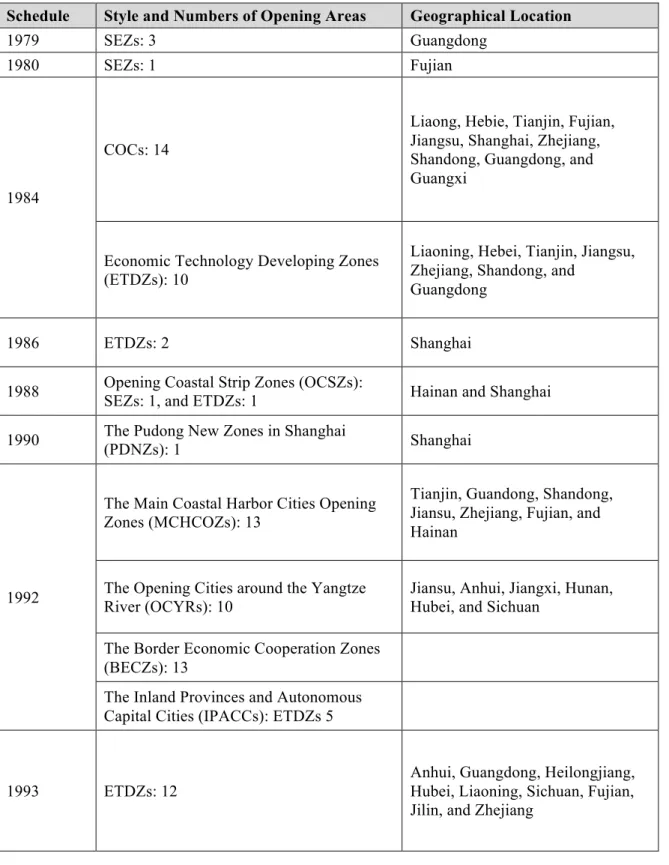
2.1 Stage 1: China’s Opening-up Policy ……….………..33
2.2 Stage 2: Great Western Development Strategy: Economic Zones –Resolving Internal Issues ……….………..……….39
2.3 Stage 3: Implementation of OBOR – Overcoming the Limitations of the Great Western Development Strategy ……….………..43
3. The Internationalization of the RMB, and the Role of the AIIB ………...47
V. Conclusion ……….………..51
Bibliography ……….…...54
Abstract in Korean ………..……….57
List of Abbreviations
ADB Asian Development Bank
AIIB Asian Infrastructure Investment Bank APEC Asia-‐Pacific Economic Cooperation CCP Chinese Communist Party
ETDZ Economic and Technological Development Zone FDI Foreign Direct Investment
FIEs Foreign-‐Invested Enterprises GDP Gross Domestic Product GWD Great Western Development HK Hong Kong
IMF International Monetary Fund JV Joint Venture
MDB Multilateral Development Bank MNE Multinational Enterprise NPC National People's Congress OBOR One Belt One Road
OECD Organization for Economic Co-‐operation and Development
PBOC People's Bank of China
RMB Renminbi
SEC State Economic Commission
SETC State Economic and Trade Commission SEZs Special Economic Zones
SOEs State-‐Owned Enterprises SPC State Planning Commission TNC Transnational corporation TPP Trans-‐Pacific Partnership
TVEs Township and Village Enterprises WB World Bank
WTO World Trade Organization
I. Introduction
The unprecedented pace of change in China was initially driven by its economic shift towards a more open, market-oriented economy, and later by its deeper integration into the world economy.
Originally a recipient country of foreign aid from various international organizations, China has now become a leading global economy and an important player in foreign assistance. China has evolved to adopt a liberal market economy through the internationalization process. This goes against its
ideological nature, and many scholars have debated how the country’s economy might evolve in the future. Now, with the One Belt, One Road (OBOR) initiative, China is trying to set another landmark in economic diplomacy with profound long-term implications. This initiative was first proposed in September 2013 by China’s president Xi Jinping, to establish a modern equivalent of the Silk Road, creating the world’s largest platform for economic cooperation. The scale of this initiative is as big as participation of 100 countries and international organizations, according to Xi Jinping during his speech at the symposium on the Belt and Road Initiative in Beijing. The OBOR initiative is the country’s most significant initiative by far, and has seen the setting up of a 40 billion USD Silk Road Fund. OBOR is in line with the message of creating a deeper integration with the world economy, which shows China’s stance on internationalization. China is optimistic about its OBOR initiative, claiming this 21st century Silk Road connectivity will first make the country’s economy grow and create advantages for the relevant states or economies by closely integrating them with the Chinese economy, ultimately to link up different parts of Asia and create several mega-continental bridges forming one economic entity.
As successful as China’s economic growth, for China to grow within the scope of
internationalization, however, its leaders needed to make difficult reforms. Reforms such as that of state-owned enterprises (SOEs); open up the country to private-sector competition; lower the barriers of government protected service sectors to private and foreign competition; and liberalizing the financial sector. Such change often requires the regime to surrender much of its power to direct economic activity, which might jeopardize it. This is why many of participants are still questioning the motivation behind China’s OBOR. All in all, the implementation of OBOR and its success are
dependent on legitimizing the political regime further, while adjusting the economic structure. Now that China is implementing its domestic strategy for a new era of economic development and
increasingly opening up to the outside world, i.e. the OBOR initiative, we need to reevaluate and redefine the country’s internationalization.
China has been gradually reforming itself to achieve a socialist market economy and improve its modern economic system. China will continue to pursue its basic policy of opening-up, and at the same time committing to a new and improved pattern of all-round opening-up, and integrating itself deeper into the market system. Through the implementation of the Belt and Road, China is trying to change its developmental direction from mere expansion to improving operations management and enhancing global competitiveness. Despite being advertised as a global strategy with inclusiveness and openness, however, OBOR should be viewed as broadening the scope of China’s domestic strategy. I call this process the “internationalization of domestic development,” turning specific economic projects into economic collaboration projects with OBOR countries. The initiative is undeniably important to China’s growth prospects, and will enable China to explore the effects of
internationalization on national economies and its growth in the proportion of international economic flows relative to domestic ones. This paper’s main focus is to analyze OBOR based on the framework of the internationalization of domestic development, and in doing so, to answer to following question:
What does internationalization mean to China, now that it is no longer a recipient state, but instead a global market leader and donor state? How is China going to pursue its internationalization process further and what are their plans? How should we systemize this process so that we can properly access its current status and predict the future behavior?
Thus, this paper attempt to analyzes China’s internationalization in line with its domestic development policies, leading up to the “OBOR” initiative, which represents the country’s new approach to internationalization. This can give us a big picture of China’s economic transformation and the future they envision whether it is for themselves or for the better of all, I believe we need to pay more attention to China’s development objectives over the past years in relation to its motivation behind put forth for internationalization. The objective of this paper is discussed in greater detail shortly, but first it is necessary to place China’s internationalization process in context. The following section aims to systemize China’s internationalization process by examining the historical background of China’s developmental stage, beginning with the 1978 opening-up and leading up to the 2000 western development stage to reduce the gap between regions; and finally the establishment of AIIB
with OBOR and the internationalization of the Chinese Yuan Renminbi (RMB) to broaden its political and economic scope, making China the leader of today’s market economy.
1. China’s Economic Transformation – From its “Opening-Up” Policy to OBOR
Initially a closed communist economy, China took a gradual approach towards internationalization;
this process was strictly internally determined, downplaying financial integration and global governance. It is important to note that domestic demand was the key focus of China’s economic policy throughout its entire reform process. It was critical for China to focus on its domestic demand- comprised of personal and household consumption, domestic investment, and government spending- as a source of economic growth. This is not surprising, considering that China is a huge continental economy with one-fifth of the world’s population. 1
Throughout China’s internationalization, the level of deregulation and decentralization has changed, but domestic demand has remained the key factor in determining its economic policy. OBOR, despite being advertised as a “win-win” strategy for member countries by removing transport bottlenecks and promoting transport connectivity between related regions, also provides the perfect economic platform for specific regions in China. Projects from the OBOR initiative involve various western and coastal regions as strategic ports of the Belt and Road mega-continental bridges, linking different parts of Asia. One of the major objectives is the Silk Road connectivity for these regions, which are less developed compared to urban areas and which received preferential treatment at the beginning of the reform period, to take economic advantage of the new projects. Additional components connecting China’s domestic policy with OBOR are discussed in the following chapters.
Since the 1978 opening-up initiated by Deng Xiaoping, China has slowly adapted itself to the outside world, showing significant economic prosperity. China changed its autarkic relationship with the international system, becoming a country that is highly engaged in global commerce and fairly active in transnational exchanges of all types.2 Its gradual shift from a closed and planned economy to a
1Yang, Lim Tin Seng. 2009. “China’s Approach to Tackle the Economic Slowdown: The Role of the Government” In REGIONAL POLITICAL ECONOMY OF CHINA ASCENDAN: Pivotal Issues and Critical Perspectives, edited by Emile Kok-Kheng Yeoh, 37-54. University of Malaya, Institute of China Studies.
2 Zweig, David. 2002. Internationalizing China: domestic interests and global linkages. Cornell University Press.
market economy, increasing its global economic power, gained the world’s attention. The 1978 policy change was the result of the strong pressure of international economic factors, and the fact that China still managed to gradually approach reforming its foreign trade administration is quite remarkable.
Chinese leaders were able to remove regulatory constraints from specific regions while managing to maintain those controls over other localities. This level of openness, of which the regions took advantage, was determined solely by the central government, and its policies and initiatives were implemented based on its plan and not on the market economy. This was highly different from what liberalists might have expected the country’s reaction to internationalization and market economy to be. Many scholars have defined Chinese characteristics of internationalization as “elite driven,”
“economic nationalist”3 (Susan Shirk, 1996), and “particularistic contracting” (David Zweig, 2002).
Over the decades, however, as China’s transnational exchanges have expanded, international forces and local demand have pushed the country into a more interdependent, and more market-oriented, global system. With its membership in the World Trade Organization (WTO) and other major international organizations, such as the World Bank and Association of South-East Asian Nations (ASEAN), China has not only become an integral part of the world community, but has also placed itself among the most influential players in the global market. Global markets continue to drive down regulatory barriers in China, and the latter is becoming more comfortable with the idea of a market economy. Yet the basic characteristic of a regulatory regime remains, and bureaucrats who supported the internationalization simply because it brought them income and opportunities still manage to remain in a communist regime country in a political sense.
Various studies have examined internationalization and China’s economic reforms. Neoliberalists such as Frieden and Rogowski argue that internationalization affects countries’ policy preferences regardless of domestic structure.4 Their argument cannot account for China’s domestic structure and how their localities responded to international opportunities, because it is not just a comparative advantage caused solely by internationalization. The East Asian model of development argues that bureaucrats are not rent seekers, but instead are “enlightened directors of industrialization who manage the market and successfully promote development.” 5 However, China showed different path during
3 Shirk, Susan L. 1996. “Internationalization and China’s Economic Reforms” In INTERNATIONALIZATION AND DOMESTIC POLITICS, edited by Robert O. Keohane, Helen V. Milner, 186-206. Cambridge University Press.
4 Keohane, Robert O. and Miler, Helen V. 1996. INTERNATIONALIZATION AND DOMESTIC POLITICS. Cambridge University Press.
5 Robert Wade, 1990. Governing the Market: Economic Theory and the Role of Government in East Asian Industrialization, Princeton: Princeton University Press.
the Maoist era. The necessity for successful late industrialization become increasingly avaricious, expending enormous energy on seeking rents. Zweig(2002) argues that in democracies, domestic pressures (democracies, lobbies, independent trade unions, etc.) possess the legal authority to pressure the government to alter its trade regime. In authoritarian systems such as China, however, even the collective interests are clarified, even if the action is not illegal, it is difficult to pursue. Despite the Chinese government deciding to reject autarky and expand transnational exchanges, bureaucrats have remained in control of many international transactions. Yet the groups that benefit from transnational links can undermine strong authoritarian regimes once they are open to the outside world, ultimately changing China’s policy building (Zweig 2002).
2. China Today
For the past few decades, China has grown sufficiently to become a new donor. The Chinese economy has risen rapidly over several decades, surpassing Japan in 2010 and becoming the second economy in the world. By the end of December 2016, China’s foreign exchange reserves reached USD 3,010.5 billion, the largest in the world, and in 2015 its total external trade reached USD 3,956 billion, ranked first in the world.6 Despite suffering from an economic slowdown (due to the rapid rise in labor costs and market saturation in China’s petrochemical, steel, and other basic industries), China remains the single largest contributor to world gross domestic product (GDP) growth. China recorded 9.3% of growth in 2011, moved down to 7.7% in both 2012 and 2013. In a similar vein, in 2014 and 2015, its GDP was up by 7.3% and 6.9%, respectively. And in 2015, its per capita GDP reached RMB 49,351.
Moreover, in the first three quarters in 2016, its GDP grew 6 % and 6.8% in the last quarter, which in overall average growth of 6.7%.7 The world is watching China’s growth very carefully because its influence on the global economy is growing, perhaps more so than U.S acknowledges.
Despite its general satisfaction with the its economic performance, and optimism about its economic future, China does face some internal challenges. The regional development gap within China,
between coastal and middle/western regions, and between urban and rural areas, has been a focal issue for the government. Specifically, middle and western China account for 80% of land and 60% of
6 The National Bureau of Statistics, Ministry of Commerce, and General Administration of Customs.
7 The National Bureau of Statistics, Ministry of Commerce.
population, but collect only 14% of foreign trade, 17% of foreign direct investments (FDI), 22% of overseas investment, and one-third of GDP. The domestic pressure to reduce the poverty rate and growing resentment over income and wealth inequality among people and regions is pushing China to find a new strategy – a strategy to expand its sphere of international influence both politically and economically, and to establish its internal and external regional hegemony.
One Belt, One Road
Since its official launch by President Xi Jinping at the Asia-Pacific Economic Cooperation (APEC) Summit in Beijing in October 2014, the OBOR initiative, or more specifically China, has made significant progress. China has signed OBOR cooperation agreements with countries along the Belt and Road, and with the establishment of the Asia Infrastructure Investment Bank (AIIB), OBOR infrastructure projects have begun to be implemented. Fifty-seven countries signed up as the initiative’s founding members, including European countries, such as the UK and Germany.
Internationally, China joined the European Bank for Reconstruction and Development in January 2016, allowing it to participate in projects in Europe. Domestically, 31 provinces have made plans to engage in OBOR, and China has expanded its free trade zone trial to 11 provinces to accelerate the development of the initiative.
OBOR connects Asia to Europe all the way to Africa by land and maritime transportation. The aim of this modern version of the Silk Road is to facilitate economic interaction between its member states and, as a result, for them to benefit from the increased trade. Xi Jinping believes that the
implementation of the OBOR in long run can improve road communication, thus enhance trade flow, encouraging currency, alternately increase the interaction between people. China seems to be
confident that this new Chinese version of the Silk Road will open a gateway to development cooperation using a regional cooperation platform to proceed with freeways, high-speed railways, trade and investment, energy cooperation, regional integration, and network interconnection. Xi has also made several remarks about how OBOR initiative is “an open, diversified, win-win project poised to bring huge opportunities for the development of China and other countries.” To verify such
confident, many countries have lined up to join or shown interest in the initiative by joining the AIIB or through various forms of cooperation.
According to a report by Minsheng Securities, the OBOR strategy will boost China’s GDP growth by 0.25%. The report further speculates that this strategy will cover 4.4 billion people from 26 countries and regions, valuing the economic effect at USD 21 trillion. China set up a Silk Road Fund of USD 40 billion, and further invested USD 50 billion as start-up capital to establish the AIIB. China has formed economic cooperation zones with more than 50 regions along the Belt and Road route, expanding its free trade zones trial from four to seven provinces. The initiative has also accelerated China’s shift, making it a major capital exporter whereas it used to be the world’s biggest goods exporter. China’s outbound direct investment (ODI) surpassed its FDI for the first time in 2015, and its ODI to countries along the OBOR grew by 23.8% Year On Year (YOY) in 2015.
In the first quarter of 2017, China’s trade with economies along the Belt and Road initiative marked double-digit growth YOY8. Moreover, the ministry’s spokesman Sun Jiwen says trades in goods between China and the Belt and Road economies increased by 26.2% in the first three months from the same period of last year. Jiwen has also stated that due to the significant progress made in infrastructure projects, China’s products and services have gained more popularity. During the first quarter, China’s non-financial ODI in 43 economies in the Belt and Road regions reached US$ 2.95 billion, taking up 14.4% of the country’s total ODI, according to data from the Ministry of Commerce.
These figures and the fact that trade between China and countries along the OBOR routes exceeded USD 1 trillion in 2015, a quarter of China’s total trade value, show that the OBOR initiative has boosted trade and investment in China considerably, and will continue to increase their value. By 2020, the initiative will have boosted cumulative non-financial ODI to USD 2 trillion.
3. The Internationalization of China
Keohane defines internationalization as expanded flows of goods, services, and people across state boundaries, thereby increasing the share of transnational exchanges relative to domestic ones.9 Along
8 Data form the Ministry of Commerce, People’s Republic of China, 2017. http://english.mofcom.gov.cn
9Keohane, Robert O. and Miler, Helen V. 1996. INTERNATIONALIZATION AND DOMESTIC POLITICS. Cambridge University Press.
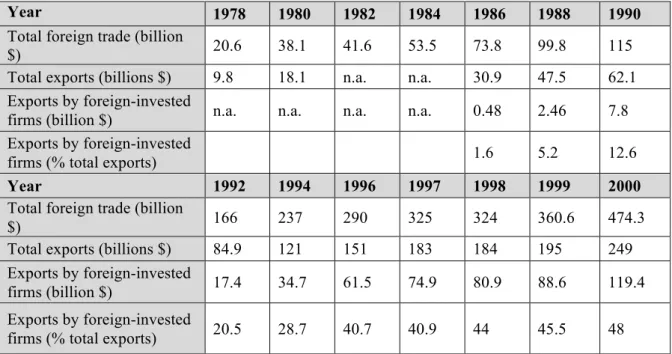
with a decline in the level of regulation affecting those flows, many sectors in China’s society and economy have become increasingly internationalized (Table 1.1).
Table 1.1: Internationalization of China
Year 1978 1980 1982 1984 1986 1988 1990
Total foreign trade (billion
$) 20.6 38.1 41.6 53.5 73.8 99.8 115
Total exports (billions $) 9.8 18.1 n.a. n.a. 30.9 47.5 62.1 Exports by foreign-invested
firms (billion $) n.a. n.a. n.a. n.a. 0.48 2.46 7.8
Exports by foreign-invested firms (% total exports)
1.6 5.2 12.6
Year 1992 1994 1996 1997 1998 1999 2000
Total foreign trade (billion
$) 166 237 290 325 324 360.6 474.3
Total exports (billions $) 84.9 121 151 183 184 195 249 Exports by foreign-invested
firms (billion $) 17.4 34.7 61.5 74.9 80.9 88.6 119.4
Exports by foreign-invested
firms (% total exports) 20.5 28.7 40.7 40.9 44 45.5 48 source 1: China Statistical Yearbook, 1978 to 1994.
If internationalization process is shaped by domestic political and economic structures, how can we explain the Chinese case of internationalization? China remains an authoritarian state even after opening its economy to international forces. How is China planning to integrate itself deeper into the global market, to increase its benefit, while retaining its political control and without jeopardizing its image?
The remainder of this paper is organized as follows. First, Chapter 2 discusses the recent literature on relevant models of internationalization, as well as the literature on domestic-international links that affect the forming of domestic policies, especially in the case of China. Here, I take David Zweig’s explanation of China’s internationalization, emphasizing not only the role of the global market force, but also that of state leaders and domestic actors in the process, and I develop his idea of a Chinese pattern of transnational links to fit the current developmental policy strategy. Chapter 3 then analyzes the OBOR initiative and attempts to determine whether China and the rest of the world need the initiative and why. The chapter is divided into four sub-sections: Domestic Need; International Need;
Strategy Behind the AIIB; and the OBOR Initiative and Connection to AIIB. In Chapter 4,
Internationalization of Domestic Development, I examine China’s pattern of domestic development leading up to OBOR, to see how and why OBOR was implemented to serve as an external instrument to assist in the necessary domestic rebalancing process, furthering China’s internationalization.
Finally, I conclude the paper by deriving the implications of OBOR and China’s new found role in the global market.
II. Literature Review and Background
Over the past few decades, rapid internationalization has refocused scholarly attention on the role of the state. Scholars have argued about the impact of globalization on the state, with the dominant view being that globalization weakens the latter’s power. The most classical theories that discuss the relationship between the state and the effect of globalization are the neo-Marxist and neoliberal arguments.10 More than a century ago, Marx noted that Capitalism knows no bounds, and this is accurate if we look at the current market system and its effect on state boundaries. In his world-system analysis, Immanuel Wallerstein gives us a contemporary version of the Marxist theory of the link between capitalism and globalization.11 Moreover, more contemporary scholars, such as Kenichi Ohmae, Mathew Horseman, Andrew Marshall, and Susan Strange, have focused on the diminishing role of the state in the age of internationalization.1213 This argument about the “de-nationalization” of economies through the establishment of transnational networks of production, trade, and finance (David Held and Anthony McGrew, 1999) tries to explain how state and market interact in both international and domestic zones.
Neoliberal scholars focus on the nature of interdependence among nation states, and thus the impact of internationalization on state behavior in world politics.14 These scholars believe that radical economic internationalization, which is above all nation states, has been established. Robert Keohane and Joseph Nye argue that internationalization resulted in complicated system of interdependent states where international institutions and their transnational rules have gained their influence. The
neoliberalists argue that while states hold the ultimate authority with its legal power to effective supremacy over their own territories, with the jurisdiction if international governance and the international law expanding, (Zheng, 2004), all states respond to international market regardless of their national regime. The term “internationalization of domestic politics” in Milner and Keohane’s (1996: 4) book is used to refer to a context in which one or more features of domestic policy-making, agenda setting, priority determination, choice of policy instruments, the content of public policies, and
10 Zheng, Yongnian., 2004. Globalization and State Transformation in China. Cambridge: Cambridge University press.
11 Immanuel Wallerstein., 1979. The Capitalist World-‐Economy. Cambridge: Cambridge University Press.
12 Kenichi Ohmae, 1995. The End of the Nation State. New York: Harper Collins.
13 Susan Strange, spring 1995, “The Defective State” Daedalus, special issue “What Future for the State?”, 124:2, p.56.
14 Zheng, Yongnian., 2004. Globalization and State Transformation in China. Cambridge: Cambridge University press.
the interpretive frameworks that guide policy-making are discernibly affected by factors that do not originate in the domestic arena.
State and International system
According to the above arguments, internationalization has led to the decline of state power and made it difficult for the national state to control civil society, which could make an authoritarian regime vulnerable. Such regimes often exercise tight political control over domestic economic transactions.
What does this mean for authoritarian states such as China? How would China interpret this argument about internationalization challenging its state power? To answer this question, we first need to review the current studies on how states interact with the international market system.
Today, domestic politics occur in a context of internationalization. There are four relevant models to understand the process by which states interact with the international system: 1) the regulatory control model, which focuses on the regulatory regimes where they control the level of interaction in world market; 2) the neoliberal model, which concerns the effect and the power of international forces domestic level; 3) the East Asian model, focusing on the role of “enlightened bureaucrats” who manage to successfully promote development in East Asia; and 4) the network capital model, which emphasizes the role of network capitalism(Zweig, 2002). These models are discussed in more depth in the following.
The regulatory controls model addresses the level of administrative constraint in the domestic economy, with the state power to control the level of transnational exchanges. It argues that political and economic institutions limit internationalization changing the effects of the international and domestic markets. However, these assumptions cannot explain China’s shift to increased international transaction and the rising role of market forces, nor the decreased regulatory controls since 1978. They undermine the market forces that influence the regulatory constraints (Zweig, 2002).
Neoliberalists, whose arguments were outlined earlier in this section, also face limits in explaining China’s internationalization. Unlike the regulatory control model, the neoliberal model emphasizes the impact that international market forces have on domestic interest.15 This argument is not sufficient to explain a country’s internationalization, however. Susan Shirk (1996) argues that China’s strong hold
15 Peter Gourevitch, Autumn 1978, “The Second Image Reversed: The International Sources of Domestic Politics,”
International Organization 32: 881-911.
over external influence reaching domestic market prevented change in relative prices which is different from what neoliberalists might expect. These institutions also undermined the role of elites, holding strong control over determining which area would get preferential treatments to be opened to international prices.16
The East Asian model of development argues that enlightened bureaucrats are not rent seekers, but showed great management skill over the market and successfully promote development.17 However, this model cannot explain the Chinese case either, because none of the other East Asian countries had the near-Stalinist style of central planning when the reform period began, and kept such style of command system after the reform. While some East Asian countries, such as Japan, South Korea, and Taiwan, shared similar GDP growth rates, the macroeconomic beliefs in competitive market
conditions that are crucial for rapid economic growth, and even authoritarian regimes, and though external competitiveness was important both in East Asia and in China, the policy direction to deal with external competitiveness showed completely different pattern (Zweig, 2002). China tended to focus more towards domestic pressure rather than the global ones, protecting its loss generating state sector. This again was atypical pattern of behavior responding to internationalization. Until the late 90s, it was difficult to set a clear industrial policy, due to elite conflict, and the key growth sectors were not centralized. This is different to the cases of South Korea and Japan, for instance, where efficiency has come more from the strong state power pushing large corporations into the international market for them to grow. In China’s case, efficiency has resulted from interprovincial competition trying to get the preferential treatment from the central government.
As the fourth model, preferred by China’s scholars, asserts elite, domestic political, or network explanations18 for the country’s post-Mao foreign economic policy. This model generally is less focused on external factors such as global economics and their market forces, but stresses the role of network capitalism to explain China’s internationalization. Jude Howell’s cyclical explanation of China’s internationalization combines economic and political logic.19 Liberalization resulted in
16 Dorothy J. Soliger., 1991. From Lathes to Looms: China’s Industrial Policy in Comparative Perspective, 1979-198.
Stanford: Stanford University Press.; Joseph Fewsmith, 1994, Dilemmas of Reform in China Armonk: M.E. Sharpe.
17 Robert Wade, 1990, Governing the Market: Economic Theory and the Role of Government in East Asian Industrialization, Princeton: Princeton University Press.
18Thomas G Moore, 2002. China in the World Market, Chinese Industry and International Sources of Reform in the Post- Mao Era. Cambridge University Press.
19 Jude Howell, 1993. China Opens Its Door: the Politics of Economic Transition, Boulder: Lynne Rienner.
increased domestic demand for international resources, forcing the government to repress the domestic and international transactions. Howell further claims that new beneficiaries of internationalization will resist retightening, leaving China more open than at the beginning of the reform. However, the author understates the role of foreign markets and the administrative interests in the process of China’s internationalization.
1. Internationalization
To understand internationalization and how it is connected to the development in China, we need to review previous studies. Many attempts have been made to define internationalization in the link between domestic and international. We can no longer explain internationalization through relying solely on either the international or the domestic structure. (Keohane 1996). This is especially true for the Chinese case. We need to examine how China came to a decision to open itself up to the global market. To this end, David Zweig incorporates the concept of “channels of global transaction,” i.e. the incentives generated by the regulatory regime to open up, authorized by the state to control any transnational exchanges. Keohane and Milner regard internationalization as “a process that can be empirically measured by the growth in the proportion of international economic flows relative to domestic ones.” Since economics and politics are so closely intertwined, there is reason to expect profound political effects of economic policy as well: in particular, we should expect to see signs of the impact of world economy in domestic politics in various countries around the world. In this vein, the main proposition of Keohane’s argument is that it became almost impossible to approach politics only within domestic level, without acknowledging comprehensive nature of national and the world economy, and the changes in such connections (Keohane, 1996). Internationalization, as he refers to
“the processes generated by underlying shifts in transaction costs that produce observable flows of goods, services, and capital”. In the past decades, the internationalization process such as currency trade, international trade and investment has grown. Such process influence the economic actors in dealing with opportunities and also constraints, and even their policy preferences.
Internationalization also increase their sensitivity and vulnerability to external changes, as it affects the aggregate welfare of countries. The economic policies and political institutions changes as incentives change through internationalization. In this vein, Frieden and Rogowski argue that
internationalization affects the policy preferences of actors in predictable ways, based on those actors’
economic interest.20 Most obviously, internationalization will increase the tradable sector within an economy, which will then reduce the amount of economic activity coming from world market forces.
Ceteris paribus, in return, the sensitivity of national economies to world market trend should increase through internationalization. Yet, one should not overlook the fact that each country will have different regime and circumstance, thus their policies and institutions would also have different effects. Thus, the second fundamental proposition of this argument is that political institutions can alter the effects of internationalization. We must not undermine the power of political institution and know that political outcomes cannot be predicted simply on the basis of economic interests. Coalition formation depends on strategic judgments and maneuvering, and often cannot be predicted from policy preferences alone. Moreover, policy decision on whether to stay with existing institution, or to radically change the current status depends on external factors as well as strategic planning and referential judgments.
2. Internationalization: the Case of China
China, as a Leninist Regime, is considered to be a difficult case in which to demonstrate the impact of internationalization on domestic policy outcomes compare to other democratic-liberalist countries.
This is due to the dense institution of the Communist Party state preventing information about the international economy from reaching domestic actors. When socialist systems operate under a one- party political structure, managing a centrally planned economy, there are limited possibilities for change. China showed different pattern of internationalization process compared to fellow Leninist Regime countries by establishing a mixed economic system.
The combination of a more marketized economy combined with an authoritarian political structure has been described as “adaptive authoritarianism,” and “market Leninism”. In 1978, Deng Xiaoping launched China’s reform program, which led to a profound marketization compare to previous regime practice in terms of party control over the economy and society. Shirk (1996) argues that
internationalization shapes the coalitional possibilities open to political entrepreneurs. In this vein, the case of China presents a complex picture of the impact of internationalization on economic policies.
China’s pre-1978 experience confirms findings from other communist countries that Leninist political
20 Jeffery A. Freiden and Ronald Rogowski, 1996. “The Impact of the International Economy on National Policies: An Analytical Overview.: In Internationalization and Domestic Politics, edited by Robert O. Keohane and Helen V. Milner, 25- 47, Cambridge: Cambridge University Press.
and economic institutions prevent the influence of internationalization on domestic outcomes. (Shirk, 1996) During this period, Government tried to get full control of the foreign trade and tried to set prices of the command economy, keeping domestic groups ignorant of international price signals. The government blocked these groups from such external information so they wouldn’t get effected from internationalization. As Leninist regime, economic interests were not permitted to influence policy- making. The groups’ interests were articulated only through the Communist Party and government ministries and agencies, which had been structured since the mid-1950s to enhance the power of the holders of capital, which was scarce in China, and thereby to perpetuate policies of rapid
industrialization and autarky.(Shirk, 1996)
A positive impact of internationalization on China’s reform was the process of foreign trade decentralization. The central government witnessed unprecedented opportunities from liberalization and what it does to economic growth. Deng Xiaoping and his allies chose a path of gradual
decentralization of trade, instead of pursuing it rapidly to its full liberalization. This choice involved maintaining the non-convertibility of Chinese currency during the transition and distributing
differential rights to retain foreign exchange earned from exports to provinces. This gradual, decentralized, particularistic approach to reforming foreign trade administration and encouraging exports was extraordinarily successful in both political and economic terms. For instance, the
decentralization of foreign trade administration was accompanied by a decentralization of authority to approve foreign investment projects. Local officials were happy to be allowed to gain access to foreign technology, equipment, and capital. On a negative note, however, decentralization left China with intensified competition for foreign business among provinces, resulting in the loss of bargaining power for China as a whole vis-à-vis foreign corporations (Shirk, 1990).21
Besides Shirk, David Zweig is another scholar who has tried to analyze China’s reaction to
internationalization. He emphasizes the role of both domestic and international structure, which should be considered together as we cannot rely solely on one or the other to explain China’s
internationalization. Moreover, Zweig agrees with the neoliberalist view on market forces affecting the process of internationalization and not just the regulatory constraint, and he also emphasizes other key
21 Shirk, Susan L. 1996. “Internationalization and China’s Economic Reforms” In INTERNATIONALIZATION AND DOMESTIC POLITICS, edited by Robert O. Keohane, Helen V. Milner, 186-206. Cambridge University Press.
actors who played critical roles in the expansion of China’s internationalization. According to him, four key actors are affected by differences in relative prices, which is the nature of the regulatory regime controlling transnational exchanges: external political and business stakeholders; China’s ruling elites; bureaucratic agents; and local communities, organizations, and individuals.
Zweig proposes several components to explain China’s internationalization. First, significant
opportunities were generated by relative prices due to the country’s long period of economic isolation.
The differences between the values of goods and services of China compare to the outside world were huge. Second, the central government of China opened the door to rest of the world: elite-driven developmental strategies created the rules according to which local governments, firms, groups, and individuals made their allocative decisions (Stephan Haggard, 1990). Global factors mixed with internal ones to create constraints and incentives for those actors who sought global links and pushed for deeper interdependence. Zweig calls this incorporated interest generated by the regulatory regime,
“channels of global transaction.” Such boundaries and incentives were also independent variables affecting domestic behavior, and not just at-the-border regulations. While the author emphasizes the state as the main actor to implement new regulation to control international transaction even as it liberalized specific sectors, the individuals, local state, local communities, and organizations also played a critical role in lowering institutional barriers to transnational exchanges. It was the central government that opened the first door and created the necessary barriers, even deciding which door to open, but the mentioned domestic actors manipulated those barriers to global transactions.
Furthermore, Zweig analyzes the impact of internationalization by comparing the latter’s different levels or processes among sectors (urban/rural internationalization, foreign assistance to government institutions and local communities).
He proposes an empirical definition of internationalization that involves two components: an expanded number of transnational exchanges, and a decrease in the barriers or regulations limiting such exchanges. Furthermore, he presents the graph in Figure 2.1 to support his main argument:
movement from left to right on the horizontal axis shows the number of transnational exchanges, while movement downward on the vertical axis represents barriers or regulations.
Figure 2.1: Level of regulatory constraints
Quadrant A: Isolated, with low levels of transnational flows and little need for regulation.
Quadrant B: Autarky, with low flows due to high levels of bureaucratic regulation. In 1978, China decided to move out of this quadrant and engage the world economy more fully.
Quadrant C: Mercantilist, economic nationalist, or developmentalist perspective, in which global transactions increase markedly but the state strictly controls those flows. Neoliberals would expect China to move to Quadrant D due to international norms, domestic interest groups, and the need for economic efficiency.
Quadrant D: Liberal market or interdependent model, in which flows are high and regulation is low.
The general expected move, based on neoliberalist assumptions, is that once a state initiates the deregulation of global transactions, it will move to Quadrant D; instead, in reality, its enormous elite and bureaucratic interest has moved China into Quadrant C, Mercantilist. As the level of China’s internationalization increases, however, the country moves down the vertical axis towards Quadrant D.
China’s membership in international organizations and regimes has led it to adjust its regulations to the international system. Joining the WTO, the International Monetary Fund (IMF), and the World Bank has changed China’s foreign trade and investment regime, making it more congruent with international practice.
In this paper, I mainly follow Zweig’s view on internationalization in China, but I admit that there is a demand for a new explanation of China’s new approach to internationalization, represented by the OBOR initiative. In China, the central government has managed to remain in control of overall transnational actions, and it is now trying to implement-larger scale economic plans. These include the OBOR initiative, which involves similar sectors from previous policy implementation but that are even more internationalized, including OBOR member states as a new sector. Now, not only is China moving from Quadrant C to Quadrant D (Figure 2.1), further immersing itself in the international system, but it is also leading the way to create new types of international norms and global capital regimes, and establishing new organizations on international markets, such as AIIB. Thus, Zweig’s approach needs to be developed to explain China’s internationalization and its new role in the system, not as a mere participant, but as an active leader.
In this chapter, I reviewed previous studies on internationalization process and what it means in domestic politics, focusing on China. On the basis of theoretical background presented here, the remainder of the paper will examine the current situation of China in terms of internationalization and discuss why this OBOR initiative is unprecedented case of internationalizing ones domestic
development.
III. China and the Development of OBOR and the Asian Infrastructure Investment Bank
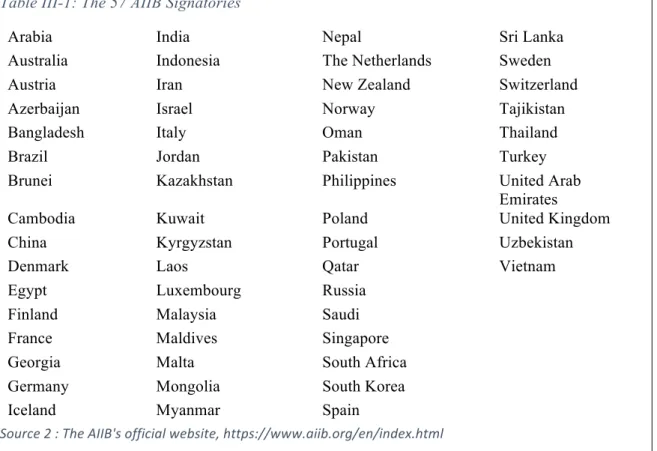
In this chapter, I explain why it was necessary for China to implement the Belt and Road strategy and establish the AIIB. The launch of OBOR was quickly followed by the establishment of the AIIB, including 57 founding member countries, with China providing half of the bank’s start-up capital:
USD 50 billion. The aim in initiating the AIIB was to make the OBOR strategy effective: the Chinese government hopes to use this bank to finance the countries along the OBOR routes to expand their infrastructures and promote their economic growth. Asia will benefit from the AIIB because
preexisting institutions, such as Asian Development Bank (ADB) and World Bank, cannot fulfill the huge demand for productive economic infrastructure development in Asia. In contrast, the AIIB specializes in Asia and infrastructure development with innovative voting rights, staff recruitment, and procurement. But what drove China to take on the role of creating this enormous economic entity that specializes in funding infrastructure projects? What was the strategy in establishing the AIIB in relation to the OBOR initiative?
This chapter is divided into four sub-parts: Domestic Economic Needs; International Economic Needs; Strategy Behind the AIIB; and The OBOR Initiative and its Relationship to the AIIB’s Projects. I examine China’s domestic components regarding the implementation of OBOR in more detail in Chapter 5 to explain how the country turned its domestic development into an international matter. To this end, I introduce the concept of Internationalization of Domestic Development.
However, in the present chapter, I focus on the domestic and international economic needs to
implement OBOR. The remainder of this chapter will hopefully give a reader basic information for the critical evaluation regarding China’s intention behind implementing the OBOR.
1. Domestic Economic Needs
China’s economy has grown rapidly over several decades, surpassing Japan in 2010 and becoming the second largest economy in the world. In recent years, however, this economic growth has slowed due to the rapid rise in labor costs. Furthermore, because the country’s petrochemical, steel, and other basic industries are facing market saturation and excess capacity, its economic growth will eventually suffer. Thus, after witnessing nearly three decades of record high growth, the economy has been slowing down, and the Chinese economic model, traditionally based on manufacturing, investments,
and exports, is currently rebalancing towards domestic consumption development. The high investment, high growth era and the long-term continuance of infrastructure investment have left China with a world-class scale of distribution companies and construction experience. The country needs to find another trajectory for its communication, raw materials, electricity, and military strength industry; and the new Silk Road could be the answer to this problem. This is another important point, because China needs a new market in which to direct its enterprises and workforce.
Internally, the effects of globalization and liberalization have fueled a renewed interest in regional development and inequality, because China’s reform process was spatially highly uneven. Rapid economic growth after the economy was opened up to rest of the world left some areas very rich, while other regions were omitted from the government’s preferential development plan. After such inequality reached its peak, the government turned its attention to the fact that regional inequality was closely intertwined with economic growth, social stability, ethnic relations, and political unity. The regional developmental gap between coastal and middle/western regions, and between urban and rural areas, was greater than China ever anticipated through its preferential developmental plan. According Zhang Yesui in a speech given in March 2014, middle and western China account for 80% of the land and 60% of the population, but only collect 14% of foreign trade, 17% of FDI, 22% of overseas investment, and one-third of GDP. For the continuous economic instability in western region, China believes that accelerated development should work as cure. Scholars examined the negative effect of regional disparity and ethnic discrimination on economic growth, and the central government of China began to make efforts to develop the interior of the country, in particular by launching the Great Western Development Strategy in 1999. When the strategy could proceed no further, China changed its tactic to find a way to use the western region as a “Eurasian Land Bridge” through Central Asia to Europe. The March 2015 blueprint for OBOR shows China’s intention of “making good use of
Xinjiang’s geographical advantages,” to “make it a key transportation, trade, logistics, culture, science, and education center.”
The OBOR initiative and China’s domestic economic and political needs are closely related, and I consider this later, in the chapter regarding the AIIB’s strategy. Various projects funded by the AIIB are closely related with China’s domestic issues, especially within the western region. For this reason,
OBOR and AIIB are judged as a solution not only to boost the economy in the western region, but also as alternatives to infrastructure businesses, and as ways of improving security issues.
2. International Economic Needs
There is a huge demand for productive economic infrastructure all around the world. In 2011, the Organization for Economic Co-operation and Development (OECD) estimated that global
infrastructure requirements over the next two decades will cost around USD 50 trillion. Moreover, the ADB has estimated that developing countries in Asia will need to invest USD 48 trillion from 2010 to 2020. Figure 3 shows the infrastructure deficiencies in countries along the OBOR. U.S. driven World Bank (WB) or ADB are now changing their path more towards concessional lending and knowledge sharing with low-income countries, because the investments needed are typically for large-scale, long- term public goods. There was certainly room for a new development bank specifically working to finance large-scale economic infrastructure on commercial terms. It was not easy to steer more savings towards infrastructure, however, either globally or in Asia. Many attempts and movements were made to fill these gaps in Asia, and reviving the “Silk Road” was one common vision.
Before China announced the OBOR initiative in 2013, many attempts had already been made to revive the glory of the ancient Silk Road. In 1993, the WTO suggested the idea of promoting the historic Silk Road through tourism exchange. In 1996, the first Silk Road Travel Forum was held by China, where member states established a framework for future “joint marketing and promotional strategies,” as well as for Silk Road countries to establish new business links (UN: silkroad.unwto.org). In 1997, Japan’s Hashimoto administration suggested “Silk Road diplomacy,” funding “the Silk Road,” which focused on tourism inventory in Silk Road area sharing information on attractions, facilities, and information centers. Moreover, Japan tried to expand its economic and political leverage in Central Asia with development assistance in the infrastructure sector and energy diversification, with the aim of entering the global market.22 The United States also procured the passage of The New Silk Road Initiative, meaning to integrate the Central Asian countries of Kyrgyzstan, Kazakhstan, Turkmenistan,
22 Akio Kawato, “What is Japan up to in Central Asia?” in Christopher Len et al. eds., Japan’s Silk Road Diplomacy: Paving the Road Ahead (Singapore: Central Asia-Caucasus Institute, 2008), pp.17-18.
Tajikistan and Uzbekistan with India, Afghanistan, and Pakistan by liberalizing trade and building infrastructure, including roads, bridges, electrical grids, railways, and pipelines. Furthermore, South Korea’s Eurasia initiative is also similar to OBOR in that they were targeting the silk road line for investment and creating a cooperative relationship with countries along the region.
Despite these many efforts, however, none had any notable success. This is unsurprising, since Central Asia is probably the world’s least economically or politically integrated region. There have been many conflicts in the region, from terror bombing to border wars. The ADB once reported that its intra-regional trade consisted of only 6.2% of global trade, and that, more importantly, there was a lack of trust between governments.
All of this makes what China has achieved seem improbable. However, China understands
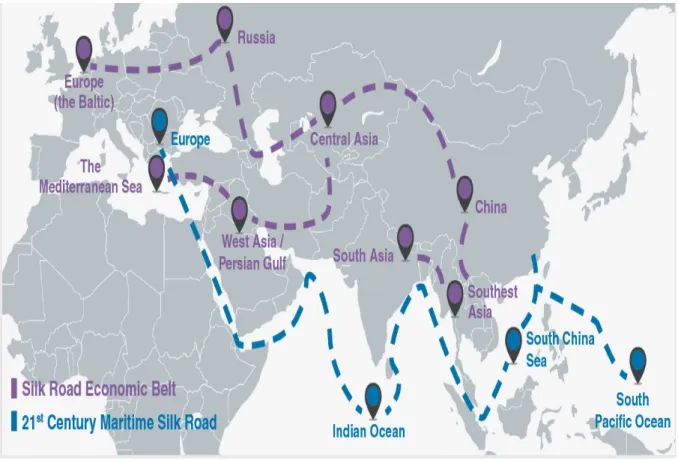
transportation bottlenecks are barriers to regional economic integration, and the OBOR initiative is a realistic solution for regional cooperation. The “Silk Road Economic Belt” mainly focuses on various infrastructure projects, transportation, energy, and telecommunication. By joining China’s new Belt and Road initiative, countries are interacting for commerce and not conflict: they are joining forces to build a network of transportation infrastructure, integrated customs, and cross-border procedures promoting trade, travel, and investment.
Table 3.1: List of countries that have participated/shown interest in the Belt and Road initiative
Figure 3.1: Silk Road economic belt
Source: Compiled by the Fung Business Intelligence Centre based on the framework chapter on the vision and actions on jointly building a Silk Road economic belt and a 21st century Maritime Silk Road
Table III-1: The 57 AIIB Signatories
Arabia India Nepal Sri Lanka
Australia Indonesia The Netherlands Sweden
Austria Iran New Zealand Switzerland
Azerbaijan Israel Norway Tajikistan
Bangladesh Italy Oman Thailand
Brazil Jordan Pakistan Turkey
Brunei Kazakhstan Philippines United Arab
Emirates
Cambodia Kuwait Poland United Kingdom
China Kyrgyzstan Portugal Uzbekistan
Denmark Laos Qatar Vietnam
Egypt Luxembourg Russia
Finland Malaysia Saudi
France Maldives Singapore
Georgia Malta South Africa
Germany Mongolia South Korea
Iceland Myanmar Spain
Source 2 : The AIIB's official website, https://www.aiib.org/en/index.html
Many have argued that the AIIB will play a critical role in financing the countries along the OBOR routes to expand their infrastructure and promote economic growth. Some organizations already exist, such as the ADB, the World Bank, and the IMF, to fund infrastructure projects in Asia, but they cannot deliver sufficient funding to those countries along the OBOR routes in need of infrastructure support. According to the AIIB official website, the bank plans to provide project loans of USD 1.2 billion in 2016, and USD 2.5 billion in 2017.
In most developing countries, the ranking of infrastructure lags far behind. As mentioned above, most countries along the OBOR routes are in urgent need of strengthening their infrastructure. The process of economic development in China shows how strong infrastructure plays a crucial role in promoting economic development, and this explains why most OBOR countries have joined the AIIB:
they understand the importance of infrastructure and seek the construction funds from the AIIB.
China’s move to establish the AIIB and OBOR came from the popular notion that long-term economic growth, can only be achieved through massive, systematic, and broad-based investments in
infrastructure assets. Xi Jinping insists that the OBOR fund and the AIIB will foster “economic
connectivity and a new type of industrialization, and promote the common development of all countries as well as the peoples’ joint enjoyment of development fruits.” 23
23 from his speech at the One Belt One Road International Think Tank Forum, 2016, “A New Silk Way Belt- is a driver of new economic development and financial growth”, Beijing Capital Hotel, Jinyun Hall.
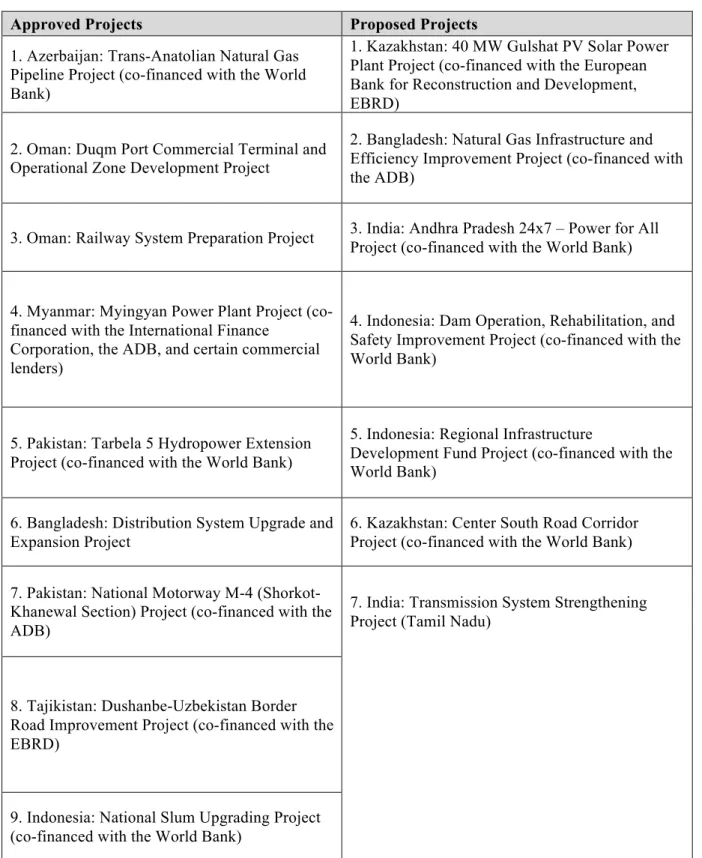
Table 3.3: The AIIB's projects
Approved Projects Proposed Projects
1. Azerbaijan: Trans-Anatolian Natural Gas Pipeline Project (co-financed with the World Bank)
1. Kazakhstan: 40 MW Gulshat PV Solar Power Plant Project (co-financed with the European Bank for Reconstruction and Development, EBRD)
2. Oman: Duqm Port Commercial Terminal and Operational Zone Development Project
2. Bangladesh: Natural Gas Infrastructure and Efficiency Improvement Project (co-financed with the ADB)
3. Oman: Railway System Preparation Project 3. India: Andhra Pradesh 24x7 – Power for All Project (co-financed with the World Bank)
4. Myanmar: Myingyan Power Plant Project (co- financed with the International Finance
Corporation, the ADB, and certain commercial lenders)
4. Indonesia: Dam Operation, Rehabilitation, and Safety Improvement Project (co-financed with the World Bank)
5. Pakistan: Tarbela 5 Hydropower Extension Project (co-financed with the World Bank)
5. Indonesia: Regional Infrastructure
Development Fund Project (co-financed with the World Bank)
6. Bangladesh: Distribution System Upgrade and Expansion Project
6. Kazakhstan: Center South Road Corridor Project (co-financed with the World Bank) 7. Pakistan: National Motorway M-4 (Shorkot-
Khanewal Section) Project (co-financed with the ADB)
7. India: Transmission System Strengthening Project (Tamil Nadu)
8. Tajikistan: Dushanbe-Uzbekistan Border Road Improvement Project (co-financed with the EBRD)
9. Indonesia: National Slum Upgrading Project (co-financed with the World Bank)
Source: The AIIB’s official website, https://www.aiib.org/en/index.html
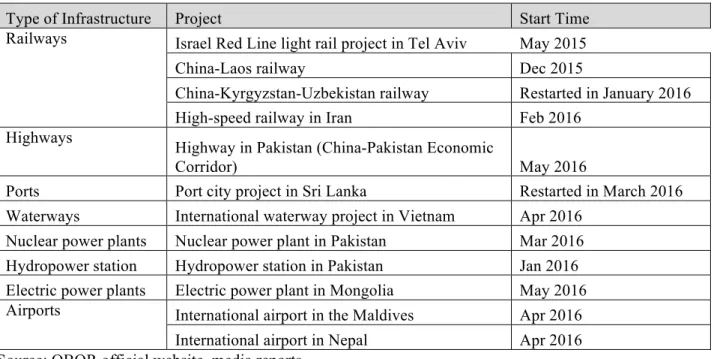
Figure 3.2: OBOR infrastructure projects have started to kick off; infrastructure projects in OBOR initiative as of April 2017
Type of Infrastructure Project Start Time
Railways Israel Red Line light rail project in Tel Aviv May 2015
China-Laos railway Dec 2015
China-Kyrgyzstan-Uzbekistan railway Restarted in January 2016
High-speed railway in Iran Feb 2016
Highways
Highway in Pakistan (China-Pakistan Economic
Corridor) May 2016
Ports Port city project in Sri Lanka Restarted in March 2016
Waterways International waterway project in Vietnam Apr 2016 Nuclear power plants Nuclear power plant in Pakistan Mar 2016 Hydropower station Hydropower station in Pakistan Jan 2016 Electric power plants Electric power plant in Mongolia May 2016 Airports International airport in the Maldives Apr 2016
International airport in Nepal Apr 2016 Source: OBOR official website, media reports