The Effectiveness of the Production-Oriented Approach in Chinese College Students’ Acquisition of English Grammar
Ci Zhang · Mun-Hong Choe
*(Wenzhou University ․ Chonnam National University)
Zhang, Ci & Choe, Mun-Hong. (2020). The effectiveness of the production-oriented approach in Chinese college students’ acquisition of English grammar.
The Linguistic Association of Korea Journal, 28 (1), 37-49. In an attempt to find a pedagogic alternative to the traditional comprehension-focused practice of English language teaching in China, the present study investigated the effectiveness of the production-oriented approach (POA) on Chinese college students’ acquisition of grammar. Two groups of first-year college students ( N = 92) participated in an intensive English course for four weeks. They were assigned randomly to either the comprehension-focused class or the POA class. Their acquisition and production of three target grammatical forms ― past perfect, temporal clauses, and passive voice ― were assessed through a pretest, an immediate post-test, and a delayed post-test. Results revealed that the POA group gained significantly more than the comprehension group in all the representational and productive accuracy measures. This suggests that the POA not merely helps learners to enhance language production skills but also enables them to be more conscious of grammar and use it accurately.
Key Words: EFL, Chinese, college students, accuracy, production-oriented approach
1. Introduction
The effectiveness of the input- and output-based approaches on second/foreign language (L2) learners’
acquisition of grammatical forms has been of considerable debate over the last two decades. One of the representative input-based approaches is VanPatten’s (1993, 1996, 2000, 2004) processing instruction (PI), which emphasizes awareness-raising activities through carefully modified input. On the other hand, explicit grammar instruction involves metalinguistic explanations of grammar, followed by repetition and application exercises that are output-based. Although the likelihood of input to be actually transformed into intake is conditioned by a multitude of factors, previous findings seem to converge on the view that PI results in L2 learners’ better acquisition of grammar while explicit instruction improves learners’ production skills, but not necessarily comprehension skills (Cadierno, 1995; VanPatten & Cadierno, 1993; VanPatten & Sanz, 1995). Izumi (2000) also pointed out that input manipulation may facilitate noticing and acquisition but it does not promote a learner’s accurate use of the form.
It goes without saying that language teachers be informed of L2 acquisition research and apply its findings to their own teaching practice (Ellis & Shintani, 2014). The input- and output-based approaches have advantages and disadvantages in complementary relationship. To develop L2 learners’ awareness and production of the target language features, eclectic methods that incorporate both input- and output-based strategies would be more desirable. When it comes to formal accuracy, in particular, output practice should be an integral part of any input-based awareness-raising approach. This topic merits further consideration given the claim that the output-oriented approach can actually improve both noticing and accurate use of grammatical forms.
In order to integrate L2 research with language pedagogy in Chinese EFL context, Wen (2015, 2017, 2018) proposed that the production-oriented approach (POA) can be a practical adaptation suitable for Chinese college students. The POA is an attempt to combine external (syllabus design, instructional materials, classroom activities,
* Ci Zhang is the first author and Mun-Hong Choe, the corresponding author
methodological techniques, etc.) and internal (input, output, noticing, corrective feedback, intentional learning, incidental learning, etc.) learning conditions with the aim of improving Chinese EFL learners’ fluency and accuracy in an efficient way. There is now a volume of empirical studies concerning whether the POA can actually function as an alternative model that effectively develops Chinese students’ English proficiency (Zhang L., 2017; Zhang W., 2017). These studies dealt mostly with macro-skills, especially focusing on reading comprehension. The potential impact of the POA on L2 learners’ acquisition of grammatical forms has not yet been attested. The goal of the present study is to quasi-experimentally assess the extent to which the POA can be a viable pedagogic alternative to the traditional comprehension-oriented approach in Chinese college students’ acquisition and accurate production of English grammar.
2. Background of the Study
The POA is built upon two language learning hypotheses: the output-driven hypothesis and the input-enabled hypothesis. The central idea is that output is more potent than input in motivating students in the classroom and input plays a facilitating role in materials selection and formative feedback. In this section, the fundamental constructs of the POA are recapitulated in perspectives of pedagogic principles, hypotheses, and procedures.
2.1. The Principles of the POA
The POA is a learner-centered approach. It emphasizes the activation of learning process rather than the learner as a person. In this respect, it is different from other learner-centered approaches in which leaners are the center of communication. For example, Nunan’s (1988) conception of learner-centeredness relates to promoting learners’
intrinsic motivation, so it does not distinguish classroom instruction from daily language learning (see Kirschner, Sweller, & Clark, 2006, for further discussion). Learners’ autonomy is likely to increase if teachers play the role of assisting their autonomous learning, but autonomy is not sufficient to maintain their motivation for learning and assess their own progress. The POA advocates teachers’ role in class as designer, organizer, and director. Teachers set up the language target, select appropriate materials from which learners can choose according to their needs and preferences, and design classroom tasks and activities for them to perform and share feedback with each other.
Second, the POA is a learning-using integration approach. It is based on the assumption that language learning takes place most effectively when language form, meaning, and function are presented and processed in an integrated way. This implies that form should be taught in a way that requires learners to utilize it for communicative purposes (Nunan, 2011). Hence, it is necessary to practice grammatical forms in combination with their specific uses in context. This principle attends to the cognitive and linguistic expansion of learners’ prior knowledge system.
Learners select input materials to engage themselves in language analysis, inference, and synthesis before output practice (Ren & Wang, 2018a, 2018b). To overcome the weaknesses of the text-centered top-down instruction, the POA puts emphasis on the connection between input materials and output tasks.
Third, the POA is a whole-person approach. Instead of considering English simply as a subject area of study, scholars and practitioners in China are willing to adopt the whole-person approach to cultivate students’ general communicative competence, critical thinking skills, and overall humanistic qualities through the medium of English (Yang, 2007; Wang, 2011, 2013; H. Wang, S. & Wang, H., 2011). Thus far, few studies have been conducted to investigate the effect of the POA on learners’ personality development.
2.2. Theoretical Constructs of the POA
The output-driven hypothesis (ODH): According to Swain (1995), the primary function of output practice is to
have learners notice something that they do not know or cannot but express in a defective way, leading to a
recognition of new knowledge or a reformulation of existing knowledge. This effect of noticing can be substantially enhanced by changing the sequence of tasks. The output-driven hypothesis holds that output practice should be performed before input processing so as to trigger learners’ intrinsic interest and desire to learn. Ellis (2017) also favors a production task before input presentation so that students can notice their cognitive and linguistic limitations and thereby become more committed to the following input-enabling activities.
The input-enabling hypothesis (IEH): This hypothesis sets input materials directly connected to output contents.
The input to be presented is largely controlled by teachers. Each lesson has a specific set of objectives in accordance with students’ progress and proficiency level. Materials are selected or developed to cater for individual students’
needs and interests. In this way, it will likely yield more desirable learning outcome. Furthermore, enabling students’
productive use of language provides a vehicle for rehearsal, and language learning is promoted by one’s willingness to explore beyond rehearsal (Schaller-Schwaner, 2018).
The selective learning hypothesis (SLH): Research shows that strategic learning is more effective than unfocused learning (Hanten et al., 2007; Miyawaki, 2012). Teachers select relevant and appropriate materials, assuring their quality and diversity, while learners are informed of the purpose of using them. This is to reinforce their preceding production upon the same topic. Moreover, it provides learners with the opportunity to repeat the target language features. According to Rottal (1999), internalizing a linguistic form requires at least six to ten times of repetition.
Repetition is therefore a crucial consideration in the POA and materials and classroom activities are designed to implement it in an engaging way.
2.3. Implementation of the POA
Motivating : A typical lesson within the framework of the POA involves three steps. First, the topic of the class is introduced. The topic should be a cognitively challenging one. For example, intercultural issues of which students are not aware and sociopolitical dilemmas that promote them to foster a sense of morality and responsibility would be appropriate. Second, students try out production activities while the instructor observes their performance. During this step, students are stimulated to realize the gap between what they know and what they need to learn, which gives them motivation and purpose for learning. Next, the teacher explains the learning objectives of the class and the tasks to perform. In so doing, students become more engaged in their learning process and concentrated on the expected outcome (Schmitt, 2008, 2015).
Enabling : The enabling phase purports to build up students’ cognitive and linguistic ability. This phase relates to the IEH and the SLH described above. The IEH highlights the link between learning and using language while the SLH stresses how to learn selectively for a specific production purpose (Wen, 2018). This module in turn consists of sub-procedures that can be rearranged and repeated according to the students’ needs. For example, a production activity can be segmented into several small activities, and students are asked to do those activities selectively. With the instructor’s careful guidance, students work out a series of activities that they have chosen.
Assessing : As noted earlier, the POA emphasizes multiple repetitions of output practice enabled by a select sample of input provided by the teacher. The teacher is also responsible for assessing and giving feedback to students’ output. Sheen, Wright, and Moldawa (2009) demonstrated that all in all, focused correction is more effective to enhance students’ accurate use of grammatical forms than unfocused feedback. Teacher assessment and feedback in the POA are to a large extent form-focused. They usually concentrate on a specified set of elements, for example, one particular form for each assessment and feedback session.
To sum up, the POA is characterized by the following theoretical and practical aspects: (1) selection of materials which relate to LUIP, WPEP, IEH, and SLH; (2) multiple times of output practice to sensitize learners to the cognitive and linguistic gap between what they do know and what they don’t; (3) teacher-learner interaction in which teachers serve as an authoritative source of input and accuracy to facilitate learners’ language learning.
Although the POA is just one of many possible ways of integrating input and output activities in L2 classrooms, it
seems to be an optimal adaptation of current theories and findings in L2 research to the Chinese EFL context. It has
been under development for over ten years with research and practice mutually feeding each other cyclically. It may well be considered an alternative arising from the traditional input-based approach in which classroom activities are designed primarily to improve learners’ receptive skills. The present focus is thus on the acquisition and use of grammatical forms by comparing the POA with the traditional approach. The aim is to determine whether the POA is relatively more effective than the traditional comprehension-oriented approach for Chinese college students’
acquisition and productive utilization of English grammar. The research questions are stated as follows:
(1) Does the POA help Chinese college students to acquire L2 English grammar more effectively than the traditional comprehension-oriented approach (COA)?
(2) Does the POA help Chinese college students to use L2 English grammar more accurately than the traditional COA?
3. Methodology
3.1. Participants
As was stated above, this study aimed to investigate the effects of the POA on Chinese college students’
acquisition and accurate production of three grammatical forms, past perfect, temporal adjunct clauses, and passive voice. These forms are known to be most problematic to Chinese EFL learners. Participants were from ZheJiang Province of China, and they were 18 to 19 year-old first-year students in Wenzhou University who started learning English from their third year in primary school. They were randomly divided into two groups: the COA class ( N = 46) and the POA class ( N = 46). The groups were made as a part of regular courses. Although they had learned English for several years, they were not able to master the three target forms and their functions. Their college entrance test scores were around 110-120 (150 in total), indicating that they were upper-intermediate level learners.
The two groups’ achievement level was equivalent as further verified by the pretest (see section 4).
3.2. Materials
The target grammatical forms were past perfect, temporal clauses, and passive voice. Past perfect was chosen to see if the POA can be effective in treating learning problems caused by L1-L2 interlingual contrasts. Although there are morphemes representing past tense in Chinese such as LE and GUO (Yao & Chen, 2017), past perfect is not encoded overtly in Chinese. On the other hand, temporal clauses were selected to examine if the POA can be an effective pedagogy to overcome L1 negative transfer. Chen (2004) found that 98% of Chinese sentences containing subordinate temporal clauses place them in sentence-initial position. In English, on the contrary, temporal clauses can be flexibly positioned either before or after the main clause. Another reason was that since temporal clauses are used together with various tenses, students would not possibly recognize what grammatical features are being tested.
Lastly, passive voice is known to cause particularly recalcitrant problems to Chinese EFL learners (Zhou, 1991).
VanPatten’s (2000, 2004) First Noun Principle, for example, reflects an ineffective general processing strategy for L2 learners who often treat the first noun in a sentence as the agent, not a patient in passive voice. Passive voice was thus chosen to examine if the POA can be useful to override language learners’ general processing tendency.
For the main medium of instruction, Integrated College English published by Shanghai Foreign Language
Education Press was adopted. It has been widely used for first-year college students in mainland China. Two units
were specifically designed for the present purpose. There were also supplementary materials including exercise
workbooks, fast-reading workbooks, and online exercises tailored for review and consolidation. Instruction was
delivered by the instructor (the first author of this study) in English.
The traditional COA followed the predetermined objectives and routes of the main text comprised of such modules as cultural awareness, key words, sentences and grammar, and writing practice. The instructor set up in-class activities based on the given input in the text, and additional resources were mostly composed of listening and reading exercises with little production practice. However, the criteria and requirements for material selection in the POA were guided by the input-enabling and selective-learning hypotheses. The materials in the POA should be pertinent to authentic and practical communicative activities. For example, with topics such as preparing meals, watching sports, and sending friends a gift, students may not be engaged in language practice because the acts and ideas can be communicated without verbal interaction (see Long, 2015 for more detailed suggestions). Therefore, the POA prefers materials that best suit production practice such as academic debates, intercultural encounters, and business negotiations.
In addition, topic-related Web materials were used to raise students’ intrinsic motivation. Being authentic and argumentative, these materials were assumed to enrich students’ language experience as well as render repeated practice more enjoyable. To minimize the intervention of extraneous variables, the two groups were exposed to the same input materials. The only difference lay in the explicitness of the instructor’s explanation about the purpose of the materials when introducing the objectives of the class. This is one of the standard procedures proposed by the POA, through which students come to have a clear idea of the purpose of learning they will engage themselves in.
3.3. Instruction Procedures
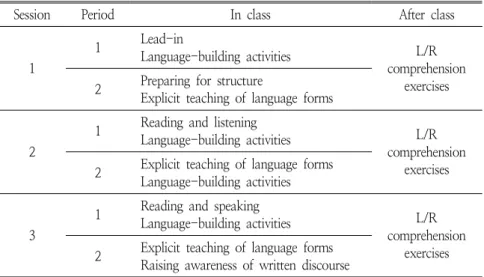
The learning objectives of the traditional COA class were: (1) improvement of listening and reading skills, (2) mastery of the words, sentences, and structural features in focus, (3) a critical awareness of rhetorical styles and conventions in English writing. The classroom instruction was based on the activities in the textbook. Table 1 below presents the classroom activities and assignments for the COA group in each session.
Table 1. Instruction Schedule of the Comprehension-Oriented Approach
Session Period In class After class
1
1 Lead-in
Language-building activities L/R
comprehension exercises 2 Preparing for structure
Explicit teaching of language forms
2
1 Reading and listening
Language-building activities L/R
comprehension exercises 2 Explicit teaching of language forms
Language-building activities
3
1 Reading and speaking
Language-building activities L/R
comprehension exercises 2 Explicit teaching of language forms
Raising awareness of written discourse
Outside the classroom, students’ learning was externally regulated by the exercises from workbooks and online applications, concentrating on receptive comprehension skills with little practice of speaking and writing. Although students were taught about writing, they had no opportunity to put it into practice.
In lead-in, students were first presented with a video clip related to the topic of intercultural differences. New
words in the unit were also introduced. In Unit 1 Writing for Myself, the author depicted his high school English
teacher and his learning experience with the teacher. A video clip from BBC documentaries about a group of
Chinese teachers in a British middle school was used to activate students’ background knowledge. In it, students
from Britain experienced both Chinese and British school life. It brought up the question of why British students did
not like Chinese students’ learning styles and strategies. Recognizing such cultural differences, students recalled their experiences in school.
In language building activities, students learned and practiced new words and structural elements in the unit. For example, the word prim was used to describe the teacher’s appearance and manner, so the students were asked to find out other scenes and expressions pertaining to the word within the text. Alongside the words they newly acquired, the instructor referred to a couple of exemplary sentences containing the target grammatical forms.
Explaining the usage of each target form in the given context, the instructor did not force students to come up with their own examples but rather tried to help them understand its meaning and function. In this respect, it was distinct from explicit explanations of grammar. The alloted time for focus-on-form activities was evenly distributed across all three sessions so as to ensure that students would practice the target forms through spaced repetition.
Besides, students were told to examine other examples and perform additional exercises for after-class assignments.
Unit 2 was about friendship. In this unit, the results of an online survey about social network services were reported. Students read about modern ways of making friends and practiced interpreting non-textual information.
Due to the limitation of classroom time, speaking practice was assigned to the third session as a post-reading activity to review and assess students’ understanding of the text. As mentioned before, there was meaning-based focus-on-form instruction to improve students’ comprehension ability and language accuracy. Importantly, however, it did not provide students with opportunities for output practice.
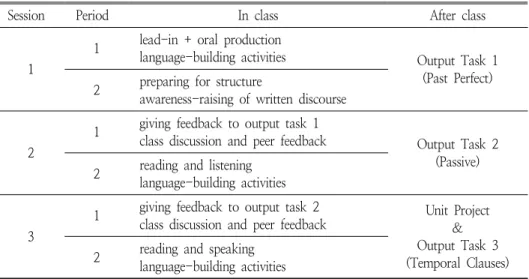
Meanwhile, the learning objectives of the POA group were: (1) fluency building in productive skills, (2) mastery of the words, sentences, and grammatical forms in focus, and (3) enhancement of oral and written discourse competence. The classroom instruction was based on communicative tasks and exercises, and students’ learning after class was self-regulated with a focus on output practice. In their assignments, they were asked to use the grammatical forms they learned in class. Each output and revision process required different forms to be used, with reference to the feedback from the instructor and other peers. The classroom activities and assignments for the POA group are presented in Table 2.
Table 2. Instruction Schedule of the POA
Session Period In class After class
1
1 lead-in + oral production
language-building activities Output Task 1 (Past Perfect) 2 preparing for structure
awareness-raising of written discourse
2
1 giving feedback to output task 1
class discussion and peer feedback Output Task 2 (Passive) 2 reading and listening
language-building activities
3
1 giving feedback to output task 2 class discussion and peer feedback
Unit Project
&
Output Task 3 (Temporal Clauses) 2 reading and speaking
language-building activities
After the same lead-in materials were used to introduce the topic of the unit, the POA group was directed to
talk about their own views on intercultural differences. This arrangement, which manifested the output-driven
hypothesis, had output practice proceed prior to presentation of input in order to promote students’ engagement and
trigger their recognition of the gap between what they want to express about the topic and what they lack in L2
lexicogrammatical resources. Furthermore, the learning-using integration principle of the POA underscores the idea
that language learning takes place most successfully when the form, meaning, and function of the target language are
presented together in cognitively and culturally challenging contexts (e.g., Bi, 2019). The tasks incorporating specific
communicative functions drove learners to express their ideas on the basis of their linguistic and cultural backgrounds. These meaning-negotiation tasks are likely to increase their noticing of the gap in L2 resources via which they can get across their messages.
In language building activities, they were provided with input materials illustrating the context in which the target forms were used appropriately. Importantly, the instructor led students to focus on meaning, rather than attending to the forms themselves. This was assumed to increase the likelihood of students repeatedly paying attention to the forms through a subsequent series of activities, as advocated, for example, by Rottal (1999). Moreover, Soleimani, Jahangiri, and Gohar (2015) claimed that both implicit and explicit grammar instruction were effective in improving their students’ command of passive voice. Robinson and Feng (2016) also reported that implicit consciousness-raising instruction and explicit metalinguistic explanation produced an equal level of improvement in their students’
grammatical competence as measured by error counts.
Therefore, both implicit and explicit grammar instruction were implemented in the POA class. The explicit focus-on-form instruction was given in the form of corrective feedback by the instructor and peer reviews on the first draft of writing. This was one of the main departures from the COA class. The instructor raised students’
consciousness of the target form by showing them several common mistakes and discussing their formal features. The instructor selected one illustrative piece of students’ writing for demonstration and asked students to provide feedback on it with respect to language, content, and structure. After completing their first drafts, students share feedback in small groups and discussed the target forms used in their writing. Similar to the COA group, other supplementary materials were provided to assist students to practice oral production as well as listening and reading comprehension.
To sum up, the POA aims at developing students’ fluency in production skills and accuracy in grammar by means of repetitive cycles of output-driven, input-enabled, and assessment components. Grammar is treated in both implicit and explicit ways, wherein its form, meaning, and function are integrated in meaningful communicative situations. That is, target grammatical forms are presented not in isolated sentences but in the usage contexts students produce on their own. It is worth noting here that one apparent shortcoming of the current implementation of the POA was the lack of speaking practice in the classroom, even though students were required to practice speaking via online exercises outside the classroom.
3.4. Assessment Tools and Analysis
The participating students’ knowledge of and ability to use the target forms were assessed at three different time points: before treatment, immediately after treatment, one month after treatment.
1)*The items were developed in the format and composition of College English Test 4, a nationwide standardized test to assess college students’ English proficiency. All the vocabulary items used in the tests were known to the students.
Each test consisted of five subsections, each of which was designed to evaluate students’ understanding and accurate use of the target forms. The items in the first section required students to identify the order of events described in the sentence or underline the agent or the patient of the denoted action. The second section asked students to put a given set of words in the right order to make a semantically and syntactically well-formed sentence. The third section was composed of multiple-choice questions that demanded students to choose the right form of a verb. The fourth section consisted of cloze items in which students had to fill in the blanks with correct word forms. In the final section, students were prompted to compose a short narrative essay using the target grammatical forms.
Although the tests were to assess students’ understanding and accurate production of three target forms (i.e., past perfect, temporal clauses, and passive voice), other language forms such as present perfect and active voice were also included in order to prevent students from recognizing the intention of the tests. The same scoring method was
1) The delayed post-test was administered one month later because the time gap was assumed to be long enough to observe whether the learned knowledge has been internalized or not, while being short enough not to be much affected by extraneous variables of no present concern.
applied to the three tests. Section 1 contained 15 items with one point for each. Sections 2 and 3 contained 10 items respectively with two points for each. There were 10 items in section 4, each given one point. Finally, the composition task in section 5 was rated on the scale of 35 points in total.
Each grammatical form of interest was evenly distributed. For example, there were three subparts in section 1, each assessing one of the three target forms. The criteria of IELTS were adapted to score students’ compositions in section 5. The rating scale was modulated to take account of the purpose of the guided writing task, i.e., assessing students’ command of the target grammatical forms in meaningful contexts. Students were required to write at least three sentences using the given grammatical form. The completion of this requirement accounted for 50% of the total score.
A pilot test was administered to a sample of students from other classes. The students said that all the items were valid and acceptable, but a few found the directions given in English difficult to understand at once. So the directions were changed into Chinese in the final version. After the post-test, an interview with individual participants was conducted. They were asked to offer their perceptions of the effectiveness of the language course.
The interview was semi-structured with the following questions: What grammatical forms have you acquired in this course? Can you give some examples of the forms you have learned? What do you think about this English course?
Did it help you develop your proficiency and grammatical accuracy? etc.
4. Results
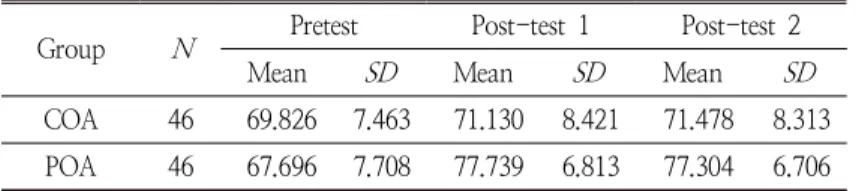
The two groups’ mean scores and standard deviations on the pre- and two post-tests are shown in Table 3.
Those who did not take any one of the tests were excluded from analysis.
Table 3. Descriptive Statistics for Three Tests
Group N Pretest Post-test 1 Post-test 2
Mean SD Mean SD Mean SD
COA 46 69.826 7.463 71.130 8.421 71.478 8.313 POA 46 67.696 7.708 77.739 6.813 77.304 6.706
While the COA group increased from 69.826 to 71.130 on the immediate post-test and 71.478 on the delayed post-test, the POA group increased from 67.696 to 77.739 and 77.304 on the two post-tests, respectively. The difference between the two groups was not statistically significant on the pretest, t
(1)= -1.35, p = .181. But the difference was significant on the immediate post-test, t
(1)= 4.14, p = .000, and on the delayed post-test, t
(1)= 3.70, p = .000. The interaction between two factors (i.e., instructional methods and test scores at three points of time) was significant, F
(2,89)= 60.64, p = .000, η
2= .577. The effect size was large, indicating that over 50% of the observed variance can be attributed to instruction method. The COA group did not show a significant improvement between the pretest and the immediate post-test, while a significant difference was observed between the pretest and the delayed post-test.
Although the COA group had made some progress in grammatical accuracy ― that is, their performance
improved after two months of learning in college ― they did not gain as much as the POA group. It is, however,
still in question whether the advantages of the POA were owing to its positive effects on students’ comprehension or
production of the target forms. One may hypothesize that since the POA devoted more time to production activities,
it might well improve students’ production skills but it was not more advantageous than the COA insofar as
comprehension is concerned.
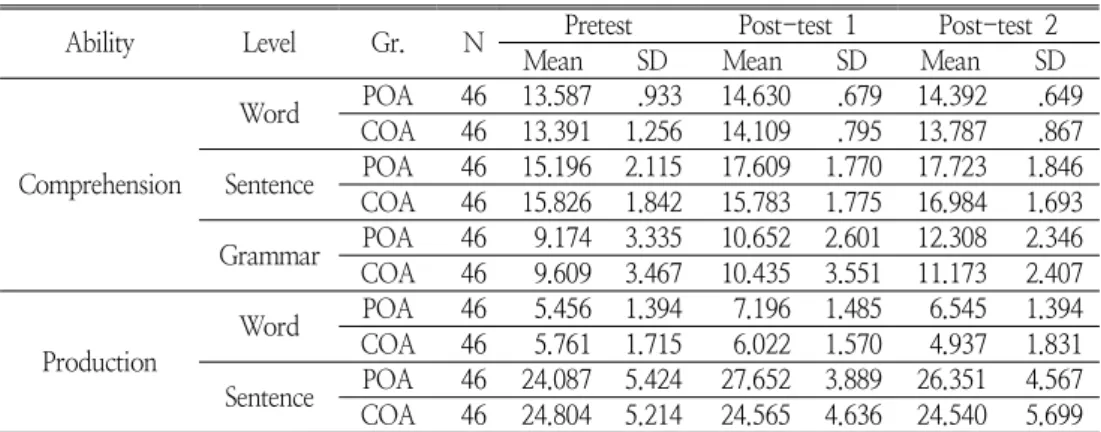
Table 4. Descriptive Statistics by Assessment Subsection
Ability Level Gr. N Pretest Post-test 1 Post-test 2
Mean SD Mean SD Mean SD
Comprehension
Word POA 46 13.587 .933 14.630 .679 14.392 .649
COA 46 13.391 1.256 14.109 .795 13.787 .867 Sentence POA 46 15.196 2.115 17.609 1.770 17.723 1.846 COA 46 15.826 1.842 15.783 1.775 16.984 1.693 Grammar POA 46 9.174 3.335 10.652 2.601 12.308 2.346 COA 46 9.609 3.467 10.435 3.551 11.173 2.407
Production
Word POA 46 5.456 1.394 7.196 1.485 6.545 1.394
COA 46 5.761 1.715 6.022 1.570 4.937 1.831
Sentence POA 46 24.087 5.424 27.652 3.889 26.351 4.567 COA 46 24.804 5.214 24.565 4.636 24.540 5.699
Therefore, a repeated measures ANOVA was run to examine the two groups’ performance on each assessment section. The results revealed that except for the grammar section, the two groups showed a significant difference in all the other four sections. In other words, the POA group achieved higher than the COA group in comprehension measures as well as production measures at both lexical and sentential level: word-level acquisition, F
(2,89)= 23, p = .000, η
2= .346; sentence-level acquisition, F
(2,89)= 33, p = .000, η
2= .431; word-level production, F
(2,89)= 24, p
= .000, η
2= .355; sentence-level production, F
(2,89)= 5, p = .000, η
2= .117.
In order to examine whether the benefits of the POA were limited to any one of the target forms or were extended across all the target forms, another line of analysis was conducted with respect to three target forms.
Table 5. Descriptive Statistics for Three Target Grammatical Forms
Target Form Group N Pretest Post-test 1 Post-test 2
Mean SD Mean SD Mean SD
Past Perfect (30)
POA 46 17.63 3.094 19.78 3.552 19.93 2.977
COA 46 17.72 3.576 17.85 3.899 17.61 2.940
Temporal Clauses (21)
POA 46 15.85 2.403 18.80 1.721 18.59 2.247
COA 46 16.65 2.451 17.35 2.203 17.72 2.115
Passive Voice (27)
POA 46 16.07 3.791 19.87 3.739 20.07 3.599
COA 46 17.13 3.344 18.52 3.456 18.09 3.224
Note: Numbers in parentheses refer to numbers of items, hence full marks.