• 검색 결과가 없습니다.

Catheter Ablation of Ventricular Arrhythmias via the Radial Artery in a Patient With Prior Myocardial Infarction and Peripheral Vascular Disease

N/A
N/A
Protected

Academic year: 2022

Share "Catheter Ablation of Ventricular Arrhythmias via the Radial Artery in a Patient With Prior Myocardial Infarction and Peripheral Vascular Disease"

Copied!
6
0
0

로드 중.... (전체 텍스트 보기)

전체 글

(1)

Introduction

Peripheral artery disease (PAD) is comorbid in 10.6% of patients with ischemic heart disease.

1)

The difficulty in accessing the arterial system may complicate ventricular tachycardia (VT) ablation proce- dures in patients with PAD. The radial artery is the preferred access route for patients undergoing percutaneous coronary intervention, in terms of the patients’ comfort and in terms of a decreased risk for vascular complications.

2)3)

Herein, we present a case of a success- ful catheter ablation of VT by radial artery access in a post-myocar- dial infarction patient with PAD, who had previously failed ablation via a transseptal approach.

Case

A 73 year-old man with prior anterior myocardial infarction was admitted for management of an electrical storm (ES) occurring 20

Jun Kim, MD, Dongcheul Han, MD, Changbae Sohn, MD, Jeong Su Kim, MD, and Yong Hyun Park, MD

Division of Cardiology, Pusan National University Yangsan Hospital, Yangsan, Korea

Herein, we present a case of a successful catheter ablation of ventricular tachycardia (VT) using a radial artery approach in a post-myocar- dial infarction patient, who had an implantable cardioverter-defibrillator and peripheral artery disease. Although the patient did not use anti- arrhythmic drugs, the patient experienced no recurrence of VT during the following 3-year period. (Korean Circ J 2012;42:632-637) KEY WORDS: Catheter ablation; Ventricular tachycardia; Ventricular premature complexes; Radial artery.

Received: December 16, 2011 Revision Received: February 8, 2012 Accepted: February 13, 2012

Correspondence: Jun Kim, MD, Division of Cardiology, Pusan National University Yangsan Hospital, 20 Geumo-ro, Mulgeum-eup, Yangsan 626- 770, Korea

Tel: 82-55-360-2357, Fax: 82-55-360-2204 E-mail: [email protected]

• The authors have no financial conflicts of interest.

This is an Open Access article distributed under the terms of the Creative Commons Attribution Non-Commercial License (http://creativecommons.

org/licenses/by-nc/3.0) which permits unrestricted non-commercial use, distribution, and reproduction in any medium, provided the original work is properly cited.

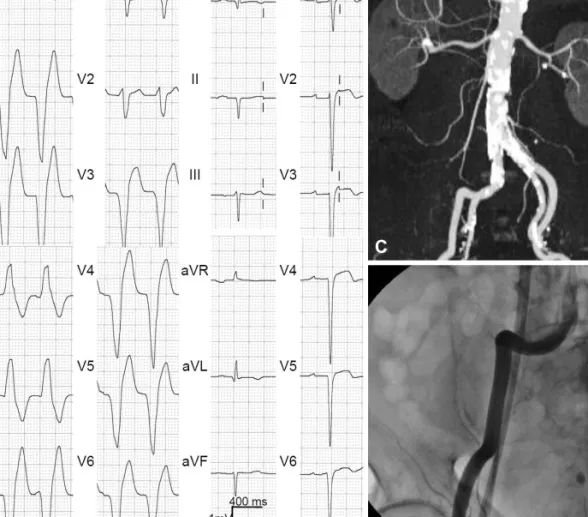
months after the implantation of an implantable cardioverter-de- fibrillator (ICD). His medical conditions included an anterior myocar- dial infarction that had occurred 15 years prior, heart failure, periph- eral arterial disease, non-disabling stroke, hypertension, gout, and dia- betes mellitus. He underwent implantation of dual chamber ICDs due to sustained VT (Fig. 1A and B). At the time, the left ventricular (LV) ejection fraction was 36%, and a LV aneurysm was noted. Co- ronary angiography showed a 50% stenosis in the mid-portion of the left anterior descending artery, 80% stenosis at the distal left circumflex artery, and 40% stenosis in the proximal right coronary artery. His medications included a beta-blocker, amiodarone, an an- giotensin-converting enzyme inhibitor, aspirin, and diuretics. Com- puted tomography angiography revealed extensive calcification from the distal abdominal aorta to the bilateral common iliac artery and the tortuous right common iliac artery (Fig. 1C and D).

The patient underwent catheter ablation for medically refractory, frequent premature ventricular complexes (60% of total beats) that were originating from the left apico-inferior septum. The ablation was performed by a transseptal approach due to the deterioration of heart failure, which had begun 13 months before presentation (Fig. 2).

Before the occurrence of the ES, there was only one episode of VT treated with anti-tachycardia pacing. Sixteen episodes of VT with a cycle length of 430 to 455 ms occurred per day, and 3 episodes were terminated by cardioversion (20 J).

After obtaining informed consent from the patient, he underwent catheter ablation of VT via a transseptal approach, using an external irrigation catheter (power-controlled mode, 30 Watts, 45°C, 17 mL/

min). During the procedure, VT was still inducible by programmed

(2)

electrical stimulation after ablation, guided by entrainment map- ping and pacemapping.

4)

Due to limitations in catheter localization in LV anterior and lateral wall, VT was still inducible after the abla- tion. Procedural and radiofrequency delivery times were 6 hours and 30 minutes for this procedure, respectively. The patient under- went a second catheter ablation of VT via the left radial artery 4 days later. Access to the radial artery was performed after confirmating normal results of an Allen’s test. During a 2nd session, a 6 Fr abla- tion catheter with a 4 mm distal tip was used for mapping and ab- lation (temperature-controlled mode, 50 Watts, 60°C). In brief, we induced VT by extra stimulation up to S4 from the right ventricular apex or outflow tract with/without isoproterenol infusion. When VT was induced, ablation catheter was moved systematically around the LV from apex to the mid-ventricular level, inferior to superior and septal to lateral to search for presystolic and diastolic poten- tials. In hemodynamically stable VT, entrainment mapping was per- formed and delivery of RF energy was done. If VT was terminated in less than 20 seconds, RF energy was delivered for 60 seconds and booster energies were delivered around the site. If VT was not termi-

nated in less than 20 seconds, delivery of RF energy was stopped.

During sinus rhythm, we mapped the late potential in the apex and border zone of aneurysm and normal myocardium. When late po- tential was found, we performed pacemapping and delivery RF en- ergy where 11-12/12 leads of pacemap was matched to induced VT.

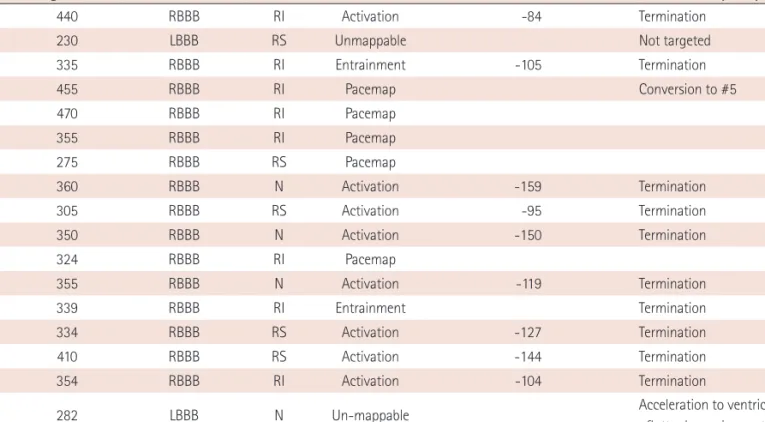
After applications of RF energy, we repeated VT induction and de- livery of RF energy until stable VT was not induced. A total of 17 sus- tained VT forms were induced, and 10 forms of VT were successfully terminated with radiofrequency energy during the 1st and 2nd VT ablations (Fig. 3) (Supplementary data). Major sites of ablation were LV anterior, anterolateral, inferolateral, inferior wall between LV an- eurysm and normal LV myocardium. Three forms of VT were treated with guidance from pace mapping. After the ablation procedure, only hemodynamically unstable VT was induced by triple ventricular extra stimulation and externally cardioverted. Procedural and ra- diofrequency delivery times were 3 hours and 36 minutes for the 2nd procedure, respectively. The procedure was completed without complications. After the VT ablation procedure, the patient had no recurrence of premature ventricular complex (PVC) or VT during a

A   B  

C  

D  

Fig. 1. Electrocardiograms and angiograms of the patient. A: a 12-lead electrocardiogram of initial ventricular tachycardia had configuration of a left bundle

branch block and left axis deviation. B: a 12-lead electrocardiogram after restoration of sinus rhythm. C: extensive calcification of the abdominal aorta and

iliac arteries were noted in computed tomography angiography. D: a very tortuous, angulated right common iliac artery is shown.

(3)

3-year follow-up period, without the use of amiodarone.

Discussion

We have presented a successful catheter ablation of a VT ES, via the radial artery, in a patient with remote myocardial infarction and PAD. This is the first report on the use of the radial artery in ablation of VT in Korea.

Frequent PVC can cause reversible ventricular dysfunction in pa- tients both with and without structural heart disease.

5)6)

Purkinje fi- bers are resistant to ischemic insult,

7)

and surviving Purkinje fibers may participate in reentrant circuits of VT.

8)9)

In addition, Purkinje fiber-related VPC can precipitate polymorphic VT and ventricular fibrillation in susceptible patients.

10)11)

Mapping and selectively ab- lating PVC, guided by Purkinje potential, is effective in some pa- tients with remote myocardial infarction.

12)

Electrical storms occur in 10-23% of patients with implantable cadioverter-defibrillators.

13-15)

Prophylactic treatment with amiod- arone and beta-blockers decreases the occurrence of VT.

16)

Catheter ablation is needed to control ES in patients with structural heart dis- ease that is refractory to antiarrhythmic drugs.

10)17)

In this case, a 2nd catheter ablation procedure was needed to con-

trol the ES. Access to the LV is usually achieved via a retrograde aor- tic approach. However, in patients with extensive aortic and pe- ripheral arterial disease, access through the femoral artery carries the potential risk of cholesterol embolism and stroke; a transseptal approach to the LV circumvents this risk. Another option in patients with extensive peripheral arterial disease is access via the brachial or radial arteries.

18)

Because of easy maneuverability of catheter mo- vement in the septum, as well as the anterior and lateral left ven- tricle from the radial approach, multiple forms of VT were success- fully ablated in the second session. Though we were not limited in our ability to manipulate the ablation catheter via the radial artery, access through the brachial artery may carry a lower risk of arterial spasm.

There are several limitations to this study. First, prophylactic cath- eter ablation before the implantation of a defibrillator decreases the occurrence of ventricular tachyarrhythmia.

19)

Earlier catheter abla- tion may have prevented late ESs in this case. Second, arterial ac- cess using a long sheath, together with use of an electro-anatomic mapping system, may be sufficient for preventing peripheral com- plications, assisting with the delineation of anatomic circuits for mul- tiple VTs and decreasing procedural time. Third, catheter ablation us- ing a Stereotaxis Niobe system may facilitate mapping of the left A  

B  

C  

Fig. 2. Intracardiac tracings (A) and right and left anterior oblique fluoroscopic image (B and C) mapping of the premature ventricular complex. The sur-

face electrocardiogram, proximal and distal bipolar electrograms from the ablation catheter (Abl p, Abl d), His recording catheter (His p, His d), right ven-

tricular apex (RVA), and arterial pressure are shown from top to bottom. A Purkinje-like potential, preceding QRS onset of PVC by 112 ms, is found in the

left ventricular apico-inferior septum. The application of radiofrequency energy at the site abolished PVC in seconds. The A-lead and ICD lead denote atrial

and ICD leads, respectively. PVC: premature ventricular complex, ICD: implantable cardioverter-defibrillator.

(4)

ventricle via a transseptal approach.

In conclusion, catheter ablation of VT storms can be performed using a transradial approach to the left ventricle and a conven- tional electrophysiologic mapping maneuver in patients with prior myocardial infarction and peripheral vascular disease. The success- ful ablation of VT made the use of antiarrhythmic drugs unnecessary in this case.

Acknowledgments

This work was supported by a 2012 research grant from Pusan National University Yangsan Hospital.

References

1. Bhatt DL, Steg PG, Ohman EM, et al. International prevalence, recogni- tion, and treatment of cardiovascular risk factors in outpatients with atherothrombosis. JAMA 2006;295:180-9.

2. Kim JY, Yoon J, Jung HS, et al. Feasibility of the radial artery as a vascu- lar access route in performing primary percutaneous coronary inter- vention. Yonsei Med J 2005;46:503-10.

3. Choussat R, Black A, Bossi I, Fajadet J, Marco J. Vascular complications and clinical outcome after coronary angioplasty with platelet IIb/IIIa receptor blockade: comparison of transradial vs transfemoral arterial access. Eur Heart J 2000;21:662-7.

A  

B  

C  

Fig. 3. Intracardiac tracings (A) and right and left anterior oblique fluoroscopic images (B and C) of ventricular tachycardia ablation approached from the left radial artery. Surface electrocardiograms, proximal and distal bipolar electrograms from the ablation catheter (Abl p, Abl d) and right ventricular apex (RVA) are displayed from top to bottom. Mid-diastolic potential was recorded prior to the onset of VT by 114 ms and the application of radiofrequency en- ergy terminated the VT within seconds (A). The successful ablation sites (anterolateral left ventricular apex) are shown in B and C. The A-lead and ICD lead denote atrial and ICD leads, respectively. VT: ventricular tachycardia, ICD: implantable cardioverter-defibrillator.

4. Stevenson WG, Friedman PL, Sager PT, et al. Exploring postinfarction reentrant ventricular tachycardia with entrainment mapping. J Am Coll Cardiol 1997;29:1180-9.

5. Takemoto M, Yoshimura H, Ohba Y, et al. Radiofrequency catheter ab- lation of premature ventricular complexes from right ventricular out- flow tract improves left ventricular dilation and clinical status in pa- tients without structural heart disease. J Am Coll Cardiol 2005;45:

1259-65.

6. Sarrazin JF, Labounty T, Kuhne M, et al. Impact of radiofrequency abl- ation of frequent post-infarction premature ventricular complexes on left ventricular ejection fraction. Heart Rhythm 2009;6:1543-9.

7. Friedman PL, Stewart JR, Fenoglio JJ Jr, Wit AL. Survival of subendo- cardial Purkinje fibers after extensive myocardial infarction in dogs.

Circ Res 1973;33:597-611.

8. Bogun F, Good E, Reich S, et al. Role of Purkinje fibers in post-infarc- tion ventricular tachycardia. J Am Coll Cardiol 2006;48:2500-7.

9. Bogun F, Crawford T, Chalfoun N, et al. Relationship of frequent po- stinfarction premature ventricular complexes to the reentry circuit of scar-related ventricular tachycardia. Heart Rhythm 2008;5:367-74.

10. Bänsch D, Oyang F, Antz M, et al. Successful catheter ablation of elec- trical storm after myocardial infarction. Circulation 2003;108:3011-6.

11. Szumowski L, Sanders P, Walczak F, et al. Mapping and ablation of polymorphic ventricular tachycardia after myocardial infarction. J Am Coll Cardiol 2004;44:1700-6.

12. Sarrazin JF, Good E, Kuhne M, et al. Mapping and ablation of frequent

(5)

tients with an implantable defibrillator: incidence, features, and pre- ventive therapy: insights from a randomized trial. Eur Heart J 2006;

27:3027-32.

16. Connolly SJ, Dorian P, Roberts RS, et al. Comparison of beta-blockers,

19. Reddy VY, Reynolds MR, Neuzil P, et al. Prophylactic catheter ablation for the prevention of defibrillator therapy. N Engl J Med 2007;357:

2657-65.

(6)

Supplementary data

Table 1. Summary of induced ventricular tachycardia and response to radiofrequency ablation

# VT number

VT cycle

length (ms) Configuration Axis Mapping Presystolic potential ahead of VT onset (ms)

Response to application of radiofrequency energy

1 440 RBBB RI Activation -84 Termination

2 230 LBBB RS Unmappable Not targeted

3 335 RBBB RI Entrainment -105 Termination

4 455 RBBB RI Pacemap Conversion to #5

5 470 RBBB RI Pacemap

6 355 RBBB RI Pacemap

7 275 RBBB RS Pacemap

8 360 RBBB N Activation -159 Termination

9 305 RBBB RS Activation -95 Termination

10 350 RBBB N Activation -150 Termination

11 324 RBBB RI Pacemap

12 355 RBBB N Activation -119 Termination

13 339 RBBB RI Entrainment Termination

14 334 RBBB RS Activation -127 Termination

15 410 RBBB RS Activation -144 Termination

16 354 RBBB RI Activation -104 Termination

17 282 LBBB N Un-mappable Acceleration to ventricular

flutter by pacing; not targeted

RBBB: right bundle branch block, LBBB: left bundle branch block, RI: right inferior, RS: right superior, N: normal

수치

Fig. 1. Electrocardiograms and angiograms of the patient. A: a 12-lead electrocardiogram of initial ventricular tachycardia had configuration of a left bundle  branch block and left axis deviation
Fig. 2. Intracardiac tracings (A) and right and left anterior oblique fluoroscopic image (B and C) mapping of the premature ventricular complex
Fig. 3. Intracardiac tracings (A) and right and left anterior oblique fluoroscopic images (B and C) of ventricular tachycardia ablation approached from the  left radial artery
Table 1. Summary of induced ventricular tachycardia and response to radiofrequency ablation

참조

관련 문서