Vol.14 No.1 2005 15
Changwoo. Woo C.D.T * Sunhong. Hwang D.D.S. MS
Keunwoo. Lee D.D.S. PH.D
Dental technician. Central Dental Laboratory. Yonsei Medical Center. Seoul.KOREA*
Department of Prosthodontics, School of Dentistry, Yonsei University, Seoul,KOREA
In order to recover the esthetic of the missing anterior area, we must consider color, shape of a tooth and the functions of a prosthesis that is harmonized with the surrounding factors .
When the tooth of a natural tooth is exposed, we face to challenge to restore them. several factors cause resorption of bones, in flammation, and gum trouble, and a defective prosthesis damages the aesthetics of the gingiva. There are two ways how to solve these problems. One can be done by periodontal surgery and the other can be done by prosthesis. Most patients want aesthetic restoration that is harmonized with their teeth and gingiva. So if prosthesis is fabricated to expose the root exposed, it is far from the patient’s expectation.
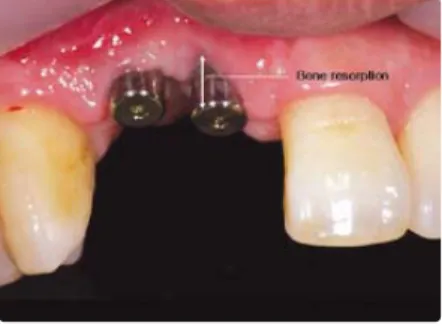
After implantation, implant platform became exposed due to resorption of bone and lack of soft tissue, which was solved by prosthesis rather than operation.
Abstract
Aesthetic Reproduction in loss of periodontal tissue using gingival ceramic
Fig 1 . Exposure of implant platform by missing of soft tissue
Journal of the Korean Academy of Esthetic Dentistry 16
Aesthetic Reproduction in loss of periodontal tissue using gingival ceramic
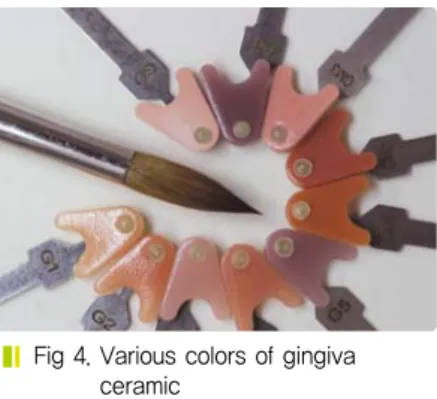
Most of the system have various colors of the gingiva. In order to express a natural color of the gingiva. The color and transparency of each area should be different. For example, the gingiva of the root should be bright, while the gingival margin should be highly transparent.
Fig 2 Select the value of tooth, the type of dentin and enamel, and individual effects, and then, do color mapping.
Fig 3 . Use gingiva shade guide to select a color
Fig 5.
It is possible to reproduce the color with basic colors by applying pink opaque to the tissue area and shade opaque to the crown area
Fig 6. Mapping of gingiva ceramic
Do color mapping with one’s sense of colors obtained through experience. Through a lot of training and experience of color mixing, it is possible to find the necessary color from a patient’s mouth. In IPS d.SIGN, the gingiva kit has various colors and transparency so it is easy to express the color. (Fig. 4). This prosthesis lengthens the tissue through an application of the gingival ceramic, so in consideration of oral hygiene, prosthesis of a removable type was designed. For reinforcement of retention, attachment including friction pin and plastic sleeve was added to the palatal side.
Fig 4. Various colors of gingiva ceramic
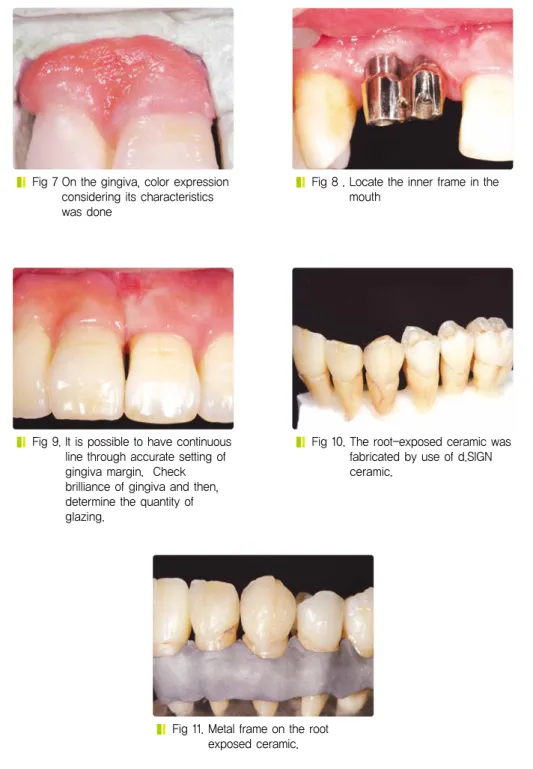
Vol.14 No.1 2005 17 Fig 7 On the gingiva, color expression
considering its characteristics was done
Fig 8 . Locate the inner frame in the mouth
Fig 9. It is possible to have continuous line through accurate setting of gingiva margin. Check brilliance of gingiva and then, determine the quantity of glazing.
Fig 10. The root-exposed ceramic was fabricated by use of d.SIGN ceramic.
Fig 11. Metal frame on the root exposed ceramic.
A Single use of the gingival powder lowers the natural quality of the gingiva and deteriorates transparency. Therefore, an appropriate mix of trans power is essential. In order to raise the value of the root eminence area, DA1 was added. (Fig. 8) For a natural extension of the gingival ceramic margin, transpa-neutral was added to show the color of the inside.
Journal of the Korean Academy of Esthetic Dentistry 18
Aesthetic Reproduction in loss of periodontal tissue using gingival ceramic
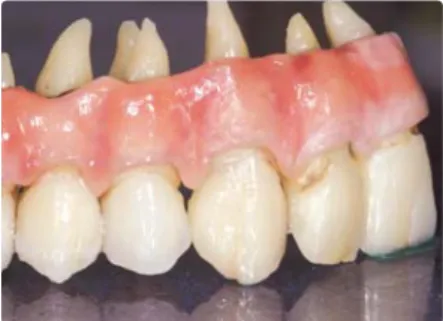
Fig 12. Gingiva powder that is built up on the metal frame
Fig 13. Various colors of gingiva were expressed by area
Fig 14. Various degrees of transparency and colors of gingiva can express the natural quality
Root ceramic was expressed, for which a natural tooth was used as the model. It is a good way to experience the color of the ceramic in advance and to obtain the morphological knowledge of teeth. The exposed root was covered with the gingival ceramic. This training makes it possible to experience the color of the gingiva, to obtain the sense of colors, and to mix various colors.
Contact address
120-752 134 Seodaemun-gu Shinchon-dong Seoul. KOREA.
Central Dental Laboratory. Dental hospital. Yonsei Medical Center.
E-mail: [email protected] Homepage:www.Zahntech.co.kr Tel.+82+2+2228+8923