다중 사용자 온라인 게임 개발을 통한 소프트웨어 개발 교육
Software Development Education through Developing a usable Multiplayer Online Game
윤일미*, 게리 앵**, 권오영***
Ilmi Yoon*, Gary Ng**, Oh Young Kwon***
요 약
게임제작은 전산학을 가르치는 효과적이고 매력적인 방법이다. 다중사용자 게임제작은 기술, 팀웍, 소프트웨어 공학등 중요한 측면들을 요구하고 있다. 전체 클래스를 다수의 팀으로 구성하고, 학생들은 하나 혹은 두 개의 팀 에 속하였다. 각 팀은 한학기동안 자신들의 진행상황을 발표하고, 향후 이정표와 트러블슈팅에 대해 논의하고, 명 확한 소통을 위해 문서를 갱신하고, SVN(Subversion)을 활용하였다. 다른 클래스 구성과 달리, 모든 학생이 하 나의 목적을 달성하려는 회사처럼 서로 협력하여 일을 했다. 한학기동안 학생들은 개념설계부터 시작해서
“deBugger(2009)"와 ”World of Balance(2011)"라는 다중사용자 온라인 게임을 완성했다. 더불어 게임설계, 3D 그래픽스, 게임엔진, 서버-클라이언트 구조, 게임프로토콜, 네트워크 프로그래밍, 데이터베이스, 소프트웨어공학, 팀 프로젝트로서 대규모 어플리케이션 제작방법들을 학습할 수 있었다.
Key Words : Multiplayer Online Game, Game development, Industry style team work, Team project taught class
ABSTRACT
Building a game has been used as effective and attractive way of teaching computer science.
Building a usable Multi-player Game is requires important aspects of technology, teamwork and software engineering principles. The whole class was structured in to several teams and students needed to join one or two teams. Each team presented their progress, discussed future milestones and troubleshoots, updated documents for clearer communication and utilized SVN(Subversion) throughout the semester. Unlike usual class setting, all students worked collaboratively together like one company to achieve the goal. In one semester, students started from concept design and completed a working Multiplayer Online Game called “deBugger” (Fall 2009), and “World of Balance” (Fall 2011), while learning game design, 3D graphics, Game Engine, Server-client architecture, Game Protocol, network programming, database, Software Engineering principles, and large application development as a team project.
* Computer Science Dept, San Francisco State University([email protected])
** Pacific Ecoinformatics and Computational Ecology Lab
*** 한국기술교육대학교 컴퓨터공학부 ([email protected]) 제1저자 (First Author) : 윤일미
교신저자 : 권오영 접수일자:2012년 12월 4일 수정일자:2012년 12월 18일 확정일자:2012년 12월 21일
Ⅰ. Introduction
Game design and development has become a popular computer science course over recent two decades. As students’ enthusiasm to build game has been so strong, instructors utilized the eagerness to teach many aspects of computing, including computer graphics, artificial intelligence, human-computer interaction, security, simulation, and software engineering[1]. Parberry [2] studied what game companies commonly want, so their game course to be designed to teach the experience; (1) work on a large project, (2) creation of game demo, (3) team player, and (4) learn independently and taught them in game class. These previous work shows the promising potential that students are willing to take a tough and intensive course work to achieve the goal of building game.
Social gaming and MMORPG(Massively Multiplayer Online Role-Playing Game) are relatively recent game genres as they bloom over the availability of Internet. Social interactions within the game radically increase the excitement of the game further and popular games easily develop communities of multimillion players [3].
Therefore, building a MMORPG game can motivate CS(Computer Science) students to focus on the course work and increase learning outcome substantially. Unlike stand-alone game, a MMORPG game keeps virtual world persistent even after players log out, so game server has to run infinitely connecting all the clients and updating game status at database. Therefore, building a MMORPG game covers broad spectrum of computer science technology from computer graphics, 3D modeling, game engine, network programming, client-server architecture, and database, so it helps students exposed to diverse technical components comprehensively. Also a MMORPG game is indeed a large application and building one ensures students to learn the qualities that software companies want.
The purpose of this paper explains how to
design a semester course to teach software development by building MMORPG game how to transform the experience of game development into enterprise level software development.
In section 2, we discuss the course design to teach students to build a working MMORPG game within a semester (15 weeks). In section 3, we present the results and learning outcome.
Conclusion and future work are discussed at section 4.
Ⅱ. Course Design
This class was designed for SFSU(San Francisco State University) CS senior and graduate students who completed programming languages, data structures and Software Development Principles but not necessarily have taken elective courses such Software Engineering, Network nor Database courses. Considering that majority of students find jobs at industry after graduation, the class was organized in more of industrial flavor; a team of students (1) receive tasks and milestones, (2) achieve the milestones by actively looking for solutions from any available resources, (3) interact with other teams collaboratively, (4) and produce documents for clear communications between teams and future extensions.
The class was organized into Game Concept Design team, Game Server team, Game Client team, Game protocol team, Database team, Art Support team, Game Content team, Testing team, and Launching team. Within first 2 weeks, objectives and the responsibility of each team were discussed and then students were assigned into one or two teams based on their interest and backgrounds. From then on, teams worked on in parallel to achieve their milestones, while learning all the required technology for the given task and sharing their learning with other teams. Summary of each team’s task is as below.
Game Concept Design Team: this team has most important initial responsibility. The objective of the whole class was to build an educational
MMORPG for Computer Science students, especially for beginners who are taking first programming courses. The concept design team should consider the limitations such as time (10 weeks for actual implementation), lack of artists, and unknown factors like the potential of other team’s performance. The team also has to collect everyone’s idea, finalize the game concept into several milestones and produce the documentation.
Game Client Team: this team is responsible to implement 3D game client using Panda3D.
Students have to learn 3D graphics, Panda3D game engine and Python. Also client communicates with server using the game protocol to update the status (position, motions, and levels, etc) of other clients concurrently in the same virtual space.
Game Server/Protocol Team: this team is responsible to implement game server that connects to all the clients, synchronize every client status and update the Database. Team did not start from scratch as there was a JAVA game server written for a similar MMORPG game called
“NurseTown” by students of Internet Application course. The server team had to read and revise the game server to work for new game. Also the server team has to develop an effective set of protocols used between clients and server.
Students in this team have to learn socket programming, client-server architecture, and Network protocols.
Game Database Team: this team is responsible to design the DB schema, install mySQL server and deploy the DB for every activity to maintain virtual persistent world. Students in this team have to learn SQL, Database scheme design and mySQL server management.
Art Support Team: this team is responsible to provide 3D models to create the virtual world and characters in the game. As there are no artists in the class, this team has to find freely available 3D models and convert the format to work with Panda3D. Students in this team have to learn basic of 3D modeling tools such as Blender or Maya and converting 3D model formats, and real
time rendering performance trade-off (visual quality vs. rendering speed).
Game Content Team: this team develops educational contents. As senior or graduate students of computer science, this team is already familiar with educational contents that beginner programmers learn which is good and bad. This team needs to interview beginner students, observe the troubles that they probably forgot and produce effective educational contents.
Game Testing Team: this team is responsible to create scenarios for testing the stability of client, server and protocols. One main task is to develop an autonomous client that connects to the server and simulates an ordinary client. Then the scaling of such clients can be used to test the server and protocols. The students in this team have to learn Panda3D, network protocols and practices in software testing planning.
Game Launching Team: this team is responsible to develop a web site where client installer can be easily downloaded and players can get simple instructions about how to get started with games – game rules, help, hot keys, etc. Also this team works on packaging the client program into an easy installer program.
IT Support Team: this team is responsible for helping every team to function without any system/software issues. For example, this team sets up SVN and creates account for each student.
This team also helps teams to set up development environment.
There were a little over 20 students in the class, so each student choose one primary team and one secondary team, so each team has at least 2 to 3 students. By having students in a few different teams, students could learn more than one technical area and teams can communicate and update the progress easily. Each team has to work very collaboratively as the whole class works for one project together.
Important concepts and technologies were taught to the whole class by several lectures, but most of class meetings were used as presentation of
milestones, progress, trouble shootings of problems on hand, so the whole class stays in a same page and gets exposed to the problem and solutions.
Software Engineering principles have been practiced throughout the whole course as teams realized the importance of the inter-team communications due to the rapid developments in parallel. Changes in one team did propagate changes in milestones or requirements in other teams.
Ⅲ. Results
The whole class successfully completed a working MMORPG game at both 2009 Fall (DeBugger - http://smurf.sfsu.edu/~debugger/) and 2011 Fall
(World of Balance -
http://smurf.sfsu.edu/~debugger/wb/) when the courses were offered in this style.
1. DEBUGGER
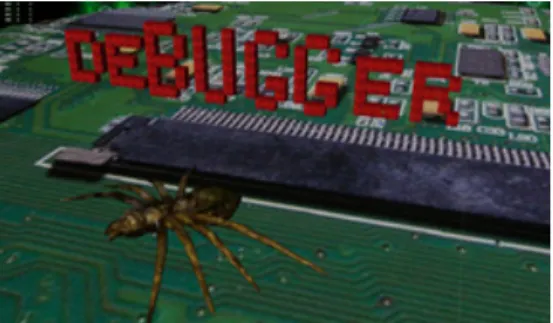
Each team achieved milestones close to the initial (very ambitious) goal. Game concept team came up with the title, “deBugger” and the theme of the game; fighting against bugs within inside of computer, inspired by the origin of the word and the significance of the word to computer science students. Team also prioritized concepts in to several milestones, so kept the milestones doable for one semester, but left many interesting ideas for future extensions.
Fig. 1. Theme of the game.
Primary milestone for Fall 2009 was to build virtual world where players can explore and fight with bugs by solving multiple choice questions.
Health drops under bug’s attack and game items can be used to shield from the bug’s attack (delay the health damage or clear out options from the multiple selections). Players can level up by solving questions required by each level. Also player should be able to chat, create friends’ list and maintain their inventory (trading or giving gifts).
Art Support Team achieved beyond the requirement. Students learned 3D modeling tools and created 3D environments for the game. We used 3D character models from Panda3D repository, but all the environments (figure 2 & 3) were created by art support team and theme was inspired by movie Matrix and Tron during inspirational discussions at class.
Fig. 2. A corner of motherboard. This is a dungeon where lots of bugs live. Players can teleport into this space from the initial desk space.
Fig. 3. Another corner of motherboard.
Client Team was the largest team and they were divided into sub teams to be responsible for specific tasks in parallel. List of such tasks are as
below.
z Registration Process
Avatar Selection z Login Process, Chat z Bubbles (translucent panel)
Chat Bubbles
Character Name and Damage Bubbles z Friends, Inventory
z Character Info, Hot keys, Camera control z Character Movements
Interface (mouse, Keyboard)
Collision
z Battle System (figure 4)
z NPCs (Non Player Character) (figure 5) z Bug, Mini maps
Fig. 4. Battle System. - A player is fighting with a bug inside of computer by solving the quiz. On the right upper corner, there is a mini-map showing the current location of the player. At the bottom, there is a bar where user can click to activate several game functions such as chat box or user inventory.
Fig. 5. NPC (Non Player Character) requires simple AI to interact with players; guide players to follow rules of game or inform about events to participate.
Fig. 6. Bugs are attacking players. Bugs have AI to chase the player, handle collision and re-spawn.
Fig. 7. Health bar shows the damage from the bug’s attack. This player lost all the health.
Client team also achieved impressive progress of completing all the requirements and the resulting game client was reliable and capable of very smooth rendering. Each task listed above took intensive effort to understand the technology (3D graphics) to manipulate Panda3D game engine.
Server team worked hard to make MMORPG game alive. Server team was able to reuse the majority of server code built for a game called,
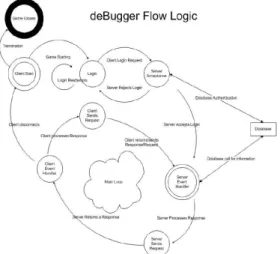
“Nursetown” by Prof. Ilmi Yoon and her graduate students. Server team had to understand the communication mechanism (figure 8 & 9) and modified DB schema and added lots of new game protocols.
Game Contents team focused on adding educational contents into the game. They attended
“Introduction to Computer Programming” class to refresh the memory of what they learnt at the beginning level and interviewed students of the
course. Game contents team structured pedagogy of computer programming learning and created quizzes in different levels for such purpose.
Fig. 8. deBugger Flow Logic used to show the cycle of information being passed between Client and Server
Fig. 9. Handling of Request and Response from Game Client to Game Server. In the picture, starting at 1 the game client A sends the game server a request. The game server receives the request from its game client object. At 2 the game server handles the request and creates the corresponding response. At 3, a response is sent back to the original requestor (client A), and also same response is created for client B to be updated about client A. At 4 the move response is sent back to the player. At 5 the client B sends a heartbeat (10 times per sec) request and receives the update of client A’s move.
Data Base team studied design of efficient DB schema and developed it for debugger game.
Team also installed mySQL server and deploy the data sets.
Testing team was developing a test client that has a minimal AI to wander around, acts like a usual client and save the communication log, so we can use the test client to measure the scalability of the server. In the middle of the semester, we found that the debugger game needs a bug server that controls all the bugs that has AI to attack the player and wander around the debugger world. Testing team took the role and successfully completed the creation of the bug server with the close collaboration with the client team (figure 10).
Fig. 10 - Difference between Player and Bug Server overview
Launching team studied popular MMORPG hosting company’s web site and designed a web site for the possible full version of the debugger web site and implemented core set of it to be able to launch the game for programming class students. The launching team made a simple web site (http://thecity.sfsu.edu/~debugger) with link to download client application (self-extracting installer for windows), game rules, information of how to get started, and screen captures.
The class as one whole team completed a
working game (version 0.9) by Dec. 2009. The game contained core MMORPG game features.
The client and server connect and communicate in stable manner. DB stores persistent data. User can create an account with options of a few characters. And then user can log in at the location where they logged out last time. Player can explore the virtual world starting from a desktop space into the inside computer world.
User can find if friends are logged in and chat with friends or other players within the same space. Players can check their game items at the inventory box, health bar and the current level as well as their current position at the mini-map.
Most importantly, players can battle with bugs using the multiple choice questions and the health bar and level were properly updated.
At the same time, whole class produced one giant document (437 pages, available at http://thecity.sfsu.edu/~debugger/download_documen tation.php) of each team’s work for future developers who will extend this game to the next level.
2. WORLD OF BALANCE
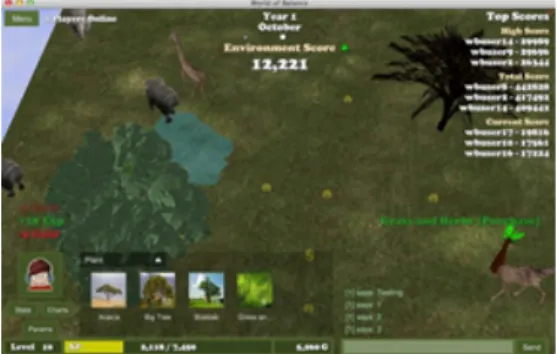
This game focuses and extends the scope of game from simple entertainment or education further into crowd computing that enables scientific data collection through game play. While players are playing an ecosystem nurturing game, they are also producing data that can be meaningfully used by ecologists. Details of game can be found at the given web site(http://smurf.sfsu.edu/~debugger/wb/).
Fig. 14. Screen shot of World of Balance game.
Ⅳ. Conclusion
Students were proud of what they achieved in one semester (15 weeks). Considering that the first few weeks were used to the introduction to the class and setting up the team, students had about 2.5 months to work on the game. To be able to make the MMORPG game work, each team has to deliver what they were expected in milestones. It serves as a good pressure on each team and students collaborated across team enthusiastically.
Most students put efforts beyond requirements, resulting in good learning outcome.
This class can serve as a good team project course for senior students in Computer Science, so they can taste the industry style problem solving approach and team work in academic environment.
Also as a by-product, the class produced a usable game that is currently used in CSc 210 Introduction to Computer Programming course at SFSU. The objective of using this game for educating CS freshman seemed to give pressure to students to deliver a smoothly working game as their clients are sitting right next to them, so it lets them alert about their end user.
To be able to replicate the same class in the future, course material needs to be better collected and organized. Inter-team communications were well captured to be used in the class for each team progress presentation and documentations.
But inner team communication and resources were not saved. Each team created very useful resources to be shared within team to learn the required technology for each team for example, client team learned Panda3D, Python, collision handling together helping each other. Same for each team. Vast amount of self study materials were created by each team. These can be better managed to be created at wiki, so they can produce more re-usable study resources.
Acknowledgement
Big thanks goes to Zoran Millic and Supakit who
developed Nursetown game and provided kind support to CSc 631/831 students to understand the key technical components.
This project is being funded by National Science Foundation Div. Of Biological Infrastructure, Biological Databases and Information, NSF DBI- 0543614. Also this project is recently funded by NSF Transform Undergraduate Education (TUES) 1140939 for 3 years to prove the learning efficacy quantitatively and spread widely.
Reference
[1] R. M. Jones. Design and implementation of computer games: A capstone course for undergraduate computer science education. In Proceedings of the 31st SIGCSE Technical Symposium on Computer Science Education, pages 260–264. ACM Press, 2000.
[2] I. Parberry. Introduction to Computer Game Programming with DirectX 8.0. Wordware Publishing, 2001.
[3] R. Moser. A fantasy adventure game as a learning environment: Why learning to program is so difficult and what can be done about it. In Proceedings of the 2nd Conference on Integrating Technology into Computer Science Education, pages 114–116.
ACM Press, 1997.
[4] Aldrich, C. Learning online with games, simulations, and virtual worlds : strategies for online instruction. San Fransisco, CA:
Jossey-Bass, 2009.
[5] Horton, W. K. E-learning by design. (2nd ed.) San Fransisco, CA: Pfeiffer, 2012.
윤일미
1996년 : University of Southern California, Computer Science (MS) 2000년 : University of Southern California, Computer Science (Ph.D) 현재: Associate Professor, Computer Science Department at San Francisco State University
게리앵
2010년 : San Francisco State University, Computer Science (BS)
현재: Software Professional, Pacific Ecoinformatics and Computational Ecology Lab, San Francisco State Univ.
권 오 영 (Oh-Young Kwon) 종신회원 1990년 2월 연세대학교 전산과학과(이학사)
1992년 2월 : 연세대학교 대학원 전산과학과(이학석 사)
1997년 2월 : 연세대학교 대 학원 컴퓨터과학과(공학박사) 1997년 4월 ~ 2000년 2월 : 한국전자통신연 구원 선임연구원
2000년 3월 ~ 한국기술교육대학교 컴퓨터공 학부 교수
〈관심분야〉고성능 컴퓨팅, 임베디드 시스템, 시스템 소프트웨어