http://dx.doi.org/10.17495/easdl.2018.4.28.2.156
서 론
국민건강영양조사(2014) 자료에 따르면 여성의 스트레스 인지율이 2013년 26.0%에서 2014년 28.6%로 증가하였으며, 특히 2014년도 연령별 스트레스 인지율에서 19세에서 29세 까지의 여성이 36.3%로 가장 높은 수치를 나타내었다. 선행 연구들을 살펴보아도 대학생 중 남학생보다 여학생이 유의하 게 생활스트레스 수준이 높은 것으로 나타났다(Sung MJ &
Chang KJ 2007; Lee HJ 2009). Shin HG & Chang JY(2003) 의 연구를 살펴보면 대학교 4학년 학생 중 여학생이 남학생 보다 취업스트레스, 우울, 불안 등 정신건강상의 문제를 더 많이 보이는 것으로 나타났고, 이는 여대생을 대상으로 스트
레스 관리에 대한 필요성이 높아지고 있음을 알 수 있었다.
청소년기에서 성인기로 넘어가면서 급변하는 환경으로 인 해 대학생들은 과도한 스트레스를 받게 되는데 이는 폭식, 과음, 자극적인 음식 섭취 등 올바르지 않는 식생활로 이어 지게 되는 경우가 많다. Park MS & Park KA(2014)의 연구를 보면 생활스트레스가 높은 군에서 섭식장애의 점수가 유의 미하게 높게 나타났으며, 스트레스가 낮은 군에 비해 과식을 자주 하는 경향을 보였다. Lee SG & Lee YH(2001)의 연구 에서도 과잉부담 스트레스는 식사실천진단지수, 식행동진단 점수, 총 식생활진단점수 모두 유의적으로 음의 상관관계를 보였으며, Lee HJ(2009)의 연구에서는 스트레스 정도가 높으 면 간식으로부터 기대하는 효과가 커져서 간식 섭취를 더 하 게 된다고 하였다.
따라서 본 연구에서는 Kim BR(2012)의 연구에서 싱글족
여대생의 생활스트레스 요인에 따른 식생활 유형과 당류 섭취 실태에 관한 구조적 관계 연구
김유정1․김보람2․윤지영3․주나미2†
1숙명여자대학교 교육대학원 영양교육전공, 2숙명여자대학교 식품영양학과,
3숙명여자대학교 문화관광학부 르꼬르동블루 외식경영전공
Structural Relations of Dietary Lifestyle and Sugar Intake according to Stress from Daily Activities:
Focusing on Female University Students in Seoul
You-Jeong Kim1, Boram Kim2, Ji-Young Yoon3 and Nami Joo2†
1Nutrition Education Graduate School, Sookmyung Women's University, Seoul 04310, Republic of Korea
2Dept. of Food and Nutrition, Sookmyung Women’s University, Seoul 04310, Republic of Korea
3Dept. of Le Cordon Bleu Hospitality Management, Division of Culture and Tourism, Sookmyung Women’s University, Seoul 04310, Republic of Korea
ABSTRACT
This study examined the effects of dietary style and sugar intake according to stress from the daily activities of female university students through the construction of a structural relation model. A structural equation model was constructed to study the level of stress from the daily activities in accordance with the dietary style and sugar intake. The reliability of the data was confirmed by exploratory factor analysis results using the Cronbach's alpha coefficient, and the measurement model was confirmed to be appropriate by confirmatory factor analysis with AMOS. Academic stress had a positive effect on the economical dietary lifestyle, while future stress had a positive effect on the gastronomical dietary lifestyle. Family stress had a significant negative effect on health-conscious type but a positive effect on convenience type of dietary lifestyle. Economic stress has a positive effect on economical dietary lifestyle. Further studies will be needed to determine whether the sugar consumption habits are indeed influenced by the rapidly changing dietary lifestyle of Koreans.
Key words: University student, SEM, stress, dietary style, sugar intake
†Corresponding author : Nami Joo, Tel: +82-2-710-9471, Fax: +82- 2-710-9479, E-mail: [email protected]
의 식생활유형과 편의식품 만족도, 그리고 삶의 질 사이에 밀접한 관계가 있다는 가정에 근거하여 싱글족의 식생활 유 형에 따라 편의식품 만족도 및 삶의 질에 미치는 영향을 알 아보기 위해 구조방정식모형을 이용하였다는 연구를 참고하 여, 여대생을 대상으로 생활스트레스가 당 섭취 실태에 미치 는 영향을 분석하는데 식생활 유형을 매개변수로 두어 구조 적 관계를 살펴보고자 하였다. 이는 건강행위 측면에서 취약 성이 있는 여대생을 대상으로 당 관련 영양교육을 실시할 때 기초자료로 활용될 수 있을 것이라 사료되며, 더 나아가 국 가 차원에서 당류 저감화 정책을 시행할 때 스트레스 관리 및 식생활 유형과 관련한 새로운 방향을 제시해 줄 수 있을 것이라 판단된다.
연구방법
1. 조사대상자 및 기간
본 연구는 숙명여자대학교 생명윤리위원회(승인번호: SM WU-1607-HR-038-01)의 심의와 승인을 거쳐 진행되었다. 조 사 대상은 서울시에 위치한 숙명여자대학교에 재학 중인 학 생을 모집단으로 선정하여 설문지를 배부하였다. 조사기간 은 2016년 10월 24일부터 10월 28일까지 실시하였고, 총 343 부의 설문지를 배부하였으며 그 중 불성실한 응답 1부를 제 외한 342부를 통계처리에 사용하였다.
2. 조사방법 및 내용
일반사항은 나이, 학년, 전공 총 3문항으로 구성하였으며 식습관 및 식행동을 알아보기 위해 아침식사 횟수, 식사속도, 평소 식사량, 편식, 간식섭취횟수를 파악하는 문항으로 총 5 항목으로 구성하였다(Kim BR 2012). 생활스트레스를 측정하 기 위해 Jeon KG 등(2000)이 개발한 개정판 대학생용 생활스 트레스 척도를 전문가 집단의 자문을 거쳐 수정, 보완하여 15문항으로 구성하였다. 식생활 유형을 파악하기 위해 총 18 항목으로 구성하였고(Kim BR 2012), Likert식 5점 척도를 이 용하여 측정하였다. 당 섭취 실태를 파악하기 위해 당류급원 식품을 총 24개로 분류하였으며 일주일을 기준으로 섭취 횟 수를 파악하였다(Lee YH 2015). 또한 생활스트레스에 따라 식생활 유형과 당 섭취 실태에 미치는 영향을 알아보기 위해 구조방정식모형을 이용하였다(Kim BR 2012; Lee SM 2011).
3. 자료분석
본 연구 결과는 SPSS 23.0을 이용하여 평균 및 표준편차 등의 기술통계와 교차분석, One Way ANOVA 분석을 실시 하였고, 유의적인 차이가 있을 경우 Duncan’s multiple range test를 통해 사후검증을 하였다. AMOS(Analysis of Moment
Strucutre) 23.0을 이용하여 신뢰성과 타당성 분석의 결과를 토대로 구조방정식모형을 개발 및 분석하였다.
결과 및 고찰
1. 일반 사항
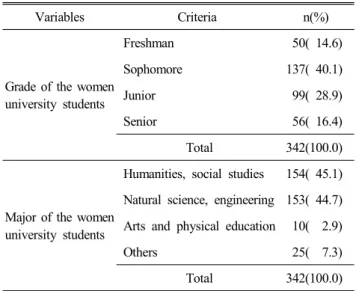
조사대상자는 총 342명으로, 학년은 2학년이 137명(40.1%) 으로 가장 많았으며, 3학년이 99명(28.9%), 4학년이 56명 (16.4%), 1학년이 50명(14.6%) 순으로 나타났다(Table 1). 조 사대상자의 전공은 인문계열, 사회계열이 154명(45.1%)으로 가장 많았으며, 자연계열, 공학계열은 153명(44.7%), 예체능 계열은 10명(2.9%), 기타 25명(7.3%) 순으로 나타났다.
2. 식습관 및 식행동
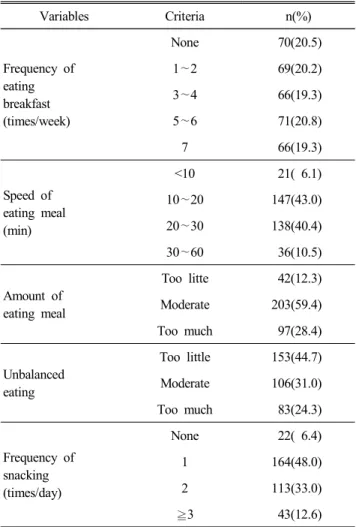
조사대상자의 식습관 및 식행동을 파악하기 위한 아침식 사 횟수, 평소 식사 속도, 식사량, 편식 여부, 간식횟수에 대 한 결과는 Table 2와 같다. 조사대상자의 아침식사 횟수를 살펴보면 주 5∼6회가 20.8%로 가장 많았다. Yang SW(2010) 의 연구에서도 전북지역 내 고등학생의 아침식사 빈도는 ‘매 일 먹는다’가 48.0%로 대부분 매일 아침식사를 하는 것으로 나타났다.
조사대상자의 식사속도에 관해서 살펴보면 10분 이상 20 분 미만이 43.0%로 가장 많았으며, 조사대상자의 평소 식사 량은 적당량을 먹는다고 대답한 사람이 59.4%로 절반 이상 의 비율을 차지했다.
조사대상자의 편식 여부를 알아본 결과, 편식을 ‘거의 안 하는 편이다’라고 대답한 사람이 44.7%로 가장 많은 비율을 차지했다. Yeo HK(2007)의 연구에서도 고등학생의 특정음식
Table 1. Demographic characteristics of the subjects
Variables Criteria n(%)
Grade of the women university students
Freshman 50( 14.6)
Sophomore 137( 40.1)
Junior 99( 28.9)
Senior 56( 16.4)
Total 342(100.0)
Major of the women university students
Humanities, social studies 154( 45.1) Natural science, engineering 153( 44.7) Arts and physical education 10( 2.9)
Others 25( 7.3)
Total 342(100.0)
Table 2. Eating habits and eating behaviors of the subjects
Variables Criteria n(%)
Frequency of eating breakfast (times/week)
None 70(20.5)
1∼2 69(20.2)
3∼4 66(19.3)
5∼6 71(20.8)
7 66(19.3)
Speed of eating meal (min)
<10 21( 6.1)
10∼20 147(43.0)
20∼30 138(40.4)
30∼60 36(10.5)
Amount of eating meal
Too litte 42(12.3)
Moderate 203(59.4)
Too much 97(28.4)
Unbalanced eating
Too little 153(44.7)
Moderate 106(31.0)
Too much 83(24.3)
Frequency of snacking (times/day)
None 22( 6.4)
1 164(48.0)
2 113(33.0)
≧3 43(12.6)
에 대한 편식 유무에 대해 살펴본 결과, 남학생 44.9%, 여학 생 35.9%가 편식을 하지 않는 것으로 나타났으며, 편식을 하 는 학생들 중 ‘채소, 과일’의 편식은 남학생이 여학생보다 유 의적으로 높았으며 ‘기름진 음식’, ‘콩류 및 곡류, 감자류’,
‘육류, 생선류, 유제품’의 편식은 여학생이 더 높은 것으로 나타났다. Hong SB(2012)의 연구에서도 대학생 중 62.5%가 편식을 하지 않는다고 응답하였으며 편식을 하는 경우 먹지 않는 식품의 종류로 생선류와 채소류를 고른 응답률이 높았 다. 공통적으로 편식을 할 때 대부분의 사람들이 채소류에 대한 편식이 있음을 할 수 있었으며, 채소에 대한 긍정적인 인식 변화와 채소 기피증을 해결하기 위해 추후 방안 모색이 필요할 것으로 사료된다.
조사대상자의 식사 이외의 간식횟수를 알아본 결과, 1일 1 회 이상 섭취하는 사람이 93.6%로 나타났다. Choi KS 등 (2008)과 Jeong GH 등(2010)의 연구에서도 서울 지역 일부 여대생의 75% 이상이 하루에 1∼2회 간식을 섭취하는 것으 로 나타났다.
3. 생활스트레스, 식생활 유형 및 당류섭취 실태 조사대상자의 스트레스요인을 살펴본 결과, 학업 스트레 스를 가장 많이 받고 있는 것으로 나타났다(Table 3). Gong SJ & Lee EH(2006), Sung MJ & Chang KJ(2007)의 연구에 서도 여대생을 대상으로 생활스트레스 정도를 파악한 결과, 학업 관련 스트레스에 대해 높은 점수를 나타내어 본 연구와 유사한 결과를 나타냈다. Lee HJ(2009)의 연구에서도 대학생 들의 스트레스 수준을 알아본 결과 ‘장래직업에 대해 고민하 였다’, ‘교과과정(수업, 전공 등)에 대해 고민하였다’, ‘성적 에 만족하지 못 한다’ 등의 순으로 점수가 높게 나타났으며 이는 본 연구결과와 유사하게 미래 및 학업성적과 관련하여 스트레스 수준이 높다는 것을 알 수 있었다.
조사대상자의 식생활 유형을 살펴본 결과는 Table 4에 제 시하였다. 식품 구매 시 경제적인 면을 고려하는 것으로 나타 났는데 Seung HS(2004)의 연구에서도 식생활 라이프스타일
Table 3. Stress from daily activities of the subjects (n=342)
Variables Mean±S.D.
The syllabus is too vast to be studied completely. 3.74±0.916 The exam pressure is too much to handle. 4.13±0.837 I attend classes that are boring and not at all
helpful. 3.00±1.000
I chose a major that does not fit my aptitude. 2.38±1.092 I do not think I will be able to get a job after
graduation. 2.91±1.033
I have a lot of conflicts between idealism and
reality. 3.40±1.022
I have no clear goals for the future. 3.05±1.167 Parents forced me to live a highly disciplined way
of life (e.g., punctuality and returning home on time). 2.09±1.149 Parents often experience marital discord. 1.77±0.910 There is no one to give me any advice in the
family. 1.94±1.069
I'm having difficulty in financing the expenses of
my schooling. 1.81±0.974
I receive a limited allowance, so my activities and
socializing is also limited. 2.27±1.162 It is difficult to get a part-time job. 2.02±1.027 Relationships are difficult(friends, senior and junior,
clubs, etc.). 2.23±0.956
I do not know how to make boyfriends. 2.72±1.299
Table 4. Dietary lifestyle of the subjects (n=342)
Variables Mean±S.D.
Do not eat instant food for health. 2.19±1.007 Care about diet for weight control. 2.65±1.035 Consider about nutrition when eating. 2.77±0.986
Take healthy food often. 2.58±0.940
Check the ingredient, additives when buying gro-
ceries. 2.46±1.190
Purchase if it looks tasty. 3.63±0.873
Not fear new flavors. 3.57±0.944
Like to search for famous restaurants. 3.63±0.855 Put taste before nutrition when choosing food. 3.73±0.785 Prefer to take short time for preparation or eating
a meal. 3.04±0.910
Often purchase processed food. 3.15±0.995 When busy, take a simple meal like bread or milk. 3.84±0.945 Often purchase the ready-to-eat food. 2.92±1.075
Eat delivery food often. 2.61±1.069
Always check the price when buying groceries. 4.06±0.821 Firstly consider discount or event products when
buying groceries. 3.36±0.952
Draw up a list before buying groceries. 2.80±1.110 Buy cheaper product when quality is similar. 4.00±0.835
중 경제추구형은 20대가 전 연령 중 29.6%로 가장 높은 비중 을 차지했으며 그 중에서도 대학생이 가장 높은 비율을 나타 냈다. Kim SJ(2015)의 연구에서도 충남 일부 지역의 대학생 이 가공식품을 구매할 때 54.0%가 가격을 가장 먼저 확인한 다고 하였으며, Lee SL & Lee SJ(2016)의 연구에서도 1인 가 구의 식생활 라이프스타일을 알아본 결과 절약형에서 여자 가 남자보다 높은 비율을 나타냈으며 1인 가구이며 미취업자 인 그룹에서도 라이프스타일 중 절약형이 59.68%로 가장 높 은 비율을 차지했다. 이는 본 연구와 유사한 결과를 나타냈 는데 연구 대상자가 미취업자이고 대학생이다 보니 식품을 구 매할 때 경제적인 면을 가장 먼저 고려한 것으로 사료된다.
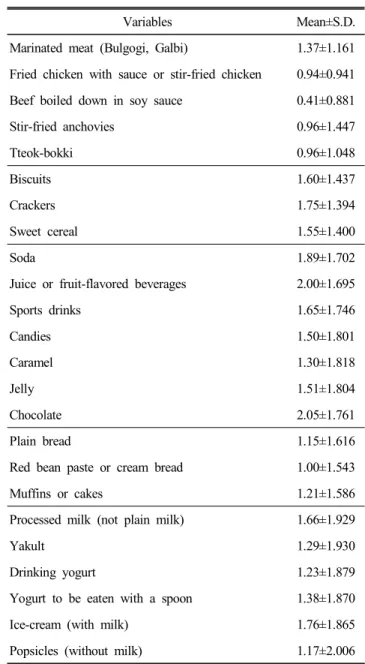
조사대상자의 당류 섭취 실태를 살펴본 결과 사탕 및 초 콜릿류 중 ‘초콜릿’을 가장 많이 섭취하는 것으로 나타났으며, 음료류 중 ‘과실주스, 과일맛 음료’가 그 뒤를 이었다(Table 5).
Yeo HK(2007)의 연구에서도 고등학생이 가장 선호하는 간식 중 ‘초콜릿류’, ‘과일’, ‘떡볶이’는 여학생이 남학생보다 더 선 호하는 것으로 나타나 본 연구와 유사한 결과를 나타냈다.
Table 5. Sugar intake of the subjects (n=342)
Variables Mean±S.D.
Marinated meat (Bulgogi, Galbi) 1.37±1.161 Fried chicken with sauce or stir-fried chicken 0.94±0.941 Beef boiled down in soy sauce 0.41±0.881
Stir-fried anchovies 0.96±1.447
Tteok-bokki 0.96±1.048
Biscuits 1.60±1.437
Crackers 1.75±1.394
Sweet cereal 1.55±1.400
Soda 1.89±1.702
Juice or fruit-flavored beverages 2.00±1.695
Sports drinks 1.65±1.746
Candies 1.50±1.801
Caramel 1.30±1.818
Jelly 1.51±1.804
Chocolate 2.05±1.761
Plain bread 1.15±1.616
Red bean paste or cream bread 1.00±1.543
Muffins or cakes 1.21±1.586
Processed milk (not plain milk) 1.66±1.929
Yakult 1.29±1.930
Drinking yogurt 1.23±1.879
Yogurt to be eaten with a spoon 1.38±1.870
Ice-cream (with milk) 1.76±1.865
Popsicles (without milk) 1.17±2.006
4. 생활스트레스 요인에 따른 식생활 유형 및 당류 섭취 실태에 관한 모형개발
1) 측정도구의 탐색적 요인분석
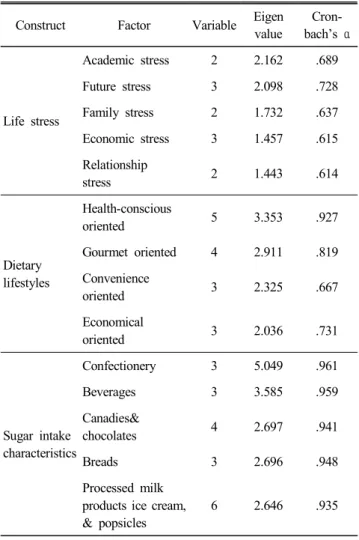
생활스트레스 관련 14항목, 식생활유형 관련 16항목, 당류 급원식품 관련 19항목에 대해 각각 탐색적 요인분석을 실시 한 결과, 생활스트레스는 5개의 요인으로 구성되어 각각 학 업스트레스, 미래스트레스, 가족스트레스, 경제스트레스, 관 계스트레스로 명명하였으며, 식생활유형은 4개의 요인으로 구성되어 각각 건강추구형, 미식추구형, 편의추구형, 경제추 구형으로 명명하였다. 당류급원식품은 5개의 요인으로 구성 되어 각각 과자류, 음료류, 사탕 및 초콜릿류, 빵류, 우유 및
유제품, 아이스크림제품류로 명명하였다. 측정 모형에 대한 신뢰도 및 유효성 결과는 Table 6에 제시하였으며, 본 연구 에서의 고유값(eigen value)은 1.0 이상, Cronbach’s alpha 계 수가 0.6 이상으로 나타나 유효성 및 신뢰성이 검증되었다.
2) 측정변수에 대한 확인적 요인분석
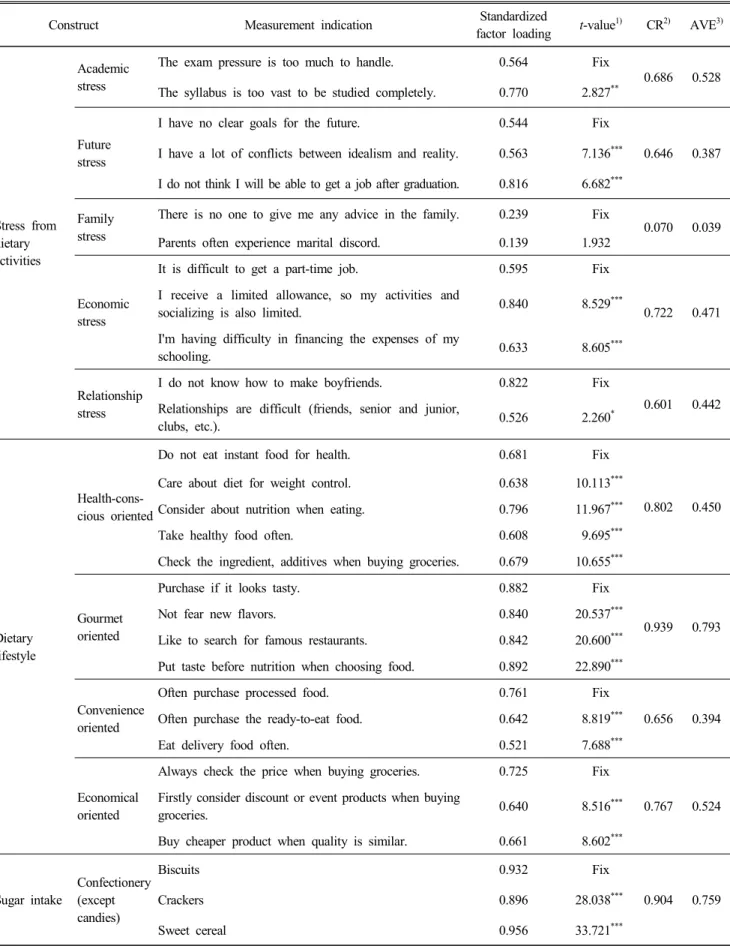
측정 모형에 대한 확인적 요인분석 결과는 Table 7에 제시 하였다. χ²값 1,477.550, χ²/df 1.426, GFI(goodness-of-fit-index) 0.853, AGFI(adjusted goodness-of-fit-index) 0.826, IFI(incre- menal fit index) 0.958, NFI(normed fit index) 0.871, CFI (comparative fit index) 0.957, RMR(root mean square residual) 0.069, RMSEA(root mean square error of approximation) 0.035로 χ²/df, IFI, CFI, RMSEA는 권장수준을 만족하였고 나머지 수치도 수용 가능한 범위 안에 포함되어 모형이 적합 한 것을 확인할 수 있었다.
측정 모형에 대한 확인적 요인분석 후 표준화 회귀 계수 값을 기준으로 하여 집중타당성을 평가한 결과, 생활스트레
Table 6. Reliability and validity of measurement models
Construct Factor Variable Eigen
value
Cron- bach’s α
Life stress
Academic stress 2 2.162 .689
Future stress 3 2.098 .728
Family stress 2 1.732 .637
Economic stress 3 1.457 .615
Relationship
stress 2 1.443 .614
Dietary lifestyles
Health-conscious
oriented 5 3.353 .927
Gourmet oriented 4 2.911 .819
Convenience
oriented 3 2.325 .667
Economical
oriented 3 2.036 .731
Sugar intake characteristics
Confectionery 3 5.049 .961
Beverages 3 3.585 .959
Canadies&
chocolates 4 2.697 .941
Breads 3 2.696 .948
Processed milk products ice cream,
& popsicles
6 2.646 .935
스 변수 중 ‘적성에 맞지 않는 학과를 선택했다’, ‘부모님으 로부터 불합리한 생활방식을 강요 받는다’ 그리고 식생활 유 형 중 ‘나는 바쁠 때는 빵, 우유 등 간단한 음식으로 끼니를 대신해 먹는다’ 이 3가지 요인이 기준치에 미치지 않아 제거 하고 측정모형의 타당성 또한 확보하였다. 측정 변수들의 표 준화 요인값의 t(C.R.)값을 보면 대체로 1.96(p<0.05)을 초과 해 유의한 것으로 나타났고 요인부하량 역시 대체로 0.5 이 상으로 나타나 전체 연구 제안 모형은 대체로 표본자료에 적 합하다고 판단되었다. 뿐만 아니라 개념신뢰도의 경우 대체 로 0.7 이상이며 AVE 역시 대체로 0.5 이상으로 나타나 수렴 타당성을 확인하였다.
3) 구조방정식모형 분석 및 가설 검증
여대생의 생활스트레스에 따른 식생활 유형과 당 섭취 실 태에 관한 이론모형에 대해 구조방정식모형을 분석하였다.
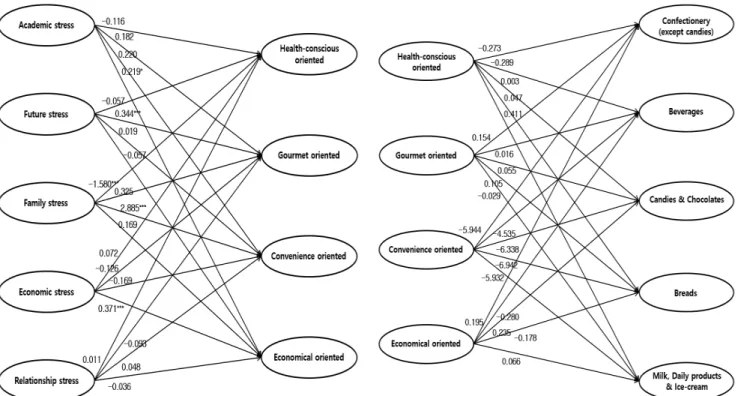
연구모형의 적합도 지수의 결과는 χ²값 1,559.844, χ²/df 1.688, GFI 0.828, AGFI 0.799, IFI 0.937, NFI 0.859, CFI 0.937, RMR 0.087, RMSEA 0.045로 χ²/df, IFI, CFI, RMSEA 는 권장수준을 만족하였고 χ², AGFI, RMR를 제외한 나머지 수치도 수용 가능한 범위 안에 포함되었기 때문에 전반적으 로 연구모형은 적합한 것으로 판명되어 본 연구의 구조모형 으로 수용할만한 모형이라 판단할 수 있었다. 본 연구의 구 조방적식 모형 결과는 Fig. 1에 나타내었으며, 여대생의 생활 스트레스 요인에 따른 식생활 유형과 당류 섭취 실태에 관한 결과는 다음과 같다.
생활스트레스 요인에 따라 식생활 유형에 영향을 미치는 지를 살펴본 결과, 생활스트레스 요인 중 학업스트레스는 경 제추구형에 0.027(p<0.05)의 유의한 정(+)의 영향을 주는 것 으로 나타났다. Bae GW(2009)의 연구에서 고등학생 학업스 트레스가 가정경제와 정의 상관관계를 보이는 것으로 나타 났는데 가정경제 상황으로 인한 교육비 부담 여부가 학업스 트레스에 영향을 미치고 이는 진로선택에도 영향을 미치는 것으로 나타났다. Han KH(2011)의 연구에서도 대학생 부모 의 사회적 지원(정서, 정보, 경제)이 생활만족도를 매개변인 으로 하여 학업 성취에 영향을 미친 것으로 나타났다. 부모 의 사회적 지원을 받는 학생이 받지 못한 학생보다 높은 생 활만족도를 보였으며, 이는 학업 성취에도 긍정적인 영향을 미치는 것으로 나타났다. Kim BK(2013)의 연구에서도 사회 적 지지 가운데 부모님의 지지는 학업 관련 스트레스에 유의 한 영향을 미치는 것으로 나타났다. 부모님의 지지를 많이 받는 사람일수록 스트레스를 적게 받는 것으로 나타났으며 월 40만원 이상을 지출하는 사람이 월 20만원 미만과 20만 원 대를 지출하는 사람보다 스트레스를 적게 받는 것으로 나 타났다. 이는 가정의 경제상황이 학업스트레스에 영향을 주
Table 7. Confirmatory factor analysis model of the women university students
Construct Measurement indication Standardized
factor loading t-value1) CR2) AVE3)
Stress from dietary activities
Academic stress
The exam pressure is too much to handle. 0.564 Fix
0.686 0.528 The syllabus is too vast to be studied completely. 0.770 2.827**
Future stress
I have no clear goals for the future. 0.544 Fix
0.646 0.387 I have a lot of conflicts between idealism and reality. 0.563 7.136***
I do not think I will be able to get a job after graduation. 0.816 6.682***
Family stress
There is no one to give me any advice in the family. 0.239 Fix
0.070 0.039 Parents often experience marital discord. 0.139 1.932
Economic stress
It is difficult to get a part-time job. 0.595 Fix
0.722 0.471 I receive a limited allowance, so my activities and
socializing is also limited. 0.840 8.529***
I'm having difficulty in financing the expenses of my
schooling. 0.633 8.605***
Relationship stress
I do not know how to make boyfriends. 0.822 Fix
0.601 0.442 Relationships are difficult (friends, senior and junior,
clubs, etc.). 0.526 2.260*
Dietary lifestyle
Health-cons- cious oriented
Do not eat instant food for health. 0.681 Fix
0.802 0.450 Care about diet for weight control. 0.638 10.113***
Consider about nutrition when eating. 0.796 11.967***
Take healthy food often. 0.608 9.695***
Check the ingredient, additives when buying groceries. 0.679 10.655***
Gourmet oriented
Purchase if it looks tasty. 0.882 Fix
0.939 0.793
Not fear new flavors. 0.840 20.537***
Like to search for famous restaurants. 0.842 20.600***
Put taste before nutrition when choosing food. 0.892 22.890***
Convenience oriented
Often purchase processed food. 0.761 Fix
0.656 0.394 Often purchase the ready-to-eat food. 0.642 8.819***
Eat delivery food often. 0.521 7.688***
Economical oriented
Always check the price when buying groceries. 0.725 Fix
0.767 0.524 Firstly consider discount or event products when buying
groceries. 0.640 8.516***
Buy cheaper product when quality is similar. 0.661 8.602***
Sugar intake
Confectionery (except candies)
Biscuits 0.932 Fix
0.904 0.759
Crackers 0.896 28.038***
Sweet cereal 0.956 33.721***
는 것으로 사료되며 본 연구결과에서도 볼 수 있듯이 이러한 이유로 스트레스를 받는 사람은 식품을 구매할 때 역시 경제 적인 면을 고려할 가능성이 높을 것으로 판단된다.
미래스트레스는 미식추구형에 0.334(p<0.001)로 유의한 정(+)의 영향을 주는 것으로 나타나 졸업 후 취직에 대한 불 안감과 이상과 현실의 차이에서 나타나는 갈등으로 인해 스 트레스를 받는 여대생은 식품을 선택할 때 영양보다 맛을 우 선으로 생각하며 새로운 맛을 시도하는 것에 대한 두려움이 없으며 처음 보는 음식이라도 맛있어 보이면 구입하는 등의 식생활 형태를 띠는 것으로 나타났다.
가족스트레스는 건강추구형에 —1.580(p<0.001)으로 유의 한 부(—)의 영향을 주는 것으로 나타났는데, Han SH(2010) 의 연구에서도 고등학생을 대상으로 자가진단을 실시한 결 과 가족의 기능이 균형 잡혀 있으며 유연한 구조를 가졌다고 생각한 학생일수록 건강증진행위 정도가 높게 나타났으며, 가족환경이 권위적이고 엄격한 규칙이 강조되는 경직한 분 위기를 가졌다고 인식할수록 건강증진행위가 가장 낮게 나 타났다. 이는 본 연구결과와 유사하게 가족 관련 스트레스가
건강증진행위에 부의 영향을 미치는 것으로 나타났으며, 가 족과 관련된 스트레스를 받을수록 식품을 구매할 때에도 영 양가를 고려하거나 건강식품을 자주 먹는 등의 행태를 보이 지 않는 것으로 사료된다.
경제스트레스는 경제추구형에 0.371(p<0.001)로 유의한 정(+)의 영향을 주는 것으로 나타나 학자금, 용돈 등과 관련 된 경제적인 스트레스를 받는 여대생이 식품을 구입할 때 가 격을 먼저 확인하며 할인상품을 우선적으로 구입하고 비슷 한 품질이라면 식품가격이 저렴한 제품을 구입하는 등 경제 적인 소비형태를 띠는 것으로 나타났다.
식생활 유형에 따라 당류 섭취 실태에 영향을 미치는지를 살펴본 결과 유의미한 영향을 보이지 않는 것으로 나타났으 며, 또한 건강추구형의 경우 예상과 다르게 우유 및 유제품, 아이스크림 제품류에 영향을 미치지 않는 것으로 나타났다.
Park SI 등(2011)의 연구에서도 우유섭취에 대한 중요성을 인식하고는 있으나, 매일 우유를 마시는 비율은 37.4%로 높 지 않는 것으로 나타났으며, 흰 우유보다는 가공우유를 선호 하는 것으로 나타났다. 국민건강영양조사 제6기 2차년도 결 Table 7. Continued
Construct Measurement indication Standardized
factor loading t-value1) CR2) AVE3)
Sugar intake
Beverages
Soda 0.907 Fix
0.848 0.650
Juice or fruit-flavored beverages 0.889 25.551***
Sports drinks 0.959 29.996***
Candies
& chocolates
Candies 0.924 Fix
0.880 0.647
Caramel 0.969 36.306***
Jelly 0.929 31.362
Chocolate 0.871 25.850***
Breads
Plain bread 0.896 Fix
0.852 0.657
Red bean paste or cream bread 0.927 26.290***
Muffins or cakes 0.907 25.239***
Milk, daily products
& ice-cream
Processed milk (not plain milk) 0.823 Fix
0.873 0.535
Yakult 0.903 21.552***
Drinking yogurt 0.926 22.525***
Yogurt to be eaten with a spoon 0.907 21.720***
Ice-cream (with milk) 0.883 20.761***
Popsicles (without milk) 0.944 23.326***
1) *
p<0.05, ** p<0.01, *** p<0.001.
2) CR: construct reliability.
3) AVE: average variance extracted.
Structural equation model of the stress from daily activities and dietary lifestyle
Structural equation model for dietary lifestyle and sugar intake
Structural equation model for the stress from daily activities and sugar intake
Fig. 1. Structural equation model of the stress from daily activities, dietary lifestyle and sugar intake.
과에 따르면 칼슘의 영양섭취기준 대비 섭취비율이 남자 73%, 여자 64%로 칼슘섭취가 매우 미흡하다는 것을 알 수 있다 (Ministry of Heath and Welfare 2014). 이는 칼슘급원식품인 우유 및 유제품에 대한 영양학적 우수성과 중요성을 인지하 고는 있으나 섭취행동으로 이어지지 않음을 알 수 있었다.
생활스트레스 요인에 따라 당류 섭취 실태에 영향을 미치 는지를 살펴본 결과 유의미한 차이는 나타나지 않았다. Hong JH & Kim SY(2014)는 고등학생의 경우 스트레스를 받은 후
‘당류’의 섭취가 증가하였다고 보고하고 있고, 특히 간식 중 단맛을 가지고 있는 ‘과자류’의 선호도가 증가하고 있다고 보고하고 있다. 이와 같이 본 연구와 다른 결과를 나타내는 것은 고등학생의 경우 입시라는 과도한 스트레스 환경에서, 대부분의 시간을 학교에서 보내야 하므로 학교 내 매점에서 쉽게 구입할 수 있는 당류가 많이 함유된 간식에 대한 섭취 가 증가된 것으로 파악되며, 본 연구에서는 대상자가 여대생 인 바, 생활스트레스 중 학업 관련 스트레스가 당 섭취에 유 의미한 영향을 주지는 않았던 것으로 사료된다.
요약 및 결론
본 연구는 여대생을 대상으로 생활스트레스에 따른 식생 활유형 및 당 섭취 실태에 관한 구조적 모형을 개발하고자 하였다. 학년은 2학년이 137명(40.1%)으로 가장 많았으며, 3 학년 99명(28.9%), 4학년 56명(16.4%), 1학년 50명(14.6%) 순으로 나타났다. 전공은 인문계열, 사회계열 154명(45.1%) 으로 가장 많았으며, 자연계열, 공학계열은 153명(44.7%), 예 체능계열 10명(2.9%), 기타 25명(7.3%) 순으로 나타났다. 조 사대상자의 아침식사 횟수를 살펴보면 주 5∼6회가 20.8%로 가장 많았으며, 주 0회 20.5%, 주 1∼2회 20.2%, 주 3∼4회 19.3%, 주 7회가 19.3% 순으로 나타났다. 조사대상자의 식사 속도에 관해서 살펴보면 10분 이상 20분 미만이 43.0%로 가 장 많았으며, 조사대상자의 평소 식사량은 적당량을 먹는다 고 대답한 사람이 59.4%로 절반 이상의 비율을 차지했다. 조 사대상자의 편식 여부를 알아본 결과, 편식을 ‘거의 안 하는 편이다’라고 대답한 사람이 44.7%로 가장 많은 비율을 차지 했다. 조사대상자의 식사 이외의 간식횟수를 알아본 결과, 1 일 1회 이상 섭취하는 사람이 93.6%로 나타났다. 구조적모 형 개발을 위해 측정도구의 탐색적 요인분석을 실시한 결과 생활스트레스는 5개의 요인으로 구성되어 각각 학업스트레 스, 미래스트레스, 가족스트레스, 경제스트레스, 관계스트레 스로 명명하였으며, 식생활유형은 4개의 요인으로 구성되어 각각 건강추구형, 미식추구형, 편의추구형, 경제추구형으로 명명하였다. 당류급원식품은 5개의 요인으로 구성되어 각각 과자류, 음료류, 사탕 및 초콜릿류, 빵류, 우유 및 유제품, 아
이스크림제품류로 명명하였으며, 모든 요인의 Cronbach’s alpha 계수가 0.5 이상으로 나타나 신뢰성이 검증되었다. 타 당성을 검증하고자 AMOS를 이용해 측정 모형에 대한 확인 적 요인분석을 실시한 결과, χ²값 1,477.550, χ²/df 1.426, GFI 0.853, AGFI 0.826, IFI 0.958, NFI 0.871, CFI 0.957, RMR 0.069, RMSEA 0.035로 χ²/df, IFI, CFI, RMSEA는 권장수준 을 만족하였고 나머지 수치도 수용 가능한 범위 안에 포함되 어 모형이 적합한 것을 확인할 수 있었다.
생활스트레스 요인에 따라 식생활 유형에 영향을 미치는 지를 살펴본 결과, 생활스트레스 요인 중 학업스트레스는 경 제추구형에 0.027(p<0.05)의 유의한 영향을 주는 것으로 나 타났다. 미래스트레스는 미식추구형에 유의한(p<0.001) 영향 을 주는 것으로 나타났으며. 가족스트레스는 건강추구형에 유의한(p<0.001) 부(—)의 영향을 주는 것으로 나타났다. 경 제스트레스는 경제추구형에 유의한(p<0.001) 정(+)의 영향을 주는 것으로 나타나 학자금, 용돈 등과 관련된 경제적인 스 트레스를 받는 여대생이 식품을 구입할 때 가격을 먼저 확인 하며 할인상품을 우선적으로 구입하고 비슷한 품질이라면 식품가격이 저렴한 제품을 구입하는 등 경제적인 소비형태 를 띠는 것으로 나타났다. 그러나 여대생의 생활스트레스 정 도가 당류 섭취 실태에 유의미한 영향을 미치지 않는 것으로 나타났다.
과거에 비해 다양한 식생활의 형태가 나타나고 있으나, 그에 따른 생활스트레스와 식생활 유형 및 당류 섭취 실태에 관한 연구가 미비한 상태이다. 따라서 이와 관련된 연구가 더 진행되어야 할 것으로 사료된다. 또한 가공식품을 통한 당 섭취량이 증가하고 있는데 본 연구결과는 당 저감화 정책에 필요한 기초자료로 사용될 것이라고 판단되며, 식생활유형 에 따른 당 섭취 패턴과 관련하여 추후 연구가 필요할 것으 로 사료된다.
REFERENCES
Bae GW (2009) A study on career choice and academic stress in high school. MS Thesis Korea University, Seoul. pp 43-44.
Choi KS, Shin KO, Jeong GH (2008) Comparison of the dietary pattern, nutrient intakes, and blood parameters according to body mass index (BMI) of college women in Seoul area. Korean J Food Sci and Nutr 37(12): 1589- 1598.
Gong SJ, Lee EH (2006) Mediation effect of coping between life stress and depression in female college students.
Korea J Woman Psychology 11(1): 21-40.
Han KH (2011) Factor influencing academic achievement of Korean adolescents: longitudinal analysis. Ph D Dissertation Inha Univerity, Incheon. pp 65-68.
Han SH (2010) Family function and health promoting beha- vior perceived by high school students. MS Thesis Ajou University, Gyeonggi. p 29.
Hong JH, Kim SY (2014) Correlation between eating behavior and stress level in high school students. Korean J Food Sci and Nutr 43(3): 459-470.
Hong SB (2012) Dietary habits and snacking among uni- versity students living on campus and condition of applying nutrition labelling: focused of university student in Seoul. MS Thesis Konkuk University, Seoul. pp 18-20.
Jeon KG, Kim KH, Lee JS (2000) (Revised version) Devel- opment of the scale for stress from daily activities for University students. Korean J Psychological 5(2): 316-335.
Jeong GH, Shin KO, Jeong TH, Choi KS, Jeon WM, Jeong DG, Lee DS (2010) Study on the dietary habit, nutrient intake, and health status according to their majors among college women in Sahmyook University. Korean J Food Sci and Nutr 39(6): 826-836.
Kim BK (2013) A study on the effects of social support and stress on suicidal ideation. MS Thesis Keimyung Unive- rsity, Daegu. p 48.
Kim BR (2012) A study on the structural correlation between convenience food satisfaction and quality of life according to the dietary lifestyle of singles - Focused on singles in Korea, Japan, and China. Ph D Dissertation Sookmyung Women's University, Seoul. pp 31-32.
Kim SJ (2015) (A) Comparison of dietary habit, dietary behavior and processed food intake status according to residing types of university students in Chungnam. MS Thesis Kongju National Universty, Chungnam. p 20.
Lee HJ (2009) The effect of stress level of college students on drinking and snack intake. MS Thesis Sangji Univer- sity, Gangwon. p 127.
Lee SG, Lee YH (2001) Comparison of stress, dietary be- haviors and nutritional intake status among college students - Focused on students from one university in the metropolitan area. Korean J Community Living Sci 12(2):
33-45.
Lee SL, Lee SJ (2016) The effects of eating habit and food consumption lifestyles on dietary life satisfaction of one-
person households. Korean J Consumption Culture Assoc 19(3): 115-133.
Lee SM (2011) The status of meal delivery programs and the study of homebound senior's meal satisfaction related to development of quality of life construct model. Ph D Di- ssertation Sookmyung Women's University, Seoul. pp 33-34.
Lee YH (2015) Perception of dietary intake and educational needs - Focused on mothers of preschool children. MS Thesis Sookmyung Women's University, Seoul. pp 4-5.
Ministry of Heath and Welfare (2014) Korea Health Statistics 2014: Korea National Health and Nutrition Examination Survey (KNHANES VI-2). Korea Centers for Disease Control & Prevention, Korea.
Park MS, Park KA (2014) The differences of dietary and health-related habits, depression, eating disorder and nutri- ent intake according to the life stress in nursing college students. J Korea Academia-Industrial Coop Soc 15(1):
344-355.
Park SI, Kim HJ, Nam ES (2011) A study on consumption behavior for milk and dairy products among middle school students. J Korea Culinary Sci and Hospitality Res 17(3):
236-258.
Seung HS (2004) A study on using behavior of bakery by dietary lifestyle. MS Thesis Ewha Womans University, Seoul. pp 12-13.
Shin HG, Chang JY (2003) Job stress and mental health according to personal characteristics and gender of seniors in university. Korean J Clinical Psychology 22(4): 815- 827.
Sung MJ, Chang KJ (2007) Correlation between life stress and sleep, physical measurements, and nutrient intake status of university students in certain areas. Korean J Food Sci and Nutr 36(7): 840-848.
Yang SW (2010) Snack consumptions of high school students and their recognitions on nutritional fact. MS Thesis Wonkwang University, Jeonbuk. pp 12-13.
Yeo HK (2007) The study on eating attitudes, food habit and perceived stress of high school students in Seoul area. MS Thesis Kyunghee University, Gyeonggi. pp 14-20.
Date Received Date Revised Date Accepted
Feb. 26, 2018 Apr. 26, 2018 Apr. 28, 2018