
ORIGINAL ARTICLE
전북지역에서 심각한 합병증이 동반된 급성 A형간염의 임상양상과 위험인자
유선호, 김인희, 장지원, 최정환, 문진창, 박진경, 이상연, 김성훈, 김상욱, 이승옥, 이수택, 김대곤, 조은영1, 정금모2
전북대학교 의과대학 전북대학교병원 임상의학연구소 내과학교실, 원광대학교병원 내과1, 예수병원 내과2
Clinical Features and Risk Factors for Severe Complications among Patients with Acute Hepatitis A Virus Infection in The Jeonbuk Province of Korea
Sun Ho Yoo, In Hee Kim, Ji Won Jang, Chung Hwan Choi, Jin Chang Moon, Jin Kyoung Park, Sang Youn Lee, Seong Hun Kim, Sang Wook Kim, Seung Ok Lee, Soo Teik Lee, Dae Ghon Kim, Eun Young Cho1 and Gum Mo Jung2
Department of Internal Medicine, Research Institute of Clinical Medicine, Chonbuk National University Hospital, Chonbuk National University Medical School, Jeonju, Department of Internal Medicine, Wonkwang University College of Medicine and Hospital, Iksan1, Department of Internal Medicine, Presbyterian Medical Center, Jeonju2, Korea
Background/Aims: The frequency of symptomatic acute HAV infections in adulthood are increasing in Korea. This study analyzes the clinical severity in patients with acute HAV infection and investigates risk factors associated with three severe complications:
prolonged cholestasis, acute kidney injury, and acute liver failure.
Methods: We performed a retrospective analysis of 726 patients diagnosed from January 2006 to December 2010 at three tertiary hospitals in Jeonbuk Province, Republic of Korea with acute HAV infection.
Results: In the group of 726 patients, the mean age was 30.3 years, 426 (58.6%) were male, and 34 (4.7%) were HBsAg positive. Severe complications from acute HAV infection occurred as follows: prolonged cholestasis in 33 (4.6%), acute kidney injury in 17 (2.3%), and acute liver failure in 16 (2.2%). Through multivariate analysis, age ≥40 years (OR 2.63, p=0.024) and peak PT (INR) ≥1.5 (OR 5.81, p=0.035) were found to be significant risk factors for prolonged cholestasis. Age ≥40 years (OR 5.24, p=0.002) and female gender (OR 3.11, p=0.036) were significant risk factors for acute kidney injury. Age
≥40 years (OR 6.91, p=0.002), HBsAg positivity (OR 5.02, p=0.049), and peak total bilirubin (OR 1.11, p=0.001) were significant risk factors for acute liver failure.
Conclusions: Age ≥40 years, female gender, HBsAg positivity, peak PT (INR) ≥1.5, and peak total bilirubin were significant risk factors for severe complications in acute HAV infections. (Korean J Gastroenterol 2014;63:25-31)
Key Words: Hepatitis A; Cholestasis; Acute kidney injuries; Acute liver failure; Risk
Received August 30, 2013. Revised December 4, 2013. Accepted December 6, 2013.
CC This is an open access article distributed under the terms of the Creative Commons Attribution Non-Commercial License (http://creativecommons.org/licenses/
by-nc/3.0) which permits unrestricted non-commercial use, distribution, and reproduction in any medium, provided the original work is properly cited.
교신저자: 김인희, 561-712, 전주시 덕진구 건지로 20, 전북대학교 의과대학 전북대학교병원 임상의학연구소 내과학교실
Correspondence to: In Hee Kim, Department of Internal Medicine, Research Institute of Clinical Medicine, Chonbuk National University Hospital, Chonbuk National University Medical School, 20 Geonji-ro, Deokjin-gu, Jeonju 561-712, Korea. Tel: +82-63-250-1677, Fax: +82-63-254-1609, E-mail: [email protected] Financial support: This study was supported by research funds of the Chonbuk National University Hospital. Conflict of interest: None.
INTRODUCTION
The epidemiology of hepatitis A virus (HAV) infection varies in different countries according to environmental conditions such as hygiene and economic status.1 In the 1980s, hep-
atitis A in Korea was classified as a disease with high ende- micity, and age-specific immunity against HAV in the adult population older than 20 years was reported to be over 90%.2 However, the seroprevalence of anti-HAV has been steadily decreasing in children and young adults due to the improve-
ment of environmental conditions and the introduction of the hepatitis A vaccine.2-4 These changes mean that more people reach adulthood without being exposed to HAV in childhood and are, therefore, at risk of developing symptomatic acute hepatitis A. Recent studies reported that acute hepatitis A has become a major cause of acute viral hepatitis in Korea.5,6 Although most patients with HAV infections have a favorable clinical course and spontaneous recovery,7 in a minor portion the rates of hospitalization and severe complications appear to have increased substantially.8 Previous studies report that risks of severe hepatitis are mainly confined to acute liver fail- ure related to HAV infection.8,9 However, limited studies note other severe atypical complications, such as prolonged cho- lestasis or acute kidney injury. In this study, we analyze the clinical severity of recent acute HAV infection in Korea and in- vestigate the risk factors associated with three severe com- plications: prolonged cholestasis, acute kidney injury, and acute liver failure.
SUBJECTS AND METHODS
1. Patients
We retrospectively reviewed the medical records of 726 pa- tients admitted from January 2006 to December 2010 to three tertiary hospitals (Chonbuk National University Hospital, Wonkwang University Hospital, and Presbyterian Medical Center) in Jeonbuk Province of Korea with acute HAV infection.
Diagnosis of acute HAV infection was made via positive se- rum IgM anti-HAV (EIA; Axsym, Abbott, IL, USA) associated with an elevation of serum aminotransferase levels five times above the upper normal limit. Superinfection of HAV in pa- tients with chronic hepatitis B and hepatitis C was diagnosed in those who had been positive for HBsAg (RIAKEY; Shin Jin Medics Inc., Goyang, Korea) for at least 6 months via serum IgM anti-HAV positive test results and in those who had been positive for anti-HCV (RIAKEY) with HCV RNA via real-time pol- ymerase chain reaction (PCR; COBAS AmpliPrep/ COBAS TaqMan HCV test; Roche Molecular Systems, Branchburg, NJ, USA). However, patients positive for anti-HBc IgM, anti- body to human immunodeficiency virus, hepatitis E virus, Epstein-Barr virus, cytomegalovirus, or herpes simplex virus were excluded. Other exclusion criteria were drug-induced liv- er injury, autoimmune hepatitis, and Wilson’s disease.
2. Methods
A total of 726 patients were analyzed by age, sex, super- imposed hepatitis B or hepatitis C, diabetes mellitus, sig- nificant alcohol intake, duration of hospital stay, complete blood count, serum biochemistry, and coagulation test at ad- mission and most severe clinical course. The following blood tests were performed at the time of admission and regularly during the hospital stay: hemoglobin, platelet count, PT, se- rum AST, ALT, total bilirubin, ALP, albumin, GGT, and creatinine. In addition, we analyzed the clinical severity in terms of peak laboratory values, occurrence of prolonged cholestasis, acute kidney injury, and acute liver failure. In this study, prolonged cholestasis was defined as that with total bi- lirubin level ≥5 mg/dL lasting for more than 4 weeks after admission.10 Acute kidney injury was defined as that with an absolute level of serum creatinine concentration ≥2.0 mg/dL or with a percentage increase of 50% or more from baseline in patients with no history of renal dysfunction.10,11 Patients were considered to have acute liver failure accord- ing to the widely accepted definition of acute liver failure that states there would be evidence of coagulation abnormality, usually a prolongation of PT by INR ≥1.5, and any degree of mental alteration (encephalopathy) in a patient without pre-existing cirrhosis and with an illness with duration <26 weeks.12 We compared clinical conditions of patients with complications versus those without complications. We also analyzed clinical risk factors associated with each severe complication. The protocol of this study was approved by the Ethics Committees of each participating hospital, and the study was conducted in accordance with the principles of the Declaration of Helsinki.
3. Statistical analysis
Statistical analysis was performed using IBM SPSS Statistics software package (version 19.0; IBM Co., Armonk, NY, USA). All results were presented as mean±standard devi- ation or number of instances (percent). To compare clinical features according to the presence of complications, Fisher’s exact test was used for categorical variables and Mann- Whitney U test or independent Student’s t-test was used for continuous variables. To identify the clinical risk factors of each complication, we performed multivariate logistic re- gression analysis of variables that were significant in uni-
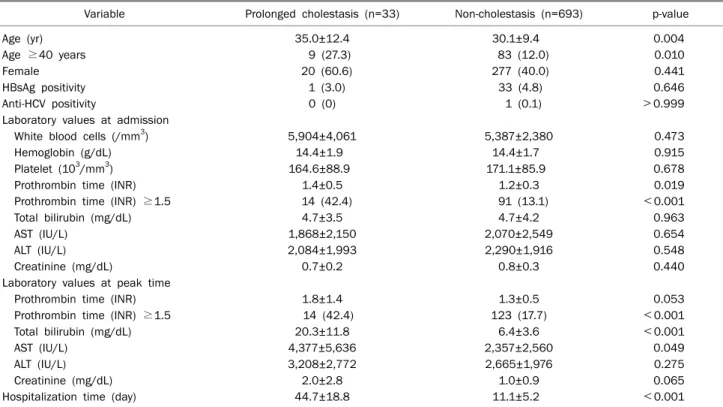
Table 1. Comparison of Clinical Characteristics of Acute HAV Infection Patients with the Presence of Prolonged Cholestasis Variable Prolonged cholestasis (n=33) Non-cholestasis (n=693) p-value
Age (yr) 35.0±12.4 30.1±9.4 0.004
Age ≥40 years 9 (27.3) 83 (12.0) 0.010
Female 20 (60.6) 277 (40.0) 0.441
HBsAg positivity 1 (3.0) 33 (4.8) 0.646
Anti-HCV positivity 0 (0) 1 (0.1) >0.999
Laboratory values at admission
White blood cells (/mm3) 5,904±4,061 5,387±2,380 0.473
Hemoglobin (g/dL) 14.4±1.9 14.4±1.7 0.915
Platelet (103/mm3) 164.6±88.9 171.1±85.9 0.678
Prothrombin time (INR) 1.4±0.5 1.2±0.3 0.019
Prothrombin time (INR) ≥1.5 14 (42.4) 91 (13.1) <0.001
Total bilirubin (mg/dL) 4.7±3.5 4.7±4.2 0.963
AST (IU/L) 1,868±2,150 2,070±2,549 0.654
ALT (IU/L) 2,084±1,993 2,290±1,916 0.548
Creatinine (mg/dL) 0.7±0.2 0.8±0.3 0.440
Laboratory values at peak time
Prothrombin time (INR) 1.8±1.4 1.3±0.5 0.053
Prothrombin time (INR) ≥1.5 14 (42.4) 123 (17.7) <0.001
Total bilirubin (mg/dL) 20.3±11.8 6.4±3.6 <0.001
AST (IU/L) 4,377±5,636 2,357±2,560 0.049
ALT (IU/L) 3,208±2,772 2,665±1,976 0.275
Creatinine (mg/dL) 2.0±2.8 1.0±0.9 0.065
Hospitalization time (day) 44.7±18.8 11.1±5.2 <0.001
All results were presented as mean±SD or n (%).
variate analysis. p-values of <0.05 were considered statisti- cally significant.
RESULTS
1. Comparison of clinical characteristics of patients with acute HAV infection according to presence of complications
In 726 patients, the mean age was 30.3 years, 426 (58.6%) were male, and 34 (4.7%) and 3 (0.4%) were HBsAg- and anti-HCV-positive. Three severe forms of acute HAV com- plications occurred in the following manner: prolonged cho- lestasis in 33 patients (4.6%), acute kidney injury in 17 (2.3%), and acute liver failure in 16 (2.2%). There were sig- nificant differences in the clinical characteristics of patients with acute HAV infection depeding on the presence of major complications.
Among the 726 patients, 33 (4.6%) patients had pro- longed cholestasis during admission. Table 1 shows clinical characteristics of acute HAV infection patients with pro- longed cholestasis in comparison to those without choles- tasis. Patients with prolonged cholestasis were significantly older (p=0.004) with age ≥40 years (p=0.010). They also
had significantly prolonged PT (INR) (p=0.019) and also had had PT (INR) ≥1.5 (p<0.001) at admission. In the follow-up after admission, patients with prolonged cholestasis had sig- nificantly prolonged peak PT (INR) ≥1.5 (p<0.001) peak to- tal bilirubin level (p<0.001), and peak serum AST level (p=0.049) and underwent longer hospitalization time (p<
0.001).
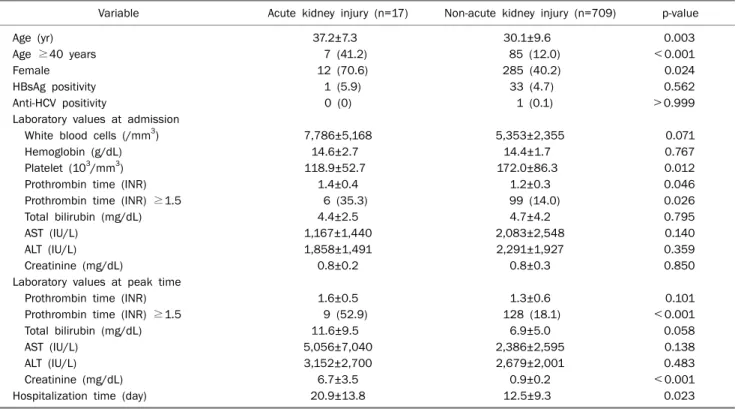
Seventeen (2.3%) patients suffered acute kidney injury af- ter the acute HAV infection. The comparisons of clinical char- acteristics of patients with and without acute kidney injury are shown in Table 2. Patients with acute kidney injury were significantly older (p=0.003) with age ≥40 years (p<0.001) and were more likely to be female (p=0.024). They also had significantly lower platelet count (p=0.012), prolonged PT (INR) (p=0.046), and had had PT (INR) ≥1.5 (p=0.026) at admission. In the follow-up, patients with acute kidney injury had significantly higher peak PT (INR) ≥1.5 (p<0.001) and peak serum creatinine level (p<0.001) and underwent lon- ger hospitalization time (p=0.023).
Sixteen (2.2%) patients had acute liver failure during admission. Compared to patients without acute liver failure, those with acute liver failure were significantly older (p=0.002) with age ≥40 years (p<0.001). They also had
Table 2. Comparison of Clinical Characteristics of Acute HAV Infection Patients with the Presence of Acute Kidney Injury Variable Acute kidney injury (n=17) Non-acute kidney injury (n=709) p-value
Age (yr) 37.2±7.3 30.1±9.6 0.003
Age ≥40 years 7 (41.2) 85 (12.0) <0.001
Female 12 (70.6) 285 (40.2) 0.024
HBsAg positivity 1 (5.9) 33 (4.7) 0.562
Anti-HCV positivity 0 (0) 1 (0.1) >0.999
Laboratory values at admission
White blood cells (/mm3) 7,786±5,168 5,353±2,355 0.071
Hemoglobin (g/dL) 14.6±2.7 14.4±1.7 0.767
Platelet (103/mm3) 118.9±52.7 172.0±86.3 0.012
Prothrombin time (INR) 1.4±0.4 1.2±0.3 0.046
Prothrombin time (INR) ≥1.5 6 (35.3) 99 (14.0) 0.026
Total bilirubin (mg/dL) 4.4±2.5 4.7±4.2 0.795
AST (IU/L) 1,167±1,440 2,083±2,548 0.140
ALT (IU/L) 1,858±1,491 2,291±1,927 0.359
Creatinine (mg/dL) 0.8±0.2 0.8±0.3 0.850
Laboratory values at peak time
Prothrombin time (INR) 1.6±0.5 1.3±0.6 0.101
Prothrombin time (INR) ≥1.5 9 (52.9) 128 (18.1) <0.001
Total bilirubin (mg/dL) 11.6±9.5 6.9±5.0 0.058
AST (IU/L) 5,056±7,040 2,386±2,595 0.138
ALT (IU/L) 3,152±2,700 2,679±2,001 0.483
Creatinine (mg/dL) 6.7±3.5 0.9±0.2 <0.001
Hospitalization time (day) 20.9±13.8 12.5±9.3 0.023
All results were presented as mean±SD or n (%).
higher HBsAg positivity (p=0.007), lower platelet counts (p<
0.001), and prolonged PT (INR) (p<0.001) and had had PT (INR) ≥1.5 (p<0.001) at admission (Table 3). In the follow- up, patients with acute liver failure had significantly higher peak levels of PT (INR) (p=0.013), peak PT (INR) ≥1.5 (p
<0.001), total bilirubin (p=0.036), serum AST (p=0.004), and serum ALT (p=0.001) and underwent significantly longer hospitalization time (p<0.001) (Table 3).
2. Clinical risk factors associated with severe compli- cations of acute HAV infection
Multivariate logistic regression analysis revealed several clinical risk factors for the three severe complications in pa- tients with acute HAV infections (Table 4). Age ≥40 years (OR 2.63, 95% CI 1.136-6.076, p=0.024) and peak PT (INR) ≥ 1.5 (OR 5.81, 95% CI 1.132-29.774, p=0.035) were sig- nificant risk factors for prolonged cholestasis. Age ≥40 years (OR 5.24, 95% CI 1.861-14.743, p=0.002) and female gender (OR 3.11, 95% CI 1.079-8.936, p=0.036) were sig- nificant risk factors for acute kidney injury. Age ≥40 years (OR 6.91, 95% CI 2.001-23.849, p=0.002), HBsAg positivity (OR 5.02, 95% CI 1.005-25.022, p=0.049), and peak total bilirubin (OR 1.11, 95% CI 1.043-1.190, p=0.001) were sig-
nificant risk factors for acute liver failure (Table 4).
DISCUSSION
The clinical severity of recent acute HAV infections in Korea has apparently worsened relative to that reported in previous studies. In this study, among 726 patients with acute HAV in- fection, three severe forms of acute HAV complications oc- curred in the following manner: prolonged cholestasis in 33 patients (4.6%), acute kidney injury in 17 (2.3%), and acute liver failure in 16 (2.2%). Furthermore, age ≥40 years, fe- male gender, HBsAg positivity, peak PT (INR) ≥1.5, and peak total bilirubin were significant risk factors for severe compli- cations in acute HAV infection.
The previous studies before the 2000s reported that se- vere hepatitis, including acute liver failure due to acute HAV infection, was rare in Korea. However, recent studies demon- strated that the rate of acute liver failure related to acute HAV infection has increased from 0.1-0.3% to 1.4%.1,8,10 A multi- center Korean study reported the incidence of severe compli- cations at 4.7% for prolonged cholestasis, 1.5% for acute kid- ney injury, 0.5% for fulminant hepatitis, and 0.2% for death.10 This study showed similar results including 4.6% for pro-
Table 3. Clinical Characteristics of Acute HAV Infection Patients with the Presence of Acute Liver Failure
Variable Acute liver failure (n=16) Non-acute liver failure (n=710) p-value
Age (yr) 38.6±9.0 30.1±9.5 0.002
Age ≥40 years 7 (43.8) 85 (12.0) <0.001
Female 8 (50.0) 289 (40.7) 0.455
HBsAg positivity 3 (18.8) 31 (4.4) 0.007
Anti-HCV positivity 0 (0) 1 (0.1) 0.881
Laboratory values at admission
White blood cells (/mm3) 6,052±5,772 5,395±2,359 0.656
Hemoglobin (g/dL) 14.9±1.0 14.4±1.7 0.856
Platelet (103/mm3) 119±33.8 171±86.4 <0.001
Prothrombin time (INR) 1.8±0.5 1.2±0.3 <0.001
Prothrombin time (INR) ≥1.5 12 (75.0) 92 (13.0) <0.001
Total bilirubin (mg/dL) 4.3±3.6 4.7±4.2 0.676
AST (IU/L) 3,038±4,285 2,039±2,478 0.367
ALT (IU/L) 2,490±2,566 2,276±1,903 0.659
Creatinine (mg/dL) 0.8±0.2 0.9±0.9 0.685
Laboratory values at peak time
Prothrombin time (INR) 2.5±1.7 1.3±0.5 0.013
Prothrombin time (INR) ≥1.5 16 (100.0) 105 (14.8) <0.001
Total bilirubin (mg/dL) 15.0±14.2 6.9±4.7 0.036
AST (IU/L) 7,391±6,049 2,337±2,583 0.004
ALT (IU/L) 5,049±1,890 2,636±1,991 0.001
Creatinine (mg/dL) 2.4±3.1 1.1±1.3 0.111
Hospitalization time (day) 18.1±10.7 12.5±9.5 <0.001
All results were presented as mean±SD or n (%).
Table 4. Risk Factors Associated with Three Major Complications of Acute HAV Infection (Multivariate Analysis)
Major complicaion OR 95% CI p-value
Prolonged cholestasis
Age ≥40 years 2.63 1.136-6.076 0.024
Peak prothrombin time (INR) ≥1.5
5.81 1.132-29.774 0.035
Acute kidney injury
Age ≥40 years 5.24 1.861-14.743 0.002
Female 3.11 1.079-8.936 0.036
Acute liver failure
Age ≥40 years 6.91 2.001-23.849 0.002 HBsAg positivity 5.02 1.005-25.022 0.049 Peak total bilirubin 1.11 1.043-1.190 0.001
longed cholestasis, 2.3% for acute kidney injury, and 2.2% for acute liver failure. The increase in number of hepatitis A pa- tients with complications, treated through hospitaliza- tion-focused treatments, is a growing burden to public health in Korea.13
The recent change of clinical severity of acute HAV in- fections in Korea was mainly related to the increased age of patients. In the 1990s, most patients with acute HAV in- fection were younger than 20 years old. In contrast, the mean age of patients with acute HAV infection was 30.3 years in this study. The increase in the mean age was related to the low
seroprevalence of anti-HAV among young adults due to the progression of socioeconomic status and the improvement of environmental hygiene in Korea.2-4 Recent area-adjusted seroprevalence in Korea is 11.9% in the age group of 20-29 years, 23.4% in the age group of 10-19 years, and 48.4% in the age group of 30-39 years.4 This epidemiologic shift sug- gests that a growing number of adults are susceptible to HAV infection leading to the development of more acute HAV in- fections with severe manifestations. In addition, although the prevalence of hepatitis C virus (HCV) infections is low, Korea is still one of the nations where the prevalence of hep- atitis B virus (HBV) infections is high due to a high rate of verti- cal transmission before the implementation of nationwide vaccination program. Recent nationwide studies reported that the seroprevalence of HBsAg and anti-HCV in Korea were 4.0% and 0.78%, respectively.14 Cho et al.15 reported that the seroprevalence of IgG anti-HAV in 986 patients with chronic liver disease (CLD) was associated with HBV or HCV. The sero- prevalence of IgG anti-HAV in patients with CLD associated with HBV or HCV according to the decade of age was 6.67%
in ages of 20-29 years, 50.86% ages of 30-39 years, 92.29%
ages of 40-49 years, similar to that in the general population.
These data suggest that in Korea a substantial proportion of
adult patients with CLD are at risk of HAV infection. Our study showed that the rates of superinfection of HAV on chronic HBV and HCV infection were 4.7% and 0.4%, respectively. Old age and underlying CLD were well known factors associated with severe complications in acute HAV infection. Thus, we could expect an increase in the clinical severity of acute HAV infections in Korea in the present and near future.
In this study, we compared clinical features of patients with acute HAV infections according to presence of three severe complications: prolonged cholestasis, acute kidney injury, and acute liver failure. We also investigated clinical risk fac- tors for complications. In the multivariate analysis, age ≥40 years, HBsAg positivity, female gender, peak PT (INR) ≥1.5, and peak total bilirubin were significant risk factors for severe complications in acute HAV infection. First, old age is a well-known risk factor for acute liver failure or mortality.8, 9 In this study, the risks of prolonged cholestasis, acute kidney in- jury, and acute liver failure were 2.63, 5.24, and 6.91 times higher, respectively, in the older (≥40 years) patients than in the younger (<40 years) patients. Secondly, patients with CLD are at an increased risk of acute liver failure when in- fected with acute HAV.16 Several studies demonstrated that superinfection of HAV on preexisting chronic hepatitis B or C has significant deleterious effects on the clinical severity of acute HAV infection.8,17-19 A Taiwanese study reported 55%
fulminant hepatitis and 25% mortality when HAV infection was superimposed on chronic hepatitis B.17 A recent Korean study reported that risk of fulminant hepatitis was 22.4 times higher when HAV infection was superimposed on chronic hepatitis B.8 Furthermore, another study showed that gastro- intestinal bleeding, acute renal failure, and acute liver failure were more frequently observed in HBsAg-positive patients than in HBsAg-negative patients.18 In particular, the risk of acute liver failure was approximately 9-fold higher in the HBsAg-positive group than in the HBsAg-negative group (23.3% vs. 3.3%; p<0.001). Consistently with those results, our study showed that HBsAg-positive patients have 5.02 times higher risk of acute liver failure than do HBsAg negative patients (p=0.049). In Korea, as mentioned above, the sero- prevalence of IgG anti-HAV was similar between patients with CLD and in the general population, but low in young adults.15 Considering the higher risk of acute liver failure, anti-HAV vac- cination should be recommended for patients with CLD. Prior studies have suggested that female gender, in addition to old
age and underlying CLD, may increase the risk of life-threat- ening acute liver failure related to acute HAV infection, but the number of patients reported has been limited.20,21 In this study, females had 3.11 times higher risk of acute kidney in- jury than did males (p=0.036), but no significant increase in risk of prolonged cholestasis or acute liver failure was found in the multivariate analysis. The causative mechanism be- tween gender and severity of HAV infection is not clear but may be because genotype IA strains were more frequent both in men and in patients with a favorable outcome.21 However, a recent Korean study reported that there were no differ- ences in duration of hospital stay, incidence of cholestatic hepatitis, acute kidney injury, acute liver failure, or mortality between genotype IA and genotype IIIA patients.22 It is still de- batable, and further study is needed.
This study presented the severity of acute HAV infections diagnosed in three tertiary hospitals in Jeonbuk Province of Korea. However, there were several limitations due to the ret- rospective study design conducted in tertiary hospitals. This may lead to selection bias because patients with more severe complications were referred for intensive care. In addition, there was lack of data for viral factors, including viral load and genotype. Further prospective, multi-centered, large num- bered studies to evaluate host and viral factors related to se- verity of acute HAV infection are needed. Despite these limi- tations, our study showed the current status of clinical se- verity and risks for acute HAV infection in Korea. In con- clusion, patients with acute HAV infection in Korea had se- vere complications including prolonged cholestasis in 4.6%
of the cases, acute kidney injury in 2.3%, and acute liver fail- ure in 2.2%. Age ≥40 years, HBsAg positivity, female gender, peak PT (INR) ≥1.5, and peak total bilirubin were significant risk factors for major complications in patients with acute HAV infection.
REFERENCES
1. Jeong SH, Lee HS. Hepatitis A: clinical manifestations and management. Intervirology 2010;53:15-19.
2. Lee H, Cho HK, Kim JH, Kim KH. Seroepidemiology of hepatitis A in Korea: changes over the past 30 years. J Korean Med Sci 2011;26:791-796.
3. Lee D, Cho YA, Park Y, et al. Hepatitis a in Korea: epidemiological shift and call for vaccine strategy. Intervirology 2008;51:70-74.
4. Lee D, Ki M, Lee A, et al. A nationwide seroprevalence of total an-
tibody to hepatitis A virus from 2005 to 2009: age and area-ad- justed prevalence rates. Korean J Hepatol 2011;17:44-50.
5. Kang HM, Jeong SH, Kim JW, et al. Recent etiology and clinical features of acute viral hepatitis in a single center of Korea.
Korean J Hepatol 2007;13:495-502.
6. Lee SS, Byoun YS, Jeong SH, et al. Type and cause of liver disease in Korea: single-center experience, 2005-2010. Clin Mol Hepatol 2012;18:309-315.
7. Lee TH, Kim SM, Lee GS, et al. Clinical features of acute hepatitis A in the Western part of Daejeon and Chungnam province: single center experience. Korean J Gastroenterol 2006;47:136-143.
8. Kim JI, Kim YS, Jung YK, et al. Factors influencing the severity of acute viral hepatitis A. Korean J Hepatol 2010;16:295-300.
9. Ajmera V, Xia G, Vaughan G, et al; Acute Liver Failure Study Group. What factors determine the severity of hepatitis A-related acute liver failure? J Viral Hepat 2011;18:e167-e174.
10. Jung YM, Park SJ, Kim JS, et al. Atypical manifestations of hep- atitis A infection: a prospective, multicenter study in Korea. J Med Virol 2010;82:1318-1326.
11. Choi HK, Song YG, Han SH, et al. Clinical features and outcomes of acute kidney injury among patients with acute hepatitis A. J Clin Virol 2011;52:192-197.
12. Polson J, Lee WM; American Association for the Study of Liver Disease. AASLD position paper: the management of acute liver failure. Hepatology 2005;41:1179-1197.
13. Park HS, Choi BY, Kwon YD. Rapid increase in the national treat- ment costs for hepatitis A infections in Korea. Tohoku J Exp Med 2011;226:85-93.
14. Kim DY, Kim IH, Jeong SH, et al. A nationwide seroepidemiology of hepatitis C virus infection in South Korea. Liver Int 2013;33:
586-594.
15. Cho HC, Paik SW, Kim YJ, et al. Seroprevalence of anti-HAV among patients with chronic viral liver disease. World J Gastro- enterol 2011;17:236-241.
16. Almasio PL, Amoroso P. HAV infection in chronic liver disease: a rationale for vaccination. Vaccine 2003;21:2238-2241.
17. Chu CM, Liaw YF. Increased incidence of fulminant hepatic fail- ure in previously unrecognized HBsAg carriers with acute hep- atitis independent of etiology. Infection 2005;33:136-139.
18. Kim KM, Eo SJ, Gwak GY, et al. Comparison of the clinical features of hepatitis A between HBsAg-positive and HBsAg-negative patients. Gut Liver 2011;5:500-505.
19. Vento S, Garofano T, Renzini C, et al. Fulminant hepatitis asso- ciated with hepatitis A virus superinfection in patients with chronic hepatitis C. N Engl J Med 1998;338:286-290.
20. Willner IR, Uhl MD, Howard SC, Williams EQ, Riely CA, Waters B.
Serious hepatitis A: an analysis of patients hospitalized during an urban epidemic in the United States. Ann Intern Med 1998;
128:111-114.
21. Rezende G, Roque-Afonso AM, Samuel D, et al. Viral and clinical factors associated with the fulminant course of hepatitis A infection. Hepatology 2003;38:613-618.
22. Kim JH, Yeon JE, Baik SK, et al. Genotypic shift of the hepatitis A virus and its clinical impact on acute hepatitis A in Korea: a na- tionwide multicenter study. Scand J Infect Dis 2013;45:811-818.

![Clinical Features and Treatment of Coronavirus Disease-19 (Severe Acute Respiratory Syndrome Coronavirus 2 [SARS-CoV-2] Infection)](data:image/gif;base64,R0lGODlhAQABAIAAAP///wAAACH5BAEAAAAALAAAAAABAAEAAAICRAEAOw==)