Biomedical Science Letters 2017, 23(3): 155~160 https://doi.org/10.15616/BSL.2017.23.3.155 eISSN : 2288-7415
Biomedical Laboratory: Its Safety and Risk Management
Tin Tun
†Singapore Association for Medical Laboratory Sciences (SAMLS), 637551, Singapore
Biomedical laboratory is full of risks. Risk could be biological, chemical, radioactive, mechanical, physical, fire and electrical. All possible risks need to be identified, evaluated and controlled. A risk management system must be in place to prevent accident or loss of lives and to improve overall workplace safety and productivity. Safety in laboratory is a combination of appropriate risk management system, engineering controls and technical facilities, administrative controls and safety procedures and practices. Laboratory safety culture must be developed so that exposure to hazards for laboratory personnel, community and environment will be minimized or eliminated. In this review, importance of safety in a biomedical laboratory and risk management will be discussed.
Key Words: Risk management, Risk assessment, Hazard identification, Risk evaluation
INTRODUCTION
The golden rule for the "Safety in a laboratory" is simply everyone's responsibility. Safety cannot be performed by one person or one group or one department. All stakeholders need to be aware of safety procedures and practices and must abide by legal requirements (if any) and guidelines.
Work entails various risks. The biomedical laboratory is a workplace where biological agents, infectious samples, toxic and corrosive chemicals, flammables, radioactive materials are handled. Many types of physical and mechanical instru- ments or equipment that are prone to accidents are also used. Risk Management (RM) is a part of work procedures to ensure risks are mitigated and properly communicated.
All possible hazards and risks must be identified, assessed and evaluated. Implementation of adequate control measures is necessary to minimize or eradicate those risks.
Safety in a Biomedical Laboratory
Safety is the condition of being safe, free from danger, risk and injury; and to prevent any accident and loss. Answer to why we need a safe laboratory is simple - to keep us safe, healthy and alive so that we do our jobs peacefully. It also allows our families to know that we are safe at work. In creating a safe workplace, the management's commitment in safety and employee's involvement are important.
Safety in the laboratory is based on a combination of risk management system, provision of adequate facility and equipment, administrative controls and standard operating procedures and safety practices. Well-designed laboratory facility and equipment will minimize or eliminate exposures to hazardous agents for laboratory personnel, community and environment. Depending on risk levels of biological agents involved, biosafety level 2 (BSL 2), biosafety level 3 (BSL 3) and biosafety level 4 (BSL 4) facilities are estab-
Review
*Received: July 19, 2017 / Accepted: August 7, 2017
†Corresponding author: Tin Tun. Registered Biosafety Professional (RBP), IFBA Certified Professional in Biorisk Management, Singapore Association for Medical Laboratory Sciences (SAMLS), 637551, Singapore.
Tel: +65-6892-1801, e-mail: [email protected]
○CThe Korean Society for Biomedical Laboratory Sciences. All rights reserved.
○CCThis is an Open Access article distributed under the terms of the Creative Commons Attribution Non-Commercial License (http://creativecommons.org/licenses/by-nc/3.0/) which permits unrestricted non-commercial use, distribution, and reproduction in any medium, provided the original work is properly cited.
lished. The laboratory is not a place open to all. There must be a kind of control to access the area. Here administrative control measures are required. Other important adminis- trative controls are to meet legislation requirements if any;
to ensure that all laboratory users are competent in laboratory safety practices; appropriate training or sharing sessions are provided; and to keep necessary documents such as inven- tories of hazardous chemicals or biological agents in pos- session, audit and inspection reports, accident investigation records, etc.
Standard operating procedures (SOP) for safe use of laboratory equipment; safe work procedures, biosafety prac- tices and procedures and emergency response plan must be in place. Proper use of personal protective equipment (PPE) such as laboratory coat, gloves, goggles, hair cover, shoes cover, mask or respirator as required is absolute necessary.
Risk management system is developed to prevent accident and loss of lives or property, to improve overall productivity.
In Singapore, risk management system is required by the Workplace Safety and Health Act (Ministry of Manpower, 2006). Risk assessment (RA) is a legally required document and must be conducted in all work places including laboratory according to the Risk Management Regulations (Ministry of Manpower, 2006). It is the responsibility of the manage- ment (Head of Department) to ensure that the RM is being
performed for all activities within the biomedical laboratory and department. Standard operating procedure on risk management must be available as an internal use only for staff members or laboratory users and updated on a regular basis. Development of the RA within any individual unit as a part of RM process is the responsibility of the principal investigator (PI), manager and the in-charge of that unit or workplace. RA document is project specific and conducted by a group or team based on feedbacks from stakeholders. It includes all activities with significant risks and is approved by the PI or the in-charge. Laboratory users are to apply appropriate control measures such as use of PPE and other protective means and to observe procedures prescribed in the risk assessments. Ultimately, it is everyone's responsibility to play a part for successful implementation of risk management.
Risk Management
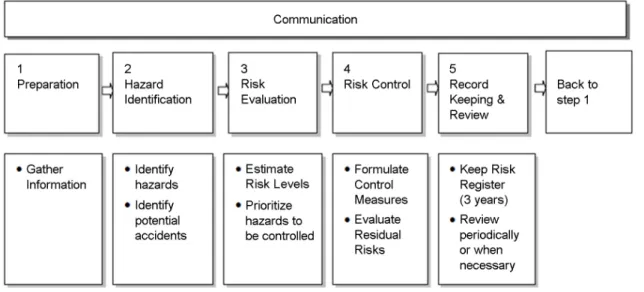
In Singapore, the MOM adopts the "Activity Based - Qualitative Evaluation Methodology" (Ministry of Man- power, 2006). Risk management involves assessment of risk associated; control measure to reduce risk; monitoring such risk at workplace and communicating the risk to the user. The process (Fig. 1) simply involves:
Fig. 1. Process in activity based - qualitative risk assessment method.
• Breakdown of an experimental procedure or activity into steps
• Identification of the hazards or risks associated with the materials used and with process. Hazards associated with waste disposal, spill and other emergency procedures should also be considered
• Assess the frequency of occurrence and the severity of each hazard in context of the process and potential exposure.
• Determine the risks according to risk matrix.
• Controlling / reducing those risks to an acceptable level.
• Keep risk register - RA documents covering activities at workplace
• Communicating the risks to the users and review and feedback to monitor effectiveness over time.
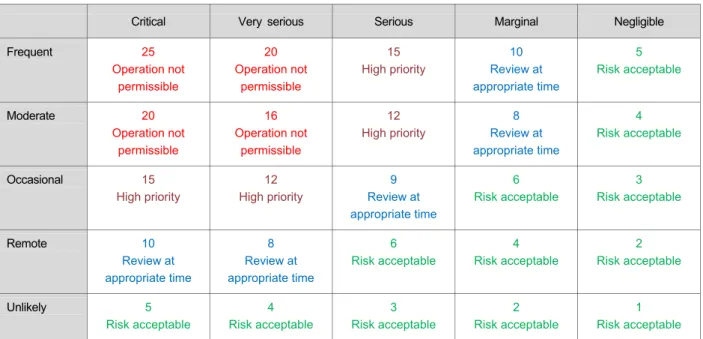
Risk assessment (RA) record includes Hazard Identifi- cation, Risk Evaluation and Control measure using a 5 × 5 risk matrix. A written description of the risk assessment for every activity must be developed at the workplace.
Identify Hazards
For each activity, the hazard or risk shall be determined.
This is the most important part; the risk cannot be quan- tified or controlled if it is failed to identify. The hazards are based on but not limited to chemical, biological, radioactive, mechanical, thermal, ergonomic, electrical, etc. To assist the identification process, the reviewer should systematically review the activities from different points of view related to
man, machine, material, method and environment for both the user and any other person at risk in the vicinity of the workplace where the activity is being carried out. Some examples of common hazards in biomedical laboratory that should be considered are:
• Biological - bacteria, virus, fungi, etc.
• Chemical - corrosive, toxic, flammable, etc.
• Radiation - radioactive materials, laser sources
• Mechanical - machine with moving parts, centrifuge, etc.
• Physical - excessive noise, heat, vibration, fire, explosion, etc.
• Electrical - frayed wires, electrical compliances
• Ergonomic - repetitive works, awkward postures
• Psychological - overwork, poor supervision, stress
Risk Evaluation
Risk Evaluation is the process of estimating severity and frequency of risk identified and calculating acceptable risk level. Risk prioritizing number (RPN) is the number assigned to an evaluated risk based on the likelihood and severity.
Severity (S) defines the degree or extent of an injury or harm caused by a hazard as a result of accident based. The extent of injury often varies but it is taken the worst possible likely to occur. The question is how badly it would occur to laboratory user (Table 1).
Likelihood (L) defines the probability or frequency of an event occurring. The question is what is the chance of an Table 1. Severity table includes five different levels of risks
Severity Level Criteria to consider
Critical 5 Fatal/ permanent injury; Poison/ Infection with unknown cure; Spill outside campus;
> $10 million damage; > 1 year downtime
Very serious 4 30 days MC/hospitalization; Infection with known cure; Spill outside building;
> $1 million damage; > 3 month downtime
Serious 3 10 days MC/hospitalization; Injury with 1 month recovery; Spill outside Lab/room;
$100,000 damage; > 1 month downtime
Marginal 2 3 days MC; Very mild exposure; Spill outside workplace; > $10,000 damage;
> 5 days downtime
Negligible 1 First aid treatment only; mild / no exposure; Spill within workplace; < $5,000 damage;
No significant downtime
event happening (Table 2).
Risk levels or RPN is assessed by using levels of the severity and likelihood. Once severity and likelihood have been established, a 5 × 5 risk matrix is constructed to quantify the qualitative data for risk assessment (Fig. 2).
Based on risk level obtained, the action and risk control measures are determined.
Table 3. Action table. Appropriate control measures are taken to reduce risk level to acceptable or residual level
Score Risk level Action Hierarchy of control measures
16~25 High Operation not permissible
Stop operation and review controls Elimination / Substitution Total removal of hazards.
12~15 Warning High priority remedial action
Implement additional controls immediately Physical Controls
Engineering controls are physical means that limit the hazards.
8~10 Medium Remedial action at appropriate time
Proceed with care. Additional control advised Administrative controls
These reduce or eliminate exposure to a hazard by adherence to procedures, instructions and training 1~6 Low Residual Risk / Risk acceptable
No imminent dangers. Frequent review in change of procedure, material or environment
Personal Protective Equipment (PPE) This should be a minimum requirement after all other control measures have been considered. The success of this control critically depends on correct choice, application and maintenance of protective equipment, observation of SOPs, training and good working practices.
Table 2. Likelihood table includes five different levels of pro- bability
Likelihood Level Occurrence criteria
Frequent 5 Likely to occur many times per year Moderate 4 Likely to occur once a year Occasional 3 Might occur once in 3 years Remote 2 Might occur once in 5 year Unlikely 1 Might occur once in 10 years
Critical Very serious Serious Marginal Negligible
Frequent 25
Operation not permissible
20 Operation not
permissible
15 High priority
10 Review at appropriate time
5 Risk acceptable
Moderate 20
Operation not permissible
16 Operation not
permissible
12 High priority
8 Review at appropriate time
4 Risk acceptable
Occasional 15
High priority
12 High priority
9 Review at appropriate time
6 Risk acceptable
3 Risk acceptable
Remote 10
Review at appropriate time
8 Review at appropriate time
6 Risk acceptable
4 Risk acceptable
2 Risk acceptable
Unlikely 5
Risk acceptable
4 Risk acceptable
3 Risk acceptable
2 Risk acceptable
1 Risk acceptable
Fig. 2. Risk matrix (5×5). RPN is calculated across the table. Risk level 1~6 will be considered as low risk or acceptable risk or residual
risk. Control measures are to apply for those higher risk levels.
Hierarchy of Control Measures
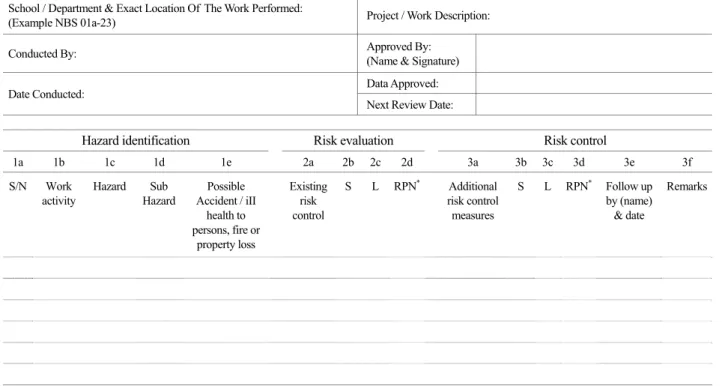
It is essential to control risks usually by elimination or reduction "at the source". The control of hazards and reduc- tion of risks can be accomplished by following the hierarchy of controls, step by step. If a risk cannot be controlled completely by engineering measures, it is necessary to pro- tect the employees by administrative control or personal protection. These control measures are not mutually exclu- sive; engineering controls can be implemented together with administrative controls like training. Proper use of personal protective equipment is always necessary (Table 3). An example of the RA form for record keeping, training and reviewing purposes is shown in the Table 4.
Conclusions
Risk assessment is a legal document at workplace in Singapore. It should be taken more seriously for risky envir- onment like laboratory. Assessments must be carried out and recorded for various activities for example, laboratory experiment, use of laboratory equipment, handling and
storage of chemical, transportation of hazardous material, etc. Supporting documents such as safety data sheet (SDS) related to specific hazardous item, work procedure and work instruction should be included. Risk assessment needs to be reviewed and updated every 3 years or whenever changes are made. It will be a useful tool to have team members trained and communicated with risks at work.
CONFLICT OF INTEREST
This paper was presented in part at the 54
thKAMT Congress held in Yeosu City, Republic of Korea from May 26-29, 2016. The author declares that there is no conflict of interest.
REFERENCES
Ministry of Manpower (MOM), Singapore. "Workplace Safety and Health Act". 2006. http://www.mom.gov.sg/workplace- safety-and-health/workplace-safety-and-health-act
Ministry of Manpower (MOM), Singapore. "Workplace Safety and Health (Risk Management). Regulations". 2006. http://
Table 4. Example of risk assessment (RA) document
School / Department & Exact Location Of The Work Performed:(Example NBS 01a-23) Project / Work Description:
Conducted By: Approved By:
(Name & Signature)
Date Conducted: Data Approved:
Next Review Date:
Hazard identification Risk evaluation Risk control
1a 1b 1c 1d 1e 2a 2b 2c 2d 3a 3b 3c 3d 3e 3f
S/N Work activity
Hazard Sub Hazard
Possible Accident / iII
health to persons, fire or
property loss
Existing risk control
S L RPN* Additional risk control measures
S L RPN* Follow up by (name)
& date
Remarks
*RPN - Risk Prioritization Number