Processability and Mechanical Characteristics of Glass Fiber and Carbon Fiber Reinforced PA6 for Reinforcement Content
S. B. Lee, H. S. Cho, and M.-Y. Lyu *,†
Department of Product Design Manufacturing Engineering, Graduate School of Seoul National University of Science and Technology, 232 Gongneung-ro, Nowon-gu, Seoul 139-743, Korea
*
Department of Mechanical System Design Engineering, Seoul National University of Science and Technology, 232 Gongneung-ro, Nowon-gu, Seoul 139-743, Korea
(Received August 7, 2015, Revised August 19, 2015, Accepted August 21, 2015)
Abstract: There is a need for light weight and high stiffness characteristics in the building structure as well as aircraft and cars. So fiber reinforced plastic with the addition of reinforcing agent such as glass fiber, carbon fiber, aramid fiber is uti- lized in this regard. In this study, mechanical strength, flow property and part shrinkage of glass fiber and carbon fiber rein- forced PA6 were examined according to reinforcement content such as 10%, 20%, and 30%, and reinforcement type. The mechanical property was measured by a tensile test with specimen fabricated by injection molding and the flow property was measured by spiral test. In addition, we measured the part shrinkage of fiber reinforced PA6 that affects part quality.
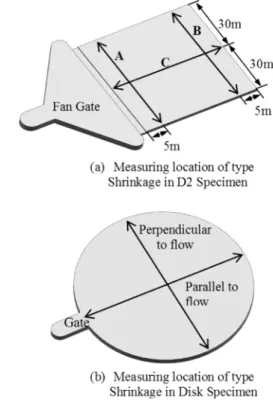
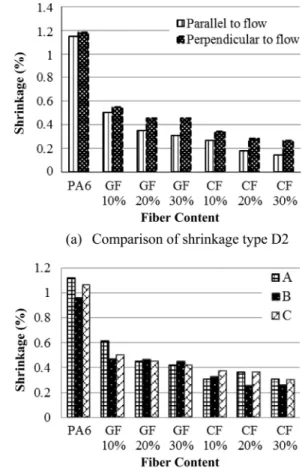
As glass fiber content increases, mechanical property increased by 75.4 to 182%, and flow property decreased by 18.9 to 39.5%. And part shrinkage decreased by 52.9 to 60.8% in the flow direction, and decreased by 48.2 to 58.1% in the per- pendicular to the flow direction. As carbon fiber content increases, mechanical property increased by 180 to 276%, flow property decreased by 26.8 to 42.8%, and part shrinkage decreased by 65.0 to 71.8% and 69.5 to 72.7% in the flow direction and the direction perpendicular to the flow respectively.
Keywords: carbon fiber, glass fiber, PA6, tensile test, spiral test, part shrinkage
Introduction
산업의 발달과 함께 재료 특성의 향상에 대한 요구가 꾸준 히 제기되고 있으며, 이에 따라 기존 재료보다 가벼우면서도 우수한 강도와 기능적 특성을 가진 신소재 개발에 대한 연구 가 활발하게 진행되고 있다. 특히 재료 특성을 향상시키는 방 법 중에서도 많은 관심의 대상이 되어온 복합재료에 대한 연 구 개발이 주목 받고 있다.
1또한 플라스틱 복합재료는 일반 생활용품에서부터 전자제품, 자동차, 항공기부품 등에 이르기 까지 다양한 분야에서 사용되고 있다.
2이러한 플라스틱 제품 은 대부분 사출성형을 통해 생산된다. 이는 사출성형이 제품 의 형상이 복잡하더라도 쉽게 성형이 가능하고 높은 정밀도 를 얻을 수 있으며 대량생산이 가능하기 때문이다.
3플라스틱 복합재료의 기본적인 물성은 매트릭스 소재 자체의 성질에 의 존하지만, 강화제의 종류와 특성 및 함유량에 따라서 큰 변화 가 나타난다. 대표적인 강화제의 종류로는 유리섬유, 탄소섬 유 그리고 아라미드 섬유가 있다.
4이러한 강화제는 본래의 보 조 재료라는 의미를 초월하여 플라스틱 제품의 최종 성능에 결정적인 영향을 미칠 수 있는 특수 소재로 인식되고 있다. 섬
유 강화제를 이용한 고분자 재료의 연구는 사출온도와 사출 압력과 같은 사출성형조건에 따른 제품의 기계적 물성과 제품의 치수정밀도에 영향을 미치는 수축률에 대하여 다루고 있다.
3,5-9본 연구는 매트릭스소재에 강화제 및 함유량에 따른 기계 적인 물성 변화와 그리고 유동성과 수축률에 대한 연구를 진 행하였다. 기존 연구와 다르게 각각의 실험을 위한 시편 제작 시 사출성형조건을 동일하게 한 상태로 사출성형을 진행하여 성형공정에 따른 변수가 배제된 시편을 제작하여 강화제의 종 류와 함유량에서 나타나는 차이를 비교하고자 하였다. 본 연 구에서는 섬유 강화제인 유리섬유 (GF, glass fiber)와 탄소섬 유 (CF, carbon fiber)가 첨가되었을 때 함유량에 따른 인장 강 도와 유동성을 실험적 연구를 통해 조사하였으며, 인장강도 와 유동성 및 수축률의 관계를 규명하였다.
Experimental
1. 재료
엔지니어링 플라스틱은 강도, 내열성, 내충격성, 내마찰성,
†