341 J. Sens. Sci. Technol. Vol. 28, No. 6, 2019 Journal of Sensor Science and Technology
Vol. 28, No. 6 (2019) pp. 341-344 http://dx.doi.org/10.5369/JSST.2019.28.6.341 pISSN 1225-5475/eISSN 2093-7563
Impact of Electric Field on Propagation Velocity of Phase Boundary Between Nematic and Isotropic Phases of 5CB Liquid Crystal
Mohammad Awwal Adeshina
1, Mareddi Bharath Kumar
1, Daekyung Kang
1, Bongjun Choi
2, and Jonghoo Park
1,+Abstract
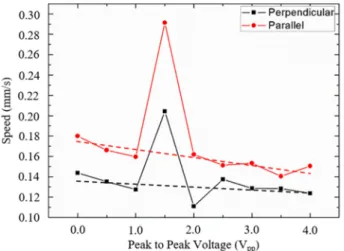
Liquid crystal (LC) mesophase materials manifest a variety of phase transitions. The optical properties of LCs are highly dependent upon the phase and orientation of the optical axis with respect to the polarization of incoming light. Studying the LC phase transitions is significantly important for a wide range of scientific and industrial applications. In this study, we demonstrate the propagation velocity of the phase boundary between the nematic and isotropic phase of 4-Cyano-4-pentylbiphenyl (5CB) liquid crystal for different electric fields using a polarized optical microscope. The results demonstrate that the propagation velocity of the phase boundary exhibits a peak value for a specific voltage, attributed to the supercooling of the isotropic phase of the LC. The analysis of the propagation velocity for different electric fields also provides a simple optical platform to measure the thermal anisotropy and voltage dependent thermal prop- erties of the homogeneously aligned LC.
Keywords: Liquid Crystals, Phase transitions, 5CB, Temperature sensors
1. INTRODUCTION
Liquid crystals (LCs) are a stable phase of matter characterized by anisotropic properties without the existence of a three-dimensional crystal lattice, generally lying between the solid and isotropic “liquid” phase[1,2]. It differs from liquid because its molecules possess anisotropic orientational order, which means the properties of the LC is dependent on the direction which they are measured. Owing to its unique anisotropic optical and electro-optic properties, the LC mesophase materials have attracted attention not only from optical applications. including optical switches [3,4], electro- optic filters [5], digital data storage devices [6], holography[7- 9], lenses [10,11], and computer displays [12], but also from sensor applications, including temperature sensors [13] and gas sensors [14,15]. The nematic to isotropic phase transition of LC is of importance for design of LC-based electro-optic
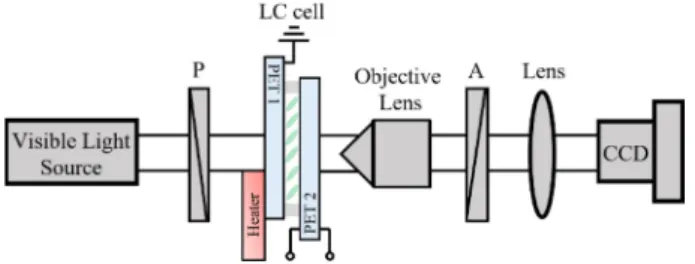
devices. Various studies on the phase transition behavior of LC have been performed; however, much has not been done to investigate the impact of the electric field on the phase transition of LC. Here, we investigate the propagation velocity of the phase boundary between the nematic and isotropic phases, as a function of the voltage applied to the LC using a polarized optical microscope (POM). We found that the propagation velocity of the phase boundary between the nematic and isotropic phases, which can be translated to thermal diffusivity, can be modulated by the electric field applied to the LC and exhibits a peak value for a specific electric field, attributed to the supercooling of the isotropic phase of the LC. Measuring the propagation velocity of the phase boundary for different electric fields offers a simple optical method to measure the electro-thermal properties and thermal anisotropy of the homogeneously aligned LC.
2. EXPERIMENTAL
2.1 Materials
The liquid crystal 4-Cyano-4-pentylbiphenyl (5CB) (CH
3- (CH
2)
4-C
6H
4-C
6H
4-CN) was purchased from Instec Inc. with a stated purity level greater than 99.5%. The indium tin oxide (ITO) coated polyethylene terephthalate (PET) and polyvinyl alcohol (PVA) were purchased from Sigma-Aldrich.
1
Department of Electrical Engineering, Kyungpook National Unversity.
E8-304, Kyungpook National University, 80 Daehak-ro, Buk-gu, Daegu, Korea
2
Electro-optical Systems Team 2, Hanwha systems
188 Pangyo station, Bundang-gu, Seongnam, Gyeonggi-do, Korea
+