• 검색 결과가 없습니다.

Ag Electrode Strain Sensor Fabrication Using Laser Direct Writing Process

N/A
N/A
Protected

Academic year: 2021

Share "Ag Electrode Strain Sensor Fabrication Using Laser Direct Writing Process"

Copied!
4
0
0

로드 중.... (전체 텍스트 보기)

전체 글

(1)

215 J. Sensor Sci. & Tech. Vol. 24, No. 4, 2015 Journal of Sensor Science and Technology

Vol. 24, No. 4 (2015) pp. 215-218 http://dx.doi.org/10.5369/JSST.2015.24.4.215 pISSN 1225-5475/eISSN 2093-7563

Ag Electrode Strain Sensor Fabrication Using Laser Direct Writing Process

Hyeonseok Kim, Jaeho Shin, Sukjoon Hong, and Seung Hwan Ko

+

Abstract

As several innovative technologies for flexible electric devices are being realized, demand for in-situ strain monitoring for flexible electric devices is being emphasized. Because flexible devices are commonly influenced by substrate strain, suitable strain sensors for flexible devices are essential for the sophisticated maneuvering of flexible devices. In this study, a flexible strain sensor based on an Ag electrode is prepared on a polyimide substrate using the LDW (laser direct writing) process. In this process, first, the Ag nanoparticles are coated on the substrate and selectively sintered using a focused laser. Because of the advantages of the LDW process (such as being mask-less, using low temperatures, and having non-vacuum characteristics), the entire fabrication process has been dramatically sim- plified; as a final outcome, a highly reliable strain sensor has been fabricated. Using this strain sensor, various strain conditions that arise from different bending radii can be detected by measuring real-time electrical signals.

Keywords: Strain sensor, Flexible device, Laser direct writing, Non-vacuum, Mask-less, Low temperature, Patterning

1. INTRODUCTION

Over the last few decades, a wide range of basic research into flexible electric devices has been conducted in diverse areas including suitable substrates for flexible devices and fabrication processes compatible with the target substrate. Currently, by virtue of the intensive progression of the last decade in both academia and industry[1], very basic flexible devices such as flexible OLEDs (organic light emitting diodes) are becoming commercially available. However, even though several flexible devices will soon be commercialized, the quality of the devices and the range of applications remain at the rudimentary level.

There are many reasons that flexible devices remain at the elementary level. One reason is that flexible substrates, which are usually made of polymers, are not compatible with standard device fabrication processes such as high temperature deposition and patterning processes using highly reactive chemicals. Because these kinds of processes have been developed in the semiconductor industry and are based on Si wafers, the majority

of fabrication processes are not compatible with polymer substrates. Therefore, to expedite flexible device development, unconventional fabrication approaches are required.

Amongst several promising candidates, LDW[2, 3] is one of the most suitable processes for flexible device fabrication. In the LDW process, a thin metal precursor layer is simply prepared on the flexible substrate using spin coating. Then, the layer is selectively sintered using a laser. Furthermore, the unsintered precursor remainders can be easily removed using normal organic solvents. Thus, patterning and fabrication do not include any costly processes demanding a vacuum, high temperatures, or toxic chemicals.

Because of these advantageous characteristics, which can be summarized as non-vacuum, low temperature, and mask-less, LDW can dramatically widen the process window and overcome the restrictions on flexible device fabrication.

Additionally, the demand for in-situ strain sensors is constantly increasing. If the sensor is flexible, the scope of applications can be greatly expanded. For example, we can utilize the sensor as a user interface by attaching it to fingers or skin.[4] Then, the sensor can convert motion into electrical signals to communicate with a computer.

Furthermore, because flexible devices and their operational characteristics are usually affected by the deformation and strain of the substrate, by integrating the device and the strain sensor, we can compensate for the effect of the strain and maneuver the device more delicately.

School of Mechanical Engineering, Seoul National University, 1 Gwanak-ro, Gwanak-gu, Seoul 151-742, Korea

+
Corresponding author: [email protected] (Received: May. 31, 2015, Accepted: Jul. 28, 2015)

This is an Open Access article distributed under the terms of the Creative Commons Attribution Non-Commercial License(http://creativecommons.org/

licenses/bync/3.0) which permits unrestricted non-commercial use, distribution,

and reproduction in any medium, provided the original work is properly cited.

(2)

Hyeonseok Kim, Jaeho Shin, Sukjoon Hong, and Seung Hwan Ko

J. Sensor Sci. & Tech. Vol. 24, No. 4, 2015 216 In this study, we fabricated flexible strain sensors on polyimide substrates using the LDW process under atmospheric conditions. A thin layer of Ag nanoparticles was coated on the substrate using a normal spin coating process and was selectively sintered using a laser to make an Ag electrode several micrometers wide with a resistance of several Ohms per centimeter. We observed that the electrical resistivity of the electrode varies with the curvature of the substrate. Using this phenomenon, we could obtain reliable electrical signals corresponding to the deformation and strain of the substrate.

2. EXPERIMENTAL

2.1 Preparation of the sensor

First, a 2 cm × 2 cm polyimide film was attached to the glass substrate. Several droplets of ethanol were scattered on the glass substrate, and the polyimide film was placed on the droplets.

Then, the substrate was placed in a clean circulation chamber until the ethanol dried out and even adhesion between the polyimide film and glass substrate had completed.

After substrate preparation, Ag nanoparticles dispersed in toluene were coated on the polyimide film using conventional spin coating.

Before the laser sintering process, the coated substrate was kept in a clean circulation chamber for 5 min to vaporize the remaining toluene.

Then, the substrate was selectively sintered using a 532-nm CW (continuous wave) laser under various power and speed conditions. After sintering, the polyimide film was gently separated from the glass substrate using tweezers. Finally, to remove the remaining unsintered Ag nanoparticle layer, the film was dipped into toluene for 5 s and was placed in the clean circulation chamber for over 5 min to vaporize the toluene.

The electrical resistivity of various sintering conditions was measured repeatedly so that the most stable sintering condition could be determined. The resultant strain sensor was sintered under the most stable condition.

Using the most stable sintering condition, the strain sensor was prepared on a 1.5 cm × 5.5 cm polyimide film. The sensor consists of 25 parallel Ag electrodes of 1 cm in length. Each electrode was drawn with 20 μm of spacing; therefore, the entire width of the 25-electrodes pattern was 0.5 cm.

To achieve good contact, Ag paste was applied at the two ends of the parallel electrodes and copper tape was connected for further electrical measurements.

2.2 Characterization of the sensor

To characterize the strain sensor, a series of resistance Fig. 1. Diagrams of the sensor fabrication process. a) Substrate prep-

aration b) Ag NP coating c) Laser sintering d) Cleaning and separation from the glass substrate.

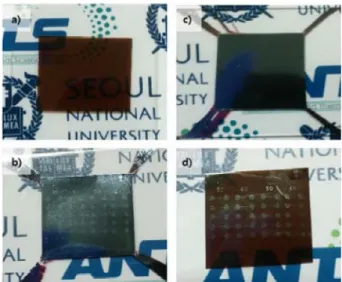
Fig. 2. Optical images for each step of fabrication. a) Substrate prep- aration b) Ag NP coating c) Laser sintering d) Cleaning and separation from the glass substrate.

Fig. 3. Curvature conditions, D = 3 cm, a) No strain (R = ) b) Radius = 2.1 cm c) Radius = 3.0 cm d) Radius = 1.5 cm.

I 2 I

(3)

Ag Electrode Strain Sensor Fabrication Using Laser Direct Writing Process

217 J. Sensor Sci. & Tech. Vol. 24, No. 4, 2015 measurements was conducted under different strain conditions. To

apply the various strains to the sensor, the curvature of the substrate was changed, as depicted in Fig. 3 below.

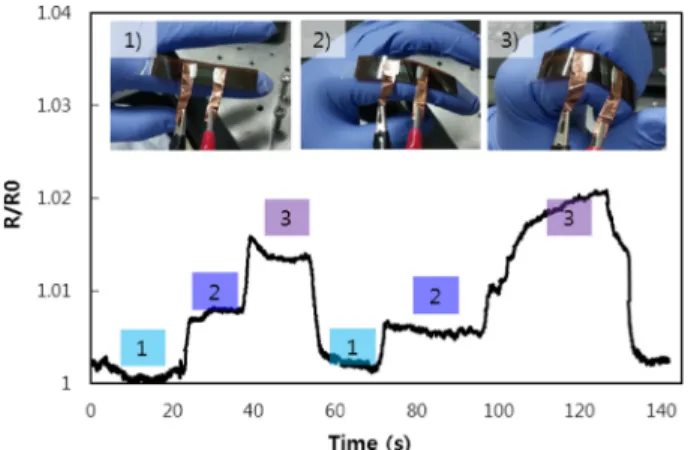
Furthermore, to demonstrate a possible application of the strain sensor, the sensor was attached to a finger and the time varying resistance of the sensor was recorded in response to movement of the finger.

3. RESULTS AND DISCUSSION

3.1 Electrical property of the electrode under various sintering conditions

In the preceding studies, the main factors in the laser sintering process were the sintering speed and the intensity of the laser.

Thus, by varying these two factors, Ag electrodes were fabricated and their electrical resistance in normal conditions (without strain) was measured.

The graph in figure 4 indicates two important features of the electrical resistance of the electrode and the sintering condition.

First, comparing the two power conditions, we found that the 50- mW conditions had lower electrical resistances than those of the 30-mW conditions. Furthermore, the variances of the 50-mW conditions were smaller than those of the 30-mW conditions.

These correlations can be interpreted as being caused by the 30- mW condition being insufficient to fully metalize the Ag precursor. Under the insufficient power condition, imperfections like the unsintered Ag particles will likely hinder electron transport and make the current path unstable.

Moreover, the low electrical resistances of slowly scanned electrodes support this interpretation. Naturally, under the slow scanning condition, a larger amount of energy would be delivered than in the fast scanning condition.

Second, in the 50-mW conditions, we find that the local minimum is near the second-lowest scanning speed. In contrast to the case of the 30-mW conditions (in which the minimum is obtained for the slowest scanning condition), the electrical resistance of the 10-mm/s scanning is higher than that of the 20- mm/s scanning condition. One of the possible explanations for this resistance increase at the high laser intensity is thermal damage to the underlying polymer substrate.

3.2 Characterization of the strain sensor

The strain sensor was fabricated at the 50-mW and 20-mm/s- scanning-speed conditions, at which both the electrical resistance and its variance are minimized. The minimized electrical resistance and enhanced reproducibility in the resistance measurement indicate that an electrode of high quality was made. Because the strain sensor should endure repeated deformation, to prevent degradation, the highest quality condition of the electrode was required.

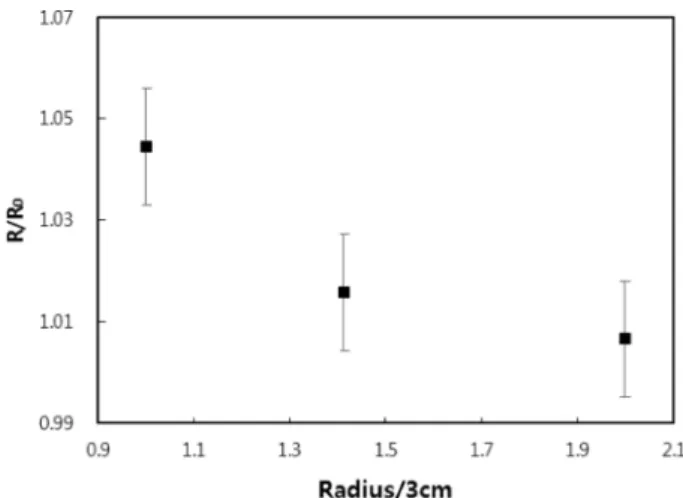
The electrical resistance of the sensor versus the bending radius is shown in Fig. 5. A relatively large amount of change (~5%) in the electrical resistance is observed at a small bending radius. In the case of a larger bending radius, the change in electrical resistance appears to be under 1%.

Because the change in electrical resistance shows monotonically decreasing behavior, we confirmed that we can utilize this phenomenon for sensing the strain or surface curvature of the object.

Increasing the electrical resistance at a smaller bending radius seems natural, because the nominal bending strain applied to the Ag electrode is inversely proportional to the bending radius.[5]

The strain applied to such a thin metallic film can cause extremely small cracks to form on the surface, which increases the overall

Fig. 4. Electrical resistance of Ag electrodes sintered under various

sintering conditions. Fig. 5. Electrical resistance vs. bending radius.

I 3 I

(4)

Hyeonseok Kim, Jaeho Shin, Sukjoon Hong, and Seung Hwan Ko

J. Sensor Sci. & Tech. Vol. 24, No. 4, 2015 218 resistance of the corresponding electrode.[6]

3.3 Real time monitoring of finger movement We can utilize the in-situ strain sensor in future user interfaces that convert body movement into electrical signals. To demonstrate this possibility, we attached the strain sensor to a finger and recorded the real time resistance while change while flexing and extending the finger.

4. CONCLUSIONS

In this study, we fabricated a flexible strain sensor using the LDW process. Based on the various bending conditions, the strain sensor demonstrated a monotonic electrical resistance transition. Using this phenomenon, reliable in-situ strain monitoring was conducted.

Because the LDW process is a non-vacuum, mask-less, and low temperature process, the entire fabrication was dramatically simplified. Moreover, this simplified fabrication process widened the process window and enhanced the reliability of the fabricated sensor.

In an experiment varying the laser power and scanning speed conditions of the LDW process, two important correlations between sintering conditions and the properties of the sintered electrodes were extracted. At low energy density conditions, the unsintered nanoparticles hinder current transportation and make the entire current path unstable. At the highest energy density condition, it is suspected that the underlying substrate is thermally damaged, yielding a poor electrical resistance. As a consequence, the best sintering condition was found ensuring the lowest electrical resistance and stable electrical properties.

Using the optimum sintering condition, a strain sensor was fabricated on the polyimide substrate and characterized under

different bending conditions. A monotonic increase in electrical resistance with decreasing bending radius was observed. At the most severely bent condition (R = 1.5 cm), a 5% increase in electrical resistance was observed.

In an additional experiment, utilizing the strain sensor, real time motion signalizing was demonstrated for a user interface application. Clear signals were obtained and the feasibility of the user interface was confirmed.

ACKNOWLEDGMENT

This work is supported by the National Research Foundation of Korea (NRF) (grant no. 2012-0008779); the Global Frontier R&D Program on Center for Multiscale Energy System (grant no. 2012- 054172) funded by the Ministry of Science, ICT & Future; and the R&D Convergence Program.

REFERENCES

[1] A. Nathan, A. Ahnood, M. T. Cole, L. Sungsik, Y. Suzuki, P. Hiralal, F. Bonaccorso, T. Hasan, L. Garcia-Gancedo, A.

Dyadyusha, S. Haque, P. Andrew, S. Hofmann, J. Moultrie, C. Daping, A. J. Flewitt, A. C. Ferrari, M. J. Kelly, J. Rob- ertson, G. Amaratunga, and W. I. Milne, “Flexible elec- tronics: The next ubiquitous platform,” Proceedings of the IEEE, Vol. 100, pp. 1486-1517, 2012.

[2] J. Yeo, S. Hong, D. Lee, N. Hotz, M.-T. Lee, C. P. Grig- oropoulos, and S. H. Ko, “Next generation non-vacuum, maskless, low temperature nanoparticle ink laser digital direct metal patterning for a large area flexible electronics,”

PLoS ONE, Vol. 7, p. e42315, 2012.

[3] S. Hong, J. Yeo, G. Kim, D. Kim, H. Lee, J. Kwon, H. Lee, P. Lee, and S. H. Ko, “Nonvacuum, maskless fabrication of a flexible metal grid transparent conductor by low-tem- perature selective laser sintering of nanoparticle ink,” ACS Nano, Vol. 7, pp. 5024-5031, 2013/06/25 2013.

[4] T. Yamada, Y. Hayamizu, Y. Yamamoto, Y. Yomogida, A.

Izadi-Najafabadi, D. N. Futaba, and K. Hata, “A stretchable carbon nanotube strain sensor for human-motion detection,”

Nat Nano, Vol. 6, pp. 296-301, 2011.

[5] J. Yeo, G. Kim, S. Hong, M. S. Kim, D. Kim, J. Lee, H. B.

Lee, J. Kwon, Y. D. Suh, H. W. Kang, H. J. Sung, J.-H.

Choi, W.-H. Hong, J. M. Ko, S.-H. Lee, S.-H. Choa, and S.

H. Ko, “Flexible supercapacitor fabrication by room tem- perature rapid laser processing of roll-to-roll printed metal nanoparticle ink for wearable electronics application,” Jour- nal of Power Sources, Vol. 246, pp. 562-568, 2014.

[6] D. Kang, P. V. Pikhitsa, Y. W. Choi, C. Lee, S. S. Shin, L.

Piao, B. Park, K.-Y. Suh, T.-i. Kim, and M. Choi, “Ultra- sensitive mechanical crack-based sensor inspired by the spi- der sensory system,” Nature, Vol. 516, pp. 222-226, 2014.

Fig. 6. Real-time change of electrical resistance.

I 4 I

수치

Fig. 3. Curvature conditions, D = 3 cm, a) No strain (R =  ) b) Radius = 2.1 cm c) Radius = 3.0 cm d) Radius = 1.5 cm.
Fig. 4. Electrical resistance of Ag electrodes sintered under various
Fig. 6. Real-time change of electrical resistance.

참조

관련 문서