One of the most common oral surgical procedures is the lower third molar (LTM) extraction. The closer the relation- ship between LTM and the inferior alveolar nerve (IAN), the more difficult it is to remove the LTM.1Postoperative complications such as paresthesia due to IAN injury are frequently observed in cases of this type of surgery, par- ticularly in cases of LTM horizontal or vertical impaction, because of LTM proximity to the IAN.1,2 Curved or thin roots have also been described as risk factors causing IAN damage.3
Two different orthodontic maneuvers used to minimize the risk of IAN injury during LTM extraction have been recently described in the literature.4,5 According to their results, orthodontic forces might be used to extrude the vertically impacted LTM, allowing the surgeon to perform a safe extraction. However, both of these maneuvers in- volve application of orthodontic brackets, either in the
mandibular molars4or in the antagonist maxillary molars.5 Another study described the first-time use of an orthodon- tic miniscrew placed in the mandible, near the lower first molar, to offer the anchorage needed to apply orthodontic forces to extrude the LTM.6Nevertheless, this study report- ed that passive bracketing on the mandibular molars of the same side was also required and led to patient discom- fort during treatment.6The role of miniscrews in cases of LTM orthodontic extrusion was also mentioned by Wang et al.5However, no clinical or tomographic images of the procedure were shown in their study.
Thus, the present study aimed to report the usefulness of cone-beam computed tomographic (CBCT) imaging follow-up in a case of orthodontic extrusion of a vertical- ly impacted LTM by using a sole orthodontic miniscrew.
Case Report
A 34-year-old male patient with no systemic conditions or any metabolic disorders presented with a previously taken routine panoramic radiograph showing signs of a close relationship between the left LTM and the mandibu-
An alternative approach to extruding a vertically impacted lower third molar using an orthodontic miniscrew: A case report with cone-beam CT follow-up
Arthur Rodriguez Gonzalez Cortes1,*, Juliana No-Cortes2, Marcelo Gusmão Paraíso Cavalcanti1, Emiko Saito Arita1
1Department of Oral Radiology, School of Dentistry, University of São Paulo, São Paulo, Brazil
2Orthodontic Clinic, São Paulo, Brazil
ABSTRACT
One of the most common oral surgical procedures is the extraction of the lower third molar (LTM). Postoperative complications such as paresthesia due to inferior alveolar nerve (IAN) injury are commonly observed in cases of horizontal and vertical impaction. The present report discusses a case of a vertically impacted LTM associated with a dentigerous cyst. An intimate contact between the LTM roots and the mandibular canal was observed on a panora- mic radiograph and confirmed with cone-beam computed tomographic (CBCT) cross-sectional cuts. An orthodontic miniscrew was then used to extrude the LTM prior to its surgical removal in order to avoid the risk of inferior alveo- lar nerve injury. CBCT imaging follow-up confirmed the success of the LTM orthodontic extrusion. (Imaging Sci Dent 2014; 44: 171-5)
KEY WORDS: Molar, Third; Orthodontic Extrusion; Cone-Beam Computed Tomography
Received August 21, 2013; Revised September 1, 2013; Accepted September 16, 2013
*Correspondence to : Dr. Arthur Rodriguez Gonzalez Cortes
Department of Oral Radiology, School of Dentistry, University of São Paulo, Av.
Prof. Lineu Prestes, 2227, São Paulo, SP 05508-000, Brazil Tel) 55-11-3091-7831, Fax) 55-11-3091-7831, E-mail) [email protected]
Copyright ⓒ 2014 by Korean Academy of Oral and Maxillofacial Radiology
This is an Open Access article distributed under the terms of the Creative Commons Attribution Non-Commercial License (http://creativecommons.org/licenses/by-nc/3.0) which permits unrestricted non-commercial use, distribution, and reproduction in any medium, provided the original work is properly cited.
Imaging Science in Dentistry∙pISSN 2233-7822 eISSN 2233-7830
lar canal, such as darkening and deflection of the roots, and narrowing and diversion of the mandibular canal. This in- itial radiographic analysis led us to suggest that the patient undergo a CBCT scan, which he did. A CBCT machine (i-CAT Classic, Image Sciences International, Hatfield, PA, USA) was used and configured with the following diagnostic protocol: 0.25 mm voxel, 120 kVp, 8 mA, and field of view (FOV) 16 cm in diameter and 6 cm in height.
From the scan, three-dimensional (3D) reconstructed images were rendered using DentalSlice®(Bioparts, São Paulo, Brazil) software.
On these preoperative CBCT images, the vertical impac- tion of the left LTM was confirmed and classified as level
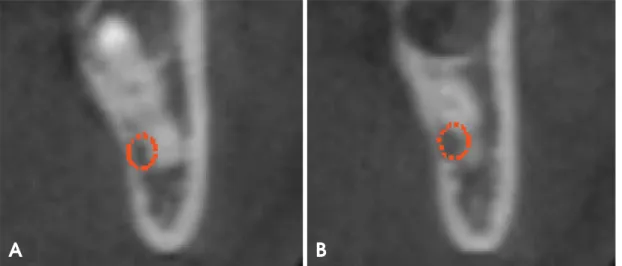
B (LTM partially buried in the bone), according to Pell and Gregory’s classification.7Additionally, a cyst-like lesion was found associated with its crown. Cross-sectional CBCT images showed that the mandibular canal came into con- tact with a root curvature and the lingual plate (Fig. 1).
Because of its intimate contact with the mandibular canal, it could be foreseen that LTM surgical extraction would increase the risk of IAN injury. Therefore, we decided to use an orthodontic miniscrew to extrude the LTM prior to its surgical removal. The risks and benefits of the available treatment options were explained to the patient, and he decided in favor of using the miniscrew to extrude the LTM and provided informed consent.
Fig. 1.Initial cross-sectional cone-beam computed tomographic (CBCT) images of the site show the contact between the mandibular canal and the curvatures of the mesial (A) and distal (B) roots, depicted in different CBCT cuts.
A B
Fig. 2.A clinical photograph shows the lower third molar before (A) and after (B) orthodontic extrusion.
A B
The first step of the treatment was to perform an initial surgical procedure to remove the bone around the occlusal and buccal surfaces of the LTM crown by using a piezoe- lectric surgical unit (Piezosonic, Driller®, São Paulo, SP, Brazil) and to remove the cyst lesion associated with this crown. The diagnosis of a dentigerous cyst was confirm- ed by histological analysis. After an 8 week healing period, there was gingival recession, and part of the LTM occlusal surface was seen in the clinical examination. Accordingly, an orthodontic separator was installed to avoid LTM im- paction caused by contact with the adjacent second molar.
Two weeks later, a periapical radiograph was taken. Accord- ing to the images, contact between the two teeth was actu- ally prevented.
Thus, an orthodontic miniscrew (8 mm in length and 1.5 mm in diameter; Morelli, São Paulo, Brazil) was inserted
into the buccal cortex between the first and second antag- onist maxillary molars. Elastic traction was applied bet- ween the miniscrew and the orthodontic hook installed on the LTM occlusal surface with two orthodontic elastics.
During the first week, the miniscrew orthodontic anchorage was applied. The patient reported a light “pins and needles”
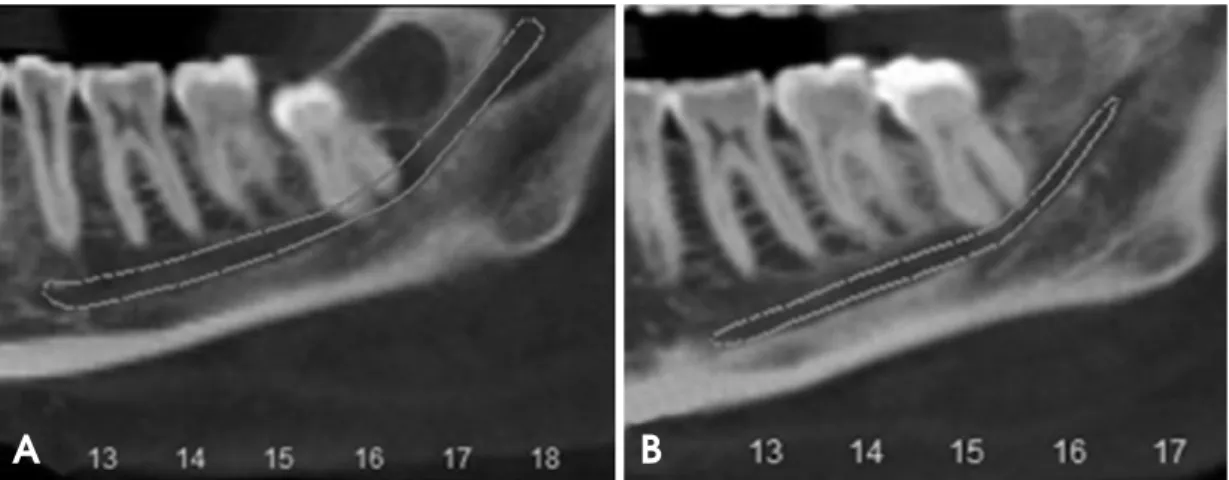
sensation in part of the tongue, lasting 3 days. At 3 weeks after miniscrew installation, the LTM was extruded marked- ly (Fig. 2), confirmed by CBCT coronal panoramic (Fig.
3) and cross-sectional follow-up images (Fig. 4). At this time, the LTM was surgically extracted. The roots did not fracture, and the LTM was easily removed from the alveo- lar socket. During surgery, there was no excessive bleed- ing or pain. No IAN damage or exposure was clinically observed. The root curvature, found to be in contact with the mandibular canal, was observed by examining the LTM
Fig. 3.Initial (A) and final (B) coronal panoramic CBCT reconstruction images of the site show the relationship between the lower third molar roots and the mandibular inferior alveolar canal.
A B
Fig. 4.Initial (A) and final (B) cross-sectional CBCT images of the site show the relationship between the lower third molar roots and the mandibular inferior alveolar canal.
A B
after it was extracted and cleaned (Fig. 5). The patient’s postoperative recovery was uneventful. The patient stated no significant discomfort during the LTM extrusion period, or during the extraction surgery. Additionally, no adjacent mandibular second molar loosening or displacement was observed during the entire treatment time. No postopera- tive complications were observed in a follow-up period of 28 months.
Discussion
In some studies on LTM extraction, panoramic radio- graphy has been used as an initial examination to check the proximity between LTM roots and the IAN.4-6 However, it does not offer cross-sectional images of the surgery site.
Computed tomographic (CT) images have been described as essential tools to diagnose the contact between LTM and the mandibular canal three-dimensionally.8These find- ings are in accordance with what was observed in the pre- sent case report, insofar as CBCT imaging detected the intimate contact between root curvatures and the IAN, confirmed by the LTM shape observed after its extraction.
In the present case, pre- and postoperative CBCT scans were necessary to confirm the detachment of the left LTM roots from the mandibular canal. Compared with other CT methods, CBCT offers advantages such as reduced effec- tive radiation doses, shorter acquisition scan time, easier imaging, and lower costs.9In addition, an FOV of 6 cm in height was used to restrain the scan to the mandible area.
For this type of scan in standard resolution, the effective doses emitted by the CBCT device used in this study were 23.9μSv and 96.2 μSv (using both the 1990 and the recent- ly approved 2007 International Commission on Radiologi-
cal Protection recommended tissue weighting factors, respectively).10
In order to avoid IAN injury risks during LTM extrac- tion, different orthodontic approaches have been develop- ed.4,5Bonetti et al4demonstrated a technique of complex orthodontic appliances used in the inferior arch and requir- ed to achieve the anchorage needed to extrude LTM, which was the main disadvantage of their technique.4 On the other hand, two other studies on an orthodontic aid to extrude LTM described a simpler technique to make LTM surgical removal easier, and observed that this technique could also be important to improve the periodontal status of the neighboring sites.11Additionally, these studies report- ed that a minimum period of 3 months was required to achieve satisfactory orthodontic extrusion of the LTM.4,11
Another article on orthodontic-aided extraction of a ver- tically impacted LTM showed a technique of bracketing the antagonist maxillary molars to achieve the anchorage required to extrude the LTM using elastic traction.5Accord- ing to their study, a mean period of 35 days was required to complete the orthodontic LTM traction. This finding supported the present case, which also used elastic traction, resulting in an orthodontic treatment time of 5 weeks (2 weeks with the orthodontic separator, and 3 weeks with the mini implant with elastic traction) to obtain LTM ex- trusion. However, in their study, an orthodontic bracket with a hook was placed on the LTM buccal surface to establish the orthodontic elastic,5 whereas in the present case, the hook was installed on the LTM occlusal surface, leading to less contact with the patient’s cheek mucosa.
Furthermore, in the present case, two elastics were used, thus reducing traction time. On the other hand, an initial surgical procedure was required to remove the bone around
Fig. 5.Mesial (A) and lingual (B) views of the extracted lower third molar show the root curvature (arrow), which comes into contact with the mandibular canal before orthodontic extrusion with the miniscrew.
A B
the occlusal and buccal surfaces of the LTM crown by using a piezoelectric surgical unit, which has recently been des- cribed as an effective method of significantly reducing surgical time and avoiding postoperative complications, such as facial swelling and trismus, in cases of third molar surgery.12
As a first-time application, Park et al6used an orthodon- tic miniscrew placed in the mandible, near the lower first molar, to offer the anchorage needed to extrude the LTM.
In their study, CBCT cross-sectional images were used to confirm the contact between the LTM roots and the mandi- bular canal, thus supporting the role of CBCT imaging, as described in the present case. On the other hand, passive bracketing was also used in their study, leading to varia- ble degrees of patient discomfort during the traction peri- ods, contrasting with the findings of the present case re- port, in which no significant discomfort during orthodontic traction was reported by the patient who was analyzed.
In conclusion, the present report demonstrated the role of the miniscrew in avoiding IAN injury in cases of ver- tically impacted LTM extraction. Our report further sup- ported the usefulness of CBCT imaging to diagnose the initial contact between the mandibular canal and the LTM, and their later detachment during the course of the treat- ment. Therefore, enhanced visualization of the mandibular canal location and its relationship with the LTM roots could improve pre-treatment and surgical planning.
References
1. Valmaseda-Castellón E, Berini-Aytés L, Gay-Escoda C. In- ferior alveolar nerve damage after lower third molar surgical extraction: a prospective study of 1117 surgical extractions.
Oral Surg Oral Med Oral Pathol Oral Radiol Endod 2001; 92:
377-83.
2. Susarla SM, Blaeser BF, Magalnick D. Third molar surgery and associated complications. Oral Maxillofac Surg Clin North Am 2003; 15: 177-86.
3. Bui CH, Seldin EB, Dodson TB. Types, frequencies, and risk factors for complications after third molar extraction. J Oral Maxillofac Surg 2003; 61: 1379-89.
4. Alessandri Bonetti G, Bendandi M, Laino L, Checchi V, Chec- chi L. Orthodontic extraction: riskless extraction of impacted lower third molars close to the mandibular canal. J Oral Max- illofac Surg 2007; 65: 2580-6.
5. Wang Y, He D, Yang C, Wang B, Qian W. An easy way to apply orthodontic extraction for impacted lower third molar compressing to the inferior alveolar nerve. J Craniomaxillofac Surg 2012; 40: 234-7.
6. Park W, Park JS, Kim YM, Yu HS, Kim KD. Orthodontic ex- trusion of the lower third molar with an orthodontic mini im- plant. Oral Surg Oral Med Oral Pathol Oral Radiol Endod 2010; 110: e1-6.
7. Pell GJ, Gregory BT. Impacted mandibular third molars: clas- sification and modified techniques for removal. Dent Digest 1933; 39: 330-8.
8. Tantanapornkul W, Okouchi K, Fujiwara Y, Yamashiro M, Maruoka Y, Ohbayashi N, et al. A comparative study of cone- beam computed tomography and conventional panoramic radio- graphy in assessing the topographic relationship between the mandibular canal and impacted third molars. Oral Surg Oral Med Oral Pathol Oral Radiol Endod 2007; 103: 253-9.
9. Scarfe WC, Farman AG, Sukovic P. Clinical applications of cone-beam computed tomography in dental practice. J Can Dent Assoc 2006: 72: 75-80.
10. Roberts JA, Drage NA, Davies J, Thomas DW. Effective dose from cone beam CT examinations in dentistry. Br J Radiol 2009; 82: 35-40.
11. Guida L, Cuccurullo GP, Lanza A, Tedesco M, Guida A, An- nunziata M. Orthodontic-aided extraction of impacted third molar to improve the periodontal status of the neighboring tooth. J Craniofac Surg 2011; 22: 1922-4.
12. Itro A, Lupo G, Marra A, Carotenuto A, Cocozza E, Filipi M, et al. The piezoelectric osteotomy technique compared to the one with rotary instruments in the surgery of included third molars. A clinical study. Minerva Stomatol 2012; 61: 247-53.