Allogeneic hematopoietic stem cell transplantation in congenital hemoglobinopathies with myeloablative conditioning and rabbit anti-thymocyte globulin
Bo-Kyoung Park
1, Hyo-Sup Kim
1, Seongkoo Kim
1, Jae-Wook Lee
1, Young Shil Park
2, Pil-Sang Jang
1, Nack-Gyun Chung
1, Dae-Chul Jeong
1, Bin Cho
1Department of Pediatrics, 1Catholic Hematology Hospital, College of Medicine, The Catholic University of Korea, 2Kyung Hee University Hospital at Gangdong, Kyung Hee University School of Medicine, Seoul, Korea
p-ISSN 2287-979X / e-ISSN 2288-0011 https://doi.org/10.5045/br.2018.53.2.145 Blood Res 2018;53:145-151.
Received on September 11, 2017 Revised on February 21, 2018 Accepted on February 22, 2018
Background
Allogeneic hematopoietic stem cell transplantation (HSCT) is a curative therapy for -tha- lassemia major (TM) and sickle cell disease (SCD) in children. Graft-versus-host disease (GVHD) and treatment-related mortality (TRM) remain significant challenges to improv- ing survival after HSCT. Here, we analyzed the outcome of TM and SCD patients, who received allogeneic HSCT with myeloablative conditioning at our institution.
Methods
Twenty-two patients (15 TM, 7 SCD), with a median age of 9 years (range, 1.6‒16.9), underwent allogeneic HSCT using busulfan, cyclophosphamide and rabbit anti-thymo- cyte globulin-based conditioning. Cells were derived from either the bone marrow (8 patients), or peripheral blood stem cells (14 patients). The majority of patients received HSCT from a matched sibling donor (N=18). GVHD prophylaxis included cyclosporine and short course methotrexate.
Results
All patients achieved donor engraftment. Two SCD patients died from TRM-related grade IV gut GVHD (N=1) or severe bronchiolitis obliterans (BO) (N=1). Cumulative incidence of acute and chronic GVHD was 36.4% and 32.7%, respectively. Veno-occlusive disease (VOD) occurred in 8 patients (36.4%), but resolved in all instances. Epstein-Barr virus (EBV)-related post-transplantation lymphoproliferative disease (PTLD) occurred in 1 patient. The overall survival (OS) was 90.9% (TM 100%, SCD 71.4%), with all patients achieving transfusion independence, while 8 achieved complete donor chimerism.
Conclusion
Busulfan, cyclophosphamide, and ATG-based conditioning for HSCT of TM and SCD pa- tients did not result in graft failure, although modifications may be required to reduce VOD incidence. Further changes to donor type and cell source prioritization are necessary to minimize TRM and morbidity caused by GVHD.
Key Words Hematopoietic stem cell transplantation, Myeloablative conditioning, Sickle cell disease, Thalassemia major
Correspondence to
Nack-Gyun Chung, M.D., Ph.D.
Department of Pediatrics, Catholic Hematology Hospital, College of Medicine, The Catholic University of Korea, 222 Banpo-daero, Seocho-gu, Seoul 06591, Korea
E-mail: [email protected]
Ⓒ 2018 Korean Society of Hematology
INTRODUCTION
According to a World Health Organization (WHO) report,
-thalassemia and sickle cell disease (SCD) are the world’s most common hereditary hemoglobinopathies and approx- imately 5% of the world’s population carries trait genes for
these hemoglobin disorders [1]. Beta-thalassemia shows a high prevalence in the Mediterranean, Middle Eastern, and South Asian regions, while SCD is endemic to Central Africa.
However, population migration has resulted in hereditary hemoglobinopathies becoming a global and growing health problem in many countries [2, 3].
Therapy for thalassemia major (TM) includes supportive
Table 1. Patient characteristics.
TM (N=15) SCD (N=7) All (N=22)
Age at HSCT (yr)
Median (Range) 6.2 (1.6–16.0) 12.5 (6.9–16.9) 9.0 (1.6–16.9)
Ethnic origin
Middle East 15 7 22
Gender
Male:female 6:9 5:2 11:11
Ferritin (ng/mL)
Median (Range) 1,803 (1,103–3,096) 233 (133–1,568)
Splenomegaly 3 (20%) 5 (71%)
Iron chelation therapy 13 (87%) 0
Vaso-occlusive crisis - 7 (100%)
Hydroxyurea treatment - 6 (86%)
Abbreviations: HSCT, hematopoietic stem cell transplantation; SCD, sickle cell disease; TM, thalassemia major.
treatment such as transfusion and iron chelation therapy.
However, allogeneic hematopoietic stem cell transplantation (HSCT) remains the only curative treatment option. Similarly, allogeneic HSCT is curative for SCD, although hydroxyurea may reduce morbidity and mortality by increasing fetal he- moglobin and decreasing red blood cell (RBC) sickling. The timing of HSCT in SCD, however, is controversial, with HSCT often recommended when patients begin to experience SCD-related complications such as stroke, acute chest syn- drome, and recurrent vaso-occlusive pain crisis.
TM and SCD are both caused by genetic defects in the hematopoietic system, and may be cured by gene therapy, although such a treatment modality is not available in most clinical settings [4-6].
Patients with severe thalassemia and sickle cell anemia requiring HSCT have not yet been reported in Korea, al- though the incidence of severe hemoglobinopathy is ex- pected to rise in the future [3]. In this study, we report the outcome of TM and SCD patients who received allogeneic HSCT with myeloablative conditioning at our institution, with the aim to present baseline results that may be utilized to improve outcome in the future.
MATERIALS AND METHODS
Patients
We retrospectively reviewed data on 22 consecutive TM or SCD patients who received allogeneic HSCT from July 2012 to December 2015 at the Department of Pediatrics, Catholic Blood Hospital, The Catholic University of Korea.
This study received approval from the institutional review board (IRB). The study group included 15 patients with TM and 7 patients with SCD (11 males, 11 females) (Table 1). The median age at transplantation was 9.0 years (range, 1.6–16.9). All patients were of Middle Eastern ethnicity.
The median ferritin level of TM patients was 1,803 ng/mL (range, 1,103–3,096), and 13 patients received iron chelation
therapy. All SCD patients had previously experienced vaso-occlusive crisis, and received hydroxyurea therapy at the time of HSCT, except for 1 patient, intolerant to the medication.
Donor and conditioning regimen
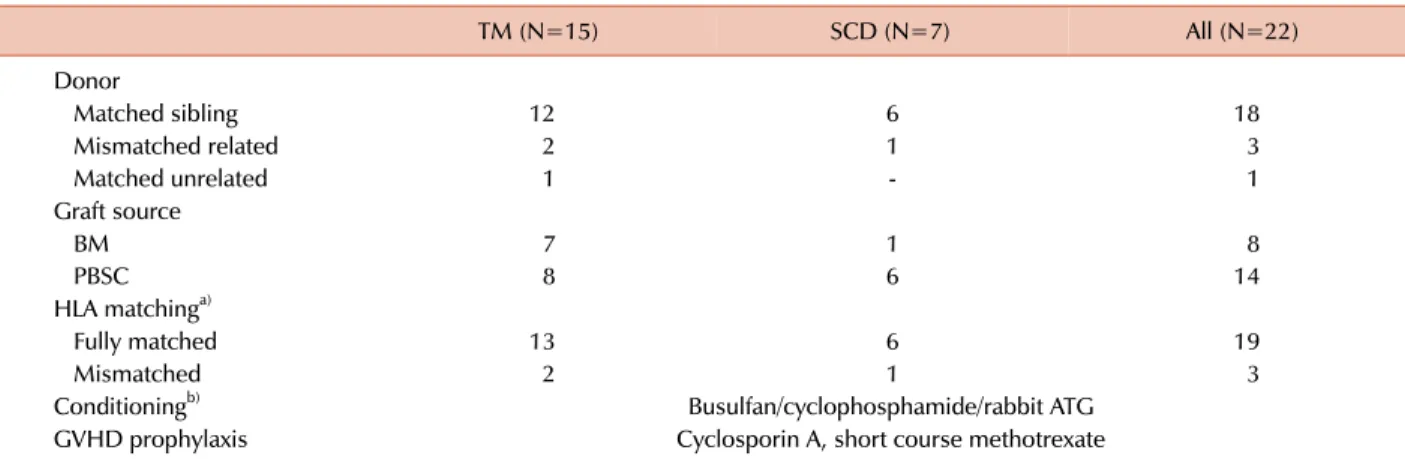
All donor–recipient pairs were matched according to high resolution typing for HLA-A, B, C, and DRB1 alleles. Donor types in the HSCTs were as follows: 18 matched sibling donors (MSD), 3 mismatched related donors (including 2 haploidentical and 1 HLA-DR 1-antigen mismatched donor), and 1 matched unrelated donor (MUD). Although 12 donors had -thalassemia trait and 3 donors had sickle cell trait, none of the donors showed evidence of hemoglobinopathy (Table 2).
Twenty patients received the following conditioning regi- men: intravenous (IV) busulfan 130 mg/m2 once daily for 4 days, cyclophosphamide 60 mg/kg once daily for 2 days and anti-thymocyte globulin (ATG) (Thymoglobulin; Genzyme, Cambridge, MA, USA) 2.5 mg/kg once daily for 3 days.
One patient received the same conditioning regimen except that cyclophosphamide was administered at 50 mg/kg for 4 days. One SCD patient, who underwent haploidentical HSCT, received total body irradiation 400 cGy, busulfan 130 mg/m2 once daily for 2 days, fludarabine 30 mg/m2 for 5 days and ATG 2.5 mg/kg for 3 days. The other TM patient received haploidentical HSCT from a homozygous HLA donor with 4/8 match in the graft-versus-host direction, and 8/8 match in the host-versus-graft direction; this patient received the same conditioning as MSD HSCT patients.
Transplantation care
Graft-versus-host disease (GVHD) prophylaxis consisted of IV cyclosporine (3 mg/kg/day IV initially, followed by 5 mg/kg/day oral dose, when oral intake was possible) starting from day -1 and 4 infusions of short course methotrexate (5 mg/m2) at days 1, 3, 6, 11. In the absence of GVHD, cyclosporine was maintained at therapeutic levels (100–200
Table 2. Transplantation characteristics.
TM (N=15) SCD (N=7) All (N=22)
Donor
Matched sibling 12 6 18
Mismatched related 2 1 3
Matched unrelated 1 - 1
Graft source
BM 7 1 8
PBSC 8 6 14
HLA matchinga)
Fully matched 13 6 19
Mismatched 2 1 3
Conditioningb) Busulfan/cyclophosphamide/rabbit ATG
GVHD prophylaxis Cyclosporin A, short course methotrexate
a)HLA-A, -B, -C, -DR matching with DNA typing. b)With the exception of one haploidentical transplantation HSCT, conditioning was performed with total body irradiation, busulfan, fludarabine and ATG.
Abbreviations: ATG, anti-thymocyte globulin; BM, bone marrow; GVHD, graft-versus-host disease; HLA, human leukocyte antigen; PBSC, peripheral blood stem cell; SCD, sickle cell disease; TM, thalassemia major.
Table 3. Transplantation outcomes.
TM (N=15) SCD (N=7) All (N=22)
Median follow up time
Months (range) 27 (16–58) 34 (22–47) 27 (16–58)
Engraftment daya)
Neutrophils (>0.5×10⁹/L)
Median day (range) 15 (8–25) 11 (10–15) 14.5 (8–25)
Platelets (20×109/L)
Median day (range) 13 (8–65) 12 (9–40) 12.5 (8–65)
CMV DNAemia 5 (33.3%) 3 (42.9%) 8 (36.4%)
EBV DNAemia 4 (26.7%) 4 (57.1%) 8 (36.4%)
Post-transplantation lympho-proliferative disease 1 (6.7%) 0 (0%) 1 (4.5%)
Veno-occlusive disease 8 (53.3%) 0 (0%) 8 (36.4%)
Hemorrhagic cystitis 1 (6.7%) 1 (14.3%) 2 (9.0%)
a)Days after stem cell transplantation.
Abbreviations: CMV, cytomegalovirus; EBV, Epstein-Barr virus; GVHD, graft-versus-host disease; SCD, sickle cell disease; TM, thalassemia major.
ng/mL) until 9 months post-transplantation, then sub- sequently tapered and stopped at 1 year post-transplantation.
Antimicrobial prophylaxis included oral acyclovir from the beginning of conditioning until day 42, and oral trimetho- prim-sulfamethoxazole from the beginning of conditioning until day -3, and from neutrophil engraftment until at least 1 year after transplantation. Antifungal prophylaxis consisted of IV micafungin (1 mg/kg/day) from the beginning of con- ditioning until neutrophil engraftment, at which point oral fluconazole was administered and maintained for at least 6 weeks. G-CSF was administered from day 5 until absolute neutrophil count (ANC) ≥3.0×10⁹/L.
Detection of post-HSCT cytomegalovirus (CMV) DNAemia and Epstein-Barr virus (EBV) DNAemia was performed with real-time quantitative monitoring of plasma samples after engraftment at weekly and fortnightly intervals, respectively,
until 3 months after transplantation, and at longer intervals subsequently. Preemptive treatment for EBV DNAemia was not provided, and rituximab was only administered with diagnosis of post-transplantation lymphoproliferative disease (PTLD).
Immune reconstitution and chimerism analyses were per- formed at 1, 3, 6, 9 and 12 months post-HSCT. Chimerism was determined with short tandem repeat polymerase chain reaction (STR-PCR) analysis of peripheral blood, with full donor chimerism defined as >95% donor hematopoietic cells, and mixed donor chimerism defined as 5–95% do- nor-derived cells.
Definition and evaluation of data
Date of neutrophil engraftment was defined as the first of 3 consecutive days with ANC ≥0.5×10⁹/L, and the date
Fig. 1. Cumulative incidence of grade ≥2 acute graft-versus-host disease (aGVHD).
Abbreviations: SCD, sickle cell disease; TM, thalassemia major.
Fig. 2. Cumulative incidence of moderate to severe chronic graft-versus-host disease (cGVHD).
Abbreviations: SCD, sickle cell disease; TM, thalassemia major.
of platelet engraftment was defined as the first of 3 consec- utive days with platelet count ≥50×109/L without platelet transfusions in the preceding week. Acute GVHD was graded according to published consensus criteria, and chronic GVHD was classified according to revised 2014 NIH criteria [7, 8]. Major toxicities were graded according to NCI CTCAE (version 4.0). Hepatic veno-occlusive disease (VOD) was di- agnosed according to clinical criteria as the presence of two of the following: 1) hyperbilirubinemia (bilirubin >2 mg/dL), 2) painful hepatomegaly, and 3) unexplained weight gain (>5% from baseline).
Statistical analysis
Primary outcomes analyzed were the incidences of graft failure and treatment-related mortality (TRM) after HSCT.
Secondary endpoints included the incidence of VOD and acute and chronic GVHD. Overall survival (OS) was calcu- lated using the Kaplan–Meier method. Both acute and chron- ic GVHD were calculated using the cumulative incidence function, with TRM without respective GVHD as a compet- ing risk [9]. Patients alive were censored at date of last follow-up, but no later than April 30, 2017. Statistical analy- ses were performed with R package version 2.14.2 (R Foundation for Statistical Computing, Vienna, Austria).
RESULTS
Engraftment and early complications
Graft failure was not observed, and all patients showed neutrophil and platelet engraftment at a median time of 14.5 days (range, 8–25), and 12.5 days (range, 8–65), respectively. Median donor chimerism at 1 month post-trans- plantation was 99% (range, 93–100) (Table 3). Twenty-one out of 22 patients showed complete donor chimerism at this time point. During the last follow-up, 2 MSD bone
marrow transplantation (BMT) recipients, who initially ach- ieved complete donor chimerism, showed a decrease in chi- merism down to 94% and 81%, while 1 patient with initial partial donor chimerism converted to complete donor chimerism. All TM patients became transfusion-independent with normal complete blood counts.
As TM and SCD are at high risk for VOD, and as 1 of the 2 initial patients showed VOD, prophylaxis against VOD was started for the third HSCT patient with alprostadil (Eglandin, Welfide Korea, Hwaseong, Korea) at a dose of 0.1 g/kg/day with continuous infusion starting 1 day prior to conditioning until 30 days after HSCT. No significant difference in VOD incidence was observed according to me- dian ferritin levels: 36.4% [95% confidence interval (CI), 21.9–50.9] for lower ferritin levels and 45.5% (95% CI, 30.5–
60.5) for higher ferritin levels (P=0.636). VOD occurred in 8 out of 15 patients with TM (53.3%) and in none of the SCD patients (Table 3). Severity of VOD was as follows:
1 mild, and 7 moderate. Median time to VOD onset was 13 days (range, 9-26), and median highest total bilirubin was 3.9 mg/dL (range, 1.7–11.2). All 7 patients with moderate VOD showed abdominal pain, and disseminated intra- vascular coagulopathy requiring antithrombin III treatment.
Median weight gain percentage was 15% (range, 6.5–27.5).
All VOD patients received either recombinant tissue plasmi- nogen activator (TPA) or defibrotide as anticoagulant ther- apy, with 12.5 days median duration of treatment (range, 9–26). Supportive care also included glutathione and vitamin E treatment. All patients showed resolution of VOD.
Hemorrhagic cystitis occurred in 1 patient in each of the TM and SCD patient groups.
GVHD incidence
Overall, 8 patients were diagnosed with and treated for acute GVHD of grade 2 or above with a cumulative incidence of 36.4% (95% CI, 25.8–47.0) (Fig. 1). Four of these patients experienced grade 3 or 4 acute GVHD (1 TM and 3 SCD
Fig. 3. Overall survival of thalassemia major (TM) and sickle cell disease (SCD) after allogeneic hematopoietic stem cell transplantation.
patients) and 1 SCD patient died of complications resulting from grade 4 gut GVHD. PB was the cell source for these 5 patients. Cumulative incidence of acute GVHD of grade 2 or above was higher in the 14 patients who underwent peripheral blood stem cell transplantation (PBSCT, 50.0%, 95% CI, 36.6–63.4), compared with the 8 patients, who re- ceived BMT (12.5%, 95% CI, 0.8–24.2), although the number of patients was too low to determine statistical significance (P=0.072). Other factors such as primary disease (TM vs.
SCD) and donor type (MSD vs. others) did not significantly influence acute GVHD incidence.
Eight patients were diagnosed with chronic GVHD and the severity of chronic GVHD was as follows: 1 mild, 2 moder- ate, and 5 severe. One patient with de novo mild chronic GVHD showed oral GVHD and dry eye symptoms, but showed rapid resolution of disease with oral prednisolone administration. The cumulative incidence of moderate to severe chronic GVHD was 32.7% (95% CI, 22.2–43.2) (Fig.
2). The cumulative incidence of chronic GVHD of at least moderate severity was higher for PBSCT recipients compared with BMT recipients, although without statistical sig- nificance (38.9%, 95% CI, 25.1–52.7 vs. 25.0%, 95% CI, 9.7–
40.3, P=0.467). Of the 7 patients with chronic GVHD of moderate severity or above, 2 were diagnosed with de novo chronic GVHD, while 5 showed preceding acute GVHD.
The following organs were involved in chronic GVHD: the lungs (5 patients), the skin (3 patients), the oral cavity (3 patients), and the eyes (2 patients). Three patients had lung GVHD alone, of whom 1 PBSCT recipient died of this complication. Four patients continued to receive immuno- suppressive therapy during the last follow-up, while GVHD treatment ceased for 3 patients without disease progression.
Infectious complications
CMV DNAemia was detected in 8 patients (36%), with initial preemptive ganciclovir treatment resulting in reso- lution of DNAemia in all instances (Table 3). EBV DNAemia
was detected in 8 patients and 1 patient with thalassemia progressed to PTLD, which resolved with rituximab therapy.
Survival results
The estimated 2-year OS for the entire cohort was 90.9±6.1%, with a median follow-up of 27 months (range, 16–58) (Fig. 3). All TM patients survived, while 2 patients with SCD died; 1 from sepsis subsequent to grade 4 acute gut GVHD after MSD PBSCT, and another patient from severe chronic lung GVHD after MSD PBSCT. All surviving SCD patients remained free of SCD-related complications, such as vaso-occlusive crisis.
DISCUSSION
In thalassemia, extramedullary hematopoiesis leads to bone deformities and hepatosplenomegaly, while regular packed RBC transfusions result in iron overload that requires iron chelation therapy. All but 2 of the TM patients received iron chelation at the time of HSCT; however, serum ferritin remained high due to regular RBC transfusions at 3-4 weekly intervals.
In SCD, hemoglobin S (HbS) polymerization may lead to vaso-occlusive disease and subsequent severe organ damage. Hydroxyurea has been used since the 1990s to mini- mize both transfusion need and vaso-occlusion [10, 11]. All 7 SCD patients in our study had previously received hydrox- yurea, including 6 who were receiving the medication until two weeks prior to HSCT. Common indications for HSCT in SCD include recurrent vaso-occlusive disease, evidence of central nervous system (CNS) complications, or osteonecrosis. However, improved HSCT outcomes have led to HSCT being considered prior to the onset of disease-related complications [12]. All SCD patients in our study had pre- viously experienced vaso-occlusive disease, leading to HSCT consideration. None of the patients, however, had experi- enced stroke or other CNS events.
The majority of HSCT donors in our study were MSDs (18/22, 82%), with 12 and 3 patients showing thalassemia or sickle cell trait, respectively. All donors were eligible for HSCT donation after pre-transplantation evaluation.
In contrast to allogeneic HSCT in malignant hematological diseases, normal immune competence and bone marrow hy- peractivity, and allo-immunization due to multiple trans- fusions may result in a high incidence of mixed chimerism and graft rejection for TM or SCD patients receiving HSCT.
Hence, myeloablative conditioning is the standard treatment for patients without significant organ dysfunction [13].
Busulfan- and cyclophosphamide-based conditioning regi- mens are commonly used, with ATG added to prevent graft rejection [14-16]. The majority of our patients received such a conditioning regimen, resulting in no graft rejection and transfusion independence in all surviving patients, with all but 2 patients showing complete donor chimerism during the last follow-up. All surviving SCD patients also remained free of SCD-related complications. However, busulfan-based
conditioning may increase TRM and VOD incidence, while transfusion-related iron overload is also known as a risk factor for VOD [17, 18]. In our study, VOD occurred in 8 patients in the TM group (36.4%), resulting in a significantly higher incidence than the average VOD incidence for HSCT [19]. Transfusion-related iron burden and busulfan-based myeloablative conditioning most likely acted as major risk factors. All cases of VOD in our study resolved with therapy including TPA, defibrotide, vitamin E, and glutathione.
However, the high incidence of VOD, as well as late effects including gonadal failure, emphasize the need to consider a non-myeloablative conditioning regimen [20, 21].
Recent studies on HSCT for TM or SCD patients showed that OS was over 90% [12, 22]. Hence, the current focus is on reducing TRM and long-term toxicities through non-myeloablative or reduced toxicity conditioning, al- though no one method is considered as the standard treat- ment [23, 24]. Our patients live in foreign countries and follow-up is difficult, therefore we used myeloablative con- ditioning for better engraftment and to improve long-term prognosis. We have also recently utilized a treosulfan-based conditioning (treosulfan, thiotepa, fludarabine, ATG) in 2 patients who did not experience VOD, although additional studies are necessary.
MSD-HSCT in TM or SCD patients results in a 10–20%
incidence of acute or chronic GVHD [12, 22]. However, when PB was used as the cell source, the incidence of GVHD has been reported to increase [25]. The incidence of GVHD in our study was high (36.4% for grades 2–4 acute GVHD, 32.7% for chronic GVHD), and in 6 out of 7 PBSCT SCD patients, the incidence of acute and chronic GVHD was 57.1% and 47.6%, respectively. Although the low number of cases limits statistical significance, the incidence of both acute GVHD (50.0% vs. 12.5%) and chronic GVHD (38.9%
vs. 25.0%) was higher in PBSCT than in BMT, indicating that BM is the optimal cell source for HSCT.
Unrelated donor or haploidentical donor transplants are currently undertaken for patients with hemoglobinopathy, who lack an MSD [26-28]. One patient who received an MUD-HSCT did not develop GVHD, although both hap- loidentical HSCT recipients developed grade 3 acute GVHD and subsequent moderate and severe chronic GVHD. These patients are currently receiving tapered immunosuppressive treatment.
Although our study is limited by the low number of pa- tients treated at a single pediatric institution in Korea with short-term follow-up, we found that treatment of patients with congenital hemoglobinopathy with busulfan/cyclo- phosphamide/ATG-based myeloablative conditioning re- sulted in engraftment and transfusion independence in all surviving patients. However, the rate of VOD was high and 2 patients died of GVHD, despite receiving HSCT from an MSD.
Reduced intensity conditioning (RIC) may be considered to reduce TRM in hemoglobinopathy patients who receive HSCT. A recent study of 52 hemoglobinopathy patients treat- ed with RIC comprised of fludarabine, melphalan and alem-
tuzumab followed by either BMT or cord blood trans- plantation reported 92.3% event-free survival, 5.7% TRM, and acute and chronic GVHD incidences of 23% and 13%, respectively [29]. Although the incidence of mixed chimerism was high (27%), all patients remained transfusion-independent and SCD patients remained free of vaso-occlusive complications.
For patients who lack an MSD or MUD, haploidentical donor HSCT may be considered. The key issue in hap- loidentical donor HSCT is the potential for severe GVHD, which may be prevented by methods such as post-trans- plantation cyclophosphamide administration or ex vivo de- pletion of T cells from the graft. Recent reports of hap- loidentical donor HSCT in hemoglobinopathy patients showed limited rates of serious toxicities, although the high rate of graft rejection remained a significant problem [27, 28, 30].
In summary, we report out results from myeloablative conditioning-based HSCT for pediatric hemoglobinopathy patients. Although survival outcomes were acceptable, addi- tional methods to ease early HSCT complications and reduce GVHD incidence are necessary.
AuthorsÊ Disclosures of Potential Conflicts of Interest
No potential conflicts of interest relevant to this article were reported.
REFERENCES
1. Modell B, Darlison M. Global epidemiology of haemoglobin disorders and derived service indicators. Bull World Health Organ 2008;86:480-7.
2. Weatherall DJ, Williams TN, Allen SJ, O'Donnell A. The population genetics and dynamics of the thalassemias. Hematol Oncol Clin North Am 2010;24:1021-31.
3. Park ES, Jung HL, Kim HJ, et al. Hereditary hemolytic anemia in Korea from 2007 to 2011: A study by the Korean Hereditary Hemolytic Anemia Working Party of the Korean Society of Hematology. Blood Res 2013;48:211-6.
4. Cavazzana-Calvo M, Payen E, Negre O, et al. Transfusion independence and HMGA2 activation after gene therapy of human -thalassaemia. Nature 2010;467:318-22.
5. Srivastava A, Shaji RV. Cure for thalassemia major - from allogeneic hematopoietic stem cell transplantation to gene therapy. Haematologica 2017;102:214-23.
6. Malik P. Gene therapy for hemoglobinopathies: tremendous successes and remaining caveats. Mol Ther 2016;24:668-70.
7. Przepiorka D, Weisdorf D, Martin P, et al. 1994 Consensus Conference on Acute GVHD Grading. Bone Marrow Transplant 1995;15:825-8.
8. Jagasia MH, Greinix HT, Arora M, et al. National Institutes of Health Consensus Development Project on Criteria for Clinical Trials in Chronic Graft-versus-Host Disease: I. The 2014 Diagnosis and Staging Working Group report. Biol Blood Marrow Transplant 2015;21:389-401.
9. Scrucca L, Santucci A, Aversa F. Competing risk analysis using R:
an easy guide for clinicians. Bone Marrow Transplant 2007;40:381-7.
10. Rodgers GP, Dover GJ, Noguchi CT, Schechter AN, Nienhuis AW.
Hematologic responses of patients with sickle cell disease to treatment with hydroxyurea. N Engl J Med 1990;322:1037-45.
11. Wong TE, Brandow AM, Lim W, Lottenberg R. Update on the use of hydroxyurea therapy in sickle cell disease. Blood 2014;
124:3850-7.
12. Talano JA, Cairo MS. Hematopoietic stem cell transplantation for sickle cell disease: state of the science. Eur J Haematol 2015;94:391-9.
13. Iannone R, Casella JF, Fuchs EJ, et al. Results of minimally toxic nonmyeloablative transplantation in patients with sickle cell anemia and beta-thalassemia. Biol Blood Marrow Transplant 2003;9:519-28.
14. Goussetis E, Peristeri I, Kitra V, et al. HLA-matched sibling stem cell transplantation in children with -thalassemia with anti-thymocyte globulin as part of the preparative regimen: the Greek experience. Bone Marrow Transplant 2012;47:1061-6.
15. Bernaudin F, Socie G, Kuentz M, et al. Long-term results of related myeloablative stem-cell transplantation to cure sickle cell disease.
Blood 2007;110:2749-56.
16. Soni S, Gross TG, Rangarajan H, Baker KS, Sturm M, Rhodes M.
Outcomes of matched sibling donor hematopoietic stem cell transplantation for severe sickle cell disease with myeloablative conditioning and intermediate-dose of rabbit anti-thymocyte globulin. Pediatr Blood Cancer 2014;61:1685-9.
17. Cheuk DK, Wang P, Lee TL, et al. Risk factors and mortality predictors of hepatic veno-occlusive disease after pediatric hematopoietic stem cell transplantation. Bone Marrow Transplant 2007;40:935-44.
18. Jastaniah W, Harmatz P, Pakbaz Z, Fischer R, Vichinsky E, Walters MC. Transfusional iron burden and liver toxicity after bone marrow transplantation for acute myelogenous leukemia and hemoglobinopathies. Pediatr Blood Cancer 2008;50:319-24.
19. Coppell JA, Richardson PG, Soiffer R, et al. Hepatic veno-occlusive disease following stem cell transplantation:
incidence, clinical course, and outcome. Biol Blood Marrow Transplant 2010;16:157-68.
20. Brachet C, Heinrichs C, Tenoutasse S, Devalck C, Azzi N, Ferster A. Children with sickle cell disease: growth and gonadal function after hematopoietic stem cell transplantation. J Pediatr Hematol
Oncol 2007;29:445-50.
21. Shenoy S, Angelucci E, Arnold SD, et al. Current results and future research priorities in late effects after hematopoietic stem cell transplantation for children with sickle cell disease and thalassemia: a consensus statement from the second pediatric blood and marrow transplant consortium international conference on late effects after pediatric hematopoietic stem cell transplantation. Biol Blood Marrow Transplant 2017;23:552-61.
22. Locatelli F, Kabbara N, Ruggeri A, et al. Outcome of patients with hemoglobinopathies given either cord blood or bone marrow transplantation from an HLA-identical sibling. Blood 2013;
122:1072-8.
23. Bernardo ME, Piras E, Vacca A, et al. Allogeneic hematopoietic stem cell transplantation in thalassemia major: results of a reduced-toxicity conditioning regimen based on the use of treosulfan. Blood 2012;120:473-6.
24. Lucarelli G, Gaziev J. Advances in the allogeneic transplantation for thalassemia. Blood Rev 2008;22:53-63.
25. Ghavamzadeh A, Iravani M, Ashouri A, et al. Peripheral blood versus bone marrow as a source of hematopoietic stem cells for allogeneic transplantation in children with class I and II beta thalassemia major. Biol Blood Marrow Transplant 2008;14:301-8.
26. Ruggeri A, Eapen M, Scaravadou A, et al. Umbilical cord blood transplantation for children with thalassemia and sickle cell disease. Biol Blood Marrow Transplant 2011;17:1375-82.
27. Bolaños-Meade J, Fuchs EJ, Luznik L, et al. HLA-haploidentical bone marrow transplantation with posttransplant cyclophos- phamide expands the donor pool for patients with sickle cell disease. Blood 2012;120:4285-91.
28. Sodani P, Isgrò A, Gaziev J, et al. Purified T-depleted, CD34+
peripheral blood and bone marrow cell transplantation from haploidentical mother to child with thalassemia. Blood 2010;115:1296-302.
29. King AA, Kamani N, Bunin N, et al. Successful matched sibling donor marrow transplantation following reduced intensity conditioning in children with hemoglobinopathies. Am J Hematol 2015;90:1093-8.
30. Wiebking V, Hütker S, Schmid I, Immler S, Feuchtinger T, Albert MH. Reduced toxicity, myeloablative HLA-haploidentical hem- atopoietic stem cell transplantation with post-transplantation cyclophosphamide for sickle cell disease. Ann Hematol 2017;96:1373-7.