Comparison of Protein Binding Polysaccharide from
Agaricus blazeiMurill Prepared by Ultrafiltration and Spray-Drying Process
Joo-Heon Hong1, Yong-Hee Choi2 and Kwang-Sup Youn3,*
1Bio Industry Center, Daegu New Technology Agency, Daegu 704-230, Korea
2Department of Food Science and Technology, Kyungpook National University, Daegu 702-701, Korea
3Department of Food Science and Technology, Catholic University of Daegu, Gyungsan 712-702, Korea
Received January 26, 2007; Accepted March 2, 2007
Chemical properties of spray-dried powders separated based on molecular weight from crude protein binding polysaccharide (CP-SD) of Agraricus blazei were examined. Contents of β-glucan in SD-1, SD-2 and SD-3 were 18.67%, 48.24%, and 37.15% respectively, and SD-2 (10-150 kDa) showed the highest molecular weight. Obtained β-glucans were not pure glucan, but was determined to be an acidic proteo-heteroglycan with a large amount of glucose (74.46-80.05%), galactose (8.91-15.2%), and mannose (4.9-5.46%). Composition of their amino acids was mainly aspartic and glutamic acids. FT-IR spectrum revealed SD-1, SD-2 and SD-3 were structures of β- 1,3-glucans and α-1,6-glucans at 890 and 930 cm−1, respectively, signals of α-1,6-glucans for CP-SD was not found. Useful CP-SD was recovered from A. blazei for preparation of three powder types as food materials.
Key words: Agaricus blazei Murill, chemical properties, protein binding polysaccharide, spray- drying, ultrafiltration
A large variety of mushrooms has been used as immune potentiators, and many polysaccharides and peptides with antitumor activity have been isolated from mushrooms, such as black mushroom shiitake, Hericium erinaceum and Calvatia caelata [Nakajima et al., 2002]. Agaricus blazei Murill extract, mainly (1-4)-α-D-glucan with (1- 6)-β blanching, has selective tumorocidal activity mediated via natural killer cell activation and apoptosis [Fujimiya et al., 1998].
The fine structure, molecular weight and molecular weight distribution of these cell wall polysaccharides are important determinants of their physical properties and functionality, including their physiological responses when they are considered as ingredients in functional foods and other formulated products. Molecular weight is also an important factor for functional activity, because the β-glucans such as lentinan, schizophyllan, and grifolan could induce antitumor activity when they have molecular weights of higher than about 1−4×10⁴
[Yoshiyuki et al., 1990].
The traditional separation process using gel filtration and affinity chromatography is not only complicated but also expensive, therefore separation of a material for a regular molecular weight is necessary. Among the membrane separation technologies which recently has been drawing attention in the food industry as one of the minimal processing technologies, ultrafiltration is applied to many areas with the main purposes of clarification, solid concentration, and fractionation. In the high-value food and pharmaceutical fields, spray- and freeze drying methods are widely used in high quality products [Rey et al., 2001].
Spray-drying is a well-known process, which is used to produce dry powders, granules, and agglomerates from solutions and suspensions [Chawla et al., 1994]. Recently, a number of articles have been published describing the preparation of microspheres by this methods [Ping et al., 1999]. Therefore, ultrafiltration and spray-drying process are applied in order to develop to healthy foods from protein binding polysaccharide of A. blazei Murill.
The purpose of this work was to compare the chemical components of protein binding polysaccharide from A.
blazei Murill having different molecular sizes prepared by ultrafiltration and spray-drying process.
*Corresponding author
Phone: 82-53-850-3209; Fax: +82-53-850-3209 E-mail : [email protected]
Abbreviations: CP-SD, crude protein bound polysaccharide;
MWCO, molecular weight cut off; SD, Spray-Drying
2 Joo-Heon Hong et al.
Materials and Methods
Materials. Dried A. blazei Murill was obtained from the Sunglim Farm Inc., Kyungsan, Korea.
Isolation of the protein binding polysaccharide from
A. blazei Murill. Dried A. blazei Murill was crushed into powder (60-100 mesh) using a mill and distilled water (20 L) was added to the powder (1 kg). CPBP was obtained by extraction under pressure of 150 kPa for 2 h.
After filtration to remove debris fragments, the filtrate was concentrated in a rotary evaporator and precipitated with 4 volumes of 95% ethanol for 24 h at 4oC. The precipitates were acquired after centrifugation and dissolved in distilled water.
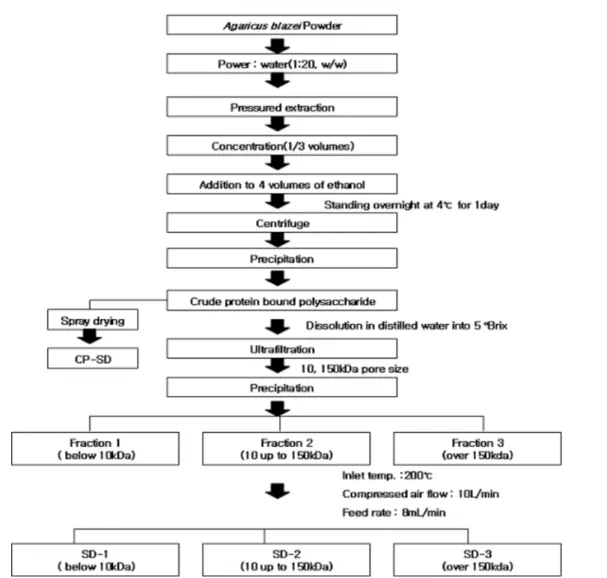
Preparation of the powders from protein binding polysaccharide. A hollow fiber membrane (Sunkyong Inc, Korea) used for the separation was made of polysulfone material having a pore size with MWCO of 10 and 150 kDa. The membrane size and characteristics are shown in Table 1. The processing conditions for the membranes were operation pressures of 0.8 and 2 kgf/
cm2 for MWCO 10 and 150 kDa, respectively, at feed temperature of 40, and feed concentration of 5oBrix.
PBP and three fractions (below 10 kDa, 10 up to 150 kDa, and over 150 kDa) were concentrated to 20oBrix and spray-drying was performed using a B-191 spray drier (Lab Plant, Buchi Inc., Switzerland), with a standard 0.7 mm nozzle. When the liquid was fed to the nozzle using peristaltic pump, atomization occurred by the force of the compressed air, disrupting the liquid into small droplets. The droplets, along with hot air, were blown into a chamber, where the solvent in the droplets was evaporated and discharged out through an exhaust tube.
The dry products (CP-SD: CPBP, SD-1: below 10 kDa, SD-2: 10-150 kDa, SD-3: over 150 kDa) were then collected in a collection bottle. Manufacturing parameters were studied by setting the pump rate, compressed air flow, and inlet temperature at 8 mL/min, 600 L/h, and 200, respectively. The procedures for the extraction, separation, and drying of A. blazei Murill are described in Fig. 1.
Total sugar contents and analysis of monosaccharide.
Total sugar contents of the four spray-dried powders were
determined by the phenol-sulfuric acid method [Saha and Brewer, 1994] distillation with water by 25 times. Two milliliters of diluted solution and 0.05 mL of 80% phenol solution were put into screw cap tubes and vortex-stirred.
Subsequently, 5 mL of concentrated sulfuric acid was added either directly to the liquid surface over 2 or 10 s, or slowly put down on the side of the tube. The tubes were then closed, vortex-stirred for 5 s, and incubated for 30 min at room temperature. Absorbance at 490 nm was then measured using distilled water as a blank. Glucose was used for the preparation of a calibration curve.
Ten milligrams of the four spray- dried powders were hydrolyzed with 2 M trifluoroacetic acid and evaporated.
Monosaccharide was detected using a high-pressure liquid chromatography system (Waters, Milford, MA) with a Sugar-Pak column (7.8×300 mm; Milipore, Tokyo, Japan) and a differential refractive index detector (RID-6A) at 80oC. Two eluants (0.15 and 0.1 M NaOH) were used at a flow rate of 1.0 ml/min.
Protein contents and analysis of hydrolyzed amino acid. Total protein content was measured by the Lowry method [Lowry et al., 1951]. The Biuret reaction was carried out using reagent A containing 20 g sodium hydroxide, 100 g sodium carbonate and 2 g seignette salt and 0.5 g CuSO4· 5H2O per 1000 ml in distilled water.
One milliliter of the prepared assay sample and 1 ml reagent A were mixed and allowed to stand for 10 min at room temperature. Four milliliters of diluted Folin reagent, prepared by dilution of 0.5 ml of 1 N folin reagent with 4 ml distilled water, were added to the mixture. The solution was incubated for 5 min at 55±1 and allowed to cool in a cold water bath for 30 min. The solution absorbance was measured at 670 nm. Total protein content of the four spray-dried powders was calculated based on a calibration curve prepared using bovine serum albumin.
The amino acids in the four spray- dried powders were determined by a Biochrom 20 amino acid analyzer (Pharmacia, Fullerton, CA) using acid hydrolysis and ninhydrin procedure. Hydrolysis of the four spray- dried powders (5 mg) was performed in a sealed ampoule for 24 h at 110oC using 1 mL of 6 M HCl. The hydrolysate was evaporated using a speed-vac concentrator (Savant Instrument, Farmingdale, NY, USA), and the dried residue was dissolved in 0.5 ml citrate buffer. The samples were filtered through a 0.45µm nylon filter prior to injection into the amino acid analyzer.
Analysis β-glucan and uronic acid contents. β-glucan content was determined according to the method of McCleary and Holmes with modifications [McCleary and Holmes, 1985]. The four spray- dried powders were submitted, with or without a pretreatment with aqueous Table 1. Specification of the membrane modules
Unit SKUF10-106 SKUF01-106 Membrane i.d./o.d. Mm Φ 0.8/1.4 0.5/0.8
MWCO - 10,000 150,000
Membrane pore size µm - 0.01
Membrane area m2 0.13 0.16
Material - polysulfone polysulfone
ethanol (50% v/v) solution, to a lichenase hydrolysis and further degraded by β-glucosidase (Megazyme Int., Ireland). The released free glucose was measured spectrophotometrically at 510 nm against a blank necessary to subtract the free glucose present in the sample. Lichenase acts at 40oC on mixed-links β(1-3)(1- 4) and the hydrolysis of the other links β(1-3), β(1-4), and
β(1-6) is catalyzed by β-glucosidase.
The addition of β-glucosidase was carried out after separating the solid residue of lichenase action by filtration to avoid any interference caused by other beta- linked saccharides. The amount of uronic acids was determined in the solution of unhydrolyzed polysaccharides using the meta-hydroxy-diphenyl method with glucuronic acid as the standard [Blumenkrantz and Asboe-Hansen, 1973].
FT-IR analysis. FT-IR spectra were collected on a spectrometer (Galaxy 7020A, Mattson Instrument, Madison, WI) with a DTGS detector at an average of 128 scans and a resolution of 4 cm−1 as follows. The four
spray-dried powder samples were dispersed in KBr (2 mg sample/200 mg KBr), ground pressed into pellets.
Results and Discussion
Chemical properties of the spray-dried powders. The amounts of sugar, protein, β-glucan, and uronic acid of spray-dried CP-SD and three spray-dried powders with different molecular weights (SD-1: below 10 KDa, SD-2:
10 up to 150 KDa, SD-3: above 150 KDa) are summarized in Table 2. The sugar contents of SD-1, 2, and 3 were 39.25, 67.05 and 73.94%, and the protein contents were 13.33, 11.95 and 8.5%, respectively. The dry matter of the fungal cell wall consisted mostly of polysaccharides (up to 80 wt.%) and proteins (from 3 to 20 wt.%), and a lesser extent of fat, minerals, and pigments [Vlasta et al., 2001].
In other words, the major portion of the sugar content is located in the cell wall, whereas the proteins are distributed more or less evenly in- and outside of the cells.
Fig. 1. Procedures for the extraction, separation and powder of crude protein binding polysaccharide from A. blazei Murill.
4 Joo-Heon Hong et al.
The contents of β-glucan in SD-1, -2, and -3 were 18.67, 48.24, and 37.15%, respectively. The uronic acid contents of SD-1, -2, and 3 were 16.01, 34.22, and 30.33
µg/mg, the β-glucan and uronic acid contents of SD-2 were larger than those of SD-1 and -3. These result indicate that SD-1 contained many low molecular impurities such as pigment and monosaccharides, whereas SD-3 contained a large mount of insoluble dietary fibers. Extraction method of the dried fruiting bodies is very important in determining the composition of compounds [Mizuno et
al., 1990]. Most of the β-glucans have also been shown to possess antitumor activities.
Compositions of monosaccharide and amino acid.
After hydrolysis of the four spray-dried powders, the constituents of monosaccharide were determined. Relative sugar compositions of the powders were glucose (74.46- 80.05%), galactose (8.91-15.2%), mannose (4.9-5.46%), and fucose (4.88-6.14%) which indicate the four spray- dried powders were not composed of pure glucan, but were acidic proteo-heteroglycans with a large amounts of glucose, galactose, and mannose. The acidic proteo- heteroglycans consisted that hexose sugar was the main component of the backbone and pentose sugar constituted a small part of the side chain in mushrooms [Kim et al., 2003].
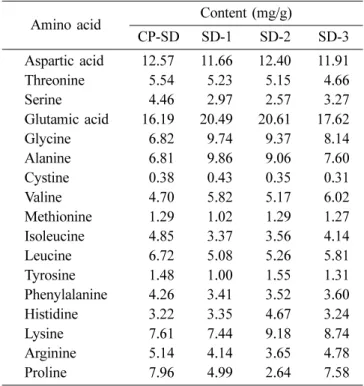
Composition of the hydrolyzed amino acids is shown in Table 4. An abundance of hydrolyzed amino acids was produced, while a few physiological amino acids were in the four spray- dried powders. Its protein portion predominantly consisted of aspartic acid, glutamic acid, glycine, alanine, and lysine. The molar ratios of aspartic acid and glutamic acid having acidic side chains in the three spray-dried powders with different molecular weight were 11.66-12.4 and 17.62-20.61 mg/g, respectively.
Chen [Chen, 1986] reported that alanine, glycine, threonine (sweet), and aspartic and glutamic acids were monosodium glutamate-like components, which is responsible for providing most of the typical mushroom taste.
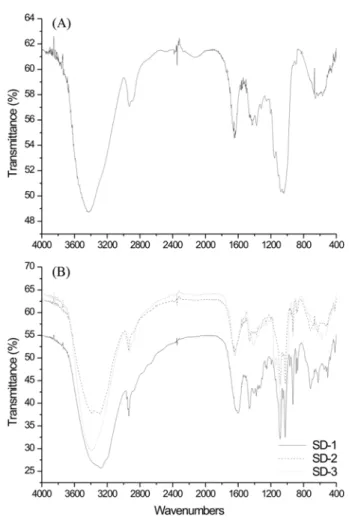
FT-IR analysis. To determine the functional groups of the three spray- dried powders, FT-IR spectrum was measured in KBr pellets (Fig. 2). In these FT-IR spectra, which were almost identical, the band corresponding to the υ (C = O) vibration in the carboxyl group at 1650 cm−1 indicates that this carbonyl group was hydrogen-bonded.
Furthermore, the banding-like-structure in the region of 2900-2930 cm−1 together with the υ (C-H) vibrations, as well as a continuous absorption beginning at approximately the region of 3400 cm−1 are characteristic of a carbohydrate ring. In addition, these had C-H and C-O-H bendings (pyranose ring) at 1410 cm−1, showing high resemblances among the spectra of the powders, particularly at 1020- 1060 cm−1. The region 1000-1200 cm−1 is in actual, a carbohydrate fringerprint region, by which each class of polysaccharides can be recognized [Kacurakova et al., Table 2. Identification of chemical properties of powders (CPBP and SD-1, 2, 3) by spray-drying process
Samples Total sugar (%) Protein (%) β-glucan (%) Uronic acid (µg/mg)
CP-SD 72.04 ± 1.89 11.87 ± 0.52 32.28 ± 1.05 35.43 ± 1.09
SD-1 39.25 ± 1.70 15.33 ± 1.05 18.67 ± 1.19 16.01 ± 0.48
SD-2 67.05 ± 2.12 11.95 ± 0.79 48.24 ± 2.06 34.22 ± 1.33
SD-3 73.94 ± 2.55 008.5 ± 0.88 37.15 ± 1.75 30.33 ± 1.26
Table 3. Monosaccharide composition of powders (CPBP and SD-1, 2, 3) by spray- drying process
Monosaccharide composition (%) Samples Fucose Galactose Glucose Mannose
CP-SD 4.73 09.93 82.56 2.78
SD-1 4.88 15.20 74.46 5.46
SD-2 6.06 11.25 77.48 5.21
SD-3 6.14 08.91 80.05 4.90
Table 4. Amino acid composition of powders (CP-SD and SD-1, 2, 3) by spray-drying process
Amino acid Content (mg/g)
CP-SD SD-1 SD-2 SD-3
Aspartic acid 12.57 11.66 12.40 11.91
Threonine 5.54 5.23 5.15 4.66
Serine 4.46 2.97 2.57 3.27
Glutamic acid 16.19 20.49 20.61 17.62
Glycine 6.82 9.74 9.37 8.14
Alanine 6.81 9.86 9.06 7.60
Cystine 0.38 0.43 0.35 0.31
Valine 4.70 5.82 5.17 6.02
Methionine 1.29 1.02 1.29 1.27
Isoleucine 4.85 3.37 3.56 4.14
Leucine 6.72 5.08 5.26 5.81
Tyrosine 1.48 1.00 1.55 1.31
Phenylalanine 4.26 3.41 3.52 3.60
Histidine 3.22 3.35 4.67 3.24
Lysine 7.61 7.44 9.18 8.74
Arginine 5.14 4.14 3.65 4.78
Proline 7.96 4.99 2.64 7.58
2000]. In addition, although particular species cannot be identified spectroscopically, vibrational absorption in the interval 1000-1200 cm−1 could serve as indicators of the mushroom genus [Vlasta et al., 2001]. The emphasis is generally placed on the 750-950 cm−1 interval, where the bands corresponding to α- or β-anomer and C1-H deformation band occur [Zhbankov et al., 1997]. The bands at 890 cm−1 of three spray-dried powders (SD-1, 2, 3) are attributed to a β-1,3-glucan, while that at approximately 930 cm−1 is assigned to an α-1,6-glucan. However, the spectrum for CP-SD was not found. The intensity of the spectral bands ranged as follows: CP-SD < SD-1 < SD-2 < SD-3.
References
Blumenkrantz N and Asboe-Hansen G (1973) New method for quantitative determination of uronic acids. Anal Bio- chem54, 484-489.
Chawla A, Taylor KMG, Newton JM and Johnson MCR (1994) Production of spray- dried salbutamol sulphate for use in dry powder aerosol formulations. Int J Pham
108, 233-240.
Chen HK (1986) Studies on the characteristics of taste- active components in mushroom concentrate and its powderization. MS Thesis, National Chung-Hsing Uni- versity, Taichung, Taiwan.
Fujimiya Y, Suzuki Y, Oshima K, Kobori H and Moriguchi K (1998) Selective tumoricidal effect of soluble proteo- glucan extracted from the basidiomycete, Agaricus bla- sei Murill, mediated via natural killer cell activation and apoptosis. Cancer Immunol Immun46, 147-159.
Kacurakova M, Capek P, Sasinkova V, Wellner N and Ebringerova A (2000) FT-IR study of plant cell wall model compound: pectic polysaccharides and hemicellu- loses. Carbohyd Poly43, 195-203.
Kim GY, Park HS, Nam BH, Lee SJ and Lee JD (2003) Purification and characterization of acidic proteo-hetero- glycan from the fruiting body of Phellinus linteus (Berk.
& M.A. Curtis) Teng Biores Tech 89, 81-87.
Lowry OH, Rosebrough NJ, Farr AL and Randall RJ (1951) Protein measurement with the Folin-phenol reagents. J Biol Chem193,265-275.
McCleary BV and Holmes MG (1985) Enzymic quantifica- tion of (1-3),(1-4) β-glucan in barley and malt. J Insti- tute Brewing91, 285-295.
Mizuno T, Hagiwara T, Nakamura T, Ito H, Shimura K, Sumiya T and Asakura A (1990) Antitumor activity and some properties of water-soluble polysaccharides from
“Himematsutake”, the fruiting body of Agaricus blazei Murill. Agric Biol Chem54, 2889-2896.
Nakajima A, Ishida T, Koga M and Takeuchi M (2002) Effect of hot water extract from Agaricus blasei Murill on antibody-producing cells in mice. Int Immunopharma- cology2, 1205-1211.
Ping H, Stanley S and Lisbeth I (1999) Chitosan micro- spheres prepared by spray- drying. Int J Pharmaceutics
187, 53-65.
Rey L, May J and Marcel D (2001) Freeze-drying/Lyo- philization of Phamaceutical and Biological products.
Eur J Pharma Biopharm51, 163-164.
Saha SK and Brewer CF (1994) Determination of the con- centrations of oligosaccharides, complex type carbohy- drates, and glyco-proteins using the phenol-sulfuric acid method. Carbohyd Res254, 157-167.
Vlasta MG, Romano B and Gerwin JP (2001) Vibrational spectroscopic characterization of wild growing mush- rooms and toadstools. Spetrochimi Acta A 57, 2815- 2829.
Yoshiyuki A, Naohito O, Masumi O, Shozo O and Toshiro Y (1990) Change of biological activities of (1-3)-β-D- glucan from Grifola frondosa upon molecular weight reduction by heat treatment. Chem Pharm Bull 38, 477- Zhbankov RG, Adrianov VM and Marchewka MK (1997)481.
Fourier transform IR and Raman spectroscopy and struc- ture of carbohydrates. J Mol Struct436, 637-654.
Fig. 2. FT-IR spectrum comparison of : (a) crude pro- tein binding polysaccharide (CP-SP) and (b) three pow- ders (SD-1, 2, 3).