Agent-based spin model for financial markets on complex networks:
Emergence of two-phase phenomena
Yup Kim, Hong-Joo Kim, and Soon-Hyung Yook
*
Department of Physics and Research Institute for Basic Sciences, Kyung Hee University, Seoul 130-701, Korea 共Received 17 July 2008; published 25 September 2008兲
We study a microscopic model for financial markets on complex networks, motivated by the dynamics of agents and their structure of interaction. The model consists of interacting agents共spins兲 with local ferromag- netic coupling and global antiferromagnetic coupling. In order to incorporate more realistic situations, we also introduce an external field which changes in time. From numerical simulations, we find that the model shows two-phase phenomena. When the local ferromagnetic interaction is balanced with the global antiferromagnetic interaction, the resulting return distribution satisfies a power law having a single peak at zero values of return, which corresponds to the market equilibrium phase. On the other hand, if local ferromagnetic interaction is dominant, then the return distribution becomes double peaked at nonzero values of return, which characterizes the out-of-equilibrium phase. On random networks, the crossover between two phases comes from the com- petition between two different interactions. However, on scale-free networks, not only the competition between the different interactions but also the heterogeneity of underlying topology causes the two-phase phenomena.
Possible relationships between the critical phenomena of spin system and the two-phase phenomena are discussed.
DOI:10.1103/PhysRevE.78.036115 PACS number共s兲: 89.65.Gh, 87.23.Ge, 02.50.Le
I. INTRODUCTION
Power-law or fat-tailed distributions observed in many economic systems 关1,2兴 have attracted many physicists be- cause of their relevance to critical phenomena in statistical physics. Especially, empirical studies on logarithmic price changes共returns兲 in real markets have found the intermittent occurrence of large bursts resulting in the power-law tails in their distributions. Various models have been introduced to understand the origin of the observed properties in real fi- nancial markets 关2–7兴. Among these models, Ising-like spin systems have been studied by some researchers, due to their simplicity 关5–7兴. For example, Chowdhury and Stauffer 关5兴 introduced a super-spin and time-dependent individual bias of each agent to show that the return distribution caused by herding of agents satisfies a power-law scaling. The effects of the heterogeneity of interaction topology on herding be- havior is also studied, which is closely related to the fat- tailed distribution of return 关8,9兴.
Recently, more realistic models have been introduced 关6–8,10,11兴, in which the pool of agents is divided into two groups: “Fundamentalist” 共or “chartist”兲 and “trend fol- lower” 共or “noise trader”兲. The fundamentalists are those who exactly know the excess demand 共difference between the demand and supply兲, and the trend followers are those who follow the decision of their interacting neighbors. The coexistence of the fundamentalist and the trend follower con- tradicts the prevalent “efficient market hypothesis” in eco- nomics. These models succeeded in reproducing several non- trivial properties in a real market. For example, Sznajd- Weron and Weron studied the effects of a single fundamentalist by using Ising-like ferromagnetic interactions on two sublattices关7兴. Another interesting spin model which
incorporates the competition between the fundamentalist and trend follower was suggested by Bornholdt 关6兴. In Born- holdt’s model, each agent is assumed to have features of both the fundamentalist and the trend follower. The ferromagnetic interaction with nearest neighbors is used to stand for the characteristics of the trend followers. At the same time, each spin 共or agent兲 interacts with the global magnetization. The global interaction represents the tendency of the fundamen- talist by encouraging a spin-flip when the global magnetiza- tion becomes large. The global interaction depends only on the magnitude of the magnetization, but not the current state of each agent. Thus, the global interaction in Bornholdt’s model implicitly contains the effective time-dependent bias of each spin, which is similar to that of the Chowdhury and Stauffer model 关5兴.
In order to study the origin of the power-law distribution of the return, we have recently investigated a spin model on a two-dimensional square lattice based on the microscopic dynamics of each agent 关12兴. The model has the explicit time-dependent global field as well as the competition be- tween the characteristics of noise trader and the fundamen- talist. The time-dependent global field represents any internal or external interferences in the market dynamics. By numeri- cal simulations, we have shown that the competition between trend follower and fundamentalist causes two different do- mains if the temperature is lower than the critical tempera- ture of Ising model, below which the system is in the ordered state. When this domain structure is completely destroyed by the external field and restored, we find large bursts in the return to make a power-law or fat-tailed distribution of re- turn.
In this paper, since all the agents in a real market do not have the same number of interacting partners, we study the effect of the heterogenous structure of interactions between each agent on the market dynamics. Moreover, the critical behavior of the Ising model on complex networks is known
*Corresponding author; [email protected]
1539-3755/2008/78共3兲/036115共6兲 036115-1 ©2008 The American Physical Society
to be different from that on regular structures. Especially, on the scale-free networks共SFN兲, in which the degree distribu- tion follows a power law, P共k兲⬃k−␥ 关13–15兴, the critical behavior of Ising model strongly depends on␥. For␥⬍3 the critical temperature, Tc0, of the simple Ising model goes to infinity as N→⬁. On the other hand, for 3⬍␥⬍5 the system shows second-order phase transition but the obtained critical exponents depend on␥. When␥⬎5 the Ising model satisfies the mean-field expectation. Therefore, it is also theoretically interesting to study how these complicated critical behavior of spin models affect the market dynamics. By numerical simulations we show that the heterogeneity of the underlying structure causes two-phase phenomena关16兴. For the theoret- ical considerations, we use two network topologies, random network 共RN兲 关17兴 and static SFN 关15兴. The paper is orga- nized as follows: In Sec. II, we introduce our model. Nu- merical results and some possible relations between the ob- served two-phase phenomena and the critical phenomena of spin system are presented in Sec. III. Finally, the summary and discussions will be given in Sec. IV.
II. MODEL
We consider N agents placed on each node in a given network. The state of each agent i is characterized by a two- state spin variable si共t兲苸兵−1, +1其 at time t. Each state cor- responds to buying 共+1兲 or selling 共−1兲 state. The state of each agent i at time t + 1, si共t+1兲, is updated by the heat-bath dynamics 关18兴 based on the Hamiltonian
H共t兲 = −
兺
i⬎j N
Jijsi共t兲sj共t兲 + 关␣M共t兲 − f共t兲兴
兺
i=1 N
si共t兲. 共1兲 Here, Jij= J共⬎0兲 if i and j are nearest neighbors 共ferromag- netic interaction兲; otherwise, Jij= 0. For simplicity, we let the Boltzmann constant kB and J be unity. This ferromagnetic interaction represents the tendency that each agent follows the decision of his cooperating agents共characteristics of the trend follower兲. In the second term, M共t兲=共1/N兲兺j
Nsj共t兲 cor- responds to the excess demand. For ␣⬎0, the interaction becomes antiferromagnetic and stands for the tendency of the fundamentalist, who exactly knows the excess demand.
The antiferromagnetic interaction reflects the following fact;
if the demand 共supply兲 exceeds the supply 共demand兲, then each agent wants to place a selling 共buying兲 order to maxi- mize his benefit. f共t兲 denotes a time-dependent external field which incorporates all internal and external interference in the market dynamics. In general, the magnitude of this inter- ference changes in time. Furthermore, large interferences such as oil shock and subprime mortgage crisis do not have the same occurrence probability as daily reported rumors.
Thus, at each time step we choose the magnitude of the external field,兩f共t兲兩, from the power-law distribution
Pf共兩f兩兲 ⬃ 1
兩f兩, 共2兲
wheredetermines the heterogeneity of the distribution. The sign of f共t兲 is chosen at random. The unit time step is defined by the usual Monte Carlo time step.
Before discussing the results on complex networks, let us briefly define the price and return. For simplicity, we assume that the evolution of price, p共t兲, follows 关19兴
dp共t兲
dt = cM共t兲p共t兲, 共3兲
where c is a scaling factor for price change. For small time interval ⌬t, we obtain p共t+⌬t兲=p共t兲 exp关cM共t兲⌬t兴 by as- suming that the change of M共t兲 during this interval is negli- gible. In a discrete time step 共⌬t=1兲, p共t+1兲
= p共t兲 exp关cM共t兲兴. Thus, the logarithmic return becomes R共t兲 = ln p共t兲 − ln p共t − 1兲 = cM共t − 1兲. 共4兲
III. RESULTS
In simulations, we use networks with N = 104 nodes. We find that our main conclusion does not crucially depend on N.
A. Random networks
RN is generated by connecting each pair of nodes with a fixed probability关17兴. By adjusting, we fix the average degree to be具k典=4.
If T⬎Tc
0or ␣Ⰷ具k典, then the system is always in the dis- ordered phase, and P共R兲 trivially depends only on P共f兲. Here Tc0means the critical temperature for the simple Ising model or H with␣= f共t兲=0 in Eq. 共1兲. When T=3.0 which is close to 共but smaller than兲 Tc
0 共⬇4 for 具k典=4兲 and ␣⬇具k典, the domainlike structure is formed as a result of the competition between ferromagnetic and antiferromagnetic interactions.
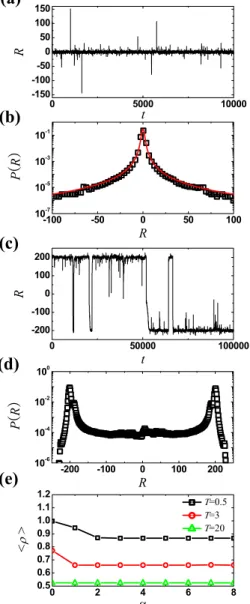
For these values of parameters, the systems is in the market equilibrium phase as shown in Figs. 1共a兲 and 1共b兲. Figure 1共a兲shows the time evolution of R共t兲 when= 2.5,␣= 4, and T = 3.0. Since the average degree of the network is具k典=4, the antiferromagnetic interaction becomes comparable with the ferromagnetic interaction when T = 3共⬍Tc
0兲 and ␣⬇4. With these values of parameters, we find the intermittent occur- rences of large bursts in R共t兲, which are very similar to those of real market indices 关20兴 and the results on two- dimensional square lattices关12兴.
In Fig. 1共b兲 we display P共R兲 for the same set of param- eters with the data in Fig. 1共a兲. In general, P共R兲 of the real market has been approximated by a Lévy stable distribution 关2,12,21兴:
P共R兲 ⬅ 1
冕
0⬁
exp共− a兩q兩兲cos共qR兲dq. 共5兲 Here, and a are the Lévy exponent and scaling factor, respectively. For large兩R兩, Eq. 共5兲 can be written as a power law,
P共兩R兩兲 ⬃ 兩R兩−共1+兲. 共6兲 From the best fit of Eq. 共6兲 to the data in Fig.1共b兲, we find
= 1.5⫾0.1 for 兩R兩 ⬎2. The solid line in Fig.1共b兲represents Eq. 共5兲 with the obtained 共⯝1.5兲. For convenience we use c = 240 on RNs. The other choice of c affects only on a
without changing . The result shows that P共R兲 obtained from the simulations agrees very well with Eq. 共5兲. For this case, the market is in the equilibrium phase in which the price is determined by nearly the same number of buyers and sellers 关16兴. As increases, Pf共兩f 兩兲 becomes relatively ho- mogeneous. Thus, the price fluctuations are not correlated and P共R兲 becomes Gaussian.
When T is very low and ␣ is small, R共t兲 does not show any intermittent bursts 关see Fig. 1共c兲兴. Thus, P共R兲 does not satisfy the power-law distribution as shown in Fig. 1共d兲.
Since the ferromagnetic interaction is always dominant for this value of T and ␣ 共⬍具k典兲, the system is always in the ferromagnetic ordered state when兩f 兩 =0. The ferromagnetic ordered state indicates that there is an imbalance in the num- ber of buyers and sellers. The imbalanced state is relatively stable against the change of external field. As a result, R共t兲 changes its sign only when兩f共t兲兩 is large enough. In this case,
the market behavior is governed by buyers for one-half of the time, and by sellers for the other one-half as shown in Fig. 1共c兲. Accordingly large fluctuations in return emerge.
Therefore, the market is in the out-of-equilibrium phase关16兴 in which P共R兲 is double-peaked at nonzero R 关see Fig.1共d兲兴.
Other results for various values of parameters are summa- rized in Table I.
When the ferromagnetic and antiferromagnetic interac- tions are balanced and P共f兲 has relatively high heterogeneity 共⬍3兲, the Lévy stable distribution is obtained for T⬍Tc
0. The similar results were reported for the model on two- dimensional square lattices 关12兴. The formation of two dif- ferent domains on a two-dimensional square lattice is easily verified by taking a snapshot when 兩f兩=0 关12兴. However, analyzing the snapshot does not give us any information in complex networks due to their heterogeneous topologies. In order to avoid this difficulty, we use the segregation function 关22兴 for the detailed investigation. The segregation function of node i in state si is defined as
共si兲 =n共si兲 ki
, 共7兲
where n共si兲 denotes the number of i’s nearest neighbors which have the same state with i, and ki is the degree of i.
The average segregation function具典 is obtained by averag- ing共si兲 over all nodes in the network. If all nodes are in the same state, then具典 becomes 1. If T⬎Tc0, then具典→1/2 in the limit N→⬁. If different domains are formed, then 具典 lies between 1/2 and 1. When T is very low, 具典 is 0.9⬃1 for ␣艋2 关see Fig.1共e兲兴. This indicates that the system is in the ferromagnetic ordered state to make the out-of- equilibrium phase when T = 0.5 and ␣= 1 关see Fig. 1共d兲兴.
When T = 3.0 and具k典/2艋␣艋2具k典, 具典 lies between 0.6–0.8.
In this regime of parameters, the system is in the market equilibrium phase as shown in Figs.1共a兲and1共b兲.
B. Scale-free networks
The scale-free network 共SFN兲 is the network whose de- gree distribution satisfies a power law, P共k兲⬃k−␥. Recent studies have found that the critical phenomena of the simple Ising model on SFNs with small ␥⬍5 are different from FIG. 1. 共Color online兲 共a兲 Time evolution of R共t兲 on RN and 共b兲
plot of P共R兲 when T=3.0 共near Tc
0兲,␣=4, and =2.5. The solid line represents Eq.共5兲 with=1.5. 共c兲 Plot of R共t兲 and 共d兲 P共R兲 for T
= 0.5,␣=1, and =2.5. 共e兲 Segregation function for various T when f共t兲=0.
TABLE I. Market behavior for various values of ␣, , and T 共⬍Tc
0兲 on the random networks. ⫻’s in the table indicate that the distribution is single peaked at R = 0, but it follows neither a power law 共Lévy distribution兲 nor a Gaussian distribution. For⬎2, the Lévy distribution is not stable.
T = 0.5 T = 3.0
2.5 Double peak ⫻
␣=1 3.0 Double peak ⫻
3.5 Double peak Gaussian
2.5 Lévy共=1.9⫾0.1兲 Lévy共=1.5⫾0.1兲
␣=4 3.0 Lévy共=2.8⫾0.1兲 Lévy共=2.3⫾0.1兲
3.5 Gaussian Gaussian
those of mean-field expectations 关23,24兴. The critical expo- nents obtained from the local tree approximation depend on the degree exponent ␥. This indicates that the heterogeneity of the underlying structure affects the critical behavior of the Ising model. Moreover, many social and economic systems are known to form various SFNs关25兴. Therefore, it has the- oretical and practical importance to investigate how the het- erogeneity of the underlying topology affects the market dy- namics. For this purpose, we use a static model suggested by Goh et al.关15兴 to generate SFN with tunable␥. The average degree具k典 is fixed to be 4 for the direct comparison with the results on RN and two-dimensional lattices 关12兴. Since the size N of network does not affect the conclusions, we present the results only for N = 104. In order to demonstrate our re- sults in an appropriate price scale, we use c = 140 when T is very low and c = 70 when T is close to Tc0. The main conclu- sions also do not depend on the value of c.
We find that our model on SFNs also shows a two-phase phenomena. For␥⬎5, we find nearly the same results with RNs. However, the origin of the observed crossover from market equilibrium phase to out-of-equilibrium phase is dif- ferent from that on RNs when ␥⬍5. In the following sec- tions, we discuss the differences in detail for␥⬍5.
C. 3⬍␥⬍5
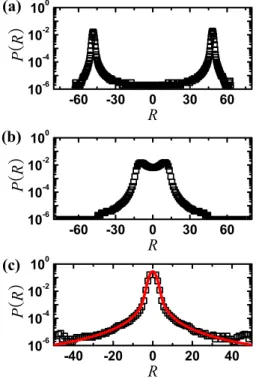
In Fig. 2共a兲 we show P共R兲 when ␣= 1 共⬍具k典兲 and T
= 1.0 on SFN with ␥= 3.5. For these values of ␣ and T the ferromagnetic interaction becomes dominant as in the case on RNs and SFNs with ␥⬎5. The market is thus in the out-of-equilibrium phase, and P共R兲 becomes double peaked when f共t兲⫽0.
At low T or T = 1.0, the market is also in the out-of- equilibrium phase even for ␣⬇具k典 关see Fig. 2共b兲兴. It indi- cates that not only the competition between ferromagnetic and antiferromagnetic interactions but also the heterogeneity of underlying topology causes the two-phase phenomena.
This results for 3⬍␥⬍5 is quite different from that on RNs and SFNs with␥⬎5, where the market is in the equilibrium phase for low T and␣⬇具k典. From the numerical simulations, we find that the system is always in the ferromagnetic or- dered state up to ␣⬇具k典 when T⬍Tc
0, ␥⬍5, and 兩f兩=0 共which is not shown兲. Since the susceptibility of the simple Ising model decays as ⬃兩Tc
0− T兩−1 for 3⬍␥⬍5 关23兴, this ferromagnetic ordered state becomes more stable as 兩Tc
0− T兩 increases. As a result, M共t兲 or equivalently R共t兲 changes its sign only when the occasional strong external field is applied and the fluctuation in the market becomes large. Thus, the market is in the out-of-equilibrium phase in which the mar- ket behavior is governed by buyers for one-half of the time and by sellers for the other one-half depending on the sign of the applied external field even for ␣⬇具k典 关see Fig. 2共b兲兴.
This result is consistent with the previous expectation that the system is in the out-of-equilibrium phase when the mar- ket fluctuation or the local noise intensity becomes large 关16兴.
When T is close to Tc0共⬇6兲 or T=4 and ␣= 1共⬍具k典兲, the ferromagnetic interaction is dominant. Moreover, for 3⬍␥
⬍5, 兩M兩 of simple Ising model increases more rapidly as 兩Tc
0− T兩 increases than that on RNs or SFNs with␥⬎5 关23兴.
This causes a large fluctuations in M共t兲 or R共t兲 when 兩f共t兲兩 is large enough. Thus, the market is still in the out-of- equilibrium phase共see the case of T=4 and␣= 1 in TableII兲.
But when T is close to Tc0共or T=4兲 and␣⬇具k典, the market is in the equilibrium phase with single peaked P共R兲 as shown in Fig. 2共c兲. When T is close to Tc0 and ␣⬇具k典, P共R兲 be- comes a Gaussian distribution for large 共see TableII兲.
D. 2⬍␥⬍3
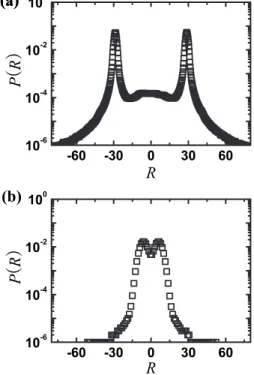
As shown in Fig. 3共a兲, P共R兲 is double peaked which cor- responds to the out-of-equilibrium phase when T = 1 and ␣
= 4.
Due to the heterogeneity of the underlying networks, the critical behavior of the Ising model on SFN with ␥⬍3 be- comes completely different from that observed on RN or SFN with ␥⬎3. In this regime, Tc
0→⬁ in the limit N→⬁
FIG. 2. 共Color online兲 Plot of P共R兲 on SFN when =2.5 and
␥=3.5 with 共a兲 ␣=1 and T=1, 共b兲 ␣=4 and T=1, and 共c兲 ␣=4 and T = 4 which is relatively close to Tc0 共⬇6兲. The solid line in 共c兲 represents Eq.共5兲 with=1.9.
TABLE II. Market behaviors for various values of␣, , and T 共⬍Tc
0兲 on SFNs with 3⬍␥⬍5. For ⬎2 the Lévy distribution is not stable.
T = 1.0 T = 4.0
2.5 Double peak Double peak
␣=1 3.0 Double peak Double peak
3.5 Double peak Double peak
2.5 Double peak Lévy共=1.9⫾0.1兲
␣=4 3.0 Double peak Lévy共=3.4⫾0.1兲
3.5 Double peak Gaussian
关23兴 and the susceptibility decreases as⬃1/T. Although Tc0
for 2⬍␥⬍3 diverges, we can determine the Tc
0共N兲 for the finite-sized network with the size N.关23兴. The small suscep- tibility near Tc0共N兲 and the imbalance in the number of buyers and sellers cause very stable domains against the change of external field when 2⬍␥⬍3. This stable domain can be dis- turbed only when the occasional large兩f兩 is applied. In Fig.
3共b兲 we show that the P共R兲 is double-peaked at nonzero R when T is close to Tc0共N兲 共or T=16兲 and␣= 4. For T = 16 and
␣= 50, double peak in P共R兲 still remains 共which is not shown兲. Since Tc0→⬁ in the limit N→⬁, the antiferromag- netic interaction is balanced with the ferromagnetic interac- tion only when ␣→⬁. Thus, the system is always in the ferromagnetic ordered state for any finite ␣. Therefore, the market is always in the out-of-equilibrium phase in the limit N→⬁. Results for other values of parameters are shown in TableIII.
IV. SUMMARY AND DISCUSSION
We study a generalized spin model for price changes in a financial market on complex networks motivated by the char- acteristics of agents. The model assumes that each agent has tendencies of both trend follower and fundamentalist. Each tendency is represented by ferromagnetic interaction with nearest neighbors and antiferromagnetic interaction with a global self-generated field. The antiferromagnetic interaction assumes that each agent is smart enough to make his deci- sion to be a minority in the market dynamics. From the nu- merical simulations we find that there exists two-phase phe- nomena on complex networks关16兴. When the ferromagnetic interaction is dominant, P共R兲 becomes double peaked. On the other hand, if the number of sellers balances with the number of buyers, then P共R兲 becomes usual fat-tailed distri- bution.
These results provide a clue to understanding the market dynamics. Our model indicates that the balance between sell- ers and buyers can be achieved by competition between the fundamentalist’s feature 共global antiferromagnetic interac- tion兲 and the characteristics of the trend follower 共ferromag- netic interaction兲 to maximize the benefit of each agent. If large market interference is applied to this balanced state, then most of the buyers 共sellers兲 are abruptly changed to sellers 共buyers兲. The sudden changes between buyers and sellers cause intermittent occurrence of large bursts depend- ing on the nature of the market interference distribution and underlying topologies. Moreover, when the fluctuation in the number of buyers or sellers in the market is small, P共R兲 can be approximated by Eq. 共5兲 which is the typical feature of the market equilibrium phase. On the other hand, if the mar- ket fluctuation becomes large then the P共R兲 becomes double peaked. Thus the market undergoes a crossover from market equilibrium phase to out-of-equilibrium phase. The results shows a good agreement with other empirical analysis 关16兴.
We also find that on RNs and SFNs with ␥⬎5 such cross- over is caused by the temperature and the competition be- tween ferromagnetic and antiferromagnetic interactions.
However, as we decrease␥of SFNs, the underlying topology also affect the crossover between the two phases. Further- more, when 2⬍␥⬍3 and TⱗTc0 we find that the market is always in the out-of-equilibrium phase.
Finally, the fluctuation of inverse concentration of buyers 共or sellers兲 was studied in the agent-based herding model, and it was found that RNs can cause fat-tailed distribution through the mean-field approach 关8兴. In our spin model, we find that not only the spin fluctuations but also fluctuation of underlying topology can cause many interesting behaviors, such as two-phase phenomena.
ACKNOWLEDGMENTS
This work was supported by the Korea Science and Engi- neering Foundation 共KOSEF兲 grant funded by the Korea government 共MOST兲 共Grants No. R01-2007-000-10910-0 and No. R01-2006-000-10470-0兲 and by the Korea Research Foundation grant funded by the Korean Government共MOE- HRD, Basic Research Promotion Fund兲 共Grant No. KRF- 2007-313-C00279兲.
FIG. 3. Plot of P共R兲 on SFN with =2.5, ␣=4, and ␥=2.5 when 共a兲 T=1, and 共b兲 T=16 which is close to Tc
0 共⬇25 for N
= 104兲.
TABLE III. Market behaviors for various values of␣, , and T 共⬍Tc
0兲 on SFNs with 2⬍␥⬍3.
T = 1.0 T = 16
2.5 Double peak Double peak
␣=1 3.0 Double peak Double peak
3.5 Double peak Double peak
2.5 Double peak Double peak
␣=4 3.0 Double peak Double peak
3.5 Double peak Double peak
关1兴 B. B. Mandelbrot, Fractals and Scaling in Finance 共Springer, New York, 1997兲.
关2兴 R. N. Mantegna and H. E. Stanley, An Introduction to Econo- physics: Correlations and Complexity in Finance共Cambridge University Press, New York, 2000兲.
关3兴 R. Cont and J. P. Bouchaud, Macroecon. Dyn. 4, 170 共2000兲.
关4兴 V. M. Eguíluz and M. G. Zimmermann, Phys. Rev. Lett. 85, 5659共2000兲.
关5兴 D. Chowdhury and D. Stauffer, Eur. Phys. J. B 8, 477 共1999兲.
关6兴 S. Bornholdt, Int. J. Mod. Phys. C 12, 667 共2001兲.
关7兴 K. Sznajd-Weron and R. Weron, Int. J. Mod. Phys. C 13, 115 共2002兲.
关8兴 S. Alfarano and M. Milakovic, J. Econ. Dyn. Control 共to be published兲.
关9兴 S. Yook and Y. Kim, Physica A 共to be published兲.
关10兴 T. Lux and M. Marchesi, Nature 共London兲 397, 498 共1999兲.
关11兴 T. Kaizoji, S. Bornholdt, and Y. Fujiwara, Physica A 316, 441 共2002兲.
关12兴 S.-H. Yook, H.-J. Kim, and Y. Yim, J. Korean Phys. Soc. 52, S153共2008兲.
关13兴 A.-L. Barabási and R. Albert, Science 286, 509 共1999兲.
关14兴 R. Albert and A.-L. Barabási, Rev. Mod. Phys. 74, 47 共2002兲.
关15兴 K.-I. Goh, B. Kahng, and D. Kim, Phys. Rev. Lett. 87, 278701
共2001兲.
关16兴 V. Plerou, P. Gopikrishnan, and H. E. Stanley, Nature 共Lon- don兲 421, 130 共2003兲.
关17兴 P. Erdös and A. Rényi, Publ. Math. 共Debrecen兲 6, 290 共1959兲.
关18兴 D. P. Landau and K. Binder, A Guide to Monte Carlo Simula- tions in Statistical Physics共Cambridge University Press, Cam- bridge, 2000兲.
关19兴 M. Bartolozzi and A. W. Thomas, Phys. Rev. E 69, 046112 共2004兲.
关20兴 P. Gopikrishnan, V. Plerou, L. A. Nunes Amaral, M. Meyer, and H. E. Stanley, Phys. Rev. E 60, 5305共1999兲.
关21兴 R. N. Mantegna and H. E. Stanley, Nature 共London兲 376, 46 共1995兲.
关22兴 S.-H. Yook, Z. Oltvai, and A.-L. Barabási, Proteomics 4, 928 共2003兲; G. Forgacs, S.-H. Yook, P. A. Janmey, H. Jeong, and C.
G. Burd, J. Cell. Sci. 117, 2769共2004兲.
关23兴 S. N. Dorogovtsev, A. V. Goltsev, and J. F. F. Mendes, Phys.
Rev. E 66, 016104共2002兲.
关24兴 M. Leon, A. Vázquez, A. Vespignani, and R. Zecchina, Eur.
Phys. J. B 28, 191共2002兲.
关25兴 Handbook of Graphs and Networks, edited by S. Bornholdt and H. G. Schuster共Wiley-VCH, Weinheim, 2003兲.