Original Article
Premenopausal early-stage endometrial carcinoma patients with low CA-125 levels and low tumor grade may undergo
ovary-saving surgery
Seung-Chul Yoo1*, Jong-Hyuck Yoon1*, Woo Young Kim1, Suk-Joon Chang1, Hee-Jae Joo2, Ki-Hong Chang1, Hee-Sug Ryu1
Departments of 1Obstetrics and Gynecology, 2Pathology, Ajou University School of Medicine, Suwon, Korea
Objective: The purpose of this study was to determine the possible predicting factors of coexisting adnexal malignancies, and to evaluate the safety of ovary-saving surgery for early-stage endometrial carcinoma in premenopausal patients.
Methods: A retrospective review of 107 patients with endometrial carcinoma who underwent surgical treatment at our institution was conducted. All patients were younger than 50 years of age and premenopausal status. Statistical analysis was performed.
Results: Of the 107 patients, 78 patients had stage I to II disease and both preoperative CA-125 levels were measured and tumor grades evaluated. On multivariate analysis, preoperative CA-125 levels (p=0.018) and preoperative tumor grade (p=0.029) were independent predicting factors of adnexal diseases. The risk of coexisting ovarian malignancy was 1.8% in patients with preoperative CA-125 levels less than or equal to 34.5 U/ml and preoperative tumor grade 1 or 2.
The risk increases to 20% for low CA-125 and grade 3, 13.3% for high CA-125 and grade 1 or 2, and 100% for high CA-125 and grade 3. Between patients who underwent unilateral salpingo-oophorectomy and those who underwent bilateral salpingo-oophorectomy, there was no statistically significant difference in terms of BMI, preoperative CA-125 levels, FIGO stage, histology, tumor grade, lymphadenectomy, and adjuvant treatment.
Conclusion: Ovary-saving surgery for premenopausal, early-stage endometrial cancer patients may be considered as a treatment option in those with low preoperative CA-125 and low tumor grade.
Key Words: Premenopausal women, Endometrial carcinoma, Ovary-saving surgery
Received July 23, 2009, Revised September 7, 2009, Accepted September 8, 2009
*Yoo SC and Yoon JH, two authors contributed equally to this paper.
Correspondence to Suk-Joon Chang
Department of Obstetrics and Gynecology, Ajou University School of Medicine, San 5, Wonchon-dong, Youngtong-gu, Suwon 442-721, Korea Tel: 82-31-219-5251, Fax: 82-31-219-5245
E-mail: [email protected]
INTRODUCTION
Endometrial cancer mostly affects postmenopausal women.
Approximately 75% of endometrial cancers occur after the age of 50 years, and 5-30% before the age of 50 years.1 Standard surgical treatment of endometrial carcinoma is total hyster- ectomy, bilateral salpingo-oophorectomy (BSO), peritoneal washings for cytology, and selective pelvic and para-aortic lymphadenectomy.2 Removal of the adnexa is important for determining the extent of disease and eliminating the poten- tial risk of adnexal disease. However, a surgeon may hesitate to perform BSO for a premenopausal woman diagnosed with
early-stage endometrial cancer. Many women with early-stage endometrial carcinoma wish to preserve ovary and maintain their endocrine function. Considering whether it is possible to preserve ovary without compromising survival, it is essen- tial to identify possible adnexal diseases for the successful ovary-saving surgery.
Several reports have estimated that the incidence of coexisting ovarian malignancy (primary or metastatic) is 5-29% of patients with endometrial carcinoma.3-5 The prognosis of primary or metastatic ovarian cancers is quite different. Some investi- gators reported that synchronous early-stage ovarian cancers coexisting with endometrial cancers showed a favorable prog- nosis.6-8 One prospective study demonstrated that the 5-year and 10-year survival rate was 85.9% and 80.3%, respectively, in women with dual primary carcinomas of the endometrium and ovary, with gross disease confined to the pelvis.6 On the other hand, others reported that the prognosis for women with ovarian metastasis was relatively poor.9-12 Two retrospective studies for large numbers of cases revealed the 5-year dis- ease-free survival rate with a range of 37.1 to 72.2%.11,12
Although a recent report from M.D. Anderson Cancer
Table 1. Clinico-pathological characteristics of patients Number of patients
Mean age, yr (range) Mean parity (range) Mean BMI, kg/m2 (range)
Mean preoperative CA-125, U/ml (range) Adnexectomy
Unilateral salpingoophorectomy Bilateral salpingoophorectomy Lymphadenectomy
Pelvic
Pelvic and para-aortic Histology, no. (%) Endometrioid Non-endometrioid
Papillary serous carcinoma Mixed
Carcinosarcoma Tumor grade, no. (%) I
II III NA
FIGO stage, no. (%) Stage I
Stage II Stage III Stage IV
Coexisting adnexal disease, no. (%) Ovarian metastasis
Primary ovarian cancer Lymph node metastasis, no. (%) Pelvic
Para-aortic
Follow-up, months (range)
107 45 (27-50)
2 (0-5) 24.6 (16.0-40.0) 21.5 (5.0-404.8)
38 69
36 71
98 (91.6) 9 (8.4)
1 4 4
83 (77.6) 13 (12.1) 8 (7.5) 3 (2.8)
84 (78.5) 7 (6.5) 14 (13.1)
2 (1.9) 9 (8.4) 6 (5.6) 4 (3.7)
8 (7.5) 4 (3.7) 36.1 (11-72) BMI: body mass index, NA: not available, FIGO: federation of inter- national gynecologic oncology.
Center showed a high rate of synchronous primary ovarian cancers,13 some studies have focused on the preservation of ovarian function in young, premenopausal women with endo- metrial carcinoma.4,5 There have been few studies comparing prognosis in patients undergoing USO (unilateral salpingo- oophorectomy) with BSO, and evaluating the predictors of co- existing adnexal diseases preoperatively.
The purpose of this study was to determine if premenopausal women with endometrial carcinoma could be candidates for ovarian preservation. We have also identified preoperative clinic-pathological factors of predicting adnexal diseases. The minor objective of this study was to evaluate which cut-off val- ue of preoperative CA-125 level as a prognostic factor is opti- mal in premenopausal women with endometrial carcinoma, and to estimate the effect of unilateral adnexectomy on pre- menopausal patients with early-stage endometrial carcinoma.
MATERIALS AND METHODS
Between January 2002 and December 2007, we identified all patients from the hospital database who were treated by pri- mary surgery for endometrial carcinoma at Ajou University Hospital, after obtaining Institutional Review Board approval.
Patients were excluded if they were in postmenopausal status or older than 50 years of age. A total of 107 patients were eligi- ble for these criteria and finally included. In this study pop- ulation, 10 patients who have already been reported in a re- cent study by the KGOG14 were included. The diagnosis of en- dometrial carcinoma was made by office endometrial biopsy in 98 (91.6%) patients. Preoperative serum CA-125 measure- ments and preoperative magnetic resonance (MR) imaging were done in most patients (82.2% and 77.6%, respectively).
The medical records were reviewed retrospectively for various clinico-pathological factors such as patient age, parity, body mass index (BMI), personal history of diabetes and hyper- tension, preoperative CA-125 levels, type of primary surgery, preoperative histology and tumor grade, preoperative MR findings, FIGO stage, histology, grade, tumor size, depth of myometrial invasion, cervical extension, adnexal involve- ment, lymph-vascular space invasion, lymph node metastasis, adjuvant therapy, duration of follow-up, and development of disease recurrence. Endometrial carcinoma was staged ac- cording to the FIGO surgical staging system.
All patients underwent total hysterectomy (abdominal or lapa- roscopic) and unilateral (USO) or bilateral salpingo-oopho- rectomy (BSO). Of the 107 patients, 85 (79.4%) patients had complete surgical staging procedures, including peritoneal washings and pelvic/para-aortic lymphadenectomy. Omentec- tomy and peritonectomy was performed for two patients with intra-abdominal and peritoneal spread. Adjuvant treatment was proposed for 26 (24.3%) patients with high-risk factors, such as advanced stage, high tumor grade or unfavorable histology.
A gynecologic pathologist reviewed all surgical specimens, and differentiated ovarian metastasis from synchronous pri-
mary cancers according to previously defined criteria:15 1) Synchronous primary ovarian cancer, characterized by super- ficial or no myometrial invasion, low grade endometrial and ovarian tumors, low stage endometrial and ovarian tumors, different grades between endometrial and ovarian sites, or di- fferent tumor histologies; 2) Ovarian metastasis, charac- terized by deep myometrial invasion, small ovary, bilateral ovarian involvement, vascular invasion, high grade tumors, and the pattern of extra-pelvic tumor spread.
Statistical analysis was performed using SPSS ver. 12.0 (SPSS Inc, Chicago, IL, USA). Clinical and pathologic factors were compared between two groups with Pearson’s χ2 test or Fisher’s exact test for categorical data, and the Student t test and Mann-Whitney U statistic for continuous data according to normality. Multivariate analysis was performed using logis- tic regression to assess the impact of various factors on coex- isting ovarian malignancy, and non-significant factors were removed in a stepwise fashion. Goodness-of-fit of the logistic model was confirmed by the Hosmer-Lemeshow test. A sig-
Fig. 1. ROC curve of preoperative CA-125 level for coexisting adnexal disease (AUC, 0.935; SE, 0.033; p<0.001; 95% CI, 0.871-0.999).
Table 2. Univariate and multivariate analysis of the association between coexisting adnexal disease and preoperative clinico-pathologic factors Variable
Univariate Multivariate
Adnexal involvement,
no. (%) OR (95% CI) p-value B SE Wald OR (95% CI) p-value
Preoperative CA-125 34.5 U/ml >34.5 U/ml Preoperative histology Endometrioid Non-endometrioid Preoperative grade Grade 1 or 2 Grade 3 MRI – Tumor size ≤2 cm >2 cm
MRI – Myometrial invasion <1/2
≥1/2
MRI – Cervical invasion No
Yes
1/66 (1.5) 6/22 (27.3)
4/90 (4.4) 1/5 (20.0)
3/79 (3.8) 2/6 (33.3)
1/46 (2.2) 7/57 (12.3)
5/72 (6.9) 1/11 (9.1)
5/68 (7.4) 1/15 (6.7)
24.4 (2.7-217.0)
5.4 (1.5-59.8)
12.7 (1.6-98.6)
6.3 (0.7-53.2)
1.3 (0.1-12.7)
0.9 (0.1-8.3)
0.001
0.241
0.038
0.072
0.586
0.999 3.22
3.17
3.17
-
1.37
1.85
1.45 5.56
2.95
4.77
25.0 (1.7-363.4)
23.9 (0.6-892.1)
23.9 (1.4-411.9)
-
0.018
0.086
0.029
0.585
MRI: magnetic resonance imaging.
nificant level of 0.05 was used for all tests.
RESULTS
Table 1 shows the clinico-pathological characteristics of the 107 patients. Mean preoperative CA-125 level was 21.5 U/ml (range, 5.0 to 404.8 U/ml). There was one case with discrep- ancy between the pre- and post operative tumor grade. Eighty- four patients had FIGO stage I disease, 7 had stage II, 14 had stage III, and 2 had stage IV disease. Nine (8.4%) patients had coexisting adnexal diseases; six had metastatic ovarian carci- nomas; three had primary ovarian carcinomas and one had both of them at the time of diagnosis.
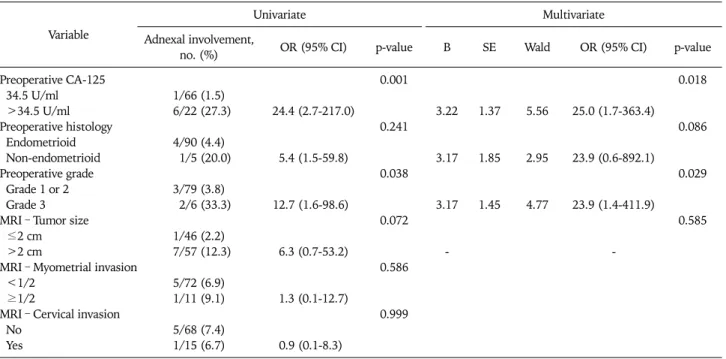
Table 2 demonstrates the results of univariate and multi- variate analysis for various preoperative clinico-pathological factors of predicting coexisting ovarian diseases. High pre- operative CA-125 levels (>34.5 U/ml) and grade 3 tumors correlated significantly with coexisting ovarian diseases (p=
0.001 and p=0.038, respectively). A multivariate analysis using logistic regression revealed that preoperative CA-125 levels (odds ratio OR, 25.0; 95% confidence interval CI, 1.7 to 363.4;
p=0.018) and preoperative tumor grade (OR, 23.9; 95% CI, 1.4 to 411.9; p=0.029) were significant predictors of coexist- ing ovarian malignancies.
Fig. 1 shows the ROC curve to determine the best cut-off point for predicting adnexal diseases. The best cut-off point was determined to be 34.5 U/ml, and the sensitivity and speci- ficity was 85.7 and 80.2%, respectively (area under curve, 0.935;
95% CI, 0.871 to 0.999; p<0.001).
To evaluate the clinical significance of ovary-preserving surgery
in premenopausal women with endometrial carcinomas, we identified a total of 82 patients who had stage I to II disease.
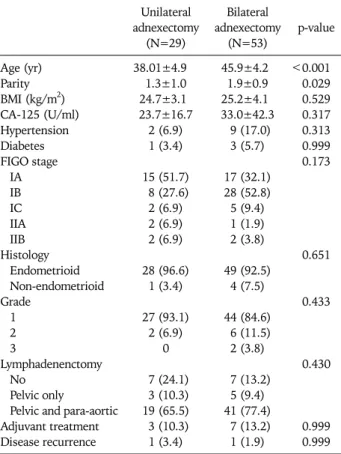
We classified them into two groups - patients who underwent USO and those who underwent BSO and compared the two groups. Patients who underwent USO had younger age and low parity than those who underwent BSO (p<0.001 and p=0.029, respectively). There was no statistically significant difference in terms of BMI, preoperative CA-125 levels, FIGO stage, his- tology, tumor grade, lymphadenectomy, and adjuvant treat- ment. The mean duration of follow-up for all patients was 36.1 months (range, 11 to 72 months, 34.4 for USO and 36.9 for BSO). Two patients experienced disease recurrence. The first patient underwent total abdominal hysterectomy (TAH), USO,
Table 3. Comparison of unilateral and bilateral adnexectomy for pa- tients with FIGO stage I-II endometrial carcinoma
Unilateral adnexectomy
(N=29)
Bilateral adnexectomy
(N=53) p-value Age (yr)
Parity BMI (kg/m2) CA-125 (U/ml) Hypertension Diabetes FIGO stage IA IB IC IIA IIB Histology Endometrioid Non-endometrioid Grade
1 2 3
Lymphadenenctomy No
Pelvic only
Pelvic and para-aortic Adjuvant treatment Disease recurrence
38.01±4.9 1.3±1.0 24.7±3.1 23.7±16.7
2 (6.9) 1 (3.4)
15 (51.7) 8 (27.6) 2 (6.9) 2 (6.9) 2 (6.9)
28 (96.6) 1 (3.4)
27 (93.1) 2 (6.9)
0
7 (24.1) 3 (10.3) 19 (65.5) 3 (10.3) 1 (3.4)
45.9±4.2 1.9±0.9 25.2±4.1 33.0±42.3
9 (17.0) 3 (5.7)
17 (32.1) 28 (52.8) 5 (9.4) 1 (1.9) 2 (3.8)
49 (92.5) 4 (7.5)
44 (84.6) 6 (11.5) 2 (3.8)
7 (13.2) 5 (9.4) 41 (77.4)
7 (13.2) 1 (1.9)
<0.001 0.029 0.529 0.317 0.313 0.999 0.173
0.651
0.433
0.430
0.999 0.999
Table 4. Details of 9 patients with coexisting adnexal disease Patient Age Site Histology
(ovarian)
Lymph node metastasis
Intraoperative extrauterine disease
Endometrial stage and grade (ovarian stage)
ovarian)
Major intraoperative findings
M1
M2 M3
M4
M5 S1 S2 S3*
S4 49
52 33
39
47 43 45 46 48
LO
LO RO
RO
BO RO LO RO RO
P
E E
E
C E (P) E (P) E (E) E (G)
+
- -
+
- - - - -
+
+ +
+
+ - + + -
IVb3
IIIa2 IIIa1
IVb3
IIIa2 Ia1 (Ia) IIIc3 (IIc)
IIIa1 (Ic) Ib1 (Ia)
LO, 6×5×4 cm, omental seeding
LO, 4×3×3 cm RO, 10×6×4 cm with pedunculated nodules Peritoneal, omental, sigmoidal,
cul-de-sac seeding Peritoneal and omental seeding
RO, 4×3×2 cm, cystic LO, 5×4×4 cm, semicystic RO, 9×8×5 cm, cancerous
NS
M1-M5: patients with extrauterine metastasis, S1-S4: patients with synchronous ovarian malignancy, E: endometrioid, P: papillary serous, C:
carcinosarcoma, G: granulosa cell, RO: right ovary, LO: left ovary, BO: both ovary, NS: not significant.
*The patient S3 has both ovarian metastasis of uterine endometrial carcinoma and synchronous ovarian malignancy in final pathology.
and pelvic/para-aortic lymphadenectomy for endometrioid adenocarcinoma, grade 1 on preoperative endometrial biopsy.
On postoperative pathology, she had FIGO stage IB, carcino- sarcoma. She received postoperative chemoradiation, but ex-
perienced recurrence in the pelvis 27 months after completion of adjuvant therapy. She was alive without disease after chemo- therapy. The second patient had endometrioid adenocarcinoma, grade 3 on preoperative biopsy, and underwent TAH, BSO and pelvic/para-aortic lymphadenectomy. Final pathology showed FIGO stage IIB disease with the same histology and grade. She experienced recurrence in the brain 10 months after receiving postoperative chemoradiation. She died of disease during pal- liation chemotherapy. Due to the relatively small numbers of recurrences/deaths, progression-free and overall survival could not be analyzed (Table 3).
Four patients with synchronous primary ovarian cancers had endometrioid histology of the endometrium, and grossly en- larged ovarian masses at the time of surgery, except for one patient. On the postoperative pathologic reports, 2 patients showed papillary serous adenocarcinoma of the ovary, one showed endometrioid histology of the ovary, and the remain- ing one showed poorly differentiated granulosa cell tumor of the ovary. All patients with coexisting ovarian diseases had been suspected to have adnexal involvement preoperatively or intraoperatively, and underwent BSO (Table 4).
Fig. 2 shows the algorithm demonstrating the occurrence of coexisting adnexal disease in the cohorts of 78 patients with clinical stage I to II disease, and both preoperative CA-125 lev- els were measured and tumor grades evaluated. The risk of co- existing ovarian malignancy was 1.8% (1/57) in patients with preoperative CA-125 level less than or equal to 34.5 U/ml and preoperative tumor grade 1 or 2. The risk increases to 20% for low CA-125 and grade 3, 13.3% for high CA-125 and grade 1 or 2, and 100% for high CA-125 and grade 3.
DISCUSSION
Ovarian preservation for premenopausal women with endo-
Fig. 2. Coexisting adnexal disease for the cohorts of 78 premenopausal women less than 50 years of age with endometrial carcinoma and who have available data of pre- operative CA-125 and tumor grade.
metrial carcinoma has provoked a great deal of controversy.
The first objective of this study was to estimate the occurrence of coexisting ovarian malignancy in premenopausal endo- metrial cancer patients. We found that 8.4% of premenopausal endometrial cancer patients under the age of 50 years had co- existing ovarian malignancy; synchronous primary ovarian cancer, 3.7% and ovarian metastasis, 5.6%. Previous studies have shown similar incidence to ours, with a range of 5 to 29%,3-5 and this relatively high rate of adnexal involvement has not allowed premenopausal patients to undergo ovary- saving surgery.
We hypothesized that the preoperative prediction of poten- tial adnexal involvement might be possible and that USO be performed safely in selected conditions, which have a low risk of adnexal disease. The second objective of this study was to determine various clinico-pathological factors in determining the need for BSO in premenopausal patients with endometrial carcinoma. On our univariate analysis, high preoperative CA-125 level (p=0.001) and preoperative tumor grade 3 (p=
0.038) were significant preoperative factors predictive of ad- nexal involvement. Multivariate analysis showed that pre- operative CA-125 levels and tumor grade were significant pre- dictors of coexisting adnexal diseases. Serum CA-125 has be- come widely accepted as a useful marker for preoperative and postoperative evaluation in patients with endometrial carcinoma. In 1984, Niloff et al.16 first described that serum CA-125 levels were elevated in patients with advanced or re- current endometrial cancer. Other several reports revealed that the elevations of preoperative CA-125 were associated with advanced-stage disease and presence of extra-uterine disease.17-20 Sood et al.21 reviewed 210 women with endometrial carcinoma, and proposed that higher CA-125 levels (>35 U/ml) were associated with higher stage and grade, lymph node metastasis, and decreased survival. They also demon- strated that elevated CA-125 was the strongest predictor of extra-uterine disease. Koper et al.22 showed that higher CA-125 levels significantly correlated with the adnexal in- volvement in patients with endometrial cancer.
The third objective of this study was to evaluate which cut-off value of preoperative CA-125 level is optimal in pre- menopausal women with endometrial carcinoma. Although
many investigators regarded the CA-125 level of 35 U/ml as a cut-off level in endometrial carcinoma, some studies in early the 1990s reported that CA-125 levels lesser than 35 U/ml had prognostic significance in endometrial cancer.23,24 Alagoz et al.25 demonstrated that 95% of patients who had been free of disease after surgery for endometrial cancer had CA-125 levels less than 20 U/ml, and suggested that an optimal cut-off level in early detection of disease recurrence could be 20 U/ml. Other reports suggested that a CA-125 level of 20 U/ml is clinically useful for management of patients with en- dometrial cancer.21,26,27 However, these results were derived from the studies of postmenopausal patients, and it is consi- dered that the cut-off level of CA-125 greater than 20 U/ml be more appropriate in young, premenopausal patients. As shown in the ROC curve, the best cut-off point for predicting adnexal disease was 34.5 U/ml with good sensitivity and specificity.
The fourth objective of this study was to estimate the effect of unilateral adnexectomy on premenopausal patients with early-stage endometrial carcinoma. In our study, we compared the clinico-pathological outcomes of premenopausal women with early-stage endometrial carcinoma who underwent USO and BSO. We observed that there was no significant difference in disease recurrence between two groups. Although signi- ficant increases of age and parity were found in patients un- dergoing BSO, there were no significant differences in FIGO stage, postoperative histology and tumor grade, lymphade- nectomy, adjuvant treatment, and the duration of follow-up.
These results seem to indicate the possibility of ovary-saving surgery in endometrial cancer patients.
We wished to estimate whether adnexal involvement was predicted by preoperative CA-125 levels and tumor grade identified from our multivariate analysis. The occurrence of coexisting adnexal disease was in 1.8% (1/57) of patients with low preoperative CA-125 level and low-grade tumor.
Because the patients had been expected to have ovarian malig- nancy preoperatively and undergone BSO, the actual risk of those who had low CA-125 and grade seemed to be negligible.
Recently, some investigators suggested that ovarian preserva- tion in young women with endometrial carcinoma could be feasible through careful preoperative and intraoperative assessment.4,5,28,29 However, they demonstrated intraoperative
and postoperative factors but did not demonstrate which pre- operative factors contributed to the prediction of coexisting ovarian malignancy, except the age of patients.
There are some limitations of our analysis that should be considered. First, all patients did not have preoperative assess- ments including endometrial biopsy, CA-125 measurements, or MR imaging, and comprehensive surgical staging. Second, the mean follow-up of 36.1 months is relatively short. Third, the small number of cases may be an obstacle to interpret our results appropriately. This is supported by the fact that in the multivariate analysis, the confidence interval of the variables is wide.
In conclusion, ovary-saving surgery seems to be a feasible pro- cedure for premenopausal women with early-stage endometrial cancer, without worsening the prognosis. Based on the data pre- sented in this report, we would carefully suggest the ovarian preservation in endometrial cancer patients with low preoperative CA-125 and low-grade tumors. Thorough intraoperative as- sessment in these patients should also be performed to identify and remove the potential risk of adnexal involvement.
REFERENCES
1. Schmeler KM, Soliman PT, Sun CC, Slomovitz BM, Gershenson DM, Lu KH. Endometrial cancer in young, normal-weight women.
Gynecol Oncol 2005; 99: 388-92.
2. Homesley HD. Management of endometrial cancer. Am J Obstet Gynecol 1996; 174: 529-34.
3. Soliman PT, Slomovitz BM, Broaddus RR, Sun CC, Oh JC, Eifel PJ, et al. Synchronous primary cancers of the endometrium and ovary: a single institution review of 84 cases. Gynecol Oncol 2004; 94: 456-62.
4. Walsh C, Holschneider C, Hoang Y, Tieu K, Karlan B, Cass I.
Coexisting ovarian malignancy in young women with endo- metrial cancer. Obstet Gynecol 2005; 106: 693-9.
5. Lee TS, Jung JY, Kim JW, Park NH, Song YS, Kang SB, et al.
Feasibility of ovarian preservation in patients with early stage endometrial carcinoma. Gynecol Oncol 2007; 104: 52-7.
6. Zaino R, Whitney C, Brady MF, DeGeest K, Burger RA, Buller RE. Simultaneously detected endometrial and ovarian carcino- mas: a prospective clinicopathologic study of 74 cases. A gyne- cologic oncology group study. Gynecol Oncol 2001; 83: 355-62.
7. Sheu BC, Lin HH, Chen CK, Chao KH, Shun CT, Huang SC.
Synchronous primary carcinomas of the endometrium and ovary. Int J Gynaecol Obstet 1995; 51: 141-6.
8. Falkenberry SS, Steinhoff MM, Gordinier M, Rappoport S, Gajewski W, Granai CO. Synchronous endometrioid tumors of the ovary and endometrium: a clinicopathologic study of 22 cases. J Reprod Med 1996; 41: 713-8.
9. DiSaia PJ, Creasman WT, Boronow RC, Blessing JA. Risk fac- tors and recurrent patterns in Stage I endometrial cancer. Am J Obstet Gynecol 1985; 151: 1009-15.
10. Morrow CP, Bundy BN, Kurman RJ, Creasman WT, Heller P, Homesley HD, et al. Relationship between surgical-pathological risk factors and outcome in clinical stage I and II carcinoma of the endometrium: a Gynecologic Oncology Group study. Gynecol Oncol 1991; 40: 55-65.
11. Takeshima N, Hirai Y, Yano K, Tanaka N, Yamauchi K, Hasumi K. Ovarian metastasis in endometrial carcinoma. Gynecol Oncol
1998; 70: 183-7.
12. Connell PP, Rotmensch J, Waggoner S, Mundt AJ. The signi- ficance of adnexal involvement in endometrial carcinoma. Gynecol Oncol 1999; 74: 74-9.
13. Soliman PT, Oh JC, Schmeler KM, Sun CC, Slomovitz BM, Gershenson DM, et al. Risk factors for young premenopausal women with endometrial cancer. Obstet Gynecol 2005; 105:
575-80.
14. Lee TS, Kim JW, Kim TJ, Cho CH, Ryu SY, Ryu HS, et al. Ovarian preservation during the surgical treatment of early stage endo- metrial cancer: a nation-wide study conducted by the Korean Gynecologic Oncololgy Group. Gynecol Oncol 2009; 115: 26-31.
15. Ulbright TM, Roth LM. Metastatic and independent cancers of the endometrium and ovary: a clinicopathologic study of 34 cases. Hum Pathol 1985; 16: 28-34.
16. Niloff JM, Klug TL, Schaetzl E, Zurawski VR Jr, Knapp RC, Bast RC Jr. Elevation of serum CA125 in carcinomas of the fallopian tube, endometrium, and endocervix. Am J Obstet Gynecol 1984;
148: 1057-8.
17. Duk JM, Aalders JG, Fleuren GJ, de Bruijn HW. CA-125: a use- ful marker in endometrial carcinoma. Am J Obstet Gynecol 1986; 155: 1097-102.
18. Rose PG, Sommers RM, Reale FR, Hunter RE, Fournier L, Nelson BE. Serial serum CA-125 measurements for evaluation of recurrence in patients with endometrial carcinoma. Obstet Gynecol 1994; 84: 12-6.
19. Patsner B, Mann WJ, Cohen H, Loesch M. Predictive value of preoperative serum CA-125 levels in clinically localized and ad- vanced endometrial carcinoma. Am J Obstet Gynecol 1988;
158: 399-402.
20. Fanning J, Piver MS. Serial CA-125 levels during chemotherapy for metastatic or recurrent endometrial cancer. Obstet Gynecol 1991; 77: 278-80.
21. Sood AK, Buller RE, Burger RA, Dawson JD, Sorosky JI, Berman M. Value of preoperative CA-125 level in the manage- ment of uterine cancer and prediction of clinical outcome.
Obstet Gynecol 1997; 90: 441-7.
22. Koper NP, Massuger LF, Thomas CM, Kiemeney LA, Verbeek AL. Serum CA-125 measurements to identify patients with en- dometrial cancer who require lymphadenectomy. Anticancer Res 1998; 18: 1897-902.
23. Granberg S, Wikland M, Friberg LG. Tumor marker CA-125 level and ovarian volume at different cycle day periods and in postmenopause. Int J Gynaecol Obstet 1990; 33: 149-52.
24. Zurawski VR Jr, Sjovall K, Schoenfeld DA, Broderick SF, Hall P, Bast RC Jr, et al. Prospective evaluation of serum CA-125 levels in a normal population, phase I: the specificities of single and serial determinations in testing for ovarian cancer. Gynecol Oncol 1990; 36: 299-305.
25. Alagoz T, Buller RE, Berman M, Anderson B, Manetta A, DiSaia P.
What is a normal CA125 level? Gynecol Oncol 1994; 53: 93-7.
26. Kurihara T, Mizunuma H, Obara M, Andoh K, Ibuki Y, Nishimura T. Determination of a normal level of serum CA125 in post- menopausal women as a tool for preoperative evaluation and postoperative surveillance of endometrial carcinoma. Gynecol Oncol 1998; 69: 192-6.
27. Dotters DJ. Preoperative CA-125 in endometrial cancer: is it useful? Am J Obstet Gynecol 2000; 182: 1328-34.
28. Wright JD, Buck AM, Shah M, Burke WM, Schiff PB, Herzog TJ. Safety of ovarian preservation in premenopausal women with endometrial cancer. J Clin Oncol 2009; 27: 1214-9.
29. Richter CE, Qian B, Martel M, Yu H, Azodi M, Rutherford TJ, et al. Ovarian preservation and staging in reproductive-age en- dometrial cancer patients. Gynecol Oncol 2009; 114: 99-104.