www.kjlm.org 197
Mycobacterial Infection after Intravesical Bacillus Calmette-Guërin Treatment for Bladder Cancer: A Case Report
Chang-Hun Park, M.D., Mi Ae Jang, M.D., Yoon Hee Ahn, M.T., Yu-Yean Hwang, M.T., Chang-Seok Ki, M.D., and Nam Yong Lee, M.D.
Department of Laboratory Medicine & Genetics, Samsung Medical Center, Sungkyunkwan University School of Medicine, Seoul, Korea
Bacillus Calmette-Guërin (BCG) has been traditionally used as a vaccine against tuberculosis. Further, intravesical administration of BCG has been shown to be effective in treating bladder cancer. Although BCG contains a live attenuated strain of Mycobacterium bovis, complications such as M. bovis BCG infection caused by BCG administration are extremely rare. Here, we report a case of BCG infection occurring after intravesical BCG therapy. A 67-yr-old man presented with azotemia and weight loss. He had been diag- nosed with bladder cancer 4 yr back, and had undergone transurethral resection of the bladder tumor and intravesical BCG (Tice strain) therapy at that time. An acid-fast bacterial strain was isolated from his urine sample. We did not detect Mycobacterium tuber- culosis protein 64 (MPT-64) antigen in the isolates obtained from his sample, and multiplex PCR and PCR-reverse blot hybridization assay indicated that the isolate was a member of the M. tuberculosis complex, but was not M. tuberculosis. Finally, sequence analysis of 16S ribosomal RNA and DNA gyrase, subunit B (gyrB) suggested that the organism was M. bovis or M. bovis BCG. Although we could not confirm that M. bovis BCG was the causative agent, the results of the 3 molecular methods and the MPT-64 antigen assay suggest this finding. This is an important finding, especially because M. bovis BCG cannot be identified using common commercial molecular genetics tools.
Key Words: BCG, Mycobacterium bovis, Bladder cancer, Multiplex-PCR, Sequence analysis
Received: November 8, 2010 Manuscript No: KJLM-10-149 Revision received: February 21, 2011
Accepted: March 25, 2011
Corresponding author: Nam Yong Lee, M.D.
Department of Laboratory Medicine & Genetics, Samsung Medical Center, Sungkyunkwan University School of Medicine, 50 Ilwon-dong, Gangnam-gu, Seoul 135-710, Korea
Tel: +82-2-3410-2706; Fax: +82-2-3410-2719; E-mail: [email protected] ISSN 1598-6535 © The Korean Society for Laboratory Medicine.
This is an Open Access article distributed under the terms of the Creative Commons Attribution Non-Commercial License (http://creativecommons.org/licenses/by-nc/3.0) which permits unrestricted non-commercial use, distribution, and reproduction in any medium, provided the original work is properly cited.
Korean J Lab Med 2011;31:197-200 DOI 10.3343/kjlm.2011.31.3.197
Case Report
Clinical Microbiology
KJLM
INTRODUCTION
Bacillus Calmette-Guërin (BCG) has been traditionally used as a vaccine against tuberculosis. Further, intravesical administration of BCG has been shown to be effective in treating bladder cancer [1]. BCG contains a live attenuated strain of Mycobacterium bovis (M. bovis BCG); however, complications after bladder instillation of BCG are extreme- ly rare [2]. The few complications reported to date include high temperature followed by hematuria or granulomatous prostatitis, epididymo-orchitis, urethral obstruction, and
systemic disease followed by dissemination of bacteria into other organs [3-5]. Here, we report a case of a M. bovis BCG infection that occurred after intravesical BCG therapy for bladder cancer.
CASE REPORT
A 67-yr-old male patient presented at our institution with azotemia. Three months before consulting our institute, he had visited a local clinic because he had been experiencing general weakness and poor oral intake. Biochemical and ul- trasonographic examinations performed at the clinic, re- vealed elevated serum creatinine and obstruction of the left ureter, respectively. Other than a weight loss of 10 kg, the patient did not show any clinical features associated with M.
bovis BCG infection, such as fever, chills, and night sweats.
Right antegrade pyelography showed mild hydroureterone- phrosis with focal stenosis in the ureteropelvic junction.
The patient’s history included diabetes mellitus and chronic renal failure for which he had received intermittent hemo- dialysis. He had been diagnosed with bladder cancer 4 yr back, and he had undergone transurethral resection of the
198 www.kjlm.org
Park C-H, et al. • Mycobacterial Infection after Intravesical BCG Therapy
DOI 10.3343/kjlm.2011.31.3.197
KJLM
bladder tumor (TUR-B), which was immediately followed by intravesical BCG therapy (Tice strain BCG; 12.5 mg of intravesical BCG was injected through a catheter into the bladder once every week for 6 weeks). A year later, another TUR-B was performed because atypical cells were observed in his urine, and a histological examination of his bladder indicated chronic granulomatous inflammation. Although, a diagnostic work-up for mycobacterial infections was not performed at that time, mycobacterial infection was sug- gested and the patient was administered isoniazid (300 mg/
day), rifampicin (600 mg/day), ethambutol (800 mg/day), pyrazinamide (1 g/day), and pyridoxine (50 mg/day) for 3 months.
Laboratory testing performed upon admission at our in- stitute yielded the following findings: proteinuria and py- uria in urinalysis, no microorganisms in Gram’s staining of the urine sample, and acid-fast bacteria (AFB) in AFB staining of the voided urine. Mycobacteria were isolated by inoculating the patient’s urine in Ogawa medium (solid egg-based medium) and by using the BACTEC MGIT 960 mycobacterial detection system (BD, Franklin Lakes, NJ, USA). The colony morphology and staining results of the isolated microorganism are shown in Fig. 1.
To identify the mycobacterial species present in the pa- tient’s samples, the Mycobacterium tuberculosis protein 64 (MPT-64) antigen assay, multiplex-PCR, and PCR-reverse blot hybridization assay (REBA) were performed. The MPT- 64 antigen detection assay was performed using samples ob- tained from liquid cultures by using the TB Ag MPT64 Rapid kit (SD, Yongin, Korea). Multiplex-PCR and PCR- REBA were performed using the MTB-ID® V3 assay system (M&D, Wonju, Korea) and the REBA Myco-ID® assay sys- tem (M&D), respectively. The MPT-64 antigen is typically detected in specimens containing members of the M. tuber- culosis (MTB) complex, which includes M. tuberculosis, M.
bovis, Mycobacterium microti, Mycobacterium africanum,
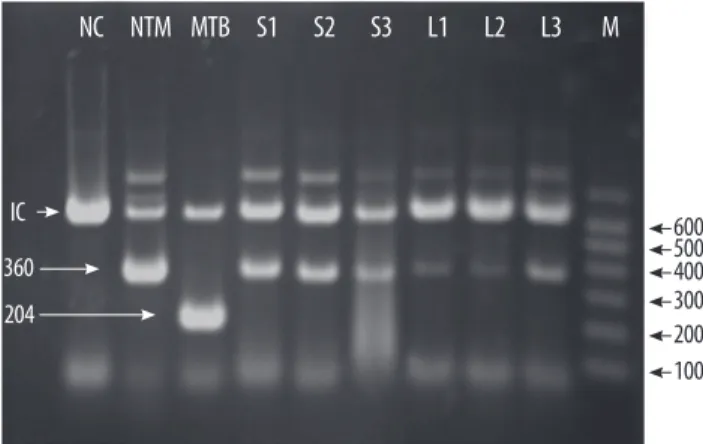
and other mycobacterial species. However, we did not detect this antigen in specimens from this patient. Multiplex-PCR allows differentiation of M. tuberculosis and mycobacterium other than tuberculosis (MOTT) on the basis of the band sizes (204 bp and 360 bp, respectively). In this study, we ob- served a band of 360 bp (Fig. 2). PCR-REBA allows differen- tiation of the MTB complex and non-tuberculous mycobac- teria (NTM) on the basis of the band position on a gel strip (refer to http://www.mndkorea.co.kr for details). In this case, the band pattern obtained after PCR-REBA suggested that the isolate belongs to the MTB complex. Thus, on the basis of the results obtained after performing multiplex-PCR and PCR-REBA, the microorganism isolated from the patient’s samples was suspected to be a member of the MTB com- plex, but not M. tuberculosis. However, the 2 PCR methods and the assay for MPT-64 antigen yielded different results.
Hence, in order to identify the causative agent we perfor- med sequence analysis of 16S ribosomal RNA (16S rRNA) and DNA gyrase, subunit B (gyrB). For sequence analysis, DNA was isolated using the MagNa Pure LC Total Nucleic Acid Isolation Kit (Roche, Mannheim, Germany) as per the manufacturer’s instructions. PCR for 16S rRNA and gyrB gene was performed in an ABI 9700 Thermal Cycler (Ap- plied Biosystems, Foster City, CA, USA) using the appropri- ate primer sets suggested by the CLSI [6] and Nakajima et al. [7]. Bi-directional sequence analysis was performed us- ing the ABI Pri-sm BigDye Terminator Cycle Sequencing Ready Reaction kit (Applied Biosystems) on an ABI Prism 3730 Genetic Analyzer (Applied Biosystems). Sequence
A B
Fig. 1. Colony morphology on solid medium (A) and cord formation by acid- fast bacillus (B) (Ziehl-Neelsen stain, ×1,000). The presence of cords is known to be a criterion for presumptive identification of the Mycobacterium tuberculosis complex.
NC NTM MTB S1 S2 S3 L1 L2 L3 M
600500 400300 200 100 IC
360 204
Fig. 2. Multiplex-PCR to identify the isolate. Products of the multiplex-PCR performed using DNA from the isolates were separated on a 2.0% agarose gel using electrophoresis, and the gel was stained with ethidium bromide.
The bands for the isolates (S1-S3 and L1-L3) corresponded to that for NTM.
IC, internal control (660 bp); NC, negative control; NTM, control non-tubercu- lous mycobacteria; MTB, control Mycobacterium tuberculosis; S1-S3, isolates from solid media; L1-L3, isolates from liquid media; M, molecular markers.
Park C-H, et al. • Mycobacterial Infection after Intravesical BCG Therapy
www.kjlm.org 199
DOI 10.3343/kjlm.2011.31.3.197
KJLM
analysis showed that the 16S rRNA (696 bp) of the isolate had 100% similarity with that of M. bovis BCG (GenBank accession no. GU142938), M. tuberculosis (GenBank acces- sion no. GU142936), M. caprae (GenBank accession no.
NR028879), M. africanum (GenBank accession no. NR- 025238), M. microti (GenBank accession no. NR025234), and M. bovis (GenBank accession no. BX248338). The anal- ysis of the gyrB gene (479 bp) revealed a 100% similarity between the sequence of the isolate and the sequence of M.
bovis BCG (GenBank accession no. AM408590, AP010918) and M. bovis (GenBank accession no. BX248334).
DISCUSSION
Complications caused by M. bovis BCG administration have been rarely reported. A retrospective study by Lamm et al. [2] suggests that local adverse effects, including cysti- tis, fever, hematuria, and prostatitis, are the most frequent complications, whereas extravesical complications are rare.
Other local adverse effects include bladder contractures, ep- ididymo-orchitis, ureteral obstruction, and renal abscesses with or without fistula formation. Although this patient did not show any significant symptoms, the laboratory findings indicated renal dysfunction and the results of right ante- grade pyelography indicated mild ureteral stenosis. Myco- bacterial infections occurring after intravesical administra- tion of BCG have been rarely reported from Korea. Most of the cases reported to date were based on the pathological findings, and to our knowledge, there are no reports of cases in which the causative species of mycobacterium has been identified. To diagnose a mycobacterial infection, Nam et al.
[8] and Jeon et al. [9] examined infected tissue showing chronic granulomatous inflammation with caseous necro- sis. Lee et al. [10] and Kim et al. [11] used AFB staining to determine whether an infection was mycobacterial in na- ture. Son et al. [12] used PCR to determine whether an in- fection was caused by a mycobacterium but they were un- successful. Recently, Kim et al. [13] reported that a molecu- lar method using multiplex PCR for the region of difference 1 (RD1), RD8, and RD14 can be used to confirm BCG in- fection. We hypothesized that M. bovis BCG was the caus- ative agent in this case and attempted to identify this organ- ism by mycobacterial cultivation, MPT-64 antigen assay, and other molecular methods.
MPT-64 is a 26-kDa secretory protein produced by M. tu- berculosis, and the initially purified protein was a homolog from M. bovis BCG, MPB-64 [14, 15]. The MPT-64 antigen assay can specifically detect the MPT-64 antigen secreted by the tuberculosis-causing bacteria. Usually, detection of MPT-
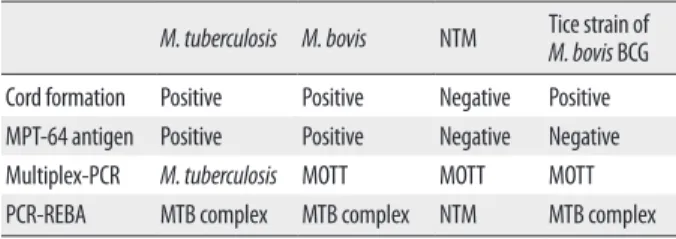
64 antigen in this assay is suggestive of the presence of an or- ganism of the MTB complex, which includes M. tuberculosis, M. bovis, M. microti, and M. africanum. However, some strains of M. bovis BCG, such as Copenhagen, Glaxo, Pas- teur, and Tice, do not express the MPB-64 gene [16, 17]. The absence of the MPT-64 antigen in our patient can be ex- plained by the fact that the Tice BCG strain was injected into the patient’s bladder. The multiplex-PCR and PCR-REBA methods used were not helpful in confirming whether the causative agent was M. bovis because these methods could not distinguish M. bovis from other members of the MTB complexes (Table 1). The sequence analysis of 16S rRNA and gyrB gene was useful in distinguishing the members of the MTB complex, but this method had a limited ability in clearly distinguishing between the M. bovis and M. bovis BCG strains.
Although we could not confirm that M. bovis BCG was the causative agent in this case, the methods employed, which included detection of MPT-64 antigen, PCR, and se- quence analysis of 16S rRNA and gyrB gene, suggest that the causative agent is the Tice strain of M. bovis BCG. This is an important finding since M. bovis BCG cannot be iden- tified using common commercial molecular genetics tools.
The patient was treated with anti-mycobacterial agents for 3 months. Subsequently, AFB staining and mycobacterial cul- ture were performed to detect any residual mycobacterial in- fection, but no mycobacteria were seen in both assessments.
Authors’ Disclosures of Potential Conflicts of Interest No potential conflict of interest relevant to this article was reported.
REFERENCES
1. Bellmunt J, Orsola A, Maldonado X, Kataja V. Bladder cancer:
ESMO practice guidelines for diagnosis, treatment and follow-up.
Ann Oncol 2010;21(S5):S134-6.
2. Lamm DL, van der Meijden PM, Morales A, Brosman SA, Cata-
Table 1. Expected laboratory findings for different Mycobacterium species M. tuberculosis M. bovis NTM Tice strain of M. bovis BCG Cord formation Positive Positive Negative Positive MPT-64 antigen Positive Positive Negative Negative Multiplex-PCR M. tuberculosis MOTT MOTT MOTT PCR-REBA MTB complex MTB complex NTM MTB complex Abbreviations: MTB, Mycobacterium tuberculosis; MOTT, mycobacterium other than tuberculosis; NTM, non-tuberculous mycobacteria; BCG, Bacillus Calmette-Guërin;
PCR-REBA, PCR-reverse blot hybridization assay.
200 www.kjlm.org
Park C-H, et al. • Mycobacterial Infection after Intravesical BCG Therapy
DOI 10.3343/kjlm.2011.31.3.197
KJLM
lona WJ, Herr HW, et al. Incidence and treatment of complications of bacillus Calmette-Guérin intravesical therapy in superficial bla- dder cancer. J Urol 1992;147:596-600.
3. Harving SS, Asmussen L, Roosen JU, Hermann G. Granuloma- tous epididymo-orchitis, a rare complication of intravesical bacil- lus Calmette-Guérin therapy for urothelial cancer. Scand J Urol Nephrol 2009;43:331-3.
4. Ilgan S, Koca G, Gundogdu S. Incidental detection of granuloma- tous prostatitis by F-18 FDG PET/CT in a patient with bladder cancer: a rare complication of BCG instillation therapy. Clin Nucl Med 2009;34:613-4.
5. Korac M, Milosevic B, Lavadinovic L, Janjic A, Brmbolic B. Dis- seminated BCG infection in patients with urinary bladder carci- noma. Med Pregl 2009;62:592-5.
6. CLSI. Interpretive criteria for identification of bacteria and fungi by DNA target sequencing; approved guideline. CLSI document MM18-A. Wayne, PA: Clinical and Laboratory Standards Insti- tute, 2008.
7. Nakajima C, Rahim Z, Fukushima Y, Sugawara I, van der Zanden AG, Tamaru A, et al. Identification of mycobacterium tuberculosis clinical isolates in Bangladesh by a species distinguishable multi- plex PCR. BMC Infect Dis 2010;10:118.
8. Nam SB, Park JS, Kim JJ, Park JT, Nam SK. Ureteral obstruction caused by periureteral tuberculous granuloma after intravesical BCG therapy for superficial bladder tumors. Korean J Urol 2006;
47:436-9.
9. Jeon HJ, Ham WS, Lee SH, Kim WY, Kim JH, Cho SY, et al. Renal
tuberculous granuloma after intravesical bacillus Calmette-Guérin instillation for bladder tumor. Korean J Urol 2002;43:1104-6.
10. Lee GS, Lee GY, Yoon JC, Na DJ, Jeong SS, Sul CK, et al. Two cases of pulmonary complications following intravesical bacillus Calme- tte-Guérin immunotherapy in patients with superficial bladder cancer. Tuberc Respir Dis 1999;46:869-78.
11. Kim SH, Kim HW, Lee HJ, Bae WJ, Cho SY. Tuberculous prostatic abscess following intravesical bacillus Calmette-Guérin instilla- tion. Korean J Urol 2009;50:186-7.
12. Son JI, Chung JP, Paek SS, Lee JI, Kim JH, Moon BS, et al. A case of granulomatous hepatitis developed after intravesical BCG instil- lation for bladder cancer. Korean J Gastroenterol 2002;39:375-8.
13. Kim SH, Kim SY, Eun BW, Yoo WJ, Park KU, Choi EH, et al. BCG osteomyelitis caused by the BCG Tokyo strain and confirmed by molecular method. Vaccine 2008;26:4379-81.
14. Nagai S, Wiker HG, Harboe M, Kinomoto M. Isolation and partial characterization of major protein antigens in the culture fluid of mycobacterium tuberculosis. Infect Immun 1991;59:372-82.
15. Harboe M, Nagai S, Patarroyo ME, Torres ML, Ramirez C, Cruz N.
Properties of proteins MPB64, MPB70, and MPB80 of mycobacte- rium bovis BCG. Infect Immun 1986;52:293-302.
16. Li H, Ulstrup JC, Jonassen TO, Melby K, Nagai S, Harboe M. Evi- dence for absence of the MPB64 gene in some substrains of myco- bacterium bovis BCG. Infect Immun 1993;61:1730-4.
17. Behr MA and Small PM. A historical and molecular phylogeny of BCG strains. Vaccine 1999;17:915-22.