277
©The Korean Society of Food Science and Technology
과실류에 잔류하는 Ethylenethiourea 분석
김은희*·장미라·김진아·김태랑·육동현·황인숙·김정헌
서울시보건환경연구원 강남농수산물검사소
Determination of Ethylenethiourea in Fruits
Eun-Hee Kim*, Mi-Ra Jang, Jin-A Kim, Tae-Rang Kim, Dong-Hyun Yook, In-Sook Hwang, and Jung-Hun Kim Gangnam Agro-marine Products Inspection Center,
Seoul Metropolitan Government Research Institute of Public Health and Environment
Abstract A rapid and very sensitive high-performance liquid chromatography/atmospheric-pressure chemical-ionization mass spectrometry method to detect ethylenethiourea (ETU) fungicide residues in fruits was developed. Methylene chloride was used as the surface extraction solvent for the target component. Recovery rates improved when cysteine hydrochloride and sodium carbonate were added to product prior to fortification. The limits of detection and quantification were approximately 0.006 and 0.02 mg/kg, respectively, from mandarin oranges. Recoveries from mandarin oranges, oranges, bananas, and pears, spiked in the range of 0.05-0.5 mg/kg, averaged 80-100%. The proposed method was used to monitor the presence of ETU in commercial fruits purchased from different markets in Seoul, Korea. ETU was found in four orange peels and in three mandarin orange peel samples. The highest ETU residue levels were 73.6µg/kg and 29.8 µg/kg. Keywords: dithiocarbamates, ETU, ethylenethiourea
서
론
Dithiocarbamates(DTCs)는 많이 사용하고 있는 유기살균제로 다 양한 병원체에 효과가 있으며, 저독성, 저비용으로 식량작물의 수 확 후 보호제로 사용되고 있다. Dithiocarbamates 농약은 탄소 골 격 구조에 따라 세 그룹으로 분류되는데 dimethyldithiocarbamate (DMDs), ethylenebis(dithiocarbamates)(EBDs) 그리고 propylenebis (dithiocarbamates)(PBDs)로 나누어 진다. 그 중 EBDC계 살균제는 산소나 수분 혹은 생체 내에서 불안정하여 ethylenethiourea(ETU), ethylenebisdithiocyanate sulphide(EBIS), ethylenethiuram disulphide (ETD) 및 ethylenethiuram monosulphide(ETM) 등 분해대사산물을 형성한다(1-3).식품이나 생태분야 연구자들이 EBDC계 분해산물 중 ETU에 관심을 가지는 이유는 실험동물에서 갑상선 호르몬 합성을 손상 시켜 갑상선비대증의 원인이 되며, 더욱이 설치류에서 발암 및 기형을 유발한다는 실험 결과가 보고되었기 때문이다(4). 또한 IARC(International Agency for Research on Cancer)도 실험동물대 상으로 ETU에 의한 발암성을 보고하였으나, 인간에게서는 암 및 기형 유발물질 발견과 ETU 연관성에 관한 충분한 자료가 부족 하므로 ETU가 위해 가능성은 있지만 group 3(not classifiable as to its carcinogen)으로 분류하고 있다(5). ETU의 물리화학적 특성은 분자량 102.16, 녹는점 203-204oC이 며 물과 극성 유기용매에 녹는다. ETU의 독성학적 특성을 보면 쥐에 대한 급성경구독성(LC50)이 900-1,833 mg/kg으로 보통 독성 에 속하며, 만성독성이 주요 관심대상이 되고 있다(6). 식품 중에서 ETU는 야채, 과일 및 와인 등에서 검출된다고 보 고되고 있다(5). 이는 EBDC계 농약이 잔류하는 상태에서 저장 및 가공처리를 하면 ETU가 증가하는 것으로 알려져 있어(7) 농 산물 중 ETU 잔류량 조사의 필요성이 강조되고 있다. 하지만 ETU는 아직까지 기준설정이 되어있지 않고 그에 필요 한 모니터링 자료도 미비하여, 식품 중에 잔류하는 ETU를 추출 하여 신속 정확하게 분석하는 방법은 효율적인 잔류모니터링에 매우 필요한 방안이라 할 수 있다.
현재까지 ETU 분석과 관련하여 thin-layer chromatography, gas chromatography 그리고 liquid chromatography를 이용한 다양한 분 석 방법이 개발되었다. Thin-layer chromatography는 정확도가 떨 어지며, GC chromatography를 이용한 분석은 감도 높고 선택적 인 결과를 얻을 수 있는 장점이 있으나(8), 극성인 ETU를 유도 체화하지 않으면 만족스러운 결과물을 얻을 수 없기 때문에 복 잡한 전처리 과정과 많은 시간이 소요된다. 이로 인해 오차의 가 능성이 높아지며 회수율이 떨어질 가능성이 있다.
최근에는 ultra violet spectrophotometer, mass spectrometry 또 는 electrochemical detector가 구비 되어있는 HPLC 분석방법이 응 용되고 있는 추세이다. Liquid chromatography/mass spectrome-try(LC/MS) 방법 중 atmospheric pressure ionization(API)를 이용 한 분석은 선택성과 감도를 모두 충족 시킬 수 있다. 본 연구는 간편하면서도 신뢰성 있는 전처리 과정을 통해 과실류에 존재하 는 ETU를 추출, 분리하는 방법을 정립하고, LC-DAD UV 검출 기가 장착된 LC/MS를 이용하여 정성 및 정량 하는 분석 방법을 개발하여 과실류에서 ETU의 잔류량을 모니터링 하였다. *Corresponding author: Eun-Hee Kim, Gangnam Agro-marine
Prod-ucts Inspection Center, Seoul Metropolitan Government Research Insti-tute of Public Health and Environment, Seoul 138-701, Korea
Tel: 82-2-3401-6291 Fax: 82-2-3401-6742 E-mail: [email protected]
Received February 7, 2011; revised March 14, 2011; accepted March 18, 2011
표준품 ETU(98.5%)는 Dr. Ehrenstorfer GmbH사(Augsburg, Germany), L-cysteine hydrochloride는 Alfa Aesar사(Lancs, UK), sodium carbonate는 Kanto사(Tokyo, Japan), sodium sulfate는 Wako사(Osaka, Japan), methylene chloride은 Burdick & Jackson 사(Muskegon, MI, USA), 여과용 필터 1PS와 0.2 µm nylon syringe filter는 Whatman사(Brentford, UK) 제품을 사용하였다. 표준용액 조제 ETU 표준용액은 조제 후 분해를 정기적으로 확인하고 크로마 토그램에서도 변화가 없었다는 Ozhan과 Alpertunga(9)의 연구결 과에 따라 다음과 같은 조건으로 조제하였다. ETU 표준품은 증 류수에 녹여 약 100 mg/L 농도로 조제하였으며 4oC 이하, 암실 에서 보관하였다. 농도는 0.01-1.0 mg/L로 희석하여 사용하였으며 3개월마다 다시 만들어 사용하였다. 크로마토그래피 분석조건
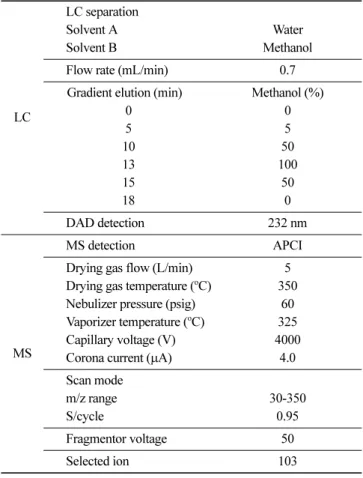
Methanol은 LC grade로 J.T.Baker(Phillipsburg, NJ, USA) 제품 을 사용하였고, 증류수는 ELGA(18.2 Mohm · cm, Bucks, UK)로 초순수 제조 된 물을 사용하였다. Diode array detector(G1315B) 가 부착된 HPLC와 LC/MS 분석장비는 1100 series(Agilent, Santa Clara, CA, USA)를 이용하였고, column은 C18(ZOBAX Eclips XDB-C18 5.0µm, 4.6× 25 mm, Agilent)으로 성분을 분리하였다. LC/MS 분석 조건은 Table 1과 같다.
최소화하기 위하여 시료를 0.5 cm가 넘지 않게 세절한 후 cys-HCl 0.4 g과 sodium carbonate(Na2CO3) 4 g, sodium sulfate(Na2SO4) 30 g을 넣고 여기에 methylene chloride(CH2Cl2) 60 mL를 넣어 10 분 동안 추출(200 rpm, JISICO, Seoul, Korea)하였다. 추출액을 여 과한 후 40 mL CH2Cl2를 잔류물에 넣고 이전 여액과 합하였다.
이 중 50 mL를 취한 후 3 mL 증류수를 넣고 진공농축기(BUCHI, Essen, Germany)로 감압하여 30oC 수욕조에서 CH2Cl2를 모두 날 려 보낸 후, 잔류물에 증류수 2 mL를 가하여 완전히 용해시킨 다 음, 0.2 µm nylon syringe filter로 여과하여 20 µL를 HPLC에 주 입하여 분석하였다. 분석 절차 직선성은 5개 농도 시험 용액으로 각 농도에서 5회 반복하여 실험하였다. 정확성과 정밀성은 0.01-1.0 mg/kg 농도로 수행하였 고 intra-day 정밀성을 측정하기 위해 위와 같은 농도를 3번 반복 분석하였으며, inter-day 정밀성은 3일간 반복 분석하였다. 회수율 은 70-120% 범위에서 RSD가 20% 이하가 되는지 확인하였다. 검 출한계와 정량한계는 3.3 σ/S와 10 σ/S 방법으로 계산하였고, 기 울기 S의 측정방법은 검출 및 정량한계 범위를 포함하는 분석물 질의 검량선에서 구한 값이며, 회기선(regression line)의 residual σ의 표준편차를 이용하였다. 회수율은 0.05-0.5 mg/kg 범위로 3회 분석하여 평균과 표준편차를 구하였다.
결과 및 고찰
시료 전처리의 최적 조건 추출용매로 사용된 CH2Cl2는 용매를 증발시키는 과정에서 ETU 회수율에 0-106%로 많은 영향을 미친다는 보고가 있다. 그 중 Burdic & Jackson의 GC2 grade CH2Cl2를 사용했을 때 우수한 회 수율을 보인다는 연구결과에 따라 위 용매를 사용하였다(10). ETU는 시료를 갈아 전처리를 하는 과정에서 분해되기 쉽다. 즉 각 시료 매트릭스가 ETU 안전성에 영향을 미칠 수 있다. Sack(11)의 연구결과에 의하면 시료에 잔류하는 ETU의 분해 방 지를 위한 보존제로 cys-HCl를 시료에 첨가 했을 때, 첨가하지 않은 시료보다 ETU의 회수율 효과가 평균 15% 향상되었다. 따 라서 본 실험에 적합한 첨가량을 알기 위해 cys-HCl와 Na2CO3의 양을 측정하였다. Fig. 1A는 ETU 안정성이 pH 영향을 받는다는 보고(12)와 매 트릭스와 pH는 아무런 연관이 없다는 상반된 결과(11)가 있어 산 성을 띠는 오렌지에 ETU를 첨가하여 Na2CO3를 0-10 g 정도로 첨 가하여 회수율을 실험하였다. 시료를 세절하여 20 g을 넣고 Na2CO3 양을 다르게 하여 ETU를 첨가하였다. 잠시 방치 후 모든 조건 을 동일하게 하여 실험한 결과 Na2CO3 4 g 정도에서 회수율이 가장 높게 나타났다. Fig. 1B는 ETU를 첨가한 바나나에 위와 동 일조건으로 cys-HCl를 0-1 g 첨가하여 회수율을 실험하였다. Sack(11)의 연구에 따르면 과실류 중 바나나의 매트릭스가 항산 화제인 cys-HCl 첨가 유무에 따라 ETU에 영향을 많이 받는다고 언급하였다. 본 연구 결과와 다소 차이가 있었으나 어느 정도 영 향을 받고 있음을 알 수 있었으며 0.4 g 정도에서 회수율이 가장 높게 나타났다. 위 결과는 cys-HCl 첨가로 인하여 ETU가 EU(Eth-yleneurea)로 산화되는 것은 저해하는 것으로 추정된다.Table 1. LC/MS conditions for analysis of ethylenethiourea
LC LC separation Solvent A Solvent B Water Methanol Flow rate (mL/min) 0.7 Gradient elution (min)
0 5 10 13 15 18 Methanol (%) 0 5 50 100 50 0 DAD detection 232 nm MS MS detection APCI
Drying gas flow (L/min) Drying gas temperature (oC) Nebulizer pressure (psig) Vaporizer temperature (oC) Capillary voltage (V) Corona current (µA)
5 350 60 325 4000 4.0 Scan mode m/z range S/cycle 30-350 0.95 Fragmentor voltage 50 Selected ion 103
컬럼은 C18 column을 선택하였다. C18 column은 잔류농약 동시 분석에 선택적으로 사용되기도 하며, dithiocarbamates 분석물질과 같이 사용할 수 있도록 편리성을 고려하여 선택하였다. 따라서 이동상 용매에 gradient를 조정하여 분리된 ETU 성분 을 머무름 시간으로 확인하고 UV DAD에 검출된 물질의 스펙 트럼으로 재확인하였다. 추가로 LC-APCI-MS에서 ETU-[M+H]+ m/z 103 모니터링으로 최종 확인하였다(Fig. 2). 특이성 본 연구는 신뢰성 있는 정량뿐 만 아니라 UV-DAD와 MS를 이용하여 원하는 분석물질의 선택적인 확인을 최적화하고자 하 였다. ETU는 232 nm에서 최고의 흡수파장을 보였다.
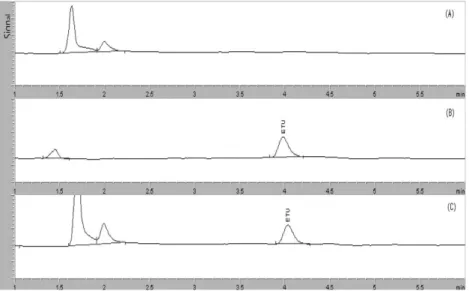
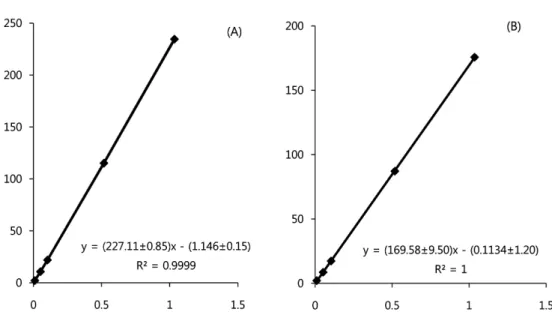
Fig. 3은 귤시료, ETU 표준용액 0.1 mg/kg 그리고 ETU 0.1 mg/kg을 첨가한 귤을 실험한 크로마토그램이다. 추출한 시료에서 ETU 머무름 시간에 어떤 간섭현상도 보이지 않았다. 포도, 배, 바나나에서도 간섭현상 없이 분리되었다. 직선성 표준품 ETU와 ETU를 첨가한 귤의 직선성을 실험하기 위해 5 개 농도로 5번 반복 분석하여 평균과 표준편차를 구하였다(Fig. 4). ETU 0.01-1.0 mg/kg 농도의 R-square 값은 0.9999이었고, ETU를 첨가한 귤의 R-square 값은 1로 높은 결정계수를 나타내 어 두 직선성에는 큰 차이가 없었다. 정밀성과 정확성
반복성(Repeatability, intra-assay precision)은 5개 농도 수준에서 3회 반복 실험하여 평가하였다. 귤 시료에 첨가한 표준품의 회수 율은 평균 80% 이상이었으며, 분석법의 정밀도 지표로 이용되는 Fig. 1. Effects of the amount of sodium carbonate (with 0.4 g
cysteine hydrochloride and 30 g sodium sulfate) from spiked mandarin orange and effects of the amount of cysteine hydrochloride (with 4 g sodium carbonate and 30 g sodium sulfate) from spiked banana.
Fig. 2. LC-APCI-MS chromatogram obtained for a mandarin orange sample spiked with 0.5 mg/kg ETU.
Fig. 3. HPLC chromatograms of (A) an unspiked mandarin orange sample, (B) a standard solution 0.1 mg/kg, (C) a spiked mandarin orange sample at 0.1 mg/kg of ETU.
상대표준편차(%RSD)는 2.20-18.42% 범위를 나타내었다. 재현성 (Reproducibility, inter-laboratory precision)은 동일한 농도에서 동일 실험방법으로 3일 반복 시험한 결과, 상대표준편차는 0.46-23.74% 의 농도 범위를 나타내었다. 0.01 mg/kg 농도에서 3일 반복 실험 한 상대표준편차는 EU guideline에서 제시한 RSD≤20% 기준에서 벗어났으며, 그 외 0.05-1.0 mg/kg에서는 반복성과 재현성 모두 RSD≤10% 이하의 결과를 보였다(Table 2). Table 3은 다양한 과실류(배, 바나나, 포도)의 회수율을 나타낸 결과이다. 3가지 농도로 첨가된 시료의 회수율은 배, 포도, 바나 나 모두 80% 이상의 회수율을 보였으며, 전체적인 RSD는 ≤20% 이하였다. 앞서 언급했듯이 배, 포도, 바나나 역시 ETU의 머무름 시간에 다른 간섭현상은 보이지 않았다. 검출한계와 정량한계 검출한계와 허용할 수 있는 정확도와 정밀도로 시료 중 분석 물질을 정량적으로 측정할 수 있는 정량한계를 계산한 결과, 귤 시료에 첨가한 ETU의 검출한계는 0.006 mg/kg으로 나타났으며, 정량한계는 0.020 mg/kg으로 나타났다. 과실류 중 ETU 잔류량 본 실험방법으로 시중에 유통중인 과실을 수거하여 과피와 과 실전체로 나누어 분석한 결과는 Table 4와 같다. 과실 전체를 세 절하고 균질화하여 분석한 결과 검출된 과일은 없었다. 이는 과 피에 잔류하는 ETU 함량이 작아 과피와 과육을 전체로 한 과일 을 대상으로 한 실험에는 검출한계 이하로 나오기 때문인 것으 로 사료된다. 그러나 과피에서는 오렌지 4건, 귤 3건, 사과 1건 이 검출되었다. 오렌지 과피는 절반이상의 검출률을 보였고 가장 높은 잔류 농도는 73.6 µg/kg이었다. 귤 과피 3건 중 최고 잔류 농도는 29.8 µg/kg이었고 사과 과피는 1건이 검출되었다. 이는 Caldas 등이 dithiocarbamate계 농약을 CS2로 분석 한 결과 오렌 지에서 mancozeb가 64% 검출되었다는 검사 결과와 비슷한 검출 률을 보였다(13). 대부분 ETU의 잔류는 EBDC계 처리를 한 농 작물에서 검출된다(14)는 의견과 일치하는 결과를 나타냈다. 모니터링은 인류건강에 잠정적인 위해 요소를 최소화하는데 있 어 매우 중요한 부분이다. 현재 dithiocarbamate계 분해산물인 ETU 는 기준 설정이 되어있지 않을 뿐만 아니라 분석방법도 아직 체 계화되어 있지 않는 실정이다. 따라서 신속하면서도 신뢰성 있는 분석방법을 마련하여 ETU에 관한 모니터링 등 확실한 자료를 구 축해야 할 필요성이 있다. 본 연구는 과실류에 잔류하는 ETU 분석법으로 간편하면서도 Fig. 4. Standard calibration plots (A) and on-matrix mandarin orange calibration plots (B). Each value is the mean±standard deviation. Table 2. Intra-day (n=3) and inter-day (over a period of 3 consecutive days) precision and accuracy data for the determination of ethylenethiourea in spiked mandarin orange
Fortification level (mg/kg) 0.01 0.05 0.1 0.5 1.0 Recovery (%) Intra-day (%RSD) Inter-day (%RSD) 110.02 018.42 023.74 88.90 04.93 05.80 83.06 02.20 02.61 82.38 02.99 01.51 81.47 09.00 00.46
Table 3. Mean recovery data (n=3) for spiked pears, grapes, and bananas
Sample Spiking level of ETU (mg/kg) Mean±RSD (%) Pears 0.05 0.10 0.50 90.78±4.94 80.21±9.60 92.00±5.76 Grapes 0.05 0.10 0.50 92.93±2.20 80.03±9.24 92.02±5.80 bananas 0.05 0.10 0.50 87.21±9.24 80.56±9.05 097.24±10.98
신뢰성 있는 분석을 위해 여러 방법을 모색하였다. 추출 및 정제 방법에 있어서 여러 번의 정제 단계는 번거로울 뿐만 아니라 시 간이 오래 걸리며 분석물질이 손실될 수 있고 용매나 초자로 인 한 간섭물질을 유발할 수 있다. 그러나 CH2Cl2로 추출하여 LC/ MS를 이용한 ETU 분석법은 전처리 시간이 비교적 짧으며, 재현 성, 정밀성 그리고 회수율 등을 고려할 때 적절한 분석방법이라 고 판단된다.
요
약
본 연구는 과실류에 잔류하는 ETU 분석을 위해 LC/APCI-MS 를 이용하여 신속 정확한 분석법 검증을 실시하였다. 시료 중 존 재하는 ETU 성분 추출로 사용된 용매는 CH2Cl2이며, 시료 전처 리 시 cys-HCl 0.4 g, Na2CO3 4 g을 사용할 때 최적의 회수율을 나타냈다. 분석 시 C18 column으로 분리되어 나온 ETU의 머무름 시간대에서 어떠한 간섭현상도 보이지 않았으며 232 nm에서 최 고의 흡수파장을 보였다. 귤 시료에 ETU를 첨가한 결과값의 직 선성은 적합한 것으로 나타났다(R2=1). 정밀성과 정확성은 0.05-1.0 mg/kg에서 RSD≤10%이며, 회수율은 평균 80% 이상의 결과를 보였다. 배, 포도, 바나나의 회수율도 마찬가지로 80% 이상으로 나타났다. 본 실험방법으로 시중에 유통중인 과실류를 구입하여 모니터링을 한 결과 ETU는 오렌지 과피에서 4건이 검출되었고 최고 잔류치는 73.6 µg/kg 이었다. 귤 과피는 3건 검출 되었고 최 고 잔류치는 29.8 µg/kg이었다. 본 연구의 과실류에 잔류하는 ETU 분석법은 시료 전처리에 필요한 시간을 줄일 수 있으며 전처리 단계를 간소화함으로써 오 염도를 줄였다. 기존에 발표된 논문에 비해 전처리 시간은 약 20 분 정도 소요되며, 분석 시 재현성, 정밀성 등을 고려할 때 과실 류에 존재하는 ETU 분석법에 적합한 것으로 사료된다.문
헌
1. Goranka C, Wolfgang S. Determination of dithiocarbamate fungi-cide residues by liquid chromatography/mass spectrometry and stable isotope dilution assay. Rapid Commun. Mass Sp. 21:
4009-4016 (2007)
2. Garcinuno RM, Ramos L, Fernandez-Hernando P, Camara C. Optimization of a matrix solid-phase dispersion method with sub-sequent clean-up for the determination of ethylenebisdithiocar-bamate residues in almond samples. J. Chromatogr. A 1041: 35-41 (2004)
3. Bolzoni L, Sannino A, Bandini M. Determination of ehtylenethio-urea and propylenethioehtylenethio-urea in tomato products and in fruit purees. Food Chem. 47: 299-302 (1993)
4. WHO. Environmental Health Criteria 78: Dithiocarbamate pesti-cides, Ethylenethiourea and Propylenethiourea: A general intro-duction. World Health Organisation, Geneva, Switzerland (1988) 5. IARC. IARC Monographs on the Evaluation of the Carcinogenic
risks to Human. International Agency for Research on Cancer, Lyon France. 79: 659-701 (2001)
6. Jang MR, Hwang KH, Lee ES, Kim EH, Yuk DH, Kim JH, Park SG. Characteristics on the conversion of EBDCs fungicides to ETU for Mancozeb and Metiram. Korean J. Pest. Sci. 14: 30-36 (2010)
7. Colosio C, Fustinoni S, Birindelli S, Bonomi I, de Paschale G, Mammone T, Tiramani M, Vercelli F, Visentin S, Maroni M. Eth-ylenethiourea in urine as an indicator of exposure to mancozeb in vineyard workers. Toxicol. Lett. 134: 133-140 (2002)
8. Dubey JK, Heberer T, Stan HJ. Determination of ethylenethiourea in food commodities by a two-step derivatization method and gas chromatography with electron capture and nitrogen-phosphorus detection. J. Chromatogr. A 765: 31-38 (1997)
9. Ozhan G, Alpertunga B. Liquid chromatographic analysis of maneb and its main degradation product, ethylenethiourea, in fruit juice. Food Addit. Contam. 25: 961-970 (2008)
10. Sack CA, Kendall DC, Krause RT. Determination of methylene chloride acceptability and its “purification” for ethylenethiourea methodology. J. AOAC Int. 76: 1146-1148 (1993)
11. Sack CA. Enhancement of ethylenethiourea recoveries in food analyses by addition of cysteine hydrochloride. J AOAC Int. 78: 1097-1101 (1995)
12. Kontou S, Tsipi D, Oreopoulou V, Tzia C. Determination of ETU in tomatoes and tomato products by HPLC-PDA. Evaluation of Cleanup Procedures. J. Agr. Food Chem. 49: 1090-1097 (2001) 13. Caldas ED, Miranda MCC, Conceicao MH, de Souza LCKR.
Dithiocarbamates residues in brazilian food and the potential risk for consumers. Food Chem. Toxicol. 42: 1877-1883 (2004) 14. Lentza-Rizos C. Ethylenethiourea (ETU) in relation to use of
eth-ylenebisdithiocarbamate (EBDC) Fungicides. Rev. Environ. Con-tam. T. 115: 1-37 (1990)
Table 4. Results of ETU residues analysis in 94 samples of commercial fruits
Product Samples analysed Samples with ETU Highest residue found (µg/kg) Peel Whole fruit Peel Whole fruit Apples Pears Mandarin oranges Grapes persimmons Bananas Oranges Kiwis Others 17 11 17 12 05 13 08 04 07 1 ND 3 ND ND ND 4 ND ND 0ND1) ND ND ND ND ND ND ND ND detected ND 29.8 ND ND ND 73.6 ND ND ND ND ND ND ND ND ND ND ND 1)ND: Not detected