노인 운전자에게 적용한 컴퓨터 기반 운전중재 프로그램에 관한 체계적 고찰
김덕주
청주대학교 작업치료학과
A Systematic Study of Computer-Based Driving Intervention Program for Elderly Drivers
Deok Ju Kim
Department of Occupational Therapy, Cheongju University
요 약 본 연구는 노인 운전자를 대상으로 한 컴퓨터 기반 운전중재 프로그램에 대해 체계적으로 분석함으로써, 노인을 위한 운전중재에 대한 근거를 제시하고자 하였다. 연구 분석을 위해 2009년 1월부터 2018년 10월까지 출판된 문헌들을 대상 으로 하였으며, 국외 문헌은 ‘Pubmed, Goggle Scholar, Science Direct’에서 검색하였고, 국내 문헌은 ‘RISS, Keris, KISS’를 통하여 검색하였다. 총 359편의 논문이 검색되었고, 포함기준과 배제기준을 바탕으로 분석하여 최종 10편의 논문이 분석에 사용되었으며, 근거수준 Ⅰ이 8편(80%), Ⅲ가 2편(20%)이었다. 분석결과 노인에게 적용한 컴퓨터 기반 중재 방법에는 운전 시뮬레이터가 7편(70%)으로 가장 많았으며, 비디오 영상훈련 2편(20%), 닌텐도 Wii 프로그램이 1편(10%)을 차지하였다. 대 부분의 연구에서 운전 시뮬레이터는 노인들의 인지영역과 시지각 능력을 훈련하고, 다양한 모의 상황에서 위험 상황에 대처 하는 능력을 향상시켜 주었으며, 다른 중재방법들도 노인들에게 긍정적인 영향을 미쳤다. 노인 운전자를 평가한 평가 항목에 서는 운전 시뮬레이터를 사용한 운전수행능력 평가가 가장 많았으며, 그 외 주의력, 시공간 능력, 인지기능, 위험인지 평가, 우울 및 불안평가 등이 시행되었다. 노인 운전자를 대상으로 한 컴퓨터 기반 운전중재 프로그램은 다양한 영역들을 훈련하고 평가하기에 적절하며, 안전운전을 위한 중재도구로 효과적으로 활용될 수 있을 것으로 기대한다.
Abstract This study systematically analyzed computer-based driving intervention programs for seniors, to provide the academic background for driving intervention for seniors. Articles published from January 2009 till December 2018 were researched and analyzed. 'PubMed, Google Scholar, and Science Direct' were used to search articles published overseas, and 'RISS, KERIS, and KISS' searched for articles published in Korea. Based on the inclusion and exclusion criteria, totally 359 papers were retrieved, and 10 articles were finally analyzed; 8 articles (80%) were evidence level I, and 2 articles (20%) were evidence level III. Amongst the computer-based interventions, driving simulators (70%) were the most common, followed by two video image training (20%) and one Nintendo Wii program (10%). In most studies, driving simulators trained the cognitive and visual abilities of seniors and enhanced their abilities to cope with risk situations under various simulated circumstances. Other interventions were also reported to have a positive effect.
For evaluating elderly drivers, the driving performance evaluation using a driving simulator was the most common;
in addition, evaluations of attention, space-time ability, cognitive function, risk perception, depression and anxiety were also commonly used. We believe that it is appropriate to employ computer-based driving intervention programs for seniors to train and evaluate various domains. We expect that these interventions can be used as an effective tool for safe driving.
Keywords : Elderly, Computer-Based, Driving Intervention, Evidence Based Practice
이 논문은 2017-2019학년도에 청주대학교 보건의료과학연구소가 지원한 학술연구조성비(특별연구과제)에 의해 연구되었음.
*Corresponding Author : Deok Ju Kim(Cheongju Univ.) Tel: +82-43-229-8385 email: [email protected]
Received January 11, 2019 Revised February 1, 2019 Accepted April 5, 2019 Published April 30, 2019
1. 서론
1.1 연구의 필요성
우리나라는 2000년에 65세 고령자 인구가 전 인구의 7%에 도달하면서 고령화 사회에 진입하였다.
2018년에는 14.3%로 고령사회에 진입하고, 2026년 20.8%로 본격적인 초 고령사회에 도달할 것으로 전망되 고 있다[1]. 최근 수명 연장으로 인해 노인운전자가 증가 하고 있으며, 적극적인 지역사회 삶의 방식변화로 인해 운전면허를 소지한 노인이 증가하고 있다[2]. 따라서 고 령사회로 진입하는 과정에서 노인 운전자는 새로운 자동 차 소비 주체로 성장할 것으로 예상하고 있다[3].
운전은 노인의 병원 진료, 장보기 등과 같은 일상적 활동을 가능하게 하고, 사회적 활동에 참여하게 함으로 써 건강한 노화를 보장하는데 중요한 역할을 한다[4]. 많 은 연구에서 운전은 노인의 이동성을 증가시키는 주요 수단으로써 자율성과 독립성을 이룰 수 있는 핵심요소이 며, 삶의 질과 행복감에 기여한다고 보고하고 있다[5,6].
운전은 사회 활동을 위한 독립적인 이동 수단으로 지속 적으로 변하는 환경 안에서 운동, 인지 및 지각 기능의 통합을 요구하는 복합적인 과제이다. 그러나 일반적으로 노인은 시각, 인지기능, 신체적 능력이 감퇴하고, 이로 인하여 젊은 층에 비해 교통사고 위험이 높은 편이다[7].
노인의 교통사고는 국가적으로 관리해야 할 문제로 대두 되고 있는 실정이다. 조사에 따르면 안전운전 불이행과 관련된 사고가 전체 사고의 59.6%에 이른다고 한다[8].
특히, 시각과 인지기능의 문제는 노인의 운전에 큰 영향 을 미치는데, 노인들은 노화로 인해 좁아진 시야로 다양 한 자극을 받아들이고, 운전을 수행하는 것에 집중력을 분산시키기 어렵다[9]. 그리고 색상대비능력 감소로 인 해 밤이나 비가 오는 날, 터널에서 운전의 어려움을 보인 다[10]. 또한 65세 이상 노인들은 젊은 운전자들에 비해 기억력이 저하되고 정보처리 속도가 늦어 신호등, 돌발 상황 등의 반응 속도가 떨어진다[11]. 이처럼, 노화로 인 해 저하되는 기능을 예방하고, 문제가 있다면 운전에 대 한 훈련 프로그램 등의 다양한 중재를 받는 것이 필요하 다.
해외에서는 운전중재를 위해 신체훈련, 인지기능 훈 련, 실제 도로주행 훈련, 시뮬레이터를 활용한 훈련, CarFit(차량조절) 프로그램 등을 활용하고 있으며, 장애 인뿐만 아니라 노인들에게도 다양한 형태로 중재하고 있
다[4]. 하지만, 신체훈련과 인지기능 훈련 같은 경우 특 별하게 정해진 매뉴얼이 없으며, 이러한 훈련으로 명확 한 효과를 보였다는 연구 사례들이 부족하였다. 그리고 실제 도로주행 훈련은 공간의 문제로 인하여 노인들이 쉽게 참여할 수 없는 어려움이 있다고 한다[9]. 이러한 부분들에 대한 대안책으로 제시되고 있는 것이 컴퓨터 기반 운전중재 프로그램이다. 컴퓨터 기반 운전중재 프 로그램으로 잘 알려진 것은 대표적으로 가상현실 기반 훈련과 드라이빙 시뮬레이션 등을 들 수 있는데, 이러한 프로그램은 대부분 안전 운전에 필요한 교통 법규 및 안 전이 100% 확보 된 상태에서 올바른 차량 제어기술과 위험예측 및 대응능력을 실제 차량을 운전하기 이전에 제공하는 프로그램으로 구성되어 있어 폭넓게 사용할 수 있다[12]. 또한 시지각과 인지기능을 평가하고 훈련할 수 있는 영역들이 대부분 포함되어 있고 변화의 과정이 기록된다는 장점도 있으며, 이 프로그램을 사용하여 다 양한 영역의 평가도 가능하다. 실제 노인들이 가정에서 컴퓨터를 사용하는 경우는 많지 않으나 노인 복지관, 도 로교통공단 등에서 노인들을 대상으로 가상현실 기반 훈 련과 드라이빙 시뮬레이션 등의 훈련을 종종 시행하고 있으며, 노인들의 참여율도 높아지고 있는 상황이다[13].
이처럼 컴퓨터 기반 운전중재 프로그램은 노인들이 부담 없이 참여 할 수 있으며, 변화의 추이를 알아볼 수 있어 그 효과를 바로 알 수 있다는 점을 가지고 있지만, 노인들을 대상으로 연구를 진행하고 체계적인 효과를 분 석한 연구는 부족한 실정이다. 따라서, 본 연구에서는 노인 운전자를 대상으로 컴퓨터 기반 운전중재 프로그램 의 효과를 체계적으로 분석함으로써 노인을 위한 운전중 재의 통합적 근거를 제시하고자 한다.
1.2 연구의 목적
본 연구의 목적은 노인 운전자를 대상으로 컴퓨터 기 반 운전중재 프로그램을 분석하고자 한 것으로, 구체적 인 목적은 다음과 같다.
1) 컴퓨터 기반 운전중재 프로그램의 적용 사례 및 연 구동향을 살펴본다.
2) 컴퓨터 기반 운전중재 프로그램의 세부 내용을 살 펴본다.
3) 컴퓨터 기반 운전중재 프로그램의 중재 결과를 살 펴본다.
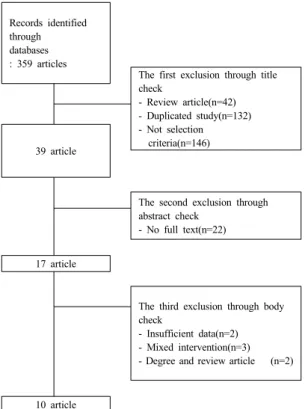
Records identified through databases : 359 articles
The first exclusion through title check
- Review article(n=42) - Duplicated study(n=132) - Not selection criteria(n=146) 39 article
The second exclusion through abstract check
- No full text(n=22) 17 article
The third exclusion through body check
- Insufficient data(n=2) - Mixed intervention(n=3) - Degree and review article (n=2)
10 article
Fig. 1. Flow diagram for research selection
Level of
evidence Research type N(%)
Ⅰ
Systematic reviews Meta-analyses
Randomized controlled trials
8(80%)
Ⅱ Two groups nonrandomized
studies 0(0%)
Ⅲ One group nonrandomized
studies 2(20%)
Ⅳ Single-subject designs
Surveys 0(0%)
Table 1. Level of Evidence of the Studies (N=10)
2. 연구방법
2.1 연구설계
본 연구는 노인 운전자에게 적용한 컴퓨터 기반 운전 중재 프로그램의 적용사례 및 연구동향을 분석하기 위한 체계적 문헌고찰 연구로, 노인을 위한 운전중재에 대한 근거를 제시하기 위해 수행되었다.
2.2 자료수집 및 분석대상
본 연구에서는 노인 운전자에게 컴퓨터 기반 운전중 재 프로그램을 적용한 연구들을 알아보기 위하여 웹 데 이터베이스를 사용하여 검색하였으며, 2009년 1월부터 2018년 10월까지 출판된 문헌들을 대상으로 하였다.
2018년 10~11월에 걸쳐 문헌을 검색하였으며, 국외문 헌의 경우 Pubmed, Goggle Scholar, Science Direct에서
‘older’, ‘elderly’, ‘driving’, ‘computer-based’, ‘simulation’
‘intervention’을 검색용어로 지정하였으며, 국내문헌의 경우 KISS, Keris, RISS에서 ‘노인’, ‘운전’, ‘컴퓨터 기 반’, ‘시뮬레이션’과 같은 용어들을 매치하여 검색하였 다. 검색된 논문은 연구자 1명이 제목과 초록, 키워드를
검색하였고, 원문이 있는 논문들은 찾아서 번역하였다.
포함 및 배제 기준은 기존의 문헌들을 참고하여 정하였 으며, 전문가 2명에게 이에 대한 자문을 구하여 최종 결 정하였다. 각 데이터베이스에서 총 359개의 논문이 검색 되었고, 그 결과 총 10편(국외 6편, 국내 4편)의 논문이 본 연구의 분석대상으로 사용되었다(Fig. 1).
2.2.1 포함기준
다른 장애가 없는 일반 노인만을 대상으로 한 논문, 컴퓨터 기반 운전중재 프로그램에 대해 제시된 논문, 2009년 1월부터 2018년 10월까지 학회지에 게재된 것 으로, 무료로 원문 서비스를 받을 수 있는 논문을 포함하 였다.
2.2.2 배제기준
노인만을 대상으로 한 연구가 아닌 논문, 컴퓨터 기반 운전중재 프로그램 이외에 다른 방법을 활용한 운전중재 프로그램 논문, 개별실험연구와 사례연구인 논문, 학위 논문 및 종설논문은 배제하였다.
2.3 연구근거의 질적 수준
본 연구에 사용된 논문의 질적 수준을 평가하기 위하 여 Arbesman, Scheer와 Lienerman[14]에 의하여 개발 된 분류기준을 사용하였다. 이 분류기준은 근거를 기반 으로 한 연구의 수준(hierarchy of levels of evidence-based practice)을 5단계로 분석하며, 연구의 질적 수준을 평가하기 위해 널리 사용되고 있다. 선정된 10편의 논문을 분석한 결과, 무작위 연구에 속하는 Ⅰ단 계 수준의 논문이 8편(80%), 단일집단 비무작위 연구에 속하는 Ⅲ단계 수준의 논문이 2편(20%)을 차지하였다.
본 연구의 배제기준에 따라 Ⅳ, Ⅴ단계에 해당하는 논문 은 없었다(Table 1).
Ⅴ
Case reports
Narrative literature reviews Qualitative research
0(0%)
Total 10(100%)
3. 연구결과
3.1 분석에 포함된 문헌의 일반적 특성 분석에 포함된 문헌의 일반적 특성을 알아본 결과는 다음과 같다. 노인에게 적용한 컴퓨터 기반 운전 중재 방 법의 사용 현황을 보면 운전 시뮬레이터가 7편(70%)으 로 가장 많았으며, 터치 방식의 LCD 모니터를 사용한 비디오 영상 프로그램이 2편(20%), 닌텐도 Wii 프로그 램이 1편(10%)을 차지하였다. 국가별 출판 논문의 수는 한국이 4편(40%), 미국이 4편(40%), 영국이 2편(20%) 으로 나타났다. 출판 연도별 학회지 게재 논문 수는 2010년~2015년 사이의 논문이 6편(60%)으로 가장 많았 다(Table 2).
Characteristics N(%)
All studies 10(100)
Type of intervention
Driving simulator 7(70)
Video footage 2(20)
Nintendo Wii 1(10)
Publish Nation
Korea 4(40)
USA 4(40)
UK 2(20)
Publish year
2009 2(20)
2010~2015 6(60)
2016~2018 2(20)
Table 2. Characteristics of studies included in the review
3.2 중재방법에 대한 결과 분석
중재방법에 대한 결과는 다음과 같으며 표 3에 요약 되어 있다(Table 3).
3.2.1 운전 시뮬레이터
운전 시뮬레이터를 사용하는 훈련은 도로나 제한된 코스에서 실시하는 도로주행 평가 같은 실제 환경을 가 상으로 재현한 것으로, 저비용과 안전상의 이유로 노인 들의 운전수행을 평가하고 훈련하는데 적절한 도구이다 [14]. 본 연구에서 분석된 10편의 연구 중 7편이 운전 시
뮬레이터를 사용하였다. Christhard 등[15]의 연구에는 노인운전자와 젊은 운전자의 시간압박(정해진 시간 안에 알맞은 차선으로 진입하는 것)과 대처능력을 운전 시뮬 레이터를 사용하여 평가하였으며, 젊은 운전자들이 시간 압박에도 불구하고 대처능력이 더 나음을 알 수 있었다.
Gaspar 등[16]의 연구에서, 실험군은 운전 시뮬레이터를 사용하여 14개의 인지영역을 훈련하였고, 대조군은 컴 퓨터를 이용한 인지 카드 게임을 시행한 후 위험에 대한 대처반응 및 고속도로 운전 평가를 진행하였는데, 그 결 과 두 군 간의 유의한 차이가 없다고 하였다. 이는 운전 시뮬레이터를 사용하여 인지영역만을 훈련하였기 때문 에, 컴퓨터를 이용한 인지 카드 게임과 비슷하게 좋은 결 과를 나타낸 것으로 풀이된다. Han[17]은 65세 이상 운 전자와 비 운전자의 대응능력을 운전 시뮬레이터를 사용 하여 평가하였으며, 두 집단 간의 과속, 중앙선 침범, 차 선 이탈 사고 횟수는 통계적으로 유의하게 나타났으나 느린 주행속도, 정지반응시간 등에서는 운전자와 비 운 전자 사이에 별다른 차이가 없음을 알 수 있었다.
Matthew 등[18]의 연구에서는 실험군에게 운전 시뮬레 이터를 사용하여 교차로와 같은 위험 상황에 대처하는 훈련을 진행하였으며, 대조군은 중재가 없었다. 그 결과 실험군은 실제 현장 훈련에서 생길 수 있는 위험 요소들 을 피할 수 있는 능력이 향상되었으며, 대조군은 어떤 개 선도 보이지 않았다. Nicholas 등[19]의 연구에서는 70 세 이상 노인 21명에게 운전 시뮬레이터를 사용하여 추 적과제, 시각집중과제, 시공간과제, 이중과제, 시각기억 력 과제 등을 시행하였으며, 그 결과 모든 항목에서 중재 전 보다 향상됨을 알 수 있었다. Park 등[20]의 연구에서 는 65세 이상 노인 운전자와 20세 이상 40세 미만 성인 운전자의 운전수행능력을 평가하였으며, 그 결과, 적성 검사와 도로주행 검사 항목에서 노인 운전자가 젊은 운 전자에 비해 합격률이 낮고, 실점률이 높음을 알 수 있었 다. Yim과 Lee[21]의 연구에서는 운전 시뮬레이터를 사 용하여 70세 이상 노인 운전자와 과 20~30세 사이 성 인운전자의 지각, 이해 및 통합, 예측능력을 측정하였으 며, 노인 운전자의 경우 젊은 성인 운전자에 비해 전반적 으로 시공간 구성능력과 기억능력이 전반적으로 낮게 나 타났음을 알 수 있었다.
3.2.2 LCD 모니터를 사용한 비디오 영상 Mark 등[22]은 65세 이상 노인 실험군에게 비디오 영
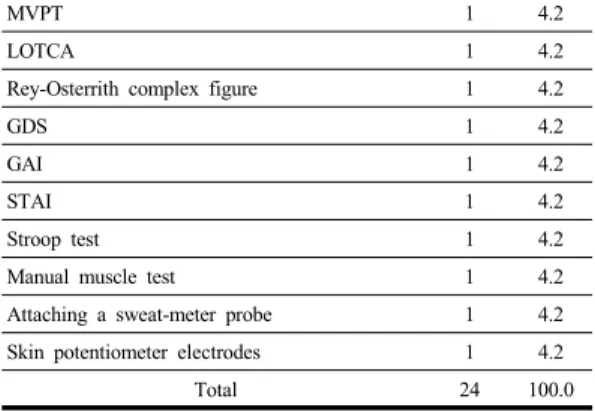
Evaluation N %
Driving simulator 6 25.0
Trail making test 3 12.1
Video processing 2 8.3
Hazard response driving assessment 1 4.2
Hazard perception 1 4.2
Highway driving assessment 1 4.2
Table 4. Evaluation to measure of elderly drivers
MVPT 1 4.2
LOTCA 1 4.2
Rey-Osterrith complex figure 1 4.2
GDS 1 4.2
GAI 1 4.2
STAI 1 4.2
Stroop test 1 4.2
Manual muscle test 1 4.2
Attaching a sweat-meter probe 1 4.2
Skin potentiometer electrodes 1 4.2
Total 24 100.0
상을 이용하여 위험 인지능력을 훈련 하였으며, 대조군 에게는 위험 상황에 대해 알려주는 비디오를 시청하게 하였다. 그 결과 실험군은 위험을 인지하고 반응하는 행 동시간이 단축되었으며, 집행기능과 감정적인 부분에서 대조군 보다 더 나은 결과를 보였다. Risa 등[23]은 60세 이상 노인 52명에게 비디오 영상을 이용하여 운전자 위 험능력을 감지하는 평가를 진행하였으며, 그 결과 복합 과정으로 진행되는 운전 항목에서 손에 땀이 나는 증상 이 증가하고, 갑자기 놀랄 수 있는 상황에서 피부 전위반 응이 증가하는 것을 확인할 수 있었다.
3.2.3 닌텐도 Wii 프로그램을 사용한 훈련 Lee 등[24]의 연구에서는 65세 이상 노인 실험군에게 닌텐도 Wii 프로그램의 일종인 가상 주행환경 프로그램 을 사용하였으며, 대조군에게는 중재를 하지 않았다. 그 결과 가상 주행환경 프로그램을 사용한 실험군의 경우 시지각 능력과 공간지각능력, 운동실행능력, 사고조작능 력에 긍정적인 영향을 미치는 것을 알 수 있었다.
3.3 운전자를 평가한 평가도구
본 연구에서 평가도구는 총 16개가 사용되었다. 분석 결과 운전 시뮬레이터가 총 6회로 가장 많이 활용되었으 며, 주로 운전 수행능력을 평가하기 위해 사용되었다. 그 다음으로 많이 사용된 것이 기호 잇기 검사(Trail making test) 이며, 비디오 촬영을 통해 대상자의 상황을 파악하는 평가도 2회 진행 되었다. 그 외 인지기능평가(LOTCA), 시지각 평가(MVPT), 시각 기억 평가(Rey-Osterrith complex figure), 위험인지평가(Hazard response driving assessment, Hazard perception), 우울평가(GDS), 불안 평가(GAI, STAI), 집행기능평가(Stroop test), 도수근력 평가(MMT), 발한검사(Attaching a sweat-meter probe), 피부 전위반응검사(Skin potentiometer electrodes) 등이 시행되었다(Table 4).
4. 고찰
운전은 힘, 협응, 관절가동범위 등의 운동조절 능력과 지속적 주의력, 분리 주의력, 시지각 능력, 판단력 등의 인지기능이 요구되는 복잡한 고위과제이다[25]. 하지만 노인이 되면 노화에 따른 시지각 능력, 반응속도, 인지능 력 등의 저하로 인해 운전수행에 어려움을 가지게 된다.
따라서 운전에 대한 지속적인 중재는 장애가 있는 사람 들에게만 하는 것이 아니라 노인들에게도 필수적이라 할 수 있다[18]. 현재 노인들의 신체 및 인지기능, 감각 기 능을 향상 시키고 안전한 운전을 위해 다양한 훈련 프로 그램의 요구가 증가하고 있으나 노인들만을 위한 훈련 프로그램이 따로 제작된 경우는 거의 없으며, 실제 도로 주행 훈련 등은 공간의 문제로 인하여 노인들이 쉽게 참 여할 수 없는 어려움이 있다[19]. 따라서 컴퓨터 기반 운 전 중재 프로그램이 대안책으로 제시되고 있는 실정이 다. 컴퓨터 기반 운전 중재 프로그램은 훈련을 위한 용도 뿐만 아니라 운전자들의 다양한 운전 능력을 측정할 수 있기 때문에, 측정 도구로서도 그 활용도가 높게 평가된 다[23].
본 연구에서는 노인 운전자에게 적용한 방법 중 컴퓨 터 기반 운전 중재 프로그램에 대한 체계적 고찰을 통해 노인 대상 운전중재 서비스의 근거를 마련하고자 하였 다. 포함기준 및 배제기준에 따라 해외문헌 6편, 국내문 헌 4편, 총 10편의 연구를 선정하여 질적 수준, 문헌의 일반적 특성, 중재방법에 대한 결과분석, 중재에 사용된 평가도구를 분석하였다.
연구를 통해 살펴본 노인에게 적용한 컴퓨터 기반 운 전중재방법에는 운전 시뮬레이터, 비디오 영상훈련, 닌 텐도 Wii 프로그램이 있었으며, 이 중 운전 시뮬레이터
Author (year)
Participants Intervention
Evaluation Result
Exp. Con. Exp. Con.
Christhard et, al.(2011)
n=21 Older drivers≥
65years
n=20 Adult drivers≥23t
o30 years
․Driving simulator was used (Fixed-base driving simulator of the University of Regensburg) -Within a fixed period of time (under time pressure), enter the left turn lane and then, drive in accordance with a traffic signal.
-Avoid collision with a coming from the opposite side when driving at left turn signal
․Same as the experimental group
․Driving simulator
․It was video taped and then, observed
․Time pressure was proven to be a factor with a significant impact on the decision of making a left turn
․Despite a time pressure, young drivers seemed to cope with the situation better.
Gaspar et, al.(2012)
n=20 Older drivers≥
70years
n=21 Older drivers≥
70years
․Driving simulator was used(CogniFit Senior Driver program)
-14 aspects of cognition
;divided attention, field of view, visual scanning, working memory
․32 session
․30min
․Played card game on a computer
․32 session
․30min
․Hazard response driving assessment
․Highway driving assessment
․Data showed no differential improvements between the training group and a control group on any driving performance measure follow-ing training. The commercial training program did not improve the simulated driving performance of older adults
Han(2016) n=17 Older drivers≥65
years
n=16 Older
Non drivers≥
65 years
․Driving simulator was used -OT Rehab_2.evt scenario (city-drive mode) was used -It included traffic situations, curve, hill, unexpected situations, stop signs, etc.
․Same as the experimental group
․STISIM driving simulator
․This attempt to evaluate the driving performance of elderly drivers using a virtual driving simulator showed that there were significant differences between these two groups in overspeed, driving over the centerline, and the no. of lane departure accident.
․There were no significant differences between these two groups in low speed driving, stop response time, and lane departure so it would be necessary to prepare measures to cope with a psychological change and degradation in a space perceptivity required for driving caused by aging.
Lee et, al.(2014)
n=30 Older drivers≥
65years
n=30 Older drivers≥
65years
․Nintendo Wii was used -Driving simulation program was used (A virtual reality program providing a driving environment very similar with of actual driving) -RC Car driving program using a model road (driving is on a model road, similar with an actual road)
․32 session
․2 hours
․No intervention
․MVPT3
․LOTCA
․Trail making test-1, 2
․Nitendo Wii and RC car driving programs were shown to positive influences over elderly seniors in terms of visual perceptivity, space perceptivity, exercise ability, and operability
Mark et al., (2010)
n=12 Older drivers≥
65years
n=12 Older drivers≥
65years
․Video footage(LCD monitor) was used.
-It is provided as a package for training a risk perceptivity, and it aims at training an ability to perceive various risks on a road.
-Touch screen. Requires to respond to each situation.
․Watching a video showing
․Various risks.
․Hazard perception test
․Trail making test
․GDS
․GAI
․STAI
․The period of time taking to acknowledge a risk and respond was shortened in the experimental group.
․The experimental group showed better results in terms of emotion and power of execution.
Matthew et, al.(2009)
n=36 Older drivers≥70
years
n=18 Older drivers≥70
years
․Driving simulator was used.
․Experimental group 1 was subject to active learning.
-Simulator was used to train an ability to cope with risky situations
․No intervention
․Driving simulator -headbanmount ed camera
․This training, made with a simulator, was helpful to enhance an actual ability to avoid risk factors that might be experienced on actual road.
․Subjects received either passive
Table 3. Summary of studies included in the review
such as being on a cross-road.
-A subject actually operate the simulator and a feedback was given on errors.
․Experimental group 2 was subject to passive learning.
-Passive training without feedbacks on errors.
․6 session, 4 to 5 months
․60min
-three bullet camers
training or no training showed no improvement.
․Compared with passive training, active training is a more effective strategy for increasing older drivers’
likehood of looking for threats during a turn.
Nicholas et, al.(2009)
n=21 Older drivers≥
70years
․Driving simulator was used.
(DriveSafety’s Vection software Version 1.4.1)
․Training program
-tracking task, visual selective attention task, visual spatial n back tack, dual task, visual memory task, car following task
- ․Driving
simulator
․Regression analyses demonstrated that performance on the single and dual cognitive tasks and improvements in these
computer-based tasks with training were predictive of improvements in driving simulator performance
Park et al., (2010)
n=55 Older drivers≥
65years
n=48 Adult drivers≥20t
o40 years
․Vision, perceptivity, motor functions and driving performance of drivers were evaluated.
-Vision: eyesight, visual field, color blindness and contrast sensitivity tests
-Perceptivity: depth perception, sustained attention, divided attention
-Motor functions: lower limb motor functions, torso stability, balancing -Driving performance: Virtual operation simulator was used for the aptitude test and the road driving test.
․Same as the experimental group
․OPTEC 6500P
․Stroop test
․Trail making test
․Manual Muscle Testing
․Driving simulator
․In the contrast sensitivity test, the photopia and dim vision of elderly drivers were shown to be less than of young drivers.
․In the perceptivity test, elderly drivers were shown to receive scores significantly lower than of young drivers.
․In the motor function test, there were no significant differences between these two groups.
․In the aptitude test and the road driving test, elderly drivers were shown to have a lower probability of acceptance and a lower score than young drivers.
Risa et al., (2017)
n=52 Older drivers≥
60years
․Video footage(LCD monitor) was used.
․Test for assessing drivers’
hazard-perception skills by measuring their palmar sweating response (PSR), skin potential reflex (SPR), and ability to operate the steering wheel, accelerator, and brake.
․Attaching a sweat-meter probe
․Skin potentiometer electrodes
․PSR tended to be greater in hazard scenes that involved anticipation or complexity processes
․SPR response was faster in hazard scenes that involved a surprise process.
Yim &
Lee(2012) n=30 Older drivers≥70
years
n=30 Adult drivers≥23t
o31 years
․Simulator was used to evaluate perceptivity, abilities of understanding and integration, and predictability
․Time-space capability was measured
-Ability of acknowledgement of driving situations was measured using 27 scenarios.
․Same as the experimental group
․Rey-Osterrit h Complex Figure
․UC-win/
Road simulator
․In case of elderly seniors, their spatio-temporal organization and memorization abilities were generally lower than of young drivers.
․Time-space capability and situation perceptivity are very closely related.
․Time-space capability plays a major role in enhancing the possibility of consistent driving of elderly drivers.
MVPT3: Motor-Free Visual Perception Test3
LOTCA: Loewenstein Occupational Therapy Cognitive Assessment GDS-K: Geriatric Depression Scale
UFOV: Useful Field of View Test COAST: California Older Adults Stroop Test GAI: Geratirc Anxiety Inventory
STAI: State-Trait Anxiety Inventory
의 빈도가 가장 높았다. 운전 시뮬레이터는 기본적으로 다양한 모의 상황 설정(시나리오)을 포함한 정교한 기능 을 갖추고 있으며, 개별적인 대상자의 데이터 관리와 훈 련뿐만 아니라 효율적인 운전 평가와 교육, 재활을 위해 사용되고 있다[17]. 본 연구에서 운전 시뮬레이터를 사 용한 논문을 분석해 보면 노인들에게 시뮬레이터에 있는 인지영역과 시지각 능력을 훈련하고, 다양한 모의 상황 에서 위험 상황에 대처하는 훈련 등을 시행하였을 때 운 전 시뮬레이터를 사용하지 않은 대조군 보다 인지 및 상 황 대처 능력에서 좋은 결과를 보였다. 이러한 결과는 노 인 및 뇌손상 환자에게 운전시뮬레이터 훈련을 실시했을 때 반응속도와 시각적 주의력에 효과적이었다는 기존의 연구결과와 일치한다[26]. 그리고 운전 시뮬레이터를 사 용하여 운전 능력 평가를 시행하기도 했는데, 주로 노인 들과 젊은 대상자와의 차이를 알아보는 연구가 많았다.
평가 결과 노인들은 시간 압박이 주어졌을 때 상황에 대 처하는 능력, 운전수행 능력, 시공간 구성능력, 인지능력 등이 젊은 대상자들에 비해서 저하되는 것을 알 수 있었 다. Owsley 등[27]은 시각주의력 및 인지기능 저하가 있 는 경우 그렇지 않은 경우에 비해 사고율이 3~4배 이상 증가한다고 하였으며, 이는 노인 운전자들이 젊은 대상 자들에 비해 사고의 위험이 훨씬 크다는 것을 나타내며, 운전에 있어 각별히 주의를 해야 한다는 점을 시사하고 있다. 운전 시뮬레이터는 모의 상황에서의 운전훈련으로 인해 다양한 영역의 기능 향상을 기대할 수 있다는 장점 이 있으나, 어떤 연구에서는 저 연령층에 비해 고 연령층 이 어지러움, 멀미, 두통, 피로, 메스꺼움 등의 증상으로 인해 중도탈락의 위험이 있다고 하였다[28]. 따라서 운 전 시뮬레이터를 이용하여 중재를 제공할 때 노인들의 컨디션 등을 파악하여 중재 시간 설정 및 중재 강도를 고려할 필요가 있을 것으로 사료된다.
운전 시뮬레이터 다음으로 많이 사용된 중재 방법은 비디오 영상훈련이다. LCD 모니터 터치 방식으로 중재 가 이루어지며, 본 연구에서 분석된 논문에서는 비디오 영상을 이용한 인지능력과 위험 상황을 인지하고 반응하 는 훈련을 시행하였다. 분석 결과 비디오 영상 훈련을 시 행한 실험군에서 위험을 인지하고 반응하는 행동 시간이 단축되었으며, 집행기능과 감정적인 부분에서 중재를 하 지 않은 대조군에 비해 더 나은 결과를 보였다. 위험을 인지하고 반응하는 훈련은 실제 도로상황에서 시행하기 가장 어려운 항목 중에 하나이다[22]. 따라서 모니터를
터치하면서 위험 상황에 반응하는 훈련은 노인 운전자들 의 순발력을 증진시키기 위해 적합한 훈련으로 사료된다.
닌텐도 Wii 프로그램을 사용하여 훈련을 진행한 연구 도 있었다. 닌텐도 Wii는 가상현실기반 게임 프로그램이 며, 실제 대상자가 컨트롤러를 움직이면 화면의 아바타 가 함께 움직이는 방법으로 진행된다[29]. 본 연구에서 는 이 프로그램을 활용하여 노인들에게 가상 주행환경에 참여하도록 하였으며, 시지각 능력과 공간지각능력, 운 동실행능력, 사고조작능력에 긍정적인 영향을 미쳤다고 하였다. 이 프로그램은 실제적으로 비용 및 공간의 문제 로 인해 운전 시뮬레이터를 설치하기 어려운 상황에서 대안적으로 활용하기에 좋은 프로그램으로 사료된다.
운전자들을 평가한 평가도구들을 살펴보면, 운전 시 뮬레이터를 사용하여 운전 수행능력을 평가한 사례가 가 장 많았고, 주의력, 시공간 탐색능력 및 이마엽의 정신적 유연성을 평가[30]하기 위해 기호 잇기 검사(Trail making test)도 다수 사용되었다. 그 외 시지각 평가와 시각기억 평가, 위험인지평가, 우울평가와 불안평가도 사용되었 다. 결과를 살펴보면, 운전과 관련된 평가에는 대부분 운 전수행능력, 인지기능, 시지각 및 감정의 상태를 알아보 는 것들이 많았다. 위와 같은 항목들이 운전 수행에 가장 중요한 영역이라는 것임을 알 수 있는 결과이다. 따라서 운전을 할 때 인지기능, 시지각 기능, 정신적인 유연성 훈련뿐만 아니라 노인들에게 자주 동반될 수 있는 우울 및 불안 상태에 대해서도 정확하게 파악할 필요가 있을 것으로 사료된다.
본 연구를 통해 운전 시뮬레이터, 비디오 영상훈련, 닌텐도 Wii와 같은 가상현실 게임프로그램이 노인 운전 자에게 긍정적인 영향을 미쳤음을 알 수 있었으며, 운전 수행을 위한 다양한 영역의 평가에도 효과적임을 알 수 있었다. 그러나 본 연구에서 분석한 논문의 수가 적어 노 인들에게 적용한 컴퓨터 기반 운전 중재 프로그램에 대 해 완전한 근거를 제시하지 못했다는 한계가 있다. 본 연 구는 최근 2009년~2018년까지, 최근 10년간의 논문을 대상으로 하였으며, 대표 주제어를 ‘노인’ ‘컴퓨터기반 운전중재 프로그램’ 으로 설정하였다. 노인에 대한 운전 중재 논문은 많고, 컴퓨터기반 운전중재 프로그램에 대 한 논문도 많지만 이 두 가지 주제를 완전히 충족하며, 연구에서 제시한 질적인 수준을 만족하는 논문을 찾기가 어려웠다. 최종 10편이 선정되었고, 다른 연구들에 비해 표본 논문 수가 적지만, 노인에게 적용한 컴퓨터기반 운
전중재 프로그램의 사례들을 정리해서 공유할 수 있다는 것에 의미를 두고자 한다. 그리고 노인들을 대상으로 진 행된 기존 운전 관련 연구들이 인식도 및 현황 등을 보 고하는 것에 치우쳐 있었고, 몇몇 뇌손상 등 질환을 가진 노인들을 대상으로 치료실에서 운전중재 프로그램을 시 행한 것을 보고한 연구들이 대부분이었다는 것을 고려한 다면, 일반 노인들을 대상으로 진행된 컴퓨터 기반 운전 중재 프로그램에 대해 고찰한 본 연구는 대상자를 일반 노인으로 확장시키고 좀 더 폭넓은 정보를 공유하고자 했다는 점에서 큰 의의가 있다고 생각한다.
5. 결론
본 연구는 노인 운전자를 대상으로 컴퓨터 기반 운전 중재 프로그램에 대해 체계적 고찰을 시행함으로써 노인 운전중재에 대한 근거를 제시하고자 하였다. 2009년부 터 2018년까지 10년간의 문헌을 검색하여 최종 10개의 연구를 분석하였다. 분석 결과 노인에게 적용한 컴퓨터 기반 중재방법에는 운전 시뮬레이터, 비디오 영상훈련, 닌텐도 Wii 프로그램이 있었으며, 이 중 운전 시뮬레이 터의 빈도가 가장 높았다. 다른 중재방법들도 노인들에 게 긍정적인 영향을 미침을 알 수 있었다. 평가 항목에서 는 운전 시뮬레이터를 사용하여 운전 수행능력을 평가한 사례가 가장 많았고, 주의력, 시공간 탐색능력, 이마엽의 정신적 유연성, 인지기능, 위험인지평가, 우울평가와 불 안평가도 사용되어 노인 운전자들의 감정적인 부분도 관 리해야 할 대상임을 알 수 있었다. 노인 운전자를 대상으 로 한 컴퓨터 기반 운전중재 프로그램은 다양한 영역들 을 훈련하고 평가하기에 적절하다. 하지만, 어지러움, 두 통, 피로 등 노인들에게 미칠 수 있는 부작용 등이 제한 점으로 볼 수 있으며, 이러한 위험요소 항목을 사전에 확 인하여 적용한다면 교통사고의 위험성을 낮추어 주며, 안전운전을 위한 중재도구로 효과적으로 활용될 수 있을 것으로 기대한다.
References
[1] Statistics Korea. Elderly statistics, 2014.
[2] N. Korrer-Bitensky, A. Kua, C. von Zweck, K. Van Bethem, “Older driver retraining: An updated systematic
review of evidence of effectiveness”, Journal of Safety Research, Vol.40, No.2, pp.105-111, 2009.
Https://doi.org/10.1016/j.jsr.2009.02.002
[3] M. H. Kim, J. W. Son, “Development of protocol for analysis of driving behavior with age categories”, Journal of the Korean Society for Precision Engineering, Vol.6, pp.289-290, 2008.
[4] K. Golisz, “Occupational therapy interventions to improve driving performance in older adults: A systematic review”, American Journal of Occupational Therapy, Vol.68, No.6, pp.662-669, 2014.
DOI: http://dx.doi.org/10.5014/ajot.2014.011247 [5] D. G. Hong, S. Y. Choi, J. S. Lee, “Developing
evaluation items for elderly drivers’s quality of life:
Applying delphi method”, Journal of Korean Society of Occupational Therapy, Vol.23, No.1, pp.73-84, 2015.
https://doi.org/10.14519/jksot.2015.23.1.06
[6] D. R. Ragland, W. A. Satariano, K. E. Macleod,
“Driving cessation and increased depressive symptoms”, Jorunal of Gerontoloty Series A: Biological Sciences and Medical Science, Vol.60, No.3, pp.399-403, 2005.
[7] M. Rizzo, D. V. McGehee, J. D. Dawson, S. N.
Anderson, “Simulated car crashes at intersections in drivers with Alzheimer’s disease”, Alzheimer disease and associated disorders, Vol.15, pp.10-20, 2001.
[8] S. C. Kang, S. K. Jo, “A study on the analysis of traffic accidents and prevention of accidents for elderly drivers”, Seoul, Korea: Korea Road Traffic Authority Traffic Science Institute.
[9] C. J. Wheatley, “Visual perceptual aspects of driving”, Physical Disabilities Special Interest Section Quarterly, Vol.24, No.3, pp.1-4, 2001.
[10] L. E. Decina, L. Staplin, “Retrospective evaluation of alternative vision screening: Criteria for older and younger drivers”, Accident Analysis and Prevention, Vol.25, No.3, pp.267-275, 1993.
[11] G. L. Odenheimer, “Driver safety in older adults. The physician’s role in assessing driving skills of older patients”, Geriatrics, Vol.61, No.10, pp.14-21, 2006 [12] H. Devos, A. E. Akinwuntan, A. Nieuwboer, I. Ringoot,
K. V. Berghen, et. al., “Comparison of the effect of two driving retraining programs on on-road performance after stroke”, Neurorehabilitation and Neural Repair, Vol.24, pp.843-850, 2009.
DOI: http://dx.doi.org/10.1177/1545968309334208 [13] M. O. Park, “Clinical usefulness of K-MBI for decision
of driving rehabilitation period in patients with stroke: A pilot study”, Journal of Rehabilitation Welfare Engineering & Assistive Technology, Vol.11, No.2, pp.91-98, 2017.
DOI: https://doi.org/10.21288/resko.2017.11.2.91 [14] M. Arbesman, J. Scheer, D. Lieberman, “Using
AOTA’s critically appraised topic(CAT) and critically appraised paper(CAP) series to link evidence to practice”, OT Practice, Vol.13, No.5, pp.18-22.
[15] G. Christhard, S. Johanna, D. Z. Katharina, “Effects of time pressure on left-turn decisions of elderly drivers in a fixed-based driving simulator”, Transportation Research Part F, Vol.12, pp.76-86, 2011.
[16] J. G. Gaspar, M. B. Neider, D. J. Simons, J. S.
McCarley, A. F. Kramer, “Examining the efficacy of training interventions in improving older driver performance”, Proceedings of the Human Factors and Ergonomics Society, 56th Annual meeting, 2012.
DOI: https://10.1177/1071.18.13.1256.1007
[17] S. W. Han, “Evaluation of the driving performance of elderly people using virtual driving simulator”, Journal of the Korea Entertainment Industry Association, Vol.10, No.1, pp.95-101, 2016.
DOI: http://dx.doi.org/10.21184/jkeia.2016.02.10.1.95 [18] R. E. Matthew, L. F. Donald, “The effect of active
versus passive training strategies on improving older drivers’ scanning in intersections”, Human Factors, Vol.51, No.5, pp.652-668, 2009.
[19] D. Nicholas, Cassavaugh, F. K. Arthur, “Transfer of computer-based training to simulated driving in older adults”, Applied Ergonomics, Vol.40, pp.943-952, 2009.
DOI:http://dx.doi.org/10.1016/j.apergo.2009.02.001 [20] S. U. Park, E. S. Choi, M. H. Yim, S. I. Hwang, E. J.
Kim et. al., “Evaluation of driving ability in older drivers”, Annals of Rehabilitation Medicine, Vol.34, No.4, pp.458-464, 2010.
UCI : G704-000430.2010.34.4.001
[21] Y. S. Yim, J. W. Lee, “Reaction research on the visuospatial ability and the situation awareness of older drivers in driving”, Journal of the Korean Gerontological Society, Vol.32, No.4, pp.1087-1099, 2012.
[22] S. H. Mark, C. K. Cut, “Improving older drivers’ hazard perception ability”, Psychology and Aging, Vol.25, No.2, pp.464-469, 2010.
DOI: http://dx.doi.org/10.1037/a0017306
[23] T. Risa, K. Masayoshi, S. Tsutomu, Y. Yoshiharu, M.
Hdeya, et. al., “Driving simulation test for evaluation hazard perception: Elderly driver response characteristics”, Transportation Research Part F, Vol.46, pp.257-270, 2017.
[24] J. S. Lee, B. R. Kim, J. Y. Ha, J. M. Park, Y. S. Cho, et. al., “The effects of driving rehabilitation program on cognitive function in elderly”, Journal of the Korean Society of Integrative Medicine, Vol.2, No.4, pp.91-100, 2014.
DOI: http://dx.doi.org/10.15268/ksim.2014.2.4.091 [25] K. J. Anstey, J. Wood, S. Lord, J. G. Walker,
“Cognitive, sensory and physical factors enabling driving safety in older adults”, Clinical Psychology Review, Vol.25, No.1, pp.45-65, 2005.
DOI: http://doi.org/10.1016/j.cpr.2004.07.008
[26] A. E. Akinwuntan, H. Devos, G. Verheyden, G. Basten, C. Kiekens, et al., “Retraining moderately impaired stroke survivors in driving-related visual attention skills”, Topics in Stroke Rehabilitation, Vol.17, pp.328-336, 2010.
DOI: http://dx.doi.org/10.1310/tsr1705-328
[27] C. Owsley, K. Ball, M. E. Sloane, D. L. Roenkr, J. R.
Bruni, et al., “Visual/cognitive correlates of vehicle accidents in alder drivers”, Psychology Aging, Vol.6, pp.403-415, 1991.
[28] J. O. Brooks, R. R. Goodenough, M. C. Crisler, N. D.
Klein, R. L. Alley, “Simulator sickness during driving
simulation studies”, Accident Analysis and Prevention, Vol.42, No.3, pp.788-796, 2010.
DOI: http://dx.doi.org/10.1016/j.aap.2009.04.013 [29] E. Y. Kim, J. H. Kang, H. M. Lee, “Effects of virtual
reality based game on balance and upper extremity function in chronic stroke patients”, Journal of Special Education & Rehabilitation Science, Vol.49, No.3, pp.131-149, 2010.
[30] J. W. Jang, K. Y. Kim, M. J. Paek, S. Y. Kim, “A comparison of five types of trail making test in Korean elderly”, Dementia and Neurocognitive Disorders, Vol.15, No.4, pp.135-141, 2016.
DOI: https://doi.org/10.12779/dnd.2016.15.4.135
김 덕 주(Deok-Ju Kim) [정회원]
•2010년 2월 : 한림대학교 치료 과학대학원 작업치료학과(이학석사)
•2015년 8월 : 인제대학교 재활과학 과 작업치료전공(이학박사)
•2015년 9월 ~ 현재 : 청주대학교 작업치료학과 교수
<관심분야>
노인작업치료, 지역사회작업치료