Journal of the Ergonomics Society of Korea
Vol. 24, No. 4 pp.63-71, November 2005 63
The Benefits of Stick Walking:
Evaluation at Ankle, Knee and Hip Joints
Sukwon Kim***, Jung Yong Lee***, Kiwon Park***, Hoon-Yong Yoon**, Sung-Ha Park****
ABSTRACT
A laboratory study was performed to evaluate the effects of an aid(i.e. stick) on joint loadings. Six healthy young participants were recruited from Virginia Tech student population. Each participant has performed three normal walking and three stick walking trials. Normalized and integrated, ground reaction forces(GRFs) and joint moments were measured at ankle, knee, and hip joints from kinematic and kinetic data. The result suggests that stick walking significantly reduces vertical ground reaction force and joint moments at ankle and knee compared to normal walking.
Keyword: Nordic walking, Stick walking, Joint Moment, Ground Reaction Force
1. INTRODUCTION
Performing an adequate level of physical activity during the aging has been suggested to prevent neuromu- sculoskeletal degradations(Hurley and Hagberg, 1998).
Specifically, cardiovascular exercises, such as running and walking, have been popular in an aging population because their beneficial impact on various cardiova- scular risk factors(Bestall et al., 2003). However, these exercises are maintained to induce excessive joint de- terioration, which is an outcome of excessive joint loa- dings(Bergmann et al., 2001; Schipplein and Andriacchi, 1991). Knee joints and hip joints are found to maintain up to 2~4 times body weight and 2~3 times body weight, respectively, while leveled walking(Bergmann et al., 2001; Morrison, 1970; Schipplein and Andriacchi 1991).
In addition, knee joints and hip joints are found to bear up to 5~7 times body weight while running(Bergmann et al., 2001; Schipplein and Andriacchi 1991).
Older adults' knees and hips are more vulnerable to joint loadings than younger adults' knees and hips, in
many cases, leading to hip and knee arthritis. It is found that older adults are more likely to develop hip and knee osteoarthritis(Carrington, 2005) due to aging and, in addition, obesity as aging also is a major risk factor for hip and knee osteoarthritis (A.C. Gelber, 2003) because it causes more stress at the joints. Commonly, the osteo- arthritis develops if daily wear and tear of the cartilage exceeds the body's ability to restore and synthesize normal cartilage structure(Toda et al., 2005). Further, joint injuries would accelerate the process of developing osteoarthritis(Hootman et al., 2003) and sport-related joint injuries due to excessive joint loadings increase the risk of developing osteoarthritis(Rogers et al., 2002).
Designing exercise that reduces joint loading for the elderly is necessary because excessive joint usage is harmful to the elderly joints. It is suggested by many studies that walking with aids such as canes and crutches reduce joint loading at knees and hips(Murray et al., 1969; Van der Esch et al., 2003; Mulley, 1988; Neumann, 1998). In addition, Nordic(or stick) walking has been suggested to reduce joint loading at knee and hip. How- ever, empirical evidence is lacking to support this sug-
*본 논문은 2003학년도 동아대학교 학술연구조성비(국외연구파견)에 의하여 연구되었음.
**동아대학교 산업경영공학과, ***Virginia Tech, ****한남대학교 교신저자: 윤훈용
주 소: 604-714 부산시 사하구 하단동 840, 전화: 051-200-7691, E-mail: [email protected]
Copyright (C) 2006 NuriMedia Co., Ltd.
gestion. The objective of this study was to evaluate if joint loading while stick walking was reduced in com- parison to normal walking.
With the objective in mind, a hypothesis was created to provide motivation for the study. Thus, the hypothesis was stated: Stick walking may not aggravate ankle, knee, and hip joint moments as much as normal walking.
2. METHOD
2.1 Subjects
Six individuals participated in this experiment. They were recruited from a general student population at Virginia Tech. Each participant completed an informed consent procedure approved by the Virginia Tech In- ternal Review Board(IRB). Participants were excluded from the study if they indicated any physical problems (i.e. hip, knee, ankle problems). An interview was used as an initial screening tool in order to obtain health history and physical background of the individual. The selection process concluded with the final recruitment of six participants, four males and two females.
2.2 Study Design
All subjects were asked to come to the gait laboratory in order to familiarize them with the apparatus(track, markers, sticks) and the basic techniques of stick walking.
Subjects performed normal walking processes as well as stick walking across the track according to constant tempo provided by a metronome. Three measurements for each subject were obtained for each normal and stick walking session.
2.3 Apparatus and Procedure
The experimentation consisted of a walking trail, a force plate, six motion analysis cameras, and the Qualysis software program which captured walking graphically.
Eight reflective markers were attached to the anato- mically significant landmarks to represent the lower extremity. There were four markers attached to each leg, one on the hip, one on the knee condyle, one on the
malleolus, and one on the toe. Each marker was symme- trically placed to ensure consistence for data collection.
Each participant performed two types of walking;
normal walking and stick walking. For each walking type, three trials were measured for each participant. This results in 6 randomly-assigned recorded trials for each participant. During the normal and stick walking trials, participants were asked to walk at 140steps/minute (fast walking) provided by metronome following strict pro- cedures of walking techniques which was practiced at training sessions before the actual data collection. These requirements included the alternative stick/leg movement and to holding the sticks at waist level.
The standard procedure of walking with sticks was to hold the sticks relatively close to the body. The stride began when the heel became in contact with the ground and ended when the toe lifts off from the ground. The alternate swing pattern of opposite leg and arm move- ments was followed throughout. To become familiarized with walking with two sticks, an investigator instructed the participants how to walk with two sticks. The sub- jects were instructed to initially start holding the sticks at a 90 degree angle position, resulting in a right angle between the forearm and upper arm. When participants reached comfortable levels of familiarization with the system, data collection began. Subjects were asked to begin the process on the same foot, executing with the alternate hand with the stick. The six-camera Pro- Reflex system(Qualysis) collected 3-dimensional posi- tion data of participant. Position data were sampled and recorded at 120 Hz using QTM software provided by the Qualysis. Ground reaction forces were collected using a force plate(BERTEC # K80102, TYPE 45550-08, Bertec Corporation, OH 43212, USA) at 1200 Hz.
2.4 Data Analysis
The coordinate data and the force data developed from the Qualysis software for each participant were used to calculate the joint moments at ankle, knee, and hip joints. Ground reaction forces were collected for 5 seconds at 1200Hz and lowpass-Butterworth-filtered at 6Hz(Winter, 1991). Position data were recorded for 5 seconds at 120Hz and lowpass-Butterworth-filtered at 12Hz(Winter, 1991).
Copyright (C) 2006 NuriMedia Co., Ltd.
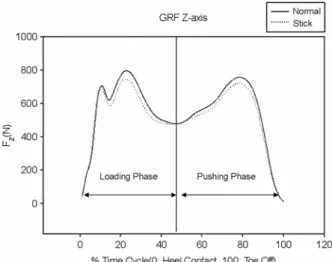
Integrated areas under ground reaction forces(Fx and Fz), and integrated areas under joint moments at ankle, knee, and hip between normal walking and stick walking were compared. In addition, peak ground reaction forces (Fx and Fz) and peak joint moments at ankle, knee, and hip were compared(Appendix A). Since the vertical for- ces during gait presents information in regard to weight bearing(Chen et al., 2001), vertical ground reaction for- ces were divided into two phases and analyzed separa- tely. The 1st phase was called loading phase and 2nd phase was called pushing phase(Figure 1).
Peak joints moments, ground reaction forces, and moment areas during loading phase were studied in each phase in order to reach significant conclusions.
Paired t-tests were used to evaluate differences in ground reaction forces and joint moments between two types of walking(normal walking vs. stick walking).
2.5 Data Calculation 2.5.1 Joint Moments
Segment weights
Segment weights were estimated from the cumulative data(Chaffin et al., 1999). Estimation was carried out in following ways.
1) Estimate %ile from each participant's body weight
(0.05) Xm X0.05
Z σ
= − (1.1)
(0.95) X0.95 Xm
Z σ
= −
(1.2) where Xm is mean value, σ is standard deviation, X0.05 is the value of 0.05%iles, X0.95 is the value of 0.95%iles, and Z(%ile) is normalized standard distribution function.
Based on Xm and σ, we can estimate each partici- pant's %iles by the equation(1.3).
(% ) XP Xm
Z ile σ
= − (1.3)
where Xp is participant's weight.
2) Estimate segment weights based on %ile.
Based on the equation(1.1) and (1.2) we can also estimate mean weight and standard deviation of each segment, Xp,i. Estimation was carried out by the equation (1.4).
( )
, %
p i m
X =X + ×σ Z ile (1.4)
Center of Mass(COM)
Each COM was calculated from each marker's position.
The approximate ratio was estimated from Dempster's study(1955).
i i i i1
i i
a X b X
X a b
+ +
= + (1.5)
1
i i i i
i i
a Z b Z
Z a b
+ +
= + (1.6)
where X is horizontal COM position, Z is vertical COM position, ai is ratio from i +1, bi is ratio from i, and i is each marker position.
Center of Pressure(COP)
COP position was estimated from the assumption in which COP would be constantly transferred from a heel to a toe along with floor. Heel position was estimated by using the assumed geometrical relation from lateral malleolus and toe positions. The distances from an ankle to a heel(D) was assumed to be constant and calculated from mid-swing point which represent the zero value in GRFx because that point refers to similar Z-position of a toe with that of a heel. Each X-position of a heel was obtained from equation(1.8) and Z-position of heel was assumed to be zero.
⎟⎟⎠
⎜⎜ ⎞
⎝
⎛
−
= − −
ANKLE TOE
ANKLE TOE
Z Z
X
1 X
α tan (1.7)
Figure 1. Ground reaction force Z; comparisons between normal walking and stick walking.
Copyright (C) 2006 NuriMedia Co., Ltd.
α sin D
XHEEL = (1.8) COP calculation was carried out from the equations (1.9) and (1.10).
B A
BX COPX AXTOE HEEL
+
= +
(1.9)
=0
COPZ (1.10) where A is a data sampling number, B is a remaining sampling number which is subtracted A from total sam- pling number from heel contact to toe-off. Thus, we assumed a COP position would change in linear trans- formation.
Free Body Diagram(FBD)
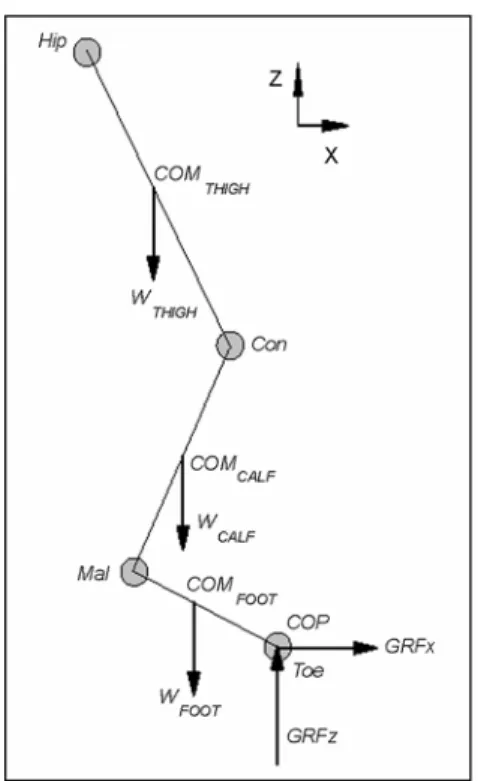
2D static model was assumed on the sagittal plane.
Figure 2 shows FBD of a right lower limb. The COP position was not fixed, but other COM positions were fixed on the each segment. GRFs were used from a force plate and each segment weight was calculated in the section 1.2.
Ankle joint moment
MANKLS = L1 × GRFZ + L2 × WFOOT + R1 × GRF X
(1.11)
where L1 is a disposition vector from the ankle to COP, L2 is a disposition vector from the ankle to COM of the foot, and R1 is a disposition vector from the ankle to COP.
Knee joint Moment
MKNEE = L3 × GRFZ + L4 × WFOOT + L5 × WCALF + R2
× GRF X (1.12)
where L3 is a disposition vector from the knee to COP, L4 is a disposition vector from the knee to COM of the foot, L5 is a disposition vector from the knee to COM of the calf and R2 is a disposition vector from the knee to COP.
Hip joint Moment
MHIP = L6 × GRFZ + L7 × WFOOT + L8 × WCALF + L9 ×
WTHIGH + R3 × GRF X (1.13)
where L6 is a disposition vector from the hip to COP, L7
is a disposition vector from the hip to COM of the foot, L8 is disposition vector from the hip to COM of the calf, L9 is a disposition vector from the hip to COM of the thigh and R3 is a disposition vector from the knee to COP.
2.5.2 Peak Moments and Peak GRFs
Peak moments and peak GRFs are the peak values of each joint moment and each participant's GRF, respec- tively. To evaluate the effect of stick, the first half phase from heel contact to mid-swing and last half phase from mid-swing to toe-off were used.
2.5.3 Normalized Moments and Area-under-moments Normalized moments were calculated from the equa- tion(3.1). To evaluate the effect of stick, first half phase from heel contact to mid-swing and last half phase from mid-swing to toe-off were used.
n i
N P
f M
M W
= × (3.1)
where Mn is normalized moment, fn is normalizing factor which is the ratio of the total sampling number to the reference sampling number, Mi is each joint moment of participant, and Wp is weight of participant. Area-under- moments were calculated from the equation(3.2)
( )
∑=
∆
×
=
−
− NS
i
N t
M moments under
Area
1
(3.2) Figure 2. Free Body Diagram of Lower Extremity.
Copyright (C) 2006 NuriMedia Co., Ltd.
where Ns is total sampling number of each participant, i is sampling number, Δt is time interval between two samples.
2.5.4 Normalized GRFs and Area-under-GRFs Normalized GRFs were calculated from the equation (4.1).
Z n
N f GRF
GRF = × (4.1) where GRFN is normalized GRF, fn is normalizing factor which is the ratio of the total sampling number to the reference sampling number, and GRFZ is each vertical GRF of participant. Area-under-GRFs were calculated from the equation(3.2) by putting GRFN instead of MN.
2.6 Variables
2.6.1 Independent variables-stick and normal walking These two variables are being compared to figure out which technique reduces joint moments and loads.
Decision of Heel Contact and Toe-off
Heel contact and toe-off frames are usually deter- mined by vertical directional GRF. One method is to set the start point of sharp increase to heel contact and the end point of sharp decrease to toe-off, around zero (Cham and Redfern, 2002). Another method is to decide frames based on reference force(Lockhart et al., 2002).
In this report, 7N was the criterion of heel contact and toe-off.
Area under GRF Z(AGZ) during loading phase Areas under GRF Z(A in Figure 3) during normal walking and stick walking were calculated and compared to find out information in regard to weight bearing characteristics. Each GRF data was time- and weight- normalized and integrated with time(Moisio et al., 2003).
Peak Moments at Ankle(PAM), Knee(PKM), and Hip (PHM) during loading phase
Peak moments between normal walking and stick walking were compared to evaluate if sticks played a role in reducing peak joint loadings.
Area under Ankle(AAM), Knee(AKM), and Hip(AHM) Moments during loading phase
Area under moments(B, C, and D in Figure 3) between
normal walking and stick walking were compared to evaluate if overall joint loadings during stick walking were reduced in comparison to normal walking. Each moment was time- and weight- normalized and in- tegrated with time as similar as AGZ.
2.6.2 Control Variables Stick Grabbing Position
The investigators instructed each participant to hold the sticks at waist height during the entire stick walking procedure. In addition, the subjects were instructed to Figure 3. Joint moments at ankle, knee, and hip; comparisons
between normal and stick walking.
Copyright (C) 2006 NuriMedia Co., Ltd.
initially start holding the sticks at a 90 degree angle position, resulting in a right angle between the forearm and upper arm. The investigators specifically instructed the subjects to maintain these positions during the entire procedure over the track when performing each type of walking.
Stick Walking Pattern and Speed
The pattern of each individual's gait was monitored during trials before data collection. This specific pattern is that the individual needed to alternate the stick pro- pulsion with the opposite leg. For example, if the in- dividual was using their right stick to contact the ground, the opposite leg, or left leg, was used at the same time to contact the ground. This alternative pattern was required to be maintained throughout each stick walking trial.
The second part of stick walking pattern control variable is that each individual should start with the same foot and also walk according to tempo controlled by the me- tronome.
2.6.3 Random Variables
- Participant characteristics: Age, Gender, and Weight of each participant could not be controlled.
- Fatigue: This variable is difficult to assess for each participant during the day of experimentation be- cause activities and personal physical characteri- stics were not monitored.
- Level of physical fitness: The participants were not monitored with their daily activities; therefore, it is impossible to determine this variable.
2.6.4 Confounding Variables Stick Supporting Time
The time from the contact of the stick on the floor until the stick is lifted could not be measured and is variable depending on each participant's gait trend.
Stick Forces
The vertical force on the sticks to the floor exerted by each participant was not assessed.
Experience
The background of each subject, in terms of related activities to the techniques of stick walking, was unknown to the investigators.
3. RESULTS
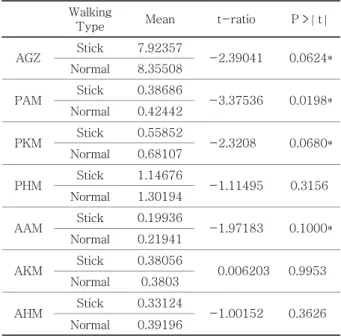
During the loading phase, at the Peak Moment, repre- sented in Table 1, a significant reduction could be no- ticed for the ankle joint(p=0.0198) and the knee joint (p=0.0680) when comparing normal walking to stick walking. Also, significant decreases were seen at AAM (p=0.1000) and AGZ(p=0.0624).
During pushing phase, no significant reduction took place for the Peak Moment for any joints during normal walking vs. stick walking. The same happened for the moment area for each joint or the ground reaction forces.
For instance, the peak moments at the ankle were 1.272 Nm/kg for normal walking and 1.318Nm/kg for stick walking. In addition, the moment area at that same joint is 0.778Nmsec/kg during normal walking and 0.783 Nmse/ kg during stick walking. Moreover, the average GRF for all participants are 7.406 for normal walking and 7.361 for stick walking.
Table 1. Means, t-ratio, and p-value for loading phase. (Area under Ground Reaction Force Z during Loading(AGZ), Peak
Ankle Moment during Loading(PAM), Peak Knee Moment during Loading(PKM), Peak Hip Moment during Loading Phase (PHM), Area under Ankle Moment during Loading Phase(AAM), Area under Knee Moment during Loading Phase(AKM), Area
under Hip Moment during Loading Phase(AHM)) Walking
Type Mean t-ratio P > | t | Stick 7.92357
AGZ Normal 8.35508 -2.39041 0.0624*
Stick 0.38686
PAM Normal 0.42442 -3.37536 0.0198*
Stick 0.55852
PKM Normal 0.68107 -2.3208 0.0680*
Stick 1.14676
PHM Normal 1.30194 -1.11495 0.3156
Stick 0.19936
AAM Normal 0.21941 -1.97183 0.1000*
Stick 0.38056
AKM Normal 0.3803 0.006203 0.9953
Stick 0.33124
AHM Normal 0.39196 -1.00152 0.3626
(* Significant if p<0.1)
Copyright (C) 2006 NuriMedia Co., Ltd.
The three graphs in Figure 4 show the mean value, depicted by the shaded column as well as bars to show the standard deviation of each value. The Area under Ground Reaction Forces graph demonstrates clearly that stick walking exhibits less ground reaction forces compared to normal walking. Likewise, the peak moments for the ankle, knee, and hip follow a J-distribution with normal walking significantly higher than stick walking.
The same pattern is seen for the Peak Moment graph and blablabla graph. Indeed, the mean value for each case is higher for normal walking compared to stick walking.
4. DISCUSSION
The objective of this study was to compare joint mo- ments and vertical ground reaction force during normal walking to that during stick walking, and to evaluate if joint loadings were reduced while walking with sticks in comparison to normal walking.
In agreement with the previous studies(Li et al., 2001), the general findings of this study indicated that there were reductions in vertical ground reaction forces and moments at the ankle and knee joints. On the other hand, hip moments were not influenced as much as ankle and knee by the sticks. Li et al.(2001) indicated that vertical ground reaction forces on the involved side, especially during loading phase, were decreased in comparison to normal walking.
This study also indicated that the reduction in forces and moments were mostly seen during the loading phase of step cycle. A previous evaluation(Chen et al. 2001) in canes walking showed that the triple and double support of sticks occupied most of the gait cycle while only 10% of gait cycle was supported by a single leg. In agreement with this study(Chen et al., 2001), in the present study, there was always one extra support(a stick) for each step, as participants walked with the sticks. As participants walked with aids(i.e. sticks), the forces acting on to support the body weight were di- stributed over each support including a stick. In the present study, this force distribution was especially seen during loading phase in agreement with Li et al.(2001).
The heel contact during loading phase seemed to be the crucial element in the reduction of joint moments. In the present study, in loading phase, all participants placed the stick on the floor in order to give support. However, during pushing phase, which consisted of "push-off" or
"lifting-up" of legs, participants actively pushed off their body weight in the forward direction while the suppor- ting stick were just lifted up in the air to prepare for a next movement. This might be an important indication for why there was no reduction in ground reaction forces and joint moments during pushing phase.
On the other hand, one could also infer that some of the limitations discussed next could also have affected the results and if more subjects - intensively trained with proper techniques - had participated to the study, Figure 4. Graphical representation of statistic in area under GRF
Z-axis, area under joint moments, and peak joint moments.
Copyright (C) 2006 NuriMedia Co., Ltd.
the reduction in forces and moments would have in- dicated some other significant finding not only in loading phase but also in pushing phase. Indeed, Nordic Walking should be practiced for relatively long periods, i.e. bet- ween half an hour and two hours at a time.
There were other some limitations to our study. First, because of budget and time constraints, only 6 partici- pants could be recruited. Also, the Stick Forces and Stick Supporting Time varied between participants, as men- tioned previously, and could have affected the results as well. Moreover, the segment weight dimensions were based on the percentage of link length estimate, which were taken from previous studies. The COM estimation was based on Dempster study, which is usually gene- rally accepted. Another limitation is the assumption about the COP. Indeed, it was assumed to be linear in the x-direction and null in the z-direction. Finally, the model used was 2-dimensional and static, which is generally accepted.
In conclusion, this study showed that the techniques of stick walking were beneficial. This study not only showed that walking with stick did not aggravate joints and knees as much as normal walking, but also located the stages where the reduction in forces and moments was significant. Overall, the techniques of stick walking will be beneficial to elder generation, who wishes to exercise more while minimizing the damages on their joints.
REFERENCES
Allan, C. Gelber, Obesity and hip osteoarthritis: the weight of the evidence is increasing. Am J Med, 114, 158-159, 2003.
Bergmann, G., Deuretzbacher, G., Heller, M., Graichen, F., Rohlmann, A., Strauss, J. and Duda, G. N., Hip contact forces and gait patterns from routine activities, Journal of Biomechanics, 34(7), 859-871, 2001.
Bestall, J., Paul, E., Garrod, R., Garnham, R., Jones, P. and Wedzicha, J., Longitudinal trends in exercise capacity and health status after pul- monary rehabilitation in patients with COPD, Respiratory Medicine, 97, 173-180, 2003
Chen, C., Chen, H., Wong, M., Tang, F. and Chen, R., Temporal stride and force analysis of cane-assisted gait in people with hemiplegic stroke.
Arch Phys Med Rehabil, 82, 43-47, 2001.
Foss, M. and Byers, P. D., Bone density, osteoarthritis of the hip, and fracture of the upper end of the femur. Ann Rheum Dis, 31, 259, 1972.
Hurley, B. and Hagberg, J., Optimizing health in older persons: aerobic or strength training? Exerc Sport Sco Rev, 26, 61-89, 1998.
Jennifer M. Hootman, Carol A. Macera, Charles G. Helmick and Steven N., Blair, Influence of physical activity-related joint stress on the risk of self-reported hip/knee osteoarthritis: a new method to quantify physical activity?, Preventive Medicine, 36(5), 636-644, 2003.
Jill, L., Carrington, Aging bone and cartilage: cross-cutting issues, Bioche- mical and Biophysical Research Communications, 328(3), 700-708, 2005.
Li, S., Armstrong, C. and Cipriani, D., Three-point gait crutch walking:
Variability in ground reaction force during weight bearing. Arch Phys Med Rehabil, 82, 86-92, 2001.
Moisio, K. C., Sumner, D. R., Shott S. and Hurwitz, D. E., Normalization of joint moments during gait: A comparison of two techniques, J.
Biomechanics, 36, 599-603, 2003.
Morrison, J. B, The mechanics of the knee joint in relation to normal walking. J. Biomech, 2, 51-61, 1970.
Mulley, G. P., Walking sticks. Br. Med. J, 296, 475-476, 1988.
Murray, M. P. et al., A survey of the time, magnitude and orientation of forces applied to walking sticks by disabled men. Am. J. Phys. Med, 48, 1-13, 1969.
Neumann, D. A., Hip abductor muscle activity as subjects with hip prostheses walk with different methods of using a cane. Phys. Ther, 78, 490-501, 1998.
Rogers, L., Macera, C. A., Hootman, J. M., Ainsworth, B E. and Blair, S.
N., The association between joint stress from physical activity and self-reported osteoarthritis: an analysis of the Cooper Clinic data?, Osteoarthritis and Cartilage, 10(8), 617-622, 2002.
Schipplein, O. D. and Andriacchi, T. P., Interaction between active and passive knee stabilizers during level walking. J. Orthop. Res., 9, 113-119, 1991.
Toda, Y., Tsukimura, N. and Segal, N., An optimal duration of daily wear for an insole with subtalar strapping in patients with varus deformity osteoarthritis of the knee, Osteoarthritis and Cartilage, 13(4), 353- 360, 2005.
Van der Esch, M. et al., Factors contributing to possession and use of walking aids among persons with rheumatoid arthritis and osteo- arthritis. Arthritis Rheum, 49, 838-842, 2003.
◐ 저자 소개 ◑
김 석 원
현 재: Virginia Tech (Industrial and Systems Engineering) 박사과정 수료
관심분야: 인간작업능력의 측정과 평가, 작업환경 최적화, Slip and fall in aging
이 정 용
현 재: Virginia Tech (Industrial and Systems Engineering) 박사과정
관심분야: 작업현장에서의 허리, biomechanics
Copyright (C) 2006 NuriMedia Co., Ltd.
박 성 하
Texas Tech University 박사
현 재: 한남대학교 산업경영공학과 부교수로 재직중.
관심분야: 인체역학, 안전공학
논 문 접 수 일 (Date Received) : 2005년 09월 21일 논문게재승인일 (Date Accepted) : 2005년 11월 28일
박 기 원
현 재: Virginia Tech (Industrial and Systems Engineering) 석사과정
관심분야: Human modeling
윤 훈 용
Texas Tech University 박사
현 재: 동아대학교 산업경영공학과 부교수
관심분야: 근골격질환, MMH, Slip and fall in aging, 제품설계
Copyright (C) 2006 NuriMedia Co., Ltd.