Print ISSN: 2288-4637 / Online ISSN 2288-4645 doi:10.13106/jafeb.2021.vol8.no5.0189
Innovation Capacity of Student: A Case Study in Vietnam
Anh Duc DO
1, Nguyen Nguyen Thao PHAM
2, Thi Minh Phuong NGUYEN
3, Van Son TU
4, Cam Nhung NGUYEN
5, Hai Duong NGUYEN
6Received: January 15, 2021 Revised: March 21, 2021 Accepted: April 01, 2021
Abstract
This study aimed to explore the factors affecting the innovation capacity of students at the National Economics University, Vietnam.
Researchers used the innovation capacity model based on six factors, including personality traits, future orientation, creative skills, social interaction, content knowledge, and management skills. The empirical analysis used data from the survey of 303 students at National Economics University, Vietnam, with reliable tools (SPSS 26.0 software). The data were analyzed by testing the reliability of the scales, correlation analysis, and Pearson’ Linear Correlation Coefficient, exploratory factor analysis, as well as regression model based on the survey data. The research results identified the following factors affecting innovation capacity of students: management skills, social interaction, and personality traits have the strongest impact on innovation capacity of students; content knowledge has the following strongest effects on innovation capacity of students; and finally the creative skills that affects on innovation capacity of students. There is also a positive relationship between all the factors and innovation capacity of students. The result can serve as useful reference sources for scholars who are interested in the innovation field. It also helps university’s managers and policymakers build the appropriate environment to improve innovation capacity of students.
Keywords: Innovation, Innovation Capacity, Exploratory Factor Analysis, Vietnam JEL Classification Code: O30, O31, O35, O36
commercial perspective) plays an important role in the development of country and enterprises, which is the motivation for the economic progress and competitiveness of all countries. Do (2020) also confirms the role of innovation in promoting the development of enterprises and the economy in the context of industry 4.0. In the context of labor productivity in industries that have made great leaps due to the application of modern technologies, the workforce, including technical workers and office workers, is gradually replaced by machines, so each individual or organization desperately needs to be innovative to catch up with the world’s trend, avoiding backwardness and being able to create momentum in the future.
According to the SWOT analysis, considering Vietnam’s digital background, one of the remaining weaknesses is
“lack of innovation and monitoring of digital use” and the object of innovations includes universities, innovation hub, start-ups, and individuals (Cameron et al., 2019). Since each individual is a cell of society, measuring the capacity of innovation at individual level is essential, which not only determines the reality of the level of innovation, but also helps find advanced solutions to improve each individual’s
1
First Author. School of Trade and International Economics, National Economics University, Vietnam. Email: [email protected]
2
School of Trade and International Economics, National Economics University, Vietnam. Email: [email protected]
3
School of Trade and International Economics, National Economics University, Vietnam. Email: [email protected]
4
School of Trade and International Economics, National Economics University, Vietnam. Email: [email protected]
5
Corresponding Author. School of Business and Management, RMIT University, Vietnam [Postal Address: 521 Kim Ma Road, Ngoc Khanh Ward, Ba Dinh District, Hanoi, 11109, Vietnam]
Email: [email protected]
6
Faculty of Mathematical Economics, National Economics University, Vietnam. Email: [email protected]
© Copyright: The Author(s)
This is an Open Access article distributed under the terms of the Creative Commons Attribution Non-Commercial License (https://creativecommons.org/licenses/by-nc/4.0/) which permits unrestricted non-commercial use, distribution, and reproduction in any medium, provided the original work is properly cited.
1. Introduction
Gagulina et al. (2020) believe that innovation brings a
positive and sustainable development in the long term. In
addition, innovation (from both a commercial and non-
innovative ability, therefore positively impacting the innovation of organizations, enterprises, and the country at all levels.
Students are motivated by creativity in education to discover, study and use all the resources to uncover something different. In practice, it requires a new way of looking at and addressing problems. The thinking process that goes into it will help students grow their imagination and their ability to solve problems (Northwest Missouri State University, 2018). Consequently, educational outcomes can be enhanced further, creating new opportunities by themselves (Redding, Twyman, & Murphy, 2013). Otherwise, Reiss Medwed claimed that students have to keep up with the industry development, as digital transformation is progressive day- by-day. She also suggested three crucial stages of educational innovation, including: identify current issues, make small- scale changes, and seek for new knowledge and support (Difranza, 2019). As a result, innovation can strengthen education because students are required to broaden their awareness to solve problems (Northwest Missouri State University, 2018).
This study built a model of factors affecting the innovation capacity of students and conducted an empirical analysis at National Economics University, Vietnam, to assess the impact level of these factors. Based on the results of the study, appropriate policies are developed that will contribute to improving the innovation capacity of students at National Economics University, Vietnam.
2. Literature Review
Many studies have clarified the concepts of competence and innovation in many aspects. The Organization for Economic Co-operation and Development (OECD, 2002) defined competency as the individual’s ability to respond to complex requirements and to successfully perform tasks in a particular context. More specifically, Barnett (1992) considers competence as a set of knowledge, skills and attitudes consistent with a practical activity; Weiner (2001) mentioned that competencies are the skills and techniques that are available or formed during training to deal with specific situations, as well as social willingness and ability to apply flexibly in those situations. Thus, it can be understood that competency is the ability to be formed, develop from existing quality, learning and practice, to meet specific requirements and objectives, to emphasize the suitability and specificity of capacity, that capacity needs to be revealed in specific circumstances and appropriate to that situation.
Previous studies have mentioned innovation from three angles. From a national and economic perspective, Schumpeter believes that innovation is a cross between invention and invention to create value for the socio-economy, innovation is one of the factors affecting the economy due
to technological changes as well as the new combination of existing production forces to solve the problems of business (Kogabayev & Maziliauskas, 2017). Urabe (1988) pointed out
“Innovation includes creating a new idea and implementing it into a new product, process or service, leading to the dynamic growth of the national economy and increasing employment as well as creating pure profits for innovative businesses”. From an enterprise perspective, innovation is the use of new knowledge to create a new service or product that customers desire; innovation including invention and commercialization. Similarly, Fagerberg (2004) argued that innovation was the first commercialization of the idea. When analyzing the origins of innovation in the business, Drucker (1998) pointed out that the innovation achieved is rooted in a purposeful search for innovation opportunities. From a personal perspective, West and Farr (1990) distinguished the difference between innovation and creativity: creativity is considered as an element of ideas, a stage of creating new ideas, the first step of the innovation process; innovation includes both the composition of ideas and the operational component of applying new ideas to practice. In general, no matter what angle, innovation is seen in two processes:
creating new value and applying that new value to practice.
Some people are good at creating ideas and giving rise to ideas, but are very weak at realizing them. Others are proactive and entrepreneur, but lack creativity. Innovation is the intertwining of creativity and entrepreneurial spirit (Cerinsek, 2009). This researcher agrees with Cerinsek that innovation capacity is an individual’s ability to act and react creatively to deal with various critical incidents, problems or tasks that require innovative thinking and responses and can occur in a given context. Therefore, it has become a core capacity of a general nature and will be integrated in daily practice (Bozic, 2017).
The creative capacity assessment models of businesses include the diamond model developed by Tidd, Bessant, and Pavit that includes five aspects – strategy, process, organization, association, and learning (Tidd et al., 2006).
The framework of the OSLO Handbook, evaluated by the OECD and the Council of Europe, classifies the different forms of innovation into four categories – product/service innovation, process innovation, organizational innovation, and marketing innovation. The innovation value chain model by Hansen and Birkinshaw (2007) emphasizes the innovation results.
Research on innovation capacity models in recent years
have also mentioned the level of innovation capacity of each
individual. A study by Pérez-Peñalver et al. (2018) showed
that the pentagram corresponds to five energy factors related
to the behavior of innovation: creativity, critical thinking,
autonomy, teamwork, and networking. Another study on
student’s innovative ability in the learning environment
by Matejun (2017) has identified three groups of factors:
cognitive, emotional and social. The Cerinsek model (2009) evaluated nine factors affecting the creative capacity of employees in an organization, including creativity, confidence, entrepreneurship, ambition, motivation, autonomy, flexibility, ability to observe, and curiosity. The model proposed by Bozic (2017) studies the innovative aspects: the inner dimension, the content dimension, and the interpersonal dimension.
Personality Traits:
Individual personalities have a significant impact on innovation capacity (Cerinsek & Dolinsek, 2009; Silva &
Davis, 2011; Bozic, 2017; Voo et al., 2019). Personality is defined as the fundamental factor related to effective performance at work and influencing the creative behavior of individuals (Chatenier et al., 2010). Bozic (2017) collects personal traits (such as the intrinsic dimension of the capacity to innovate) including self-control, intrinsic motivation, openness, flexibility, curiosity, self-confidence, trust, resilience, intuition, risk-taking, and achievement needs; Rasmussen (2009) argued that there are some important characteristics of the capacity to innovate such as “the ability to transfer and combine knowledge, the ability to autonomy in society and spirit, ability to focus effort and understand thoroughly in the area of knowledge in question”; Güse et al. (2011) classified personalities as a higher category including flexibility, motivation and participation, achievement orientation, self-esteem, and self- management. In the framework of the research and based on the authors’ assessment, we decided to collect a number of important personalities that influence the ability to innovate, including: flexibility, self-awareness, curiosity and self-control.
Future Orientation:
Many researchers affirm the importance of future orien- tation to human behavior and development. Psychologically, Lewin (1942) defined “future orientation” as the picture of what really happened afterwards. These situations greatly affect upcoming behaviors and attitudes, whether it is true or not. On the other hand, scientifically speaking, the term
“future-oriented” is used to describe someone’s image of “future-related issues as a temporary extension” (Seginer, 2009). According to Michelini (2012), future orientation refers to “future thinking” and “insight at new opportunities”.
Creative Skills:
Creativity is defined as the ability to think about pre- existing ideas, rules, patterns, or relationships (Marin- Garcia, 2016). Creative thinking skills also involve creating or adapting meaningful alternatives, ideas, products, methods, or services regardless of the practicality and potential added value in future (Pérez-Peñalver et al., 2018). The definition of creativity also includes an essential
requirement that the idea or product can be used (Kalyar, 2011). Previous research (Cerinsek & Dolinsek, 2009) showed that the tool for measuring the capacity to innovate is acceptable and can be used to determine the capacity of employees to innovate through nine competencies, including creativity. Kalyar (2011) pointed out two factors affecting innovation capacity: Creativity and Self- Leadership in personal spheres and the scholar strongly believes that self-leadership alone is not enough to develop innovation. In 2012, Pratoom and Savatsomboon studied innovation from two perspectives, group and individual, and correlated factors with others.
Social Interaction:
Social interaction, including collaboration skills, networking skills and communication skills, are considered core factors that influence innovation improvement. First, collaboration skills demonstrate the ability to work effectively with others, engage in teamwork tasks and demonstrate the role of a team member (Cobo, 2013). Moreover, at the multi-institution level, cooperation creates opportunities in technology trade, stimulates investment, and thereby, promotes economic growth in the region (M2 Presswire, 2015). For example, in the partnership between COMESA and Microsoft, this partnership is affirmed to develop local commerce, enhance Information and Communication Technology (ICT) expertise in the public sector, and promote the creation of urban areas for better delivery service (M2 Presswire, 2015). Second, connection skills, or the ability to create, maintain, and strengthen relationships, which have been suggested to influence educational outcomes (Werf &
Bosker, 2008). In the Benson and Morgan (2016) report on higher education, social skills can generate potential ideas by using interpersonal relationships to “facilitate resource mobilization.” Finally, communication skill refers to the exchange of information and ideas between colleagues (Cobo, 2013). Collecting and sharing ideas brings change to stimulate creative skills because it “breaks boundaries” and fosters the development of innovation (Blasini et al., 2013). Social skills can generate potential ideas by using interpersonal relationships to “facilitate resource mobilization”.
Content Knowledge:
Content knowledge refers to a person’s domain or
specialty proficiency and knowledge of other disciplines or
disciplines (Ball, Thames, & Phelps, 2008). Shulman (1986)
pointed out that subject knowledge which goes beyond facts
and concepts, requires organizing and presenting them. In
Shulman’s (1986) Content of pedagogical knowledge, the
framework is based on two types of knowledge: intensive
content – ‘deep’ knowledge of the subject itself, and
knowledge of curriculum construction. According to Suh
and Park (2017), in-depth knowledge plays an important role
in innovation capacity.
Management Skills:
Management is the implementation of knowledge, skills, techniques and tools to achieve a project’s goals (Richman, 2012). Zaman and Nadeem (2020) conclude that project management, including CEO transformational leadership;
project management best practices; and project management technology metrics, impact innovation success. Management skills are identified as planning skills, decision-making skills, organizational skills, work execution and coordination skills, leadership skills and teamwork skills (Shariff et al., 2013). Besides, management skills, along with technology skills, tend to be more and more important in the digital and/
or technological aspects (Kinkus, 2007).
Considering the findings of previous studies, this research has come up with the following hypotheses:
H1: Personality traits will positively affect the innovation capacity of student.
H2: Future orientation will positively affect the innovation capacity of student.
H3: Creative skills will positively affect the innovation capacity of student.
H4: Social interaction will positively affect the innovation capacity of student.
H5: Content knowledge will positively affect the innovation capacity of student.
H6: Management skills will positively affect the innovative capacity of student.
3. Research Methods and Materials
Based on the aforementioned discussion, this study will examine the linkage between these above factors and
innovation capacity of student. The theoretical framework is proposed in Figure 1:
This study reviews scholars’ literature based on the research of innovation capacity – the appropriate measurement scales of Di Fabio (2012); Cerinsek and Dolinsek (2009); Pérez-Peñalver et al. (2014); Cerinsek and Dolinsek (2009); Montero-Fleta (2018); Riggio (1986);
Hsieh (2012); Barfield (2016); Bjornali and Støren (2012);
Jack et al (2014); Belzer (2001); Richman (2011); Pérez- Luño et al (2011); Goh (2005); Gurteen (1998); Nakano and Wechsler (2018), and information gathered from expert interviews (see Table 1).
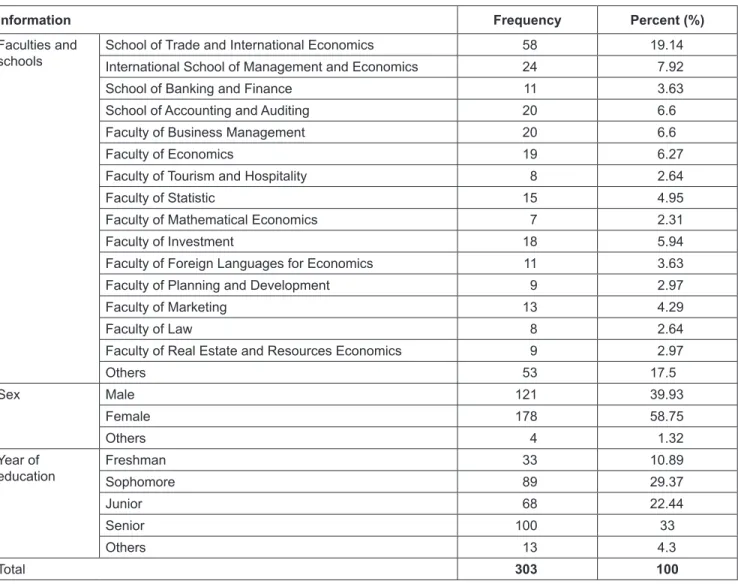
We have chosen the form of interview as a method to collect data. Our goal is to collect 350 samples of survey questions from different faculties and schools at National Economics University. This study used a survey questionnaire to elicit perceptions/opinions about innovation capacity of students. The survey instrument included questions seeking demographic information (see Table 2). SPSS 26.0 and PLS- SEM 3.0 software were applied to analyze and verify the gathered data, and the hypothesis developed. We obtained 326 responses, of which 23 were not suitable (lack of information); finally, there were 303 valid samples, which were analyzed.
4. Results
4.1. Testing the Reliability of Scales
This study uses Cronbach’s Alpha (CA) analysis to determine the reliability of the valid variables for the scales (including personality traits, future orientation, creative skills, social interaction, content knowledge, and management
Figure 1: The Proposed Theoretical Framework H1
H2 H3 Personality traits
Future orientation
Innovation capacity of student Creative skills
Social interaction
Content knowledge Management skills
H4
H5
H6
Table 1: Factors and Items
Factors Items Code Source
Personality traits
(PT) Self-evaluate of the importance of personality traits
affecting innovation capacity PT1 Di Fabio (2012); Cerinsek
and Dolinsek (2009)
Curiosity PT2
Self-discipline PT3
Initiative PT4
Ambition PT5
Future orientation
(FO) Future thinking FO1 Montani, Odoardi and
Battistelli (2014) Being sensitive to new opportunities in the context of digital
economy FO2
Future vision FO3
Risk-taking FO4
Creative skills
(CS) Analyzing capacity CS1 Cerinsek and Dolinsek
(2009); Pérez-Peñalver et al.
(2018)
Multidimensional thinking CS2
Create new steps to change workflow CS3
Experiment new ways of learning and doing things done CS4 Self-evaluate of the importance of creative competence
affecting innovation capacity CS5
Social interaction
(SI) Collaboration skill SI1 Riggio (1986);
Hsieh (2012); Barfield (2016)
Communication skills SI2
Networking skills SI3
Social context astuteness and sensitivity SI4 Content
knowledge (CK)
Mastery of one’s own field or discipline CK1 Bjornali and Støren (2012);
Jack et al (2014)
Skills in making (know-how) CK2
Understanding the components of digital economy CK3 Ability to use computers and the internet CK4
Ability to classify information CK5
Management skills (MS)
Planning skills MS1 Belzer (2001);
Richman (2011)
Project management skills MS2
Leadership skills MS3
Ability to control progress MS4
Innovation capacity (IC)
Love of innovation IC1 Pérez-Luño et al (2011);
Goh (2005); Gurteen (1998);
Nakano and Wechsler (2018)
Knowledge to innovation IC2
Ability to apply knowledge related to innovation IC3
Skills to apply innovation results IC4
Experience innovation in practice IC5
skills) as well as innovation capacity. Cronbach’s Alpha of all variables after extracting unsatisfactory items and exploratory factor analysis (EFA) were described in Table 3.
The generally agreed lower limit for Cronbach’s Alpha is 0.70 (Hair, 2009). Also, the value of the factor loading
measured from latent variables via each observed variable (item) and reliability coefficient.
Exploratory factor analysis (EFA) with Principal Axis Factoring (Promax) showed that KMO = 0.883 <
1.0, Sig. of Bartlett’s Test of Sphericity = 0.000 < 0.005;
Table 2: Demographic Information
Information Frequency Percent (%)
Faculties and
schools School of Trade and International Economics 58 19.14
International School of Management and Economics 24 7.92
School of Banking and Finance 11 3.63
School of Accounting and Auditing 20 6.6
Faculty of Business Management 20 6.6
Faculty of Economics 19 6.27
Faculty of Tourism and Hospitality 8 2.64
Faculty of Statistic 15 4.95
Faculty of Mathematical Economics 7 2.31
Faculty of Investment 18 5.94
Faculty of Foreign Languages for Economics 11 3.63
Faculty of Planning and Development 9 2.97
Faculty of Marketing 13 4.29
Faculty of Law 8 2.64
Faculty of Real Estate and Resources Economics 9 2.97
Others 53 17.5
Sex Male 121 39.93
Female 178 58.75
Others 4 1.32
Year of
education Freshman 33 10.89
Sophomore 89 29.37
Junior 68 22.44
Senior 100 33
Others 13 4.3
Total 303 100
Thus, the sample size of the survey is eligible to conduct EFA. Bartlett’s Test of Sphericity value is significant with P-value = 0.00. This value indicates that the observed variables are correlated with respect to the total number of observations.
Cumulative (%) = 71.925 > 50% and Initial Eigenvalues
= 1.206. All observed variables in Table 3 have Factor Loading is larger than 0.5. Thus, the validity and reliability of all variables after extracting inappropriate observed variables were confirmed.
4.2. Correlation Analysis
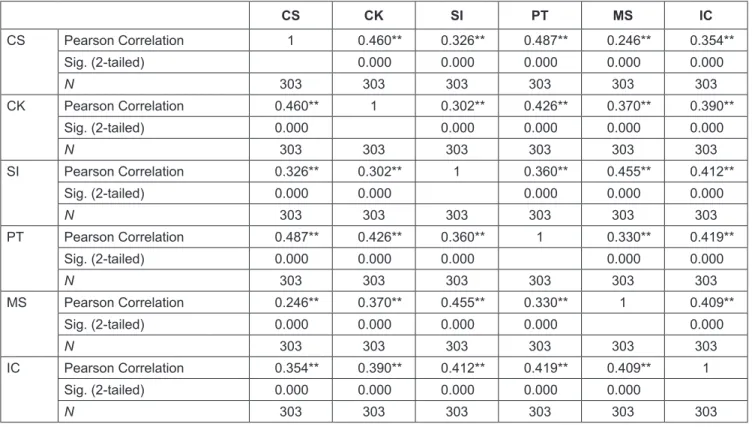
Table 4 shows a linear correlation between the independent and dependent variables because the value of P-value is less than 5%. In addition, the Pearson coefficient
between these variables is positive, indicating a positive relationship. This means that the increase in the value of the independent variables increases the value of the dependent variables.
4.3. Regression Analysis
Based on the result shown in Table 6, the study analyzes the impact of independent variables CS, CK, SI, PT, and MS on the dependent variable IC. The results of multiple regression analysis using the least squares method in Tables 5 and 6 show that there are five factors affecting the dependent variable IC.
The value of adjusted R Square is = 0.32, indicating that
the independent variables CS, CK, SI, PT, and MS explained
32% of the variation of the dependent variable IC. The VIF
Table 3: Cronbach’s Alpha and Exploratory Factor Analysis after Extracting Unsatisfactory Items
Item Factor
IC PT CS SI CK MS
Cronbach’s Alpha 0.927 0.718 0.956 0.884 0.931 0.757
IC4 0.888
IC3 0.874
IC2 0.849
IC5 0.848
IC1 0.672
CS2 0.905
CS1 0.890
CS4 0.874
PT1 0.709
PT5 0.683
PT3 0.676
PT4 0.663
PT2 0.650
CK3 0.894
CK2 0.865
CK1 0.816
MS2 0.748
MS4 0.741
MS1 0.707
MS3 0.642
SI2 0.840
SI3 0.838
SI1 0.816
KMO (Kaiser-Meyer-Olkin) 0.883
Sig. (Bartlett’s Test) 0.000
Cumulative (%) 71.925
Initial Eigenvalues 1.206
Note: N = 303; PT: Personality Traits; FO: Future Orientation; CS: Creative Skills; SI: Social Interaction; CK: Content Knowledge;
MS: Management Skills; IC: Innovation Capacity.
values of all independent variables are less than 10 and Durbin-Watson is 1.833. The results show that the model does not have multi-collinearity and there is no superlative autocorrelation between adjacent errors. The regression model reflects the impact of the independent variables on the dependent variable IC is:
IC = 0.658 + 0.0091 * CS + 0.143 * CK + 0.187 * SI + 0.185 * PT + 0.188 * MS
5. Conclusion
This research developed a conceptual framework for innovation capacity of students with six factors, including personality traits, future orientation, creative skills, social interaction, content knowledge, and management skills.
Based on the developed model, this study sought to examine
and analyze the impact of all factors on innovation capacity
of students at National Economics University by exploratory
Table 4: Correlations Between Independent Variable and Dependent Variables
CS CK SI PT MS IC
CS Pearson Correlation 1 0.460** 0.326** 0.487** 0.246** 0.354**
Sig. (2-tailed) 0.000 0.000 0.000 0.000 0.000
N 303 303 303 303 303 303
CK Pearson Correlation 0.460** 1 0.302** 0.426** 0.370** 0.390**
Sig. (2-tailed) 0.000 0.000 0.000 0.000 0.000
N 303 303 303 303 303 303
SI Pearson Correlation 0.326** 0.302** 1 0.360** 0.455** 0.412**
Sig. (2-tailed) 0.000 0.000 0.000 0.000 0.000
N 303 303 303 303 303 303
PT Pearson Correlation 0.487** 0.426** 0.360** 1 0.330** 0.419**
Sig. (2-tailed) 0.000 0.000 0.000 0.000 0.000
N 303 303 303 303 303 303
MS Pearson Correlation 0.246** 0.370** 0.455** 0.330** 1 0.409**
Sig. (2-tailed) 0.000 0.000 0.000 0.000 0.000
N 303 303 303 303 303 303
IC Pearson Correlation 0.354** 0.390** 0.412** 0.419** 0.409** 1
Sig. (2-tailed) 0.000 0.000 0.000 0.000 0.000
N 303 303 303 303 303 303
Note: N = 303; PT: Personality Traits; CS: Creative Skills; SI: Social Interaction; CK: Content Knowledge; MS: Management Skills;
IC: Innovation Capacity.
Table 5: Model Summary
Model R R Square Adjusted R Square Std. Error of the Estimate Durbin-Watson
1 0.565
a0.320 0.308 0.65352 1.833
a
Significant at the 0.05 Level.
Table 6: Coefficients
aModel
Unstandardized
Coefficients Standardized
Coefficients t Sig. Collinearity Statistics
B Std. Error Beta Tolerance VIF
1 (Constant) 0.658 0.284 2.314 0.021
CS 0.086 0.055 0.091 1.562 0.119 0.671 1.490
CK 0.135 0.055 0.143 2.480 0.014 0.688 1.453
SI 0.198 0.059 0.187 3.330 0.001 0.724 1.382
PT 0.213 0.067 0.185 3.159 0.002 0.671 1.490
MS 0.239 0.071 0.188 3.337 0.001 0.723 1.383
a