Vol. 25, No. 2, pp. 201-211, April 30, 2019, ISSN 1229-3431(Print) / ISSN 2287-3341(Online) https://doi.org/10.7837/kosomes.2019.25.2.201
1)
1. Introduction
The terrorist attacks by the Islamic terrorist group Al-Qaeda on the twin towers in New York City on September 11, 2001 is an event that had significant political, social, and economic
* First Author : [email protected], 051-410-4381
†Corresponding Author : [email protected], 051-620-5086
repercussions worldwide. Transport and international trade were among the sectors most heavily affected by a perceived renewed need for international security measures aimed at protecting ports, ships and cargo. For example, the International Maritime Organization (IMO) adopted new codes aimed at enhancing security measures in the maritime industry in response to security threats since 2001. All of these requirements set by the
Maritime Security Training: Evaluation of the Impact on Seafarers’ Security Awareness and Security Performance
Enrico D’agostini
*․Sohyun Jo
**†* Graduate School of International Studies, Pusan National University, Busan 46241, Korea
** Korea Institute of Maritime and Fisheries Technology, 367 Haeyang-ro, Yeongdo-gu, Busan 49111, Korea
선박보안교육 : 선원의 보안인식과 보안성과에 미치는 영향 평가
D’agostini Enrico
*․조소현
**†* 부산대학교 국제전문대학원, ** 한국해양수산연수원
Abstract : Safety and security measures in the shipping industry play a pivotal role in ensuring efficient and reliable cargo and passengers operations at each stage of the supply chain. The ISPS Code was adopted into SOLAS convention to protect seafarers and vessels from security threats.
Furthermore, according to the Manila amendments to STCW Convention in 2010, personnel employed on board are required to participate in security training. Effective seafarers’ education and training programs are of major importance to guarantee satisfactory performance levels onboard to minimize security-related risks. The study’s contribution focuses on empirically evaluating the relationship between personal level of awareness and security performance when seafarers undertake security training courses. Findings of this study suggest that (1) seafarers who undertake maritime security training have a higher awareness of ship security, (2) security training and security awareness have a positive influence on security performance, and (3) security awareness mediates the impact of security training and security performance. In conclusion, education and training programs are key tools in enhancing seafarers’ security awareness and security performance which, from an industry viewpoint, can translate into major economic, operational and reputational benefits.
Key Words :Seafarers, ISPS Code, Maritime security training, Maritime security awareness, Maritime security performance
요 약 : 선박의 안전과 보안의 유지는 공급망의 각 단계에서 화물운송 및 여객의 인명 안전을 보장하는데 중추적인 역할을 한다. ISPS Code는 선원과 선박을 보안 위협으로부터 보호하기 위해 SOLAS 협약에 채택되었고, STCW 2010 마닐라 개정에 따라 선원은 반드시 보안 교육을 이수해야 한다. 효과적인 선원의 교육과 훈련은 선박의 보안 관련한 위험을 최소화하기 위한 적절한 이행활동의 수준을 보장하는 데 중요하다. 이 연구의 목적은 선원들이 이수한 보안교육과 선원의 보안인식 및 선박의 보안성과 사이의 관계를 실증 분석하는데 있다.
연구 결과에 따르면 (1) 선박 보안 교육을 이수한 선원들은 선박 보안에 대한 인식이 높고 (2) 이러한 보안 교육 및 보안 인식은 선박의 보안성과에 긍정적 영향을 미치며, (3) 보안 인식은 보안 교육과 보안성과 관계에서 매개 효과가 있는 것으로 분석되었다. 따라서 보안 교 육과 훈련은 선원의 보안인식과 보안성과에 중요한 영향을 미치며, 이는 결과적으로 해운산업에서 보다 경제적․운영적 및 이미지 측면 에서 주요 이점으로 해석될 수 있을 것이다.
핵심용어 : 선원, 국제선박및항만보안규칙, 선박보안교육, 선박보안인식, 선박보안성과
international community had several impacts across supply chains in terms of planning, implementation, and resources for operators involved in the port and shipping arenas (McNicholas, 2016).
In particular, on July 1, 2004, the International Ship and Port Facility Security Code (ISPS Code) came into force and was adopted into the International Convention for the Safety of Life at Sea’s (SOLAS) in chapter XI-2 on special measures to enhance maritime security and with amendments in chapter XI-1. The ISPS Code requires the implementation of polices, plans, and procedures for enhancing security on ships and in port facilities in response to maritime security threats.
The IMO created a Ship Security Officer Training Course under the International Convention on Standards of Training Certification and Watchkeeping Seafarers (STCW) in order to enhance seafarers’ security awareness and allow merchant vessels to conduct security activities in a more systematic and pragmatic way. Chapter VI of the convention covers ‘standards regarding emergency, occupational safety, security, medical care and survival functions’, while Section A-VI/6 discusses ‘mandatory minimum requirements for security-related training and instruction for all seafarers’ that contribute to the enhancement of maritime security through heightened awareness, better recognition of security threats, and greater understanding of the need for and methods of maintaining SA and vigilance (IMO, 2011).
In addition, STCW was revised in 2010 and the Security Awareness Training for all Seafarers (IMO model course 3.27) was added and made mandatory for all seafarers. Under this course, seafarers’ awareness of ship security is a pivotal factor. In addition, in accordance with the revised convention, the Security Training for Seafarers with Designated Security Duties (DSD) (IMO model course 3.26) was created to enable seafarers to execute ship security-related duties such as responding to pirates and armed robbers.
Nowadays, the maritime industry is responsible for carrying more than 80 % of global trade by volume (UNCTAD, 2017) and any security attack on ships can have serious consequences. An increasing number of maritime threats, including terrorism, piracy, and armed robbery as well as illegal fishing, human smuggling, trafficking of narcotics, waste dumping can all undermine the efficiency and reliability of the whole supply chain, either when cargos and passengers are in transit at ports or when transported at sea. Both terrorism and piracy are considered act of violence within the area of maritime security, yet they fundamentally differ in the motive of the offender (Mejia and Mukherjee, 2004).
Maritime security issues deserve attention both from an academic and industry viewpoint with respect to the global threat to the peace and security of countries around the world. Besides the glaring physical destruction of a maritime terrorist or pirate attack, the economic repercussions and the perception of insecurity from stakeholders may have a notable negative impact by disrupting supply chains, affecting the protection of maritime routes, and weakening the assurance of carriers and investors.
Measures aimed at reducing threats from a maritime security viewpoint should therefore not be solely aimed at maritime transportation but should rather also cover international supply chains in a holistic way (Marlow, 2010). The study contribution to investigate the relations between security training (ST) (herewith defined by the authors as the degree of perceived usefulness of the seafarer for the security training), security awareness (SA) (herewith defined by the authors as the level of awareness of security techniques or security personnel about security risks that can occur on ship) and security performance (SP) (herewith defined by the authors as an achievement that can reduce loss of internal and external damage caused by security activities of ship and evaluate ship security), it is of pivotal importance for the whole shipping industry in order to minimize the risks aforementioned and improving a ship operators’ economic benefits, enhance operational efficiency and improve the corporate image and marketability of assets.
Seafarers undertaking education and training courses may be able assessing whether a threat or an actual attack is to be labelled as a pirate or terror attack and hence perform accordingly onboard.
This paper assumes that mandatory training required for seafarers can raise their maritime security awareness and influence security performance. This implies that ship security training courses participated in by seafarers will influence their SA, which will in turn lead to a better SP aboard a vessel. This paper takes into account, for the analysis and the evaluation of the factors, several shipping routes among the most commercially relevant ones for several broad categories (ship, cargo, crew, passenger). This study focus on the Southwest route, herewith defined as the maritime route connecting Europe and the Middle East to the Far East as well as the Far East and Europe through the Suez Canal and Malacca Strait. The area is deemed as a region of high piracy and armed robbery activities and has been designated as a known piracy high-risk area1).
1) An area as defined in the best management practices requiring protection against Somalia-based piracy.
This paper is organized as follows: section 2 contains a literature review; section 3 introduces the research model and hypothesis; section 4 details the analysis; section 5 highlights the conclusion of the study and managerial implications based on the findings as well as discusses limitation of the paper and future research.
2. Selected Literature
Studies in the literature containing the security-related keywords
‘maritime field’, ‘education and training,’ ‘security awareness,’ and
‘security performance’ are very limited. There exist a significant number of studies related to security information management, but, when narrowing down the area of research to the maritime industry and to seafarers in particular, the literature is scarce. Considering
‘security awareness’ as a single subject not in connection with
‘education and training’ and ‘security performance’, there exist a number of papers which investigates the issue.
Awareness is widely used in the fields of social science (social cognition), psychology, medicine, and information systems. In these fields, awareness can be defined as individual awareness, a concept considered to be one of the major components of consciousness.
Thus, humans use the environment as a guideline or criteria standard to act consistently towards their own goals by recognizing the current state of the threats and activities associated with them (Yim, 2014).
Among the first authors to investigate the concept of security awareness have been Fornell and Larcker (1981) who proved how security awareness plays a key role in raising employee awareness of their responsibilities in relation to information management within a corporation.
In the maritime domain, the term security awareness has been defined as ‘the effective understanding of any activity associated with the maritime environment that could impact security, safety, economic [aspect], or environment’ (National Security Presidential Directive-41, 2004). This relation between awareness and security is further clarified by Thiele (2012) in terms of activities and maritime spatial analysis. The author indicated that a key issue, when considering security threats, is to build awareness towards the multiple maritime activities taking place on both territorial and international waters of a country and acting accordingly (Thiele, 2012).
Thai and Grewal (2007) revealed that security awareness within an educational and training context is seen as the most effective security dimension for people working in the shipping industry.
Security control and management of a corporation must start from the education of security awareness for the people who are directly and indirectly involved in maritime logistics operations.
Thai (2007) found that security improvements can enhance service quality and business performance of a corporation involved in maritime transport. He pointed out that the major benefits brought by security improvements are increased reliability, heightened awareness, and a better company image. Furthermore, security improvements can enhance service quality and business performance of a corporation involved in maritime transport. If effectively implemented, security awareness programs within an organization can also contribute to reduce the probability of an information security breach and can act as a deterrent (Yim, 2014).
However, in order to effectively implement security awareness programs, it is of vital importance for corporations to spend time and effort on promoting such programs (Tsohou et al., 2008).
The positive relationship between security awareness, security training and employees’ perception on security has been tested and confirmed by Baek and Sohn (2011). In the study, the information security perceptions of employees have an impact on their information security behavior and, consequently, on organizational information security performance.
Kang and Chang (2016) found that security awareness has a significant influence on information security behavior. This is one of the factors affecting information security performance for maritime and port organization members. Such behavior was consequently identified as a factor affecting security performance.
According to Kang and Chang (2016), information security awareness and information security education are positively correlated with information security perceptions and perceived information security risk factors.
3. Research Model and Hypothesis
In this study, to verify the effects of ST on seafarers' SA and the impact on SP, a research model was designed as seen below in Figure 1.
Security Training
Security Awareness
Security Performance Fig. 1. Research model.
The following hypotheses are set up based on previous studies to statistically verify the causal relationship between each variable such as ST, SA, and SP and have been included in the research
model.
Existing research that describes the causal relationship between ST, SA, and SP is very limited. More studies have focused rather on information security training, awareness, and performance in various industrial sectors, but not specifically on the education of seafarers. Nevertheless, this study considers these prior researches as similar referencguses, even though there are major differences in the investigated subjects.
The current study set the below hypotheses:
H1: ST for seafarers positively (+) influences their awareness of maritime security.
H2: ST and SA of maritime security positively (+) influences maritime SP.
H3: Seafarers on merchant vessels sailing on the Southwest route will have a higher awareness of maritime security.
The Southwest route is deemed as a region of high piracy and armed robbery activities and has been designated as a known piracy high-risk area. Therefore, H3 was specifically designed for seafarers engaged on ships navigating Southwest routes. This study assumed that seafarers on merchant ships sailing on the Southwest route have a higher SA as compared with seafarers sailing on other routes due to the higher likelihood of piracy attack. This route obliges ships to pass through the Malacca Straits and the Gulf of Aden. Considering a five (5) years period from January 2014 to December 2018, these two areas have registered very significant piracy incidents. For instance, considering actual and attempted attacks in South East Asia, Indonesia registered three hundred thirty six attacks (336), Malacca Straits six (6), Malaysia sixty two (62), the Philippines fifty nine (59) and Singapore Straits twenty six (26). Several incidents are attributed to Somali pirates in the Gulf of Aden with nine (9) attempted and actual attacks between 2014 and 2018, Red Sea five (5), Somalia eleven (11) (ICC IMB, 2018).
In this paper, it is verified that the ST completed by seafarers has a significant influence on the SA of seafarers, which will eventually have a significant effect on SP.
4. Analysis
4.1 Sampling and Analysis Technique
In order to evaluate the factors that influence the ST for seafarers and their awareness of maritime security, the present study conducted a survey. Three hundred twelve (312) questionnaire
sheets were distributed to analyse the research model, of which two hundred sixty seven (267) were returned. Excluding sixty six (66) answer sheets with missing data or unfaithful answers, a total of two hundred one (201) questionnaires were included in the final analysis. The collected data were processed by SPSS Windows 18.0 to analyse the sample group’s demographic features. AMOS 7.0 was used to evaluate the structural equation model applied to verify the fitness of the research model.
Table 1 shows the sample features of the present study. There were one hundred ninety eight (198) male respondents (98.5 %) and three (3) female respondents (1.5 %) in terms of gender; one hundred ninety three (193) officers (96.0 %) and eight (8) ratings (4.0 %) in terms of ranking; and sixty (60) seafarers who had been working on board for one (1) to three (3) years (29.9 %), thirty eight (38) who had been working on board for three (3) to five (5) years (18.9 %), and thirty seven (37) who had been working on board for 15 years or more (18.4 %).
Sixty five (65) respondents (32.3 %) sailed the Southwest route, showing the highest frequency among the sample. This route was the main focus for the analysis carried.
One hundred eighty five (185) respondents (92.0 %) undertook maritime ST according to the STCW convention such as a Ship Security Officer training course, a Ship SA for All Seafarers training course, and a Designated Security Duties Training course.
Only sixteen (16) respondents (8.0 %) reported not taking any training courses relevant to maritime security.
As such, the sample population obtained had demographic characteristics that enabled the current study to empirically analyse seafarers’ ST and SA as well as related factors impacting maritime SP.
4.2 Concentrated Validity and Reliability of the Measurement Model
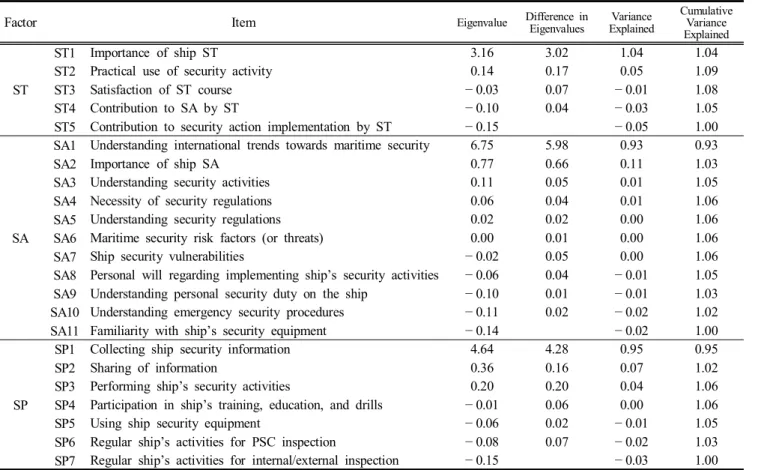
This study conducted validity analyses for the three factors of ST, SA, and SP. Table 2 indicates the main items taken into account in the questionnaire for each of these factors.
ST is here operationally defined as the degree of perceived usefulness of the seafarer for the security training. The measurement items were selected according to the importance of security training, practical utilization, training satisfaction, and contribution to enhance security awareness or performance.
SA is here operationally defined as the level of awareness of security techniques or security personnel about security risks that can occur on ship. The items to measure security perception
including: importance of ship security activities, recognition of ship security threats, recognition of ship security vulnerability, understanding of ship security activities, and international trends related to ship security.
SP is operationally defined as an achievement that can reduce loss of internal and external damage factors caused by security activities of ship and evaluate ship security.
The selected items include active participation in security related activities, participation in education and training, security inspection activities, and regular security monitoring and inspection activities.
All survey items were designed with five (5) points of Likert scale.
Exploratory factor analysis was the method used to validate the analysis, and Table 2 shows the eigenvalue and distributed ratio of explanatory power.
Division Item Frequency Percentage
Gender Female 3 1.5
Male 198 98.5
Rank
Management level 83 41.3
Operational level 97 48.3
Support level 8 4.0
Cadet 13 6.5
Type of ship
Oil tanker 24 11.9
Chemical tanker 27 13.4
LPG 15 7.5
LNG 18 9.0
Container ship 22 11.0
Bulk carrier 30 14.9
Ferry 7 3.5
Car carrier 13 6.5
Reefer ship 3 1.5
General cargo ship 9 4.5
Tug boat 4 2.0
Offshore plant 1 0.5
Other 28 13.9
Years of experience on board
Less than 1 year 28 14.0
1–3 years 60 29.9
3–5 years 38 18.9
5–10 years 20 10.0
10–15 years 18 9.0
More than 15 years 37 18.4
Main navigation route
Coastal 24 11.9
Route between Korea and China 36 17.0
Route between Korea and Japan 27 13.4
Southwest route* 65 32.3
Southeast route** 62 30.9
Northern route*** 27 13.4
Other 61 30.4
ST
None 16 8.0
Ship Security Awareness for All Seafarers course 24 11.9
Designated Security Duties course 110 54.7
Ship Security Officer course 51 25.4
Southwest Route*: Routes used to transport dry and liquid bulk cargoes from Europe and Middle East to Far East as well as containers between Far East and Europe through the Strait of Singapore
Southeast Route**: Routes connecting Far East to Australia, Oceania, Central and South America Northern Route***: Routes connecting Far East and North America, Canada and Europe Table 1. Sample characteristics
This was done to extract the common items in each of the prime factors’ categories; the basic method involves finding areas factors have significant difference between the eigenvalues of large cumulative proportions of explained variance. All three factor 1 in which the eigenvalue changes rapidly and areas with sufficiently and factor 2, which are visually confirmed by the grafico scree plot in Figures 2, 3, and 4. The key factor is that the cumulative proportion of explained variance is higher than 90 % in factor 1, which means that only one factor is enough to explain the variance of the factors.
Depending on the order of extraction, the grafico scree plot below displays, on the graph, the eigenvalue on the y-axis and the number of factors on the x-axis explained by each factor, respectively. The method used determines the number of factors in the vicinity of the area in which the slope of the values suddenly becomes gradual. The number of factors is selected depending on the eigenvalue; an adequate number of factors were selected after checking the explanatory value of the factors and the scree plot graph when the eigenvalue was 1 or higher.
Fig. 2. Grafico scree plot of ship ST.
Fig. 3. Grafico scree plot of ship SA.
Factor Item Eigenvalue Difference in
Eigenvalues Variance Explained
Cumulative Variance Explained
ST
ST1 Importance of ship ST 3.16 3.02 1.04 1.04
ST2 Practical use of security activity 0.14 0.17 0.05 1.09
ST3 Satisfaction of ST course − 0.03 0.07 − 0.01 1.08
ST4 Contribution to SA by ST − 0.10 0.04 − 0.03 1.05
ST5 Contribution to security action implementation by ST − 0.15 − 0.05 1.00
SA
SA1 Understanding international trends towards maritime security 6.75 5.98 0.93 0.93
SA2 Importance of ship SA 0.77 0.66 0.11 1.03
SA3 Understanding security activities 0.11 0.05 0.01 1.05
SA4 Necessity of security regulations 0.06 0.04 0.01 1.06
SA5 Understanding security regulations 0.02 0.02 0.00 1.06
SA6 Maritime security risk factors (or threats) 0.00 0.01 0.00 1.06
SA7 Ship security vulnerabilities − 0.02 0.05 0.00 1.06
SA8 Personal will regarding implementing ship’s security activities − 0.06 0.04 − 0.01 1.05
SA9 Understanding personal security duty on the ship − 0.10 0.01 − 0.01 1.03
SA10 Understanding emergency security procedures − 0.11 0.02 − 0.02 1.02
SA11 Familiarity with ship’s security equipment − 0.14 − 0.02 1.00
SP
SP1 Collecting ship security information 4.64 4.28 0.95 0.95
SP2 Sharing of information 0.36 0.16 0.07 1.02
SP3 Performing ship’s security activities 0.20 0.20 0.04 1.06
SP4 Participation in ship’s training, education, and drills − 0.01 0.06 0.00 1.06
SP5 Using ship security equipment − 0.06 0.02 − 0.01 1.05
SP6 Regular ship’s activities for PSC inspection − 0.08 0.07 − 0.02 1.03
SP7 Regular ship’s activities for internal/external inspection − 0.15 − 0.03 1.00 ST: security training; SA: security awareness; SP: security performance
Table 2. Description of prime factors and eigenvalues, variance explained
Fig. 4. Grafico scree plot of ship SP.
Depending on the order of extraction, the scree plot below displays, on the graph, the eigenvalue on the y-axis and the number of factors on the x-axis explained by each factor, respectively. The method used determines the number of factors in the vicinity of the area in which the slope of the values suddenly becomes gradual. The number of factors is selected depending on the eigenvalue; an adequate number of factors were selected after checking the explanatory value of the factors and the scree plot graph when the eigenvalue was 1 or higher.
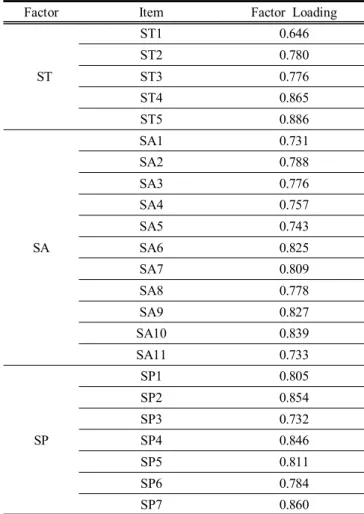
The results of a factor loading calculation performed with only one factor show that all factor loadings were 0.6 or higher, which are on the high side. Factor loading is the value that shows the degree/magnitude of relationship among each of the variables and factors, and a value of 0.3 or generally higher indication of significant relationship. The factor loading in the current study is shown in Table 3. As a result, the scales of ST, SA, and SP were determined to have been structured in a valid format.
As the validity for the model in the current study was secured, the research moved on to the next step of reliability analysis, using the most prevalently used method of Cronbach’s alpha.
Reliability is a measure of how consistently the respondents answered the questions, which, in this study, was represented by the factors taken into account.
Nunnally and Bernstein (1967) found that the reliability of the questionnaire was high when the Cronbach's alpha value was more than 0.60. The study suggested that the reliability of the measurement tools for statistical analysis is more than 0.80 by applying strict criteria. The reliability of the items in this study was 0.895 (ST), 0.944 (SA), and 0.93 (SP). In other words, the alpha values for ST, SA, and SP applied in this study were all over 0.7, so these items have internal consistency for each factor.
Factor Item Factor Loading
ST
ST1 0.646
ST2 0.780
ST3 0.776
ST4 0.865
ST5 0.886
SA
SA1 0.731
SA2 0.788
SA3 0.776
SA4 0.757
SA5 0.743
SA6 0.825
SA7 0.809
SA8 0.778
SA9 0.827
SA10 0.839
SA11 0.733
SP
SP1 0.805
SP2 0.854
SP3 0.732
SP4 0.846
SP5 0.811
SP6 0.784
SP7 0.860
Table 3. Factor loadings of ST, SA and SP
Table 4 shows that all reliability coefficients in the current study were close to 0.9 or higher, which mean that the reliability of the scales is adequate. In the end, the validity and reliability of the model were found to be adequate for the empirical analysis.
Factor Number of Items Cronbach’s Alpha
ST 5 0.895
SA 11 0.944
SP 7 0.930
Table 4. Reliability analysis of ST, SA and SP
4.3 Correlation Analysis of the Measurement Model and Verification of the Hypotheses
In addition, correlation analyses were conducted to understand the mutual correlation of the individual factors; correlation analysis is performed when it is necessary to determine how each factor is correlated, i.e., the relationship between variables. In general, when
the absolute value of the correlation coefficient (r) between variables is 1.0, then such represents a perfect correlation, while 0.9 suggests a very high correlation and 0.7 to 0.8 indicates a high correlation (Boyd et al., 1989). The correlation analysis yielded values of 0.7 or higher in terms of correlation among ST, SA, and SP. As such, the three factors have high mutual correlation with each other.
Table 5 shows the correlation analysis descriptive statistics of the factors. The mean of the following factors has been calculated based on the sum of five items related to ST, the sum of 11 items related to SA, and the sum of seven items related to SP.
ST SA SP
ST 1.000
SA 0.765*** 1.000
SP 0.717*** 0.834*** 1.000
Mean 18.1 40.4 25.0
Standard Deviation 3.5 7.0 4.8
Max 25 55 35
***p < 0.001
Table 5. Correlation analysis of the factor
Next in the analysis, hypotheses set in the study are verified.
Table 6 shows the results of the hypothesis testing using SA as a dependent variable.
Dependent Variable: SA
Variable Intercept ST
Unstandardized
Regression Coefficient 12.968 1.518
Standard Error 1.673 0.091
t 7.75*** 16.73***
P < 0.0001 < 0.0001
Standardization
Regression Coefficient 0.000 0.764
***p < 0.001
Model F=279.88, p < 0.001, R2=0.584, adjusted R2=0.582
Table 6. Results of regression analysis with SA as a dependent variable
H1: Security training for seafarers positively (+) influences their awareness of maritime security.
Regression analysis of ST of seafarers has a positive effect on
ship SA. As shown in Table 7, the regression coefficient of the ST is statistically significant, and the sign of the coefficient is (+).
Therefore, H1 is supports the idea that ST has a positive effect on SA. Table 8 also shows that the distribution of ST through R2 is 58.4% of the SA distribution.
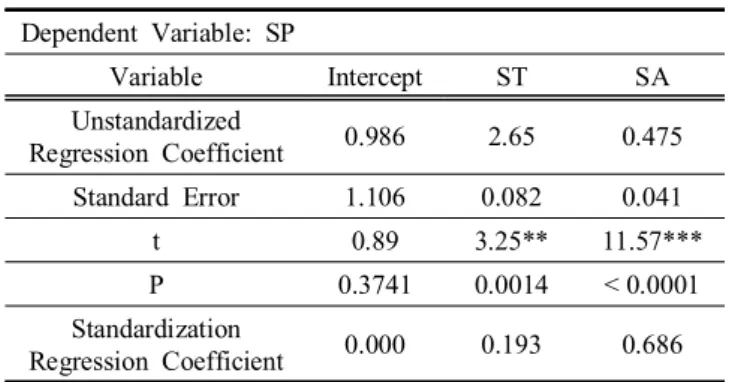
Table 7 shows the results of the hypothesis testing, in which the dependent variable is SP.
Dependent Variable: SP
Variable Intercept ST SA
Unstandardized
Regression Coefficient 0.986 2.65 0.475
Standard Error 1.106 0.082 0.041
t 0.89 3.25** 11.57***
P 0.3741 0.0014 < 0.0001
Standardization
Regression Coefficient 0.000 0.193 0.686
**p < 0.01, ***p < 0.000
Model F=242.82, p < 0.001, R2=0.710, adjusted R2=0.707
Table 7. Results of regression analysis with SP as a dependent variable
H2: Security training and awareness of maritime security positively (+) influence maritime security performance.
Regression analysis of ST and SA of seafarers had a positive effect on ship SP. As shown in Table 8, the regression coefficients of ST and SA are both statistically significant, and the sign of the coefficient is positive (+). Therefore, H2, in which ST and SA have a positive influence on SP, is supported. It can also be seen that the distribution of ST and SA through R2 explains 71 % of the SP dispersion.
0.764
Security
Awareness 0.686
Security Training
0.193 Security
Performance Fig. 5. Mediation effect analysis.
As displayed in Figure 5, according to the mediation effect analysis, ST affects SA positively, and SA has a positive influence on SP on board. ST has a standardization coefficient regression of 0.764 towards SA, whilst SA has a standardization coefficient
regression of 0.686 toward SP. ST has a weaker direct effect towards SP, with a standardization coefficient regression of 0.193.
Therefore, ST enhances SA and this in turn enhances SP. In this case, SA mediates the impact of ST on SP on board.
H3: Seafarers on marine vessels sailing on the Southwest Route will have higher awareness of maritime security.
H3 states essentially that 'the more seafarers there are operating on the Southwest route, the higher the perception of ship security'.
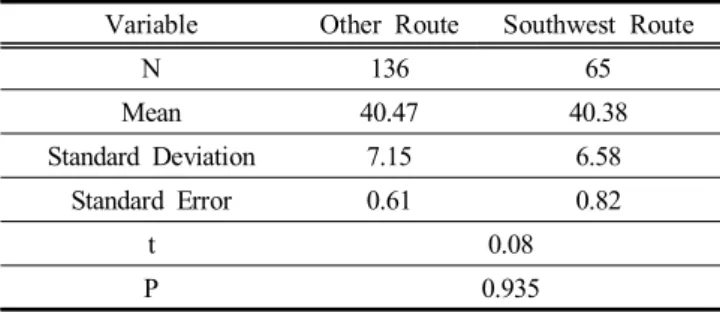
The entire route could not be processed at once by conducting the questionnaire in multiple responses. This study compared the two groups of seafarers who selected the Southwest route and those who did not. Since the two groups were compared, a t-point was applied. As a result, the difference between the two groups was not statistically significant. Therefore, the results were interpreted as that there was no difference in SA whether taking into account the Southwest route or not. As for other routes, the difference in SA was found to be not large. Therefore, H3 was ultimately rejected. Table 8 indicates the results of regression analysis taking into account the ‘Southwest route’ and ‘other routes’ as variables.
Variable Other Route Southwest Route
N 136 65
Mean 40.47 40.38
Standard Deviation 7.15 6.58
Standard Error 0.61 0.82
t 0.08
P 0.935
Table 8. Results of regression analysis for other routes and the southwest route
5. Conclusion
5.1 Finding
The purpose of this study was to verify the relationship between personal level of awareness and SP in cases where seafarers undertake ST courses in an empirical way. It is assumed that the effectiveness of ST required by international conventions heightens the SA of seafarers and consequently increases their SP.
In particular, three hypotheses were set and their validity was tested; they were as follows: (1) ST for seafarers positively (+) influences their awareness of maritime security; (2) ST and SA of
maritime security positively (+) influences maritime SP; and (3) seafarers on merchant vessels sailing on the Southwest route will have a higher awareness of maritime security as compared with those sailing on other routes. In order to validate the model, several analytics steps were taken. First, it was confirmed that ST, SA, and SP all have significant differences between the eigenvalues of factors 1 and 2. Second, the results of a factor loading calculation, which were all higher than 0.6, demonstrate a high degree of relationships among each of the factors. Third, the reliability of the model is further tested by using a Cronbach’s alpha value. Results show that all reliability coefficients in the current study are close to 0.9 or higher, meaning that the reliability of the scales is adequate.
Among the three hypotheses, only the first two were validated, while the third one was rejected. In H1, it was demonstrated that ST has a positive effect on SA, while H2 was also validated, in that ST and SA were found to have a positive influence on security performance.
Therefore, according to the mediation effect analysis, ST affects SA positively, and SA has a positive influence on SP on board.
ST enhances SA and this in turn enhances SP. It was found that SA mediates on the impact of ST on SP on board. As a result, in order to increase SP, it can be interpreted that, the more effective the SA is, then the more positive and larger the impact is on SP.
5.2 Managerial Implications and Limitations
This paper provides a contribution to maritime related organizations by introducing a set of valuable indicators by which security training, awareness and performance can be measured and improved in both a theoretical and practical way. The proposed categorization of variables, contain a specific number and types of items which maritime-related organization can set up to effectively implement in-house education and training courses. In this sense, given the results of the study, educational courses could and should be set not only to fulfill minimum regulatory requirements but also to enhance the operational efficiency on board a ship.
Security training is the basic requirements through which the whole shipping industry along with individual market players such as shipping companies, operators, charterers, governmental bodies can gain significant benefits.
Given the security threats that countries face at a national and international level, a comprehensive and multi-facet improvement in onboard crew security performance aimed at reducing external security threats is to be beneficial to the whole maritime sector in
creating a safer and less disrupted industry. Similarly, individual market players can expect major advantages, when well-performing crew are able to reduce ships’ damages, hijacking threats, deficiencies or PSC inspection. Ship-owners, operators and charterers can expect higher operational efficiency, improved financial performances given a higher marketability of ships to be chartered out, enhanced corporate image and stronger market reputation if the operated ships are not involved in major incidents or detentions.
This paper not only shows the validity of the model but it also contributes to further understand the relationship among the variables. Training can have a pragmatic effect to enhance security awareness and performance. When security awareness is increased by effective security training, an enhanced security performance of board is achieved and this reduces the likelihood of occurrence of security threats. The results of the study suggest, for example, that areas of improvement in relation to security performance may be related, but not limited to:
Collection and sharing of ship security information
Performing ships’ security activities
Participation in ship’s training, education and drills
Using ship’s security equipment
Regular ship’s activities for PSC inspections
Regular ship’s activities for internal and external inspections
The key issue to enhance security awareness and security performance is to set high security training standards. Besides the pragmatic initiatives promoted internationally by the IMO, under STCW, namely security awareness training for all seafarers (IMO model course 3.27) and security training for seafarers with designated security duties (IMO model course 3.26), it is recommended to adopt ad-hoc training courses at a regional level as the security awareness of seafarers may be different depending upon several factors such as working experience, ship type, cargo carried, route sailed. Examples of regional cooperation among States in Asia are provided by: the Asia Maritime Security Initiative 2004 (AMARSECTIVE, 2004) in which Japan took a leading role in the cooperation and coordination among Asian States to combat piracy and armed robbery; and the Regional Cooperation Agreement on Combating Piracy and Armed Robbery against Ships in Asia (ReCAAP), under which agreement ASEAN countries cooperate closely to prevent piracy and armed robbery in the region (IMO, 2004).
Not only maritime administrations have a major role to play but also shipowners, operators, maritime associations and ad-hoc organization. These stakeholders could design and implement security training programs aimed at a national, sub regional and regional level. Considering a worldwide context, there exist regions showing very peculiar security threats, which need specific multidisciplinary education and training programs in order to enhance specific security awareness. For instance, cooperation at a regional level through capacity building involving both developed and developing countries, design of security training programs and sharing of information and best practice could be pivotal in implementing effective regional security awareness.
Although meaningful findings were drawn, the present study has some limitations, and future research should be addressed to consider several areas. First, the survey data were only collected from a limited sample of seafarers, and it could be meaningful to extend the study sample to include a wider range of relevant sectors and professionals such as port managers, logistics operators, stevedores, and maritime security-related personnel. Different results according to the sector taken into account should be analysed. Second, SA and SP on board should be audited and it may be assessed whether or not there are any differences in these variables according to seafarers’ nationalities, countries where training courses were completed, or frequency of updates made to the training courses by seafarers. Third, investigating what training courses and which educational tools may be the most effective in enhancing SA according to the different maritime sectors considered.
References
[1] Baek, M. J. and S. H. Sohn(2011), A Study on the Effect of Information Security Awareness Behavior on the Information Security Performance in Small Medium Sized Organization, Asia Pacific Journal of Small Business, Vol. 33, No. 2 pp.
113-132.
[2] Boyd, H. W., R. L. Westfall and S. F. Stasch(1989), Marketing Research: Text and Cases, McGraw-Hill/Irwin.
[3] Fornell, C. and D. F. Larcker(1981), Evaluating Structural Equation Models With Unobservable Variables and Measurement Error, Journal of Marketing Research, Vol. 18, No. 1, pp. 39-50.
[4] ICC, International Maritime Bureau(2018), Piracy and Armed Robbery Against Ships Annual Report: 1 January – 31
December 2018.
[5] IMO(2004), Measures To Enhance Maritime Security, Maritime Safety Committee, 79thsession, Agendaitem5London.
[6] IMO(2011), International Convention on Standards of Training, Certification and Watchkeeping for Seafarers, (STCW) 1978, as amended in 1995/2010. International Maritime Organization, London.
[7] Kang, D. Y. and M. H. Chang(2016), The Influence of Information Security Behaviours on Information Security Performance in Shipping and Port Organization, Journal of Korean Navigation and Port Research, Vol. 40, No. 4, pp.
213-222.
[8] Marlow, P. B.(2010), Maritime Security: An Update of Key Issues, Maritime Policy & Management, Vol. 37, No. 7, pp.
667-676.
[9] McNicholas, M.(2016), Maritime Security: An Introduction, Butterworth-Heinemann.
[10] Meija, M. and P. K. Mukherjee(2004), Selected Issues of Law and Ergonomics in Maritime Security, Journal of International Maritime Law, Vol. 10, No. 4, pp. 316-326.
[11] National Security Presidential Directive-41/Homeland Security Presidential Directive-13 (NSPD-41/HSPD-13)(2014), Maritime Security Policy, https://www.dhs.gov/sites/default/files/public- ations/HSPD_MDAPlan_0.pdf. Accessed December 21, 2004.
[12] Nunnally, J. C. and I. H. Bernstein(1967), Psychometric Theory, Vol. 226. New York: McGraw-hill.
[13] Thai, V. V.(2007), Impacts of Security Improvements on Service Quality in Maritime Transport: An Empirical Study of Vietnam, Maritime Economics & Logistics, Vol. 9, No. 4, pp.
335-356.
[14] Thai, V. V. and D. Grewal(2007), The Maritime Security Management System: Perceptions of the International Shipping Community, Maritime Economics & Logistics, Vol. 9, No. 2, pp. 119-137.
[15] Thiele, R. D.(2012), Building Maritime Security Situational Awareness, Institut für Strategie-Politik-Sicherheits-und Wirtschaftsberatung(ISPSW) 182.
[16] Tsohou, A., S. Kokolakis, M. Karyda and E. Kiountouzis (2008), Process-Variance Models in Information Security Awareness Research, Information Management & Computer Security, Vol. 16, No. 3, pp. 271-287.
[17] UNCTAD(2017), Review of Maritime Transport 2017, http://unctad.org/en/PublicationsLibrary/rmt2017_en.pdf.
Accessed 10 March 2018.
[18] Yim, M. S.(2014), Why Security Awareness Education Is Not Effective?, Journal of Digital Convergence, Vol. 12, No. 2, pp. 27-37.
Received : 2019. 04. 08.
Revised : 2019. 04. 24.
Accepted : 2019. 04. 26.