Print ISSN: 2288-4637 / Online ISSN 2288-4645 doi:10.13106/jafeb.2020.vol7.no8.247
1
First Author and Corresponding Author. Associate Professor, Institute for Business and Accounting Innovation, Nakhan Phanom University, Thailand [Postal Address: Nakhon Phanom, 48000, Thailand] Email: [email protected]
2
Assistant Professor, Mahasarakham Business School, Mahasarakham University, Thailand. Email: [email protected]
© Copyright: The Author(s)
This is an Open Access article distributed under the terms of the Creative Commons Attribution
Non-Commercial License (http://Creativecommons.org/licenses/by-nc/4.0/) which permits
unrestricted noncommercial use, distribution, and reproduction in any medium, provided the
original work is properly cited.
Integrated Performance Measurement as a Strategic Management Accounting Approach: A Case of Beverage Businesses in Thailand
Kornchai PHORNLAPHATRACHAKORN
1, Jindarat PEEMANEE
2
Received: June 05, 2020 Revised: June 28, 2020 Accepted: July 09, 2020
Abstract
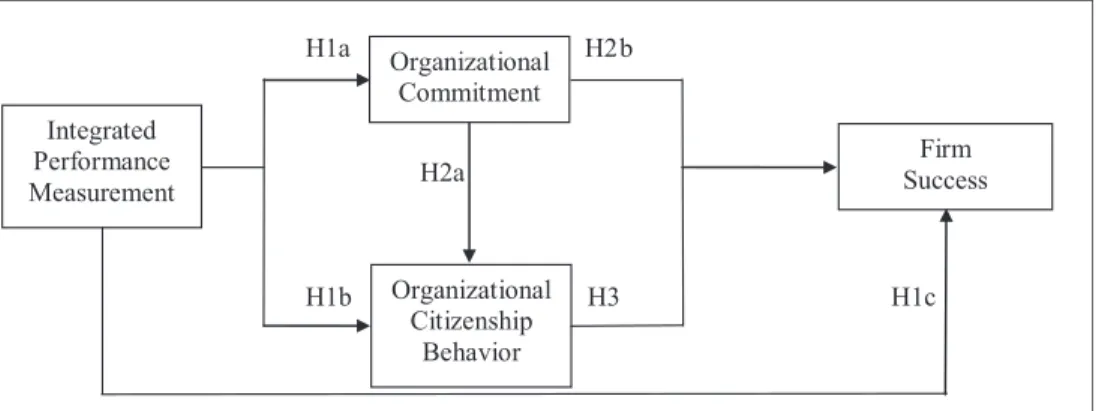
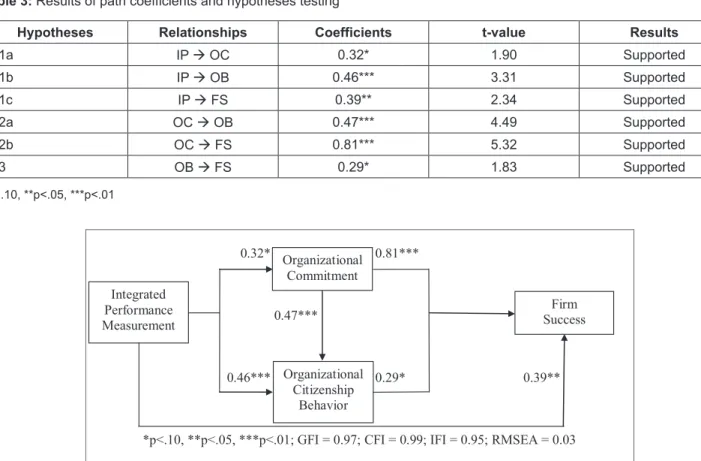
This study aims to examine the effects of integrated performance measurement on firm success of beverage businesses in Thailand. Integrated performance measurement, organizational commitment, organizational citizenship behavior, and firm success are the main variables of the study. In this study, all 653 beverage businesses from Department of Business Development, Ministry of Commerce, Thailand are the samples of the study. The data collection was provided during February - April, 2016. A mail survey procedure via questionnaire was used for data collection. 163 responses were received. Of the surveys completed and returned, 159 were usable. The structural equation model (SEM) is conducted to examine the effects of integrated performance measurement on organizational commitment, organizational citizenship behavior and firm success. The results show that integrated performance measurement positively influences organizational commitment, organizational citizenship behavior and firm success. Organizational commitment positively affects both organizational citizenship behavior and firm success while organizational citizenship behavior positively impacts firm success. In summary, integrated performance measurement as a strategic management accounting approach is a key determinant of firms’ business outcome. Firms need to support their resources and capabilities in developing, implementing, utilizing, and maintaining integrated performance measurement.
Potential discussion, conclusion, and suggestions and directions for future research are highlighted.
Keywords: Integrated Performance Measurement, Organizational Commitment, Organizational Citizenship Behavior, Firm Success JEL Classification Code: M41
1. Introduction
Recently, markets are competitive and environments are highly uncertain. Firms need to create, utilize, and maintain a valuable strategy that can help them deal with and compete against competitors in these markets and environments. They can provide outperforming business operations and activities via implementing these strategies. Strategic management accounting is a source of valuable strategies which enhances firms to achieve success, survival and sustainability in
the current and future perspectives. In existing literature, strategic management accounting is defined as the provision and analysis of management accounting data and information about a business and its competitors, for use in developing and monitoring business strategies (Simmonds, 1981). It is a key determinant of firms’ best business outcome. Better strategic management accounting implementation can promote sustainable competitive advantage and superior performance. In addition, strategic management accounting comprises of five techniques, namely strategic costing, strategic performance measurement, strategic decision making, competitor accounting, and customer accounting (Cadez & Guilding, 2012).
These techniques are increasingly focused on providing
values to customers and firms. They are important drivers
of strategic management process under rapidly changing
business environments. In this study, strategic performance
measurement is considered as a key business strategy that can
encourage firms to meet their objectives, goals and purposes
in the aforementioned situations and conditions, especially
integrated performance measurement. Accordingly, this