Improved Iterative Decoding of Parallel and Serially Concatenated Trellis Coded Modulation
병렬 및 직렬적으로 연접된 트렐리스 부호화 변조 기법을 위한 향상된 반복적 복호 기법
Cheolwoo You * , Dongsun Seo **
劉 哲 雨 * , 徐 東 善 **
Abstract
For parallel and serially concatenated trellis coded modulation (TCM), improved iterative decoding schemes with a simple mechanism are proposed and their performances are compared with those of conventional decoding schemes. Simulation results have shown that the proposed schemes have provided a considerable decoding gain in additive white Gaussian noise (AWGN) channels and Rayleigh fading channels, even if they can be implemented by a simple modification of conventional decoding algorithms.
요 약
본 논문에서는, 병렬 혹은 직렬적으로 연접된 트렐리스 부호화 변조 기법 (Trellis coded modulation: TCM)을 위 한 간단한 구조를 가진 향상된 반복적 복호 기법들이 제안되며, 동시에 제안된 기법들의 성능을 기존 기법들과 비 교 제시한다. 제안된 복호 알고리즘은 기존 알고리즘의 단순 변형을 통해서 구현될 수 있음에도 불구하고, 모의 실험 결과는 제안된 기법들이 부가 백색 가우스 잡음 채널 (Additive white Gaussian noise channel: AWGN channel) 및 레일리 (Rayleigh) 페이딩 채널 상에서 상당한 부호 이득을 제공함을 보여 준다.
Key words : Iterative decoding, Bit-interleaved, Parallel concatenated code, Serially concatenated code, Trellis coded modulation
*
明知大學校 通信工學科(Dept.ofCommunicationEngineering,Myongji University)
**
明知大學校 電子工學科(Dept. of Electronics, Myongji University)
※ 본 연구는 2007년도 명지대학교 산학컨소시엄 및 산학 협력실에 의한 연구비 지원 결과의 일부임.
接受日:2007年 10月 15日, 修正完了日:2007年 12月 23日
Ⅰ. Intorduction
As the near-capacity gains claimed for parallel concatenated convolutional codes (PCCC's), what are called as Turbo codes, and serially concatenated convolutional codes (SCCC's) have been confirmed and widely reported in the literature, the range of applications of PCCC's and
SCCC's has expanded to many areas of communications. Especially, it is interesting to combine PCCC's or SCCC's with a bandwidth-efficient modulation in order to improve the transmission spectral efficiency. Many papers have shown the good results of applying PCCC's or SCCC's to trellis-coded modulation (TCM) [1, 2].
In this paper, we propose the enhanced iterative
decoding schemes for parallel and serially
concatenated trellis coded modulation (PC-TCM
and SC-TCM) with an interleaver between an
encoder and a modulator. By the soft or hard
decision feedback according to the new iterative
decoding algorithm, the proposed schemes use the
sequences of probability distributions that have not
been used in conventional decoding schemes. Note that in conventional schemes, a Turbo decoder and a TCM decoder are mutually exclusive and, therefore, independently operated.
Ⅱ. Iterative Decoding Algorithm of SC-TCM and PC-TCM
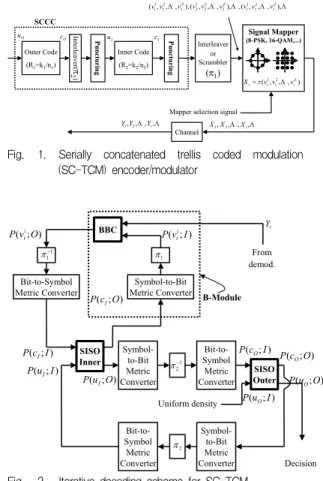
We consider the association of M-state QAM (Quadrature Amplitude Modulation) or PSK (Phase Shift Keying) modulation and encoder built from a standard SCCC by using puncturing technique as depicted in Fig. 1. By using two puncturing functions, it is possible to obtain a large code family, with various code rates. In order to obtain symbols affected with uncorrelated noises at the SCCC-decoder input and to randomize the data prior to modulation to limit the peak to average ratio of the envelope of the modulated waveform, a bit interleaver π
1has to be inserted between the SCCC-encoder and the modulator.
For 2
Z-ary modulation, every Z interleaved bits are grouped together to form a channel symbol
(1)
at time t and mapped to a complex symbol X
t=τ (V
t). Consider a coherent demodulator, the received signal is
(2)
where ρ
tis a Rayleigh fading channel amplitude and a constant equal to 1 for a Gaussian channel, and n
tis a complex Gaussian random variable.
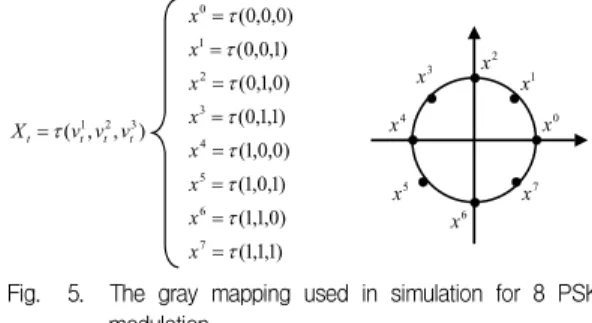
A functional diagram of the new iterative decoding algorithm for SC-TCM is presented in Fig. 2. This schemeis similar to conventional SCCC-decoders using the soft-input soft-output (SISO) module [3], except that the output probability of SISO Inner P(C
I: O), which has not been used in conventional SCCC-decoders, is iteratively fed back through B-Module. Note that the interleaved coded modulation concept originally proposed by Zehavi [4] is applied to B-Module.
Interleaver or Scrambler
(p
1)
SCCCSignal Mapper (8-PSK, 16-QAM,...)
Channel
l ll l
l ll l l ll ll ll l llll
l ll l l ll ll ll ll l
l ll l ll ll
l ll l ll
L L, , , , 2
1X Xt
L X L, , , ,2
1Y Yt
Y
L L L L
L, ),( , , , ), ,( , , , ), ,
,
(v11v12 v1Z v12v22 v2Z v1tv2t vtZ
) , , , (1t t2 Zt
t vv v
X=t L
Puncturing
Mapper selection signal Outer Code
(R1=k1/n1)
Inner Code (R2=k2/n2) Interleaver(
p
2) PuncturinguO
cO uI cI
Fig. 1. Serially concatenated trellis coded modulation (SC-TCM) encoder/modulator
)
; ( c I
P
IP ( c
O; I )
BBC
)
; ( c O P
I)
; ( v I P
tiYt
)
; ( v O P
it)
; ( u I P
O)
; ( c O P
O)
; ( u O P
O)
; ( u I P
I)
; ( u O P
ISISO Inner
1 1
p
-p
1p
2Symbol- to-Bit Metric Converter
SISO Outer
1 2
p
-Uniform density Bit-to- Symbol Metric Converter
Symbol- to-Bit Metric Converter Bit-to-
Symbol Metric
Converter Decision
Bit-to-Symbol Metric Converter
Symbol-to-Bit Metric Converter
From demod.
B-Module
Fig. 2. Iterative decoding scheme for SC-TCM
1. Algorithm Using Soft Decision Value
The decoding steps are as follows. For each received signal Y
t, Bit-to-Bit metric Calculator (BBC) using soft-decision feedback calculates the probabilities
{ }
( )
å Õ
å
Î ¹
Î
þ ý ü î
í
ì =
=
=
=
= =
=
) , (
) , (
);
, ( )
,
| (
) ( ) ,
| (
)
; (
)
| ) (
; (
a i
X ji
t j t t t t a i X
t t t t i t
t i i t
t
t t
I j X f v P X Y P
X P X Y P
I a v P
Y a v O P a v P
c c
r r
(3)
where a∊{1, 0} and
χ (i, a)={τ(v
1, v
2,…, v
Z)| v
i=a}. (4)
f(X
t, j)∊{1, 0} is the value of the j-th bit of the label for X
t. The initial value of P(v
tj; I)—prior to any decoding—is assumed to be constant for all i.
Note that the probability P(X
t) is assumed to be equal for any X
t∊χ (i, a) in the first decoding step.
2. Algorithm Using Hard Decision Value For each received signal Y
t, BBC using hard-decision feedback calculates the probabilities
{ }
å
Î
=
=
= =
=
) , (
) ( ) ,
| (
)
; (
)
| ) (
; (
a i X
t t t t i t
t i i t
t
t
X P X Y P
I a v P
Y a v O P a v P
c
r (5)
where
î í
ì = = ¹
= 0 , otherwise
) all for ˆ ( ) , ( and ) , ( if , ) 1
( f X i a f X j v j i
X P
j t t t
t
(6)
where is the previous iterative decoding decision.
The probability P(v
tj; O) calculated by (3) or (5) is deinterleaved and used by a conventional SCCC-decoder using the SISO algorithm [3]. Then, P(C
I; O) is interleaved and fed back for the next iteration.
3. Computation of Input and Output Bit Computation
In this subsection, the operation of the metric converters shown in Fig. 2 is described. Consider a rate k
o/n
otrellis encoder such that each input symbol U consists of k
obits and each output symbol C consists of n
obits.
Bit-to-symbol metric converter calculates the symbol probabilities
Õ
=
=
0
1
)
; ( )
; (
n
j j
j c I
P I
c
P (7)
Õ
=
=
0
1
)
; ( )
; (
k
j j
j u I
P I
u
P (8)
where c
jdenotes the value of the j-th bit of the coded symbol C
k=c; j=1,…,n
oand u
jdenotes the value of the j-th bit of the input symbol U
k=u; j=
1,…,k
o.
Symbol-to-bit metric converter calculates the bit probabilities
å Õ
=
¹
=
=
j j j
c C c
n
j i i
i c i
j
j c O H P c O P c I
P
: 1
0
)
; ( )
; ( )
; (
(9)
å Õ
=
¹
=
=
j j j
u U u
k
j i i
i u i
j
j u O H P u O P u I
P
: 1
0
)
; ( )
; ( )
; (
(10)
where
and
are normalization constants such that
å { } Î
=
=
1 , 0
1 )
; (
j j
c
j
c P j c O
H
(11)
å { } Î
=
=
1 , 0
1 )
; (
j j
u
j
u P j u O
H
. (12)
4. Description for PC-TCM
We consider the association of 2
Z-ary QAM or PSK modulation and encoder built from a standard PCCC by using puncturing technique as depicted in Fig. 3. In order to obtain symbols affected with uncorrelated noises at the decoder input and to randomize the data prior to modulation to limit the peak to average ratio of the envelope of the modulated waveform, a random interleaver π
1is inserted between the encoder and the modulator.
The new iterative decoding scheme for PC-TCM is presented in Fig. 4, where B-to-S indicates bit-to-symbol metric converters. Each SISO module is a four-port device that accepts at the input the sequences of probability distributions {P(C; I), P(U;
I)} and outputs the sequences of probability
distributions {P(C; O), P(U; O)} [3]. The proposed
schemes are identical with conventional decoder
schemes using the SISO module. However, there is
one important difference. In these schemes, the
sequences of probability distributions {P(C
1; O),
P(C
2; O), P(C
I; O)} that have not been utilized in conventional PCCC-decoder and SCCC-decoder are iteratively fed back by B-Module. These sequences can be iteratively fed back without amplification of self-information because the interleaver π
1is inserted between the encoder and the modulator.
The decoding steps using hard decision values are as follows. For each received signal Y
t, BBC with hard-decision feedback calculates the probabilities defined by Eq. (5). In Eq. (6), f(X
t, j)
∊ {1, 0} is the value of the j-th bit of the label for X
tand is the previous iterative decoding decision. The probability P(X
t) is assumed to be equal for any X
t∊χ (i, a) in the first decoding step.
Finally, the probability P(v
ti; O) calculated by Eq.
(3) is deinterleaved and used by a conventional PCCC or SCCC decoder using the SISO algorithm [3]. Then, {P(C
1; O), P(C
2; O)} generated by the SISO modules are interleaved and fed back into BBC for the next iteration.
p
2Code 1 M U X
Code 2
P unc tur ing
u 1 u 2
c 1 c 2
Signal Mapper X
t= t (V
t) p
1X
tV
tl
PCCC
Fig. 3. Encoder/modulator block diagrams of PC-TCM.
)
; ( c
1I P
)
; ( c
2I P
)
; ( c
1O P
)
; ( c
2O P
)
; ( u
2O P )
; ( u
1I P
)
; ( u
1O SISO P Code1
p
2SISO Code2
1 2
p
-)
; ( u
2I P Decision
Device
l l
p
1S-to-B
S-to-B
M U X
1 1
p
-B -to -S
D eM U X
)
; ( v O P
tiB-to-S p
2 lDecision From Demod. Y
tB-Module BBC P ( v
it; I )
Fig. 4. Iterative decoding scheme for PC-TCM
III. Experimental Results and Discussion 1. Performance of SC-TCM
To show the performance of the SC-TCM
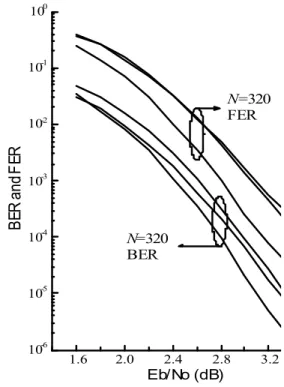
decoded using the new algorithm, we have simulated a rate R=1/3 SCCC and 8PSK modulation, joined by a random interleaver π
1. To achieve the best performance, the gray mapping (see Fig. 5) and soft-decision feedback are used.
l l
l
l l l l
l
) 1 , 1 , 1 (
) 0 , 1 , 1 (
) 1 , 0 , 1 (
) 0 , 0 , 1 (
) 1 , 1 , 0 (
) 0 , 1 , 0 (
) 1 , 0 , 0 (
) 0 , 0 , 0 (
7 6 5 4 3 2 1 0
t t t t t t t t
=
=
=
=
=
=
=
=
x x x x x x x x
x
0x
1x
2x
3x
4x
5x
6x
7) , , (
1t 2t 3tt
v v v
X = t
Fig. 5. The gray mapping used in simulation for 8 PSK modulation
The SCCC is formed by an outer code with rate 2/3 obtained by puncturing a systematic, recursive, rate 1/2 convolutional code with generating matrix
÷÷ ø ö çç è
æ
+ +
= + 2
2
1 , 1 1 )
( Z Z
Z Z
G (13)
(the rate 2/3 is obtained by puncturing every other parity-check bit), and an inner code consisting of a rate 1/2 systematic recursive convolutional code with the same previous generating matrix, joined by a random interleaver π
2.
We have computed the bit error rate (BER) using the Monte Carlo method as a function of Eb/No. In Figs. 6-8, the results over Gaussian channels are plotted for information block length 318, 596, and 700. In these figures, [BI-On, FB-On], [BI-On, FB-Off], and [BI-Off, FB-off]
means the proposal method (π
1is used in Fig. 1 and the proposed feedback is also used), the conventional method-A (π
1is used and the proposed feedback is not used), and the conventional method-B (π
1is not used and the proposed feedback is not used), respectively. Also, BI, FB and IT mean bit-interleaver, feedback, iteration number, respectively.
Fig. 9 shows that BER comparison between
SCCC-TCM and the 64-state TCM by Ungerboeck
under additive white Gaussian noise (AWGN) channel.
We have also simulated rates R=1/4 and 1/4 SCCC and 8PSK modulation as shown in Fig. 10.
In this case, the SCCC is formed by an outer code that is the systematic, recursive, rate 1/2 convolutional code with generating matrix Eq. (13), and an inner code consisting of a rate 1/2 systematic recursive convolutional code with the same previous generating matrix, joined by a random interleaver (π
2).
1.4 1.6 1.8 2.0 2.2 2.4 2.6 2.8 3.0 3.2 3.4 3.6
10
-610
-510
-410
-310
-210
-1B it a n d F ra m e E rr o r R a te s
Eb/No (dB)
BER(It-10, R=1/3, 8-PSK(Gray0), AWGN, BI-Off, FB-Off) BER(It-10, R=1/3, 8-PSK(Gray0), AWGN, BI-On, FB-Off) BER(It-10, R=1/3, 8-PSK(Gray0), AWGN, BI-On, FB-On) FER(It-10, R=1/3, 8-PSK(Gray0), AWGN, BI-Off, FB-Off) FER(It-10, R=1/3, 8-PSK(Gray0), AWGN, BI-On, FB-Off) FER(It-10, R=1/3, 8-PSK(Gray0), AWGN, BI-On, FB-On)
Fig. 6. BER and FER Comparison for SCCC-TCM under AWGN Channel. Data Block Size: 318, Overall Code Rate: 1/3
1.0 1.2 1.4 1.6 1.8 2.0 2.2 2.4 2.6 2.8 3.0 3.2
10
-810
-710
-610
-510
-410
-310
-210
-110
0B it E rr o r R a te ( B E R )
Eb/No (dB)
BER(It-10, R=1/3, 8-PSK(Gray0), AWGN, BI-Off, FB-Off) BER(It-10, R=1/3, 8-PSK(Gray0), AWGN, BI-On, FB-Off) BER(It-10, R=1/3, 8-PSK(Gray0), AWGN, BI-On, FB-On) FER(It-10, R=1/3, 8-PSK(Gray0), AWGN, BI-Off, FB-Off) FER(It-10, R=1/3, 8-PSK(Gray0), AWGN, BI-On, FB-Off) FER(It-10, R=1/3, 8-PSK(Gray0), AWGN, BI-On, FB-On)
Fig. 7. BER and FER Comparison for SCCC-TCM under AWGN Channel. Data Block Size: 596, Overall Code Rate: 1/3
0.8 1.0 1.2 1.4 1.6 1.8 2.0 2.2 2.4 2.6 2.8
10
-710
-610
-510
-410
-310
-210
-110
0B it E rr o r R a te ( B E R )
Eb/No (dB)
BER(It-10, R=1/3, 8-PSK(Gray0), AWGN, BI-Off, FB-Off) BER(It-10, R=1/3, 8-PSK(Gray0), AWGN, BI-On, FB-Off) BER(It-10, R=1/3, 8-PSK(Gray0), AWGN, BI-On, FB-On) FER(It-10, R=1/3, 8-PSK(Gray0), AWGN, BI-Off, FB-Off) FER(It-10, R=1/3, 8-PSK(Gray0), AWGN, BI-On, FB-Off) FER(It-10, R=1/3, 8-PSK(Gray0), AWGN, BI-On, FB-On)
Fig. 8. BER and FER Comparison for SCCC-TCM under AWGN Channel. Data Block Size: 700, Overall Code Rate: 1/3
1.0 1.2 1.4 1.6 1.8 2.0 2.2 2.4 2.6 2.8 3.0 3.2 3.4 10
-810
-710
-610
-510
-410
-310
-210
-110
0(iii) (ii)
(i) (iv)
(ii) (iii) N=596 (i)
N=318
B it E rr o r R a te ( B E R )
Eb/No (dB)
Fig. 9. BER Comparison for SCCC-TCM under AWGN channel. Overall Code Rate: 1/3. (i) Proposal [BI-On, FB-ON], (ii) Conventional-A [BI-On, FB-Off], (iii) Conventional-B [BI-Off, FB-Off], (iv) Conventional TCM (64-State)
The performance comparison over a Rayleigh fading channels is also presented in Fig. 11. From this figure, we can see that over a Rayleigh channel, the interleaver π
1is necessary to achieve the best performance.
2. Performance of PC-TCM
To show the performance of the proposed
PC-TCM schemes, we have simulated a rate 1/3
PCCC with 8-PSK modulation and a random
interleaver π
1. To achieve the best performance, the
gray mapping and the soft-decision feedback are
also used. Two equal 8-state rate 1/2 recursive systematic convolutional codes are used to form the PCCC and their generating matrix is
. (14)
We have computed the bit error rate (BER) and the frame error rate (FER) using the Monte Carlo method as a function of Eb/No. The results over AWGN channels are plotted in Fig. 12: (i) the proposal; (ii) the conventional-A (π
1is used and
1.2 1.4 1.6 1.8 2.0 2.2 2.4 2.6 2.8 3.0 3.2 3.4
10
-610
-510
-410
-310
-210
-110
0B it E rr o r R a te ( B E R )
Eb/No (dB)
BER(It-10, R=1/4, 8-PSK(Gray0), AWGN, BI-Off, FB-Off) BER(It-10, R=1/4, 8-PSK(Gray0), AWGN, BI-On, FB-Off) BER(It-10, R=1/4, 8-PSK(Gray0), AWGN, BI-On, FB-On) FER(It-10, R=1/4, 8-PSK(Gray0), AWGN, BI-Off, FB-Off) FER(It-10, R=1/4, 8-PSK(Gray0), AWGN, BI-On, FB-Off) FER(It-10, R=1/4, 8-PSK(Gray0), AWGN, BI-On, FB-On)
Fig. 10. BER and FER Comparison for SCCC-TCM under AWGN Channel. Data Block Size: 318, Overall Code Rate: 1/4
6.0 6.2 6.4 6.6 6.8 7.0 7.2 7.4 7.6 7.8 8.0 8.2
10
-510
-410
-310
-210
-1B it E rr o r R a te ( B E R )
Eb/No (dB)
BER(It-10, R=1/3, 8-PSK(Gray0), Fad, BI-Off, FB-Off) BER(It-10, R=1/3, 8-PSK(Gray0), Fad, BI-On, FB-Off) BER(It-10, R=1/3, 8-PSK(Gray0), Fad, BI-On, FB-On) FER(It-10, R=1/3, 8-PSK(Gray0), Fad, BI-Off, FB-Off) FER(It-10, R=1/3, 8-PSK(Gray0), Fad, BI-On, FB-Off) FER(It-10, R=1/3, 8-PSK(Gray0), Fad, BI-On, FB-On)
Fig. 11. BER and FER Comparison for SCCC-TCM under Rayleigh Channel. Data Block Size: 318, Overall Code Rate: 1/3
1.6 2.0 2.4 2.8 3.2
10 -6 10 -5 10 -4 10 -3 10 -2 10 -1 10 0
N=320 FER
N=320 BER
B E R a n d F E R
Eb/No (dB)
Fig. 12. Performance of PC-TCM (Gaussian channel, rate 1/3 PCCC, 8-PSK)
B-Module is not used); (iii) the conventional-B (Both π
1and B-Module are not used). For (i)-(iii), ten decoding iterations are performed.
As shown in Fig. 12, the proposed schemes achieve better performance. On AWGN channels, the proposed algorithm outperforms the conventional-A by 0.2-0.4 dB and the conventional-B by 0.1-0.2 dB at the BER of 10
-5and at the FER of 10
-4.
IV. Conclusion
In this paper, we considered the enhanced
iterative decoding schemes for parallel and serially
concatenated trellis coded modulation. Through the
simulation results over AWGN channels and
Rayleigh fading channels, it has been found that
the proposed schemes have outperformed the
conventional Turbo decoding schemes. The high
performance of the proposed schemes is essentially
due to the fact that the extrinsic information not
used in previous schemes is additionally utilized by feedback.
참고문헌
[1] S. Le Goff, A. Glavieux, and C. Berrou,
"Turbo-codes and high spectral efficiency modulation," Proc. ICC94, pp. 645-649, May 1994.
[2] S. Benedetto, D. Divsalar, G. Montorsi, and F.
Pollara, "Bandwidth efficient parallel concatenated coding schemes," Electron. Lett. vol. 31, no. 24, pp.
2067-2069, 1995.
[3] S. Benedetto, D. Divsalar, G. Montorsi, and F.
Pollara, "A soft-input soft-output maximum a posteriori (MAP) module to decode parallel and serial concatenated codes," JPL TDA Progress Report 42-127, pp. 1-20, 1996.
[4] E. Zehavi, "`8-PSK trellis codes for a Rayleigh fading channel,'" IEEE Trans. Commun., vol. 40, pp.
873-884, 1992.
저 자 소 개
Cheolwoo You (Member)