Geosciences Journal
Vol. 7, No. 4, p. 323−325, December 2003
A structure-controlled model for hot spring exploration in Taiwan by remote sensing
ABSTRACT: Hot Spring Law of Taiwan was passed in legislative assembly on 3 June 2003. Hot springs would become one of the most important natural resources for recreation purposes. Both public and private sectors will invest large amount of capital in this area in the near future. The value of remote sensing technol- ogy is to give a critical tool for observing the landscape to find out mega-scaled geological structures, which may not be able to be found by conventional approaches. The occurrences of the hot springs in Taiwan are mostly in metamorphic and sedimentary rocks, other than in volcanic environments. Local geothermal anomaly or heat of springs transfer by liquid convection other than conduction or radiation. The deeply-seated fractures of hard rocks are the conduit of the convection of hot water, which could be as deep as 3000 meters in a hypothetical model of Taiwan.
Clues to find outcrops of hot spring can be obtained by a struc- ture-controlled model deduced by geological lineaments observed by satellite images and stereoscopic interpretation of aerial pho- tographs. A case study conducted in Eastern Taiwan will be dem- onstrated.
Keywords: hot springs, geological model, remote sensing, photo-inter- pretation
1. INTRODUCTION
Hot spring is a non-renewable natural resource with char- acteristics of rarity, uniqueness, exhaustiveness. The Tourist Promotion Committee of Executive Yuen of Taiwan initi- ated a “Hot spring development program” in 1999 aiming to improve the utilities of the selected 18 hot spring areas of Taiwan and thus to invoke capital investment by private sectors. On the approval of Hot Spring Law, the Hot Spring Association of Taiwan declared that more than US$2 bil- lions would be devoted to hot spring tourism by their mem- bers in the next two years. The synoptic and stereoscopic nature of remotely- sensed images are applied to observe geological structures which may be related to the outcrop- ping of hot springs. And, the lineament model is subse- quently applied to locate well-drilling sites, as will be discussed in this paper.
2. GENESIS OF HOT SPRINGS
Two major types of occurrences of hot springs in Taiwan can be identified, e.g. volcanic type and non-volcanic type.
A 20% of the total 130 hot springs found so far are dis- tributed in Tatun Volcano Group in Northern Taiwan. 80%
of the hot springs are in areas of metamorphic and sedi- mentary rocks. Both volcanic and non-volcanic hot springs are strongly related to local geological structures, especially the cases for non-volcanic areas. Three elements are included in the model of hot spring genesis, e.g. the heat source, the water source and the path. Geological structures give the path for the heated water to travel from the depth to ground surface. And, thus, this is a process of convection of heat transfer, rather than conduction or radiation.
By thorium isotope dating, hot spring water is mostly with an age of more than 20000 years in the hydrological cycle from precipitation to underground water and then to the surface. This implies a deep circulation of ground water, which subsequently supports the structure-controlled model deduced by geological lineaments obtained from remotely- sensed images (Chen, 1975, 1989, 2000).
3. OCCURRENCES OF HOT SPRINGS
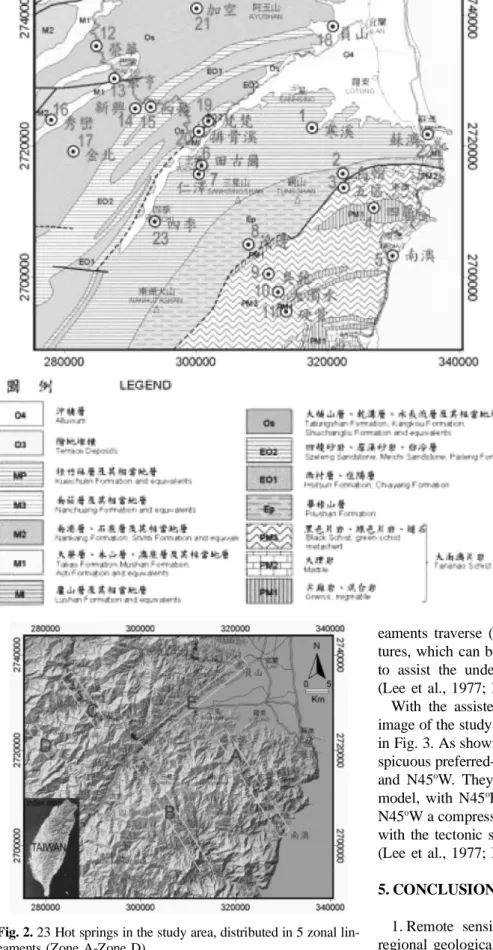
In the study area of 65 km by 55 km, there are 23 natural hot springs. They are distributed in lithological types of non-metamorphism, low-grade metamorphism and high- grade metamorphism. This indicates no implications of lithological significance of the occurrences of hot springs (Fig. 1), i.e. natural hot springs occur in all types of lithol- ogies.
However, as depicted in Fig. 2, a NW−SE and NE−SW tectonic trend is very obvious for the locations of these hot springs.
4. LINEAMENTS AND TECTONIC STRESS
It was observed that outcrops of hot springs in central Taiwan were located in places where 2 or more sets of lin- Jin-King Liu*
Ming-Fang Yu Shiun-Jenq Ueng
}
Geospace Information Technology Laboratory, Energy and Resources Laboratories (ERL), Industrial Technology Research Institute (ITRI), Building 24, 195 Sec.4 Chung-Hsing Road, Chutung, Hsin-Chu Hsien, 310 TaiwanEnvironmental Resources & Hazard Mitigation Laboratory, ERL, ITRI, 310 Taiwan
*Corresponding author: [email protected]
324 Jin-King Liu, Ming-Fang Yu, and Shiun-Jenq Ueng
eaments traverse (ITRI, 1980). Lineaments are strain-fea- tures, which can be applied to a stress-strain ellipse model to assist the understanding of local tectonic movements (Lee et al., 1977; Liu et al., 1983; Liu, 1984).
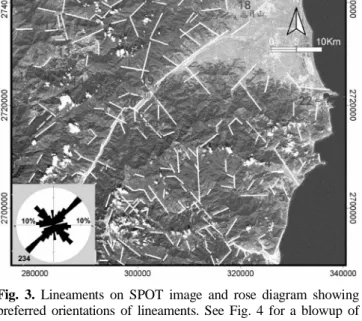
With the assistence of 3-D perspective view of SPOT image of the study area, lineaments were mapped as shown in Fig. 3. As shown in the rose diagram of Fig. 3, two con- spicuous preferred-orientations of the lineaments are N45
oE and N45
oW. They are conjugate in a stress-strain ellipse model, with N45
oE representing an extensional strain and N45
oW a compressional strain. This finding is in agreement with the tectonic stress model developed for Taiwan Area (Lee et al., 1977; Liu et al., 1983; Liu, 1984).
5. CONCLUSIONS
1. Remote sensing images can be used for observing regional geological lineaments, which can be applied to a
Fig. 1. 23 Hot springs in the study area, distributed in sedimentary and metamorphic rock types.Fig. 2. 23 Hot springs in the study area, distributed in 5 zonal lin- eaments (Zone A-Zone D).
A Structure-controlled model for hot spring exploration in Taiwan by remote sensing 325
regional stress-strain ellipse model to assist the understand- ing of the possible path which natural hot spring could travel from deep underground to the ground surface.
2. The results of image lineaments, tectonic pattern, and field observations are in good agreement. This supports the finding of structural-control of hot spring occurrences in this study.
REFERENCES
Chen, J.S., 1975, Some opinions on the origin of hot springs in Tai- wan and geological explorations. TiChi, 1(2), 107−108.
Chen, J.S., 1989, Hot springs and geothermals in Taiwan. TiChi, 9(2), 327−339.
Chen, J.S., 2000, Hot springs and geothermal resources. Proc. Hot Spring Tourism, 6-8 September, 2000. Tourist Bureau, Taichung County Government, Taiwan Hot Spring Association, Guguan Local Society Development Association.
ITRI, 1980, Report of study on the geological structures of of geo- thermal areas in central Taiwan. remote sensing promotion com- mittee, Ministry of economic affairs, the republic of China.
Lee, J.C., Angelier, F.J.De., Chu, S.J., Hu, C.C., La, K.B., Mu, D.H., Yeh, Y.S., Bu, R., Ko, W.Y., Lu, J.Y., Liu, P.M., Ru, D., Lee, F.C., Cheng, Z. J. and Lee, C. T., 1977, Map of Taiwan New Tectonic Pattern. Central Geological Survey.
Liu, J.K., 1984, Two newly-discovered tectonic patterns in Taiwan region - The circular pattern and the NW-SE Shear zone - as interpreted from small-scaled remote sensing images. XV ISPRS Congress, Rio de Janeiro, Brazil, 17-29 June 1984, Volume 25, part A7, p.293−302.
Liu, J.K., Wu, C.N. and Chuang, M.Y., 1983. Relations between lin- eaments, joint patterns, seismicity, and tectonic stresses in Tai- wan island. Proc. the 17th International symposium on remote sensing of environment, Ann Arbor, Michigan, 9-13 May 1983.
Manuscript received November 28, 2003 Manuscript accepted December 15, 2003
Fig. 4. Lineaments on SPOT image and rose diagram showing preferred orientations of lineaments.
Fig. 3. Lineaments on SPOT image and rose diagram showing preferred orientations of lineaments. See Fig. 4 for a blowup of central middle part of the image.