Vol. 9, No. 3, p. 235−242, September 2005
Milankovitch cycles and paleoceanographic evolution within sediments from ODP Sites 980 and 983 of the North Atlantic Ocean
ABSTRACT: Sediments from Ocean Drilling Program (ODP) Sites 980 and 983 in the North Atlantic Ocean were analyzed to obtain evidence of long-range Milankovitch cycles and to examine the cycles’ effect on the paleoceanographic evolution of the North Atlantic Ocean. Wide cyclic variations in total organic carbon and biogenic carbonate occur throughout the columns at both sites and provide distinctive characteristics of both sediment groups. Spec- tral modeling of these variations shows typical 100-ka cyclic vari- ations in both the total organic carbon (TOC) and carbonate records at Site 980, although this 100-ka Milankovitch frequency occurs only in the upper, ~472.5 ka, section of the core. In Site 983, only 400-ka cycle in carbonate is observed but the 100-ka cycle in TOC and carbonate is absent. The terrigenous content, expressed in terms of K, Al, Ti, and Th, also shows strong 100-ka and 400-ka cyclic variations at Site 983. The earth’s eccentricity as expressed 100-ka and 400-ka cycles, and no appearance of obliquity (41-ka) and precession (23-ka) are important characteristics of North Atlan- tic Ocean sediments. Milankovitch pulse differences in carbonate, TOC at the two sites likely arise from the evolution of paleocean- ography. The dilution of carbonate fractions by terrigenous mate- rials (indicated by the cyclical behavior of trace elements) at Site 983 is one of plausible explanation. Climatic warming over the last 600 ka probably caused the differences in the sedimentary cycles at the two sites; induced meltwater discharge is recorded in the terrige- nous record, and changes in the oceanic circulation system are related to major glacial–interglacial climatic episodes that probably underlie the differences in the cyclical records.
Key words: Milankovitch cycle, Paleoceanography, North Atlantic Ocean, Ocean Drilling Program (ODP)
1. INTRODUCTION
One of the significant scientific findings from the North Atlantic ODP Leg 162 (Fig. 1) was the discovery that high- amplitude oscillations exist in both the carbonate and TOC records of the last 2.8 Ma (Jansen et al., 1996). Earlier stud- ies recognized long-term cyclic variations in glacial and interglacial sedimentology and paleoceanography patterns of the Northern Hemisphere that arose from climatic changes extending from the late Pliocene into the Quaternary (Shackleton et al., 1988; Henrich, 1989; Jansen and Sjoholm, 1991; Raymo et al., 1992). Hence, carbonate fluctuations were expected, given the oceanographic and climatic evo-
lution of the North Atlantic Ocean documented by Jansen et al. (1988), Henrich (1989), and McManus et al. (1999).
Oritz et al. (1999) demonstrated significant sub-Milanko- vitch variability using a color reflectance record that implied the presence of carbonate fluctuation. This particular data set demonstrated that sub-Milankovitch variability had occurred not only during periods of major Northern Hemi- sphere glaciation over the last 2.5 Ma, but also prior to the late Pliocene intensification of Northern Hemisphere glaci- ation. All the results to date imply that Milankovitch vari- ability has contributed to climatic and paleoceanographic changes in the North Atlantic Ocean. However, the conse- quences of Milankovitch variation and its related long-term geochemical records are not well documented.
The present study analyzed TOC, biogenic carbonate, and K, Ti, Al, and Th at ODP sites 980 and 983 to establish the geochemical characteristics of the Milankovitch cycles and explore the cycles’ inter-relationships with the paleoceano- graphic evolution and paleoenvironmental changes in the North Atlantic Ocean.
2. LOCATION AND STUDY AREA
Site 980 is located on the Feni Drift in the northeast Atlantic Ocean, southeast of Rockall Bank (Fig. 1). The drift is deposited along the northwestern flank of Rokall Trough under the influence of geostrophic currents formed by Norwegian Sea overflow (Jansen et al., 1996). Site 983 was drilled on the Garder Drift, a sediment drift deposited on the eastern flank of the Reykjans Ridge that skirts the northwest margin of the Iceland Basin (Fig. 1). Sediment recovered from Site 983 is characterized by the cyclic occurrences of biogenic particles, ice-rafted debris (IRD), and redeposited fine-grained material carried by bottom currents (Jansen et al., 1996).
The North Atlantic is characterized by thermohaline con- vection that includes the northward transport of warm Atlantic water by the Norwegian Current and southward surface transport of cold polar water contained in the East Greenland Current (EGC). The growth and calving of the northern ice sheet has probably caused intermediate water Sangmin Hyun*
Naokaze Ahagon Ho-Il Yoon
South Sea Institute/Korea Ocean Research and Development Institute, 391 Jangmok-ri, Geoje 656-830, Korea
Hokkaido University, Kita 8 Nishi 5, Sapporo 060-0810, Japan
Korea Polar Research Institute, Ansan P.O. Box 29, Seoul 425-600, Korea
*Corresponding author: [email protected]
conditions to form in the Nordic and Icelandic seas and sig- nificantly contribute to the convection renewal rate of the North Atlantic Ocean during successive glacial and inter- glacial episodes (Aagaard and Carmack, 1994). A warm northward flow of North Atlantic surface water and a south- ward flow of cold saline polar surface water are the most prominent currents that affect the study area.
3. METHODS AND MATERIALS
From ODP Site 980, 160 samples were analyzed for TOC and biogenic carbonate. In addition, 53 samples from site 983 sediment were analyzed for TOC, carbonate, and major and trace elements. All samples were collected by onboard sampling during the ODP Leg 162 North Atlantic cruise. In the laboratory samples were dried at 100oC for more than 24 hr and then crushed in a ball mill for homogenization.
The total carbon (TC) content of the powders was measured directly using a carbon–hydrogen–nitrogen–sulfur (CHNS) analyzer (EA 1112) at the Korea Ocean Research and Development Institute (KORDI). The TOC content of the samples was determined, following treatment with 1N hydrochloric acid. The amount of biogenic carbonate was derived from the weight difference between TC and TOC as follows: CaCO3 (wt%)=(TC wt% -TOC wt%) ×(100/12). The inorganic content, including Ti, Al, and Th, was determined by X-ray fluorescence (XRF, Rigaku model 3270) at the University of Tokyo. Analytical errors for major elements ranged from 1% to 5% with minor elements having errors of <1% (Hyun et al., 1999). The age controls used in this study are based on the magnetostratigraphic and biostrati- graphic determinations of Channel and Lehman (1999), Jan- sen et al. (1996) and Koc et al. (1999); the age control points and related sedimentation rates at the two sites are
The sediment collected from site 980 on the Rockall Pla- teau is part of a large body of sediment that has accumu- lated largely from the action of the northward-moving, warm Norwegian Current. The sediments at this site vary in composition from ∼10 wt% to 90 wt% biogenic material.
The primary component is calcium carbonate, which varies from 8.02 to 83.85 wt% with an average value of 43.75 wt%.
Sediment from Site 983 came from the Garder Drift, where large amounts of sediment have been transported from neighboring Greenland and the Raykabikan Ridge by bottom currents (Ruddiman and Bowles, 1976). The bio- genic content of these sediments is slightly lower than those at Site 980 and consists of biogenic carbonate, biogenic sil- ica and minor TOC (Jansen et al., 1996). Biogenic carbon- ate varies from 2.81 to 48.24 with an average value of 18.99%.
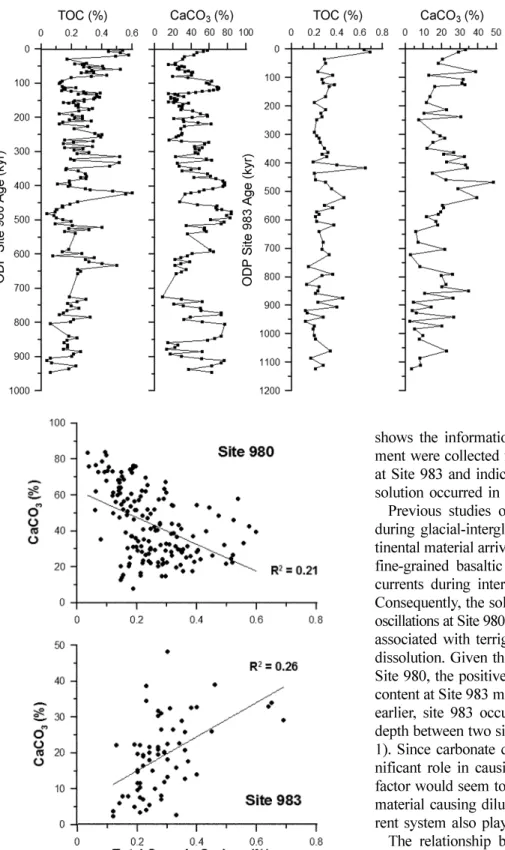
Wide variation occurs in both TOC and carbonate carbon throughout the core at both sites (Fig. 2). There is a six-fold variation in TOC from 0.1 to 0.6%, and a ten-fold variation in carbonate from 8 to 83% at Site 980. Similar large fluc- tuations occur in TOC and biogenic carbonate at Site 983 (Fig. 2). The maximum and minimum values of TOC are similar at both sites, but the overall carbonate content is slightly higher at Site 980 than Site 983.
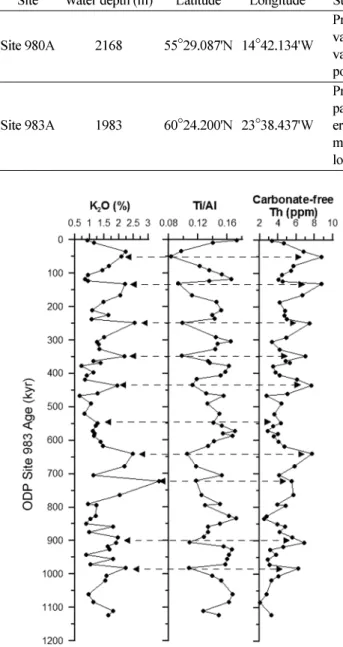
The striking ten-fold variation in carbonate content of the column results from time-dependent changes in oceanic productivity and carbonate dissolution, as well as carbonate dilution by terrigenous materials. The inter-relationship between TOC and carbonate indicates whether any variations arise from changes in productivity and/or carbonate dissolu- tion as illustrated in Figure 3. The negative relationship at Site 980 and the positive relationship at Site 983 indicate that dif- ferent mechanisms have operated in TOC and carbonate dep- ositional and accumulation processes at both sites.
In normal open ocean conditions the relationship between TOC and carbonate content usually shows a negative rela- tionship as seen at Site 980 (Fig. 3). Ricken (1993) inter- preted this inverse correlation between carbonate and organic carbon as a consequence of significant variation in carbon- ate supply; this is considered the most likely cause of the variations at site 980, although carbonate dissolution prob-
Fig. 1. Map showing ODP Leg 162 and Sites 980 and 983 in the North Atlantic Ocean. The location of the area investigated in this study is indicated by arrow. Table 1 lists the water depth and other information relevant to the two sites.
ably made a minor contribution. The present carbonate compensation depth (CCD) in the Atlantic Ocean occurs at roughly 4,000–4,500 m (Biscaye et al., 1976). Table 1
shows the information of the two Sites. The drilled sedi- ment were collected from 2,168 m at Site 980 and 1983 m at Site 983 and indicates that no significant carbonate dis- solution occurred in any of the present samples.
Previous studies of non-biogenic sediment fluctuations during glacial-interglacial cycles at Site 983 point to con- tinental material arriving as IRD during glacial periods with fine-grained basaltic debris being deposited from bottom currents during interglacial episodes (Hyun et al., 1999).
Consequently, the sole major causes of carbonate and TOC oscillations at Site 980 can only be the time-dependent changes associated with terrigenous materials and minor carbonate dissolution. Given the nature of the carbonate excursion at Site 980, the positive relation between TOC and carbonate content at Site 983 may have a different cause. As indicated earlier, site 983 occurs in an area of drift with the water depth between two sites differing by only 200 m (see Table 1). Since carbonate dissolution can not have played a sig- nificant role in causing this positive correlation, the main factor would seem to lie in the ready supply of terrigenous material causing dilution at Site 983, with the surface cur- rent system also playing a role.
The relationship between the terrigenous and biogenic fractions was ascertained by analysis of geochemical vari- ations in the major and minor elements of the Gardner Drift sediments at Site 983. Aluminum and Ti are considered typ- ical terrigenous elements occurring in aluminosilicate matri- ces (Spears and Kanris-Sotirios, 1976; Mooby, 1983; Hyun and Kim, 1999), and variations in these elements have been used to evaluate the movements of terrigenous material from sediment sources (Grousset et al., 1982; Garver et al., 1996)
Fig. 2. Vertical variations in the con- tents of TOC and biogenic carbonate (CaCO3) at Sites 980 and 983. The model ages for each core are con- structed on the basis of magnetostrati- graphic and biostratigraphic data contained in the scientific results of Leg 162 (see text).
Fig. 3. Scatter diagram showing the inverse relationships between the TOC and the biogenic carbonate content (CaCO3) at Site 980 and the positive relationship at Site 983.
and the presence of IRD in the North Atlantic (Moros et al., 2004).
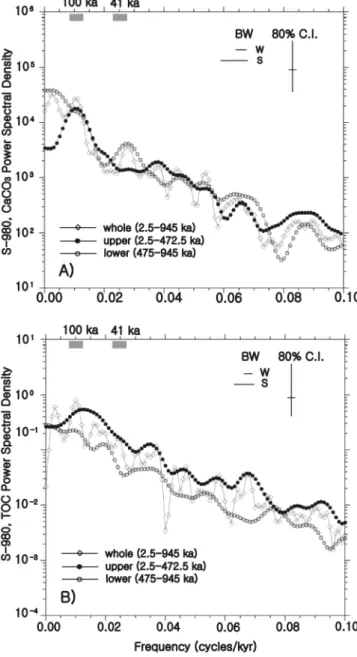
The vertical profiles of the non-biogenic fraction, K2O, Ti/Al, and carbonate-free Th of Site 983 are shown in Figure 4.
The percentage of K2O fluctuates between about 0.7 and 3% and displays a cyclic variation. The ratios of Ti/Al and carbonate-free Th (ppm) show large fluctuations throughout and also have cyclic variations that possess a concordant inverse relationship (Fig. 4). Carbonate-free Th and K2O have a pronounced covariance that has an inverse relation- ship with that of Ti/Al throughout the core as indicated by arrows. The coherent fluctuations in carbonate-free Th and
4.2. Milankovitch Cycle
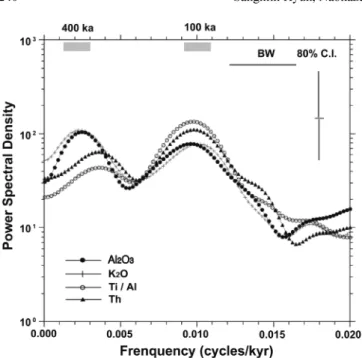
The excursions in TOC and carbonate and their cyclic variations could be produced by time-dependent carbonate dissolution, but they are also consistent with Milankovitch cycles in biogenic oceanic productivity. To evaluate the probable causes for such large fluctuations, spectral models of the biogenic carbonate and TOC were constructed and analyzed in the upper 2.5–472.5 kyr, lower 475–945 kyr sections and for the whole (2.5–945 kyr) sequence at Site 980 (Fig. 5A, B). The results show typical 100-ka cyclic variations in both TOC and carbonate records at Site 980.
However, this 100-ka Milankovitch frequency pattern is not dominant throughout the core; it occurs only in the upper section from 0 to 472.5-ka. However, the tilt and precession cycles are not clearly developed, and a potential source of error is a lack of age control in the high-frequency range as a result of insufficient sampling. On the other hand, it is possible that variations in the percent of CaCO3 fail to reflect the tilt and precession cycles because of some local environmental condition. This approximate 100-ka cycle is similar to that found in a previous study in the North Atlan- tic Ocean (Henrich, 1989; Bout-Roumazeilles et al., 1997).
The reason behind the absence of any 100-ka cycle in the lower part of the column and the nature of the tilt and pre- cession cycles require further study if the precise relation- ship between Milankovitch cycles and paleoceanographic variations is to be ascertained.
At Site 983 the spectral results for TOC and carbonate do not show the tilt and precession cycles, but only eccentric orbital factor of a 400-ka cycle in carbonate (Fig. 6). There are several reports about 400-ka cycle in orbital eccentricity (Berger et al., 2002; Williams et al., 2002). Especially, Wil- liams et al. (2002) had demonstrated that high-resolution records of sedimentary cycles were regarded as 400-ka cycles in orbital eccentricity in the Bahama Bank. Further- more, this 400-ka cycle are related with the amplitude of sea-level fluctuation, which will cause more carbonate pro- duction and deposited than a low-amplitude sea-level rise.
Fig. 4. Vertical variation in K2O, Ti/Al and carbonate-free Th con- centrations. The strong coherent variation among the three com- ponents is indicated by the broken-arrow lines.
Therefore, the long-range variations in 400-ka cycle may be attribute to carbonate production, which is related with the evolution of North Atlantic Ocean.
The absence of any 100-ka cycle of TOC and carbonate at Site 983 may reflect the dilution by terrigenous material.
Further, the cyclic nature of the terrigenous input may have diluted and modulated any original 100-ka cycles of either TOC or carbonate. Hyun et al. (1999) demonstrated that glacial–interglacial cyclic variations in the terrigenous mate- rials were reflected in the K2O, Ti/Al and carbonate-free Th contents of sediments. At Site 983 on the Garder Drift, large amounts of sediment have been transported from neighbor-
ing Greenland and the Raykabikan Ridge by the bottom current (Ruddiman and Bowles, 1976), creating a relatively rapid sedimentation rate at Site 983 compared with Site 980 and presumably causing the differences in the relevant 100-ka Milankovitch signal recorded at both sites.
As illustrated in Figure 4, the most striking feature of site 983 is the cyclic variations in Ti/Al and carbonate-free Th throughout the core. This cyclic variation is most evident in the upper layer above 600 ka. Hyun et al. (1999) demon- strated that sediments from the North Atlantic ODP Site 983 have cyclic Ti/Al variations that were interpreted as reflecting variations in dilution from input of terrigenous material and, to a lesser extent, carbonate dissolution. In Figure 4, terrigenous materials at Site 983, as represented by Th, K2O, and Ti/Al and Al2O3, show cyclic variations that exhibit a 100-ka Milankovitch cycle. In previous work, this phenomenon was interpreted as reflecting a major glacial–
interglacial cycle with input arising from continental materials supplied as ice-rafted debris during the glacial period and fine-grained basaltic material transported by bottom cur- rents during interglacial episodes (Hyun et al., 1999).
Figure 7 shows the results of spectral analysis of the ter- rigenous content at Site 983. Strong 100-ka cyclic varia- tions and weak 400-ka and are present in all parameters.
This is consistent with the previous results modeled graph- ical by Hyun et al. (1999). No clear 41-ka or 23-ka cycles are apparent, although a faint 400-ka cycle could be present in Figure 7. Therefore, the absence of 100-ka cycle in TOC and carbonate is attribute to the dilution by terrigenous material. As mentioned earlier, the reason for the 400-ka cycle is attributed to the amplitude of sea-level fluctuation.
The possible sub-Milankovitch signal reported by Ortiz et
Fig. 5. Spectral modeling of CaCO3 (A) and TOC content (B).
Whole column is divided into the upper, 2.5–472 ka section, lower 472-945 ka section and whole columm (2.5–945 ka) of Site 980.
In bandwidth (BW), W means for whole section and S means that for split sections.
Fig. 6. Spectral modeling of the biogenic content (TOC and cal- cium carbonate) at Site 983 showing weak 400-ka carbonate cycles.
al. (1999) or insufficient age control may cause the weak- ness of the 400-ka cycle signal in the North Atlantic Ocean.
4.3. Paleoceanographic Evolution of the North Atlantic Ocean over the Last 1 Ma
Open ocean conditions have likely prevailed in the cen- tral Icelandic Plateau since at least the middle Miocene (Talwani and Eldholm, 1977). Any accumulation of terrig- enous sediments should therefore be related to major gla- cial–interglacial ocean conditions. Sea-ice and the waxing and waning of the continental ice sheets contribute signif- icantly to the circulation of deep water and therefore the supply of terrigenous materials. The development of sea ice and ice-calving in the North Atlantic Ocean has greatly affected the distribution of terrigenous sediments, given that large amounts of deep-sea sediments are supplied to the ocean by continental IRD from neighboring continents (Broecker, 1984; Henrich, 1989).
The paleoceanographic evolution of the North Atlantic Ocean has been documented by several proxy studies such as those concerned with IRD (Henrich, 1989) and foramin- iferal isotopes (Raymo et al., 1985). Jansen et al. (1988) used analysis of sediments collected from DSDP and ODP cores to model the oceanographic and climatic evolution of the North Atlantic over the last 2.8 Ma. That study clearly showed that a major expansion of the Scandinavian Ice sheet into coastal areas took place about 2.5 Ma, with a transition toward larger glacial episodes from 1.2 to 0.6 Ma, accompanied by warmer interglacials and reduced calcite dissolution. Only during the last 0.6 Ma has the oceano-
controls affecting the intensity of physical and chemical weathering, but also to latitudinal controls influencing high latitude wind- and ocean-driven transportation processes.
As shown in Figure 4, cyclic variations in terrigenous mate- rials expressed in Ti/Al and carbonate-free Th probably arise from a major glaciation affecting the North Atlantic Ocean. A rather obscure signal occurring between 500−600 ka is another characteristic of this site. In addition, bottom current sedimentation along the eastern Reykjanes Ridge (Ruddiman and Bowles, 1976) has probably influenced the cyclic variation in both Ti/Al and Th.
Studies by Hagen and Hald (2002) and Reeh (2004) dem- onstrated that ocean surface circulation and temperature are the likely cause of Holocene cycles in the IRD contribu- tions to North Atlantic deep-sea sediments, with IRD car- ried as surface load on sea- or glacier-ice. This finding supports the notion that changes in atmospheric and ocean- surface circulation and their temperatures are the most likely cause of cycles in IRD concentration in North Atlan- tic deep sea sediments (Bond and Lotti., 1995; Bond et al., 2001). Hence, the cyclic variations present at Site 983 are most probably related to glacial–interglacial climatic vari- ations that have affected the distribution of terrigenous material. However, this 100-ka cycle is not clear in the lower part of site 980 (Fig. 4) due to lack of resolution in this part of the core. Given that the IRD of the North Atlan- tic’s deep-sea sediments records the glacial episodes of the Northern Hemisphere (Jansen and Sjoholm, 1991), the cyclic variations present in our core reflect the evolution of the North Atlantic paleoceanographic and climatic changes.
5. CONCLUSIONS
Sediment samples from ODP sites 980 and 983 were examined for evidence of long-range Milankovitch cycles and their consequence on the paleoceanography of the North Atlantic Ocean. Spectral analyses showed repeated cyclic variation of TOC and carbonate at 100-ka intervals over the last 600 ka at site 980, and a 100-ka and 400-ka cyclic variation in terrigenous material at Site 983. This
Fig. 7. Spectral modeling of the non-biogenic content of Al2O3, K3O, Ti/Al and Th at Site 983 showing a relatively strong 100-ka cycle and weak 400-ka cycles.
100-ka Milankovitch frequency pattern is not seen through- out either core and occurs only in the upper (0 to 472.5 ka) section. This approximate 100-ka cycle is similar to that found by Henrich (1989) in the North Atlantic Ocean with repeated 100-ka pulses occurring over the last 600 ka being an important characteristic of the North Atlantic sediments.
A large fluctuation in carbonate and TOC over the last 1 Ma has arisen due to dilution by terrigenous sediments. A cyclical flux in trace elements at Site 983 confirmed the effect of terrigenous input. Climatic warming over the last 600 ka has probably caused the variations that record not only the terrigenous record but also the induced melt water discharge.
ACKNOLOGEMENT: This work was conducted by using ODP Leg 162 sediments. We thank to Dr. S. Nam of KIGAM for critical reviews and two anonymous reviewers. This research was mainly conducted by program of KORDI, PG90202. Funding for this study was partly supported by KOPRI (Korea Polar Research Institute) Project (PE 05004) and K-IODP (Korean Integrated Ocean Drilling Program, 05-9102).
REFERENCES
Aagaard, K. and Carmack, E.C., 1994, The Arctic ocean and climate:
a pespective. In: Johannessen, O.M., Muensch, R.D. and Over- land, J.E. (eds.), The Role of Ocean and Their Role in Shaping the Global Environment. Geophysics Monography, Maurice Ewing Series, American Geophysical Union, 85, 5−20.
Berger, W.H., Lange, C.B and Perez, M.E., 2002. The early Matuyama diatom maximum off SW Africa: a conceptual model. Marine Geology, 180, 105−116.
Biscaye, P.E., Kolla, V., Turekian, K.K., 1976, Distribution of cal- cium carbonate in surface sediment of the Atlantic Ocean. Jour- nal of Geophysical Research, 81, 2595−2603.
Bond, G.C., Lotti, R., 1995, Iceberg discharge into the North Atlantic on Millennial time scales during the last Glaciation. Science, 267, 1005−1010.
Bond, G.C., Kromer, B., Beer, J., Muscheler, R., Evans, M.N., Show- ers, W., Hoffmann, S., Lotti-Bond, S., Hajdas, I., and Bonani, G., 2001, Persistant solar influence on North Atlantic climate during the Holocene. Science, 294, 2130−2136.
Bout-Roumazeilles, V., Debrabant, P., Labeyrie, L., Chamley, H., and Cortijo, E., 1997, Latitudinal control of astronomical forcing parameters on the high-resolution clay mineral distribution in the 45o–60oN range in the North Atlantic Ocean during the past 300,000 year. Paleoceanography, 12, 671−686.
Boyle, E.A., and L.D. Keigwin, 1982, Deep circulation of the North Atlantic over the last 200,000 year: Geochemical evidence, Sci- ence, 218, 784−787.
Broecker, W.S., 1984, Massive iceberg discharge as triggers for glo- bal climate change. Nature, 327, 421−424.
Broecker, W.S., 1997, Thermohaline circulation, the Achilles heel of our climate system: Will man-made CO2 upset the current bal- ance? Science, 278, 1582−1588.
Channell, J.E.T., Lehman, B., 1999, Magnetic stratigraphy of North Atlantic Sites 980−984. Proceedings of the ODP Scientific Results, 162, 113−130.
Garver, J.I., Royce, P.R. and Smick, T.Y., 1996, Chromium and nickel in shale of the tactonic foreland: a case study for the prov-
enance of fine-grained sediment with an ultramafic source. Jour- nal of Sedimentary Research, 66, 100−106.
Grousset, F., Latouche, C. and Parra, M., 1982, Late Quaternary sed- imentation between the Gibbs Fracture and the Greenland Basin:
Mineralogical and geochemical data. Marine Geology, 47, 303−330.
Hagen, S., and Hald, M., 2002, Variation in surface and deep water circulation in the Denmark Strait, North Atlantic, during marine isotope stages 3 and 2. Paleoceanography, 17, doi:10.1029/2001 PA000632.
Hays, J.D., Imbrie, J., Shackleton, N. J., 1976, Variation in the Earth’s Orbit: Pacemaker of the ice ages, Science, 194, 1123−1131.
Henrich, R., 1989, Glacial/interglacial cycles in the Norwegian Sea:
Sedimentology, and evolution of late Pliocene to Quaternary northern hemisphere climate. Proceedings of the ODP Scientific Results, 104, 189−215.
Hyun, S., Joseph D. O., Raymo, M.E and Taira, A., 1999, Low-fre- quency oscillations in site 983 sediment: relationship between carbonate and productivity proxies. Proceedings of the ODP Sci- entific Results, 162, 197−207.
Hyun, S., and Kim, S., 1999, Geochemical study for provenance and paleoceanography on ODP Site 907 sediments of the North Atlan- tic Ocean. Geoscience Journal, 3, 95−106.
Jansen, E., Bleil, U., Henrich, R., Kringstad, L and Slettemark, B., 1988, Paleoenvironmantal changes in the Norwegian Sea and the Northeast Atlantic during the last 2.8 m.y.: Deep Sea Drilling Project/Ocean Drilling Program Sites 610, 642, 643 and 644.
Paleoceanography, 3, 563−581.
Jansen, E. and Sjoholm, J., 1991, Reconstruction of glaciation over the past 6 Myr from ice-boron deposits in the Norwegian Sea.
Nature, 349, 600−603.
Jansen, E., Raymo, M.E., Blum, P., Anderson, E.S., Austin, W.E.N., Baumann, K-H., Bout-Roumazeilles, V., Carter, S.J., Channell, J.E.T., Cullen, J.L., Flower, B., Higgins, S., Hodell, D.A., Hood, J.A., Hyun, S., Ikehara, M ., King, T., Larter, R., Lehman, B., Locker, S., Mclntyre, K., McManus, J., Meng, L.B., O’Commell, S., Ortiz, J.D., Rack, F.R., Solheim, A., Wei, W., 1996. Proceed- ings of the ODP Initial Reports, 162; College Station, TX (Ocean Drilling Program), 1182 pp.
Koc, N., Hodell, D.A., Kleiven, H and Labeyrie, L., 1999, High-res- olution Pleistocene diatom biostratigraphy of Site 983 and cor- relations with isotope stratigraphy. Proceeding of the ODP Scientific Results, 162, 51−62.
McManus, J.F., Oppo, D.W and Cullen, J.L., 1999, A 0.5 million year record of millennial-scale climate variability in the North Atlantic. Science, 283, 971−975.
Mooby, S.A., 1983, The geochemistry of transitional sediments recovered from the Galapagos hydrothermal mounds field during DSDP Leg 70-implication for mound formation. Earth and Plan- etary Science Letters, 62, 367−376.
Moros, M., McManus, J.F., Rasmussen, T., Kuijpers, A., Dokken, T., Snowball, I., Neilsen, T., and Jansen, E., 2004, Quartz content and the quartz-to-plagioclase ratio determined by X-ray diffrac- tion: a proxy for ice rafting in the northern North Atlantic? Earth and Planetary Science Letters, 218, 389−401.
Oritz, J. D., Mix, A.C., Harrism S.E and O’Connell, S.B., 1999, Dif- fuse spectral reflectance as a proxy for percent carbonate content in North Atlantic sediments. Paleoceanography, 14, 171−186.
Paillard, D., Labeyrie, L and Yiou, P., 1996, Macintosh program per- forms time-series analysis. EOS Trans. AGU, 77, 378.
Rasmussen, T.L and Thomsen E., 2004, The role of the North Atlan- tic Drift in the millennial timescale glacial climate fluctuations.