대한내시경복강경외과학회지
□ 원 저 □
Vol. 11. No. 2, 2008
73
복강경 수술 시 발생하는 연기와 연기필터의 효과
전북대학교 의학전문대학원 외과학교실
최석진ㆍ황시은ㆍ유희철ㆍ김찬영ㆍ이민로ㆍ윤현조
Surgical Smoke and the Effect of a Laparoscopic Filter
Seok Jin Choi, M.D., Si Eun Hwang, M.D., Hee Chul Yu, M.D., Chan Young Kim, M.D., Min Ro Lee, M.D., Hyun Jo Youn, M.D.
Department of Surgery, Chonbuk National University Medical School, Jeonju, Korea
Purpose: The aim of this study is to analyze the gaseous byproducts produced during laparoscopic surgery and to determine the effect of a laparoscopic filter for protecting operating room personnel and patients from potentially biohazardous byproducts.
Methods: We analyzed the gaseous byproduct samples emitted during laparoscopic surgery and we compared the TVOCs (total volatile organic compounds) and chemicals between the filtered gas and the non-filtered gas. The subjects of our study were 14 patients who underwent laparoscopic surgery between November 2006 and February 2007.
Results: Surgical smoke or the fumes produced during laparoscopic surgery contained potentially biohazard chemicals such as acetonitrile, carbon disulfide, methane, phenol, styrene, sulfur dioxide, toluene and xylene and carcinogens
such as benzene, chloroform and ethylene oxide. A laparoscopic filter, as an offtake device, effectively removes most of the harmful chemicals, including carcinogens.
Conclusion: Many kinds of potentially hazard, gaseous byproducts, including carcinogens, were produced during laparoscopic surgery, and especially when performing electro- cautery. A laparoscopic smoke filter reduced the hazardous smoke and noxious odor, in addition to providing clearer vision for the operating personnel. Surgeons and operating room personnel should do all that is possible to protect themselves and patients from surgical smoke.
Key words: Laparoscopy, Smoke, Filter 중심단어: 복강경, 연기, 필터
※ 통신저자:유희철, 전주시 덕진구 금암동 634-18 우편번호:561-712
전북대학교 의학전문대학원 외과학교실 Tel:063-250-1576, Fax:063-271-6197 E-mail:[email protected]
서 론
최근 복강경 수술은 경험의 축적 및 숙련된 술자, 그리고 수술 기구의 발달로 다양한 분야에서 표준화된 술식으로 자 리를 잡아가고 있다. 절제 장기의 박리 및 분리를 위한 도구 로서 전기 소작기(electrocautery)나 초음파 절단기(ultrasonic scalpel)의 역할은 복강경 수술에 있어 절대적이라 할 수 있 다. 이러한 전기 소작기 및 초음파 절단기를 이용하여 조직 을 분리하는 과정에서 발생하는 연기(smoke or plume)는 수 술자의 시야를 가리고 이로 인한 수술 시간의 지연을 초래 하여왔다. 이 뿐 만 아니라 역한 냄새와 함께 다양한 유해 물질들을 내포하고 있음이 최근의 연구들에 의하여 밝혀져 있다. 유해 물질 내에 포함된 것으로 알려진 Acetonitrile, Benzene, Chloroform, Ethyl benzene, Phenol, Toluene 등은 피 부나 눈, 또는 폐에 자극제(irritant)로 작용할 수 있고, virus
particle 등의 bio-aerosol이 감염을 유발 할 수 있을 뿐만 아니라 누적효과에 의하여 종양을 유발할 수도 있다(Table 1).1-3,10,11 이에 본 연구에서는 복강경 수술 시 발생하는 연기 속에 포함된 다양한 유해 가스를 분석하고 환자 및 수술장내의 의료진들이 유해 가스에 노출되는 위험성을 최소화 하기 위한 방법의 하나로 세포나 바이러스뿐만 아니라 화학적 유해 물질 및 역한 냄새를 제거하는 것으로 알려진 복강경 용 필터를 사용하여 그 효과를 확인하고자 한다.
대상 및 방법 1) 대상
2006년 11월부터 2007년 2월 사이에 전북대학교병원 외 과에서 시행한 복강경담낭절제술, 복강경보조원위부위절 제술, 복강경전방절제술, 내시경갑상선절제술을 시행 받은 14명의 환자를 대상으로 하였다(Table 2).
2) 유해 가스 포집과 분석 방법 및 필터
모든 환자에 있어 복강경 또는 내시경적 수술 시 사용한 투관침과 연결된 포집관을 통하여 가스를 포집하였고, 수술 시야 확보를 위해 사용한 CO2 가스만 적용한 경우를 그 기저
74 대한내시경복강경외과학회지 제11권 제2호 2008
Table 2. Chemicals in surgical smoke Acetaldehyde
Acetic acid Acetonitrile Benzene*
Butadiene*
Carbon disulfide Chloroform*
Ethane Ether Ethyl benzene
Ethylene oxide*
Isopropyl alcohol Methane
2-methyl propanol Naphthalene
Phenol Stylene Sulfur dioxide Toluene Xylene
*Carcinogen.
Fig. 1. Schematic diagram of the laboratory setup. Smoke produced during laparoscopic surgery was collected through tube (TenaxⓇ TA) and analyzed.
Table 1. Patient characteristics
Group Op name Diagnosis Age Sex Weight (kg) Height (cm)
Electrocautery
Ultrasonic scalpel
Laparoscopic cholecystectomy
LADG†
Endoscpic thyroidectomy
Laparoscopic anterior resection
CC*
CC CC CC CC CC Ca‡ Ca Ca Ca Ca NG§ Ca Ca
68 55 47 46 27 73 48 72 58 80 38 38 36 61
F M M M F M F F F F M F F F
57 70 60 90 49 67 62 63 68 39 81 53 49 65
158 164 176 174 166 162 153 150 150 145 174 157 161 154
*CC = chronic cholecystitis; †LADG = laparoscopy assisted distal gastrectomy; ‡Ca = cancer; §NG = nodular goiter.
치로 하였다. 초음파 절단기 및 전기 소작기를 사용하기 시 작한 후부터 발생한 연기는 포집관을 통하여 테낙스 튜브 컨 디션닝 시스템(TenaxⓇ TA, Agilent, USA)을 이용, 분당 167 ml의 속도로 3.2 liter를 포집하였고 열탈착식 가스크로마토 질량분석기(Thermal desorption gas chromatograph mass spectrometer, Agilent, USA)를 통하여 TVOCs (total volatile organic compounds) 및 각각의 유해 가스들을 분석하였다. 필 터를 사용한 경우는 포집 직전 과정에 필터(LaparoshieldTM LSF1, Pall medical, USA)를 삽입하고 포집하였다(Fig. 1).4 3) 비교 분석
임상적인 인자에 대한 분석은 paired T-test와 Mann- Whitney 검정을 시행하였고, p value가 0.05 미만인 경우 통 계적으로 유의한 차이가 있다고 판단하였다. 모든 통계처 리는 Window용 SPSS 15.0 프로그램을 이용하였다.
결 과 1) 수술 시 발생하는 유해 가스
전기 소작기나 초음파 절단기를 사용한 복강경 수술 시 발생하는 연기를 포집하여 분석한 결과, Acetonitrile, Carbon
disulfide, Methane, Phenol, Styrene, Sulfur dioxide, Toluene, Xylene 등의 다양한 자극성 유해 물질 뿐 만 아니라 발암물 질로 알려진 Benzene, Chloroform, Ethylene oxide 등도 포함 되어 있었다(Table 3).
2) 필터 사용 유무에 따른 TVOCs 농도 및 유해 물질의 농도 모든 대상자로부터 분석한 연기 내 총 휘발성 유기 화합 물(TVOCs)의 농도 및 선별된 유해 물질의 농도를 필터 여 과와 비여과로 나누어 평균값을 비교한 결과 총 휘발성 유 기 화합물의 농도는 필터 여과 시 3.118 ppm, 비여과 시 11.473 ppm으로 통계적으로 유의한 차이를 보였다. 각각의 유해 물질 있어서는 Acetic acid, Benzene, Ethyl benzene, Styrene, Sulfur dioxide, m-Xylene이 통계적으로 유의한 차이 를 보이고 있다(Table 4).
최석진 외 5인: 복강경 수술 시 발생하는 연기와 연기필터의 효과 75
Table 4. Reduction of TVOCs and chemicals when using filter NIOSH permissible
exposure limit (ppm*)
Non-filtered (ppm) (n=14)
Filtered (ppm)
(n=14) p value
TVOCs Acetic acid Acetonitrile Benzene Carbon disulfide Chloroform Ethyl benzene Ethylene oxide Isopropyl alcohol Styrene
Sulfur dioxide m-Xylene
10 TWA† 20 TWA
0.1 TWA 1 TWA 2 STEL§
100 TWA
<0.1 TWA 400 TWA 50 TWA 2 TWA 100 TWA
11.473±9.007 0.049±0.065 0.007±0.026 0.525±0.778 0.005±0.012 0.024±0.047 0.067±0.083 0.344±0.756 0.163±0.319 0.052±0.069 0.022±0.036 0.059±0.064
3.118±2.242 0.007±0.014
ND‡ 0.035±0.046 0.001±0.005 DNM∥ 0.012±0.014 0.116±0.231 0.341±0.565
ND ND 0.021±0.035
0.006 0.055 0.337 0.034 0.385 0.091 0.038 0.379 0.379 0.020 0.050 0.022
*ppm = part per million; †TWA = time-weighted average over 8 hour period; ‡ND = not detected; §STEL = short-term exposure limits for 15 min. period; ∥DNM = detected but not measured; NOISH = national institute of occupational safety and health.
Table 5. Concentration difference between ultrasonic scalpel group (A; laparoscopy-assisted distal gastrectomy, laparoscopic anterior resection, endoscopic thyroidectomy) and electrocautery group (B; laparoscopic cholecystectomy)
Group A (ppm*) (n=8) Group B (ppm) (n=6)
Non-filtered Filtered Non-filtered Filtered
TVOCs Acetic acid Acetonitrile Benzene Carbon disulfide Chloroform Ethyl benzene Ethylene oxide Isopropyl alcohol Styrene
Sulfur dioxide m-Xylene
7.441±3.653 0.027±0.046
ND† 0.004±0.010
ND ND 0.024±0.031 0.612±0.979 0.214±0.379 0.007±0.012
ND ND
3.533±2.546 0.010±0.017
ND ND 0.003±0.007
DNM‡ 0.016±0.017 0.197±0.304 0.561±0.717
ND ND 0.032±0.044
16.177±11.374 0.075±0.007 0.015±0.038 1.133±0.792 0.011±0.017 0.052±0.059 0.117±0.098 0.031±0.076 0.164±0.254 0.104±0.072 0.047±0.040 0.032±0.039
2.632±1.940 0.004±0.009
ND 0.075±0.036
ND 0.001±0.002 0.007±0.007 0.064±0.078 0.084±0.046
ND ND 0.009±0.014
*ppm = part per million; †ND = not detected; ‡DNM = detected but not measured.
Table 3. Risks of surgical smoke
Acute and chronic inflammatory changes in respiratory Tract (emphysema, asthma, chronic bronchitis) Hypoxia/Dizziness
Eye irritation Nausea/vomiting Headache Sneezing Carcinoma Dermatitis Lacrimation Anxiety Hepatitis/HIV
3) 초음파 절단기를 사용한 군과 전기 소작기를 사용한 군간의 필터 사용 유무에 따른 TVOCs 및 유해 물질의 농도
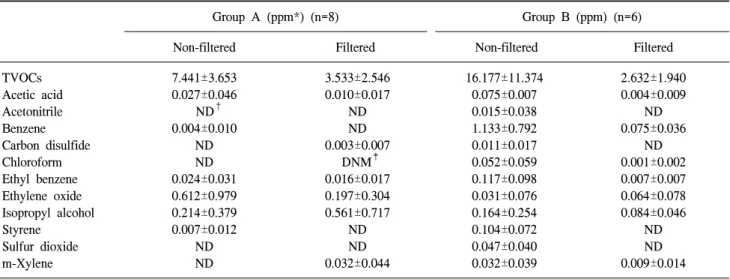
주로 초음파 절단기를 사용한 군(복강경보조원위부위절 제술, 복강경전방절제술, 내시경갑상선절제술)과 전기 소 작기를 사용한 군(복강경담낭절제술)으로 나누어 두 군간 의 TVOCs 및 각각의 유해 물질 농도의 평균값을 비교한 결과, 전기 소작기를 사용한 군이 전반적으로 고농도의 유 해 물질을 포함하고 있는 것으로 나타났다. 필터를 사용한 경우 양 군 모두 그 농도가 감소하는 결과를 보이고 있다 (Table 5).
76 대한내시경복강경외과학회지 제11권 제2호 2008
고 찰
수술 시 발생하는 연기에의 노출과 관련하여 수많은 연 구들이 그 내재된 위험성 및 건강에 미치는 영향들을 보여 주었다. 특히 미국내의 권위 있는 국가기관인 National Institute of Occupational Safety and Health (NIOSH), Occupational Safety and Health Administration (OSHA), Association of Operating Room Nurses (AORN) 및 American National Standard Institute (ANSI) 등에서 환자 및 수술장내 의료진들은 수술 시 발생하는 연기로 인하여 그들의 건강 에 유해한 결과가 초래될 수 있음을 밝혔고 피부, 호흡기 및 여러 기관(organ)에의 자극제로서의 효과 뿐 아니라 돌 연변이를 유발하거나 암을 유발할 수 있는 여러 유해 가스 성분 각각에 대하여 NIOSH와 OSHA에서는 허용 노출 농도 (PEL; permissible exposure limit)를 제시하였다.2,3,10-13 또한 위에 언급한 모든 기관에서 유해 가스 노출을 최소화하기 위해 적절한 연기 방출 시스템 및 마스크를 사용해야 함을 권고하고 있고 일부 기관에서는 적절한 연기 방출 시스템 이 없다면 적절한 필터를 사용해야 함을 권고하고 있다. 따 라서 연기 방출 시스템이나 복강경용 필터, 또는 적절한 마 스크의 사용에 대한 수술방내 의료진들의 자각이 무엇보다 도 필요한 시점이나 수술 시 발생하는 연기로부터 노출을 피하기 위한 적극적 노력은 부족한 실정이다.
본 연구에서 복강경 및 내시경 수술로 발생하는 유해 물 질로부터 수술장내의 의료진 및 환자의 노출을 최소화 하 기 위한 방법으로 복강경용 필터를 사용하였다. 그 결과 TVOCs 및 각각의 유해가스가 감소되어 배출됨을 확인하였고, 특히 발암성 물질로 알려진 Benzene 등을 포함하여 여러 유 기 화합물의 농도가 통계적으로 유의하게 감소함을 볼 수 있었으며 본문에서 언급하지 않았지만 각각의 수술방법에 있어서도 필터를 사용한 경우 유해 가스의 농도가 감소됨을 확인할 수 있었다. 또한, 초음파 절단기를 사용한 군과 전기 소작기를 사용한 군 간의 비교에 있어서도 전기 소작기를 사용한 군에서 초음파 절단기를 사용한 군보다 고농도의 유해 물질이 발생됨을 확인함과 함께 필터를 사용하였을 경우 유해 가스가 현저하게 감소됨을 확인하였다. 그러나 증례수가 적어 일부 통계적 유의성을 갖기 어려웠던 부분 에 대하여 증례의 확대가 필요할 것으로 생각된다. 또한 수 술 중 발생한 연기 전체를 분석, 적용하여 고농도의 유해 물질들이 포함되어 있음을 확인해 볼 필요성을 갖게 한다.
결 론
복강경 및 내시경 수술 시 사용하는 초음파 절단기 및 전 기 소작기로 인해 즉각적 또는 잠재적 위험성을 갖는 것으 로 알려진 다양한 종류의 유해 물질이 발생하고, 특히 암을
유발하거나 돌연변이를 유발할 수 있는 유해 물질이 발생 할 수 있음을 확인하였고, 필터를 사용할 경우, 복강경 또는 내시경 수술 시 시야의 확보에 도움이 될 뿐 만 아니라, 수 술장내의 의료진 및 환자가 유해 가스로부터 노출되는 위 험을 줄일 수 있음을 확인하였다. 복강경 및 내시경 수술 시 발생하는 유해 물질에 대한 수술장내 의료진들의 자각 이 무엇보다 필요하며 증례의 확대 및 많은 연구를 통해 유해물질들의 위험성의 증명 및 노출 위험을 최소화 할 수 있는 방법들을 개발하여야 할 것으로 생각된다.
참고문헌
1) Barrett WL, Garber SM. Surgical smoke-a review of the literature. Surg Endosc 2003;17:979-987.
2) Occupational Safety and Health Administration technical links.
http://www.osha.gov/SLTC/laserelectrosurgeryplume/index.html 3) NIOSH Pocket Guideline to Chemical Hazards. http://www.
cdc.gov/niosh/npg
4) LaparoshieldTM Laparoscopic Smoke Filtration System.
http://pall.com/datasheet_medical_38242.asp
5) Krones CJ, Conze J, Hoelzl F, et al. Chemical composition of surgical smoke produced by electrocautery, harmonic scalpel and argon beaming - a short study. Eur Surg 2007;39:118-121.
6) Andrew RM, Ketherine ML, Paul FW, et al. Composition of volatile organic compounds in diathermy plume as detected by selected ion flow tube mass spectrometry. ANZ J Surg 2007;77:20-23.
7) DesCbteaux JG, Picard P, Poulin EC, Baril M. Preliminary study of electrocautery smoke particles produced in vitro and during laparoscopic procedures. Surg Endosc 1996;10:152-158.
8) Wu JS, Luttmann DR, Meininger TA, Soper NJ. Production and systemic absorption of toxic byproducts of tissue combustion during laparoscopic surgery. Surg Endosc 1997;11:1075-1079.
9) Nduka CC, Poland N, Kennedy M, Dye J, Darzi A. Does the ultrasonically activated scalpel release viable airborne cancer cells? Surg Endosc 1998;12:1031-1034.
10) Spearman J, Tsavellas G, Nichols P. Current attitude and practices towards diathermy smoke. Ann R Coll Surg Engl 2007;89:162-165.
11) Alp E, Bijl D, Bleichrodt RP, Hansson B, Voss A. Surgical smoke and infection control. Journal of Hospital Infection 2006;62:1-5.
12) Recommended practices for electrosurgery. In: Perioperative Standards and Recommended Practices. Denver, CO: AORN, Inc; 2008:315-330.
13) ANSI Z135.3. The Safe Use of Lasers in Health Care Facilities. Washington, DC: American National Standards Institute; 1996:7.