• 검색 결과가 없습니다.

Effects of conjugated linoleic acid and selenium on body composition and serum cholesterol concentration in broiler chickens

N/A
N/A
Protected

Academic year: 2021

Share "Effects of conjugated linoleic acid and selenium on body composition and serum cholesterol concentration in broiler chickens"

Copied!
10
0
0

로드 중.... (전체 텍스트 보기)

전체 글

(1)

429

CLA와 selenium의 투여가 닭의 체구성과 혈중 콜레스테롤 수준에 미치는 영향

전호진·김진영·임좌진·이수한·이병한·정순욱·박희명·정병현*

건국대학교 수의과대학 (게재승인: 2005년 8월 17일)

Effects of conjugated linoleic acid and selenium on body composition and serum cholesterol concentration in broiler chickens

Ho-Jin Jun, Jin-Young Kim, Joa-Jin Lim, Soo-Han Lee, Byeong-Han Lee, Soon-Wuk Jeong, Hee-Myung Park, Byung-Hyun Chung*

College of Veterinary Medicine, Konkuk University, Seoul 143-701, Korea (Accepted: August 22, 2005)

Abstract : The purpose of this study was to examine whether conjugated linoleic acid and selenium supplementation in broiler chicken diets would be effective, enhance indices of immune status and body weight, and modulate serum lipid concentration. Forty Hyline brown chickens, 1 weeks of age, were divided into 5 groups of 8 chickens. Chickens were fed the experimental diets supplemented with 1% CLA (conjugated linoleic acid; Group 1), 1% CLA + selenium (Group 2), 1% safflower-seed-oil as LA (Group 3), 1% safflower-seed-oil as LA + selenium (Group 4) or nothing (Control) for 4 weeks. After 4 weeks, serum, liver, spleen and abdominal fat were taken. Measurement of total immunoglobulin were executed using sandwich ELISA. Weight ratio of liver to body showed that the group fed with CLA were significantly higher than the group fed with CLA + selenium. Weight ratios of spleen and fat to body showed no significantly differences. In concentrations of serum total cholesterol and HDL-cholesterol, the group fed with CLA showed significantly higher values than that fed with CLA + selenium. In concentrations of serum triglyceride and LDL-cholesterol there were no significantly differences between the treatment groups.

In conclusion, supplementation of CLA with selenium protected hepatomegaly and reduced level of serum total cholesterol and HDL-cholestererol in chickens.

Key words : CLA, selenium, cholesterol, chickens

서 론

CLA(conjugated linoleic acid) 오래전부터 자연계에

존재하는 것으로 알려져 왔으나 , 1978 Wisconsin 대학

의 Dr. Pariza 에 의해 우연히 발견되었으며 [36], 항암효

과가 있다는 것을 알게 된 1987 물질이 CLA 임을

확인하였다 [15~36]. 이후 여러 연구진에 의해 항암성

[15, 16, 21, 27, 36], 항 동맥경화 [26], 당뇨병 치료 [19],

체지방감소 [11, 32, 43, 45], 면역증강 [8] 등의 생리활

성을 갖는 물질로 확인되었다 [31,36].

CLA 반추동물의 1 위에 서식하는 미생물인

Butyrivibio fibrisolvens에 의해 linoleic acid 로부터 소량

합성되며 [20, 28], 우유로 배설되어 유지방 1 g 당

2.9~11.3 mg 함유되어 있고 , 외의 식품에서도 미량

으로 존재한다 [10].

Selenium 은 1817 년 Jons Jacob Berzelius 에 의해 발견

이논문은
2003

년도건국대학교학술진흥연구비지원에의한논문임

*Corresponding author: Byung-Hyun Chung

College of Veterinary Medicine, Konkuk University, Seoul 143-701, Korea

[Tel: +82-2-450-3717, Fax: +82-2-444-4524, E-mail: [email protected]]

(2)

되었다 . 반도체 , 사진복사기 , 스테인레스 스틸 그리고

듬샴푸의 제조 등 공업용으로 광범위하게 사용되던 독 성 금속이었으나 , 1957 년 rat 의 비타민 부족성 간괴사를 예방하는 필수 미량원소인 것이 알려졌다 . Selenium

토양과 식물에 존재하는 미량원소이나 각 나라와 지역

에 따라 다른 분포를 나타낸다 [34].

Selenium glutathione peroxidase(GSH-PX) 구성성

분으로 세포의 변성 또는 괴사를 유발하는 과산화수소 와 과산화지방을 파괴시켜 세포를 보호하고 비타민 E 의 유효도를 강화시킨다 [38]. 대표적인 항산화물질로 면역

기능 [35], 바이러스 감염 [42], 가축의 생산성 [44], 두 뇌활동 [4, 14, 17], 갑상선기능 [30], 심혈관계질환 [29],

항암 효과 [7] 등이 알려져 있다 .

CLA 는 닭에서 콜레스테롤 함량을 낮춘 달걀의 생산

을 위한 사료 첨가제로 사용되고 있고 , selenium 또한 달

걀의 신선도 향상 또는 계육의 질 향상을 위한 사료첨 가제로 이미 사용되고 있다 . CLA 와 selenium 모두 면역 성 향상에 대한 연구결과가 있고 서로 다른 기전으로 작 용하는 것으로 밝혀져 있으나 혼합투여에 관한 연구는 활발하지 않다 .

본 실험에서는 CLA 와 selenium 의 혼합 투여가 닭에 서 육질과 증체 및 혈중 콜레스테롤 농도에 미치는 효 과를 확인하고자 실험하였다 .

재료 및 방법

공시동물과 사육환경

실험동물로 1 일령의 Hyline Brown 병아리 40 마리

를 분양받아 일주일 간의 적응사육 후 , 실험에 사용하였 다 . 군은 집단사육 형태로 양계용 사육장에서 사육했

으며 , 스트레스로 인한 면역 반응을 줄이기 위해 부리와

발톱을 자르지 않았다 . 5 주간의 실험사육기간 동안 백 신접종은 하지 않았다 .

실험동물실의 온도는 23±2

o

C 유지되었으며 , 12 시간

의 명암주기를 유지하였다 .

사료는 산란계 병아리용 분말사료 (Purina, Korea)

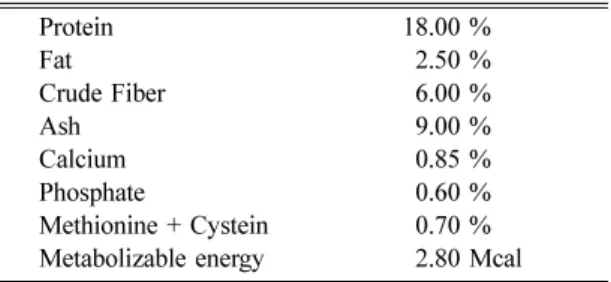
과 함께 자유 급여하였고 사료와 물은 하루에 한번씩 보 충해주었다 . 체중측정은 9 일령부터 실험 종료까지 3 일 간격으로 실시하였으며 사료의 조성 및 첨가제는 Table 1 과 같다 .

실험에 사용한 CLA 는 c9,t11-CLA 와 t10,c12-CLA 의 비율이 2:3 순도 90% , 실험에 필요한 사료 첨가

도인 1% 를 만들기 위해 [19] w/w 퍼센트 비율로서 분

말형 사료 98.9 g 에 CLA 1.1 g 을 혼합하였고 , selenium

은 양계사료의 첨가제로 이용되는 Sel-Plex(Alltech)

말사료에 3 ppm 이 되도록 혼합하였다 . CLA 의 대조군으

로 처방된 LA(linoleic acid) 는 홍화씨유를 사용하였

으며 , LA 의 첨가 농도는 CLA 와 동일한 방법으로 혼합 하여 사용하였다 .

실험군의 분류와 처치

본 실험은 4 개의 실험군과 1 개의 대조군으로 나누었

다 . CLA 가 첨가된 사료를 먹인 실험군 (Group 1, n=8), CLA 와 selenium 이 첨가된 사료를 먹인 실험군 (Group 2,

n=8), 홍화씨유가 함유된 사료를 먹인 실험군 (Group 3,

n=8), 그리고 LA 와 selenium 이 첨가된 사료를 먹인 실 험군 (Group 4, n=8) 으로 나누고 , 일반 사료만을 먹인 대 조군 (Control, n=8) 두었다 .

혈청 분리 및 시료분석

4 주간의 실험사육기간이 지난 12 시간 절식시킨

음 경정맥에서 채혈하였다 . 혈액은 total cholesterol(TC), triglyceride(TG), high-density lipoprotein cholesterol(HDL)

그리고 low-density lipoprotein cholesterol(LDL) 의 측정 을 위하여 vacutainer tube(BD, USA) 에 담아 37

o

C 에서

1 시간 동안 보관한 다음 4

o

C 에서 3000 rpm 으로 20

간 원심분리 시킨 후 -80

o

C 서 냉동보관 하였다가 TC

와 TG 는 혈청자동분석기 (HITACHI-7600; ROCHE,

Swiss) 사용하였고 , HDL LDL 혈청자동분석기

(COBAS INTEGRA-700; ROCHE, Swiss) 를 이용하여

Enzymatic colorimetric assay 법으로 분석하였다 .

복부장기(간, 비장)와 복부지방의 분리

간과 비장은 적출한 뒤 무게를 측정하여 기록하였다 .

복부지방은 총배설강으로부터 근위까지의 지방을 분리 한 뒤 무게를 측정하여 기록하였다 .

통계처리

실험결과의 통계처리 및 유의성 검정은 SPSS ( 버전

10.0 for windows) 를 이용하여 일원배치 분산분석을 하

였고 , 사후검정으로는 Scheffe's test Dunnett's test

용하였다 .

Table 1 . Composition and nutrient content of standard experimental diets

Protein Fat Crude Fiber Ash Calcium Phosphate

Methionine + Cystein Metabolizable energy

18.00 %

2.50 %

6.00 %

9.00 %

0.85 %

0.60 %

0.70 %

2.80 Mcal

(3)

결 과

증체량

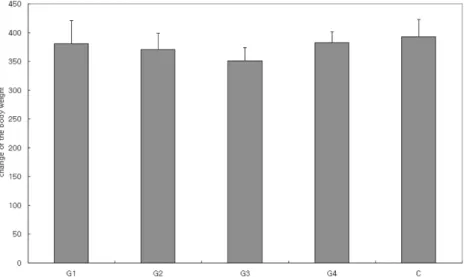
실험기간 4 주간 군의 체중 증가량은 Group 1, Group 2, Group 3, Group 4, 그리고 Control 군이 각각 380±40g, 370±28 g, 350±23 g, 382±18 g, 그리고 392±30 g 으로 나 타났다 (Fig. 1).

대조군이 가장 높은 체중 증가를 보였고 , Group 4,

Group 1, Group 2, Group 3 의 순서로 낮은 증가량을 보

였지만 Group 3 제외하면 간의 유의성은 인정

되지 않았다 . Group 3 의 경우 대조군에 비해 유의적인

감소를 보였다 .

체중에 대한 간, 비장, 지방 무게 비율

(1) 체중에 대한 간장무게 비율

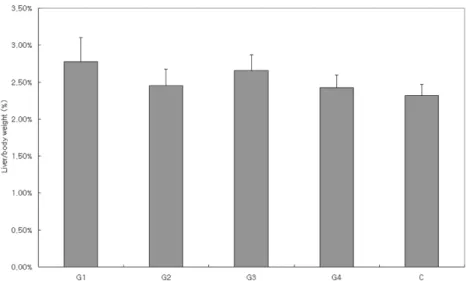
각 군에서 체중에 대한 간장무게의 백분율은 Group 1, Group 2, Group 3, Group 4, 그리고 Control 군이 각 각 2.78±0.32%, 2.45±0.22%, 2.65±0.21%, 2.42±0.17%, 그 리고 2.31±0.16% 나타났다 (Fig. 2).

CLA 단독 투여군인 Group 1 과 LA 단독 투여군인

Group 3 은 대조군에 비해서 각각 유의적인 증가를 보였

으나 , Group 1 Group 3 과의 상호간에는 차이가 인정

되지 않았다 . Selenium 과 CLA 를 혼합 투여한 Group 2

는 Group 1 및 Group 2 에 비해 감소를 보였으나 ,

CLA 단독 투여군인 Group 1 에서만 유의성이 인정

되었다 .

(2) 체중에 대한 비장무게비율

각 군에서 체중에 대한 비장무게의 백분율은 Group 1, Group 2, Group 3, Group 4, 그리고 Control 군이 각 각 0.23±0.05%, 0.31±0.09%, 0.27±0.05%, 0.26±0.04%

리고 0.28±0.07% 나타났다 (Fig. 3).

Group 1 에서 다른 군에 비해 큰 감소를 보였고 , Group

2 반대로 증가를 보였지만 , 간의 차이에는 유의

성이 인정되지 않았다 .

(3) 체중에 대한 지방무게 비율

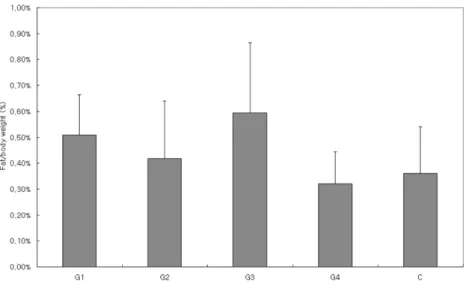
각 군에서 체중에 대한 지방무게의 백분율은 Group 1, Group 2, Group 3, Group 4, 그리고 Control 군이 각 각 0.51±0.16%, 0.42 ± 0.22%, 0.59±0.27%, 0.32±0.12%

리고 0.36±0.18% 로 나타났다 (Fig. 4).

LA 단독 투여군인 Group 3 은 대조군에 비해 두드러

진 증가가 보였고 , CLA LA 단독 투여군인 Group 1

과 Group 3 에 비해 selenium 혼합 투여군인 Group 2 와

Group 3 에서는 감소가 보였으나 , 각 군 간의 차이에는

유의성이 인정되지 않았다 .

혈청 콜레스테롤

(1) TC

각 군의 TC 농도는 Group 1, Group 2, Group 3, Group 4, 그리고 대조군이 각각 164±15 mg/dl, 135±10 mg/dl, 172±14 mg, 138±10 mg/dl 그리고 132±15 mg/dl 나타

났다 (Fig. 5).

Fig. 1. Changes of the body weights. G1 : group fed diet supplemented with 1% CLA, G2 : group fed diet supplemented

with 1% CLA + Selenium, G3 : group fed diet supplemented with 1% safflower-seed-oil, G4 : group fed diet supplemented

with 1% safflower-seed-oil + Selenium, C : group fed diet supplemented with nothing. Each bar represents the mean change

of the body weight and Y error bar is expressed as means±SE (n=8).

(4)

CLA 단독 투여군인 Group 1 LA 단독 투여군인 Group 3 은 selenium 혼합 투여군 및 대조군에 대해 유

의적인 증가를 보였다 . 그러나 CLA 투여군과 LA 투여

군 간의 유의성은 인정되지 않았다 . (2) TG

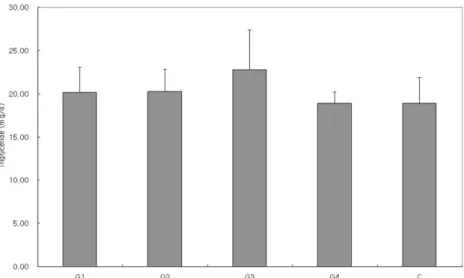
각 군의 triglyceride Group 1, Group 2, Group 3, Group 4, 그리고 Control 군이 각각 20±2 mg/dl, 20±2 mg/dl, 22±4 mg/dl, 18±1 mg/dl 그리고 18±3 mg/dl 로 나 타났다 (Fig. 6).

LA 단독 투여군인 Group 3 이 대조군에 비해 두드러

진 증가를 보였고 , CLA 단독 투여군인 Group 1 은 CLA Fig. 3. Weight ratios of spleen to body. Group 1 : group fed diet supplemented with 1% CLA, Group 2 : group fed diet supplemented with 1% CLA + Selenium, Group 3 : group fed diet supplemented with 1% safflower-seed-oil, Group 4 group fed diet supplemented with 1% safflower-seed-oil + Selenium, C : group fed diet supplemented with nothing. Each bar represents the mean weight ratio of spleen to body and Y error bar is expressed as means±SE (n=8).

Fig. 2. Weight ratios of liver to body. Group 1 : group fed diet supplemented with 1% CLA, Group 2 : group fed diet supplemented with 1% CLA + Selenium, Group 3 : group fed diet supplemented with 1% safflower-seed-oil, Group 4:

group fed diet supplemented with 1% safflower-seed-oil + Selenium, C : group fed diet supplemented with nothing. Each

bar represents the mean weight ratio of liver to body and Y error bar is expressed as means±SE (n=8).

(5)

와 selenium 혼합 투여군인 Group 4 대조군에 비해

약간의 증가를 보였지만 , 각 군 간의 차이는 유의성이 인정되지 않았다 .

(3) HDL

각 군의 HDL 농도는 Group 1, Group 2, Group 3,

Group 4, 그리고 Control 군이 각각 110±11 mg/dl, 86±11 mg/dl, 11713 mg/dl, 86±9 mg/dl 그리고 83±10 mg/dl 로 나타났다 (Fig. 7).

각 군 간의 차이는 유의성이 인정되었으며 , CLA LA 단독 투여군인 Group 1 과 Group 3 은 selenium 혼합 투여군인 Group 2 와 Group 4 에 대해 유의적인 증가를

Fig. 5. Total Cholesterol. G1 : group fed diet supplemented with 1% CLA, G2 : group fed diet supplemented with 1%

CLA + Selenium, G3 : group fed diet supplemented with 1% safflower-seed-oil, G4 : group fed diet supplemented with 1% safflower-seed-oil + Selenium, C : group fed diet supplemented with nothing. Each bar represents the mean serum total cholesterol concentration and Y error bar is expressed as means±SE (n=8).

Fig. 4. Weight ratios of fat to body. Group 1 : group fed diet supplemented with 1% CLA, Group 2 : group fed diet

supplemented with 1% CLA + Selenium, Group 3 : group fed diet supplemented with 1% safflower-seed-oil, Group 4

: group fed diet supplemented with 1% safflower-seed-oil + Selenium, C : group fed diet supplemented with nothing. Each

bar represents the mean weight ratio of fat to body and Y error bar is expressed as means±SE (n=8).

(6)

보였다 . 그러나 Group 1 과 Group 3 의 상호간의 유의성 은 인정되지 않았다 .

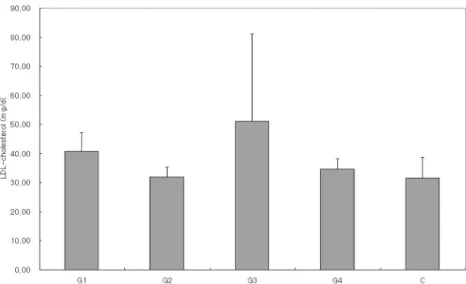
(4) LDL

각 군의 LDL 농도는 Group 1, Group 2, Group 3, Group 4, 그리고 Control 군이 각각 40±6 mg/dl, 32±3 mg/dl, 51±30 mg/dl, 34±3 mg/dl 그리고 31±7 mg/dl 로 나타났다

(Fig. 8).

CLA LA 단독 투여군인 Group 1 Group 3

해 selenium 혼합 투여군인 Group 2 및 Group 4 에서는 감소를 보였지만 , 각 군 간의 차이는 유의성이 인정되지

않았고 , Group 3 만이 대조군에 비해 유의적인 증가를

였다 .

Fig. 6. Serum triglyceride(TG) concentrations. G1 : group fed diet supplemented with 1% CLA, G2 : group fed diet supplemented with 1% CLA + Selenium, G3 : group fed diet supplemented with 1% safflower-seed-oil, G4 : group fed diet supplemented with 1% safflower-seed-oil + Selenium, C : group fed diet supplemented with nothing. Each bar represents the mean serum triglyceride concentration and Y error bar is expressed as means±SE (n=8).

Fig. 7. Serum HDL-cholesterol concentrations. G1 : group fed diet supplemented with 1% CLA, G2 : group fed diet

supplemented with 1% CLA + Selenium, G3 : group fed diet supplemented with 1% safflower-seed-oil, G4 : group fed

diet supplemented with 1% safflower-seed-oil + Selenium, C : group fed diet supplemented with nothing. Each bar represents

the mean serum HDL-cholesterol concentration and Y error bar is expressed as means±SE (n=8).

(7)

고 찰

CLA 닭에서 농도에 비례하는 체중감소 효과를

타내고 [12], 생쥐에서도 체중감소 효과를 나타낸다 [22].

한편 , selenium 의 투여로 닭에서 체중의 감소가 야기되

었다는 보고가 있다 [25]. 실험에서는 군에서

조군보다 낮은 체중증가를 보였으나 , 유의성은 인정되 지 않았다 . 다만 LA 만을 투여한 군에서 체중에 대한 지 방의 비율은 가장 높았으나 , 증체율은 현저히 낮은 현상

을 보였다 .

CLA 는 지방의 간 대사를 촉진시키는 결과 체지방 감

소를 나타내며 [2], CLA 의해 야기된 간에서의 지방

축적은 축종에 따라 차이가 있다 . CLA 가 보충된 사료

를 섭취한 생쥐는 지질 축적으로 인해 명백하게 간이 종

대 된다 [3, 43]. 반면에 햄스터에서는 간비대가 지질

적에 의한 것이 아닌 것으로 보고하였고 [9], 렛트나 돼

지는 지질 축적이나 간 무게의 증가가 없다 [31]. 닭에

서는 CLA 급여가 간에서의 지방 축적을 감소시킨다

는 결과 [1] 와 간조직의 지질 함량을 증가시킨다는 보고 가 있다 [5]. 또한 selenium 은 조류에서 간의 무게를 증 가시킨다는 보고가 있다 [25].

본 실험에서는 체중에 대한 간의 무게 비율을 볼 때 , CLA 와 LA 투여군에서 증가를 나타내는 것을 볼 수 있

다 . 반면에 selenium 혼합 투여군에서는 증가가 일어

나지 않은 것을 볼 수 있었는데 , CLA 단독 투여군에 비

해 CLA 와 selenium 의 혼합 투여군에서는 감소를 나타

낸 것으로 보아 , selenium 의 투여가 CLA 및 LA 의 섭취 에 의한 간의 비대를 완화시키는 것으로 생각되어진다 .

1% CLA 를 투여했을 때 , 렛트에서 비장의 무게가 증

가한다고 알려져 있지만 [37], 본 실험에서 체중에 대한

비장 무게의 변화는 유의성을 나타내지 않았다 . CLA

닭 [42], 생쥐 [32-45], 렛트 [19] 및 돼지 [13] 에서 체지 방 감소 효과가 있는 것으로 알려져 있다 . 비록 사료 섭 취량의 감소에 중요한 역할을 하지만 , 지방저장소인

adipocytes 와 주요 지방연소 기관인 골격근세포에 직접

적으로 큰 영향을 준다고 한다 [33]. 이와 같이 서로 다

른 요인들과의 관계는 명확하지 않지만 , CLA 지방대

사에 영향을 미치고 [33], 세포소멸에 의한 지방조직의

감소와 지방이영양증을 일으키기도 한다 [43].

본 실험에서는 LA 단독 투여군에 비해 CLA 단독

여군의 복강 지방의 비율이 낮고 , selenium 혼합 투여군

의 경우 , 단독 투여군에 비해서 추가적인 지방의 감소를 볼 수 있었으나 , 간의 차이에서 유의성은 인정되

지 않았다 . 이는 1% 농도의 CLA 투여시 대조군에 비

해 복강 지방의 감소가 없었다는 실험 결과와 일치했으 며 [12], selenium 투여로 고지방 식이에 의한 atheroma

를 예방한다는 결과 [23] 와 연관이 있는 것으로 보인다 . CLA 는 혈중 지질과 콜레스테롤 농도를 감소시키는데

[23] 이는 , 소장의 acyl coA : cholesterol acyltransferase

활동도를 감소시켜 , 그 결과 콜레스테롤의 에스테르화

Fig. 8. Serum LDL-cholesterol concentrations. G1 : group fed diet supplemented with 1% CLA, G2 : group fed diet

supplemented with 1% CLA + Selenium, G3 : group fed diet supplemented with 1% safflower-seed-oil, G4 : group fed

diet supplemented with 1% safflower-seed-oil + Selenium, C : group fed diet supplemented with nothing. Each bar represents

the mean serum LDL-cholesterol concentration and Y error bar is expressed as means±SE (n=8).

(8)

가 감소되어 혈액내 콜레스테롤의 흡수가 감소되고 ,

변내 콜레스테롤의 배출 증가에 의해 혈중 콜레스테롤 이 감소된다는 것이라 한다 [6]. 또 다른 설명으로 t10, c12-CLA 이성질체에 의해 TG LDL 전환시키는

포내 lipoprotein lipase 활성도의 억제에 의해 LDL

소한다고 하였다 [46].

본 실험에서는 CLA LA 단독 투여군에서 대조군

에 비해 뚜렷한 TC 와 HDL 의 상승을 보였다 . 이는 혈 중 TC 와 HDL 이 1% 농도의 CLA 를 급여했을 때 최고 수준에 도달했다는 실험 결과와 일치했다 [41]. 또한

selenium 의 혼합 투여군에서는 대조군과 비슷한 수준의

TC 와 HDL 농도를 보였는데 , selenium 이 CLA 와 LA 에 의한 콜레스테롤의 증가를 억제하는 것으로 생각된다 .

TG 의 농도 변화는 유의성이 인정되지 않았다 . 본 실험

에서의 LDL 의 농도 변화를 살펴보면 , LA 단독 투여군

에서 눈에 띄는 증가를 보였고 , CLA 단독 투여군에서

도 증가된 것을 볼 수 있었다 . 또한 selenium 혼합 투여 군에서는 상대적인 감소를 나타내어 HDL 에서와 비슷한 결과가 나타났으나 LA 단독 투여군을 제외하면

간의 유의성은 인정되지 않았다 .

닭에서 CLA 에 의한 간 비대와 복강 지방의 증가 및 콜레스테롤 농도의 상승을 selenium 감소시키는 것으

로 생각되어 , 사료첨가제로서 CLA 와 selenium 의 혼합 투여는 긍정적일 것으로 생각된다 .

결 론

체지방 감소 및 콜레스테롤 저 함량 계란의 생산을 위해 사료첨가제로 급여하는 CLA 와 계란 및 계육의 품 질향상을 위해 사료첨가제로 이용되는 selenium 혼합

투여에 대한 영향을 알아보기 위하여 CLA 또는 LA

첨가된 사료 , CLA 또는 LA 와 selenium 이 첨가된 사료 그리고 일반 사료를 4 주간 닭에게 자유 급여시킨

중 변화와 각 장기의 무게를 측정하고 , 혈청 콜레스테롤

과 TG 의 농도변화를 확인한 결과를 요약하면 다음과 같다 .

(1) CLA 와 LA 투여군은 간의 무게가 증가했다

(P<0.05).

(2) Selenium 혼합 투여군은 CLA LA 투여군에

해 간의 무게가 감소했다 (P<0.05).

(3) CLA 와 LA 투여군은 혈청 TG 및 HDL 농도가 증 가했다 (P<0.05).

(4) Selenium 혼합 투여군은 CLA 및 LA 투여군에 비 해 혈청 TC 및 HDL 의 농도가 감소했다 (P<0.05).

(5) CLA LA selenium 투여군은 대조군에 비해 TG 는 약간 증가하였으나 각 군간의 유의성은 인

정되지 않았다 (P>0.05).

이상의 결과로 보아 닭에서의 CLA 투여는 체중에

대한 간과 복강 지방의 비율 및 콜레스테롤의 증가를 유 발하며 , selenium 혼합 투여는 이러한 CLA 의한

화를 감소시키는 것으로 확인되었다 . 참고문헌

1. Badinga L, Selberg KT, Dinges AC, Corner CW, Miles RD. Dietary conjugated linoleic acid alters hepatic lipid content and fatty acid composition in broiler chickens. Poult Sci 2003, 82 , 111-116.

2. Belury MA, Kempa-Steczko A. Conjugated linoleic acid modulates hepatic lipid composition in mice.

Lipids 1997, 32 , 199-204.

3. Belury MA, Moya-Camarena SY, Liu K, Heuvel JPV. Dietary conjugated linoleic acid induces peroxisome specific enzyme accumulation and ornithine decarboxylase activity in mouse liver. J Nutr Biochem 1997, 8 , 579-584.

4. Benton D, Cook R. Selenium supplementation improves mood in a double-blind crossover trial. Biol Psychiatry 1991, 29 , 1092-1098.

5. Cherian G, Holsonbake TB, Goeger MP, Bildfell R.

Dietary CLA alters yolk and tissue FA composition and hepatic histopathology of laying hens. Lipids 2002, 37 , 751-757.

6. Chi H, Thomas Y, Lin Y, Yu H, Jun W, Zhen-Yu C. Dietary conjugated linoleic acid mixture affects the activity of intestinal acyl coenzyme A: cholesterol acyltransferase in hamsters. Br J Nutr 2000, 84 , 935- 7. 941. Clark LC, Combs GFJr, Turnbull BW. Effects of selenium supplementation for cancer prevention in patients with carcinoma of the skin. A randomized controlled trial. Nutritional Prevention of Cancer Study Group, JAMA 1996, 276 , 1957-1963 Erratum in:

JAMA 1997, 277 , 1520.

8. Cook ME, Miller CC, Pariza MW. Immune modulation by altered nutrient metabolism: nutritional control of immune-induced growth depression. Poultry Sci. 1993, 72 , 1301-1305.

9. de Deckere EAM, van Amelsvoort JMM, McNeil GP, Jones P . Effects of conjugated linoleic acid (CLA) isomers on lipid levels and peroxisome proliferation in the hamster. Br J Nutr 1999, 82 , 309-317.

10. Decker EA. The Pole of phenolics, conjugated linoleic

(9)

acid, carnosine, and pyrroloquinoline quinone as nonessential dietary Antioxidants. Nutr Rev 1995, 53 , 49-58.

11. Delany JP, Blohm F, Truett AA, Scimeca JA, West DB. Conjugated linoleic acid rapidly reduces body fat content in mice without affecting energy intake. Am J Physiol 1999, 276 , R1172-R1179.

12. Du M, Ahn DU. Effect of dietary conjugated linoleic acid on the growth rate of live birds and on the abdominal fat content and quality of broiler meat. Poult Sci 2002, 81 , 428-433.

13. Dugan ME, Aalhus, JL, Schaefer AL, Kramer JKG.

The effect of conjugated linoleic acid on fat to lean repartitioning and feed conversion in pigs. Can J Ani Sci 1997, 77 , 723-725.

14. Finley JW, Penland JG. Adequacy or deprivation of dietary selenium in healthy men: clinical and psychological findings. J Trace Elem Exp Med 1998, 11 , 11-27.

15. Ha YL, Grimm NK, Pariza MW. Anticarcinogens from fried ground beef : hear-altered derivatives of linoleic acid. Carcinogenesis 1987, 8 , 1881-1887.

16. Ha YL, Storkson J, Pariza MW. Inhibition of benzo(a)pyrene - induced mouse forestomach neoplasia by conjugated dienoic derivatives of linoleic acid. Cancer Res 1990, 50 , 1097-1101.

17. Hawkes WC, Hornbosterl L. Effects of dietary selenium on mood in healthy men living in a metabolic research unit. Biol Psychiatry 1996, 39 , 121-128.

18. Hayek MG, Han SN, Wu D, Watkins BA, Meydani M, Dorsey JL, Smith DE, Meydani SN. Dietary conjugated linoleic acid influences the immune response of young and old C57BL/6NCrlBR mice. J Nutr 1999, 129 , 32-38.

19. Houseknecht KL, Vanden Heuvel JP, Moya- Camarena SY, Portocarrero CP, Peck LW, Nickel KP, Belury MA. Dietary conjugated linoleic acid normalizes impaired glucose tolerance in zucker diabetic fatty fa/fa Rat. Biochem Biophys Res Comm 1998, 244 , 678-682.

20. Hughes PE, Hunter WJ, Tove SB. Biohydrogenation of unsaturated fatty acids. J Biol Chem 1982, 257, 3643-3649.

21. Ip C, Chin SF, Scimeca JA, Pariza MW. Mammary cancer prevention by conjugated dienoic derivative of linoleic acid. Cancer Res 1991, 51 , 6118-6124.

22. Peters JM, Park YH, Gonzalez FJ, Pariza MW.

Influence of conjugated linoleic acid on body composition and target gene expression in peroxisome proliferator-activated receptor α -nell mice. Biochim Biophys Acta. 1533. 2001, 233-242.

23. Kang BP, Mehta U, Bansal MP. Selenium supplementation protects from high fat diet-induced atherogenesis in rats: role of mitogen stimulated lymphocytes and macrophage NO production. Indian J Exp Biol 2001, 39 , 793-797.

24. Kelley DS, Taylor PC, Rudolph IL, Benito P, Nelson GJ, Mackery BE, Erickson KL. Daitary conjugated linoleic acid did not alter immune status in young healthy women. Lipids 2000, 35 , 1065-1071 25. Khan MZ, Szarek J, Markiewicz K. Effects of oral

administration of toxic levels of lead and selenium upon concentration of different elements in the liver of broiler chicks. Zentralbl Veterinarmed 1993, 40 , 652- 26. 664. Lee KN, Kritchevsky D, Pariza MW. Conjugated linoleic acid and atherosclerosis in rabbits. Athero- sclerosis. 1994, 108 , 19-25.

27. Liew C, Schut HA, Chin SF, Pariza MW, Dashwood RH. Protection of conjugated linoleic acids against 2- amino-3-methlimidazo [4,5-f] quinoline-induced colon carcinogenesis in the F344 rat: a study of inhibitory mechanisms. Carcinogenesis 1995, 16 , 3037-3043.

28. Mir Z, Rushfeldt ML, Mir PS, Paterson LJ, Weselake RJ. Effect of dietary supplementation with either conjugated linoleic acid (CLA) or linoleic acid rich oil on the CLA content of lamb tissue. Small Rumin Res 2000, 36 , 25-31.

29. Néve J. Selenium as a risk factor for cardiovascular diseases. J Cardiovasc Risk 1996, 3 , 42-47.

30. Olivieri O, Girelli D, Azzini M. Low selenium status in the elderly influences thyroid hormones. Clin Sci.

1995, 89 , 637-642.

31. Pariza MW, Park Y, Cook ME. The biologically active isomers of conjugated linoleic acid. Prog Lipid Res 2001, 40 , 283-298.

32. Park Y, Albright KJ, Liu W, Storkson JM, Cook ME, Pariza MW. Effect of conjugated linoleic acid on body composition changes in mice. Lipids 1997, 32, 853-858.

33. Park Y, Storkson JM, Albright KJ, Liu W, Pariza

MW. Evidence that the trans-10, cis-12 isomer of

conjugated linoleic acid induces body composition

changes on mice. Lipids 1999, 34 , 235-241.

(10)

34. Roderick CM, Teresa SR, Geoffrey JB. Selenium : an essential element for immune function. Immunol Today 1998, 19 , 342-345.

35. Roy M, Kiremidjian-Schumacher L, Wishe HI.

Supplementation with selenium restores age-related decline in immune cell function. Proc Soc Exp Biol Med 1995, 209 , 369-375.

36. Scimeca JA, Miller GD. Potential health benefits of conjugated linoleic acid. J Am Coll Nutr 2000, 19, 470S-471S.

37. Sugano M, Tsujita A, Yamasaki M, Noguchi M, Yamada K. Conjugated linoleic acid modulates tissue levels of chemical mediators and immunoglobulins in rats. Lipids 1998, 33 , 521-527.

38. Swain BK, Johri TS, Majumdar S. Effect of supplementation of vitamin E, selenium and their different combinations on the performance and immune response of broilers. Br Poult Sci 2000, 41 , 287-292.

39. Swecker WS, Thatcher CD, Eversole DE, Blodgett DJ, Schurig GG. Effect of selenium supplementation on colostral IgG concentration in their calves. Am J Vet Res 1995, 56 450-453.

40. Swecker WS, Eversole DE, Thatcher CD, Blodgett DJ, Schurig GG, Meldrum JB. Influence of supplemental selenium on humoral immune responses in weaned beef calves. Am J Vet Res 1989, 50 , 1760-

1763.

41. Szymczyk B, Pisulewski PM, Szczurek W, Hanczakowski P. Effects of conjugated linoleic acid on growth performance, feed conversion efficiency, and subsequent carcass quality in broiler chickens. Br J Nutr 2001, 85 , 465-473.

42. Taylor EW, Nadimpalli RG, Ramanathan CS.

Genomic structures of viral agents in relation to the biosynthesis of selenoproteins. Biol Trace Elem Res 1997, 56 , 63-91.

43. Tsuboyama-Kasaoka N, Takahashi M, Tanemura K, Kim H, Tange T, Okauyama H, Kasai M, Ikemoto S. Ezaki O. Conjugated linoleic acid supplementation reduce adipose tissue by apoptosis and develos lipodystrophy in nice. Diabetes 2000, 49 , 1534-1542.

44. Underwood EJ. Trace elements in human and animal nutrition, 4th ed, pp. 303-345, Academic Press, New York, 1977.

45. West DB, Delany JP, Camet PM, Blohm F, Truett AA, Scimeca J. Effects of conjugated linoleic acid on body fat and energy metabolism in the mouse. Am J Physiol 1998, 275 , R667-R672.

46. Yuguang L, Arja K, Johan AE, Schuurbiers RD.

Different effects of conjugated linoleic acid isomers on

lipoprotein lipase activity in 3T3 - 11 adipocytes, J Nutr

Biochem 2001, 12 , 183-189.

수치

Table 1 . Composition and nutrient content of standard experimental diets
Fig. 1.  Changes of the body weights. G1 : group fed diet supplemented with 1% CLA, G2 : group fed diet supplemented with 1% CLA + Selenium, G3 : group fed diet supplemented with 1% safflower-seed-oil, G4 : group fed diet supplemented with 1% safflower-see
Fig. 2.  Weight ratios of liver to body. Group 1 : group fed diet supplemented with 1% CLA, Group 2 : group fed diet supplemented with 1% CLA + Selenium, Group 3 : group fed diet supplemented with 1% safflower-seed-oil, Group 4:
Fig. 5.  Total Cholesterol. G1 : group fed diet supplemented with 1% CLA, G2 : group fed diet supplemented with 1%
+3

참조

관련 문서