Capillary Characteristics of Water and Cations in Multi-layered Reclaimed Soil with Macroporous Subsurface Layer Utilizing Coal Bottom Ash
Jin-Hee Ryu*, Doug-Young Chung
1, Sang-Keon Ha
2, Sang-Bok Lee, Si-Ju Kim, Min-Tae Kim, Ki-Do Park, and Hang-Won Kang
National Institute of Crop Science, RDA
1
Chungnam National University
2
National Academy of Agricultural Science, RDA
(Received: November 3 2014, Revised: December 11 2014, Accepted: December 12 2014)
Serious problems in reclaimed land agriculture are high soil salinity and poor vertical drainage, so desalinization in these soils is very difficult. Also, although desalinization is accomplished in reclaimed top soils, before long, soils are resalinized according to capillary rise of salts from the subsurface soils. To resolve these problems, multi-layered soil columns with subsurface layer of macroporous medium utilizing coal bottom ash (CBA) were constructed and the effects of blocked resalinization of these soils were investigated. In this experiment soil samples were collected from Munpo series (coarse-loamy, nonacid, mixed, mesic, typic Fluvaquents). The soil texture was silt loam and the EC was 33.9 dS m
-1. As for groundwater seawater was used and groundwater level of 1 cm from the bottom was maintained. The overall rate of capillary rise was 2.38 cm hr
-1in soil 60 cm column, 0.25 cm hr
-1in topsoil (30 cm) + CBA (5 cm) + subsurface soil (10 cm) column and 0.08 cm hr
-1in topsoil (30 cm) + CBA (10 cm) + subsurface soil (10 cm) column. In multi-layered soil columns with CBA 20, 30 cm layer, wetting front due to capillary rise could not be seen in top soil layer. After 70 days capillary rise experiment water soluble Na
+accumulated in top soil of soil columns with CBA 20, 30 cm was diminished by 92.8, 96.5% respectively in comparison with Na
+accumulated in top soil of soil 60 cm column because CBA layer cut off capillary rise of salts from the subsurface soil. From these results we could conclude that the macroporous layer utilizing CBA placed at subsurface layer cut off capillary rise of solutes from subsurface soil, resulting in lowered level of salinity in top soil and this method can be more effective in newly reclaimed saline soil.
Key words: Multi-layered soil, Reclaimed land, Coal bottom ash, Capillary rise
Distribution of water-soluble cations in soil columns made of coal bottom ash 60 cm (CBA60), soil 60 cm (S60), topsoil 30 cm + CBA 5 cm + subsurface soil 10 cm (TS30+CBA5+SS10), topsoil 30 cm + CBA 10 cm + subsurface soil 10 cm (TS30+CBA10+SS10), topsoil 30 cm + CBA 20 cm + subsurface soil 10 cm (TS30+CBA20+SS10) and topsoil 30 cm + CBA 30 cm + subsurface soil 10 cm (TS30+CBA30+SS10) after 70 days capillary rise experiment.
1)
*Corresponding author : Phone: +821026591858, Fax: +82312906784, E-mail: [email protected]
§
Acknowledgement: This work was carried out with the support of “Cooperative Research Program for Agriculture Science & Technology
Development (Project No. PJ007424)” Rural Development Administration, Republic of Korea.
Table 1. Physico-chemical properties of the soil collected from the Saemangeum reclaimed land.
pH
(1:5) EC
1OM
2Water-soluble Cations Exchangeable cations Particle size distribution Soil texture
K Ca Mg Na K Ca Mg Na clay silt sand
dS m
-1g kg
-1--- cmol
ckg
-1--- --- % ---
7.7 33.9 1.5 1.40 1.1 7.4 24.7 2.22 2.4 10.2 28.2 6.1 56.1 37.8 SiL
1
Electric conductivity,
2Organic matter
Table 2. Chemical properties of the soil used for capillary rise experiment.
pH
(1:5) EC
1CEC
2Water-soluble Cations Exchangeable cations
K Ca Mg Na K Ca Mg Na
dS m
-1cmol
ckg
-1--- cmol
ckg
-1---
5.5 7.5 7.1 0.05 0.1 0.1 0.18 0.09 0.3 0.4 0.21
1
Electric conductivity,
2Cation exchange capacity
Introduction
간척지 토양은 일반적으로 매우 높은 염농도를 가지므로 식물에 염 스트레스 (salt stress)를 줄 뿐 아니라 점토입자 의 분산으로 통기성 및 투수성이 불량하여 작물 재배에 매 우 불리하다 (Alperovitch et al., 1985; Koo et al., 1988;
Bolan et al., 1996; Hopkins and Hüner, 2004). 따라서 간 척지를 효율적으로 활용하기 위해서는 토양의 제염이 선행 되어야 한다. 대부분의 간척지 토양은 담수, 암거배수 및 토 양개량제의 사용으로 토양 염농도를 낮출 수 있으나, 건조 상태를 유지하게 되면 지하부로부터 수분의 모세관 상승과 함께 염류의 상승이 지속적으로 일어나 토양의 표면에 염류 가 집적되는 재염화 (Resalinization) 현상이 일어난다 (Kim and Han, 1990; Cho et al., 1992; Kim et al., 1997). 이와 같은 제염의 어려움 때문에 간척지에서는 밭작물 보다 담수 상태에서 재배가 가능한 벼가 주로 재배되어왔다. 그러나 국민의 쌀 소비 감소 및 쌀 시장 개방추진에 따라 간척지의 고도이용과 부가가치 증진을 위해 간척지에서의 밭작물 재 배가 중요한 상황이 되었다.
지금까지 염류토양에서 재염화 억제에 관한 연구는 모래 피복 등을 이용하여 토양표면의 수분증발 및 염류 집적을 억제하는 연구 등이 있었고, 표토 하부에 자갈층을 조성하 여 염류의 모세관 상승을 차단하는 연구가 일부 있었으나 간척지에서 실용적으로 염류의 모세관 상승을 차단하는 기 술에 관한 연구는 아직 미흡하다 할 수 있다 (Kim et al., 1988; Kim and Han, 1990; Jo et al., 1993; Rooney et al., 1998; Topark et al., 2002; Akudago et al., 2009).
화력발전소에서 부산물로 발생되는 석탄회는 2008년 기 준 연간 약 760만톤이 발생되고 있고 비산재 위주로 콘크리 트 혼화재, 골재 등으로 재활용되고 있다. 석탄회를 농업적 으로 재활용하기 위해 중금속 축적 가능성 평가 등의 연구 가 수행되었는데 (Hong et al., 2006; Lee et al., 2010), Hong
et al. (2006)은 논에서 석탄회 시용 후 벼를 재배한 결과, 토양 및 벼 체내의 중금속 축적현상을 발견할 수 없었다고 한 바 있다. 석탄회 중 약 15~25%를 차지하는 석탄바닥재 는 미세분말 형상의 비산재와는 달리 괴상 (입경 0.5~6.0 mm)의 형상을 가지고 있고 활용이 어려워 대부분 매립 처 리되고 있으며 이를 재활용하기 위해 물리화학적 특성 및 환경성 평가에 대한 연구가 주로 콘크리트 골재 등 분야에서 수행되었다 (Jang et al., 2009; Lee et al., 2010).
본 연구에서는 석탄바닥재를 소재로 활용하여 작토층의 하부에 대공극 층위 (Macroporous layer)를 형성한 간척지 다층토양 (Multi-layered soil) 구조에서 대공극층의 재염화 억제 효과를 구명하기 위하여 대공극층으로 석탄바닥재층 을 가지는 토주 (soil column)를 만들어 토주 내 수분과 염 류의 이동 및 분포를 조사하였다.
Materials and Methods
시험토양
시험토양은 전라북도 김제시 광활면 새만금 간척지의 문포통 토양을 선택하였다. 이 토양은 하해혼성충 적층을 모재로 하여 하해혼성평탄지에 분포하고 있는 염류 토양으로 토양시료는 농촌진흥청 국립식량과학원에서 조성한 포장에서 채취하여 토양의 이화학성을 분석하였다 (Table 1).시험토양의 토성은 점토함량이 적고 미사의 함량이 많은 미 사질양토 (Silt loam)로 토양의 전기전도도(Electric conductivity;
EC)는 33.9 dS m-1를 나타내어 매우 높았다. 토주실험에 사 용한 토양은 상기 문포통에서 채취한 고염도 토양을 세척하 여 모세관 상승 실험에 사용하였다. 즉, 풍건한 토양에 1N NH4OAc를 1:5의 비율로 가한 후 1시간 동안 진탕하고 8시 간 경과 후 상등액을 제거하는 방식으로 토양을 총 2회 세 척하여 토양 중 양이온을 제거하고 이 토양을 건조한 후 토 주실험에 사용하였다. Table 2에 토주실험에 사용한 토양의 화학성을 나타내었다. 세척한 토양의 수용성양이온 및 치환
Table 3. Chemical properties of the coal bottom ash.
pH
(1:5) EC
1CEC
2Exchangeable Cations
K Ca Mg Na
dS m
-1cmol
ckg
-1--- cmol
ckg
-1---
9.2 2.8 0.6 0.09 0.4 0.5 1.3
1
Electric conductivity,
2Cation exchange capacity
Table 4. Particle composition of coal bottom ash.
Particle diameter (mm) Percentage of particles (%)
4.0 < 15.5
2.0 ~ 4.0 30.0
1.0 ~ 2.0 32.0
0.5 ~ 1.0 11.3
< 0.5 11.2
Total 100.0
Table 5. Bulk densities of soil columns used for capillary rise experiment.
Soil column Bulk densities (g cm
-3)
Pore Volume (cm
3)
Porosity (%)
Top soil 30 cm 1.47 262.3 44.53
60 cm 1.47 524.6 44.53
CBA
15 cm 0.96 47.7 48.58
10 cm 0.96 95.4 48.58
20 cm 0.96 190.8 48.58
30 cm 0.96 286.1 48.58
60 cm 0.96 572.3 48.58
Subsurface soil 10 cm 1.47 87.43 44.53
1
Coal bottom ash
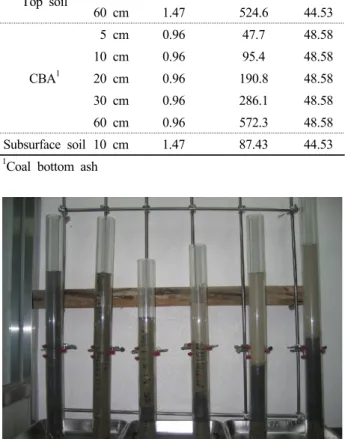
Fig. 1. Soil columns used for capillary rise experiment.
Table 6. Major cation concentrations in sea water used for capillary rise experiment.
Sampling site pH EC Cations of sea water
K Ca Mg Na
dS m
-1--- cmol
cL
-1--- Simpo port 8.2 41.8 1.1 1.8 8.6 35.7
성양이온 함량은 토양에 증류수와 1N NH4OAC를 각각 1:10의 비율로 가한 후 30분간 진탕하고 용출액의 양이온을 분 석하여 측정하였다.
시험에 사용한 석탄바닥재는 서천화력발전소에서 생산된 것으로 입경조성 및 화학성은 Table 3 및 Table 4와 같다.
석탄바닥재의 입경은 2 mm 이상이 전체의 45.5%를 차지하 였다.
토주(Soil Column)의 제작
토주는 풍건 상태의 상기 세척토양 및 석탄바닥재를 내부직경 5 cm의 Acryl column 에 Table 5과 같은 용적밀도가 되도록 정해진 부피에 대한 토양 및 석탄바닥재의 양을 충전하여 제작하였다. 단일층 토주로 토양을 60 cm 충전한 토주 (S60)와 석탄바닥재를 60 cm로 충전한 토주 (CBA60)를 제작하였고 다층토주로 표토 층 30 cm와 심토층 10 cm 사이에 석탄바닥재층을 5 cm 깊 이로 충전한 토주 (TS30+CBA5+ SS10)와 10 cm 깊이로 충 전한 토주 (TS30+CBA10+SS10), 20 cm 깊이로 충전한 토주 (TS30+CBA20+SS10) 및 30 cm 깊이로 충전한 토주 (TS30+CBA30+SS10)를 각각 제작하였다(Fig. 1).
토주실험
토주실험은 20°C 실온조건에서 토주의 하단 에 해수 1 cm 깊이의 지하수위를 유지하고 시간 경과에 따 라 상승하는 토양의 젖은 경계면 (wetting front) 높이를 측 정하여 모세관 상승속도를 조사하였다. 토주시험에 사용한 해수는 전북 김제시 심포항에서 채취하였고, 해수의 주요 양이온 함량은 Table 6과 같다.70일간의 모세관 상승시험 후 각 토주를 2.5 cm 단위로 절단하여 토양수분 및 수용성양이온 함량을 분석하였다. 이 때 토양수분 함량 및 토양의 양이온 분석은 농촌진흥청의 토양화학분석법 (1988)에 준하여 분석하였다.
Results and Discussion
수분의 모세관 상승 특성
토주 내 모세관 상승 면 (wetting front)의 이동 속도를 측정하여 Table 7에 나타내 었다. 각 토주의 모세관상승 속도는 토주의 하층부에서는 높고 상층부로 올라갈수록 낮아지는 경향을 나타내었다. 토 주 별 수분의 평균 모세관 상승속도는 S60 토주에서 2.38 cm hr-1인 반면, 5 cm의 석탄바닥재층을 가진 TS30+CBA5+SS10 토주에서는 0.25 cm hr-1로 낮아졌고 10 cm의 석탄바 닥재층을 가진 TS30+CBA10+SS10 토주는 0.08 cm hr-1로 더욱 낮아졌으며 20 cm와 30 cm의 석탄바닥재층을 가진
Table 7. Overall rate of capillary rise of wetting front in soil columns.
Soil Column Soil layer Rate of capillary rise (cm hr
-1)
Ⅰ CBA
160 cm -
Ⅱ Soil 60 cm 2.38
Ⅲ
Topsoil 30 cm 0.17
CBA 5 cm 0.88
Subsurface soil 10 cm 18.18
Total 0.25
Ⅳ
Topsoil 30 cm 0.05
CBA 10 cm 0.42
Subsurface soil 10 cm 18.18
Total 0.08
Ⅴ
Topsoil 30 cm -
CBA 20 cm -
Subsurface soil 10 cm 18.18
Total -
Ⅵ
Topsoil 30 cm -
CBA 30 cm -
Subsurface soil 10 cm 18.18
Total -
1
Coal bottom ash
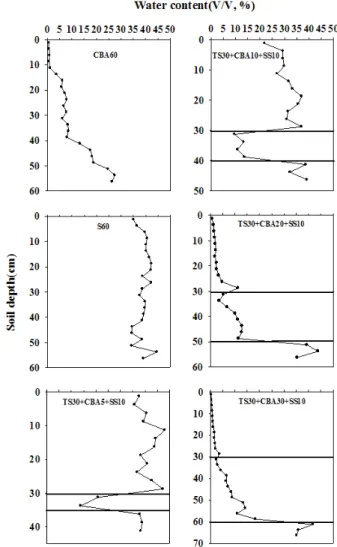
Fig. 2. Distribution of soil water content in soil columns made of coal bottom ash 60 cm (CBA60), soil 60 cm (S60), topsoil 30 cm + CBA 5 cm + subsurface soil 10 cm (TS30+
CBA5+SS10), topsoil 30 cm + CBA 10 cm + subsurface soil 10 cm (TS30+CBA10+SS10), topsoil 30 cm + CBA 20 cm + subsurface soil 10 cm (TS30+CBA20+SS10) and topsoil 30 cm + CBA 30 cm + subsurface soil 10 cm (TS30+CBA30+
SS10) after 70 days capillary rise experiment.
TS30+CBA20+SS10 토주와 TS30+CBA30+SS10 토주에서는 해수의 모세관 상승면 (wetting front)이 석탄바닥재층 상부 로 나타나지 않았다.
토주의 수분 함량
모세관 상승 시험 70일 후 토주를 2.5 cm 단위로 절단하여 토주 내 용적수분함량을 조사한 결 과는 Fig. 2와 같다. CBA60 토주는 깊이 40~60 cm까지는 6.1~27.4%의 수분함량을 나타냈고 깊이 10~40 cm는 1.1~7.8%의 수분함량을 보였으며 깊이 0~10 cm 깊이에서는 1% 미만 의 수분함량을 나타냈다. S60 토주는 전체적으로 34.3~44.6%
의 수분함량을 나타내었다. TS30+CBA5+SS10 토주의 심토 층 (SS10)에서는 37.8~38.9%의 수분함량을 나타냈으나, 석 탄바닥재층 (CBA5)에서는 13.8~20.9%의 상대적으로 낮은 수분함량을 나타내었고, 표토층 (TS30)에서는 35.6~47.3%
의 수분함량을 보여 S60 토주와 비슷한 정도의 수분함량을 나타냈다. TS30+CBA10+SS10 토주는 심토층 (SS10)에서는 32.2~39.1%의 수분함량을 나타냈으나, 석탄바닥재층 (CBA10) 에서는 9.6~13.6%의 낮은 수분함량을 나타내었고, 표토층 (TS30)에서는 TS30+CBA5+SS10 토주의 표토보다 낮은 21.9~
37.0%의 수분함량을 보였다. TS30+CBA20+SS10 토주는 심 토층 (SS10)에서는 35.4~43.9%의 수분함량을 나타냈으나 석탄바닥재층 (CBA20)에서는 11.2~12.9%의 낮은 수분함량 을 나타내었고 표토층 (TS30)에서는 표토 하부의 11.2%에서
부터 깊이가 낮아질수록 지속적으로 수분함량이 감소하여 0~20 cm 깊이에서는 2.5% 미만의 수분함량을 보였다. TS30+
CBA30+SS10 토주는 심토층 (SS10)에서는 35.1~41.8%의 수 분함량을 나타냈으나 석탄바닥재층 (CBA30)에서는 2.4~18.3%
의 수분함량을 나타내었고 표토층 (TS30)에서는 표토층 하 부의 3.7%에서부터 깊이가 낮아질수록 수분햠량이 감소하 여 0~20 cm 깊이에서는 1.7% 미만의 수분함량을 보였다. 토 양을 모세관의 꾸러미로 여긴 모세관모델 (Capillary model) 로 부터 지하수면에서부터 토양 내 수분의 모세관 상승높이는 토양공극의 반지름에 대하여 Eq. 1과 같이 표현된다 (Hillel, 1998). 20 cm 이상의 석탄바닥재층을 가진 TS30+CBA20+
SS10 토주와 TS30+CBA30+SS10 토주에서 표토층의 수분함 량이 매우 낮게 나타났는데, 이는 수분의 모세관 상승 높이 가 Eq. 1과 같이 모세관의 반지름에 반비례하기 때문으로
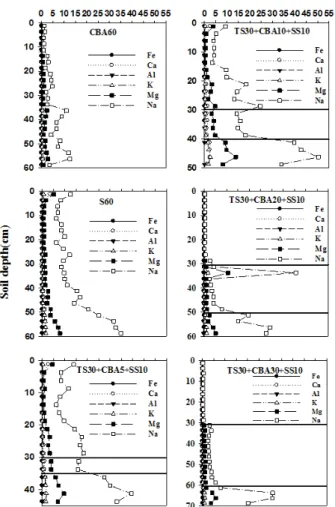
Fig. 3. Distribution of water-soluble cations in soil columns made of coal bottom ash 60 cm (CBA60), soil 60 cm (S60), topsoil 30 cm + CBA 5 cm + subsurface soil 10 cm (TS30+
CBA5+ SS10), topsoil 30 cm + CBA 10 cm + subsurface soil 10 cm (TS30+CBA10+SS10), topsoil 30 cm + CBA 20 cm + subsurface soil 10 cm (TS30+CBA20+SS10) and topsoil 30 cm + CBA 30 cm + subsurface soil 10 cm (TS30+CBA30+
SS10) after 70 days capillary rise experiment.
대공극(Macropore)를 다량 보유한 석탄바닥재층 내에서 수 분의 모세관 상승이 중단되었기 때문으로 해석된다.
cos
(Eq. 1)
h
: 모세관상승 높이γ
: 표면장력r
: 모세관 반지름ρ
: 물의 밀도g
: 중력가속도α
: 접촉각토주의 수용성양이온 분포
모세관 상승 70일 후 토주 를 2.5 cm 단위로 절단하여 토양의 수용성 양이온 함량을 분석한 결과는 Fig. 3과 같다. 토주 내 수용성양이온은 해수 의 양이온 조성과 같이 Na+의 함량이 가장 많아 Na+ > Mg2+> Ca2+ > K+ 순을 나타내었다. CBA60 토주의 수용성 Na+는 1.0~12.6 cmolc ㎏-1의 범위에 있었고, Na+ 함량은 대체로 토양의 깊이가 낮아질수록 대체로 감소하여 10~20 cm 깊이 에서는 1.0~3.1 cmolc ㎏-1, 0~10 cm 깊이에서는 1.0~1.5 cmolc ㎏-1의 낮은 함량을 보였다. S60 토주의 수용성 Na+ 는 전체적으로 6.2~34.8 cmolc ㎏-1의 함량을 나타내었는데 토양의 깊이가 낮아짐에 따라 감소하는 경향을 보였으나 토 주 상부의 0~5 cm 깊이에서는 다시 증가하여 Na+ 이온이 토양 표면 부위에 축적되는 경향을 나타내었다. 이는 토주 의 상단 토양표면에서 수분이 증발됨에 따라 Na+ 이온이 토 양표면에 집적되었기 때문으로 판단된다. TS30+CBA5+SS10 토주의 수용성 Na+는 심토층 (SS10)에서 27.5~39.5 cmolc
㎏-1의 높은 함량을 나타냈고, 석탄바닥재층 (CBA5)에서는 15.8~16.2 cmolc ㎏-1을 나타내었으며 표토층 (TS30)에서는 6.2~18.5 cmolc ㎏-1을 보였다. 토주의 깊이가 낮아짐에 따 라 수용성 Na+는 감소하는 경향을 보였으나 토양 표면 부위 에서는 수분증발에 따라 Na+이온이 집적되어 13.9 cmolc ㎏-1 의 높은 함량을 나타냈다. TS30+CBA10+SS10 토주의 수용 성 Na+는 심토층 (SS10)에서 34.0~50.3 cmolc ㎏-1의 높은 함량을 나타냈고, 석탄바닥재층 (CBA10)에서는 14.2~18.2 cmolc ㎏-1을 나타내었으며 표토층 (TS30)에서는 3.4~24.6 cmolc ㎏-1을 보였다. 토주의 깊이가 낮아짐에 따라 수용성 Na+는 감소하는 경향을 보였으나 표토층의 상부에서는 S60, TS30+CBA5+SS10 토주와 같이 Na+ 이온이 토양 표면에 집 적되어 9.3 cmolc ㎏-1을 나타냈다. TS30+CBA20+SS10 토 주의 수용성 Na+는 심토층 (SS30)에서 15.1~29.3 cmolc ㎏-1 의 함량을 나타내었고 석탄바닥재층 (CBA20)에서 2.5~40.6 cmolc ㎏-1을 나타낸 반면, 표토층 (TS30)은 0.2~2.7 cmolc
㎏-1의 낮은 수용성 Na+ 함량을 나타내었다. 이는 토주 내에 해수의 모세관상승이 이루어지다가 석탄바닥재층에서 모세
관상승력이 크게 약화되고 결국 모세관 상승이 중단되었기 때문으로 판단된다. TS30+CBA30+SS10 토주의 수용성 Na+ 는 심토층 (SS10)에서 8.1~31.0 cmolc ㎏-1 의 함량을 나타 냈고, 석탄바닥재층 (CBA30)는 2.4~5.8 cmolc ㎏-1을 나타 내었으며 표토층 (TS30)에서는 TS30+CBA20+SS10 토주에 서와 같이 0.2~0.5 cmolc ㎏-1의 낮은 Na+ 함량을 나타냈 다. 70일간의 모세관 상승 시험 후 표토층 (0~30cm)의 수 용성 Na+ 축적량은 S60 토주의 Na+ 축적량에 비해 TS30+
CBA20+SS10 토주는 92.8%, TS30+CBA30+SS10 토주는 96.5% 감소한 수치를 나타내었다.
이상의 결과로부터 표토층 하부에 대공극성 석탄바닥재 를 20 cm 이상 두께로 조성할 경우 수분 및 염류의 모세관 상승을 차단할 수 있음을 알 수 있었으며 이와 같은 결과는 자갈을 소재로 모세관 차단층을 조성하여 염류의 모세관상
승을 효과적으로 차단한 기존의 연구결과와 부합되었다 (Jo et al., 1993; Rooney et al., 1998; Topark et al., 2002; Akudago et al., 2009).
따라서 석탄바닥재와 같은 대공극성 소재의 활용은 숙전 화가 이루어지지 않은 신간척지에서 밭작물 재배에 중요한 재염화 억제에 매우 효과적일 것으로 판단된다. 그러나 작 토층 하단에 대공극층을 조성하는 방법은 유효토심이 제한 되는 문제가 있어 재배가능 작물이 콩, 감자 등과 같은 천근 성 작물로 제한될 수 있다고 판단되며 이와 관련하여 향후 현장에 적용할 수 있는 세부기술의 개발이 필요하다고 생각 된다.
References
Akudago, J. A., M. Nishigaki, L. P. Chegbeleh, M. Komatsu, and M. A. Alim. 2009. Capillary cut design for soil-groundwater salinity control. Journal of the Faculty of Environmental Science and Technology. Okayama University. 14:17-22.
Alperovitch, N., I. Shainberg, R. Keren, and M. J. Singer. 1985.
Effect of clay mineralogy and aluminum and iron oxides on the hydraulic conductivity of clay-sand mixtures. Clay and Clay minerals. 33:443-450.
Bolan, N. S., J. K. Syers, M. A. Adey, and M. E. Sumner. 1996.
Origin of the effect of pH on the saturated hydraulic conductivity of non-sodic soils. Commun. Soil Sci. Plant Anal. 27:2265-2278.
Ch, Y. K., I. S. J, and K. T. Um. 1992. Effects of decreasing methods of salt content in root zone on soil properties and crop growth at the reclaimed tidal soil. Korean J. Soil Sci. Fert.
25:127-132.
Lee, J. Y., H. Y. Choi, and J. E. Yang. 2010. Physicochemical Effects of Bottom Ash on the Turfgrass Growth Media of Sandy Topsoil in Golf Course. Kor. Turfgrass Sci. 24:199-204.
Lee, J. K., T. H. Koh, K. M. Sa, S. J. Lee, and T. Y. Lee. 2010.
Evaluation of Leaching Characteristics of Bottom Ash and Waste Tire. Journal of KSEE. 32:682-689.
Hillel. D. 1998. Environmental Soil Physics. p. 510-511. Academic Press. San Diego. USA.
Hong, C. H., C. H. Lee, H. Lee, Y. B. Lee, and P. J. Kim. 2006.
Evaluating Possibility of Heavy Metal Accumulation by Fly Ash Application in Rice Paddy Soils. Korean Journal of Environmental Agriculture. 25:331-338.
Hopkins, W. G., and N. P. A. Hüner. 2004. Introduction to plant physiology. 3rd ed. John Wiley & Sons, Inc.
Jang, Y. C., S. W. Lee, and J. M. Lim. 2009. Physico-chemical characteristics and environmental assessment of coal bottom ash from coal-fired power plant for beneficial use. Journal of Korea solid wastes engineering society. 26: 680-688.
Kim, J. G., M. S. Han, S. B. Lee, and H. J. Han. 1988. Effects of sand mulching on forage production in newly reclaimed tidal lands. Ⅰ. Desalinisation of the soils and crop performance. J.
Korean Crassl. Sci. 8:55-60.
Kim, J. G., and H. J. Han. 1990. Effects of sand mulching on forage production in newly reclaimed tidal lands. Ⅱ. Studies on growth, Dry matter accumulation and nutrient quality of selected forage crops grown on saline soils. J. Korean Crassl.
Sci. 10:77-83.
Kim, S. S., S. Y. Lee, G. H. Han, and E. S. Im. 1997.
Underdrainage effects on salinity and growth of rice in Gyehwa reclaimed saline land. Korean J. Crop Sci. 42:61-67.
Jo, I. S., Y. K. Jo, and K. T. Um. 1993. Red Earth addition and sand mulching at the newly reclaimed tidal soil and plant growth. RDA J. Agri. Sci. 35:270-275.
Koo, J. W., and C. H. Eun. 1988. Changes of hydraulic conductivity during desalinization of reclaimed tidelands. Journal of the Korean Society of Agricultural Engineers. 30:85-93
Koo, J. W., K. W. Han, J. G. Son, and D. W. Lee. 1992. Determining Irrigation Requirements and water management practices for normal growth of dry crops in reclaimed tidelands. 34:80-96.
NIAST. 1988. Methods of soil chemical analysis. National institute of Agricultural Science and Technology, RDA, Suwon, Korea.
Rooney, D. J., K. W. Brown, and J. C. Thomas. 1998. The effectiveness of capillary barriers to hydraulically isolate salt contaminated soils. Water, Air, and Soil Pollution. 104:403-411.
Topark, N. B., H. Michihiro, S. Suiichi, and P. Surasak. 2002.
Cutting-off zone technique for crop production in salt affected area of Northeast Thailand. 17th WCSS. Symposium no. 33, Paper no. 164.