총설
간척지 염해토양의 Phytoremediation에 의한 제염*
1)
손재권
**․송재도
**․신원태
***․이수환
****․류진희
****․조재영
*****Desalinization of Salt-affected Soil by Phytoremediation
Son, Jae-Kwon․Song, Jae-Do․Shin, Won-Tae․
Lee, Su-Hwan․Ryu, Jin-Hee․Cho, Jae-Young
Salted-affected soil is a major environmental constraint with severe negative impacts on agricultural productivity and sustainability in reclaimed tidelands. This review focuses on the phytoremediation of reclaimed tidelands. We address the process of phytoremediation of these soils, comparison of phytoremediation with other amelioration approaches, driving forces contributing to the process, selection of phytoremediation crops, and the role of cropping in securing environmental integrity under salt-affected soils.
Key words : phytoremediation, reclaimed tidelands, salinity, salt-affected soil, sodicity
Ⅰ. 염해토양의 식물복원(Phytoremediation)
1. Phytoremediation 정의여러 가지 환경오염물질을 분해 제거하는데 있어 식물을 이용하는 방법을 흔히 식물복 원(Phytoremediation)이라 한다. 더 자세하게는, 식물이 뿌리를 통해 수분과 양분을 흡수하는 데, 이 경로를 통해 환경매체 중 특정물질을 흡수한 다음 체내 대사과정에서 무독화(detoxi-
*****
본 연구는 농촌진흥청 공동연구사업(과제번호 : PJ010258)의 지원에 의해 이루어진 것임.
*****
전북대학교 농업생명과학대학 지역건설공학과
*****
전북대학교 농업생명과학대학 생물환경화학과
*****
국립식량과학원 작물기초기반과
*****
Corresponding author, 전북대학교 농업생명과학대학 생물환경화학과([email protected])
fication) 시키거나 식물체내에 고농도로 축적한 다음 식물체의 지상부를 제거함으로써 오염 된 환경매체를 복원(remediation)하는 기술이다. 일반적으로 특정물질이 식물체내로 흡수됨 으로써 제거하는 것으로 이해하고 있지만, 근권 주위에서 특정물질의 분해를 촉진하기 위 하여 미생물의 활성도를 촉진시키는 방법도 포괄적으로 식물복원의 범주에 포함하고 있다.
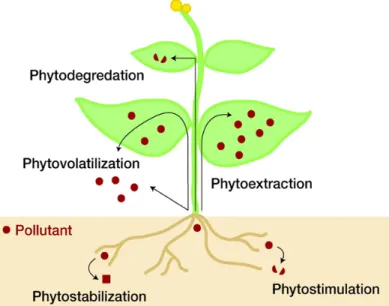
현재까지 알려져 있는 식물복원 기술을 세부적으로 분류하면, 1) 식물추출법(식물체 안으 로 환경매체 중 특정물질을 흡수; phytorextraction; phytoaccumulation), 2) 식물안정화법(환경 매체 중 특정물질의 이동 제한; phytostabilization), 3) 식물촉진법(근권에서 특정물질의 분해․
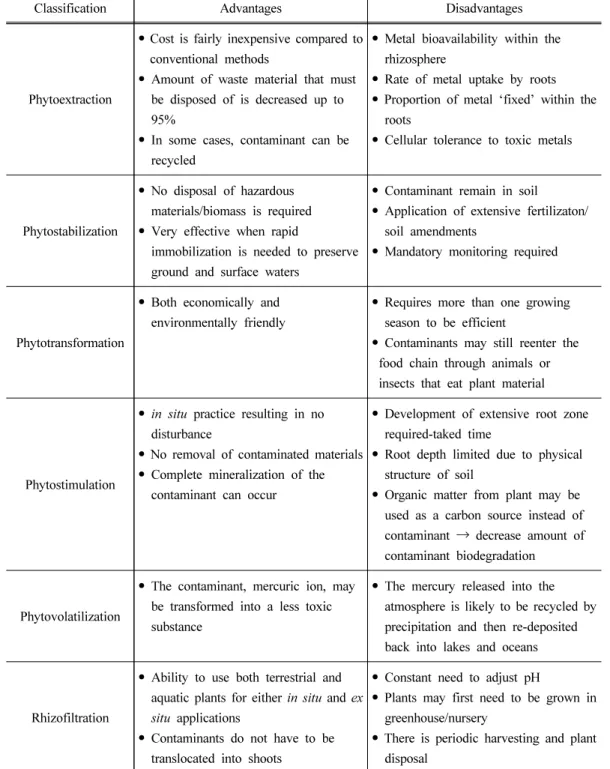
제거를 용이하게 하기 위해 미생물 활성 촉진; phytostimulation), 4) 식물전환법(식물체내에 서 대사를 통해 특정물질을 분해 및 전환; phytotransformation), 5) 식물휘산법(식물체내에서 특정물질을 분해후 대기중으로 방출, phytovolatilization), 그리고 6) 근권여과법(식물체 뿌리 의 활동을 의한 특정물질 제거; rhizofiltration)법으로 나눌 수 있다. 식물복원기법과 기타 물 리․화학적 복원기법을 대상으로 장 ․ 단점을 비교한 자료는 Table 1에 제시되어 있다.
Table 1. Advantages and disadvantages of phytoremediation technology
Advantages Disadvantages
• In situ and ex situ • Take several years to remediate a contaminated site
• Amenable to a variety of organic and inorganic compounds
• Limited to shallow ground water, soils and sediments
• Suited to remediation of large areas of soil • Not as effective for sites with high contaminant concentrations
• Costs effective compared to conventional methods • Slower than conventional methods
• Easy to implement and maintain & accepted by public
• Toxicity and bioavailability of biodegradation products are not known
• Fewer spread of contaminant via air and water • Contaminants may be mobilized into the groundwater
• Conserves natural resources • Influenced by soil and climate conditions of the site. It does not work in the winter
• Environmentally friendly and aesthetically pleasing to the public
• Disposal of contaminants accumulated in plants after harvesting-pollution again
또한 Table 2에는 상기에서 논의한 6가지 식물복원기법을 대상으로 장단점을 비교한 자 료가 제시되어 있다.
Table 2. Advantages and disadvantages of individual phytoremediation technology
Classification Advantages Disadvantages
Phytoextraction
• Cost is fairly inexpensive compared to conventional methods
• Amount of waste material that must be disposed of is decreased up to 95%
• In some cases, contaminant can be recycled
• Metal bioavailability within the rhizosphere
• Rate of metal uptake by roots
• Proportion of metal ‘fixed’ within the roots
• Cellular tolerance to toxic metals
Phytostabilization
• No disposal of hazardous materials/biomass is required
• Very effective when rapid
immobilization is needed to preserve ground and surface waters
• Contaminant remain in soil
• Application of extensive fertilizaton/
soil amendments
• Mandatory monitoring required
Phytotransformation
• Both economically and environmentally friendly
• Requires more than one growing season to be efficient
• Contaminants may still reenter the food chain through animals or insects that eat plant material
Phytostimulation
• in situ practice resulting in no disturbance
• No removal of contaminated materials
• Complete mineralization of the contaminant can occur
• Development of extensive root zone required-taked time
• Root depth limited due to physical structure of soil
• Organic matter from plant may be used as a carbon source instead of contaminant → decrease amount of contaminant biodegradation
Phytovolatilization
• The contaminant, mercuric ion, may be transformed into a less toxic substance
• The mercury released into the atmosphere is likely to be recycled by precipitation and then re-deposited back into lakes and oceans
Rhizofiltration
• Ability to use both terrestrial and aquatic plants for either in situ and ex situ applications
• Contaminants do not have to be translocated into shoots
• Constant need to adjust pH
• Plants may first need to be grown in greenhouse/nursery
• There is periodic harvesting and plant disposal
Fig. 1에는 식물체를 중심으로 식물복원기법 모식도를 나타내었다.
Fig. 1. Schematic picture of individual phytoremediation technology (Pilon-Smits, 2005).
2. 염해토양에서 phytoremediation 적용 사례
토양의 염류도는 농경지 이용의 효율성을 제한하는 인자로 작용하고 있다. 이들 염해토 양을 복원하는 경제적이고 효과적인 방법에 대해 그동안 많은 연구가 진행되어 왔다. 염해 토양으로부터 염류를 제거하는 전통적인 방법은 흔히 말하는 물을 가지고 염류를 세정하 는 수세법(rinsing method)과 침출법(leaching method)이다. 그러나 이들 방법은 비현실적이 고, 노동집약적이며 그리고 비용이 많이 들어가고 토양구조를 파괴할 수 있다. 더욱이 용수 가 풍부하지 않은 곳에서는 거의 적용이 불가능한 기법이다. 이 같은 이유로 식물복원기법 이 염해토양에서 염류를 제거하는 대안으로 30여 년 전부터 전 세계적으로 사용되어 왔다.
식물복원은 토양으로부터 유기 또는 무기 오염물질을 제거하기 위해 식물을 이용하는 기법이다. 이 기술은 중금속, 유류, 농약 그리고 염류를 제거하기 위해 널리 사용되어 왔다 (Qadir et al., 2007). 적정기술이 개발된다면, 식물복원은 염해토양으로부터 염류를 제거하 는데 저비용이면서 친환경적으로 유용한 기술로 개발될 수 있다. 그러나 몇 가지 극복해야 할 난제 또한 안고 있다. 이 기술은 토양 중에서 작물의 생장이 가능한 수준까지 염류 농도 를 낮추기 위해서는 수차례에 걸쳐 작물을 재배해야 하는 등 시간이 많이 소요된다는 점이 가장 큰 단점으로 대두되고 있다. 더욱이 고염도하에서 Na+ 이온 스트레스로 인해 식물복 원에 사용되는 식물의 발아 불량, 유묘기 생장불량과 같은 문제 때문에 초기에는 식물복원 효과가 미미할 수도 있다. 따라서, 식물 뿌리생장이 양호한 내염성작물을 선발해야 함은 물 론이고 지상부 바이오매스 생산량이 높은 작물의 선정이 필요하다.
1920~1930년도 미국 캘리포니아에서 염해토양을 개량하는데 보리(Hordeum vulgare L.), 인디언 스위트 클로버(Melilotus indicus L.). 화이트 스위트 클로버(M. albus Medik.), 알팔파 (Medicago sativa L.) 그리고 목화(Gossypium hirsutum L.)를 이용한 사례가 보고되어 있다 (Qadir and Oster, 2002). Kelley(1937)의 보고에 의하면, 1930년 버뮤다그라스[Cynodon dactylon (L.) Pers.] 2년 재배 - 보리 1년 재배 - 알팔파 4년 재배 - 귀리(Avena sativa L.) 1년 재배 등 총 8년 동안 식물복원 적용실험을 한 결과, 토양 표토층(0~30 cm)에서 ESP (exchangeable sodium percientage)가 57%에서 1%로 감소하였고, 심토층(0~120 cm)에서는 ESP가 73%에서 6%로 급감하였다. 이 같은 결과는 식물복원기법이 석고와 같은 화학자재 처리구보다 더 염 류제거에 효과적이었을 뿐만 아니라, 토양 층위 전체적으로 고르게 염류가 제거되는 우수 한 결과를 얻었다.
초기 식물복원 기술 개발 이후 1950~1960년대에는 건조지대인 인도 대륙에서 목초와 사료작물을 대상으로 다양한 연구가 진행되었다. 이때 사용된 내염성식물은 주로 버뮤다 그라스, 카날 그라스{Karnal grass, [Leptochloa fusca (L.) Kunth]}, 포더 케인{fodder cane, (Saccharum spontaneum L.)} 그리고 세스바니아[Sesbania bispinosa (Jacq.) W. Wight] 등이었 다. 식물복원의 효과가 어느 정도 과학적으로 입증되었음에도 불구하고, 실제 농민들은 염 해토양 개량시 물리적, 화학적 그리고 식물학적 처리를 병행하는 것으로 알려져 있다. 벼 재배시 토양중 염류피해를 최소화하기 위한 실제 적용사례를 들면 다음과 같다. 1) 토양검 정후 석회요구량에 기준하여 약 10-15 Mg ha-1의 석고 처리, 2) 벼 이앙전 15~20일 동안 관 개후 용탈법 실시, 3) 지하수위를 최대한 낮게 유지하기 위해 암거배수 설치, 4) 내염성 작 물 재배, 5) 매년 일정량의 유기물 투입 그리고 6) 벼 재배전 세스바니아와 같은 내염성 녹 비작물 재배(Gupta and Abrol, 1990; Quirk, 2001).
3. 염해토양에서 phytoremediation 메카니즘
염해토양의 식물복원 메카니즘 해석에 대한 자료는 Qadir et al. (2007)의 자료를 부분적 으로 발췌하여 정리하였다. 염해토양의 식물복원은 토양용액 중 CO2의 농도가 증가함에 따 라 토양-뿌리 간극(soil-root interface)에서 토양중 Ca2+의 용해도를 증가시키게 된다. 이러한 메카니즘은 다음과 같이 표현될 수 있다.
PhytoSaline-sodic = RpCO2 + RH+ + Rphy + SNa+
RpCO2는 근권내에서 CO2의 분압 증가, RH+는 근권에서 방출되어 증가된 수소이온, Rphy는 근권의 토양입단과 수리학적인 특성을 개선하는 뿌리의 물리적인 효과 그리고 SNa+는 식물 체 지상부중 Na+ 이온의 함량을 나타내고 있다. 이같은 인자의 효과는 적절한 용탈과 관개-
배수가 이루어졌을 때 궁극적으로 토양개량 효과를 나타내게 된다(Fig. 2).
Fig. 2. Schematic illustration of driving forces for phytoremediation of calcareous sodic and saline-sodic soils: increased partial pressure of CO2 within the root zone; enhanced proton (H+) release in the root zone in case of certain crops; physical effects of roots in improving soil aggregation and hydraulic properties of the root zone; and salt and sodium (Na+) content of shoot, which is removed through harvest of aerial plant portion (Qadir et al., 2007).
1) 근권내 이산화탄소(CO2)의 분압
토양내 칼슘(CaCO3)의 용해와 침전은 화학적인 시스템에 의해 결정된다. 가장 일반적인 토양내 CaCO3의 용해는 근권내 CO2의 분압에 의존하게 된다.
CaCO3 + CO2 + H2O ↔ Ca2+ + 2HCO3-
상기 식에서 CaCO3가 CO2와 반응하면 토양용액중으로 Ca2+와 HCO3-의 방출이 일어나게 된다. 물에서는 CaCO3의 용해도가 낮기 때문에 Ca2+가 용출되어 Na+ 이온을 치환할 수 없 다. 호기성토양에서 PCO2는 토양공기의 양이 1%일 때 최대 1 kPa까지 증가하게 된다(Nelson
and Oades, 1998). 아울러 담수된 혐기성 조건에서는 대기중으로 CO2의 방출을 저해하기 때 문에 더 증가하게 된다(Narteh and Sahrawat, 1999). 이는 곧 CO2의 토양중 분압을 증가시키 게 될 것이다. 비슷하게 근권에서 PCO2는 작물재배조건하에서 뿌리호흡에 의해 더 증가할 수 있다(Robbins, 1986). 토양 중 Ca2+의 함량이 낮은 토양에서는 CO2의 증가가 H+ 이온의 방출을 촉진하여 토양 pH가 산성으로 진행될 수도 있지만, 토양의 완충능 때문에 그 영향 은 그다지 크지 않을 것이다. 결론적으로, Ca2+가 풍부한 염해토양에서 PCO2의 증가는 Ca2+
의 용해도를 증가시키게 되고, 증가된 Ca2+는 토양용액/토양점토 광물중 Na+ 이온과 치환반 응을 함으로써 방출된 Na+ 이온을 용탈시켜 궁극적으로 염해토양을 개량하는데 도움을 줄 수 있을 것이다.
2) 식물뿌리에 의한 양성자(H+) 방출
염해토양의 근권내에서 양성자(H+)의 방출은 Ca2+와 HCO3-를 생성하는 토양중 CaCO3의 용해도를 증가시킬 것이다. 토양-뿌리 간극에서 식물에 의한 양성자(H+)의 방출은 전기화 학적 기울기(electrochemical gradient)에 의존한다. 양성자(H+)는 식물뿌리의 호흡 결과 HCO3-
로서 분비되는 CO2에 의하여 균형이 잡히고, pH 5~6의 식물뿌리 표면에서 일어나는 CO2의 방출과 가스 확산은 양성자(H+)의 증가를 가져오게 된다. 이는 계속적으로 치환을 일으키 는 이온압을 공급하게 된다. 치환을 계속적으로 일으키려면 양성자(H+)는 토양용액중의 음 이온에 의하여 균형이 유지되거나, 다른 양이온(Ca2+, Mg2+ 및 K+)과 치환되어 토양입자에
Treatment P
CO2(kPa)
aNa
+removal (mol)
bControlc 0.9-4.3 1.0±0.1
Gypsumd 0.9-2.4 3.3±0.3
Manuree 3.1-6.0 1.6±0.2
Cotton (Gossypium hirsutum L.) 3.0-3.6 1.4±0.1
Alfalfa (Medicago sativa L.) 4.8-7.2 2.6±0.2
Sordan [Sorghum × drummondii (Steud.) × Millsp & Chase] 5.8-14.1 4.0±0.3
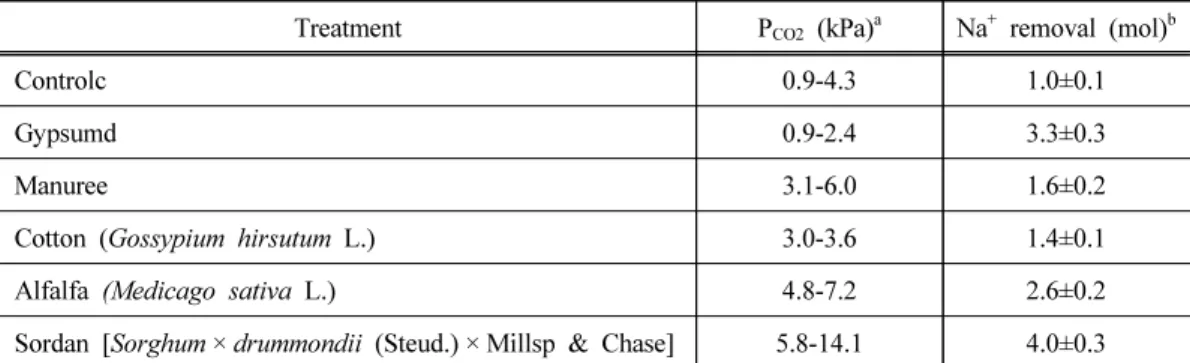
aThe PCO2 vales fluctuated during the experimental period. The highest values in the cropped treatments were obtained during vigorous vegetative growth
bInitially there were 7.5 mol of Na+ in each soil column
cWithout crop or chemical amendment application
dGypsum applied at 5 kg m-2 soil and incorporated in 0-0.2m
eFresh manure applied at 5 kg m-2 soil and incorported in 0-0.2m
Table 3. Mean values for net Na+ removal (±standard error) in various cropped and non- cropped treatments as a function of partial pressure of CO2 (PCO2) in a lysimeter experiment (Robbins, 1986)
흡착하게 된다. 염해토양에서 주로 작용하는 양이온은 Na+ 이온이 될 것이며, 이 계에서 얻어지는 것은 호흡에 의하여 생성되는 H+ 이온과 토양중 Na+ 이온이 지속적인 치환을 일 으켜 염해토양중 Na+ 이온을 제거하게 되는 것이다.
3) 식물뿌리의 물리적 효과
식물 뿌리는 토양구조 유지에 필수적이며, 식물 뿌리는 생물학적 공간(지렁이 또는 뿌리 통로) 또는 구조적 균열을 만듦으로서 토양 공극률을 향상시킬 수 있다(Yunusa and Newton, 2003). 또한, 뿌리는 습윤과 건조를 반복하면서 근권의 변화를 유도하기도 한다. 또한, 일부 작물의 뿌리는 압축된 토양구조를 부드럽게 하기도 한다. 식물 뿌리는 양이온 교환복합체 에 의해 Na+ 이온을 용탈과정을 통해 제거하는데 중요한 기능을 한다. 이 과정은 식물복원 중에 높은 염도와 알카리도에 견딜 수 있는 심근성 영년생 목초 또는 콩과식물에서 진행된 다(Tisdall, 1991).
여러 연구자들의 현장 연구에서 식물복원이 진행되는 동안에 식물뿌리가 염류도와 알카 리도를 개선하는데 유익한 기능을 한다는 것이 밝혀졌다. Ilyas et al. (1993)은 파키스탄에서 심근성 알팔파 단일 재배구와 세스바니아 - 밀 - 세스바니아 윤작 재배구를 대상으로 식물복 원 효과를 검증하였는데, 심근성 알팔파 재배구에서 토양의 수리전도도가 세스바니아 윤작 재배구보다 훨씬 개선됨을 확인하였다. 이는 세스바니아가 뿌리털이 풍부하고 두껍고 생장 이 우수하지만, 뿌리 깊이가 30 cm 이내에 대부분 분포하기에 심근성 알팔파 보다 토양개 량 효과가 낮은 것으로 평가되었다.
4) 식물 지상부에 의한 염류와 Na+ 이온 흡수
염해토양의 식물복원에 사용된 식물의 지상부 제거는 식물체와 그들의 지상부에 축적된 염류와 Na+ 이온의 제거와 일맥상통한다. 염생식물과 같이 고염도 내염성식물은 그들의 지 상부에 매우 높은 농도의 염류와 Na+ 이온을 축적하게 된다. 예를 들어, 명아주과 식물은 잎에 130-270 g salts kg-1까지 염류를 함유할 수 있다(Hyder, 1981). 만약 염해토양에서 명아 주과 식물이 생장한다면, 잎에 약 390 g salt kg-1까지 염류를 함유할 수 있다고 한다(Malcolm et al., 1988). 식물체의 지상부 수확물 제거를 통해 고농도의 염류를 상당량 제거할 수 있을 것으로 기대되지만, 실질적으로 광범위하고 고염도인 염해토양에서 식물체 지상부로 이동 된 염류는 그다지 많은 양이 아닐 것이다. 실례를 들어 설명하면, Barret-Lennard (2002)는 비관개조건 하에서, 약 10 ton ha-1의 연간 생산량을 가지는 내염성식물이 건물량 기준(250 g kg-1) 으로 25%의 염류를 지상부에 함유할 수 있다고 할 때, 이 내염성 염생식물은 염해 토양 2 m 깊이에 분포하는 초기 염류 함량(86 Mg ha-1)의 절반을 제거하는데 20년이 소요 될 것으로 추정하였다. 또한 잎에 축적된 염류의 주요 부분은 낙엽의 형태로 다시 토양으 로 되돌아가 재순환된다. 어쩌면 염해토양에서 염생식물의 지상부로 이행된 형태의 염류제
거는 우리가 기대하는 것보다 적을 수도 있을 것이다. 더욱이 관개조건하에서 염류와 Na+ 이온의 지상부 수확물을 통한 염류제거 효과는 비관개조건보다 더 낮을 수도 있다. 그 이 유는 관개수를 통해 염류 또는 Na+ 이온이 추가적으로 염해토양으로 유입될 수 있기 때문 이다. 예를 들어, Kallar 잔디는 세계의 여러 지역에서 식물복원 작물로 알려져 있으며, 염 해토양에서도 생장이 매우 우수하다. 약 20 dS m-1의 염도를 가진 토양에서 이 식물이 생장 할 때 Kalla 잔디의 지상부에는 약 40-80 g kg-1의 염류를 함유할 수 있을 것이다. 연간 Kallar 잔디 생산량을 약 25 Mg ha-1로 가정하였을 대, 이 Kallar 잔디가 생장하는데 필요한 관개수량은 약 104 m3 ha-1 (107 liter ha-1)로 평가된다. 이러한 조건하에서 염류농도 1.5 dS m-1의 염류를 함유한 관개수를 공급하였을 때, 관개수에 의해 공급될 수 있는 염류의 양은 9.6 Mg ha-1이고 Kallar 잔디의 재배를 통해 약 1.2 ton ha-1의 염류가 제거될 수 있을 것이다.
Gritsenko와 Gritsenko (1999)에 따르면, 내염성 식물의 지상부로 이행된 Na+ 이온의 양은 전 체 흡수된 염류의 2.2% 수준밖에 되지 않는다고 하였다. 또한 Qadir et al. (2003)의 연구에 서도 알팔파의 지상부로 이행되어 제거할 수 있는 Na+ 이온의 양은 식물복원 기간에 제거 된 전체 Na+ 이온의 단지 1.2% 밖에 되지 않는다는 것이 확인되었다. 결론적으로, 염해토양 에서 식물복원을 통해 제거되는 염류와 Na+ 이온은 식물체 지상부로 흡수이행되어 Na+ 이 온이 제거되는 것보다는 토양의 근권으로부터 CO2의 분압과 뿌리에서 방출된 양성자(H+) 에 의한 Na+ 이온과 염류의 용탈이 더 효과적이라는 것이다.
Ⅱ. 식물학적 복원에 적합한 식물종
염해토양의 염류를 제거하기 위한 가장 이상적인 식물은 고염도에서 내성이 있어야 할 뿐만 아니라 동시에 염류를 고농도로 축적할 수 있어야 하며, 높은 바이오매스 생산성을 가지고 있어야 한다. 염류를 제거하기 위해 적합한 식물종을 선택하는 가장 합리적인 방법 은 강한 비바람, 조풍 그리고 척박한 토양에서도 내성을 가지고 잘 생장할 수 있는 자연적 인 염생식물 종에서 선택하는 것이다. 우리나라에서 염해토양을 대상으로 식물복원기법을 적용한 사례는 전무하다고 하는 것이 보다 타당할 것이다. 지금까지 수행된 대부분의 연구 가 간척지 토양을 개량하기 위해 수종의 내염성작물의 생육가능성을 검토하는 단계에 머 물러 있기 때문이다. 대표적으로, Lee et al. (2007)이 간척지 토양을 개량하기 위해 내염성 이 알려져 있는 사료작물 6종, 약용작물 2종, 채소 2종, 녹비작물 2종, 벼 3종 및 기타 3종 등 총 18종을 대상으로 국내 간척지 토양의 식물복원에 적용가능한 식물종을 탐색한 결과, Limonium, Atriplex, Barnyard grass, Sesbania 및 Bermuda grass가 선정되었다. Kim et al.
(2008)이 우리나라 대호간척지의 토양 염류농도별 식생분포에 조사한 결과는 Table 4에 나 타나 있다.
Table 4. Plants species in Daeho reclaimed tidal flats of the west coast of Korea in 2002 (Kim et al., 2008)
Family Scientific Name Korean Name Habitat Distribution
Juncaceae Juncus gracillimus 물골풀 Only one place Small clumped
Compositae
Aster tripolium Aster pilosus Aster subulatus Erigeron canadensis Sonchus brachyotus
갯개미취 미국쑥부쟁이 빗자루국화 망초 사데풀
Only one place
Random, clumped, zonation Small clumped
Mixed with the A. tripolium Small clumped
Scattered, random
Polygonaceae Rumex crispus 소리쟁이 Quite few
Chenopodiaceae
Suaeda glauca
Suaeda maritima
Salicornia europea
나문재 해홍나물 퉁퉁마디
Mixed with the S. europaea, S. maritima
Scattered, random a few Zonalion, mixed with the S. glauca, S. europaea Random, Zonation, mixed with the S. maritima
Onagraceae Epibbium pyrricholophum 바늘꽃 Individual
Asclepiadaceae Metaplexis japonica 박주가리 Quite a few
Cyperaceae
Cyperus sanguinolentus Scirpus planiculmis Scirpus wallichii
방동사니대가리 새섬매자기 남양골
Wetted area Wetted area
A few, clumped Clumped Zonalion
Caryophyllaceae Spergularia marina 갯개미자리 A few
Plumbaginaceae Limonium tetragonum 갯질경 Clumped
Plantaginaceae Plantago asiatica 질경이 Side by paddy soil A few
Leguminosae Trifolium pratense 레드클로버 Clumped
Gramineae
Alopecurus aequalis Beckmannia syzigachne Bromus tectorum
Calamagrostis pseudo-phragmites Festuca arundinacea
Imperata cylindrica Miscanthus sinensis Phragmites communis
Puccinellia nipponica Setaria viridis Trisetum bifidum Zoycia japonica
둑새풀 개피 털빕새귀리 갯조풀 돌페스큐 띠 억새 갈대 갯꾸러미풀 강아지풀 잠자리피 잔디 Halophyte :
All over the area
Mixed with the S. brachyous, red clover
One individual Quite a few Clumped Clumped Clumped Clumped A few, clumped Clumped, random
Clumped, zonation Random, clumped Clumped Clumped
Total
12 Families 27 Genera 31 Species
6 Families.
9 Genera.
12 Species
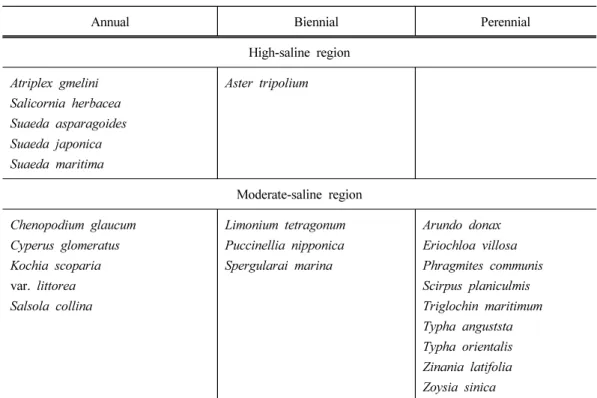
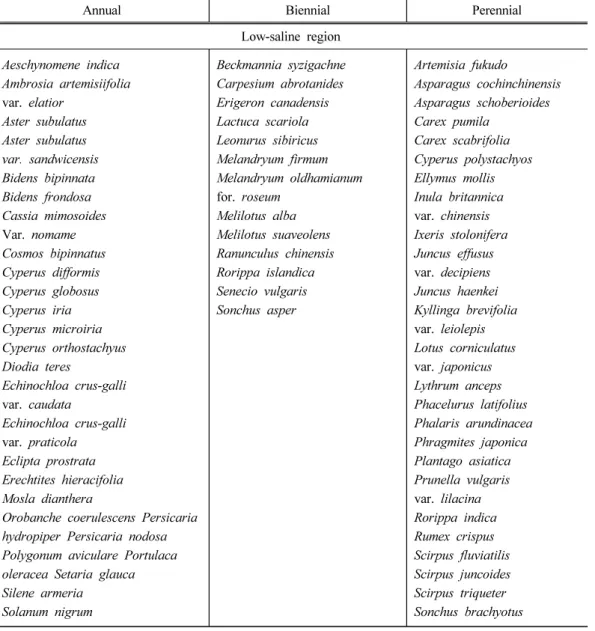
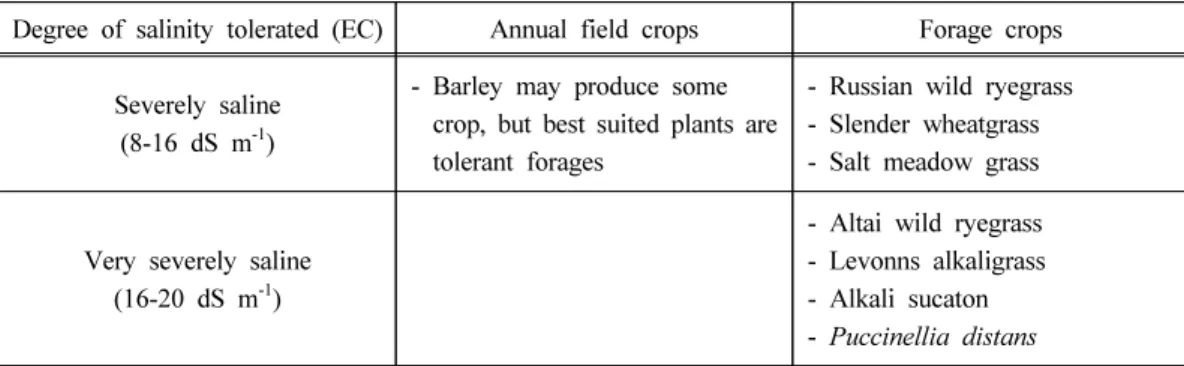
대호간척지 식생 분포와 토양 염류농도와의 관계를 분석한 결과, 식물 집락별 출현지의 토양 염농도에 근거할 때 퉁퉁마디, 해홍나물 및 나문재의 단일 집락은 토양 염농도가 31.05 dS m-1 정도인 곳에, 이들의 혼생 집락은 42.75 dS m-1에 출현하여 내염성이 강하고, 사데풀, 갯개미취 및 새섬매자기 등의 단일집락은 11.73 dS m-1인 곳에, 이들의 혼생집락은 9.43 dS m-1 정도인 곳에 출현하여 저염생식물군의 특성을 나타내었고 띠, 레드클로버, 억 새, 강아지풀 및 잠자리피의 단일집락은 2.42 dS m-1 정도인 곳에 분포하여 내염성이 약한 중성식물군의 특성을 보였다. Kang and Shim (1998)의 연구에 따르면, 간척지를 비롯한 염 해지의 주요 우점 초종은 명아주과의 나문재, 칠면초, 해홍나물, 퉁퉁마디와 국화과의 갯개 미취 등 이었으며, 이후에는 갯개미자리, 갯질경, 갯골풀 등이 우점하였고, 탈염이 진행딘 곳에는 부들, 갈대, 갯꾸러미풀 등의 화본과 식물이 우점하였다고 하였다(Table 5). 캐나다 알버타 주에서 식물복원에 사용된 내염성 식물종은 Table 6에 자세히 제시되어 있다. Gupta 와 Abrol(1990)이 염해토양에서 식물복원에 적용 가능한 식물을 ESP를 기준으로 제시한 자 료는 Table 7에 나타나 있다. 국내 ․ 외 선행 연구에서 제시된 연구결과를 활용하여 우리나 라 간척지 염해토양에서 식물복원 식물종을 선정하는데 활용할 수 있을 것이다.
Table 5. Classification of herbaceous plants occurred in the reclaimed region by their saline adaptability and life cycle (Kang and Shim, 1998)
Annual Biennial Perennial
High-saline region Atriplex gmelini
Salicornia herbacea Suaeda asparagoides Suaeda japonica Suaeda maritima
Aster tripolium
Moderate-saline region Chenopodium glaucum
Cyperus glomeratus Kochia scoparia var. littorea Salsola collina
Limonium tetragonum Puccinellia nipponica Spergularai marina
Arundo donax
Eriochloa villosa
Phragmites communis
Scirpus planiculmis
Triglochin maritimum
Typha anguststa
Typha orientalis
Zinania latifolia
Zoysia sinica
Annual Biennial Perennial Low-saline region
Aeschynomene indica Ambrosia artemisiifolia var. elatior
Aster subulatus Aster subulatus var. sandwicensis Bidens bipinnata Bidens frondosa Cassia mimosoides Var. nomame Cosmos bipinnatus Cyperus difformis Cyperus globosus Cyperus iria Cyperus microiria Cyperus orthostachyus Diodia teres Echinochloa crus-galli var. caudata
Echinochloa crus-galli var. praticola
Eclipta prostrata Erechtites hieracifolia Mosla dianthera
Orobanche coerulescens Persicaria hydropiper Persicaria nodosa Polygonum aviculare Portulaca oleracea Setaria glauca Silene armeria
Solanum nigrum
Beckmannia syzigachne Carpesium abrotanides Erigeron canadensis Lactuca scariola Leonurus sibiricus Melandryum firmum Melandryum oldhamianum for. roseum
Melilotus alba Melilotus suaveolens Ranunculus chinensis Rorippa islandica Senecio vulgaris Sonchus asper
Artemisia fukudo
Asparagus cochinchinensis Asparagus schoberioides Carex pumila
Carex scabrifolia Cyperus polystachyos Ellymus mollis Inula britannica var. chinensis Ixeris stolonifera Juncus effusus var. decipiens Juncus haenkei Kyllinga brevifolia var. leiolepis Lotus corniculatus var. japonicus Lythrum anceps Phacelurus latifolius Phalaris arundinacea Phragmites japonica Plantago asiatica Prunella vulgaris var. lilacina Rorippa indica Rumex crispus Scirpus fluviatilis Scirpus juncoides Scirpus triqueter Sonchus brachyotus
Table 6. Relative sensitivity to soil salinity of selected plants
Degree of salinity tolerated (EC) Annual field crops Forage crops Non to slightly saline
(0-4 dS m
-1)
- Peas - Canola
- Timothy
Moderately saline (4-8 dS m
-1)
- Mustard - Oats - Safflower - Sunflower - Row barely
- Reed canary - Meadow fescue - Intermediate wheatgrass - Brome grass
- Sweet clover
Degree of salinity tolerated (EC) Annual field crops Forage crops
Severely saline (8-16 dS m
-1)
- Barley may produce some crop, but best suited plants are tolerant forages
- Russian wild ryegrass - Slender wheatgrass - Salt meadow grass
Very severely saline (16-20 dS m
-1)
- Altai wild ryegrass - Levonns alkaligrass - Alkali sucaton - Puccinellia distans
Adapted from Holm (1982) and Alberta Agriculture (1995)Table 7. Ranges of ESP in soils indicating about 50% of the potential yields of different crops (Gupta and Abrol, 1990)
ESP range
Crop
Common name Botanical name
10-15
16-20
20-25
25-30
30-50
50-60
60-70
70+
Safflower Mash Pea Lentil Pigeon pea Urd-bean Bengal gram Soybean Groundnut Cowpea Onion Pearl millet Linseed Garlic Guar
Indian mustard Wheat Sunflower Guinea grass Barley Sesbania Rice Para grass Bermuda grass Kallair/Karnal grass Rhodes grass
Carthamus tinctorius L.
Vigna mungo (L.) Hepper Pisum sativum L.
Lens culinaris Medik.
Cajanus cajan (L.) Millsp.
Phaseolus mungo L.
Cicer arietinum L.
Glycine max (L.) Merr.
Apios americana Medik Vigna unguiculata (L.) Walp.
Allium cepa L.
Pennistum glaucum (L.) R. Br.
Linum usitatissimum L.
Allium sativum L.
Cyamopsis tetragonoloba (L.) Taub.
Brassica juncea (L.) Czern.
Triticum aestivum L.
Helianthus annuus L.
Panicum maximum Jacq.
Hordeum vulgare L.
Sesbania bispinosa (Jacq.) W. Wight Oryza sativa L.
Brachiaria mutica (Forssk) Stapf.
Cynodon dactylon (L.) Pers
Leptochloa fusca (L.) Kunth
Chloris gayana Kunth
Ⅲ. 결 론
염해토양에서 일반적인 물리 ․ 화학적인 복원기법보다 식물복원기법이 여러 가지 측면에 서 유리하다. 1) 값비싼 화학자재를 사용할 필요가 없고, 작물의 필요수량 수준의 토양수분 만 유지되면 된다. 2) 식물복원 기간 동안에도 일부 경제성 작물의 재배가 가능하다. 3) 식 물뿌리에 의해 토양의 입단 안정성과 대공극의 형성 그리고 토양 수리전도도 개선 효과가 우수하다. 4) 식물복원이 완료된 이후에도 식물 필수양분의 유효도가 우수하다. 5) 식물뿌 리의 확장에 의해 토양 심층부까지 효율적으로 토양개량이 가능하다. 6) 환경적인 측면에 서 작물재배에 의해 탄소격리의 효과가 나타난다. 반면에, 식물복원기법이 일부 단점도 가 지고 있는데, 1) 토양의 염류도 및 알카리도의 개선효과가 물리적 ․ 화학적 기법보다 느리게 나타날 수 있다. 2) 고염도하에서 일부 작물의 발아불량 및 초기생육불량 현상이 나타날 수 있다. 3) 일부 작물의 경우 수확 후 지상부를 외부로 반출해야 진정한 의미의 염류제거 효 과가 나타난다. 염해토양에서 식물복원기법의 메카니즘은 1) 근권내 이산화탄소(CO2)의 분 압, 2) 식물뿌리에 의한 양성자(H+) 방출, 3) 식물뿌리의 물리적 효과, 그리고 4) 식물 지상 부로의 염류와 Na+ 이온의 이행 및 흡수로 크게 대별할 수 있다. 이 가운데 실질적으로 염 해토양에서 식물복원에 가장 크게 영향을 끼치는 인자는 근권내 CO2의 분압이다. Ca2+ 가 풍부한 염해토양에서 PCO2의 증가는 Ca2+의 용해도를 증가시키게 되고, 증가된 Ca2+는 토양 용액/토양점토광물중 Na+ 이온과 치환반응을 함으로써 방출된 Na+ 이온을 용탈시켜 궁극적 으로 염해토양을 개량하는 효과를 나타낼 수 있게 된다.
[Submitted, July. 4, 2016; Revised, August. 4, 2016; Accepted, August. 5, 2016]
References
1. Alberta Agriculture. 1995. Soil salinity, soil and water conservation manual series. Con- servation and Development Branch. Edmonton, Canada.
2. Barrett-Lennard, E. G. 2002. Restoration of saline land through revegetation. Agric. Water Manage. 53: 213-226.
3. Gritsenko, G. V. and A. V. Gritsenko. 1999. Quality of irrigation water and outlook for phytomelioration of soils. Eurasian Soil Sci. 32: 236-242.
4. Gupta, R. K. and I. P. Abrol. 1990. Salt-affected soils: Their reclamation and management for crop production. Adv. Soil Sci. 11: 223-288.
5. Holm, H. M. 1982. Salt tolerance of crops. In: First Annual Western Conference. Rationali- zation of Water and Soil Research and Management. Lethbridge, Alberta. Canada.
6. Hyder, S. Z. 1981. Preliminary observations on the performance of some exotic species of Atriplex in Saudi Arabia. J. Range Manag. 34: 208-210.
7. Ilyas, M., R. W. Miller, and R. H. Qureshi. 1993. Hydraulic conductivity of saline-sodic soil after gypsum application and cropping. Soil Sci. Soc. Am. J. 57: 1580-1585.
8. Kang, B. H. and S. I. Shim. 1998. Screening of saline tolerant plants and development of biological monitoring technique for saline stress. 1. Survey of vegetation in saline region and determination of saline tolerance of the plant species of the region. Korean J. Environ. Agri.
17: 26-33.
9. Kelley, W. P. 1937. The reclamation of alkali soils. Calif. Agric. Exp. Stn. Bull. 617: 1-40.
10. Kim, E. K., S. U. Chun, Y. K. Joo, Y. S. Jung, and H. G. Jung. 2008. Soil salinity and continuum distribution of vegetation on the three reclaimed tidal flats of Kyonggi-Bay in the mid-West coast of Korea. Korean J. Soil Sci. Fert. 41: 173-180.
11. Lee, K. B., J. G. Kang, J. Li, D. B. Lee, C. W. Park, and J. D. Kim. 2007. Evaluation of salt-tolerance plant for improving saline soil of reclaimed land. Korean J. Soil Sci. Fert. 40:
173-180.
12. Malcolm, C. V., A. J. Clarke, M. F. D’Antuono, and T. C. Swaan. 1988. Effects of plant spacing and soil conditions on the growth of five Atriplex species. Agric. Ecos. Env. 21:
265-279.
13. Narteh, L. T. and K. L. Sahrawat. 1999. Influence of flooding on electrochemical and chemical properties of West African soils. Geoderma. 87: 179-207.
14. Nelson, P. N. and J. M. Oades. 1998. Organic matter, sodicity, and soil structure. In:
Distribution, Management and Environmental Consequences’. Oxford University Press, NY.
15. Pilon-Smits, E. 2005. Phytoremediation. Annu. Rev. Plant Biol. 56: 15-39.
16. Qadir, M. and J. D. Oster. 2002. Vegetative bioremediation of calcareous sodic soils:
History, mechanisms, and evaluation. Irrig. Sci. 21: 91-101.
17. Qadir, M., D. Steffens, F. Yan, and S. Schubert. 2003. Proton release by N2-fixing plant roots: A possible contribution to phytoremediation of calcareous sodic soils. J. Plant Nutr.
Soil Sci. 166: 14-22.
18. Qadir, M., J. D. Oster, D. Schubert, A. D. Noble and K. L. Sahrawat. 2007. Phytoremeida- tion of sodic and saline-sodic soils. Adv. Agro. 96: 197-239.
19. Quirk, J. P. 2001. The significance of the threshold and turbidity concentrations in relation to sodicity and microstructure. Aust. J. Soil Res. 39: 1185-1217.
20. Robbins, C. W. 1986. Carbon dioxide partial pressure in lysimeter soils. Agron. J. 78: 151- 158.
21. Tisdall, J. M. 1991. Fungal hyphae and structural stability of soil. Aust. J. Soil Res. 29:
729-743.
22. Yunusa, I. A. M., and P. J. Newton. 2003. Plants for amelioration of subsoil constraints and hydrological control: The primer-plant concept. Plant Soil. 257: 261-281.